
Self-supervised learning for searching jellyfish galaxies in the ocean of data from upcoming surveys
Abstract
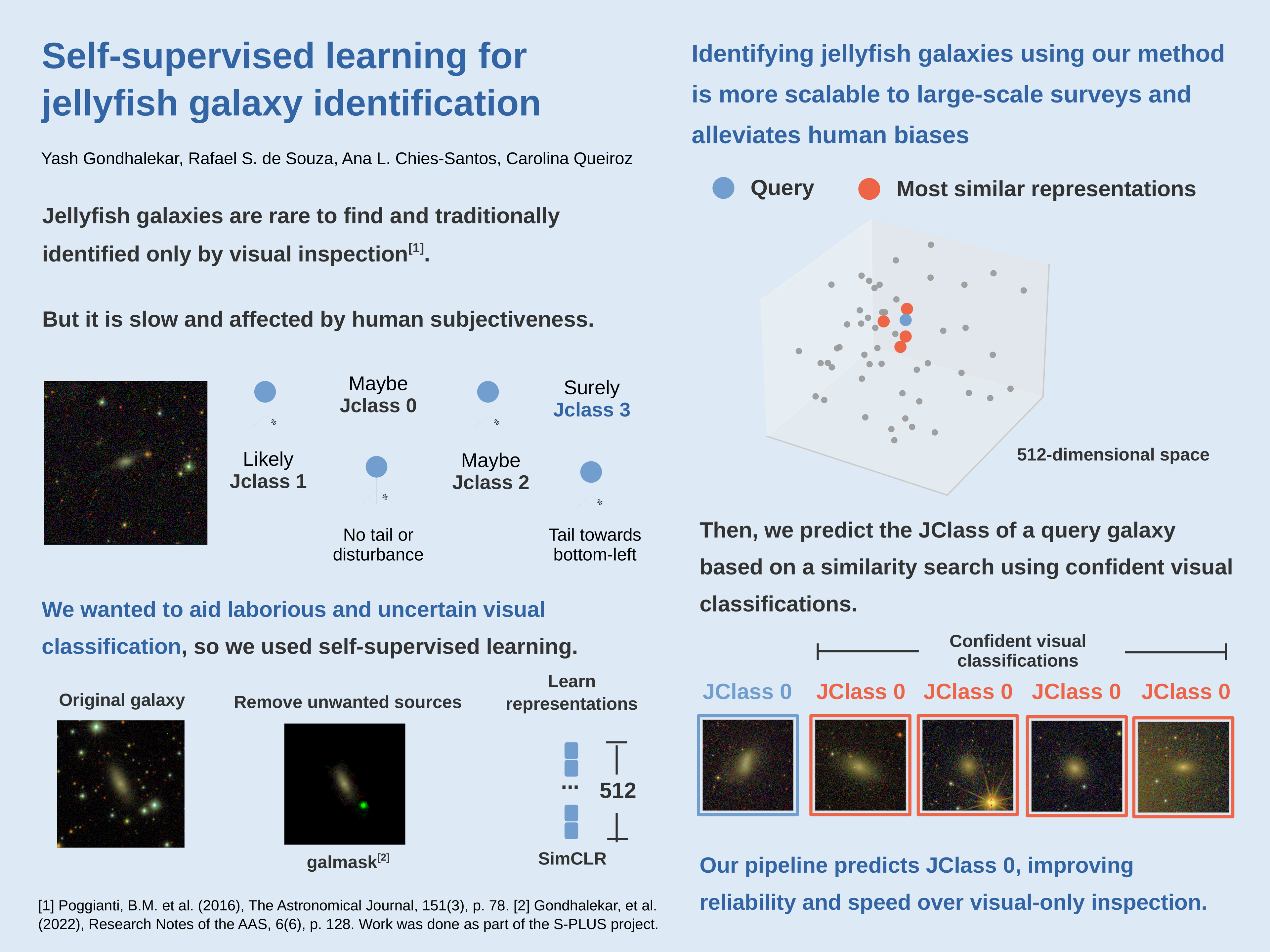
Human visual classification is the traditional approach to identifying jellyfish galaxies. However, this approach is unsuitable for large-scale galaxy surveys. In this study, we employ self-supervised learning on a dataset of approximately 200 images to extract semantically meaningful representations of galaxies. Despite the small dataset size, a similarity search suggests that the self-supervised representation space contains meaningful morphological information. We propose a framework for assigning JClass, a categorical disturbance measure, based on nearest-neighbor search in the self-supervised representation space to assist visual classifiers. Our pipeline is highly adaptable, allowing for the seamless identification of any rare astronomical signatures within astronomical datasets.