
Physics-aware Discrete Reparameterization with Symmetry-aware Bayesian Fusion for Multimodal Radiography
Abstract
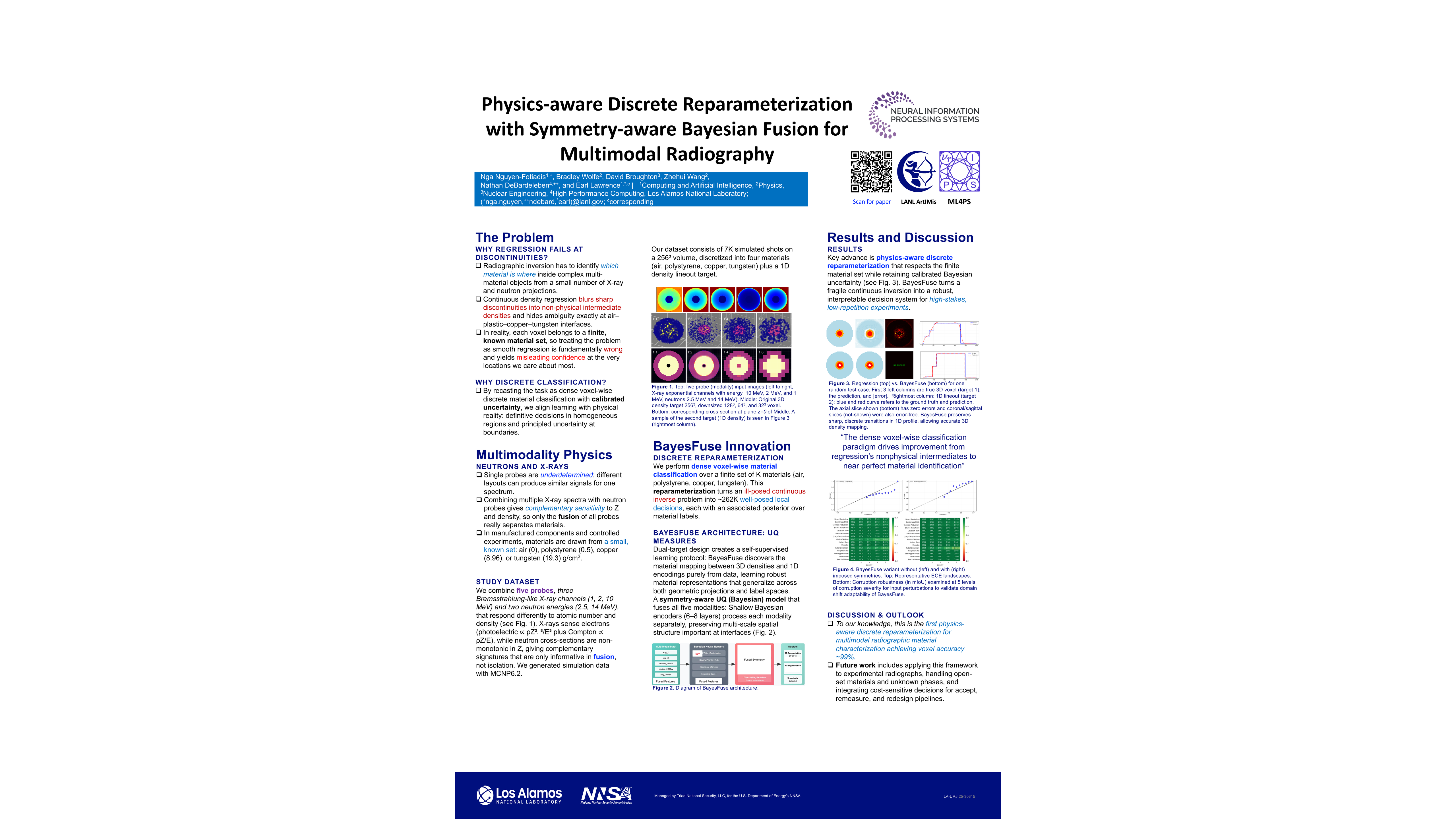
Radiographic inspection must identify materials from X-ray and neutron transmissions; single-probe signatures are often ambiguous, whereas multi-modal fingerprints are complementary because photons and neutrons have distinct interaction physics. Single-shot data contain discontinuities in density (voids, interfaces, inclusions). Modeling density as a smooth field (classical inversion or image-to-image regression) blurs those jumps and yields non-physical values. In practice, each voxel of the density field is drawn from a small, known material set; thus many inverse problems that appear continuous are in fact discrete, and standard regression fatally assumes continuity where none exists. We perform a physics-aware discrete reparameterization of the inverse problem: dense per-voxel discrete material classification with calibrated uncertainty, rather than continuous regression. We introduce BayesFuse, a symmetry-aware Bayesian model that fuses five probes (neutrons at 14 MeV and 2.5 MeV, plus three Bremsstrahlung-like X-ray spectra) and encodes in-plane rotational/view symmetries. On a multimodal dataset with 64^3 voxel volumes and 1D targets reparameterized to four materials (air, tungsten, copper, polystyrene; densities {0, 19.3, 8.96, 0.5} g/cm^3), BayesFuse attains near-perfect fidelity: mean Intersection over Union (mIoU) ~98–99% and Expected Calibration Error (ECE) ~3e-4 to 5e-4, with uncertainty concentrated at interfaces and rising gracefully under corruptions. The result is a well-posed, physics-aware decision system fit-for-purpose in high-stakes, low-replicate experiments.