
Mind the Gap: Navigating Inference with Optimal Transport Maps
Abstract
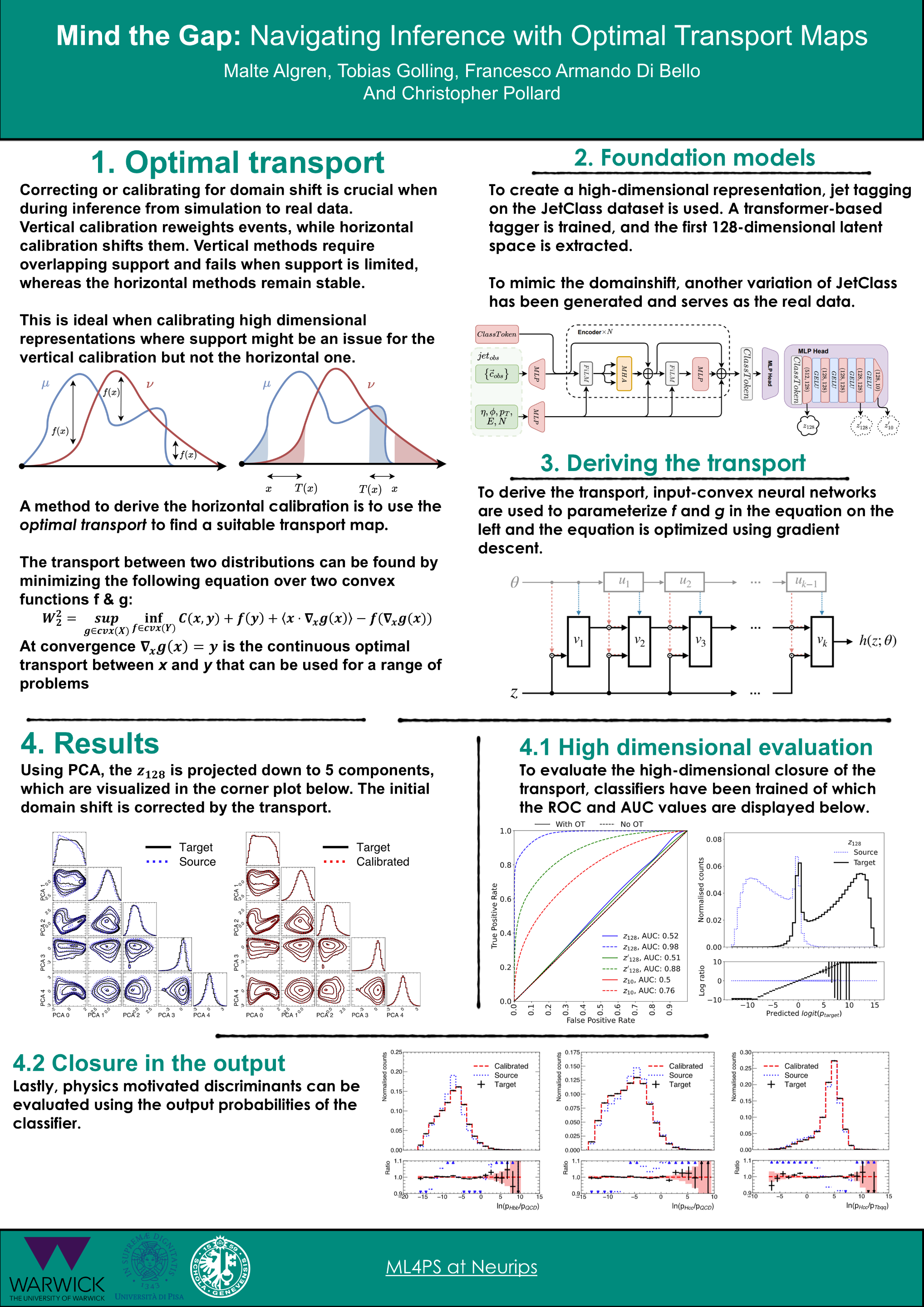
Machine learning (ML) techniques have recently enabled enormous gains in sensitivity across the sciences. In particle physics, much of this progress has relied on excellent simulations of a wide range of physical processes. However, due to the sophistication of modern machine learning (ML) algorithms and their reliance on high-quality training samples, discrepancies between simulation and experimental data can significantly limit the effectiveness of ML techniques. In this work, we present a solution to this "mis-specification'' problem: a calibration approach based on optimal transport, which we apply to high-dimensional simulations for the first time. We demonstrate the performance of our approach through jet tagging, using a CMS-inspired dataset. A 128-dimensional internal jet representation from a powerful general-purpose classifier is studied; after calibrating this internal "latent'' representation, we find that a wide variety of quantities derived from it for downstream tasks are also properly calibrated: using this calibrated high-dimensional representation, powerful new applications of jet flavor information can be utilized in LHC analyses. This is a key step toward allowing properly-calibrated ``foundation models'' in particle physics. More broadly, this calibration framework has broad applications for correcting high-dimensional simulations across the sciences.