
Warping Away Nonstationarity: Benefits in Mineral Resource Estimation
Abstract
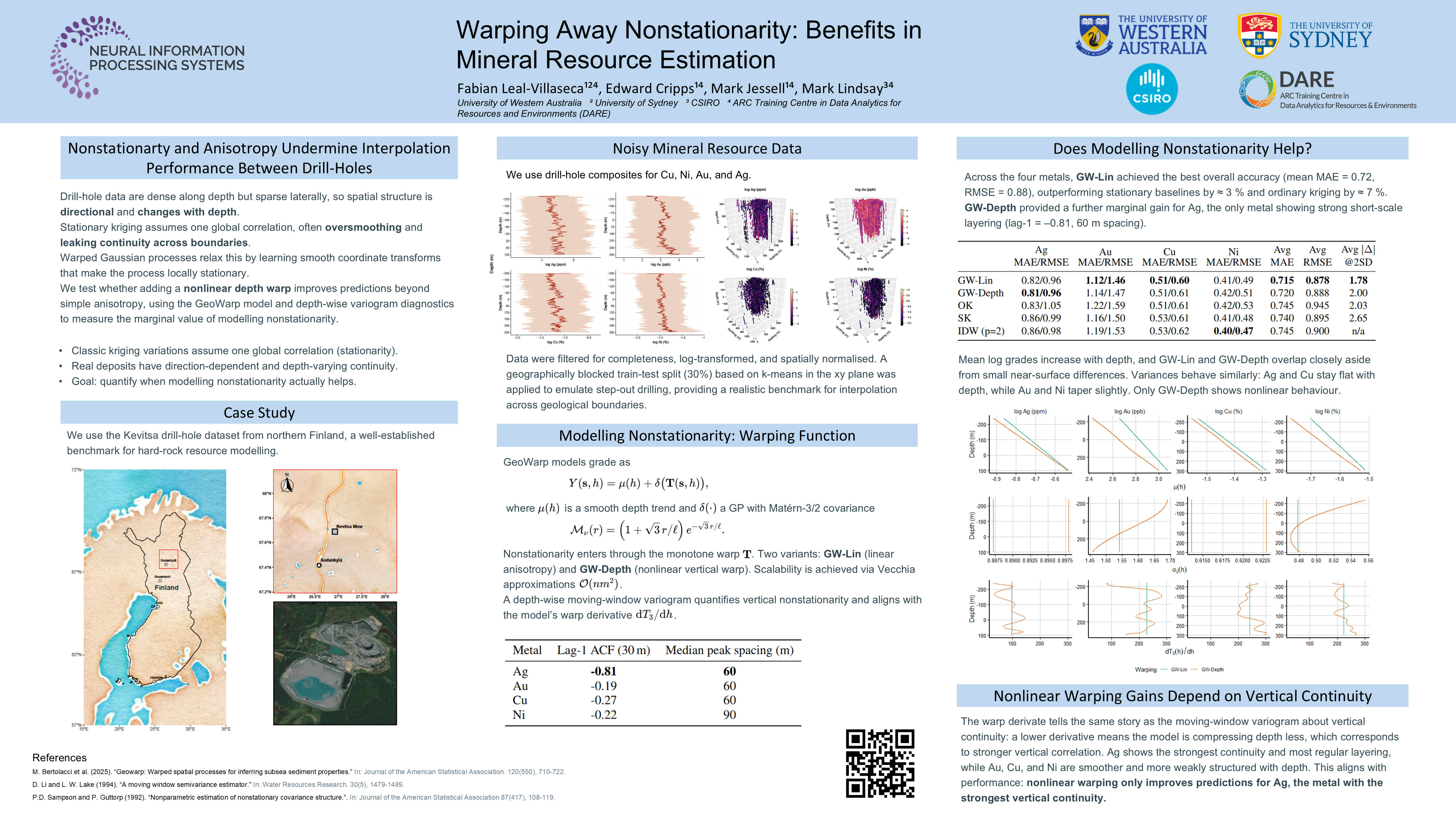
Mineral resource estimation predicts grade distributions between limited hole measurements. Spatial structure is directional (anisotropy) and changes with location (nonstationarity), so traditional stationary methods can oversmooth and leak continuity across boundaries. We introduce a quantitative framework that measures and separates the value of modelling anisotropy and depth-changing correlation by coupling a warped Gaussian process (GeoWarp) with depth-wise moving-window variogram diagnostics. GeoWarp decomposes a depth trend and a 3D residual process and learns a monotone coordinate warp; its vertical warp derivative, together with the variogram diagnostic computed in shallow sliding depth bins, provides an interpretable readout of vertical continuity. On Kevitsa drill-hole data we compare two variants: a linear axis-wise warp (anisotropy only) and the same model with a nonlinear depth warp. Using a geographically blocked split that mimics step-out drilling, the anisotropy-only variant delivers the best average MAE/RMSE across three of the four metals we made predictions on; the nonlinear depth warp adds value only where diagnostics reveal strong, regular short-scale vertical structure. The framework tells practitioners when depth warping helps, quantifies its marginal benefit over anisotropy, and offers a practical, scalable machine learning alternative for hole-based interpolation.