
Efficient optimization of COHERENT detector design parameters with the Rare Event Surrogate Model
Brian Z. Liu ⋅ Sonata Simonaitis-Boyd ⋅ Ann-Kathrin Schuetz ⋅ Aobo Li ⋅ Zepeng Li
Abstract
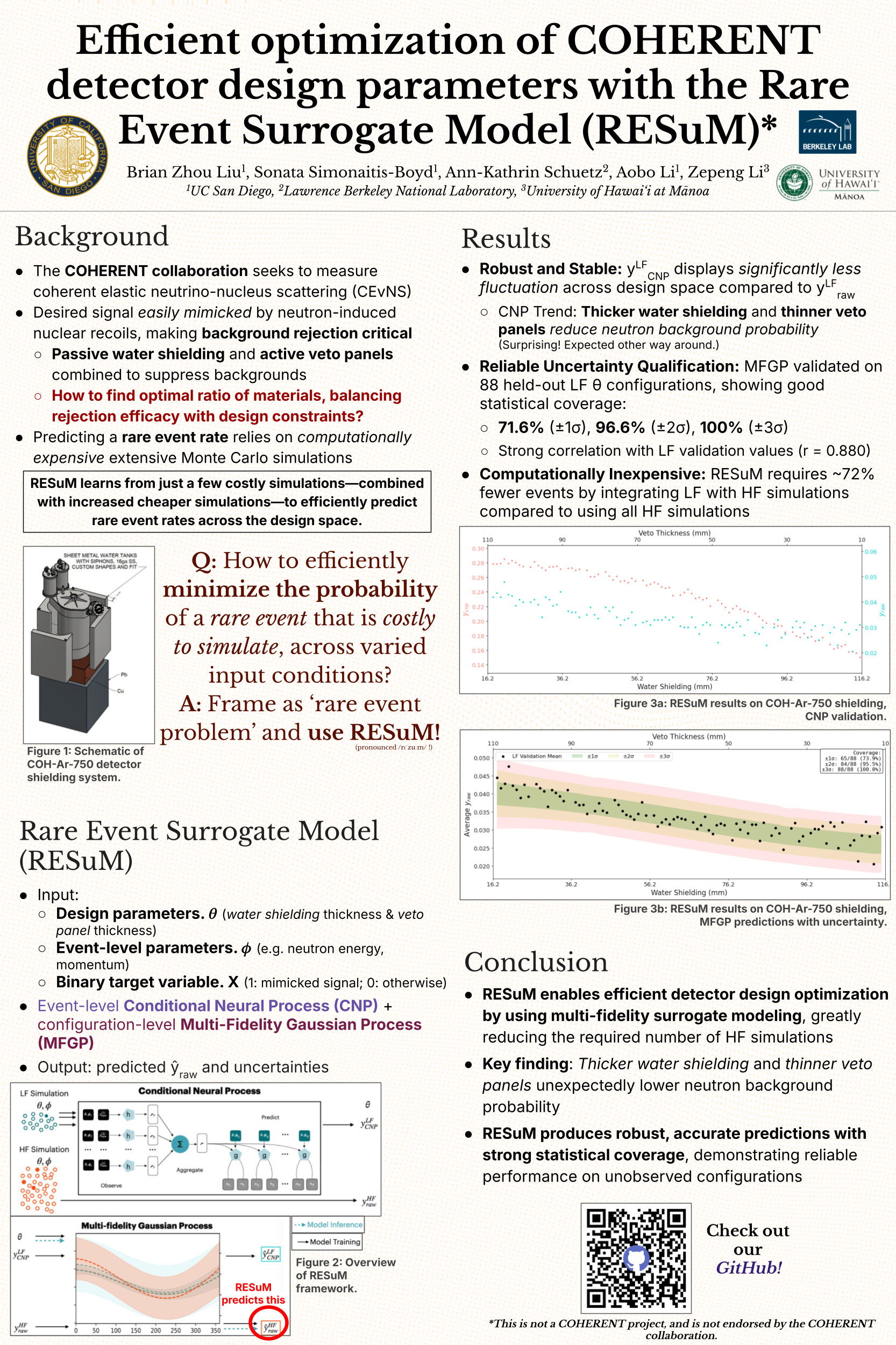
Coherent elastic neutrino-nucleus scattering (CE$\nu$NS) is a weak neutral-current process in which a neutrino scatters off of a nucleus as a whole. Following an initial observation by the COHERENT collaboration in 2017, the next-generation COH-Ar-750 detector is being developed to measure CE$\nu$NS with percent-level precision and probe for physics beyond the Standard Model. A primary design challenge is mitigating neutron backgrounds from the Spallation Neutron Source (SNS) at Oak Ridge National Laboratory (ORNL), as neutron-induced nuclear recoils produce signals that are nearly indistinguishable from CE$\nu$NS. The detector's veto system combines passive shielding using lead and water blocks with active shielding using plastic scintillator panels. Because neutrons have a low probability of depositing energy in the active liquid argon volume, extensive Monte Carlo event simulations are required to optimize the arrangement of these shielding materials. In this work, we addressed this challenge with a Rare Event Surrogate Model (RESuM) to optimize the shielding design for COH-Ar-750. RESuM integrates a Conditional Neural Process (CNP) with a Multi-Fidelity Gaussian Process (MFGP) to reduce the need for expensive simulations. Our experimental results suggested thicker water shielding and thinner veto panels increase neutron rejection efficiency, with RESuM achieving a correlation coefficient of $r=0.880$ and well-calibrated uncertainties. This work demonstrates that RESuM has the potential to accelerate the design optimization of a broad range of rare event search experiments.
Chat is not available.
Successful Page Load