
Differentiable Ray-Tracing for Optical Particle Detector Simulation
Abstract
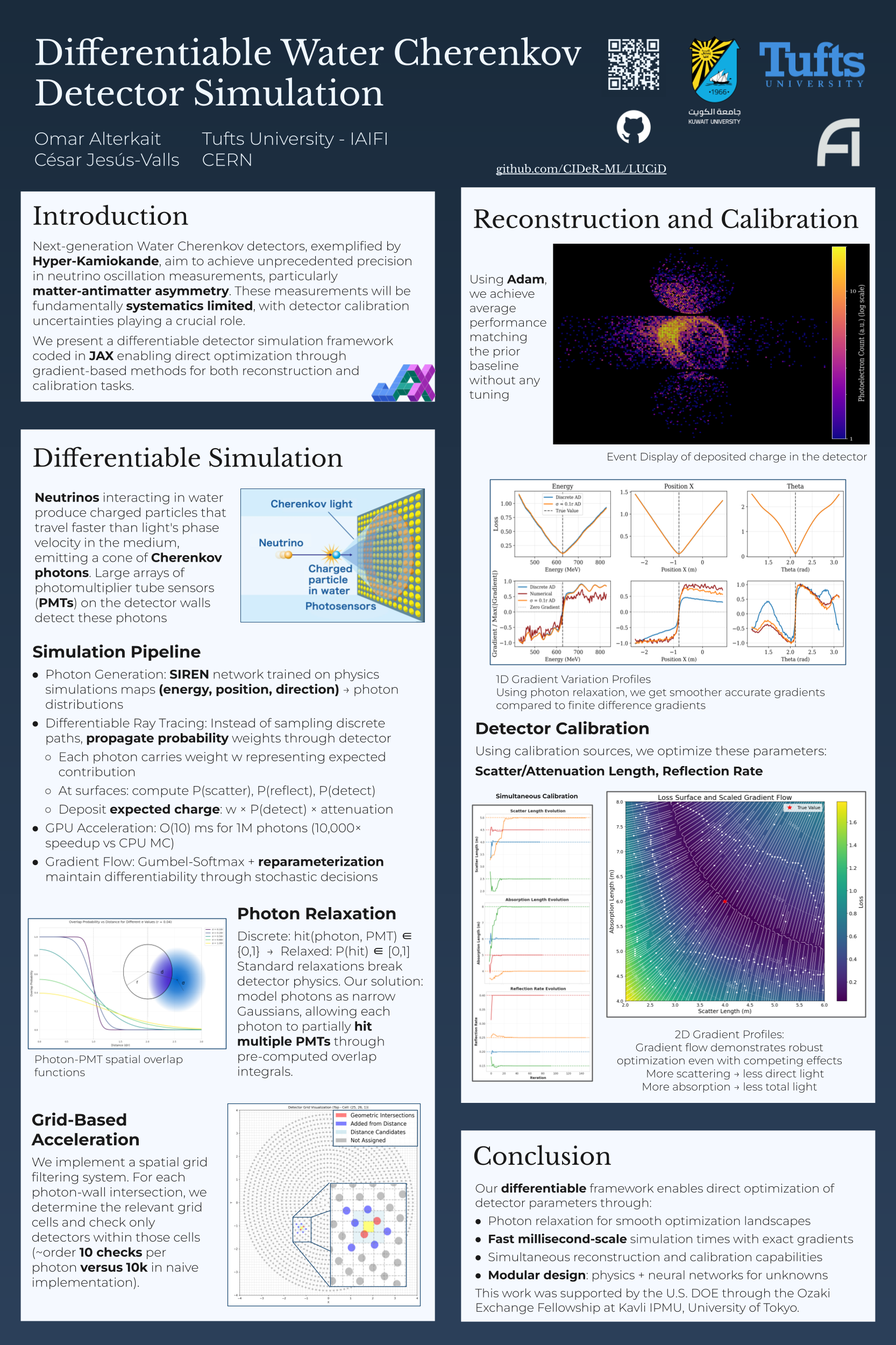
Optical particle detectors face increasingly complex calibration challenges as experiments scale. High-dimensional parameter spaces with strong correlations make traditional Monte Carlo sampling computationally prohibitive. We introduce LUCiD, the first differentiable ray-tracing framework for optical particle detectors. LUCiD computes expected detector responses by propagating probability weights rather than sampling discrete paths. Gumbel-Softmax handles stochastic decisions while Gaussian relaxations enable differentiable hit detection, implemented in JAX for GPU acceleration. Processing one million photons with gradients takes 30ms on a single GPU, four orders of magnitude faster than CPU Monte Carlo. These gradients enable direct navigation through correlated parameter spaces where sampling methods struggle. Differentiable physics unlocks new gradient-based methods for calibration, reconstruction, and physics-ML integration.