
Physics-constrained Plane Wave Decomposition Network: Solving the Helmholtz Equation in Airborne Acoustics
Abstract
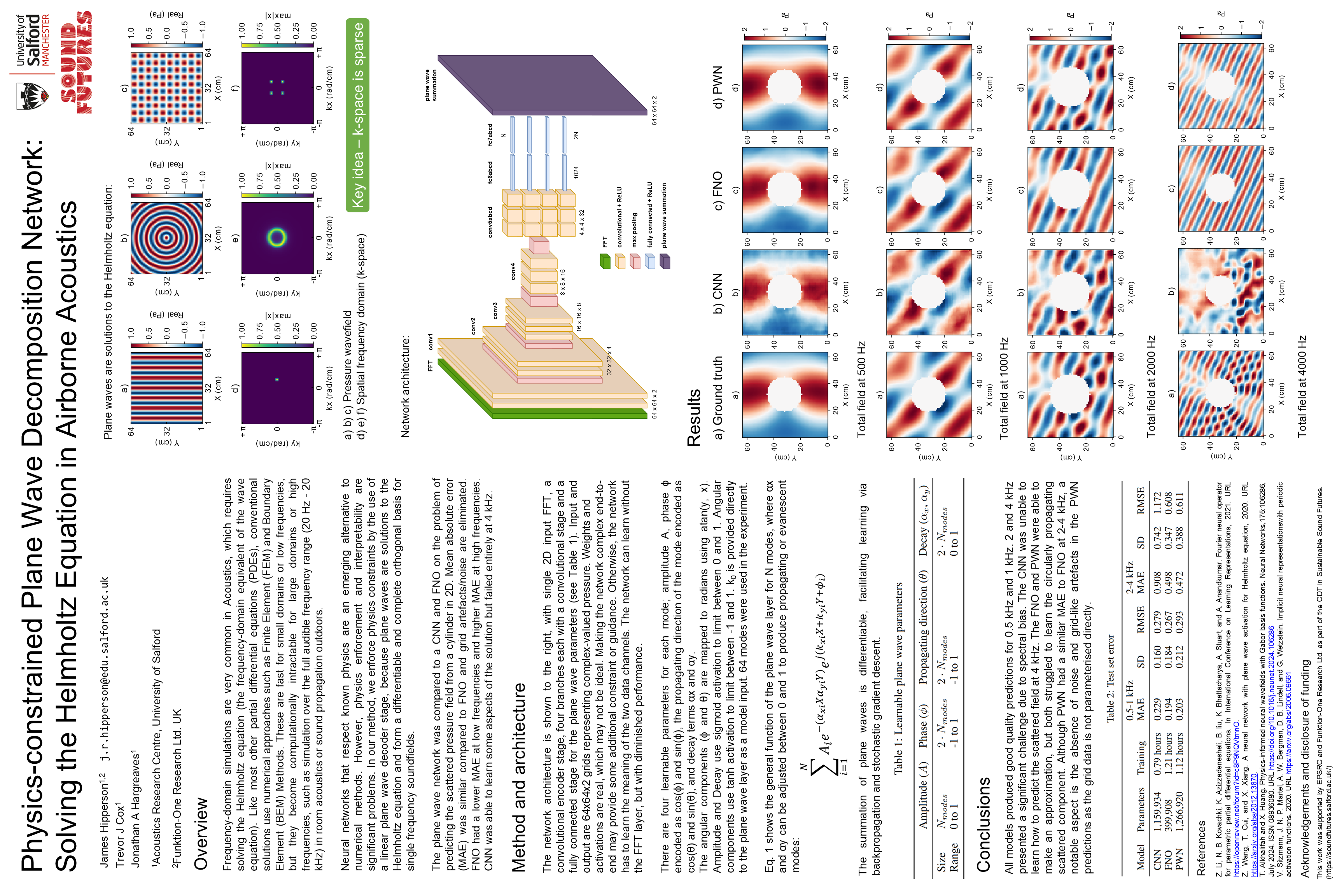
Frequency-domain simulations are very common in Acoustics, which requires solving the Helmholtz equation (the frequency-domain equivalent of the wave equation). Like most other partial differential equations (PDEs), conventional solutions use numerical approaches such as Finite Element (FEM) and Boundary Element (BEM) Methods. These are fast for small domains or low frequencies, but they become computationally intractable for large domains or high frequencies, such as simulation over the full audible frequency range (20 Hz - 20 kHz) in room acoustics or sound propagation outdoors. Neural networks that respect known physics are an emerging alternative to numerical methods. However, physics enforcement and interpretability are significant problems. In our method, we enforce physics constraints by the use of a linear plane wave decoder stage, because plane waves are solutions to the Helmholtz equation and form a differentiable and complete orthogonal basis for single frequency soundfields. The plane wave network was compared to a CNN and FNO on the problem of predicting the scattered field from a cylinder. Mean absolute error (MAE) was reduced at high frequencies compared to FNO and grid artefacts/noise are eliminated. However, FNO had a lower MAE at low frequencies. CNN was able to learn some aspects of the solution, but failed entirely at 4 kHz.