
Embedding conservation structure in neural fields for reduced state dynamics modeling from sparse and noisy measurements
Abstract
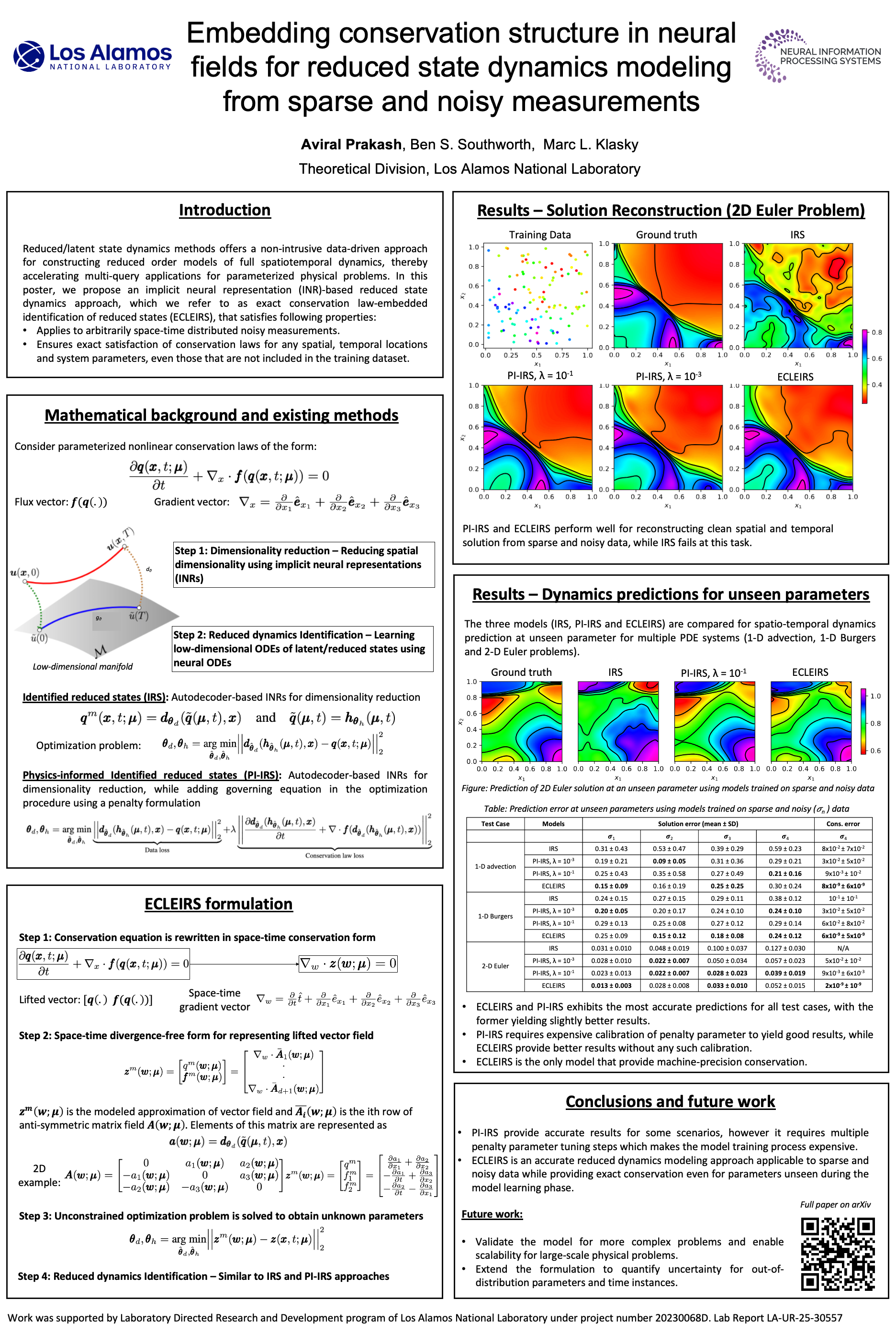
Reduced/latent state dynamics models for parameterized PDEs offer a viable alternate method to high-fidelity methods for multi-query applications These reduced state dynamics approaches rely on high-quality data and struggle with noisy and sparse spatiotemporal measurements typically obtained from experiments and do not satisfy underlying conservation laws. In this article, we propose a reduced state dynamics approach, which we refer to as ECLEIRS, that satisfies conservation laws exactly even for parameters unseen in the model training process. We compare ECLEIRS with other reduced state dynamics approaches, those that do not enforce any physical constraints and those with physics-informed loss functions, for three shock-propagation problems: 1-D advection, 1-D Burgers and 2-D Euler equations. The numerical experiments conducted in this study demonstrate that ECLEIRS provides the most accurate prediction of dynamics for unseen parameters in the presence of highly sparse and noisy measurements.