
Learning IRC-Safe Jet Clustering with Geometric Algebra Transformers
Abstract
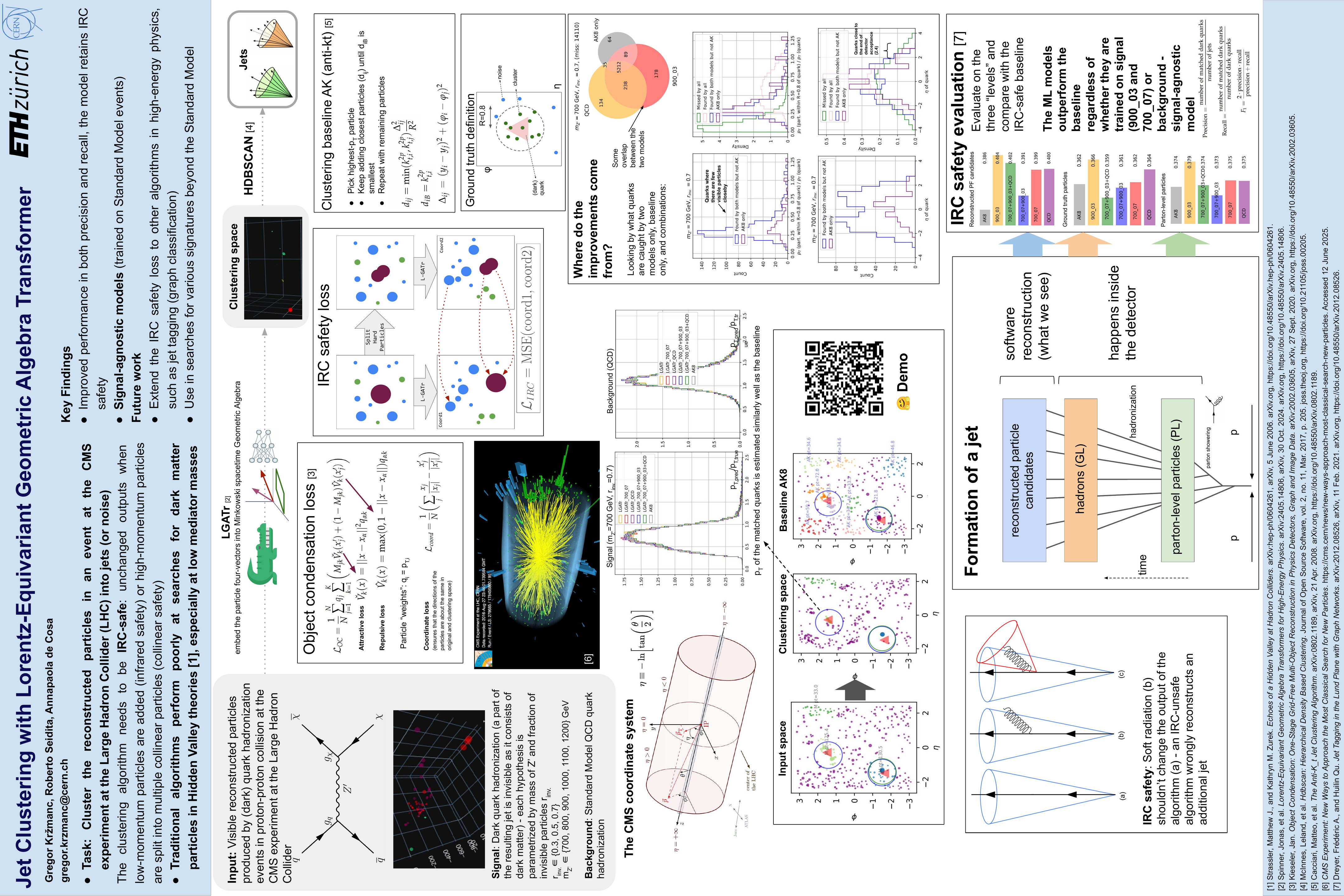
Jet clustering is a key algorithm in particle physics used to detect sprays of particles produced as a result of hadronization of highly energetic quarks and gluons produced in particle colliders. We present a novel machine learning-based jet clustering algorithm based on the Lorentz-equivariant geometric algebra transformer trained with object condensation loss to cluster particle flow candidates around the originating quarks. We propose an additional loss term that prevents the model from relying on features of the hadonization process not well described by theoretical models (IRC safety). The models are evaluated on events resulting from quantum chromodynamics (QCD) processes, as well as a possible dark sector signature in the form of semi-visible jet signal events. Our results demonstrate an improvement in jet clustering across a wide range of parameters of dark sector models compared to the standard in the field (anti-kt), regardless of whether the models were trained on QCD background or semi-visible jet signal events. Comparison of the performance on generator particles before and after hadronization demonstrates a high degree of IRC safety of the models. The IRC safety loss can be extended to existing algorithms for processing high-energy physics data from particle colliders, thereby facilitating a more accurate reconstruction of the underlying physics processes.