
Connecting the Dots: A Machine Learning Ready Dataset for Ionospheric Forecasting Models
Abstract
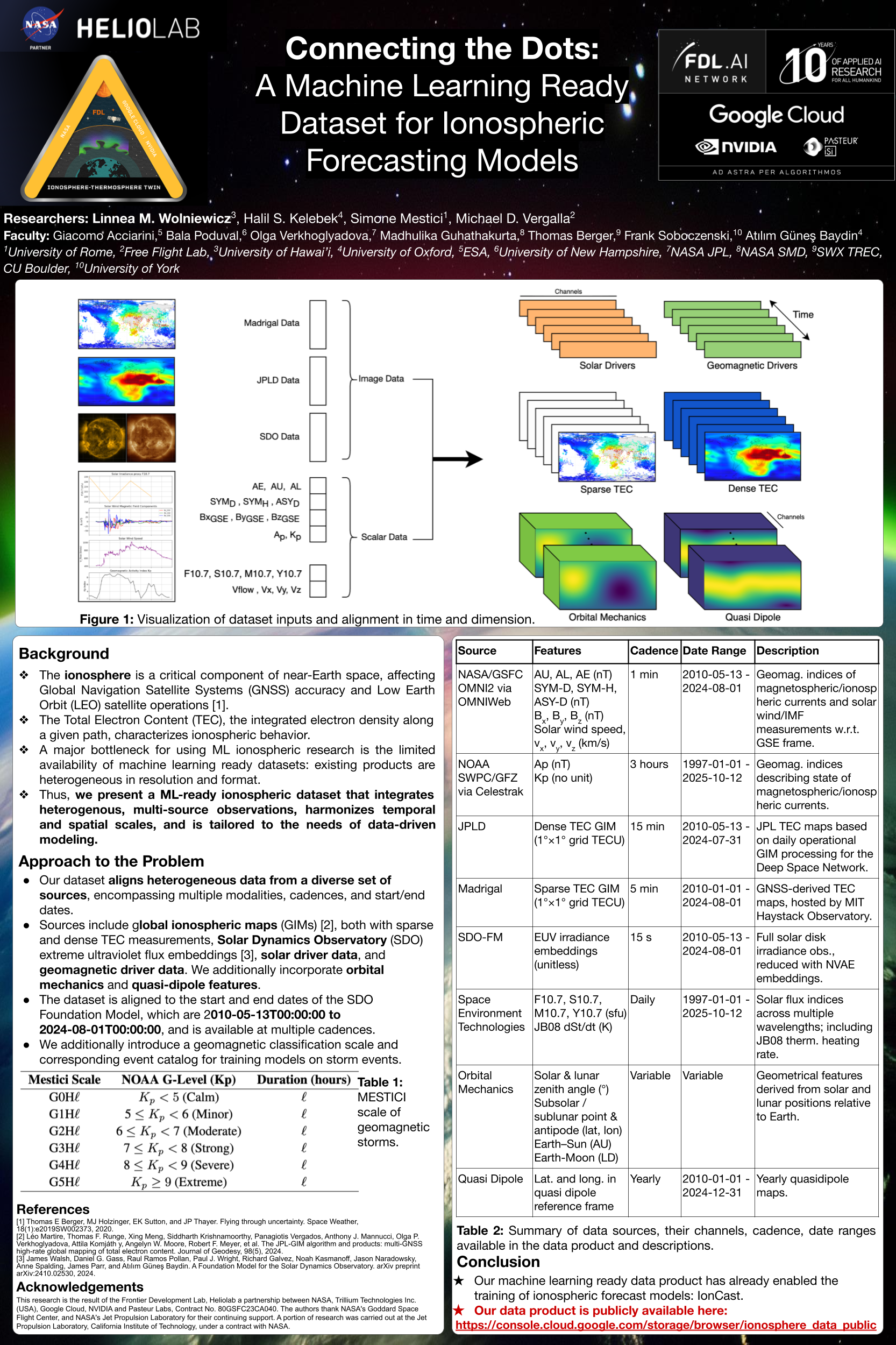
Operational forecasting of the ionosphere remains a critical space weather challenge due to sparse observations, complex coupling across geospatial layers, and a growing need for timely, accurate predictions that support Global Navigation Satellite System (GNSS), communications, aviation safety, as well as satellite operations. As part of the 2025 NASA Heliolab, we present a curated, open-access dataset that integrates diverse ionospheric and heliospheric measurements into a coherent, machine learning-ready structure, designed specifically to support next-generation forecasting models and address gaps in current operational frameworks.Our workflow integrates a large selection of data sources comprising Solar Dynamic Observatory data, solar irradiance indices (F10.7), solar wind parameters (velocity and interplanetary magnetic field), geomagnetic activity indices (Kp, AE, SYM-H), and NASA JPL's Global Ionospheric Maps of Total Electron Content (GIM-TEC). We also implement geospatially sparse data such as the TEC derived from the World-Wide GNSS Receiver Network and crowdsourced Android smartphone measurements. This novel heterogeneous dataset is temporally and spatially aligned into a single, modular data structure that supports both physical and data-driven modeling. Leveraging this dataset, we train and benchmark several spatiotemporal machine learning architectures for forecasting vertical TEC under both quiet and geomagnetically active conditions.This work presents a key operational gap by delivering an extensive dataset and modeling pipeline that enables exploration of not only ionospheric dynamics but also broader Sun-Earth interactions, supporting both scientific inquiry and operational forecasting efforts.