
Multi-modal Foundation Model for Cosmological Simulation Data
Abstract
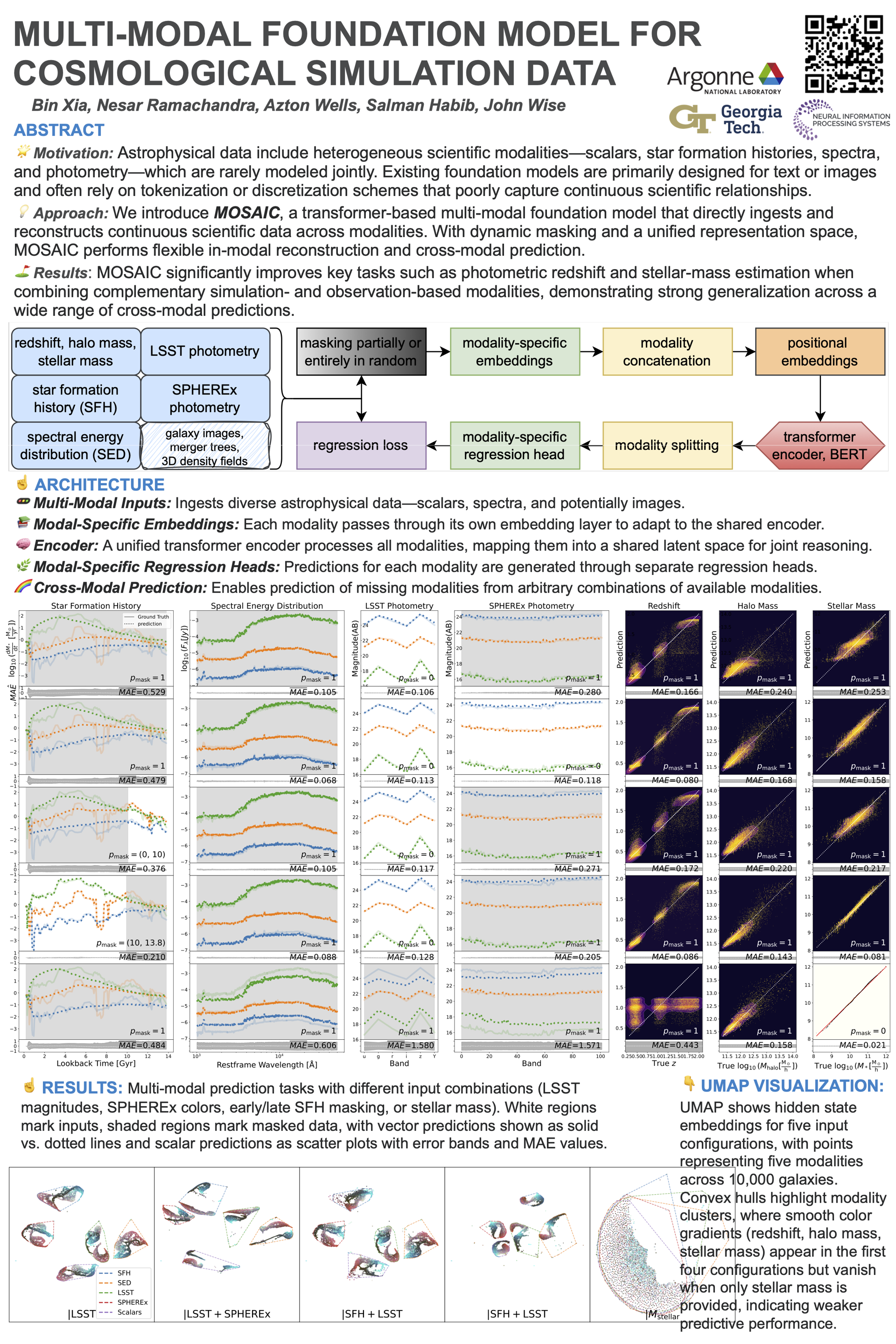
We present a multi-modal foundation model for astrophysical galaxy data, designed to map between simulation- and observation-based galactic features. Our encoder-only transformer flexibly ingests scalar quantities (e.g., redshifts, galaxy masses) and vectors (e.g., star formation histories, spectra), supporting multi-task training that includes within-modality reconstruction and cross-modality prediction. With a dynamic masking strategy, the model can query arbitrary galaxy properties from partial inputs—including predicting spectra from redshift and mass, or estimating photometric redshifts from broadband magnitudes—while also recovering missing segments within a modality. Trained on 185,000 simulated galaxies from a gigaparsec-scale Cosmology simulation, the model yields a 50\% improvement in redshift estimation when combining LSST and SPHEREx photometry over LSST photometry alone, and a 63\% improvement in stellar mass inference when combining late-time SFH with LSST photometry over early-time SFH with LSST photometry. The model demonstrates strong generalization across multi-modal tasks and lays the groundwork for future integration of higher-dimensional and structured data such as images, merger trees, and 3D fields. This approach provides a unified framework for connecting simulations and observations, advancing the development of generalizable astrophysical foundation models.