
Uncovering Solar Wind Phenomena with iSAX, HDBScan, Human-in-the-loop and PSP Observations
Valmir Moraes Filho ⋅ Daniela Martin Vega ⋅ Jasmine Kobayashi ⋅ Connor O'Brien ⋅ Jinsu Hong ⋅ Evangelia Samara ⋅ Joseph Alejandro Gallego Mejia
Abstract
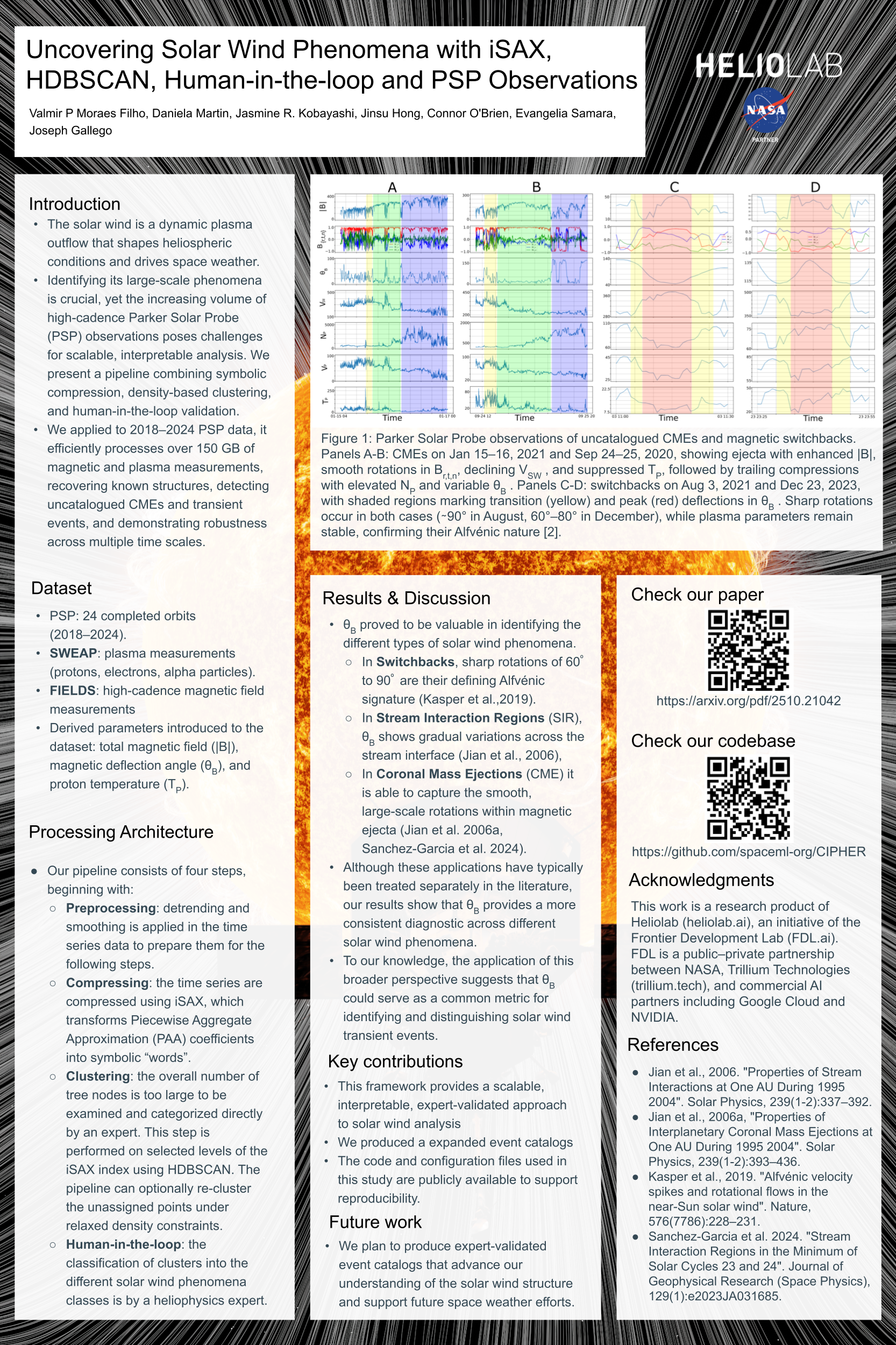
The solar wind is a dynamic outflow of plasma that shapes the heliospheric conditions and drives space weather phenomena. Identifying its large-scale phenomena is essential for understanding solar events that impact the near-Earth environment. However, the growing volume of high-cadence observations from Parker Solar Probe (PSP) poses a challenge for scalable and interpretable analysis. We introduce a pipeline that combines symbolic compression and indexing, unsupervised density-based clustering, and human-in-the-loop validation. Applied to 2018-2024 PSP measurements, this framework efficiently processes over 150 GB of magnetic and plasma data, reducing computational cost while preserving physical interpretability. The method successfully recovers known solar wind structures, identifies uncatalogued CMEs and transient events, and demonstrates robustness across multiple time scales. A key outcome is the systematic use of the magnetic deflection angle ($\theta_B$), which emerges as a unifying diagnostic for these phenomena. This pipeline establishes a scalable, interpretable, and expert-validated approach to solar wind analysis. By producing expanded event catalogs, it advances our understanding of heliospheric variability and provides a foundation for future space weather forecasting in the era of large in situ datasets.
Chat is not available.
Successful Page Load