
Fourier Neural Operators for Fast Simulation and Inverse Design of Second-Harmonic Generation in Nanophotonics
Valentin Duruisseaux ⋅ Robert Gray ⋅ Siyuan Jiang ⋅ Selina Zhou ⋅ Robert Joseph George ⋅ Kamyar Azizzadenesheli ⋅ Alireza Marandi ⋅ Animashree Anandkumar
Abstract
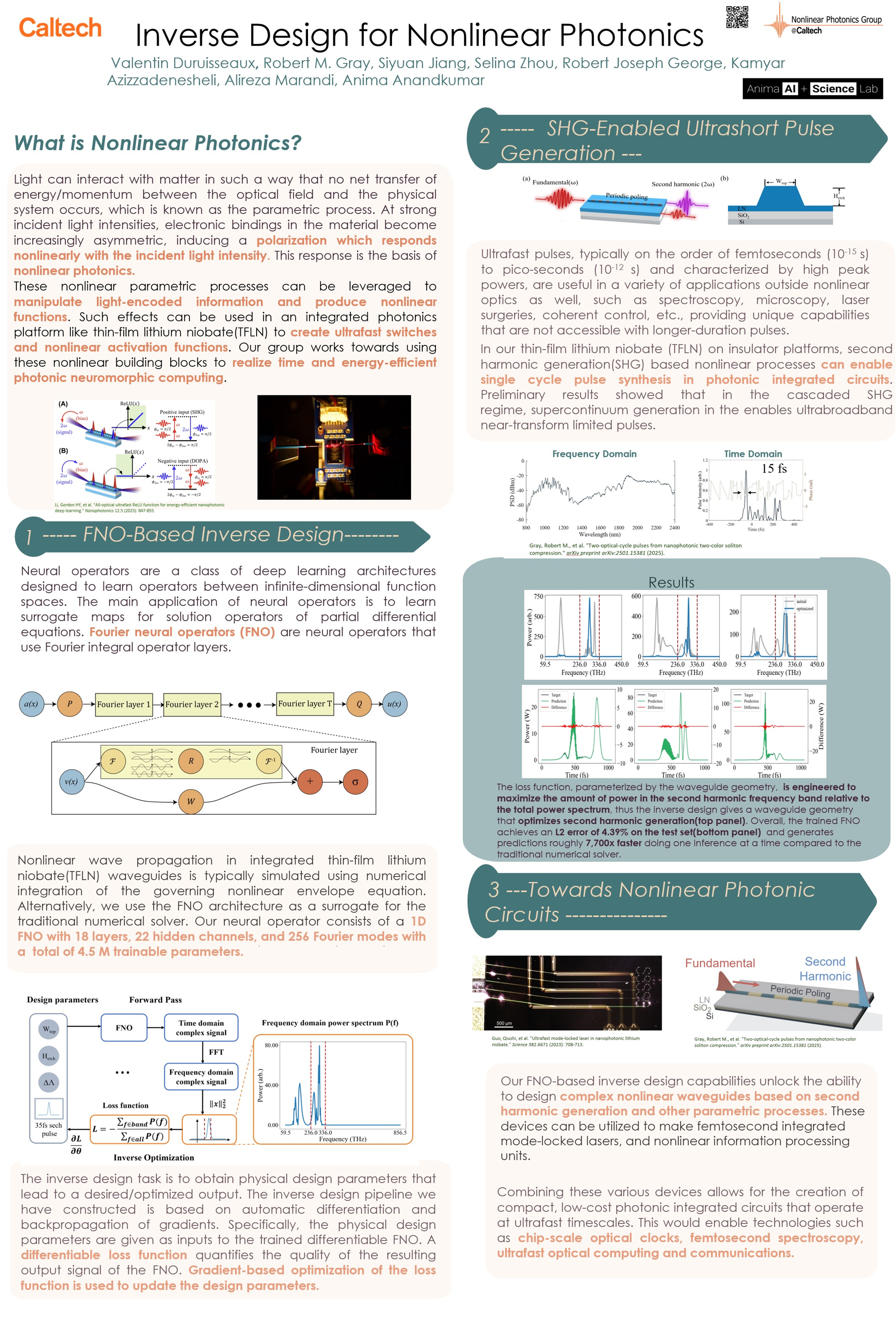
Advances in nanophotonics require increasingly fast and accurate modeling tools for nonlinear optical phenomena, yet conventional numerical solvers are constrained by high computational cost and limited scalability. Thin-film lithium niobate (TFLN), combining strong nonlinearities and low-loss integration, enables efficient second-harmonic generation (SHG) for telecommunications, frequency combs, and quantum photonics with stable, broadband, low-noise signals. In this paper, we present a Fourier Neural Operator (FNO) based framework for simulating SHG in TFLN waveguides. Trained on high-fidelity reference simulations from a Fourier split-step solver, the FNO achieves a relative $L^{2}$ error around 4\% on the test set while delivering an approximate 550,000× speedup over the solver, when executed in batch on GPUs. This computational efficiency enables extensive sampling of large design spaces, accelerating the discovery of configurations with desired properties. By further exploiting the differentiability of the FNO, we develop an inverse design pipeline that applies gradient-based optimization to directly adjust waveguide geometry, poling period mismatch and pump pulse energy to maximize conversion efficiency. The pipeline identifies high-efficiency device configurations very rapidly, reducing design cycles from days or weeks to seconds. Across 1000 random initializations, 63\% of designs exceeded 90\% conversion efficiency within 100 optimization iterations, underscoring the potential of FNO-driven methods to revolutionize nonlinear photonic device design.
Chat is not available.
Successful Page Load