
Improving and Assessing Astronomical Light Curve Classifiers with Classification Histories
Abstract
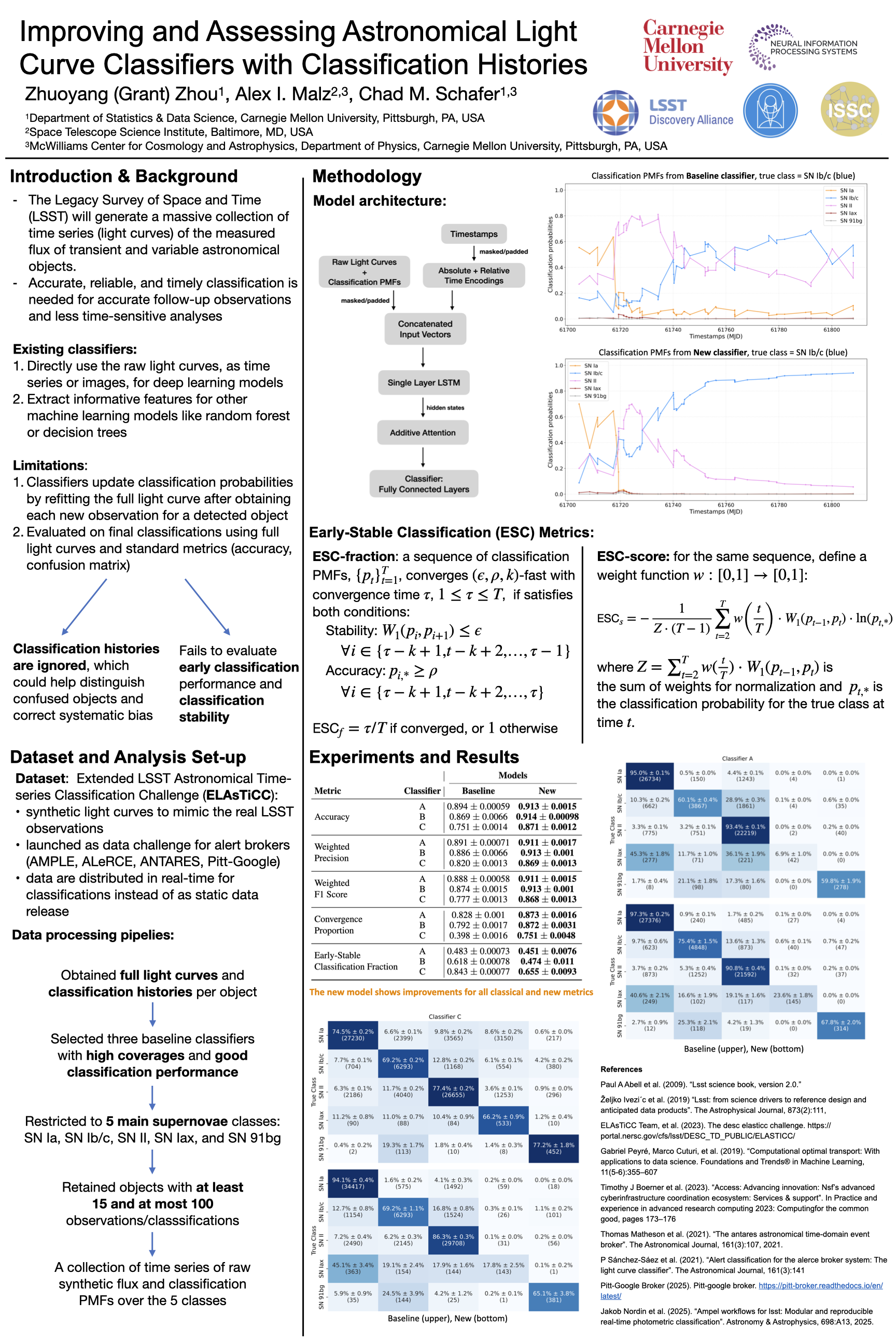
The Legacy Survey of Space and Time (LSST) will generate a massive collection of time series (light curves) of the measured flux of transient and variable astronomical objects. Each new observation of a detected source will lead to an updated probability distribution over candidate classes, which will then be provided to the global community for the purpose of identifying interesting targets for follow-up observations. Using the synthetic light curves and classification results from the Extended LSST Astronomical Time-series Classification Challenge (ELAsTiCC), we investigate how to enhance existing classifiers by incorporating their historical classifications and temporal evolutions. The new model, consisting of a Long Short-Term Memory network and an additive self-attention module, shows higher classification accuracy and more balanced performance across all classes compared to existing classifiers in the challenge. We also propose new metrics that can better evaluate the model's classification stability and early classification ability with partial observations using Wasserstein distances and by considering their temporal evolution. This offers a more comprehensive perspective for model assessment by supplementing classical methods such as the confusion matrix and precision-recall.