
TGLF-SINN: Deep Learning Surrogate Model for Accelerating Turbulent Transport Modeling in Fusion
Yadi Cao ⋅ Futian Zhang ⋅ Wesley Liu ⋅ Tom Neiser ⋅ Lawson Fuller ⋅ Brian Sammuli ⋅ Rose Yu
Abstract
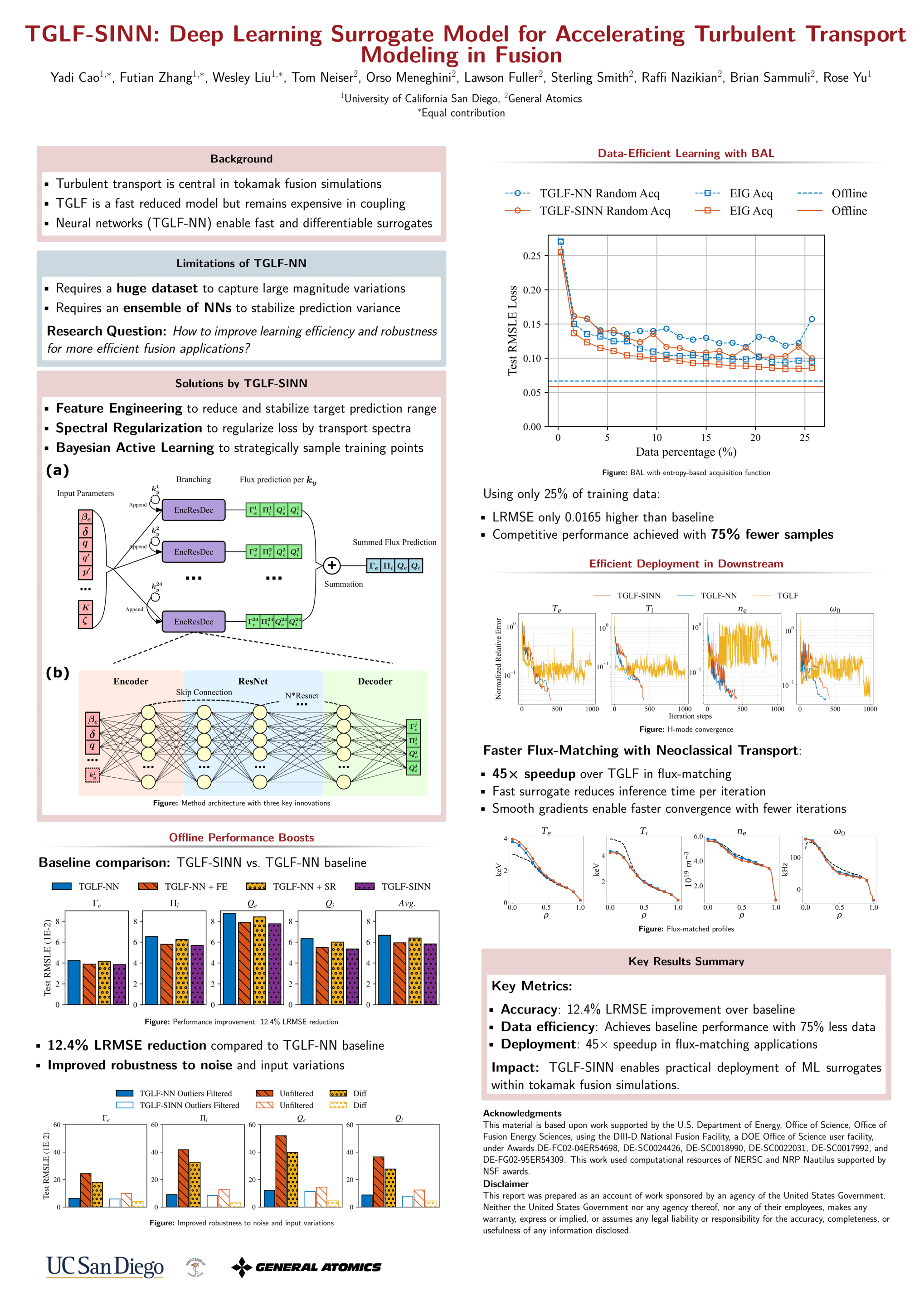
Fusion simulations require accurate modeling of core turbulent transport in tokamaks, but even the most state-of-the-art numerical simulator (TGLF, Trapped Gyro-Landau Fluid) is too slow for interactive device simulation due to frequent simulation queries needed to couple with other components. Neural network surrogates have offered speedup but typically need massive datasets to cover the diverse scale variations of transport fluxes, limiting their adaptation to full-scale simulations in core plasma such as gyrokinetics. Tackling this high data demand challenge, we propose \textbf{TGLF-SINN (Spectra-Informed Neural Network for TGLF)} with three innovations: (1) principled feature engineering to compress the wide-ranging outputs, (2) physics-informed regularization using turbulent energy spectrum, and (3) Bayesian Active Learning (BAL) to select training data smartly. Our approach achieves 12.4\% better accuracy than the SOTA NN surrogate in the offline setting, while still achieving competitive performance using 25\% of offline training data through BAL. In downstream fusion applications, flux-matching with neoclassical simulations, we demonstrate a $45\times$ speedup compared to the most optimized numerical methods while maintaining accuracy, showing promise for interactive device simulation and accelerating fusion energy research.
Chat is not available.
Successful Page Load