
Continuous Representations of Baryonic Feedback for Robust Inference from Multiple Simulation Suites
Abstract
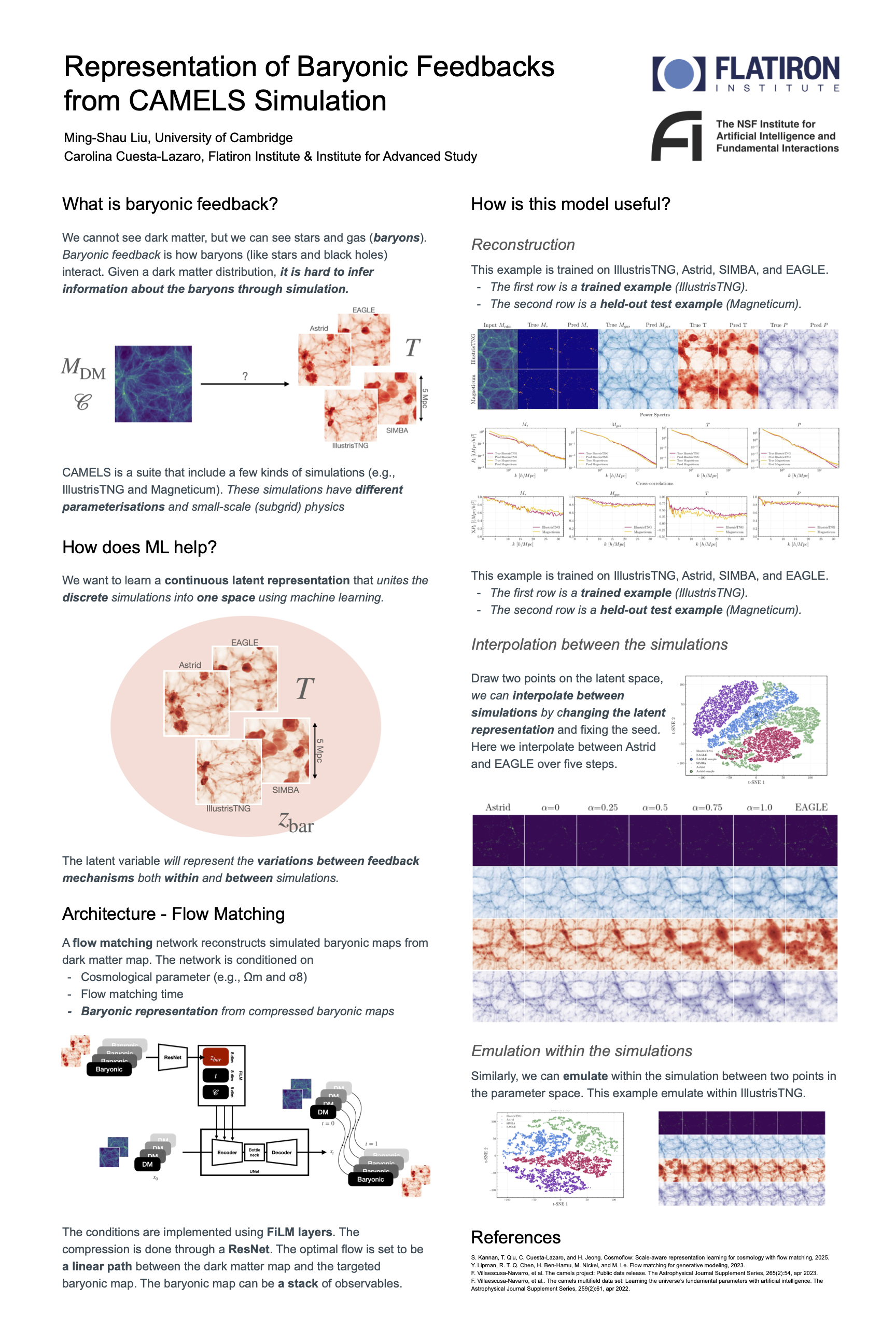
Accurate modeling of baryonic physics remains a major challenge for precision cosmology due to our incomplete understanding of complex subgrid processes, like star formation and feedback from supernovae and active galactic nuclei below ~10 Mpc scales. This uncertainty leads to different hydrodynamical simulation suites to implement fundamentally different prescriptions for these unresolved physics. Current simulation-based inference approaches rely therefore on discrete sets of simulators, each encoding specific physical assumptions, making it difficult to robustly quantify theoretical uncertainties and learn about the underlying physics from observations. We introduce a machine learning framework that learns continuous representations of baryonic feedback across multiple simulation suites, to enable interpolation between different physical implementations while providing robust uncertainty quantification. Our approach addresses the key challenge of marginalizing over theoretical uncertainties represented by various simulators while simultaneously constraining the underlying baryonic physics from observations. We frame this as learning a shared continuous latent representation of the physics implemented across different simulators, allowing us to both marginalize over and constrain a continuous baryonic parameter space. Using the CAMELS simulation suite, we demonstrate our method on several baryonic fields including stellar mass, gas density, temperature, and pressure fields. This framework provides a path toward more robust cosmological inference by properly accounting for theoretical uncertainties in baryonic modeling while extracting maximum information about the underlying physical processes from current and future surveys.