
Denoising weak lensing mass maps with diffusion model and generative adversarial network
Abstract
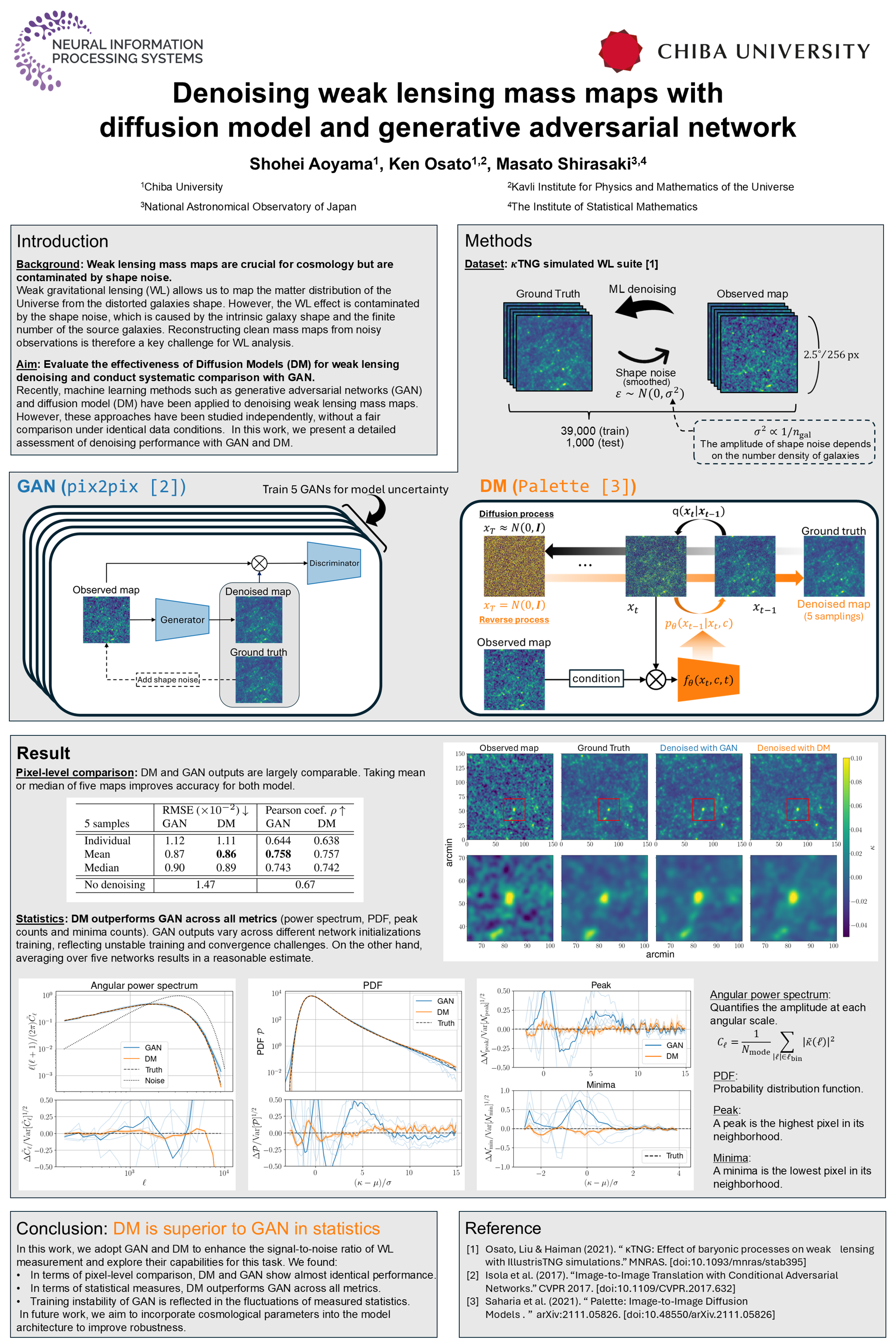
The matter distribution of the Universe can be mapped throughthe weak gravitational lensing (WL) effect: small distortions of the shapes of distant galaxies,which reflects the inhomogeneity of the cosmic density field.The most dominant contaminant in the WL effect is the shape noise;the signal is diluted due to the finite number of source galaxies.In order to explore the full potential of WL measurements, sharpening the signal by removing the shape noisefrom the observational data, i.e., WL denoising, is a pressing issue.Machine learning approaches, in particular, deep generative models, have proveneffective at the WL denoising task.We implement a denoising model based on the diffusion model (DM) and conduct systematic in-depth comparisonswith generative adversarial networks (GANs), which have been applied in previous works for WL denoising.Utilizing the large suite of mock simulations of WL observations,we demonstrate that DM surpasses GAN in the WL denosing task in multiple aspects:(1) the training process is more stable,(2) taking average of multiple samples from DM can robustly reproduce the true signal,and (3) DM can recover various statistics with higher accuracy.