
Towards Characterizing the Complexity of Riemannian Online Convex Optimization
Hibiki Fukushima ⋅ Hiroshi Hirai ⋅ Shinji Ito
Abstract
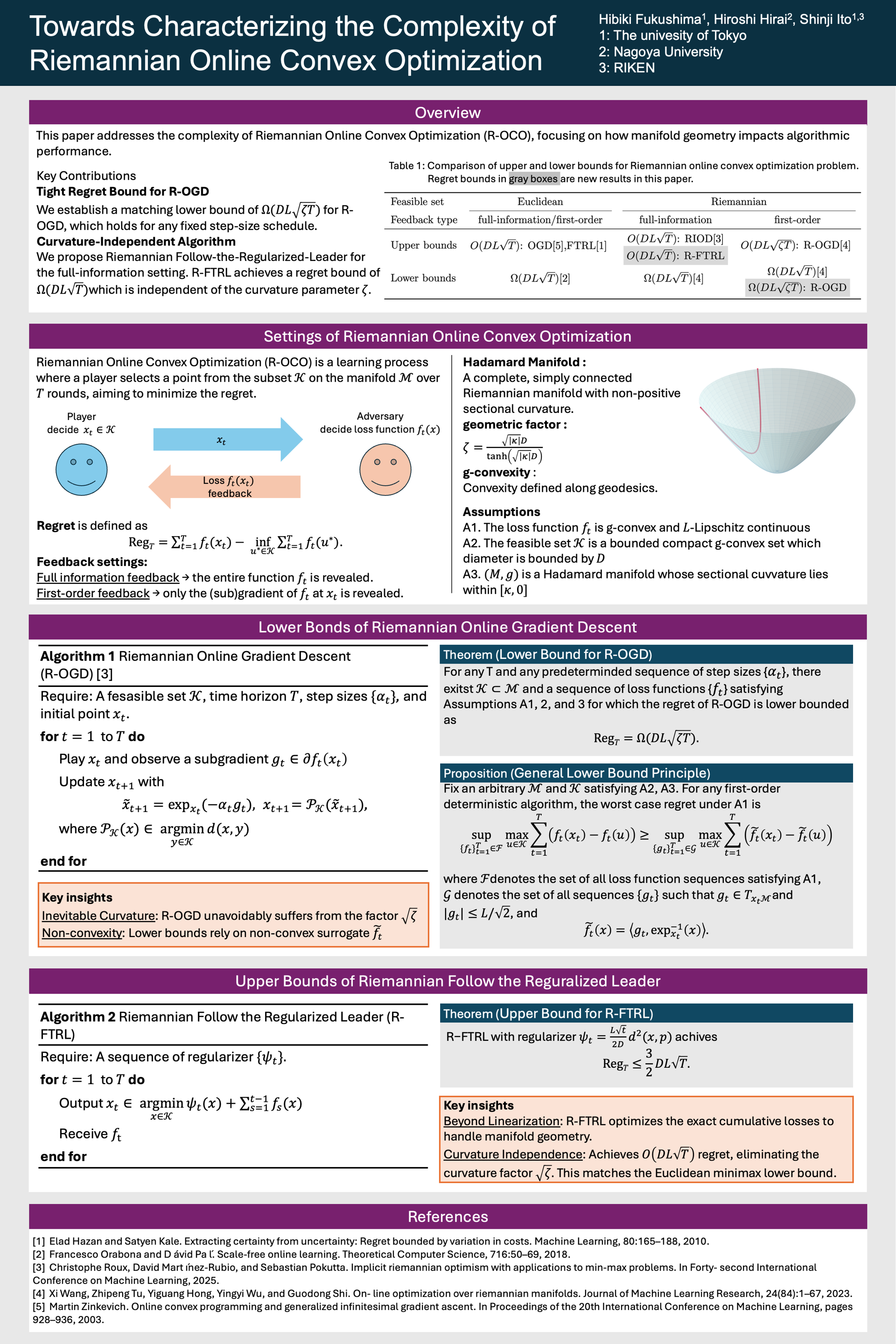
Online Convex Optimization (OCO) over Riemannian manifolds raises fundamental questions about how geometry affects algorithmic performance.While Riemannian Online Gradient Descent (R-OGD) has been shown to achieve a regret upper bound of $O(DL\sqrt{\zeta T})$,where $\zeta$ depends on the manifold's curvature,the tightness of this bound remained unclear.We first establish a matching lower bound of $\Omega(DL\sqrt{\zeta T})$ for R-OGD,valid for any fixed step-size schedule.This shows that the worst-case regret of R-OGD is $\Theta(DL\sqrt{\zeta T})$,and that the effect of manifold curvature appears as a multiplicative factor of $\sqrt{\zeta}$ in the regret.In contrast to the Euclidean setting—where OGD is minimax optimal and regret bounds are independent of feedback models—this result reveals that geometry can substantially degrade the performance of first-order algorithms.Our second contribution shows that this degradation is not unavoidable.In the full-information setting,we propose a new algorithm, R-FTRL, based on a Riemannian extension of Follow-the-Regularized-Leader.R-FTRL achieves a regret bound of $O(DL\sqrt{T})$,independent of the curvature.This establishes that curvature-dependent regret is an artifact of limited feedback,not of the problem itself.Our findings highlight a fundamental separation between first-order and full-information models in non-Euclidean settings,and uncover subtle interactions between feedback structure, algorithm design, and geometry.
Chat is not available.
Successful Page Load