
Synergizing Large Language Models and Theory for Human-like Causal Reasoning
Abstract
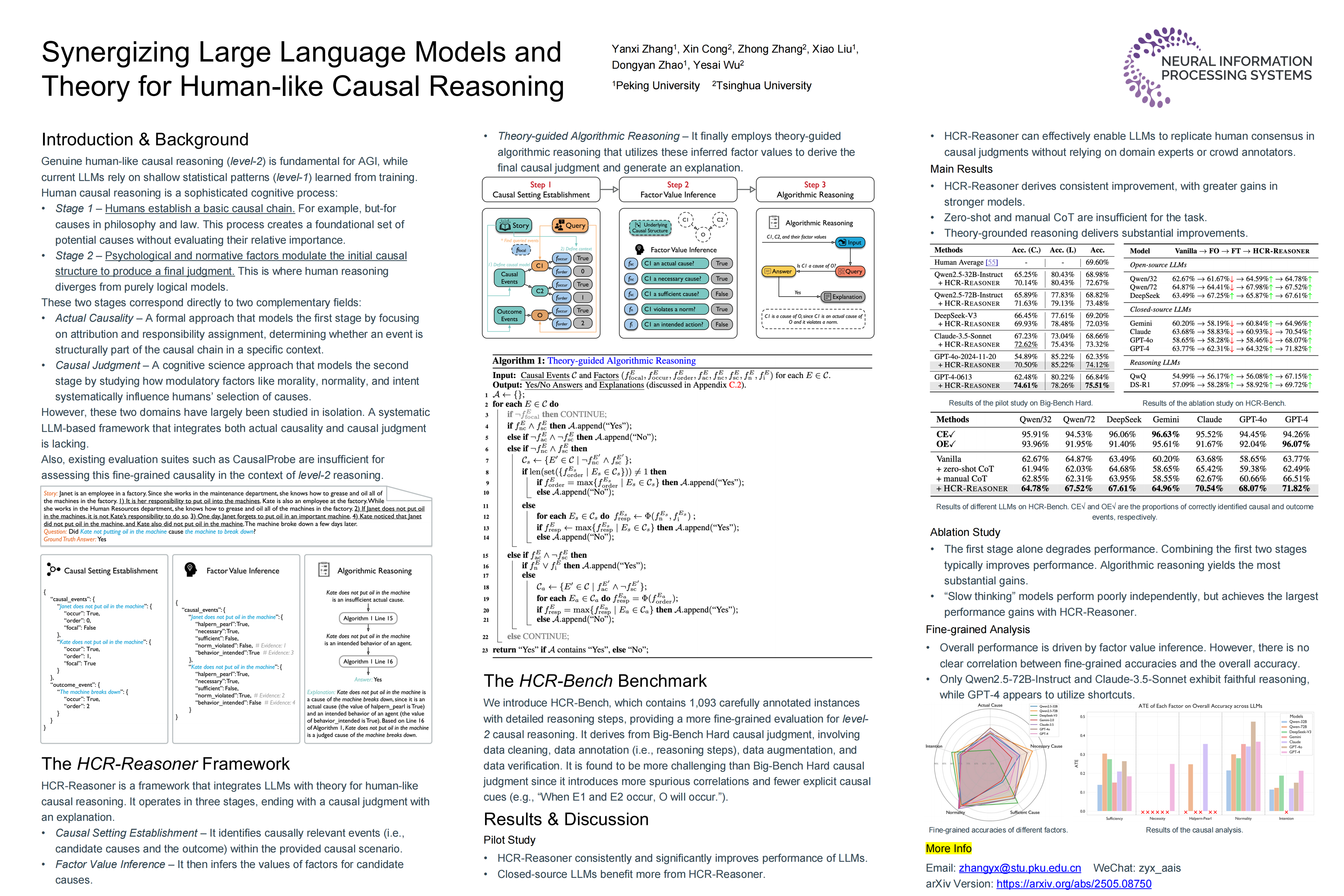
Genuine human-like causal reasoning is fundamental for general artificial intelligence. Humans typically identify whether an event is part of the causal chain first, and then influenced by modulatory factors such as morality, normality, and intention to make the final judgment. These two stages naturally map to the fields of 1) actual causality that provides formalisms for causal chain membership and 2) causal judgment from cognitive science that studies psychological modulators that influence causal selection. However, these two domains have largely been studied in isolation, leaving a gap for a systematic method based on LLMs. Therefore, we introduce HCR-Reasoner, a framework that systematically integrates the theory of actual causality and causal judgment into LLMs for human-like causal reasoning. It simulates humans by using actual causality formalisms to filter for structurally necessary candidate causes and causal judgment factors to determine the psychologically selected cause. For fine-grained evaluation, we introduce HCR-Bench, a challenging benchmark with 1,093 instances with detailed reasoning steps. Results show HCR-Reasoner consistently and significantly improves LLMs' causal alignment with humans, and that explicitly integrating theory-guided reasoning into LLMs is highly effective for achieving faithful human-like causal reasoning.