
Poster Session
Mexico City Poster Session 2
Transcending Cost-Quality Tradeoff in Agent Serving via Session-Awareness
Yanyu Ren ⋅ Li Chen ⋅ Dan Li ⋅ Xizheng Wang ⋅ Zhiyuan Wu ⋅ Yukai Miao ⋅ Yu Bai
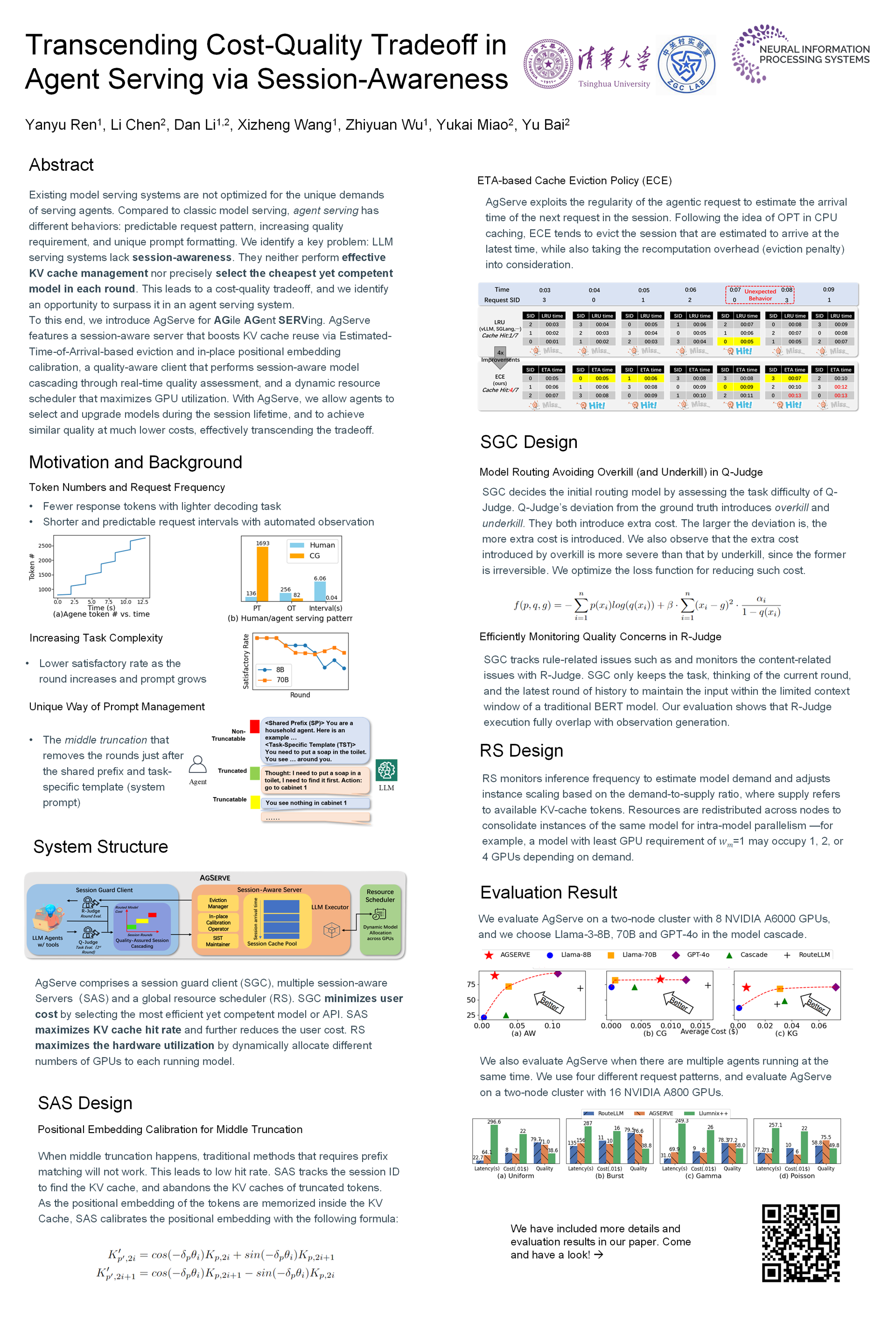
Large Language Model (LLM) agents are capable of task execution across various domains by autonomously interacting with environments and refining LLM responses based on feedback. However, existing model serving systems are not optimized for the unique demands of serving agents. Compared to classic model serving, agent serving has different characteristics: predictable request pattern, increasing quality requirement, and unique prompt formatting. We identify a key problem for agent serving: LLM serving systems lack session-awareness. They neither perform effective KV cache management nor precisely select the cheapest yet competent model in each round. This leads to a cost-quality tradeoff, and we identify an opportunity to surpass it in an agent serving system. To this end, we introduce AgServe for AGile AGent SERVing. AgServe features a session-aware server that boosts KV cache reuse via Estimated-Time-of-Arrival-based eviction and in-place positional embedding calibration, a quality-aware client that performs session-aware model cascading through real-time quality assessment, and a dynamic resource scheduler that maximizes GPU utilization. With AgServe, we allow agents to select and upgrade models during the session lifetime, and to achieve similar quality at much lower costs, effectively transcending the tradeoff. Extensive experiments on real testbeds demonstrate that AgServe (1) achieves comparable response quality to GPT-4o at a 16.5\% cost. (2) delivers 1.8$\times$ improvement in quality relative to the tradeoff curve.
3DID: Direct 3D Inverse Design for Aerodynamics with Physics-Aware Optimization
Yuze Hao ⋅ Linchao Zhu ⋅ Yi Yang
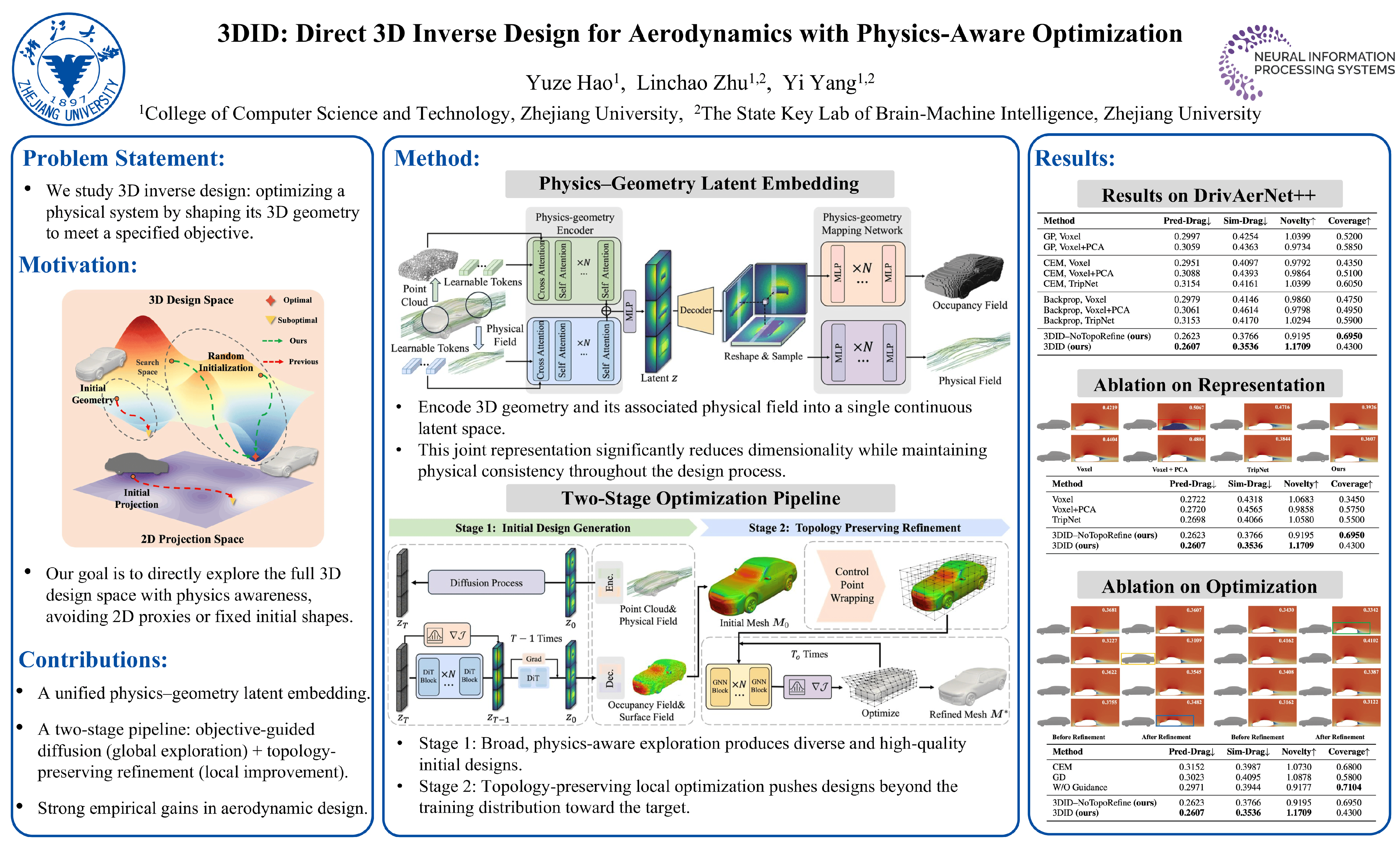
Inverse design aims to design the input variables of a physical system to optimize a specified objective function, typically formulated as a search or optimization problem. However, in 3D domains, the design space grows exponentially, rendering exhaustive grid-based searches infeasible. Recent advances in deep learning have accelerated inverse design by providing powerful generative priors and differentiable surrogate models. Nevertheless, current methods tend to approximate the 3D design space using 2D projections or fine-tune existing 3D shapes. These approaches sacrifice volumetric detail and constrain design exploration, preventing true 3D design from scratch. In this paper, we propose a 3D Inverse Design (3DID) framework that directly navigates the 3D design space by coupling a continuous latent representation with a physics-aware optimization strategy. We first learn a unified physics–geometry embedding that compactly captures shape and physical field data in a continuous latent space. Then, we introduce a two-stage strategy to perform physics-aware optimization. In the first stage, a gradient-guided diffusion sampler explores the global latent manifold. In the second stage, an objectivedriven, topology-preserving refinement further sculpts each candidate toward the target objective. This enables 3DID to generate high-fidelity 3D geometries, outperforming existing methods in both solution quality and design versatility.
Implicit Modeling for Transferability Estimation of Vision Foundation Models
Yaoyan Zheng ⋅ Huiqun Wang ⋅ Nan Zhou ⋅ Di Huang
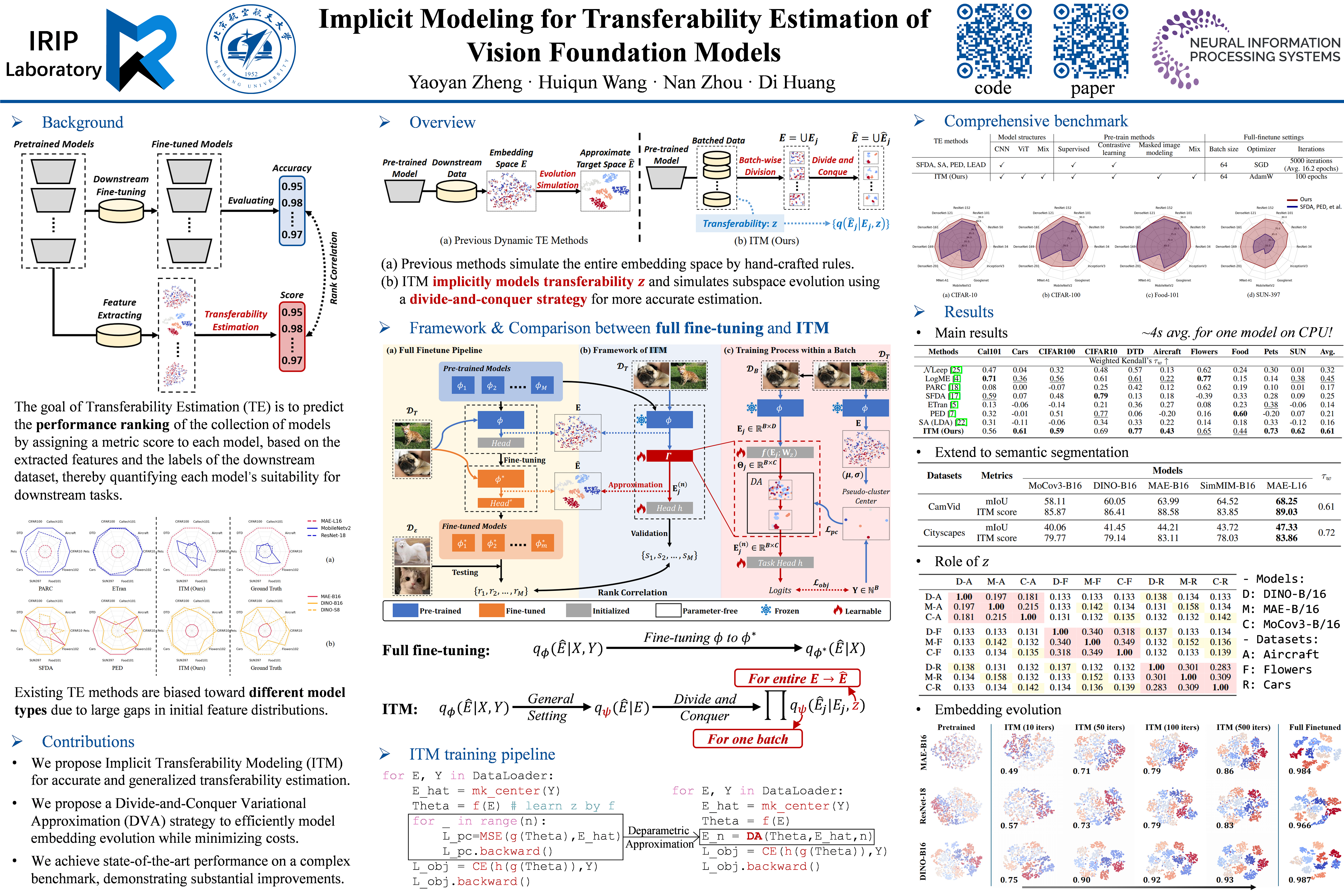
Transferability estimation identifies the best pre-trained models for downstream tasks without incurring the high computational cost of full fine-tuning. This capability facilitates deployment and advances the pre-training and fine-tuning paradigm. However, existing methods often struggle to accurately assess transferability for emerging pre-trained models with diverse architectures, training strategies, and task alignments. In this work, we propose Implicit Transferability Modeling (ITM), a novel framework that implicitly models each model’s intrinsic transferability, coupled with a Divide-and-Conquer Variational Approximation (DVA) strategy to efficiently approximate embedding space evolution. This design enables generalization across a broader range of models and downstream tasks. Extensive experiments on a comprehensive benchmark—spanning extensive training regimes and a wider variety of model types—demonstrate that ITM consistently outperforms existing methods in terms of stability, effectiveness, and efficiency.
FedIGL: Federated Invariant Graph Learning for Non-IID Graphs
Lingren Wang ⋅ Wenxuan Tu ⋅ Jiaxin Wang ⋅ Xiong Wang ⋅ Jieren Cheng ⋅ Jingxin Liu
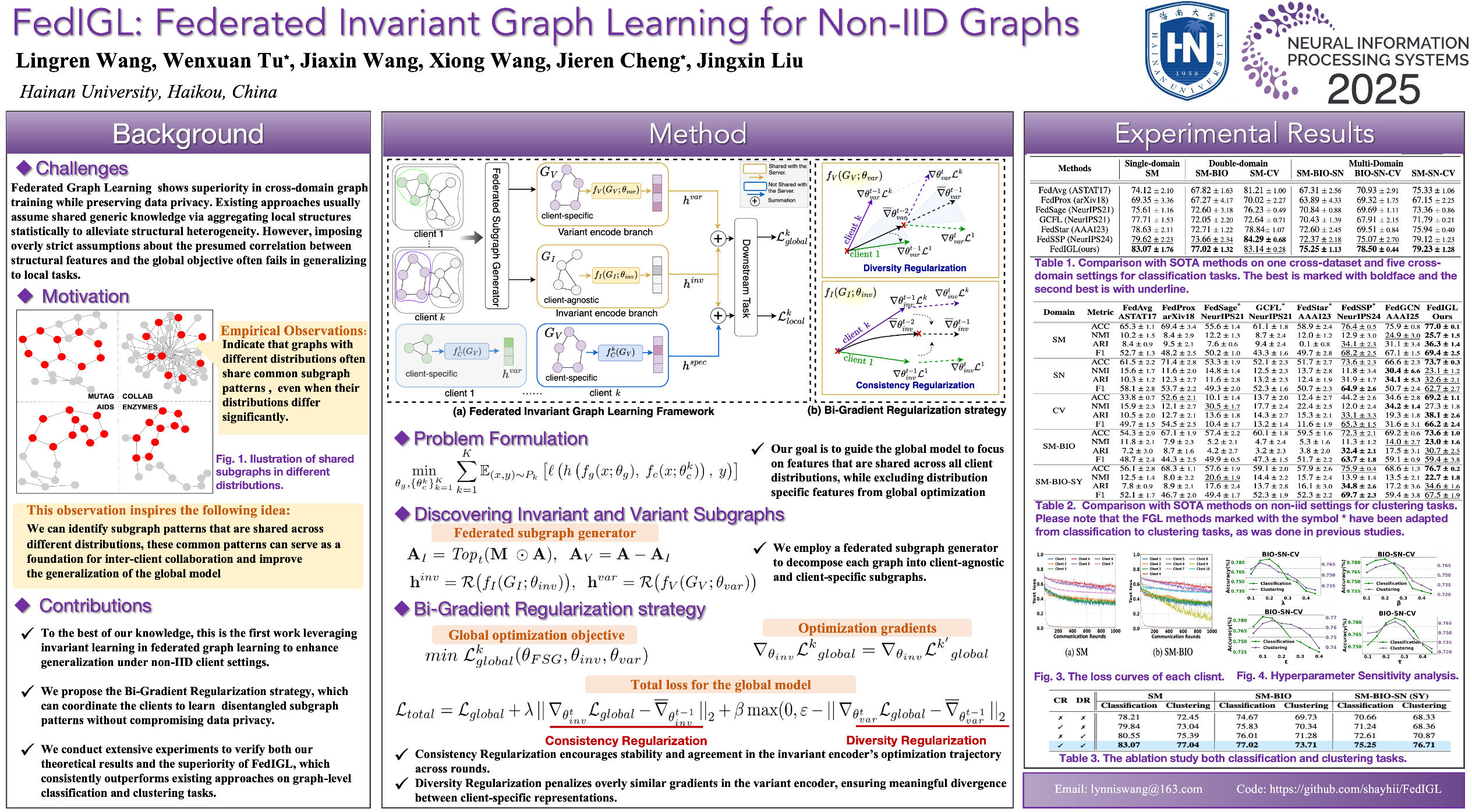
Federated Graph Learning (FGL) effectively facilitates cross-domain graph model training by enabling decentralized learning across multiple domains, while ensuring data privacy through local data storage and communication of model updates instead of raw data. Existing approaches usually assume shared generic knowledge (e.g., prototypes, spectral features) via aggregating local structures statistically to alleviate structural heterogeneity. However, imposing overly strict assumptions about the presumed correlation between structural features and the global objective often fails in generalizing to local tasks, leading to suboptimal performance. To tackle this issue, we propose a Federated Invariant Graph Learning (FedIGL) framework based on invariant learning, which effectively disrupts spurious correlations and further mines the invariant factors across different distributions. Specifically, a server-side global model is trained to capture client-agnostic subgraph patterns shared across clients, whereas client-side models specialize in client-specific subgraph patterns. Subsequently, without compromising privacy, we propose a novel Bi-Gradient Regularization strategy that introduces gradient constraints to guide the model in identifying client-agnostic and client-specific subgraph patterns for better graph representations. Extensive experiments on graph-level clustering and classification tasks demonstrate the superiority of FedIGL against its competitors.
Pessimistic Data Integration for Policy Evaluation
Xiangkun Wu ⋅ Ting Li ⋅ Gholamali Aminian ⋅ Armin Behnamnia ⋅ Hamid Rabiee ⋅ Chengchun Shi
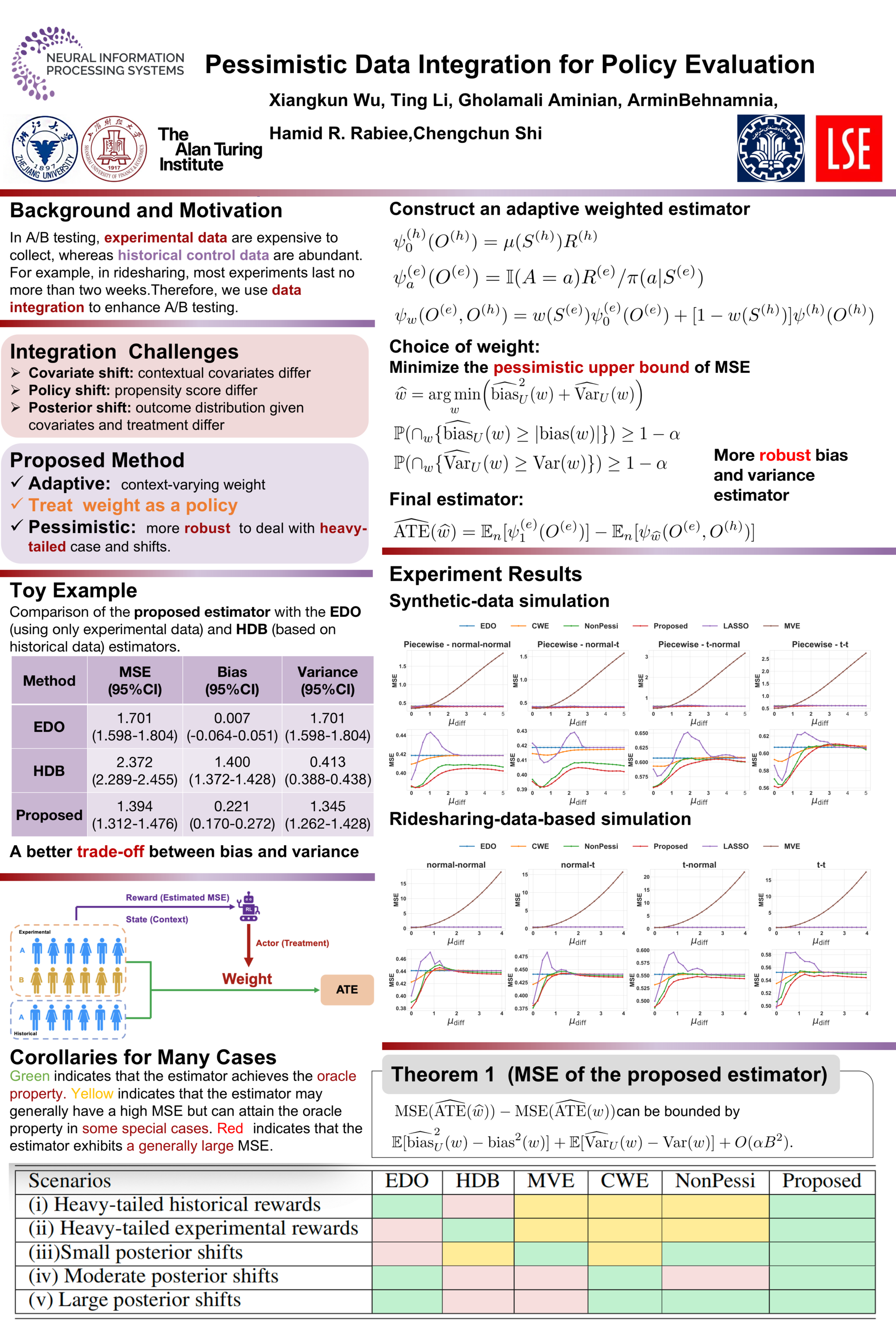
This paper studies how to integrate historical control data with experimental data to enhance A/B testing, while addressing the distributional shift between historical and experimental datasets. We propose a pessimistic data integration method that combines two causal effect estimators constructed based on experimental and historical datasets. Our main idea is to conceptualize the weight function for this combination as a policy so that existing pessimistic policy learning algorithms are applicable to learn the optimal weight that minimizes the resulting weighted estimator's mean squared error. Additionally, we conduct comprehensive theoretical and empirical analyses to compare our method against various baseline estimators across five scenarios. Both our theoretical and numerical findings demonstrate that the proposed estimator achieves near-optimal performance across all scenarios.
Flow-Based Policy for Online Reinforcement Learning
Lei Lyu ⋅ Yunfei Li ⋅ Yu Luo ⋅ Fuchun Sun ⋅ Tao Kong ⋅ Jiafeng Xu ⋅ Xiao Ma
We present $\textbf{FlowRL}$, a novel framework for online reinforcement learning that integrates flow-based policy representation with Wasserstein-2-regularized optimization. We argue that in addition to training signals, enhancing the expressiveness of the policy class is crucial for the performance gains in RL. Flow-based generative models offer such potential, excelling at capturing complex, multimodal action distributions. However, their direct application in online RL is challenging due to a fundamental objective mismatch: standard flow training optimizes for static data imitation, while RL requires value-based policy optimization through a dynamic buffer, leading to difficult optimization landscapes. FlowRL first models policies via a state-dependent velocity field, generating actions through deterministic ODE integration from noise. We derive a constrained policy search objective that jointly maximizes Q through the flow polciy while bounding the Wasserstein-2 distance to a behavior-optimal policy implicitly derived from the replay buffer. This formulation effectively aligns the flow optimization with the RL objective, enabling efficient and value-aware policy learning despite the complexity of the policy class. Empirical evaluations on DMControl and Humanoidbench demonstrate that FlowRL achieves competitive performance in online reinforcement learning benchmarks.
Test-Time Adaptive Object Detection with Foundation Model
Yingjie Gao ⋅ Yanan Zhang ⋅ Zhi Cai ⋅ Di Huang
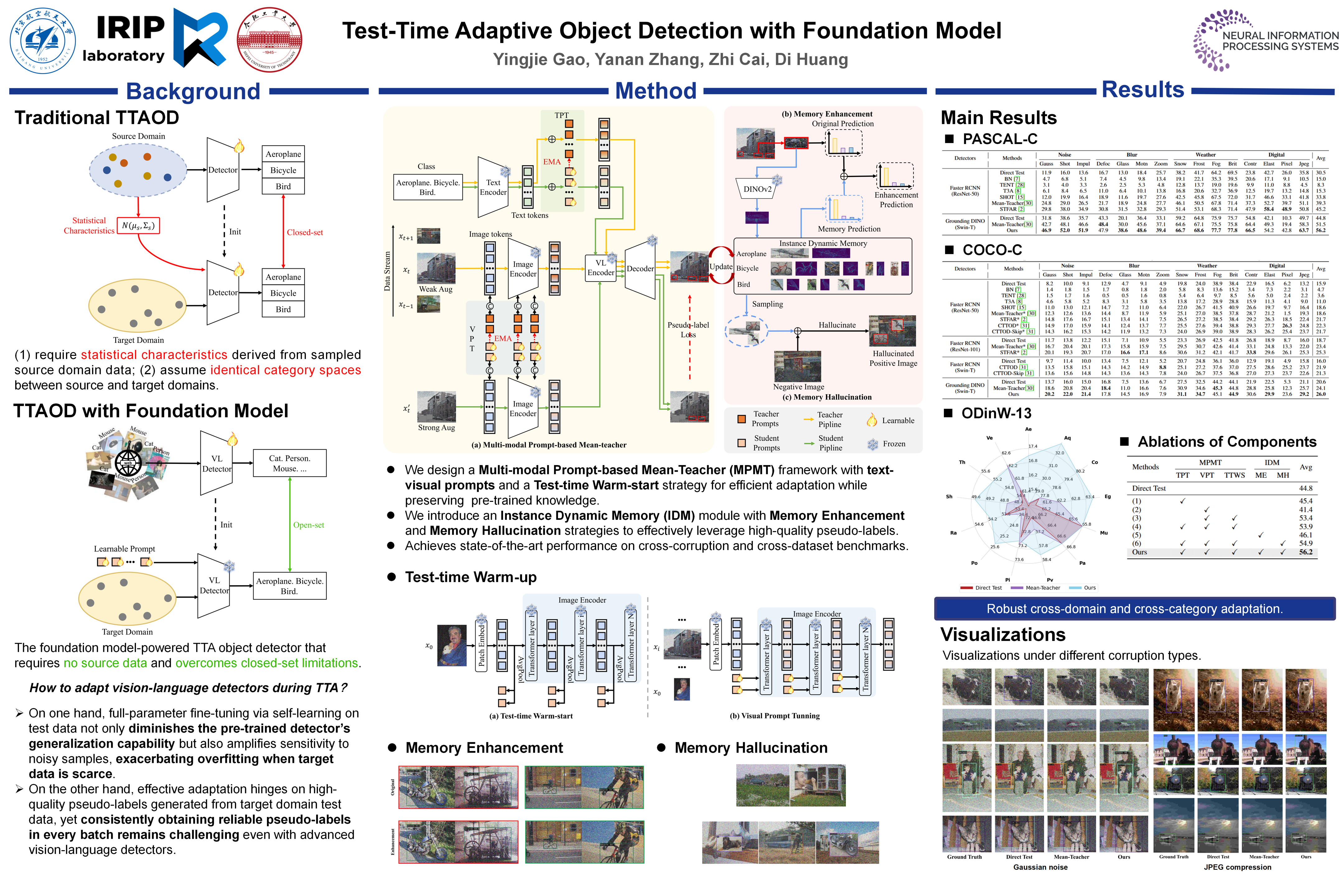
In recent years, test-time adaptive object detection has attracted increasing attention due to its unique advantages in online domain adaptation, which aligns more closely with real-world application scenarios. However, existing approaches heavily rely on source-derived statistical characteristics while making the strong assumption that the source and target domains share an identical category space. In this paper, we propose the first foundation model-powered test-time adaptive object detection method that eliminates the need for source data entirely and overcomes traditional closed-set limitations. Specifically, we design a Multi-modal Prompt-based Mean-Teacher framework for vision-language detector-driven test-time adaptation, which incorporates text and visual prompt tuning to adapt both language and vision representation spaces on the test data in a parameter-efficient manner. Correspondingly, we propose a Test-time Warm-start strategy tailored for the visual prompts to effectively preserve the representation capability of the vision branch. Furthermore, to guarantee high-quality pseudo-labels in every test batch, we maintain an Instance Dynamic Memory (IDM) module that stores high-quality pseudo-labels from previous test samples, and propose two novel strategies-Memory Enhancement and Memory Hallucination-to leverage IDM's high-quality instances for enhancing original predictions and hallucinating images without available pseudo-labels, respectively. Extensive experiments on cross-corruption and cross-dataset benchmarks demonstrate that our method consistently outperforms previous state-of-the-art methods, and can adapt to arbitrary cross-domain and cross-category target data. Code is available at https://github.com/gaoyingjay/ttaod_foundation.
Sampling-Efficient Test-Time Scaling: Self-Estimating the Best-of-N Sampling in Early Decoding
Yiming Wang ⋅ Pei Zhang ⋅ Siyuan Huang ⋅ Baosong Yang ⋅ Zhuosheng Zhang ⋅ Fei Huang ⋅ Rui Wang
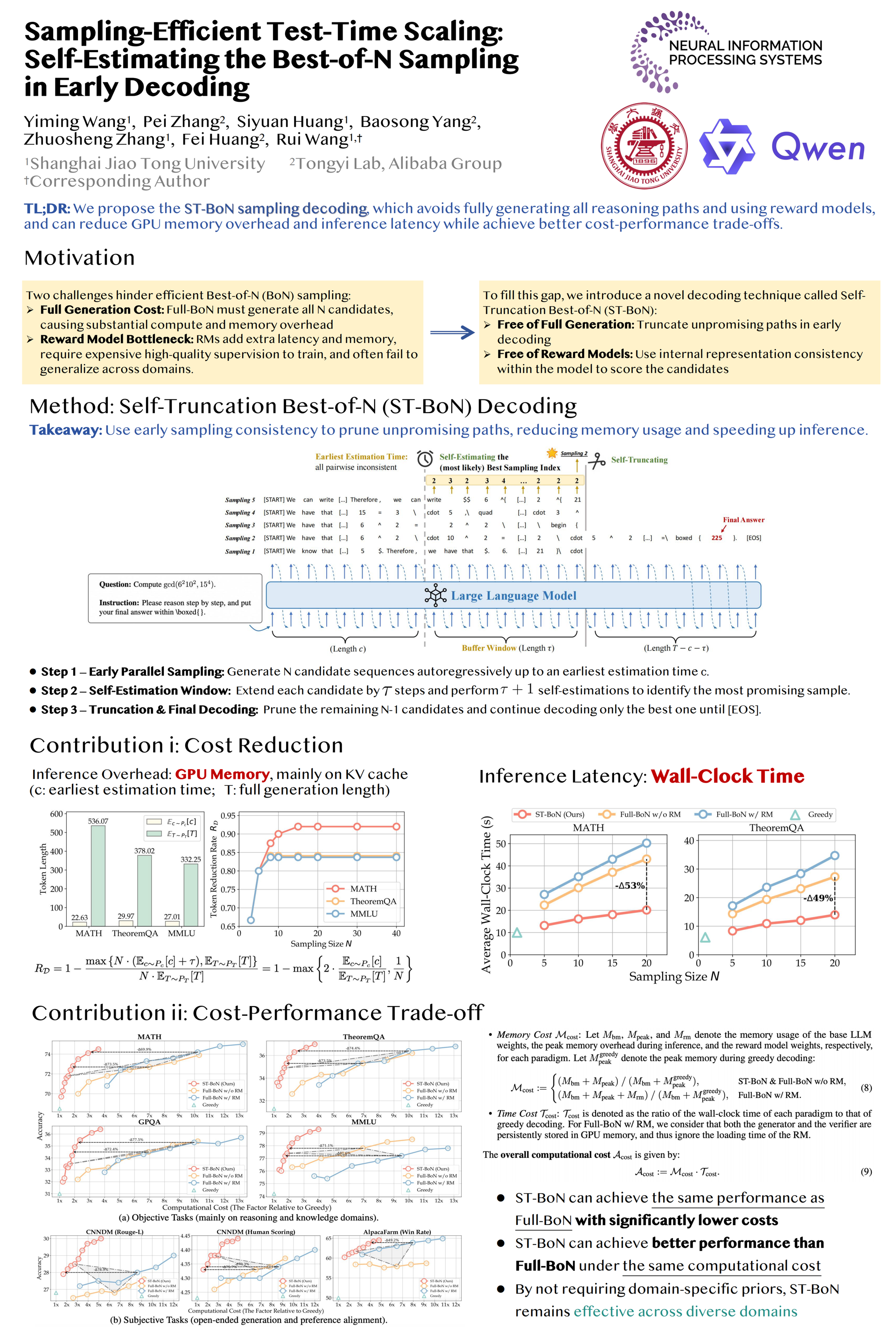
Test-time scaling enhances large language model performance by allocating additional compute resources during decoding. Best-of-$N$ (BoN) sampling serves as a common sampling-based scaling technique, broadening the search space in parallel to find better solutions from the model distribution. However, its cost–performance trade-off is still underexplored. Two main challenges limit the efficiency of BoN sampling: (1) Generating $N$ full samples consumes substantial GPU memory, reducing inference capacity under limited resources. (2) Reward models add extra memory and latency overhead, and training strong reward models introduces potential training data costs. Although some studies have explored efficiency improvements, none have addressed both challenges at once. To address this gap, we propose **Self-Truncation Best-of-$N$ (ST-BoN)**, a decoding method that avoids fully generating all $N$ samples and eliminates the need for reward models. It leverages early sampling consistency in the model’s internal states to identify the most promising path and truncate suboptimal ones. In terms of cost, ST-BoN reduces dynamic GPU memory usage by over 80% and inference latency by 50%. In terms of cost–performance trade-off, ST-BoN achieves the same performance as Full-BoN while saving computational cost by 70%–80%, and under the same cost, it can improve accuracy by 3–4 points.
SYMPHONY: Synergistic Multi-agent Planning with Heterogeneous Language Model Assembly
Wei Zhu ⋅ Zhiwen Tang ⋅ Kun Yue
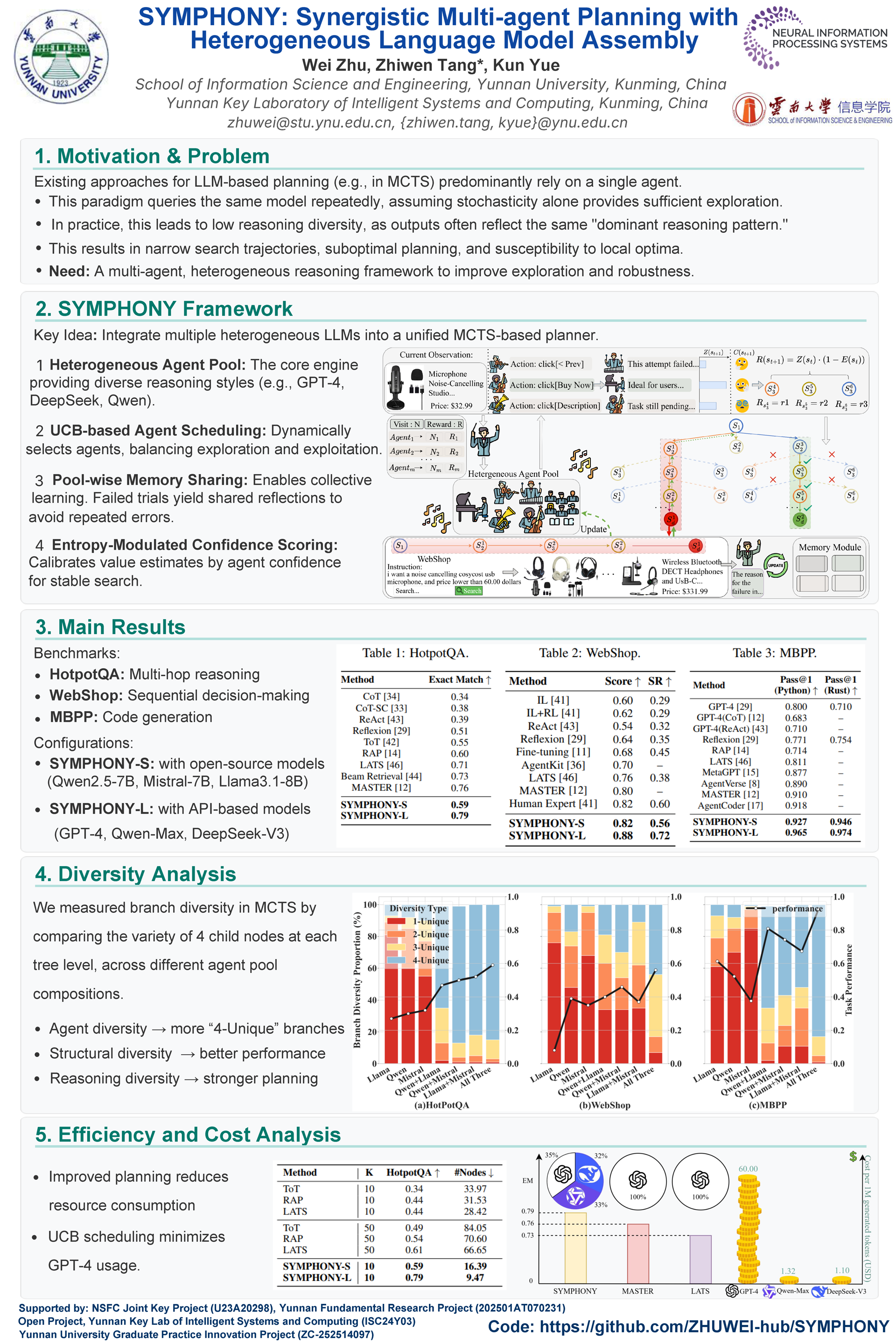
Recent advancements have increasingly focused on leveraging large language models (LLMs) to construct autonomous agents for complex problem-solving tasks. However, existing approaches predominantly employ a single-agent framework to generate search branches and estimate rewards during Monte Carlo Tree Search (MCTS) planning. This single-agent paradigm inherently limits exploration capabilities, often resulting in insufficient diversity among generated branches and suboptimal planning performance. To overcome these limitations, we propose $\textbf{SY}$nergistic $\textbf{M}$ulti-agent $\textbf{P}$lanning with $\textbf{H}$eter$\textbf{O}$geneous la$\textbf{N}$gauge model assembl$\textbf{Y}$ ($\textbf{SYMPHONY}$), a novel multi-agent planning framework that integrates a pool of heterogeneous language model-based agents. By leveraging diverse reasoning patterns across agents, SYMPHONY enhances rollout diversity and facilitates more effective exploration. Empirical results across multiple benchmark tasks show that SYMPHONY achieves strong performance even when instantiated with open-source LLMs deployable on consumer-grade hardware. When enhanced with cloud-based LLMs accessible via API, SYMPHONY demonstrates further improvements, outperforming existing state-of-the-art baselines and underscoring the effectiveness of heterogeneous multi-agent coordination in planning tasks.
PolypSense3D: A Multi-Source Benchmark Dataset for Depth-Aware Polyp Size Measurement in Endoscopy
Ruyu Liu ⋅ Lin Wang ⋅ Zhou Mingming ⋅ Jianhua Zhang ⋅ ZHANG HAOYU ⋅ Xiufeng Liu ⋅ Xu Cheng ⋅ Sixian Chan ⋅ Shen yanbin ⋅ Dai Sheng ⋅ Yuping Yan ⋅ Yaochu Jin ⋅ Lingjuan Lyu
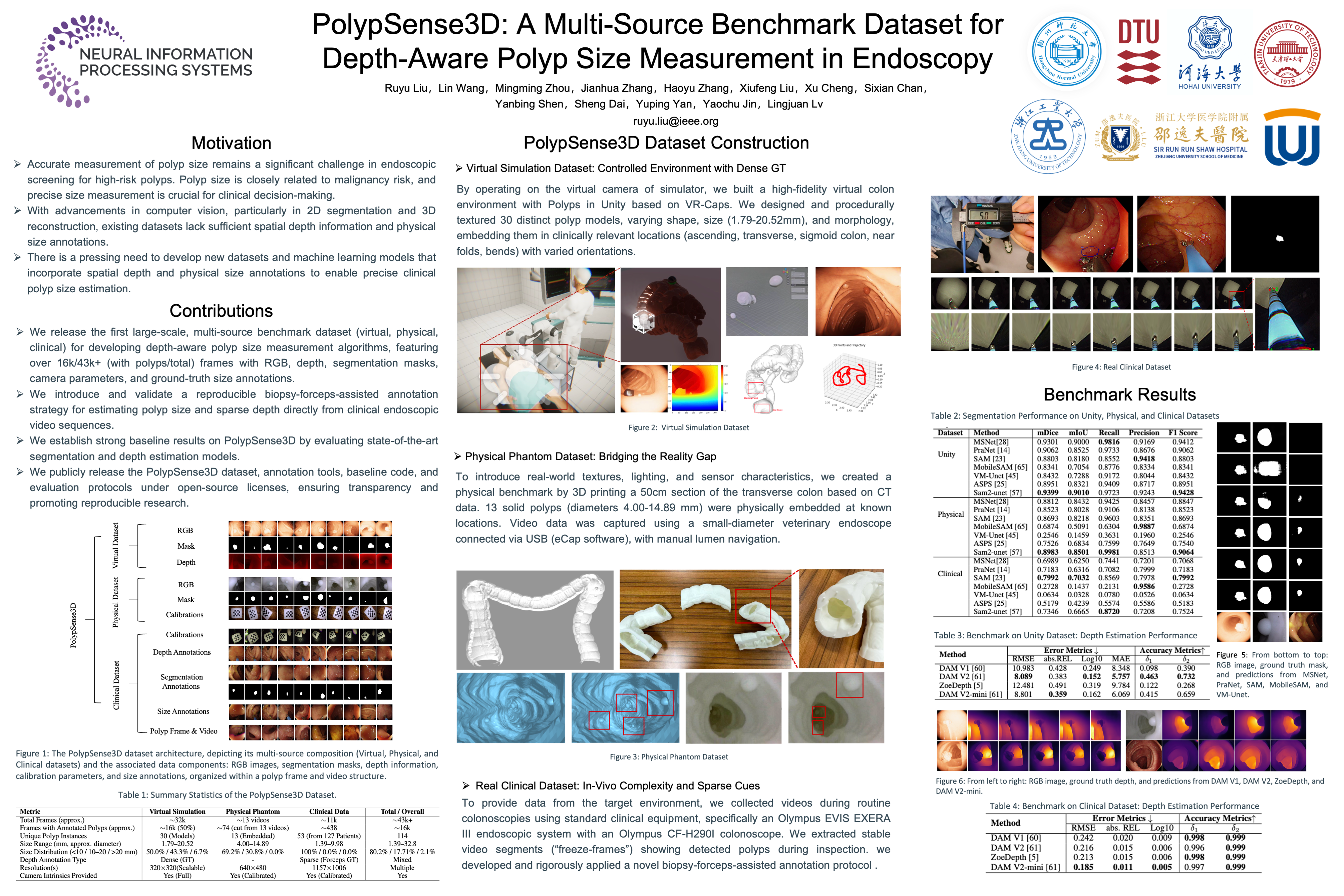
Accurate polyp sizing during endoscopy is crucial for cancer risk assessment but is hindered by subjective methods and inadequate datasets lacking integrated 2D appearance, 3D structure, and real-world size information. We introduce PolypSense3D, the first multi-source benchmark dataset specifically targeting depth-aware polyp size measurement. It uniquely integrates over 43,000 frames from virtual simulations, physical phantoms, and clinical sequences, providing synchronized RGB, dense/sparse depth, segmentation masks, camera parameters, and millimeter-scale size labels derived via a novel forceps-assisted in-vivo annotation technique. To establish its value, we benchmark state-of-the-art segmentation and depth estimation models. Results quantify significant domain gaps between simulated/phantom and clinical data and reveal substantial error propagation from perception stages to final size estimation, with the best fully automated pipelines achieving an average Mean Absolute Error (MAE) of 0.95 mm on the clinical data subset. Publicly released under CC BY-SA 4.0 with code and evaluation protocols, PolypSense3D offers a standardized platform to accelerate research in robust, clinically relevant quantitative endoscopic vision. The benchmark dataset and code are available at: https://github.com/HNUicda/PolypSense3D and https://doi.org/10.7910/DVN/K13H89.
No Object Is an Island: Enhancing 3D Semantic Segmentation Generalization with Diffusion Models
Fan Li ⋅ Xuan Wang ⋅ Xuanbin Wang ⋅ Zhaoxiang Zhang ⋅ Yuelei Xu
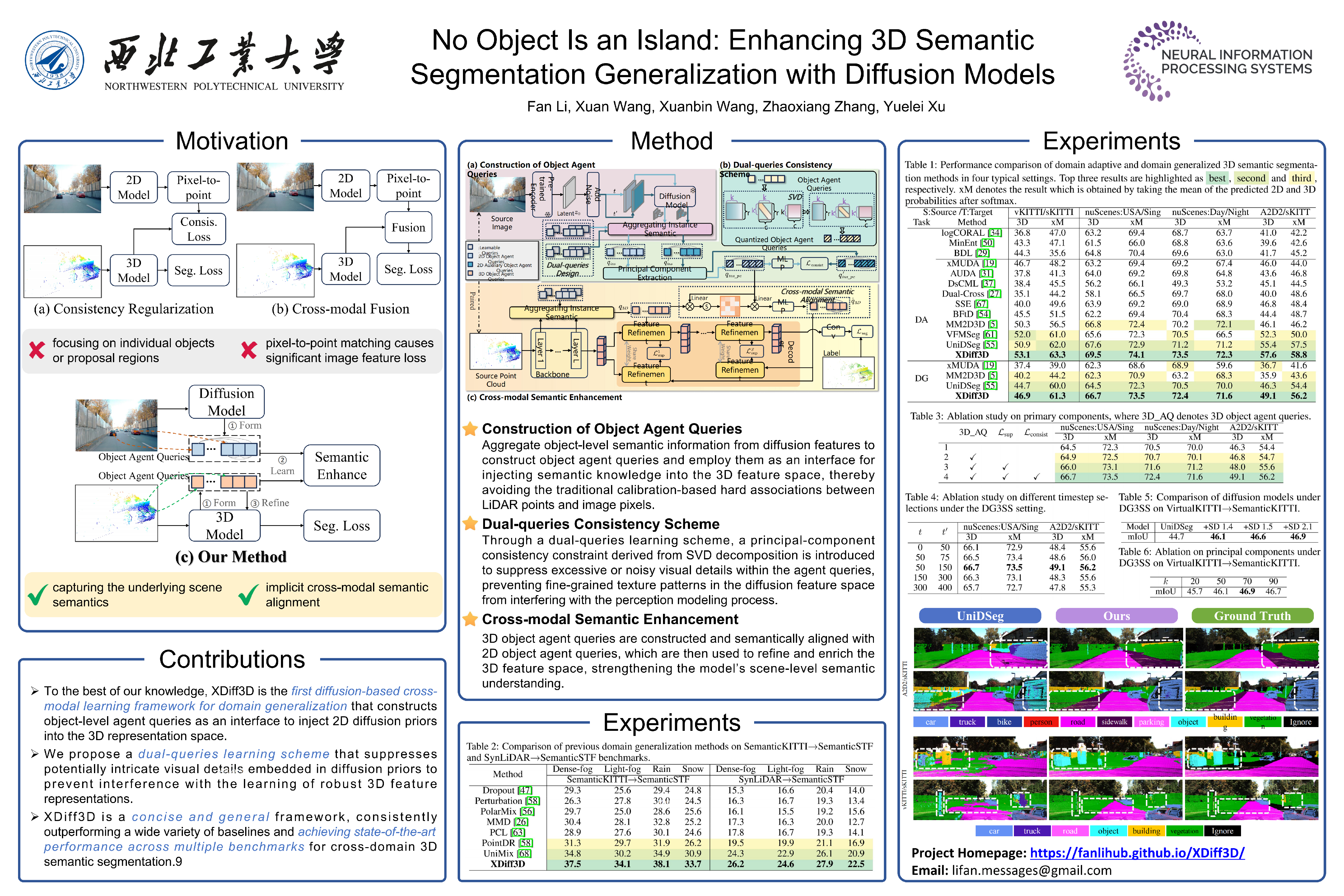
Enhancing the cross-domain generalization of 3D semantic segmentation is a pivotal task in computer vision that has recently gained increasing attention. Most existing methods, whether using consistency regularization or cross-modal feature fusion, focus solely on individual objects while overlooking implicit semantic dependencies among them, resulting in the loss of useful semantic information. Inspired by the diffusion model's ability to flexibly compose diverse objects into high-quality images across varying domains, we seek to harness its capacity for capturing underlying contextual distributions and spatial arrangements among objects to address the challenging task of cross-domain 3D semantic segmentation. In this paper, we propose a novel cross-modal learning framework based on diffusion models to enhance the generalization of 3D semantic segmentation, named XDiff3D. XDiff3D comprises three key ingredients: (1) constructing object agent queries from diffusion features to aggregate instance semantic information; (2) decoupling fine-grained local details from object agent queries to prevent interference with 3D semantic representation; (3) leveraging object agent queries as an interface to enhance the modeling of object semantic dependencies in 3D representations. Extensive experiments validate the effectiveness of our method, achieving state-of-the-art performance across multiple benchmarks in different task settings. Code is available at \url{https://github.com/FanLiHub/XDiff3D}.
Adaptive Batch-Wise Sample Scheduling for Direct Preference Optimization
Zixuan Huang ⋅ Yikun Ban ⋅ Lean Fu ⋅ Xiaojie Li ⋅ Zhongxiang Dai ⋅ Jianxin Li ⋅ deqing wang
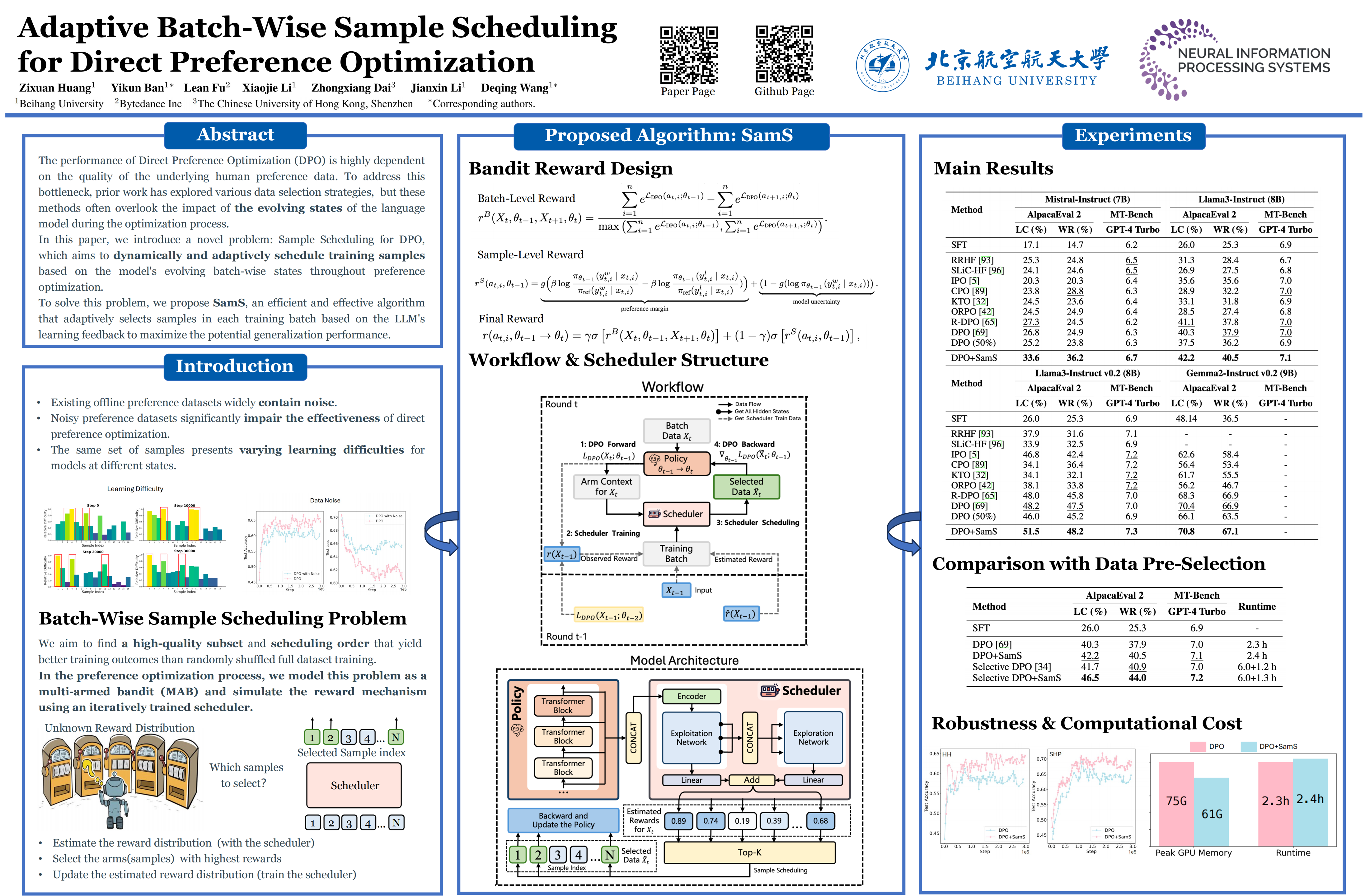
Direct Preference Optimization (DPO) has emerged as an effective approach for aligning large language models (LLMs) with human preferences. However, its performance is highly dependent on the quality of the underlying human preference data. To address this bottleneck, prior work has explored various data selection strategies, but these methods often overlook the impact of the evolving states of the language model during the optimization process. In this paper, we introduce a novel problem: Sample Scheduling for DPO, which aims to dynamically and adaptively schedule training samples based on the model's evolving batch-wise states throughout preference optimization. To solve this problem, we propose SamS, an efficient and effective algorithm that adaptively selects samples in each training batch based on the LLM's learning feedback to maximize the potential generalization performance. Notably, without modifying the core DPO algorithm, simply integrating SamS significantly improves performance across tasks, with minimal additional computational overhead. This work points to a promising new direction for improving LLM alignment through batch-wise sample selection, with potential generalization to RLHF and broader supervised learning paradigms.
Addressing Mark Imbalance in Integration-free Marked Temporal Point Processes
Sishun Liu ⋅ KE DENG ⋅ Yongli Ren ⋅ Yan Wang ⋅ Xiuzhen Zhang
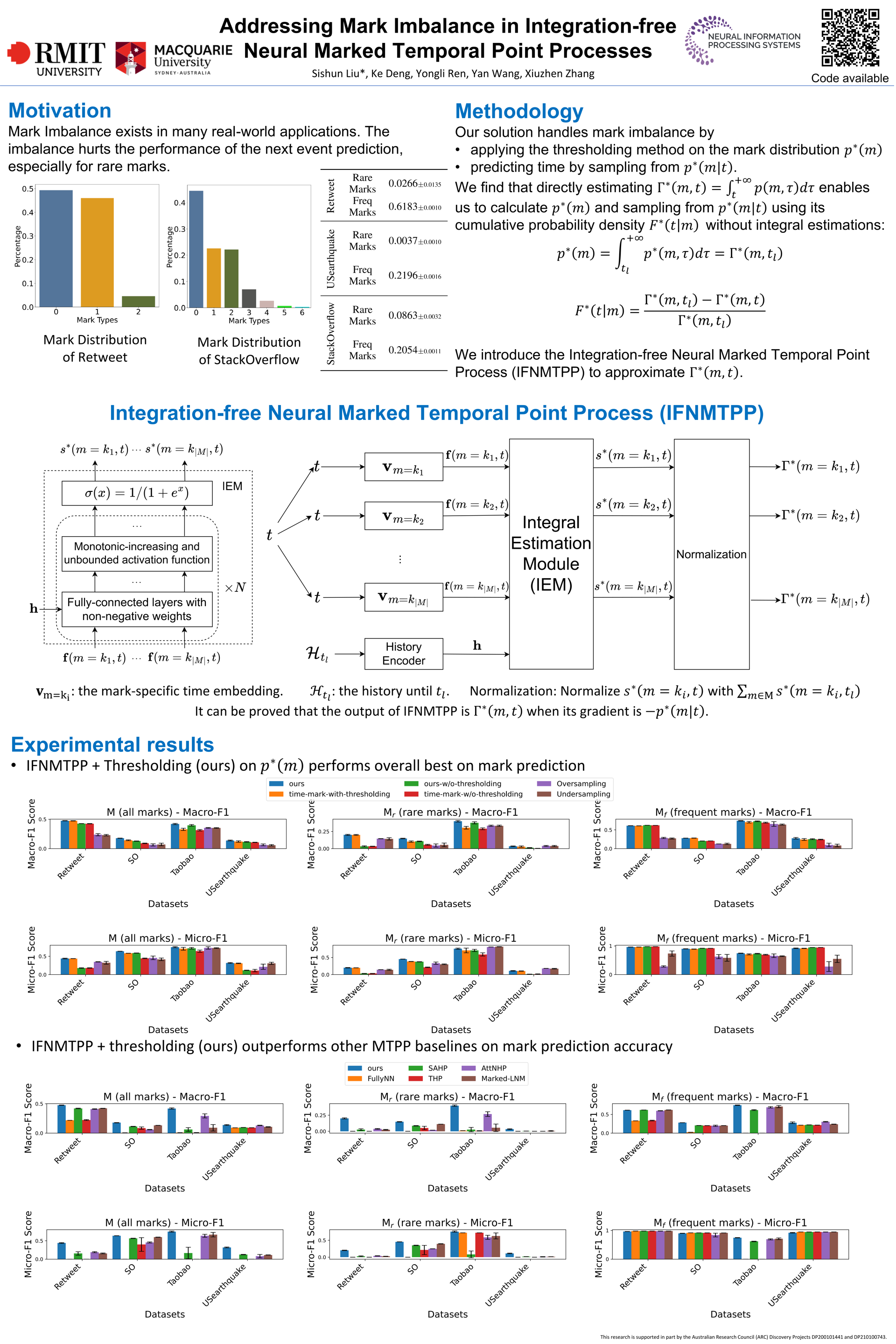
Marked Temporal Point Process (MTPP) has been well studied to model the event distribution in marked event streams, which can be used to predict the mark and arrival time of the next event. However, existing studies overlook that the distribution of event marks is highly imbalanced in many real-world applications, with some marks being frequent but others rare. The imbalance poses a significant challenge to the performance of the next event prediction, especially for events of rare marks. To address this issue, we propose a thresholding method, which learns thresholds to tune the mark probability normalized by the mark's prior probability to optimize mark prediction, rather than predicting the mark directly based on the mark probability as in existing studies. In conjunction with this method, we predict the mark first and then the time. In particular, we develop a novel neural Marked Temporal Point Process (MTPP) model to support effective time sampling and estimation of mark probability without computationally expensive numerical improper integration. Extensive experiments on real-world datasets demonstrate the superior performance of our solution against various baselines for the next event mark and time prediction. The code is available at https://github.com/undes1red/IFNMTPP.
An Evidence-Based Post-Hoc Adjustment Framework for Anomaly Detection Under Data Contamination
Sukanya Patra ⋅ Souhaib Ben Taieb
Unsupervised anomaly detection (AD) methods typically assume clean training data, yet real-world datasets often contain undetected or mislabeled anomalies, leading to significant performance degradation. Existing solutions require access to the training pipelines, data or prior knowledge of the proportions of anomalies in the data, limiting their real-world applicability. To address this challenge, we propose EPHAD, a simple yet effective test-time adaptation framework that updates the outputs of AD models trained on contaminated datasets using evidence gathered at test time. Our approach integrates the prior knowledge captured by the AD model trained on contaminated datasets with evidence derived from multimodal foundation models like Contrastive Language-Image Pre-training (CLIP), classical AD methods like the Local Outlier Factor or domain-specific knowledge. We illustrate the intuition behind EPHAD using a synthetic toy example and validate its effectiveness through comprehensive experiments across eight visual AD datasets, twenty-six tabular AD datasets, and a real-world industrial AD dataset. Additionally, we conduct an ablation study to analyse hyperparameter influence and robustness to varying contamination levels, demonstrating the versatility and robustness of EPHAD across diverse AD models and evidence pairs. To ensure reproducibility, our code is publicly available at https://github.com/sukanyapatra1997/EPHAD.
AutoPartGen: Autoregressive 3D Part Generation and Discovery
Minghao Chen ⋅ Jianyuan Wang ⋅ Roman Shapovalov ⋅ Tom Monnier ⋅ Hyunyoung Jung ⋅ Dilin Wang ⋅ Rakesh Ranjan ⋅ Iro Laina ⋅ Andrea Vedaldi
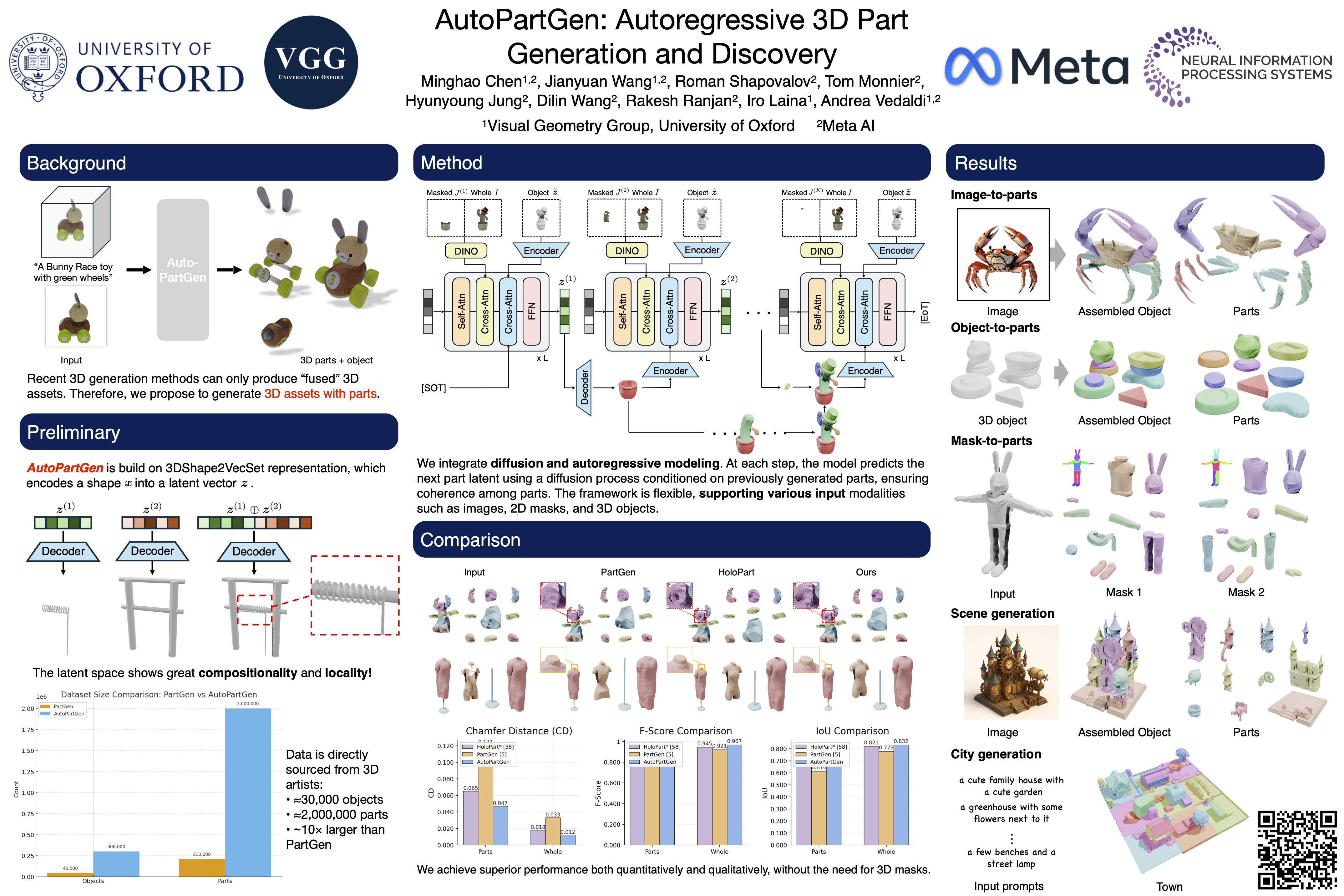
We introduce AutoPartGen, a model that generates objects composed of 3D parts in an autoregressive manner. This model can take as input an image of an object, 2D masks of the object's parts, or an existing 3D object, and generate a corresponding compositional 3D reconstruction. Our approach builds upon 3DShape2VecSet, a recent latent 3D representation with powerful geometric expressiveness. We observe that this latent space exhibits strong compositional properties, making it particularly well-suited for part-based generation tasks. Specifically, AutoPartGen generates object parts autoregressively, predicting one part at a time while conditioning on previously generated parts and additional inputs, such as 2D images, masks, or 3D objects. This process continues until the model decides that all parts have been generated, thus determining automatically the type and number of parts. The resulting parts can be seamlessly assembled into coherent objects or scenes without requiring additional optimization. We evaluate both the overall 3D generation capabilities and the part-level generation quality of AutoPartGen, demonstrating that it achieves state-of-the-art performance in 3D part generation.
Detecting Data Deviations in Electronic Health Records
Kaiping Zheng ⋅ Horng-Ruey Chua ⋅ Beng Chin Ooi
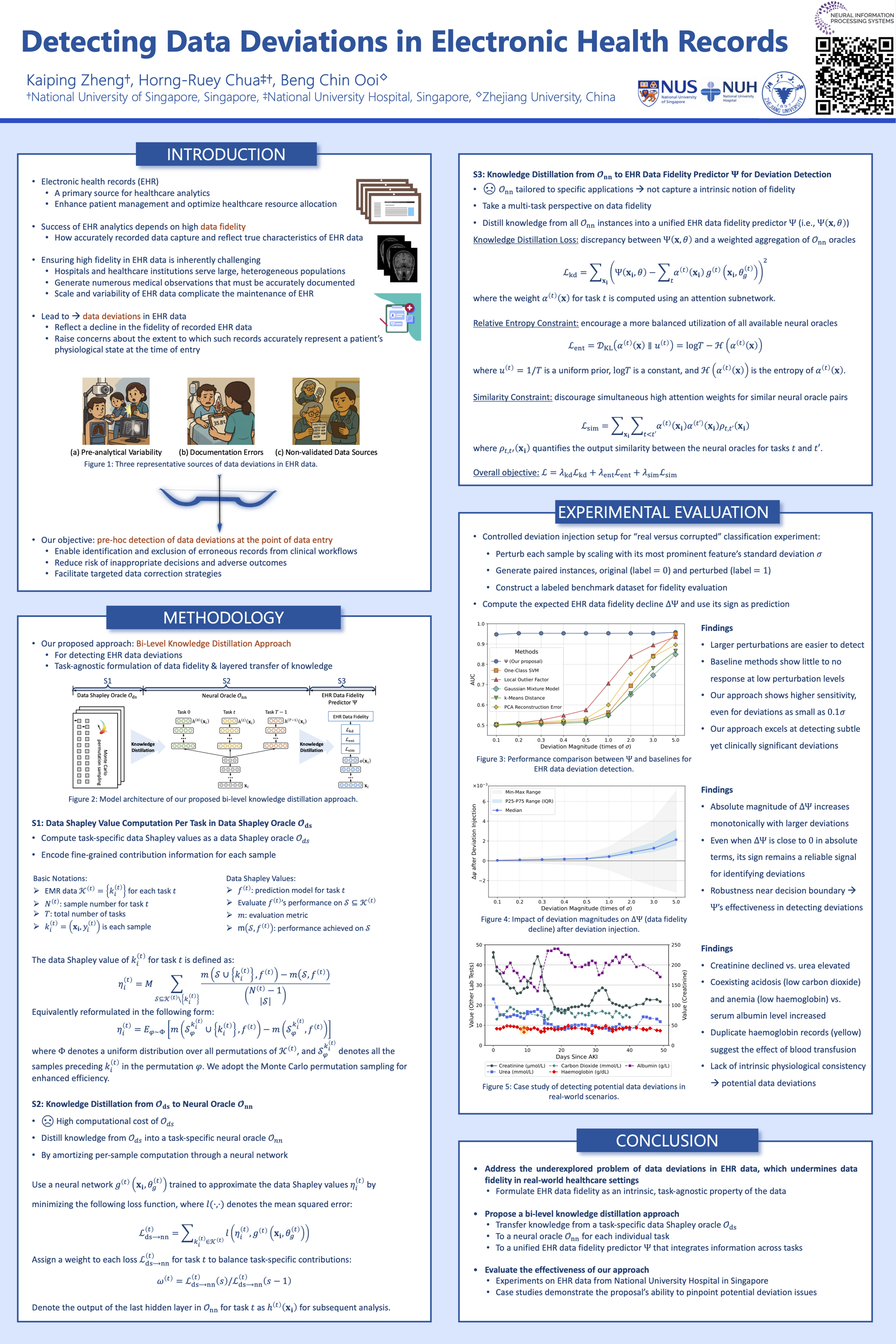
Data deviations in electronic health records (EHR) refer to discrepancies between recorded entries and a patient’s actual physiological state, indicating a decline in EHR data fidelity. Such deviations can result from pre-analytical variability, documentation errors, or unvalidated data sources. Effectively detecting data deviations is clinically valuable for identifying erroneous records, excluding them from downstream clinical workflows, and informing corrective actions. Despite its importance and practical relevance, this problem remains largely underexplored in existing research. To bridge this gap, we propose a bi-level knowledge distillation approach centered on a task-agnostic formulation of EHR data fidelity as an intrinsic measure of data reliability. Our approach performs layered knowledge distillation in two levels: from a computation-intensive, task-specific data Shapley oracle to a neural oracle for individual tasks, and then to a unified EHR data fidelity predictor. This design enables the integration of task-specific insights into a holistic assessment of a patient’s EHR data fidelity from a multi-task perspective. By tracking the outputs of this learned predictor, we detect potential data deviations in EHR data. Experiments on both real-world EHR data from National University Hospital in Singapore and the public MIMIC-III dataset consistently validate the effectiveness of our approach in detecting data deviations in EHR data. Case studies further demonstrate its practical value in identifying clinically meaningful data deviations.
Diffusion-Guided Graph Data Augmentation
Maria Marrium ⋅ Arif Mahmood ⋅ Muhammad Haris Khan ⋅ M. Shakeel ⋅ Wenxiong Kang
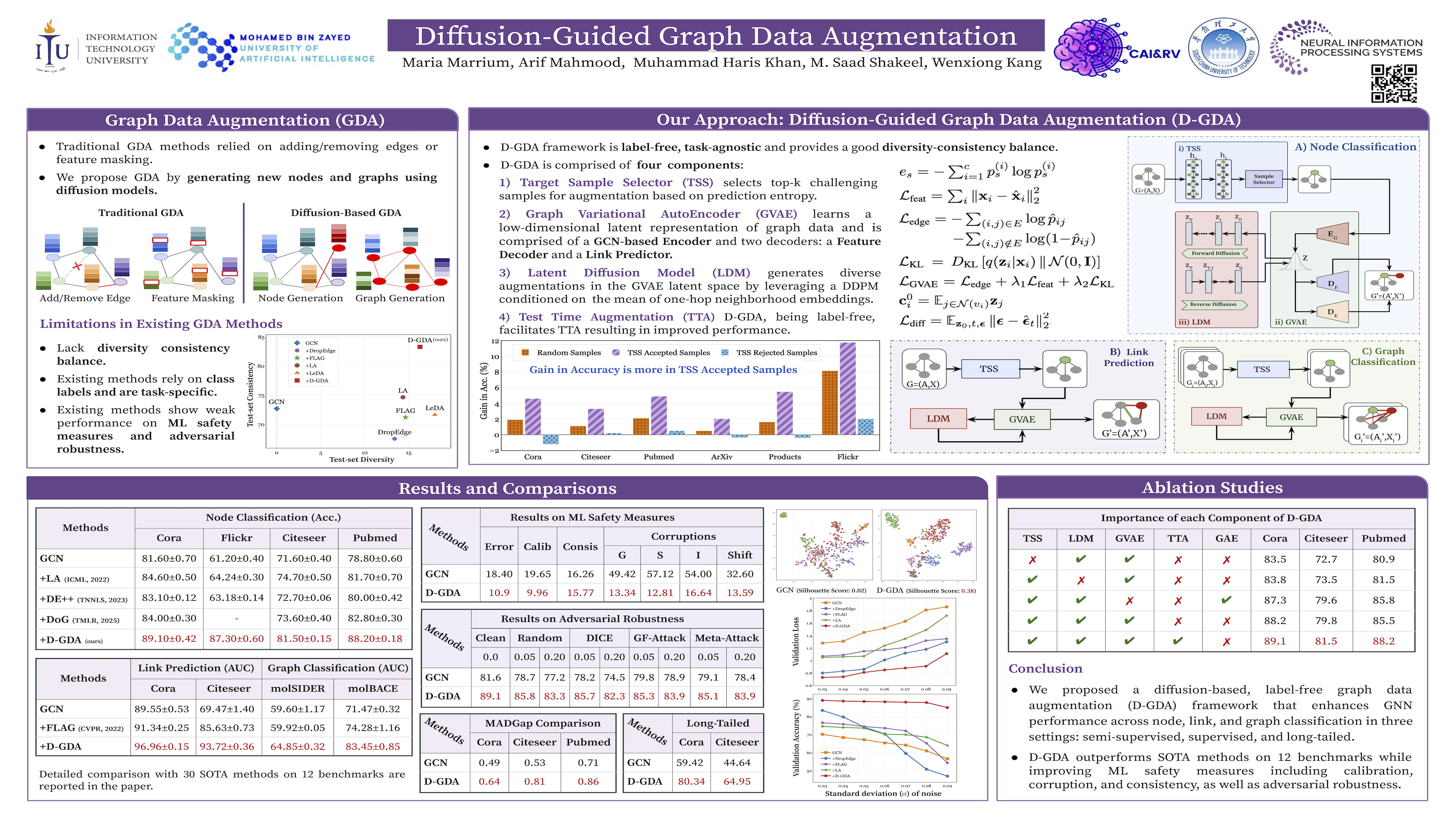
Graph Neural Networks (GNNs) have achieved remarkable success in a wide range of applications. However, when trained on limited or low-diversity datasets, GNNs are prone to overfitting and memorization, which impacts their generalization. To address this, graph data augmentation (GDA) has become a crucial task to enhance the performance and generalization of GNNs. Traditional GDA methods employ simple transformations that result in limited performance gains. Although recent diffusion-based augmentation methods offer improved results, they are sparse, task-specific, and constrained by class labels. In this work, we propose a more general and effective diffusion-based GDA framework that is task-agnostic and label-free. For better training stability and reduced computational cost, we employ a graph variational auto-encoder (GVAE) to learn a compact latent graph representation. A diffusion model is used in the learned latent space to generate both consistent and diverse augmentations. For a fixed augmentation budget, our algorithm selects a subset of samples that would benefit the most from the augmentation. To further improve performance, we also perform test-time augmentation, leveraged by the label-free nature of our method. Thanks to the efficient utilization of GVAE and latent diffusion, our algorithm significantly enhances machine learning safety measures, including calibration, robustness to corruptions, and prediction consistency. Moreover, our method has shown improved robustness against four types of adversarial attacks and achieves better generalization performance. To demonstrate the effectiveness of the proposed method, we compare it with 30 existing methods on 12 benchmark datasets across node classification, link prediction, and graph classification in various learning settings, including semi-supervised, supervised, and long-tailed data distributions. The code will soon be made publicly available.
Don’t Give Up on Democratizing AI for the Wrong Reasons
Annette Zimmermann ⋅ Andrew Zeppa ⋅ Srijan Pandey ⋅ Kenneth Diao

The claim that the AI community, or society at large, should ‘democratize AI’ has attracted considerable critical attention and controversy. Two core problems have arisen and remain unsolved: conceptual disagreement persists about what democratizing AI means; normative disagreement persists over whether democratizing AI is ethically and politically desirable. We identify eight common AI democratization traps: democratization-skeptical arguments that seem plausible at first glance, but turn out to be misconceptions. We develop arguments about how to resist each trap. We conclude that, while AI democratization may well have drawbacks, we should be cautious about dismissing AI democratization prematurely and for the wrong reasons. We offer a constructive roadmap for developing alternative conceptual and normative approaches to democratizing AI that successfully avoid the traps.
Dr. RAW: Towards General High-Level Vision from RAW with Efficient Task Conditioning
Wenjun Huang ⋅ Ziteng Cui ⋅ Yinqiang Zheng ⋅ Yirui He ⋅ Tatsuya Harada ⋅ Mohsen Imani
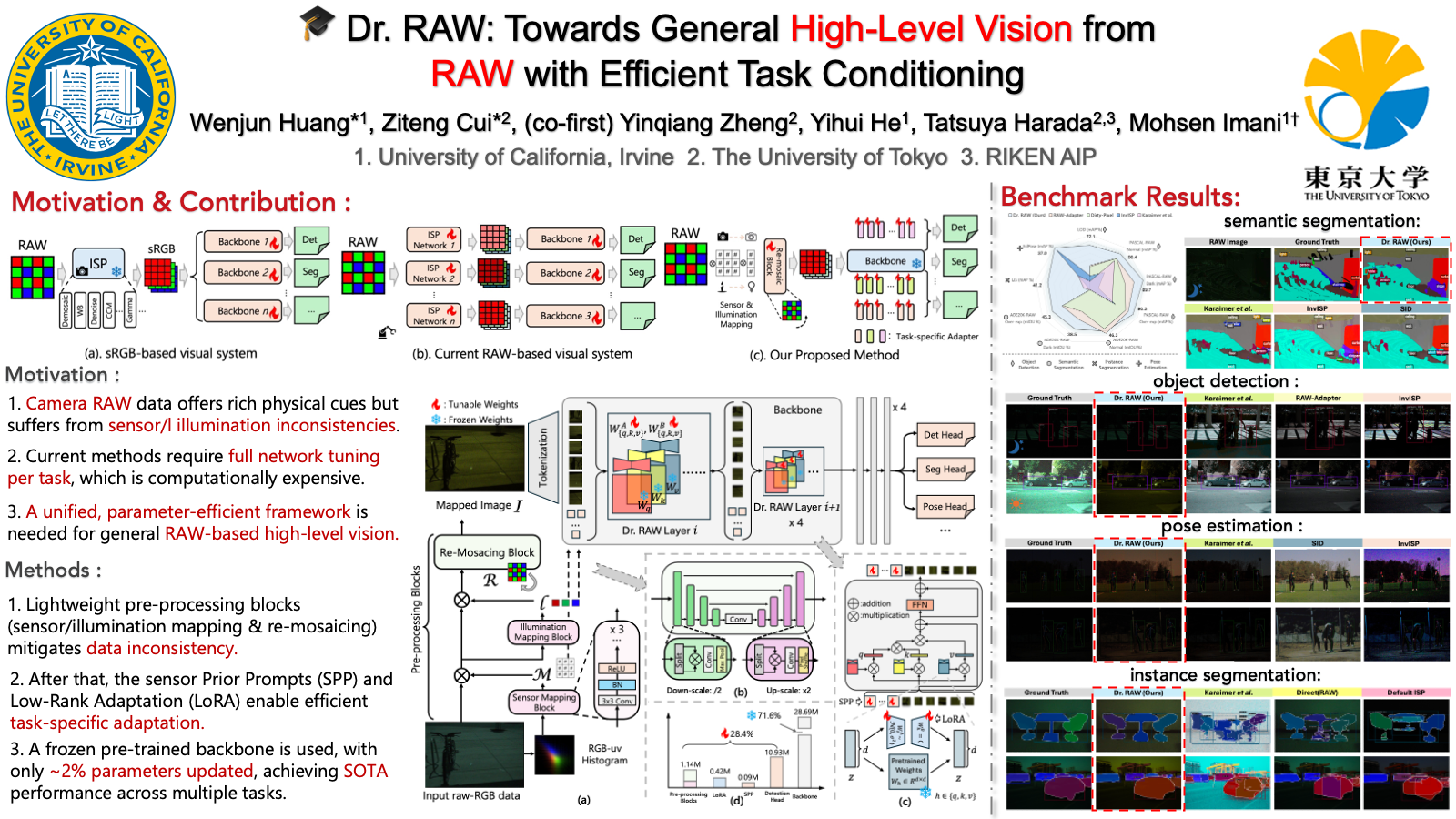
We introduce Dr. RAW, a unified and tuning-efficient framework for high-level computer vision tasks directly operating on camera RAW data. Unlike previous approaches that optimize image signal processing (ISP) pipelines and fully fine-tune networks for each task, Dr. RAW achieves state-of-the-art performance with minimal parameter updates. At the input stage, we apply lightweight pre-processing modules, sensor and illumination mapping, followed by re-mosaicing, to mitigate data inconsistencies stemming from sensor variation and lighting. At the network level, we introduce task-specific adaptation through two modules: Sensor Prior Prompts (SPP) and Low-Rank Adaptation (LoRA). SPP injects sensor-aware conditioning into the network via learnable prompts derived from imaging priors, while LoRA enables efficient task-specific tuning by updating only low-rank matrices in key backbone layers. Despite minimal tuning, our method delivers superior results across four RAW-based tasks (object detection, semantic segmentation, instance segmentation, and pose estimation) on nine datasets encompassing low-light and over-exposed conditions. By harnessing the intrinsic physical cues of RAW data alongside parameter-efficient techniques, our method advances RAW-based vision systems, achieving both high accuracy and computational economy. We will release our source code.
Efficient Knowledge Transfer in Federated Recommendation for Joint Venture Ecosystem
Yichen Li ⋅ Yijing Shan ⋅ YI LIU ⋅ Haozhao Wang ⋅ Cheng Wang ⋅ wangshi.ww ⋅ Yi Wang ⋅ Ruixuan Li
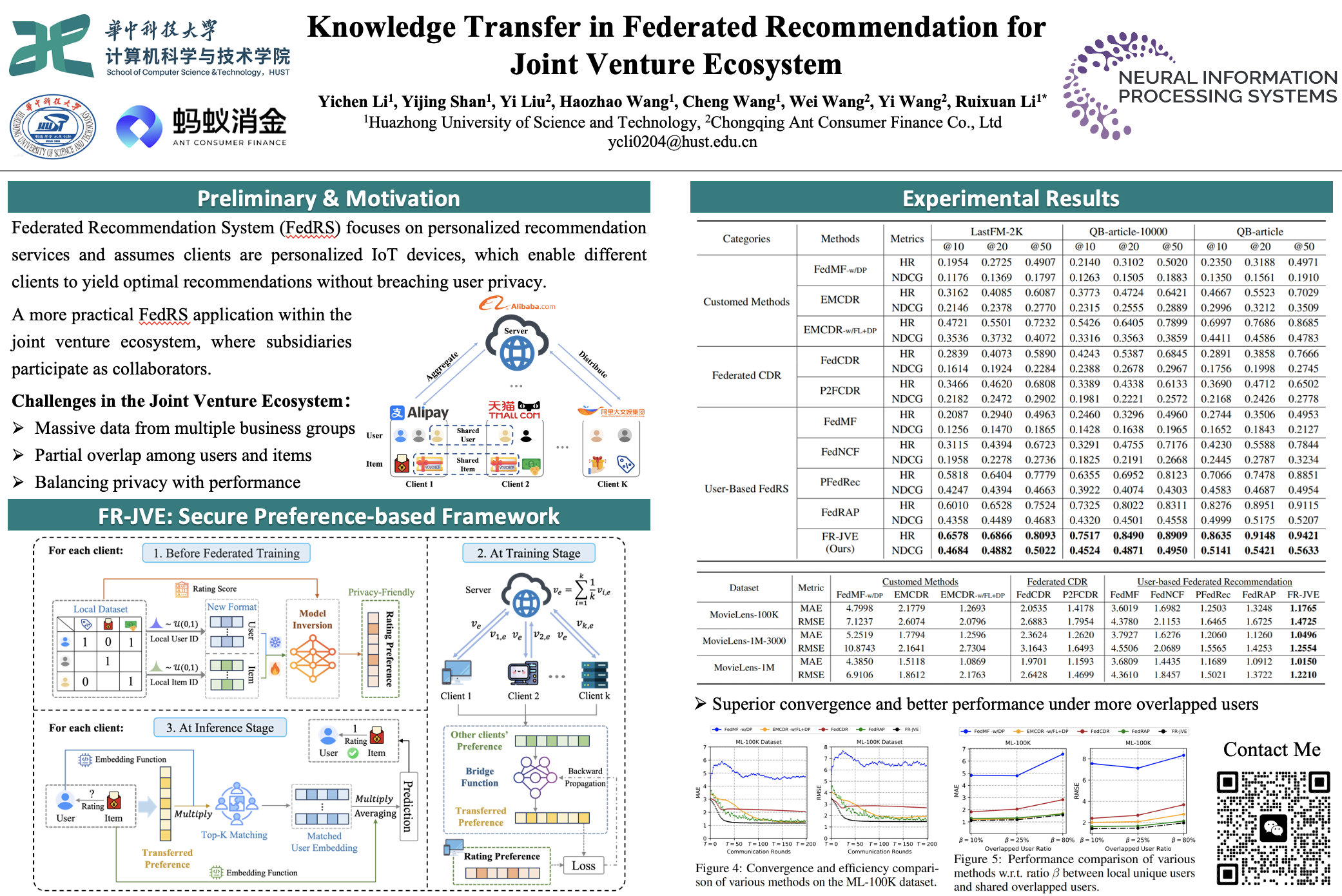
The current Federated Recommendation System (FedRS) focuses on personalized recommendation services and assumes clients are personalized IoT devices (e.g., Mobile phones). In this paper, we deeply dive into new but practical FedRS applications within the joint venture ecosystem. Subsidiaries engage as participants with their users and items. However, in such a situation, merely exchanging item embedding is insufficient, as user bases always exhibit both overlaps and exclusive segments, demonstrating the complexity of user information. Meanwhile, directly uploading user information is a violation of privacy and unacceptable. To tackle the above challenges, we propose an efficient and privacy-enhanced federated recommendation for the joint venture ecosystem (FR-JVE) that each client transfers more common knowledge from other clients with a distilled user's \textit{rating preference} from the local dataset. More specifically, we first transform the local data into a new format and apply model inversion techniques to distill the rating preference with frozen user gradients before the federated training. Then, a bridge function is employed on each client side to align the local rating preference and aggregated global preference in a privacy-friendly manner. Finally, each client matches similar users to make a better prediction for overlapped users. From a theoretical perspective, we analyze how effectively FR-JVE can guarantee user privacy. Empirically, we show that FR-JVE achieves superior performance compared to state-of-the-art methods.
Empirical Study on Robustness and Resilience in Cooperative Multi-Agent Reinforcement Learning
Simin Li ⋅ Zihao Mao ⋅ Hanxiao Li ⋅ Zonglei Jing ⋅ Zhuohang bian ⋅ Jun Guo ⋅ Li Wang ⋅ Zhuoran Han ⋅ Ruixiao Xu ⋅ Xin Yu ⋅ Chengdong Ma ⋅ Yuqing Ma ⋅ Bo An ⋅ Yaodong Yang ⋅ Weifeng Lv ⋅ Xianglong Liu
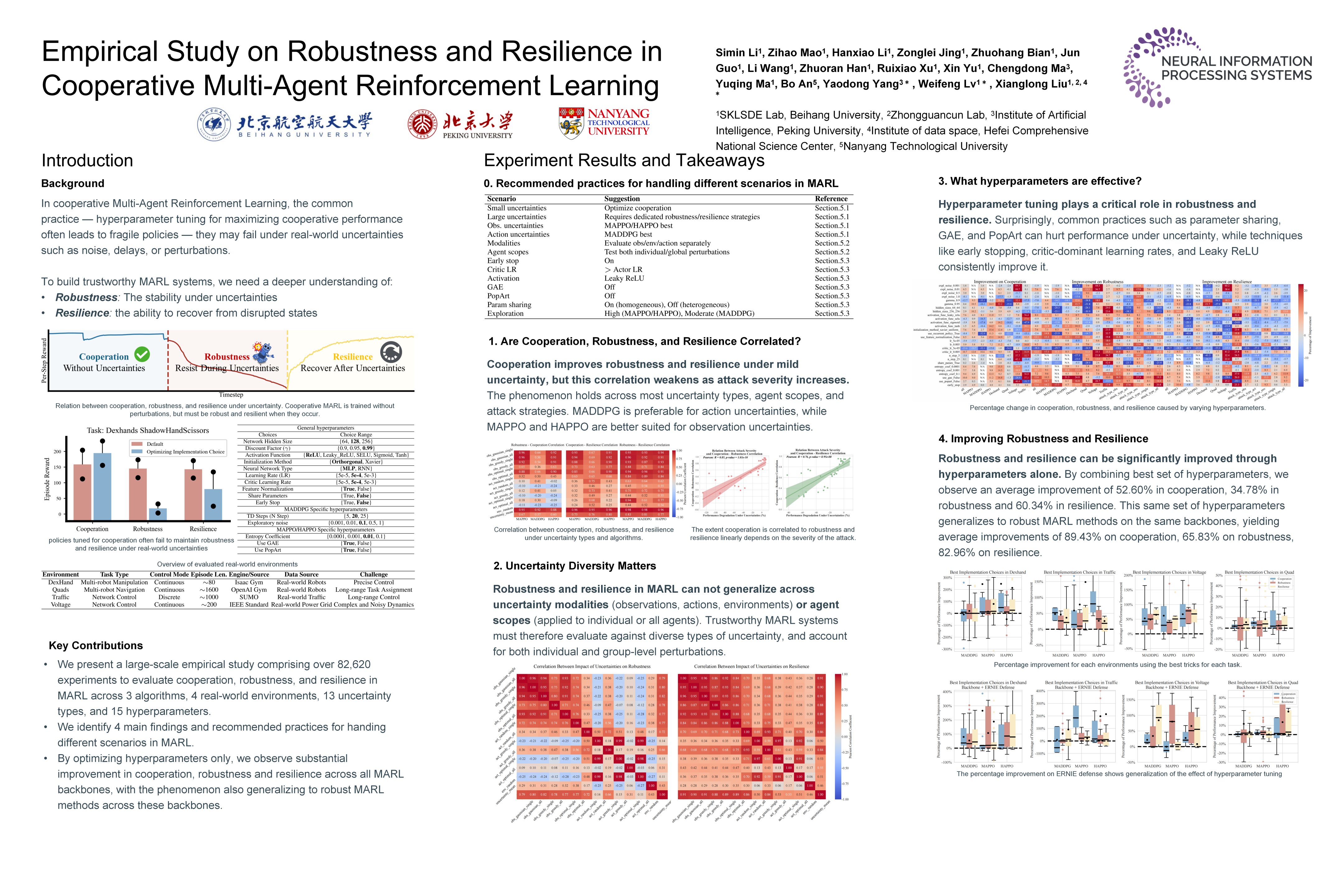
In cooperative Multi-Agent Reinforcement Learning (MARL), it is a common practice to tune hyperparameters in ideal simulated environments to maximize cooperative performance. However, policies tuned for cooperation often fail to maintain robustness and resilience under real-world uncertainties. Building trustworthy MARL systems requires a deep understanding of \emph{robustness}, which ensures stability under uncertainties, and \emph{resilience}, the ability to recover from disruptions—a concept extensively studied in control systems but largely overlooked in MARL. In this paper, we present a large-scale empirical study comprising over 82,620 experiments to evaluate cooperation, robustness, and resilience in MARL across 4 real-world environments, 13 uncertainty types, and 15 hyperparameters. Our key findings are: (1) Under mild uncertainty, optimizing cooperation improves robustness and resilience, but this link weakens as perturbations intensify. Robustness and resilience also varies by algorithm and uncertainty type. (2) Robustness and resilience do not generalize across uncertainty modalities or agent scopes: policies robust to action noise for all agents may fail under observation noise on a single agent. (3) Hyperparameter tuning is critical for trustworthy MARL: surprisingly, standard practices like parameter sharing, GAE, and PopArt can hurt robustness, while early stopping, high critic learning rates, and Leaky ReLU consistently help. By optimizing hyperparameters only, we observe substantial improvement in cooperation, robustness and resilience across all MARL backbones, with the phenomenon also generalizing to robust MARL methods across these backbones.
Enhancing GUI Agent with Uncertainty-Aware Self-Trained Evaluator
Gongwei Chen ⋅ Lirong Jie ⋅ Lexiao Zou ⋅ Weili Guan ⋅ Miao Zhang ⋅ Liqiang Nie
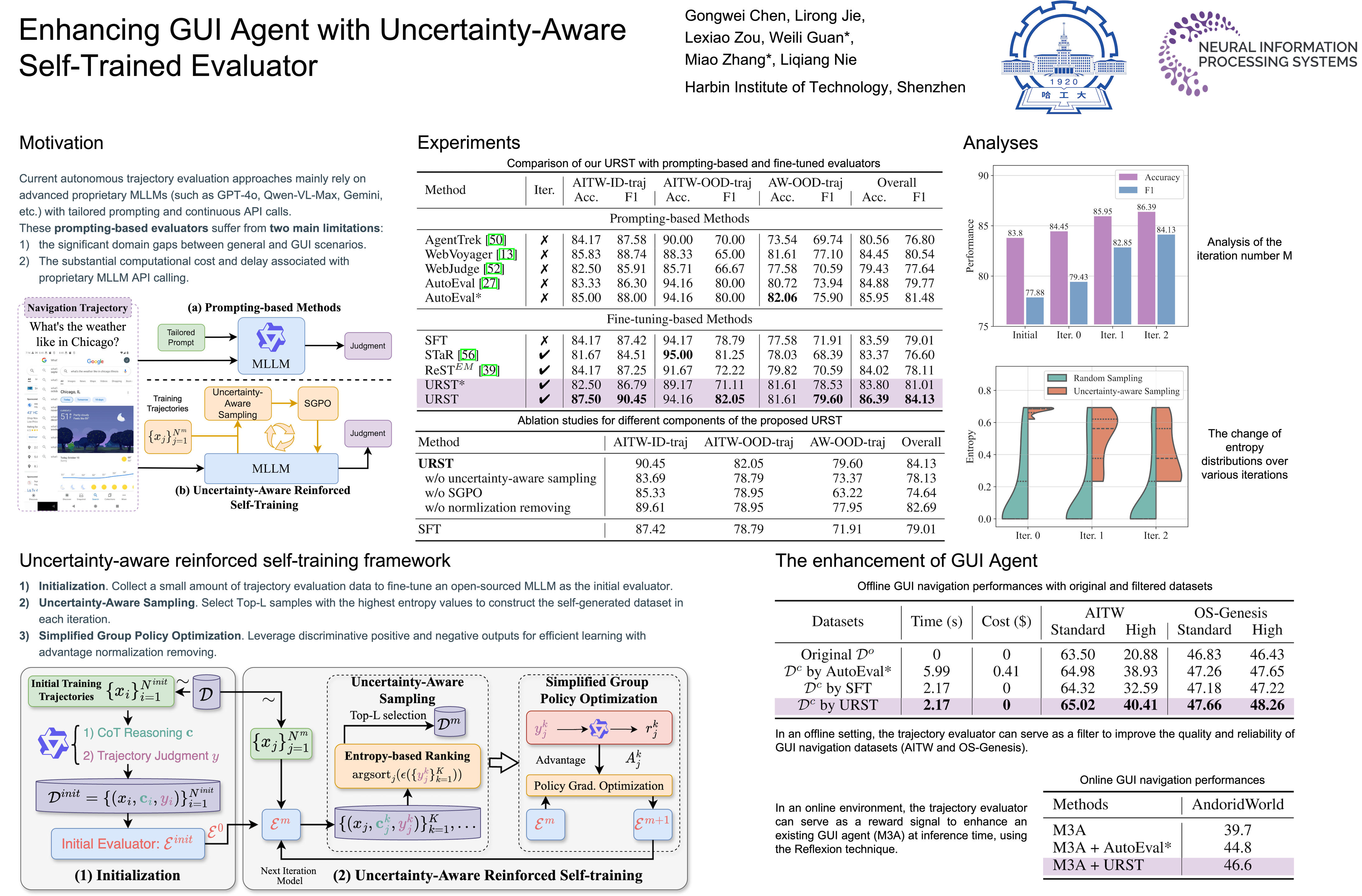
Benefiting from the availability of extensive navigation trajectories, both manually and automatically annotated, current graphical user interface (GUI) agents have achieved remarkable advancements in performance. However, these annotated datasets often contain substantial noise, which impedes effective agent training and underscores the necessity for rigorous trajectory quality assessment. In contrast to existing prompting-based evaluators that rely on proprietary multimodal large language models (MLLMs), we propose an Uncertainty-aware Reinforced Self-Training (URST) framework to train lightweight MLLMs for efficient and reliable trajectory evaluation. URST iteratively fine-tunes MLLMs using their own generated thoughts and judgments to enable self-improvement, while its uncertainty-aware sampling strategy ensures the selection of the most informative training examples. To further enhance reasoning and judgment capabilities, we propose a simplified group policy optimization approach that effectively leverages diverse positive and negative samples for evaluator learning. Our evaluator demonstrates superior judgment performance across both in-domain and out-of-domain datasets. When used to filter navigation datasets, it consistently leads to performance improvements in training GUI agents.
FrameShield: Adversarially Robust Video Anomaly Detection
Mojtaba Nafez ⋅ Mobina Poulaei ⋅ Nikan Vasei ⋅ Bardia moakhar ⋅ Mohammad Sabokrou ⋅ Mohammad Hossein Rohban
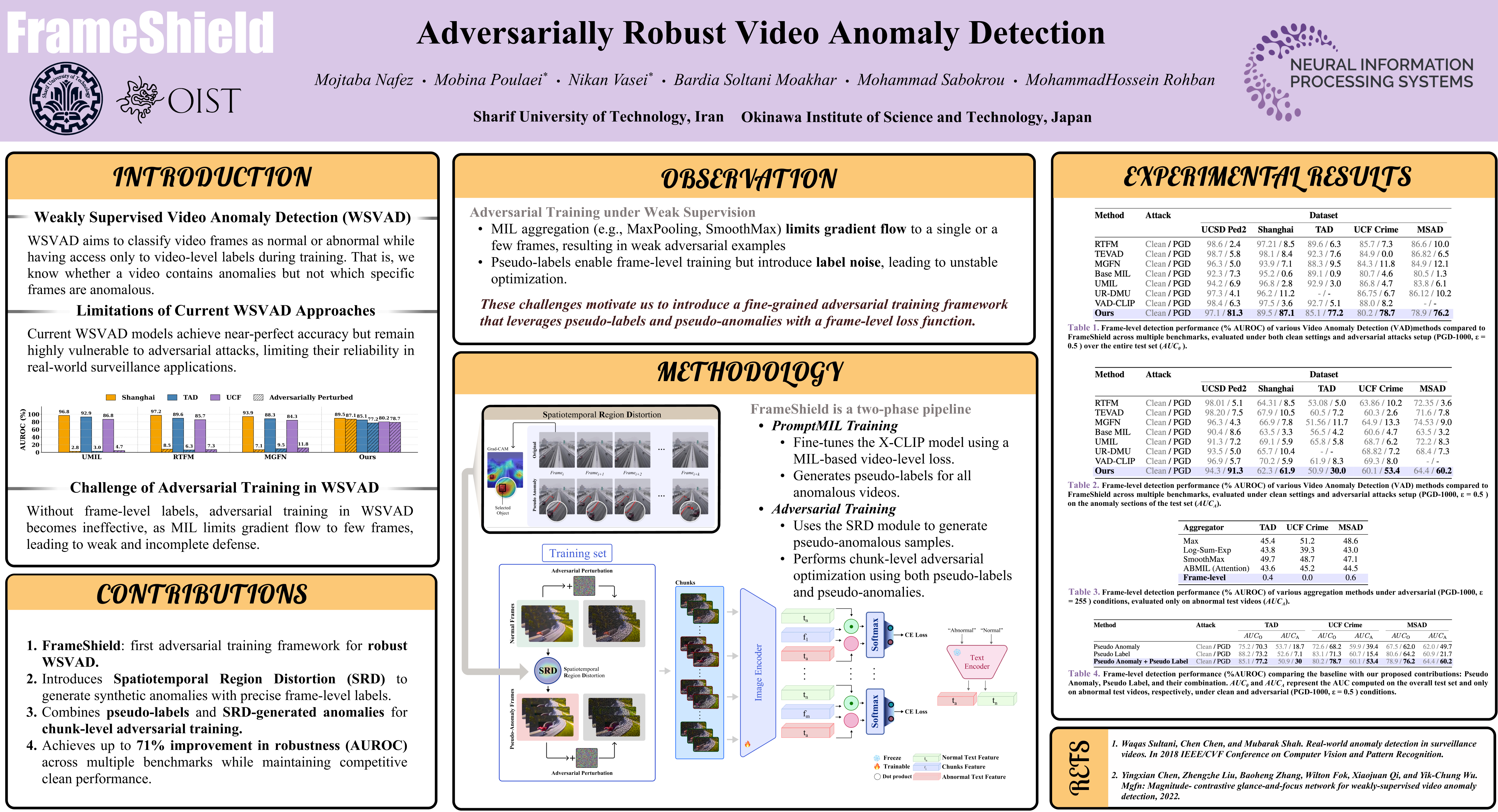
Weakly Supervised Video Anomaly Detection (WSVAD) has achieved notable advancements, yet existing models remain vulnerable to adversarial attacks, limiting their reliability. Due to the inherent constraints of weak supervision—where only video-level labels are provided despite the need for frame-level predictions—traditional adversarial defense mechanisms, such as adversarial training, are not effective since video-level adversarial perturbations are typically weak and inadequate. To address this limitation, pseudo-labels generated directly from the model can enable frame-level adversarial training; however, these pseudo-labels are inherently noisy, significantly degrading performance. We therefore introduce a novel Pseudo-Anomaly Generation method called Spatiotemporal Region Distortion (SRD), which creates synthetic anomalies by applying severe augmentations to localized regions in normal videos while preserving temporal consistency. Integrating these precisely annotated synthetic anomalies with the noisy pseudo-labels substantially reduces label noise, enabling effective adversarial training. Extensive experiments demonstrate that our method significantly enhances the robustness of WSVAD models against adversarial attacks, outperforming state-of-the-art methods by an average of 71.0\% in overall AUROC performance across multiple benchmarks. The implementation and code are publicly available at FrameShield (GitHub).
Hierarchical Self-Attention: Generalizing Neural Attention Mechanics to Multi-Scale Problems
Saeed Amizadeh ⋅ Sara Abdali ⋅ Yinheng Li ⋅ Kazuhito Koishida
Transformers and their attention mechanism have been revolutionary in the field of Machine Learning. While originally proposed for the language data, they quickly found their way to the image, video, graph, etc. data modalities with various signal geometries. Despite this versatility, generalizing the attention mechanism to scenarios where data is presented at different scales from potentially different modalities is not straightforward. The attempts to incorporate hierarchy and multi-modality within transformers are largely based on ad hoc heuristics, which are not seamlessly generalizable to similar problems with potentially different structures. To address this problem, in this paper, we take a fundamentally different approach: we first propose a mathematical construct to represent multi-modal, multi-scale data. We then mathematically derive the neural attention mechanics for the proposed construct from the first principle of entropy minimization. We show that the derived formulation is optimal in the sense of being the closest to the standard Softmax attention while incorporating the inductive biases originating from the hierarchical/geometric information of the problem. We further propose an efficient algorithm based on dynamic programming to compute our derived attention mechanism. By incorporating it within transformers, we show that the proposed hierarchical attention mechanism not only can be employed to train transformer models in hierarchical/multi-modal settings from scratch, but it can also be used to inject hierarchical information into classical, pre-trained transformer models post training, resulting in more efficient models in zero-shot manner.
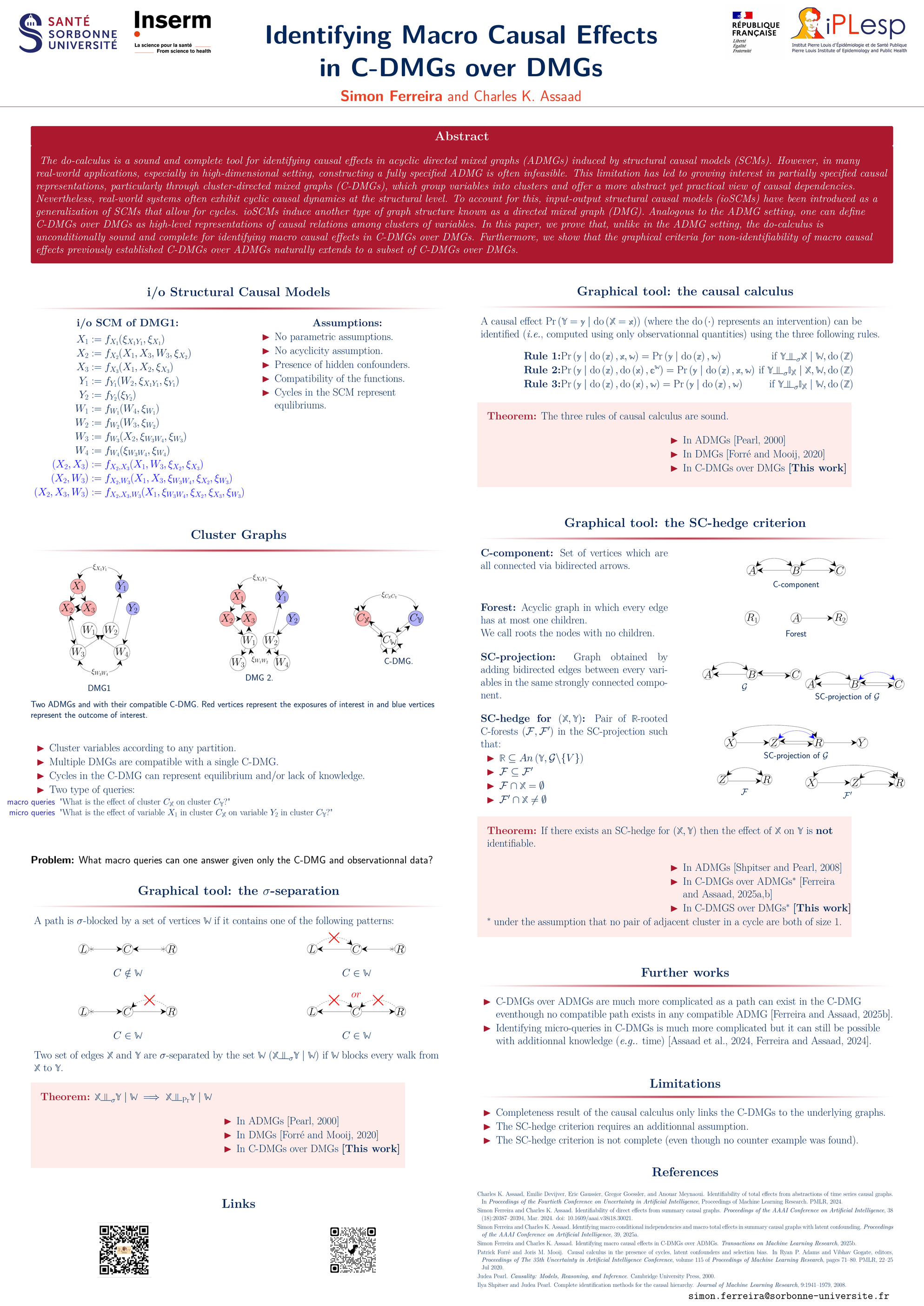
The do-calculus is a sound and complete tool for identifying causal effects in acyclic directed mixed graphs (ADMGs) induced by structural causal models (SCMs). However, in many real-world applications, especially in high-dimensional settings, constructing a fully specified ADMG is often infeasible. This limitation has led to growing interest in partially specified causal representations, particularly through cluster-directed mixed graphs (C-DMGs), which group variables into clusters and offer a more abstract yet practical view of causal dependencies. While these representations can include cycles, recent work has shown that the do-calculus remains sound and complete for identifying macro-level causal effects in C-DMGs over ADMGs under the assumption that all clusters sizes are greater than 1. Nevertheless, real-world systems often exhibit cyclic causal dynamics at the structural level. To account for this, input-output structural causal models (ioSCMs) have been introduced as a generalization of SCMs that allow for cycles. ioSCMs induce another type of graph structure known as a directed mixed graph (DMG). Analogous to the ADMG setting, one can define C-DMGs over DMGs as high-level representations of causal relations among clusters of variables. In this paper, we prove that, unlike in the ADMG setting, the do-calculus is unconditionally sound and complete for identifying macro causal effects in C-DMGs over DMGs. Furthermore, we show that the graphical criteria for non-identifiability of macro causal effects previously established C-DMGs over ADMGs naturally extends to a subset of C-DMGs over DMGs.
Learning to Plan Like the Human Brain via Visuospatial Perception and Semantic-Episodic Synergistic Decision-Making
Tianyuan Jia ⋅ Ziyu Li ⋅ Qing Li ⋅ Xiuxing Li ⋅ Xiang Li ⋅ Chen Wei ⋅ Li Yao ⋅ Xia Wu
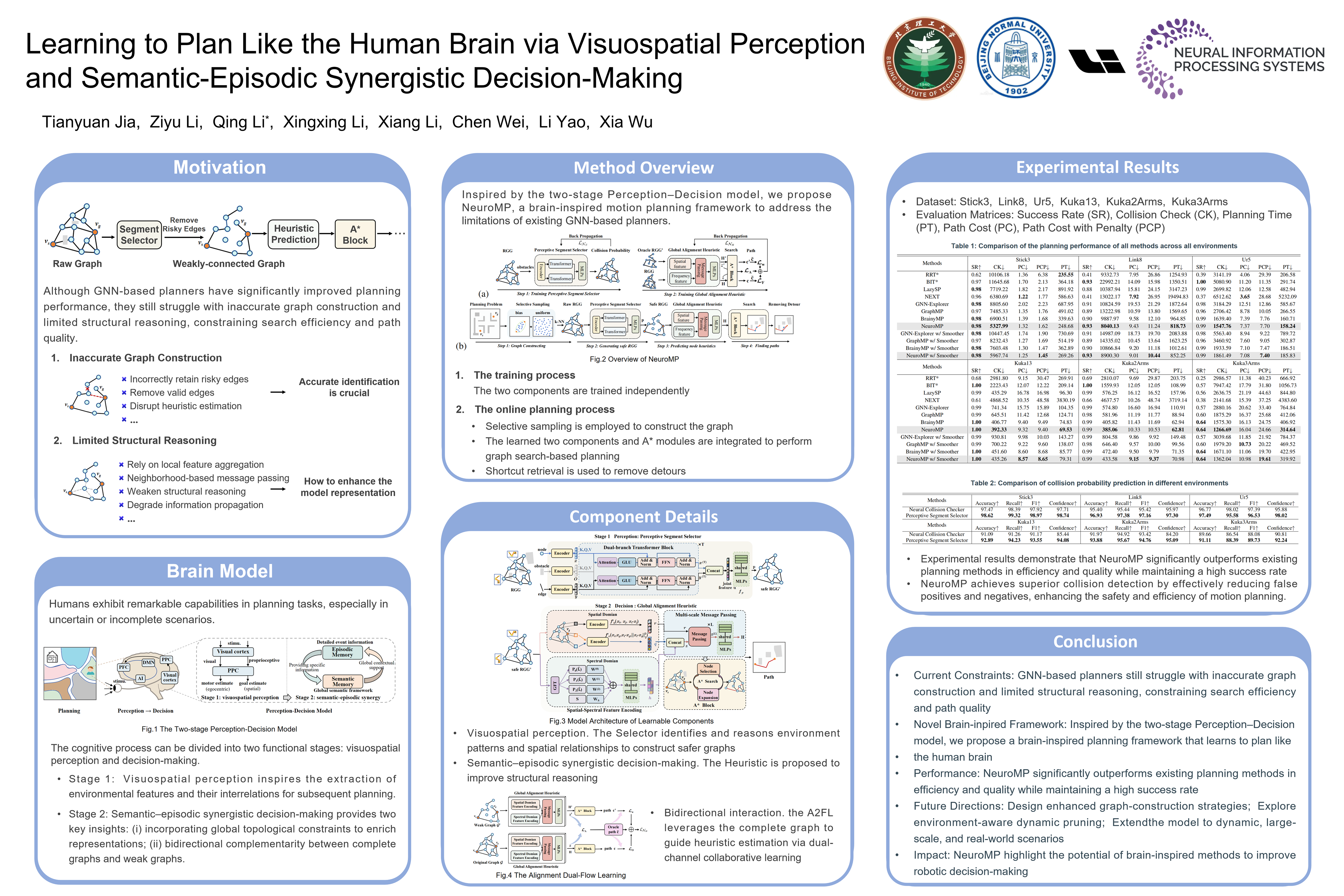
Motion planning in high-dimensional continuous spaces remains challenging due to complex environments and computational constraints. Although learning-based planners, especially graph neural network (GNN)-based, have significantly improved planning performance, they still struggle with inaccurate graph construction and limited structural reasoning, constraining search efficiency and path quality. The human brain exhibits efficient planning through a two-stage Perception-Decision model. First, egocentric spatial representations from visual and proprioceptive input are constructed, and then semantic–episodic synergy is leveraged to support decision-making in uncertainty scenarios. Inspired by this process, we propose NeuroMP, a brain-inspired planning framework that learns to plan like the human brain. NeuroMP integrates a Perceptive Segment Selector inspired by visuospatial perception to construct safer graphs, and a Global Alignment Heuristic guide search in weakly connected graphs by modeling semantic-episodic synergistic decision-making. Experimental results demonstrate that NeuroMP significantly outperforms existing planning methods in efficiency and quality while maintaining a high success rate.
Localized Data Shapley: Accelerating Valuation for Nearest Neighbor Algorithms
Guangyi Zhang ⋅ Yanhao Wang ⋅ Chengliang Chai ⋅ Qiyu Liu ⋅ Wei Wang
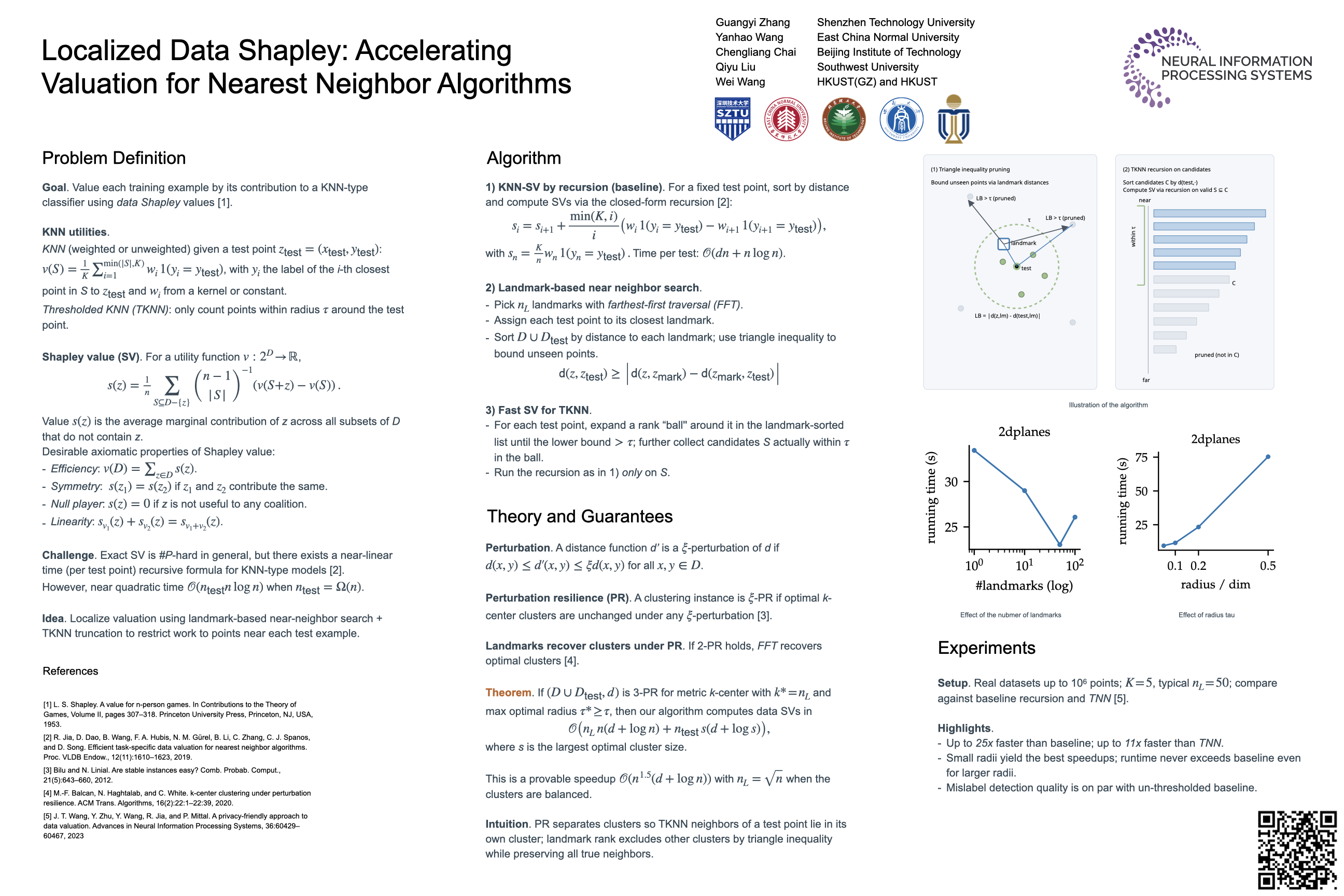
Data Shapley values provide a principled approach for quantifying the contribution of individual training examples to machine learning models. However, computing these values often requires computational complexity that is exponential in the data size, and this has led researchers to pursue efficient algorithms tailored to specific machine learning models. Building on the prior success of the Shapley valuation for $K$-nearest neighbor (KNN) models, in this paper, we introduce a localized data Shapley framework that significantly accelerates the valuation of data points. Our approach leverages the distance-based local structure in the data space to decompose the global valuation problem into smaller, localized computations. Our primary contribution is an efficient valuation algorithm for a threshold-based KNN variant and shows that it provides provable speedups over the baseline under mild assumptions. Extensive experiments on real-life datasets demonstrate that our methods achieve a substantial speedup compared to previous approaches.
NAUTILUS: A Large Multimodal Model for Underwater Scene Understanding
Wei Xu ⋅ Cheng Wang ⋅ Dingkang Liang ⋅ Zongchuang Zhao ⋅ Xingyu Jiang ⋅ Peng Zhang ⋅ Xiang Bai
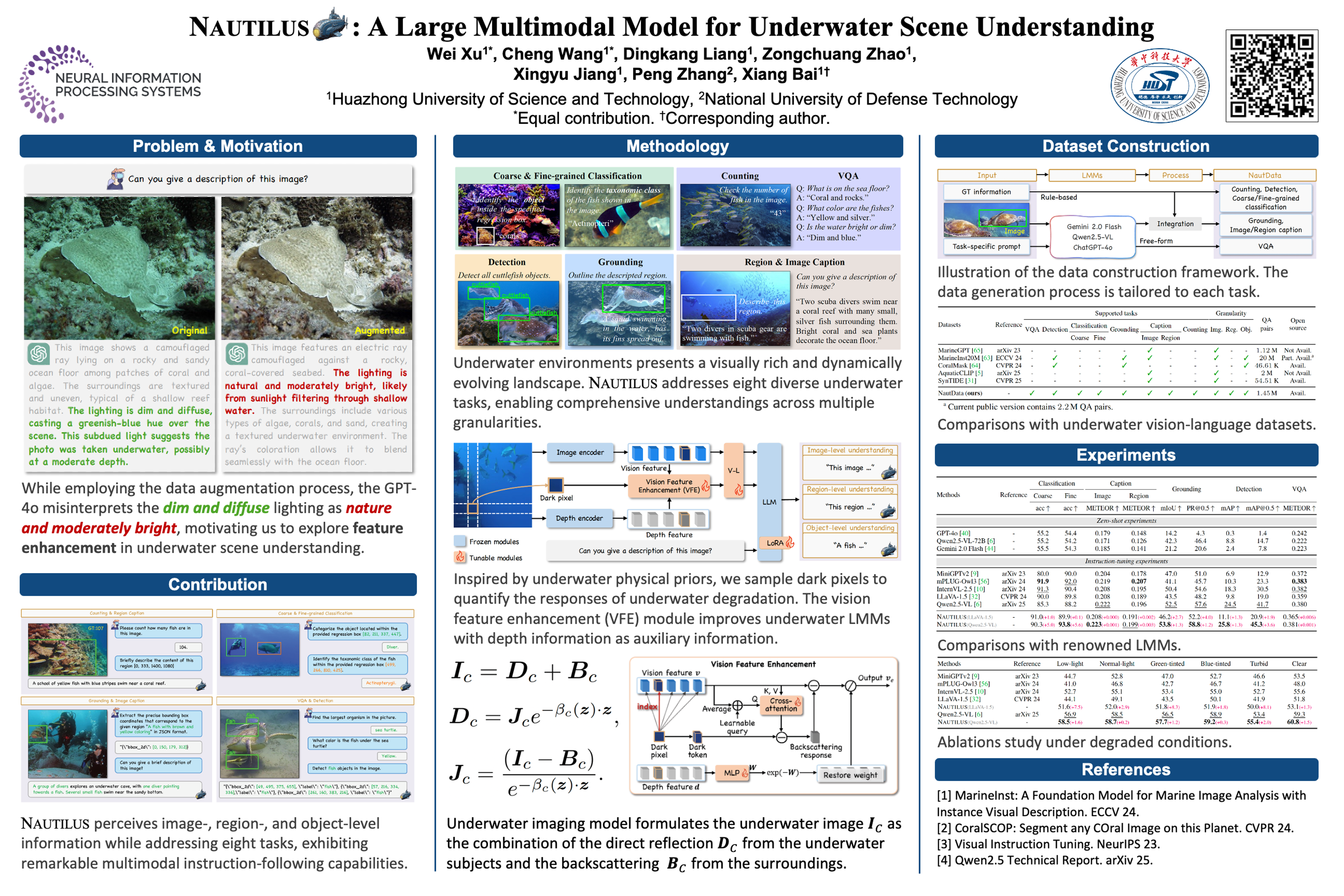
Underwater exploration offers critical insights into our planet and attracts increasing attention for its broader applications in resource exploration, national security, etc. We study the underwater scene understanding methods, which aim to achieve automated underwater exploration. The underwater scene understanding task demands multi-task perceptions from multiple granularities. However, the absence of large-scale underwater multi-task instruction-tuning datasets hinders the progress of this research. To bridge this gap, we construct NautData, a dataset containing 1.45 M image-text pairs supporting eight underwater scene understanding tasks. It enables the development and thorough evaluation of the underwater scene understanding models. Underwater image degradation is a widely recognized challenge that interferes with underwater tasks. To improve the robustness of underwater scene understanding, we introduce physical priors derived from underwater imaging models and propose a plug-and-play vision feature enhancement (VFE) module, which explicitly restores clear underwater information. We integrate this module into renowned baselines LLaVA-1.5 and Qwen2.5-VL and build our underwater LMM, NAUTILUS. Experiments conducted on the NautData and public underwater datasets demonstrate the effectiveness of the VFE module, consistently improving the performance of both baselines on the majority of supported tasks, thus ensuring the superiority of NAUTILUS in the underwater scene understanding area. Data and models are available at https://github.com/H-EmbodVis/NAUTILUS.
OpenGU: A Comprehensive Benchmark for Graph Unlearning
Bowen Fan ⋅ Yuming Ai ⋅ Xunkai Li ⋅ Zhilin Guo ⋅ LEI ZHU ⋅ Guang Zeng ⋅ Rong-Hua Li ⋅ Guoren Wang
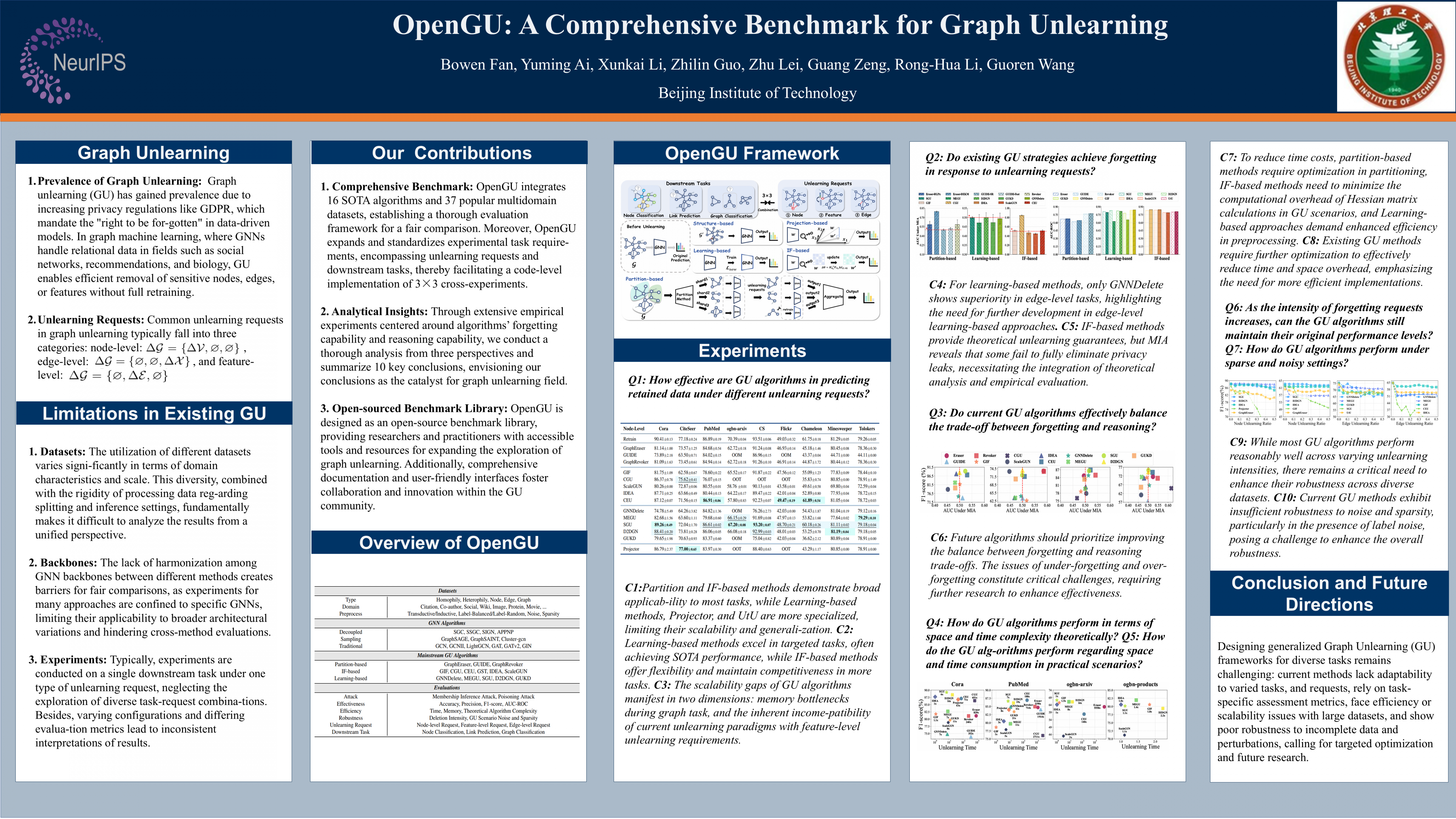
Graph Machine Learning is essential for understanding and analyzing relational data. However, privacy-sensitive applications demand the ability to efficiently remove sensitive information from trained graph neural networks (GNNs), avoiding the unnecessary time and space overhead caused by retraining models from scratch.To address this issue, Graph Unlearning (GU) has emerged as a critical solution to support dynamic graph updates while ensuring privacy compliance. Unlike machine unlearning in computer vision or other fields, GU faces unique difficulties due to the non-Euclidean nature of graph data and the recursive message-passing mechanism of GNNs. Additionally, the diversity of downstream tasks and the complexity of unlearning requests further amplify these challenges. Despite the proliferation of diverse GU strategies, the absence of a benchmark providing fair comparisons for GU, and the limited flexibility in combining downstream tasks and unlearning requests, have yielded inconsistencies in evaluations, hindering the development of this domain. To fill this gap, we present OpenGU, the first GU benchmark, where 16 SOTA GU algorithms and 37 multi-domain datasets are integrated, enabling various downstream tasks with 13 GNN backbones when responding to flexible unlearning requests. Through extensive experimentation, we have drawn $10$ crucial conclusions about existing GU methods, while also gaining valuable insights into their limitations, shedding light on potential avenues for future research. Our code is available at \href{https://github.com/bwfan-bit/OpenGU}{https://github.com/bwfan-bit/OpenGU}.
PCA++: How Uniformity Induces Robustness to Background Noise in Contrastive Learning
Mingqi Wu ⋅ Qiang Sun ⋅ Archer Yang
High-dimensional data often conceal low-dimensional signals beneath structured background noise, limiting standard PCA. Motivated by contrastive learning, we address the problem of recovering shared signal subspaces from positive pairs--paired observations sharing the same signal but differing in background. Our baseline, PCA+, uses alignment-only contrastive learning and succeeds when background variation is mild, but fails under strong noise or high-dimensional regimes. To address this, we introduce PCA++, a hard uniformity-constrained contrastive PCA that enforces identity covariance on projected features. PCA++ has a closed-form solution via a generalized eigenproblem, remains stable in high dimensions, and provably regularizes against background interference. We provide exact high-dimensional asymptotics in both fixed-aspect-ratio and growing-spike regimes, showing uniformity’s role in robust signal recovery. Empirically, PCA++ outperforms standard PCA and alignment-only PCA+ on simulations, corrupted-MNIST, and single-cell transcriptomics, reliably recovering condition-invariant structure. More broadly, we clarify uniformity’s role in contrastive learning—showing that explicit feature dispersion defends against structured noise and enhances robustness.
PlanarGS: High-Fidelity Indoor 3D Gaussian Splatting Guided by Vision-Language Planar Priors
Xirui Jin ⋅ Renbiao Jin ⋅ Boying Li ⋅ Danping Zou ⋅ Wenxian Yu
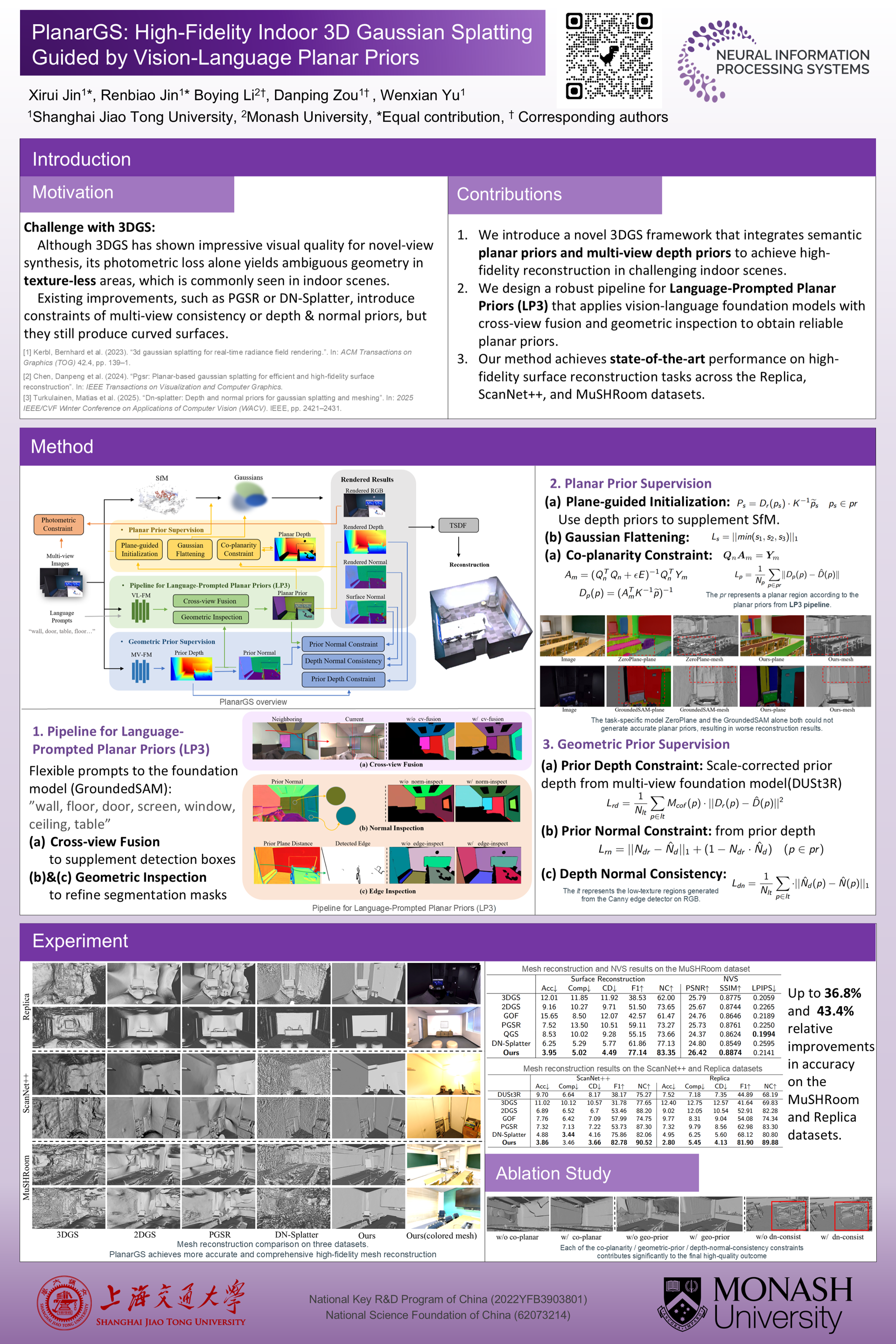
Three-dimensional Gaussian Splatting (3DGS) has recently emerged as an efficient representation for novel-view synthesis, achieving impressive visual quality. However, in scenes dominated by large and low-texture regions, common in indoor environments, the photometric loss used to optimize 3DGS yields ambiguous geometry and fails to recover high-fidelity 3D surfaces. To overcome this limitation, we introduce PlanarGS, a 3DGS-based framework tailored for indoor scene reconstruction. Specifically, we design a pipeline for Language-Prompted Planar Priors (LP3) that employs a pretrained vision-language segmentation model and refines its region proposals via cross-view fusion and inspection with geometric priors. 3D Gaussians in our framework are optimized with two additional terms: a planar prior supervision term that enforces planar consistency, and a geometric prior supervision term that steers the Gaussians toward the depth and normal cues. We have conducted extensive experiments on standard indoor benchmarks. The results show that PlanarGS reconstructs accurate and detailed 3D surfaces, consistently outperforming state-of-the-art methods by a large margin. Project page: https://planargs.github.io
PolyMath: Evaluating Mathematical Reasoning in Multilingual Contexts
Yiming Wang ⋅ Pei Zhang ⋅ Jialong Tang ⋅ Hao-Ran Wei ⋅ Baosong Yang ⋅ Rui Wang ⋅ Chenshu Sun ⋅ Feitong Sun ⋅ Jiran Zhang ⋅ Junxuan Wu ⋅ Qiqian Cang ⋅ Yichang Zhang ⋅ Fei Huang ⋅ Junyang Lin ⋅ Fei Huang ⋅ Jingren Zhou
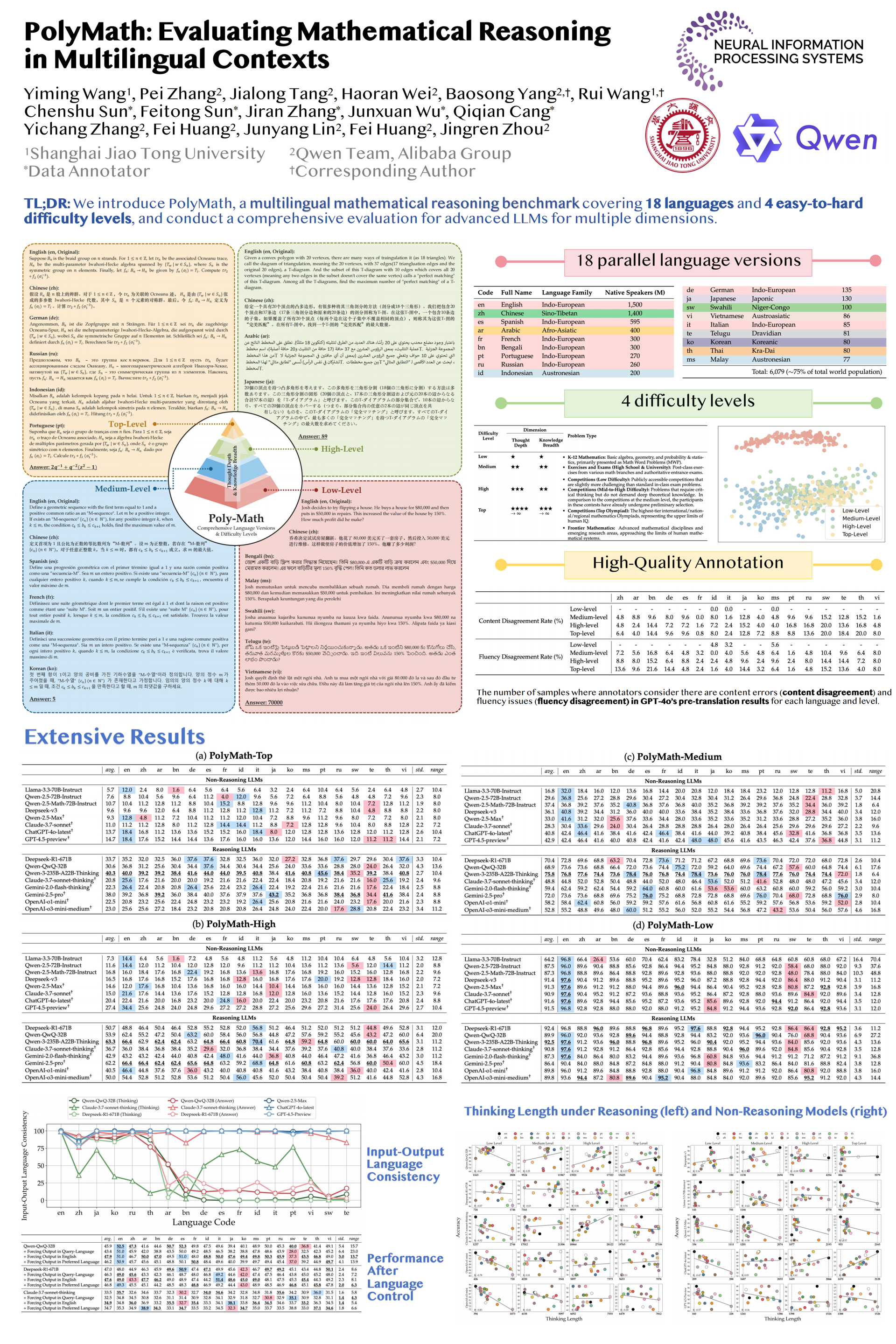
In this paper, we introduce PolyMath, a multilingual mathematical reasoning benchmark covering 18 languages and 4 easy-to-hard difficulty levels. Our benchmark ensures difficulty comprehensiveness, language diversity, and high-quality translation, making it a highly discriminative multilingual mathematical benchmark in the era of reasoning LLMs.We conduct a comprehensive evaluation for advanced LLMs and find that even Qwen-3-235B-A22B-Thinking and Gemini-2.5-pro, achieve only 54.6 and 52.2 benchmark scores, with about 40% accuracy under the highest level.From a language perspective, our benchmark reveals several key challenges of LLMs in multilingual reasoning:(1) Reasoning performance varies widely across languages for current LLMs;(2) Input-output language consistency is low in reasoning LLMs and may be correlated with performance;(3) The thinking length differs significantly by language for current LLMs.Additionally, we demonstrate that controlling the output language in the instructions has the potential to affect reasoning performance, especially for some low-resource languages, suggesting a promising direction for improving multilingual capabilities in LLMs.
Statistical Parity with Exponential Weights
Stephen Pasteris ⋅ Chris Hicks ⋅ Vasilios Mavroudis
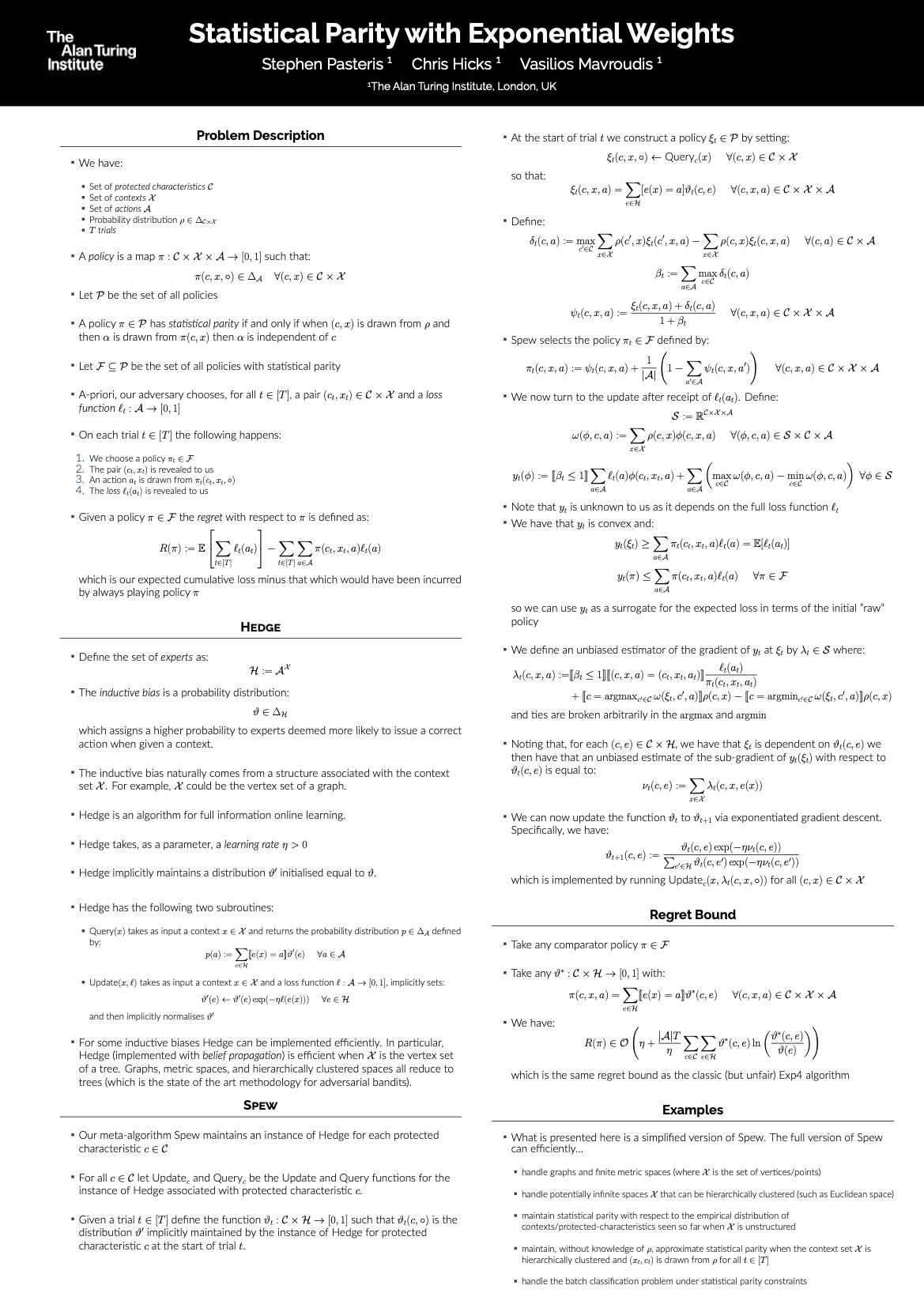
Statistical parity is one of the most foundational constraints in algorithmic fairness and privacy. In this paper, we show that statistical parity can be enforced efficiently in the adversarial contextual bandit setting while retaining strong performance guarantees. Specifically, we present a meta-algorithm that transforms any efficient implementation of Hedge (or, equivalently, any discrete Bayesian inference algorithm) into an efficient contextual bandit algorithm that guarantees exact statistical parity on every trial. Compared to any comparator that satisfies the same statistical parity constraint, the algorithm achieves the same asymptotic regret bound as running the equivalent instance of Exp4 for each group. We also address the scenario where the target parity distribution is unknown and must be estimated online. Finally, using online-to-batch conversion, we extend our approach to the batch classification setting.
SubTrack++ : Gradient Subspace Tracking for Scalable LLM Training
Sahar Rajabi ⋅ Nayeema Nonta ⋅ Sirisha Rambhatla
Training large language models (LLMs) is highly resource-intensive due to their massive number of parameters and the overhead of optimizer states. While recent work has aimed to reduce memory consumption, such efforts often entail trade-offs among memory efficiency, training time, and model performance. Yet, true democratization of LLMs requires simultaneous progress across all three dimensions. To this end, we propose SubTrack++ that leverages Grassmannian gradient subspace tracking combined with projection-aware optimizers, enabling Adam’s internal statistics to adapt to subspace changes. Additionally, employing recovery scaling, a technique that restores information lost through low-rank projections, further enhances model performance. Our method demonstrates SOTA convergence by exploiting Grassmannian geometry, reducing training wall-time by up to 65% compared to the best performing baseline, LDAdam, while preserving the reduced memory footprint. Code is at https://github.com/criticalml-uw/SubTrack.
Tighter CMI-Based Generalization Bounds via Stochastic Projection and Quantization
Milad Sefidgaran ⋅ Kimia Nadjahi ⋅ Abdellatif Zaidi
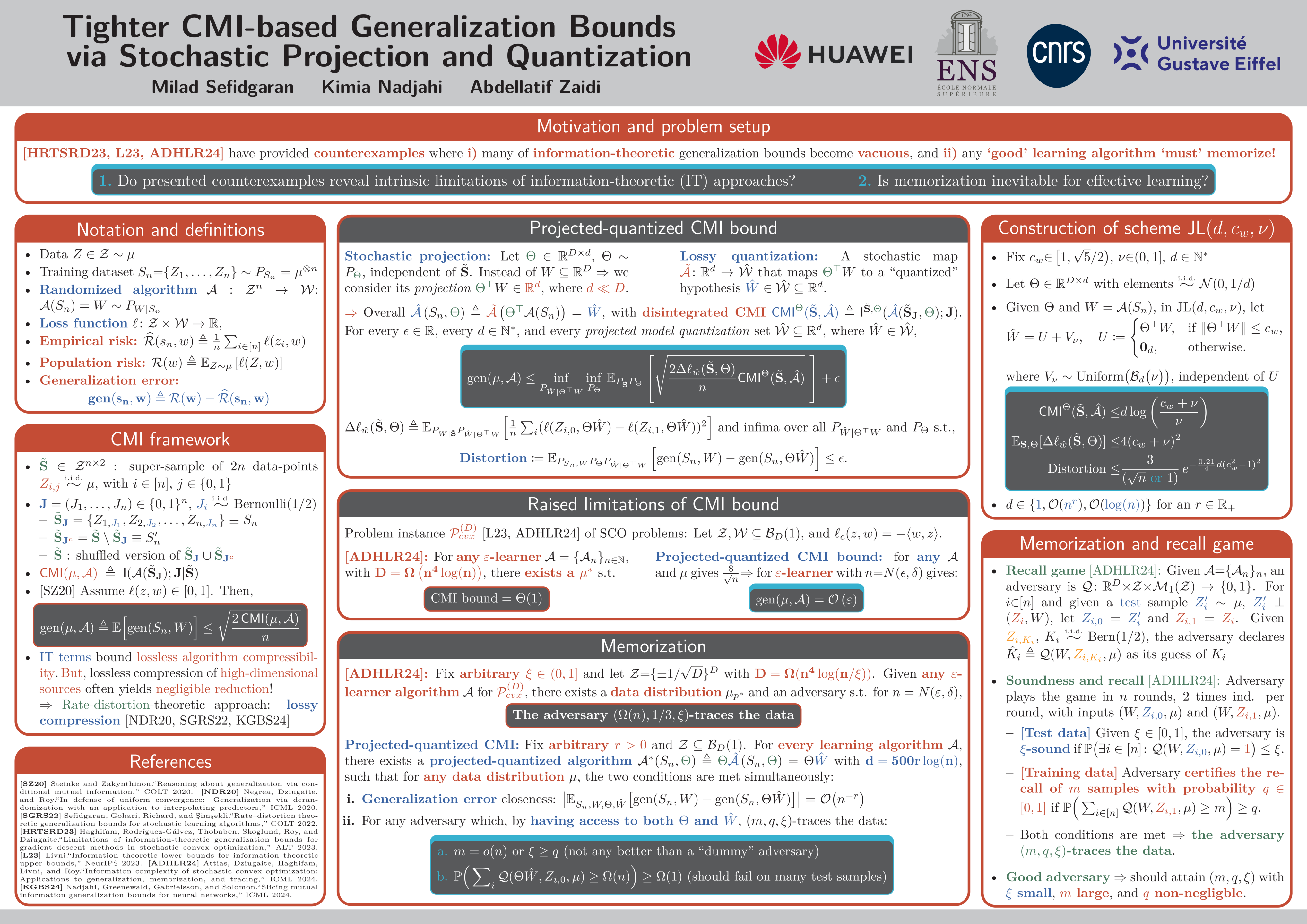
In this paper, we leverage stochastic projection and lossy compression to establish new conditional mutual information (CMI) bounds on the generalization error of statistical learning algorithms. It is shown that these bounds are generally tighter than the existing ones. In particular, we prove that for certain problem instances for which existing MI and CMI bounds were recently shown in Attias et al. [2024] and Livni [2023] to become vacuous or fail to describe the right generalization behavior, our bounds yield suitable generalization guarantees of the order of $\mathcal{O}(1/\sqrt{n})$, where $n$ is the size of the training dataset. Furthermore, we use our bounds to investigate the problem of data "memorization" raised in those works, and which asserts that there are learning problem instances for which any learning algorithm that has good prediction there exist distributions under which the algorithm must "memorize'' a big fraction of the training dataset. We show that for every learning algorithm, there exists an auxiliary algorithm that does not memorize and which yields comparable generalization error for any data distribution. In part, this shows that memorization is not necessary for good generalization.
Towards Unified Multimodal Interleaved Generation via Group Relative Policy Optimization
Ming Nie ⋅ Chunwei Wang ⋅ Jianhua Han ⋅ Hang Xu ⋅ Li Zhang

Unified vision-language models have made significant progress in multimodal understanding and generation, yet they largely fall short in producing multimodal interleaved outputs, which is a crucial capability for tasks like visual storytelling and step-by-step visual reasoning. In this work, we propose a reinforcement learning-based post-training strategy to unlock this capability in existing unified models, without relying on large-scale multimodal interleaved datasets. We begin with a warm-up stage using a hybrid dataset comprising curated interleaved sequences and limited data for multimodal understanding and text-to-image generation, which exposes the model to interleaved generation patterns while preserving its pretrained capabilities. To further refine interleaved generation, we propose a unified policy optimization framework that extends Group Relative Policy Optimization (GRPO) to the multimodal setting. Our approach jointly models text and image generation within a single decoding trajectory and optimizes it with our novel hybrid rewards covering textual relevance, visual-text alignment, and structural fidelity. Additionally, we incorporate process-level rewards to provide step-wise guidance, enhancing training efficiency in complex multimodal tasks. Experiments on MMIE and InterleavedBench demonstrate that our approach significantly enhances the quality and coherence of multimodal interleaved generation.
Visual Structures Help Visual Reasoning: Addressing the Binding Problem in LVLMs
Amirmohammad Izadi ⋅ Mohammadali Banayeeanzade ⋅ Fatemeh Askari ⋅ Ali Rahimiakbar ⋅ Mohammad Vahedi ⋅ Hosein Hasani ⋅ Mahdieh Baghshah
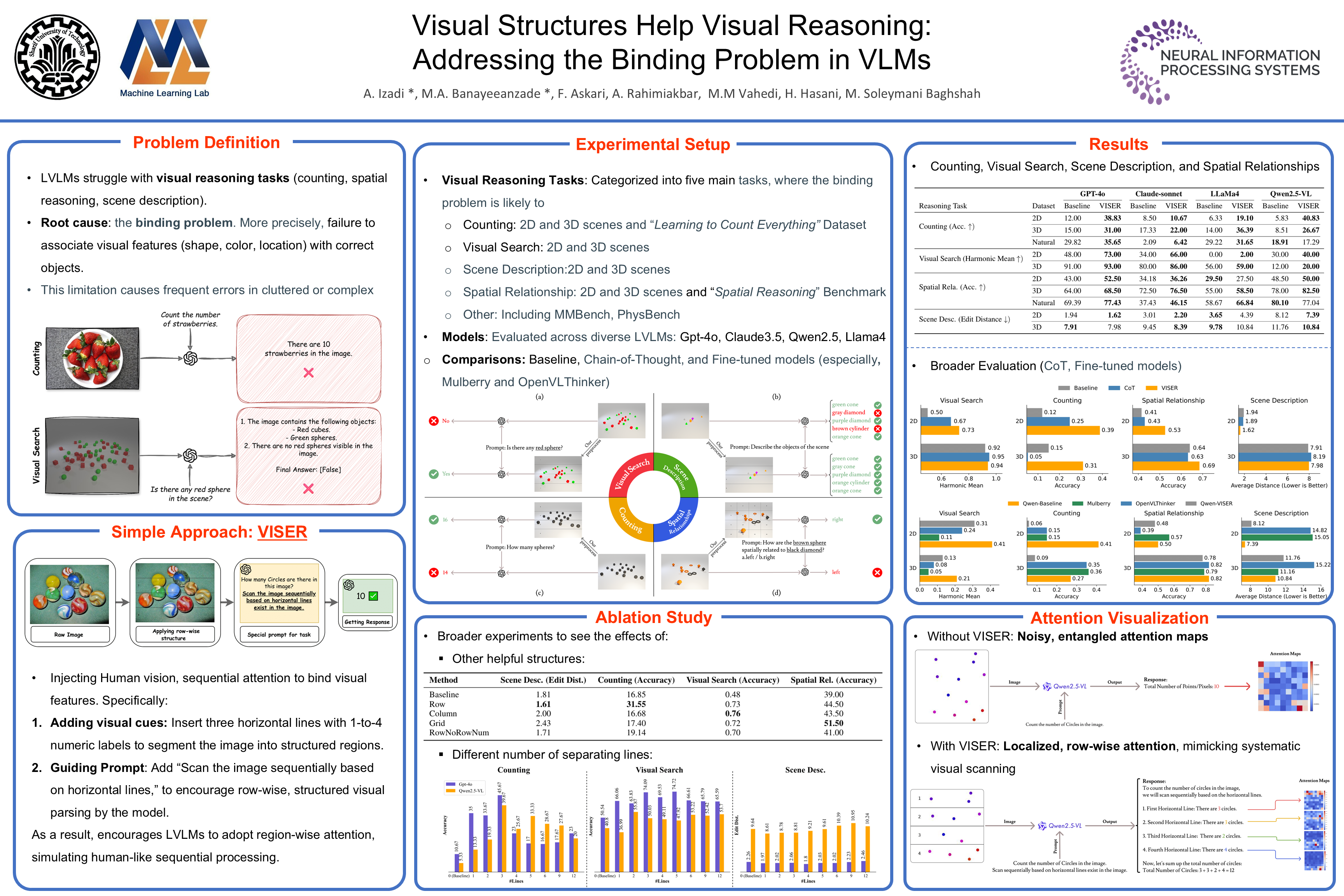
Despite progress in Large Vision-Language Models (LVLMs), their capacity for visual reasoning is often limited by the binding problem: the failure to reliably associate perceptual features with their correct visual referents. This limitation underlies persistent errors in tasks such as counting, visual search, scene description, and spatial relationship understanding. A key factor is that current LVLMs process visual features largely in parallel, lacking mechanisms for spatially grounded, serial attention. This paper introduces Visual Input Structure for Enhanced Reasoning (VISER), a simple, effective method that augments visual inputs with low-level spatial structures and pairs them with a textual prompt that encourages sequential, spatially-aware parsing. We empirically demonstrate substantial performance improvements across core visual reasoning tasks, using only a single-query inference. Specifically, VISER improves GPT-4o performance on visual search, counting, and spatial relationship tasks by 25.0%, 26.8%, and 9.5%, respectively, and reduces edit distance error in scene description by 0.32 on 2D datasets. Furthermore, we find that the visual modification is essential for these gains; purely textual strategies, including Chain-of-Thought prompting, are insufficient and can even degrade performance. VISER underscores the importance of visual input design over purely linguistically based reasoning strategies and suggests that visual structuring is a powerful and general approach for enhancing compositional and spatial reasoning in LVLMs.
VPO: Reasoning Preferences Optimization Based on $\mathcal{V}$-Usable Information
Zecheng Wang ⋅ Chunshan Li ⋅ Yupeng Zhang ⋅ Han Liu ⋅ Bingning Wang ⋅ Dianhui Chu ⋅ Dianbo Sui
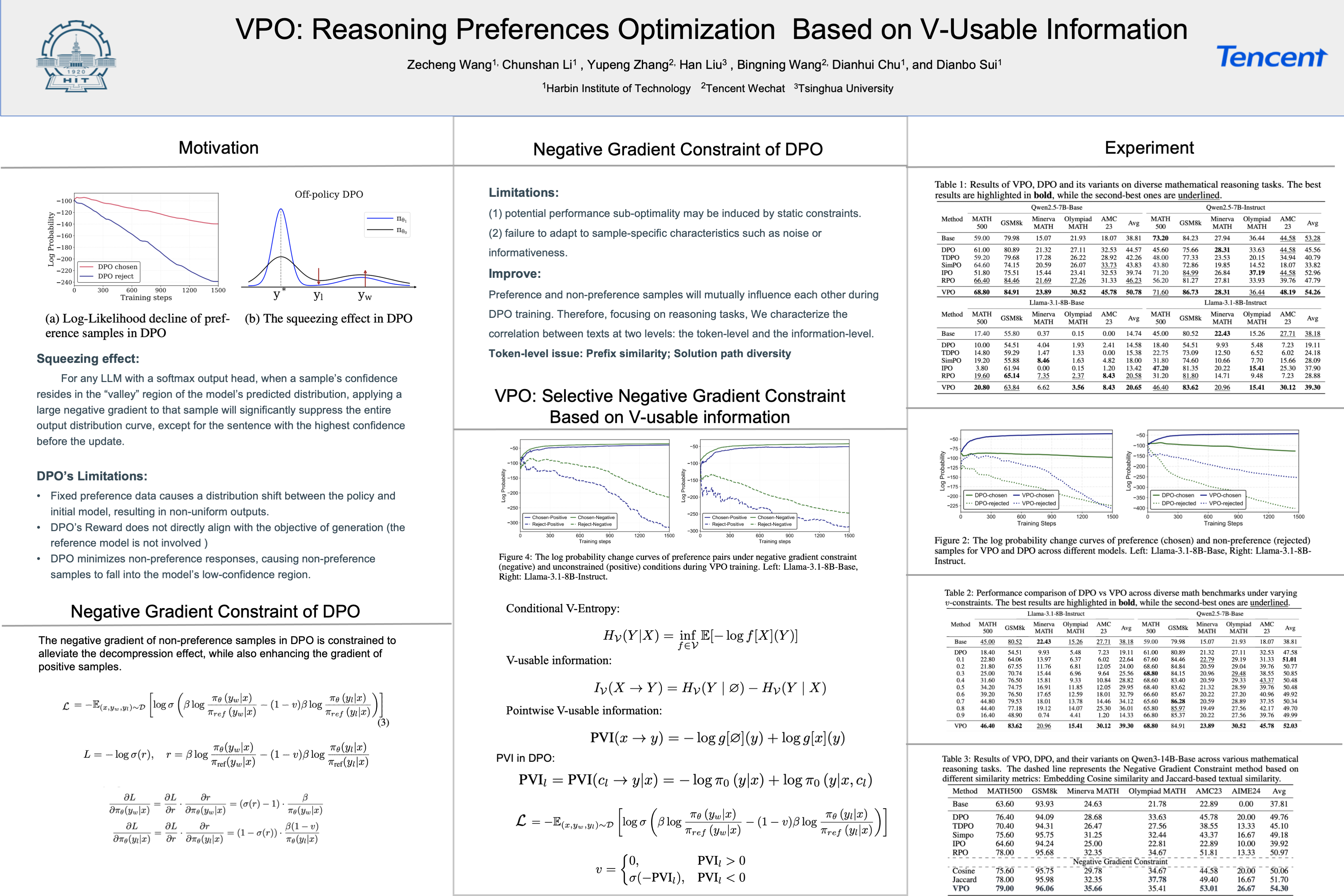
Direct Preference Optimization (DPO) is a widely used preference optimization algorithm in large language model (LLM) alignment, which reparameterizes the reward function in reinforcement learning with human feedback (RLHF) without requiring a separate reward model. However, during the DPO training process, when a large negative gradient is applied to low-confidence samples, LLMs with a softmax output head tend to squeeze the confidence in the model's output distribution towards the highest-confidence sentence, which may lead to a decrease in the confidence of both preference and non-preference samples, while increasing the confidence of unrelated tokens. This phenomenon becomes more complex in reasoning tasks. In this work, focusing on reasoning tasks, we propose VPO, a negative gradient constraint method for human non-preference samples based on $\mathcal{V}$-usable information. By using $\mathcal{V}$-usable information to measure the similarity between preference pairs and selectively constrain the negative gradient, VPO can alleviate the squeezing effect of DPO, enhance alignment with the generation objective, and maintain the model's ability to distinguish between preference and non-preference samples. We compare VPO with DPO and its latest variants on mathematical reasoning tasks using the LLama 3.1 and Qwen 2.5 series, including both Base and Instruct models. Our results demonstrate that VPO consistently and significantly outperforms existing methods. Specifically, on Qwen2.5-7B-Base, VPO achieves 7.80\% and 13.25\% improvement over DPO on MATH500 and AMC23, respectively. We also conduct ablation experiments and in-depth analysis on VPO to explain its effectiveness and rationale.
World Models as Reference Trajectories for Rapid Motor Adaptation
Carlos Stein Brito ⋅ Daniel McNamee
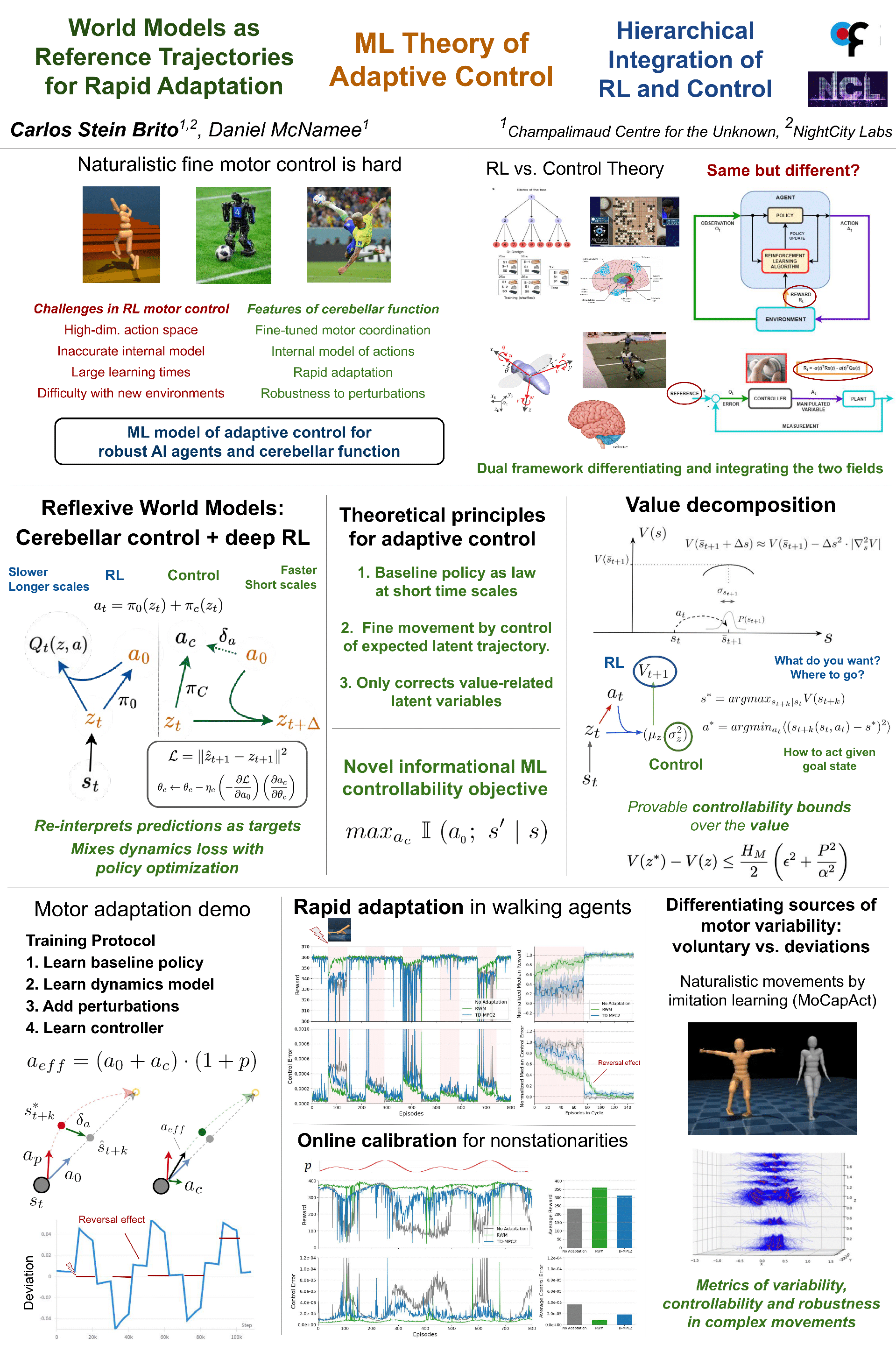
Learned control policies often fail when deployed in real-world environments with changing dynamics. When system dynamics shift unexpectedly, performance degrades until models are retrained on new data. We introduce Reflexive World Models (RWM), a dual control framework that uses world model predictions as implicit reference trajectories for rapid adaptation. Our method separates the control problem into long-term reward maximization through reinforcement learning and robust motor execution through reward-free rapid control in latent space. This dual architecture achieves significantly faster adaptation with low online computational cost compared to model-based RL baselines, while maintaining near-optimal performance. The approach combines the benefits of flexible policy learning through reinforcement learning with rapid error correction capabilities, providing a theoretically grounded method for maintaining performance in high-dimensional continuous control tasks under varying dynamics.