
Developing Surrogates for Epidemic Agent-Based Models via Scientific Machine Learning
Abstract
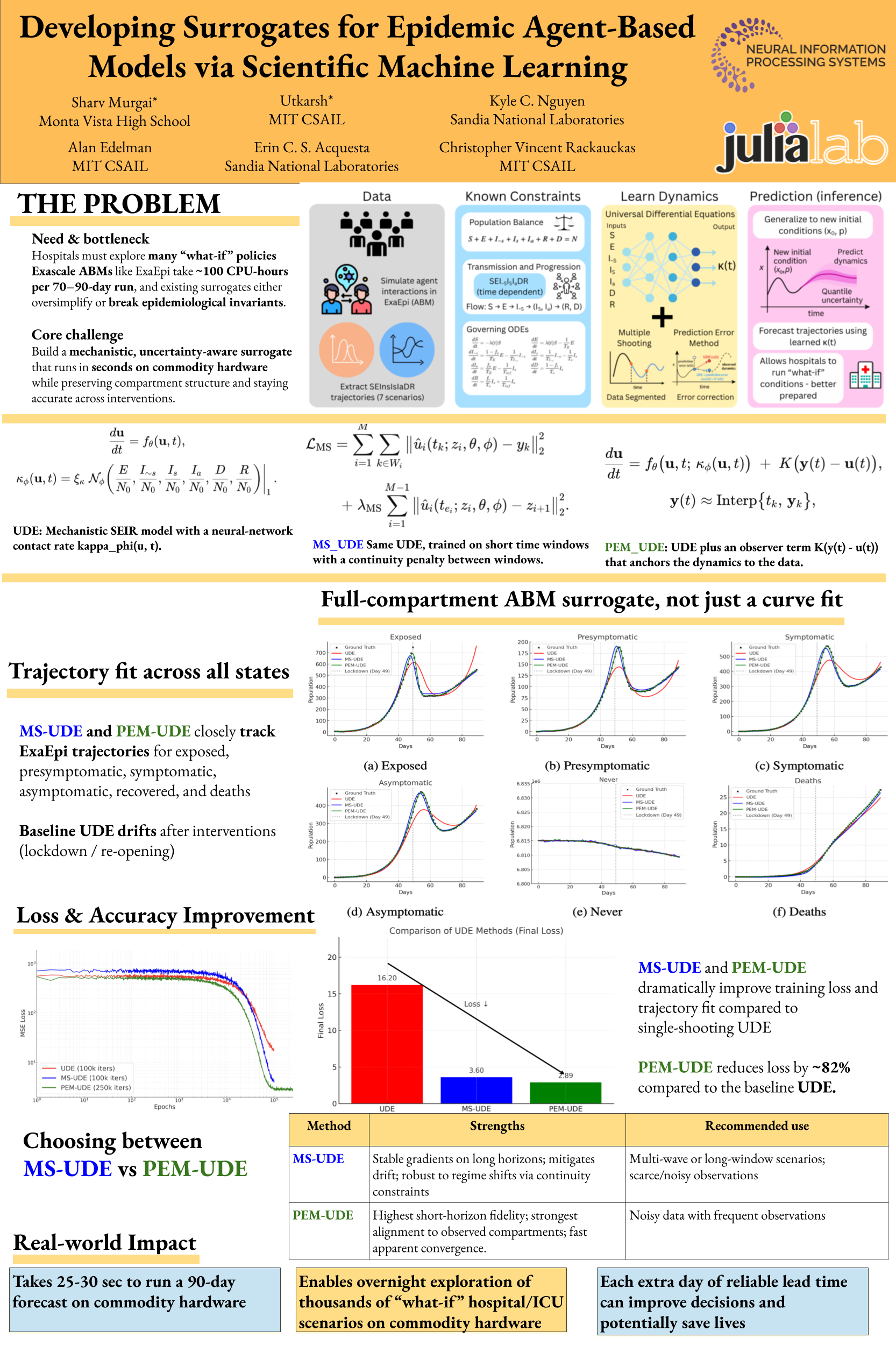
Forecasting epidemic trajectories is challenging due to nonlinear dynamics, abrupt interventions, and limited data. Classical compartmental models are interpretable but rigid, while purely data-driven methods often lack physical consistency. We propose a hybrid framework based on Universal Differential Equations (UDEs), which augment epidemiological Ordinary Differential Equations (ODEs) with neural networks to capture unresolved dynamics. To overcome instability in standard single-shooting training, we introduce two advances: (i) a multiple-shooting (MS) scheme that segments trajectories and enforces continuity across intervals, and (ii) a prediction error method that iteratively corrects forward simulations. Applied to epidemic datasets, our approach reduces symptomatic prediction error by 77.8\% with multiple shooting and 82.1\% with the prediction error method (PEM), particularly around intervention periods such as lockdowns. Multiple shooting improves stability and efficiency, while the prediction error method achieves the most accurate ground-truth alignment at a higher computational cost. These results demonstrate how MS and PEM methods could improve the fitting of UDEs, which will help bridge the gap between purely mechanistic models and agent-based models, and enable interpretable and accurate epidemic forecasting.