
Differentiable Models for Control of Complex Physical Systems: A Case Study in Laser Pulse Shaping
Abstract
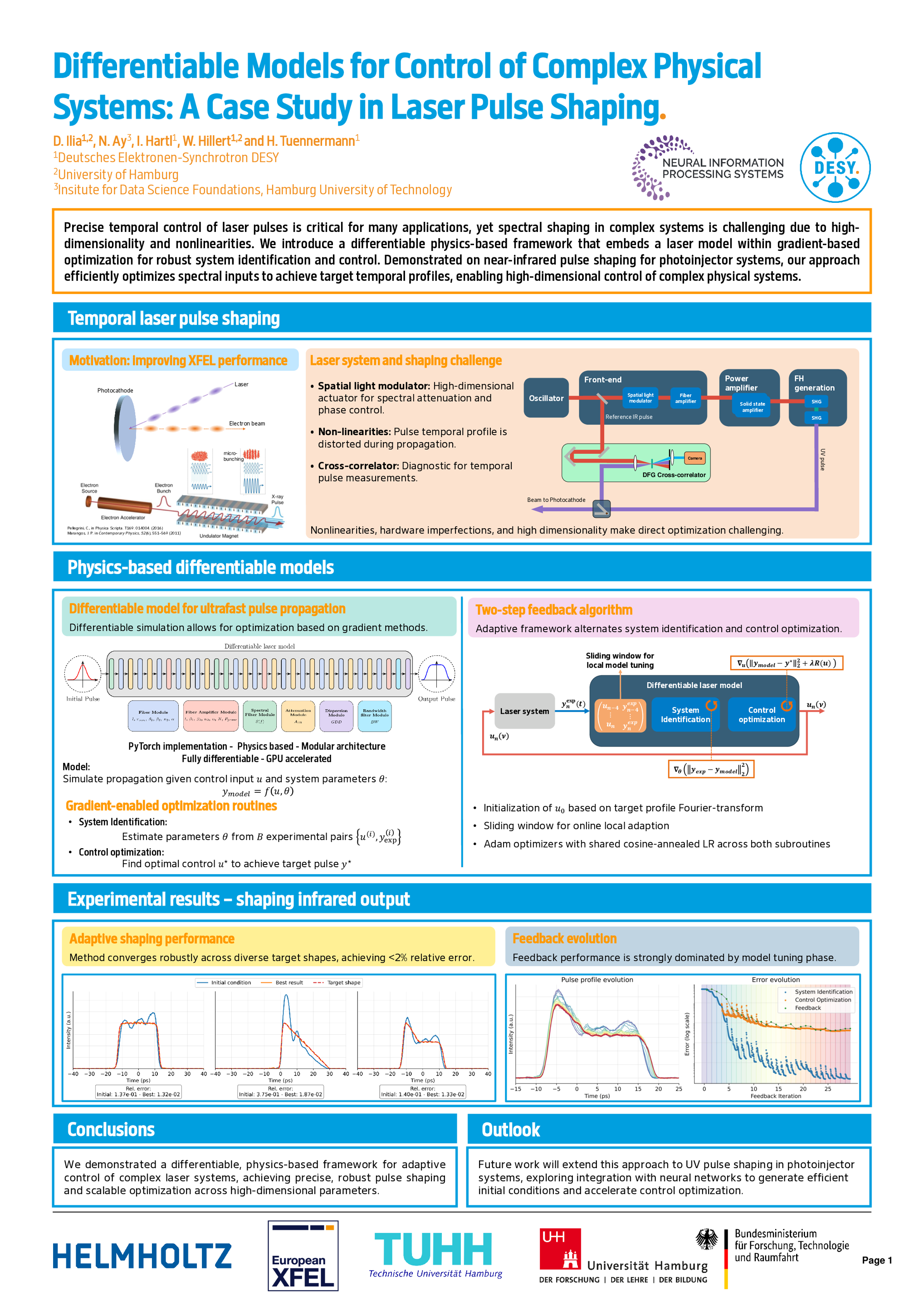
Precise control of the temporal profile of laser pulses is critical for many scientific and industrial applications. Achieving this via spectral shaping is particularly challenging in complex systems due to nonlinear effects, input fluctuations, and hardware imperfections. Conventional approaches—such as manual iterative tuning, precomputed spectral settings, or evolutionary optimization—are often insufficient or scale poorly with system complexity. We introduce a differentiable physics-based framework for spectral pulse shaping that embeds a physical model of the laser within a gradient-based optimization loop. This approach enables rapid system identification and control, accurately capturing complex laser dynamics while optimizing control inputs to achieve target temporal pulse shapes. We demonstrate the method by shaping near-infrared pulses as a proof of concept for photoinjector laser systems, highlighting its generality and potential for high-dimensional control of complex physical systems.