
Equivariant Compression of Quantum Operator Representations
Abstract
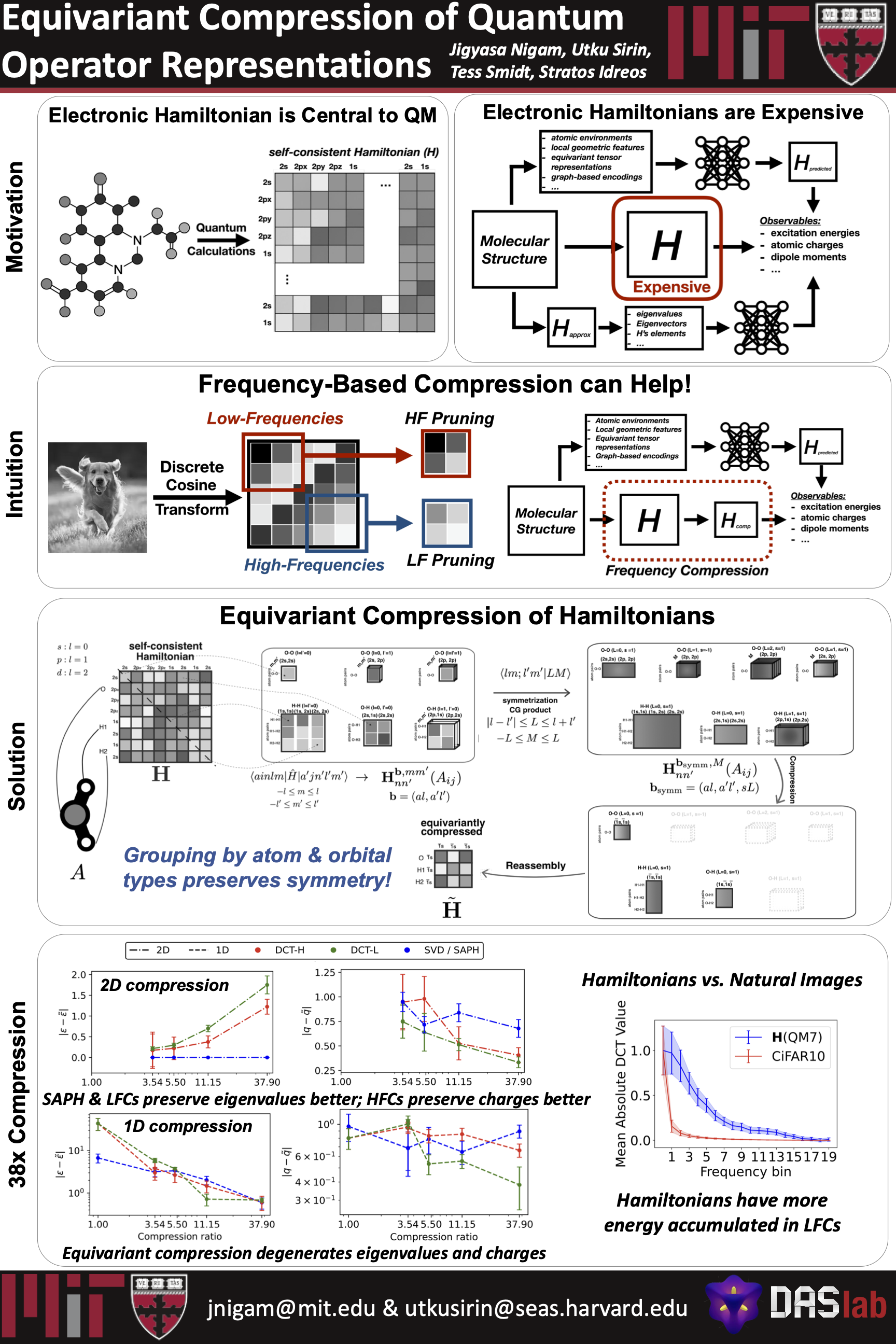
Electronic structure is being increasingly prioritized in atomistic machine learning (ML), offering a direct path to predicting diverse properties beyond single-property surrogates. However, quantum mechanical (QM) data, such as matrix representations of the electronic Hamiltonian, are inherently high-dimensional. This makes operations such as diagonalization, often the first step in obtaining eigenspectra and other observables, prohibitively expensive, and also makes the ML and storage of such data computationally demanding. In this work, we ask whether QM data can benefit from classical compression strategies that have gained widespread popularity in other fields. Taking the example of effective single-particle Hamiltonians, we analyze how these methods interact with the symmetric structure of their matrix representations and derived observables. We then propose an equivariant compression framework that retains symmetry while reducing dimensionality, enabling the quantum observables derived from the compressed representation to match those from the original, larger representation as closely as possible. Our results underscore the need for compression techniques that are physics-aware and pave new directions for scalable, structure-preserving ML for electronic structure.