
Learning to Compress Plasma Turbulence
Abstract
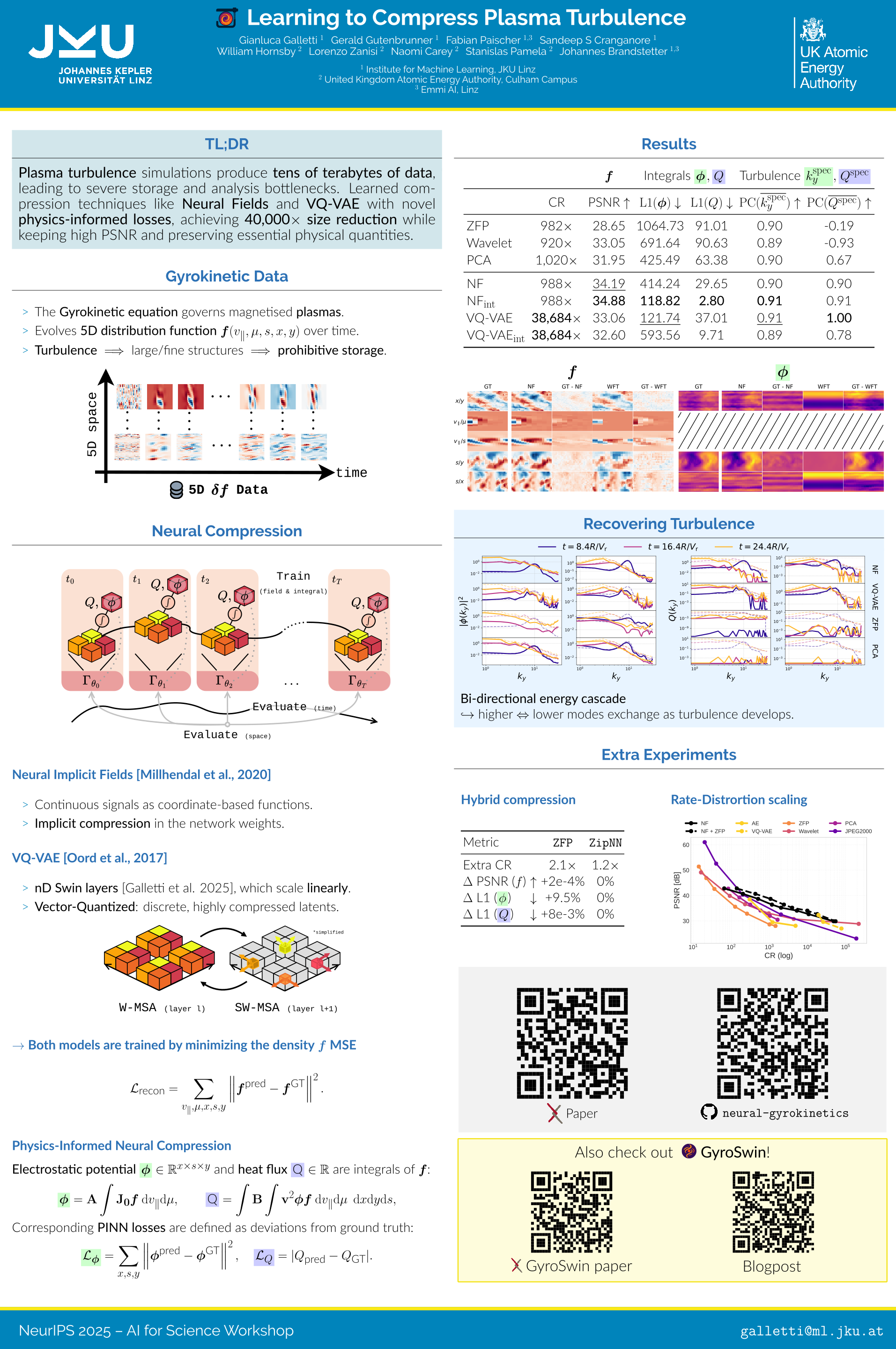
Turbulence is a nonlinear phenomenon exhibiting chaotic, multiscale behavior. It is simulated with high-fidelity numerical solvers operating on fine grids, making the process both computationally demanding and storage intensive. A prime example is gyrokinetics, which simulates turbulence in a magnetized plasma. A single run can take weeks and produce up to tens of terabytes of data, making storage unfeasible even with standard compression algorithms. To that end, we investigate neural compression methods capable of extreme compression ratios (up to 40,000x) while preserving reconstruction quality and physical fidelity.Our study focuses on autoencoders and neural implicit fields, specifically trained to preserve physical quantities.This could enable practitioners to store high-fidelity turbulence simulations for downstream scientific analysis.