
LLM Agent-Based Modeling for Zakat Policy Simulation in Islamic Finance
Abstract
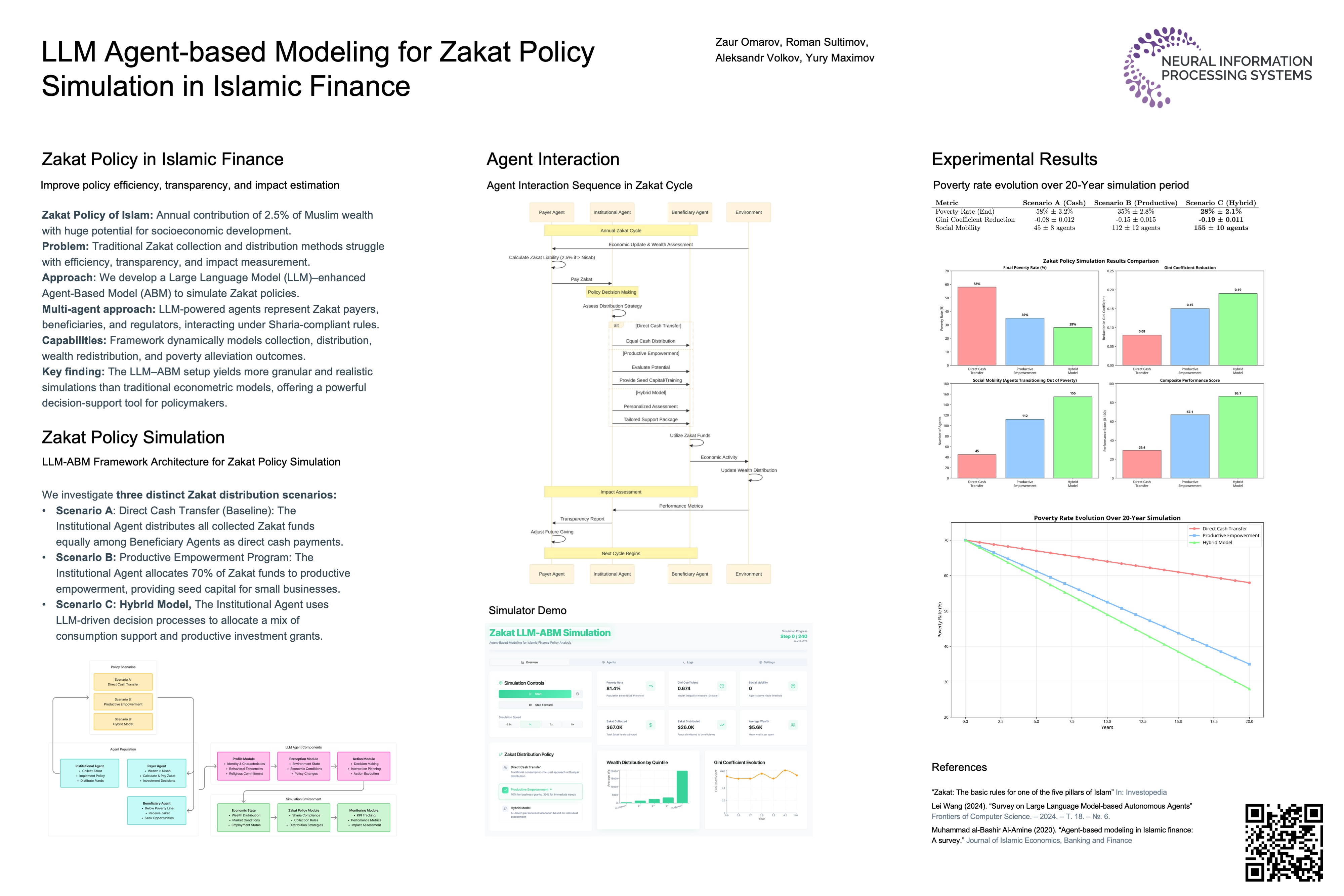
Zakat, a fundamental pillar of Islam, mandates an annual charitable contribution of 2.5% of a Muslim's wealth. While its potential for socioeconomic development is immense, traditional methods of Zakat collection and distribution often face challenges in efficiency, transparency, and impact assessment. This paper introduces a novel approach to simulating Zakat policy by leveraging Large Language Model (LLM) based Agent-Based Modeling (ABM). We propose a multi-agent system where LLM-powered agents represent diverse economic actors within an Islamic finance ecosystem, including Zakat payers, beneficiaries, and regulatory bodies. These agents, endowed with nuanced profiles and decision-making capabilities, interact within a simulated environment governed by Sharia principles. Our methodology allows for the dynamic modeling of Zakat collection, distribution, and its subsequent effects on wealth distribution and poverty alleviation. Preliminary results suggest that our LLM-ABM framework can provide more granular and realistic simulation of Zakat dynamics compared to traditional econometric models. This research represents a pioneering step toward integrating advanced AI techniques into Islamic finance, offering a powerful tool for policymakers to design, test, and optimize Zakat policies for greater social impact.