
Individually Fair Diversity Maximization
Ruien Li ⋅ Yanhao Wang
2025 Poster
Abstract
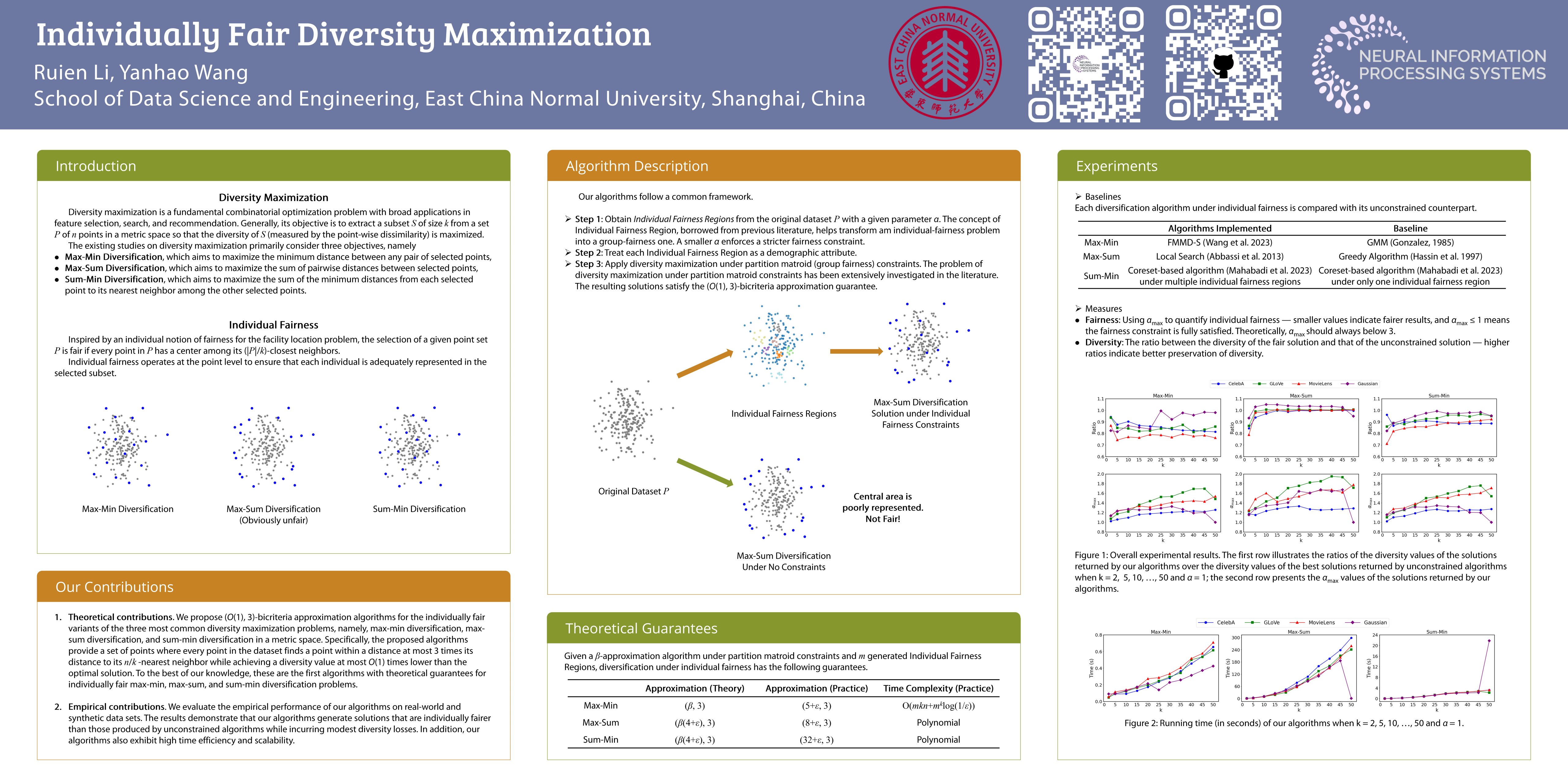
We consider the problem of diversity maximization from the perspective of individual fairness: given a set $P$ of $n$ points in a metric space, we aim to extract a subset $S$ of size $k$ from $P$ so that (1) the diversity of $S$ is maximized and (2) $S$ is \emph{individually fair} in the sense that every point in $P$ has at least one of its $\frac{n}{k}$-nearest neighbors as its ``representative'' in $S$. We propose $\left(O(1), 3\right)$-bicriteria approximation algorithms for the individually fair variants of the three most common diversity maximization problems, namely, max-min diversification, max-sum diversification, and sum-min diversification. Specifically, the proposed algorithms provide a set of points where every point in the dataset finds a point within a distance at most $3$ times its distance to its $\frac{n}{k}$-nearest neighbor while achieving a diversity value at most $O(1)$ times lower than the optimal solution. Numerical experiments on real-world and synthetic datasets demonstrate that the proposed algorithms generate solutions that are individually fairer than those produced by unconstrained algorithms and incur only modest losses in diversity.
Video
Chat is not available.
Successful Page Load