
Tightening Regret Lower and Upper Bounds in Restless Rising Bandits
Cristiano Migali ⋅ Marco Mussi ⋅ Gianmarco Genalti ⋅ Alberto Maria Metelli
2025 Poster
Abstract
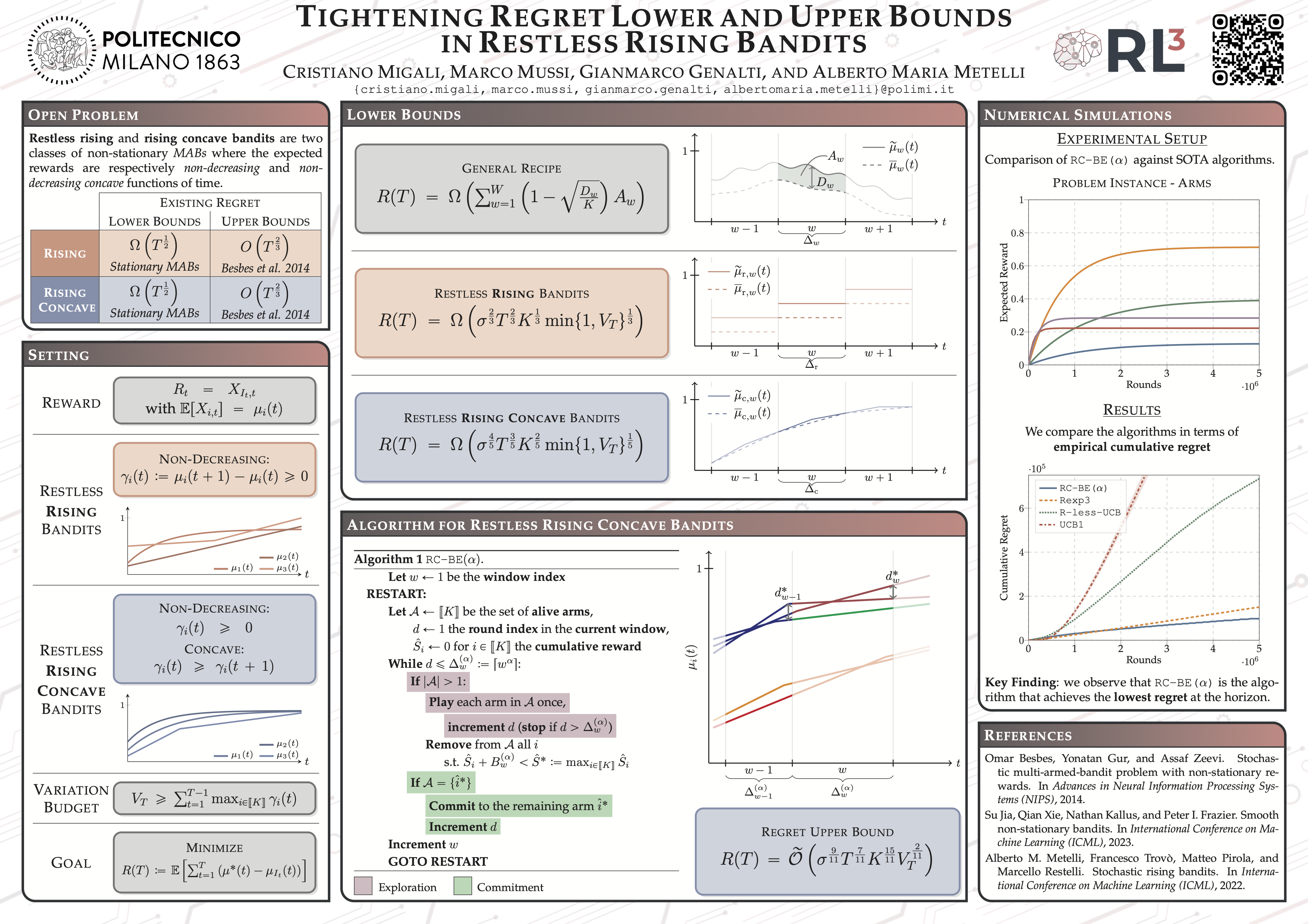
*Restless* Multi-Armed Bandits (MABs) are a general framework designed to handle real-world decision-making problems where the expected rewards evolve over time, such as in recommender systems and dynamic pricing. In this work, we investigate from a theoretical standpoint two well-known structured subclasses of restless MABs: the *rising* and the *rising concave* settings, where the expected reward of each arm evolves over time following an unknown *non-decreasing* and a *non-decreasing concave* function, respectively. By providing a novel methodology of independent interest for general restless bandits, we establish new lower bounds on the expected cumulative regret for both settings. In the rising case, we prove a lower bound of order $\Omega(T^{2/3})$, matching known upper bounds for restless bandits; whereas, in the rising concave case, we derive a lower bound of order $\Omega(T^{3/5})$, proving for the first time that this setting is provably more challenging than stationary MABs. Then, we introduce Rising Concave Budgeted Exploration (RC-BE($\alpha$)), a new regret minimization algorithm designed for the rising concave MABs. By devising a novel proof technique, we show that the expected cumulative regret of RC-BE($\alpha$) is in the order of $\widetilde{\mathcal{O}}(T^{7/11})$. These results collectively make a step towards closing the gap in rising concave MABs, positioning them between stationary and general restless bandit settings in terms of statistical complexity.
Video
Chat is not available.
Successful Page Load