
Open-Insect: Benchmarking Open-Set Recognition of Novel Species in Biodiversity Monitoring
Abstract
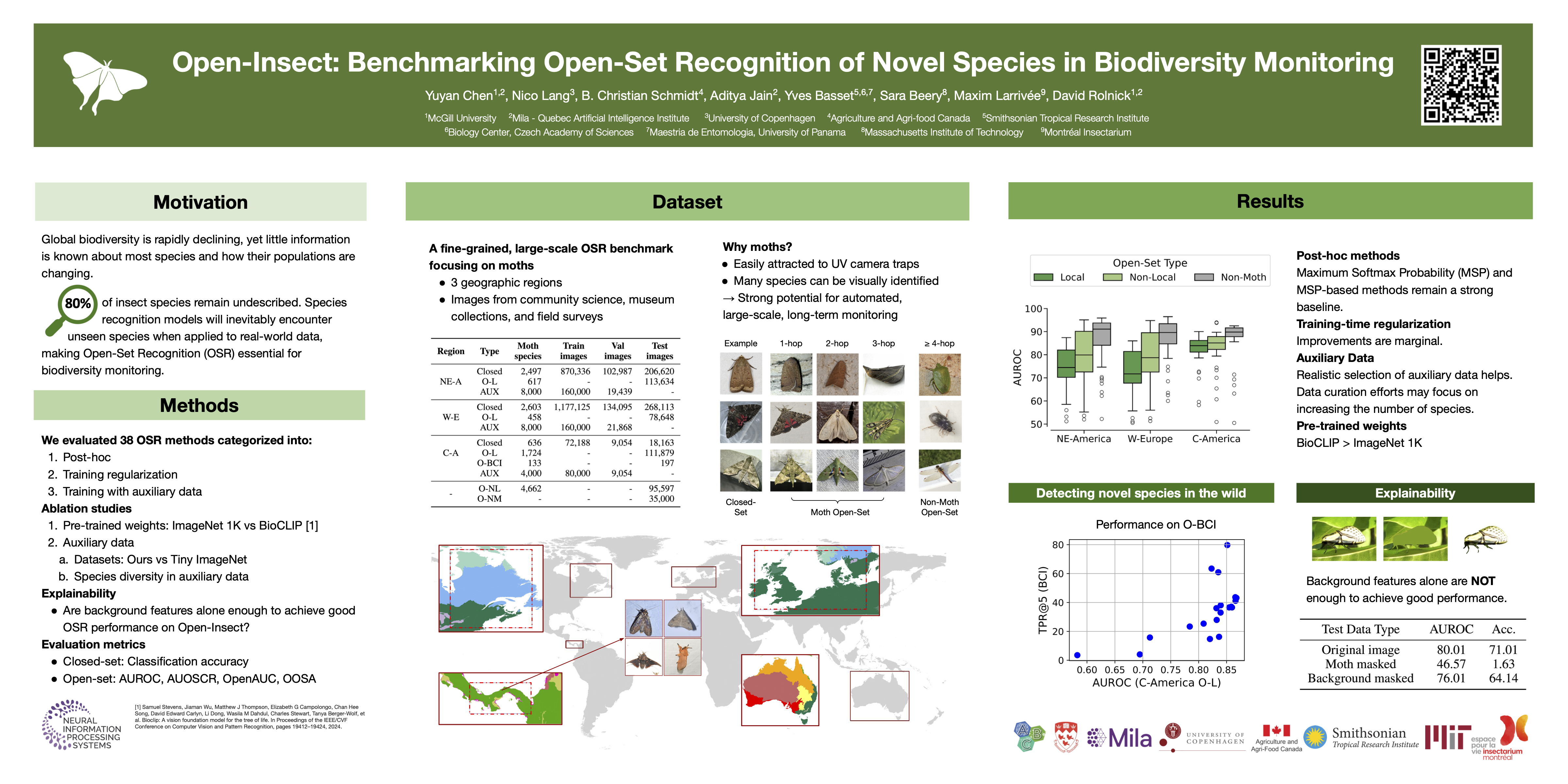
Global biodiversity is declining at an unprecedented rate, yet little information isknown about most species and how their populations are changing. Indeed, some90% Earth’s species are estimated to be completely unknown. Machine learning hasrecently emerged as a promising tool to facilitate long-term, large-scale biodiversitymonitoring, including algorithms for fine-grained classification of species fromimages. However, such algorithms typically are not designed to detect examplesfrom categories unseen during training – the problem of open-set recognition(OSR) – limiting their applicability for highly diverse, poorly studied taxa such asinsects. To address this gap, we introduce Open-Insect, a large-scale, fine-graineddataset to evaluate unknown species detection across different geographic regionswith varying difficulty. We benchmark 38 OSR algorithms across three categories:post-hoc, training-time regularization, and training with auxiliary data, finding thatsimple post-hoc approaches remain a strong baseline. We also demonstrate how toleverage auxiliary data to improve species discovery in regions with limited data.Our results provide timely insights to guide the development of computer visionmethods for biodiversity monitoring and species discovery.