
Real-Time Hyper-Personalized Generative AI Should Be Regulated to Prevent the Rise of "Digital Heroin"
Abstract
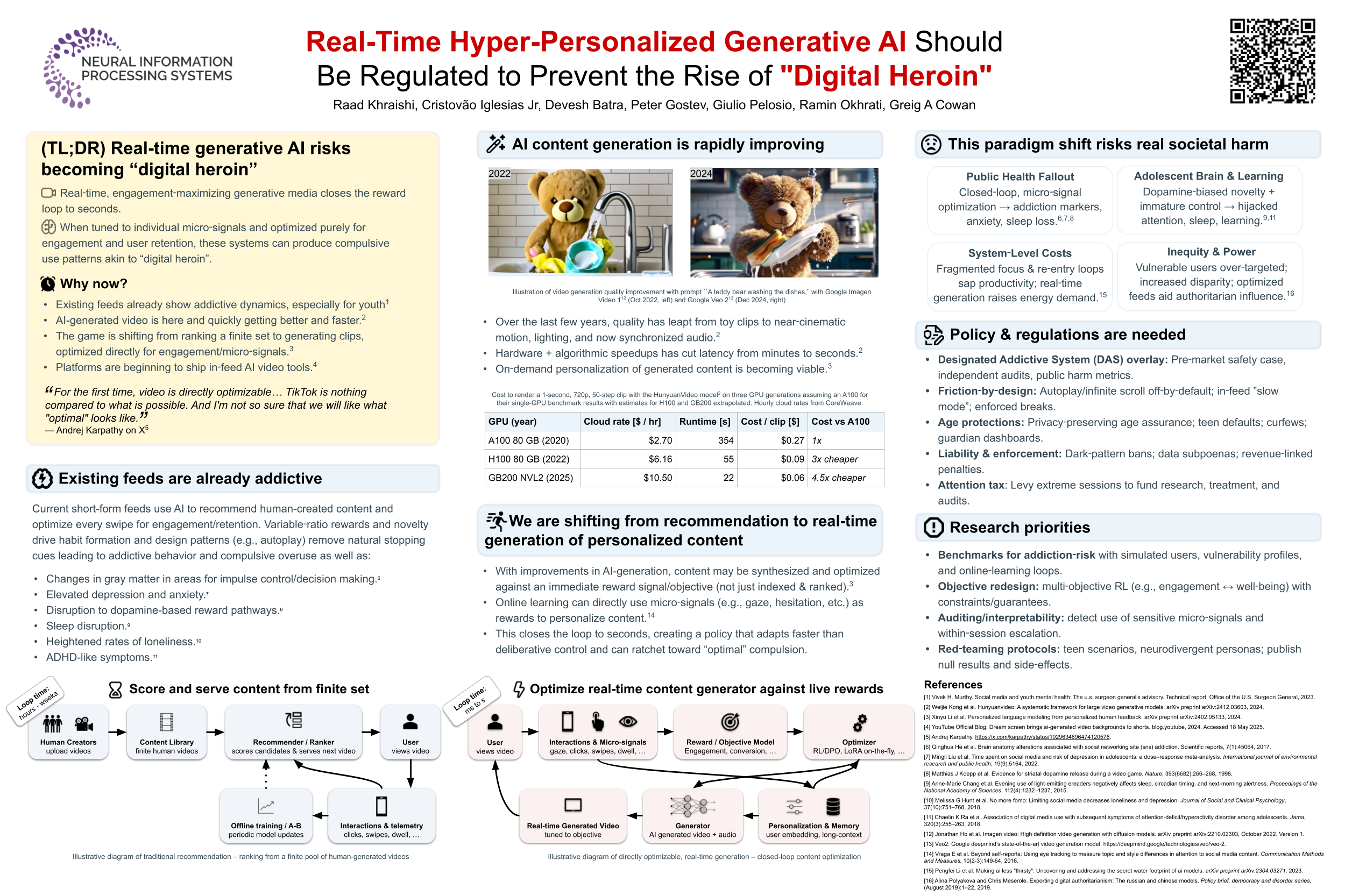
This position paper argues that real-time generative AI has the potential to become the next wave of addictive digital media, creating a new class of digital content akin to ``digital heroin'' with severe implications for mental health and youth development. By shortening the content-generation feedback loop to mere seconds, these advanced models will soon be able to hyper-personalize outputs on the fly. When paired with misaligned incentives (e.g., maximizing user engagement), this will fuel unprecedented compulsive consumption patterns with far-reaching consequences for mental health, cognitive development, and social stability. Drawing on interdisciplinary research, from clinical observations of social media addiction to neuroscientific studies of dopamine-driven feedback, we illustrate how real-time tailored content generation may erode user autonomy, foment emotional distress, and disproportionately endanger vulnerable groups, such as adolescents. Due to the rapid advancement of generative AI and its potential to induce severe addiction-like effects, we call for strong government oversight akin to existing controls on addictive substances, particularly for minors. We further urge the machine learning community to act proactively by establishing robust design guidelines, collaborating with public health experts, and supporting targeted policy measures to ensure responsible and ethical deployment, rather than paving the way for another wave of unregulated digital dependence.