
SWE-SQL: Illuminating LLM Pathways to Solve User SQL Issues in Real-World Applications
Abstract
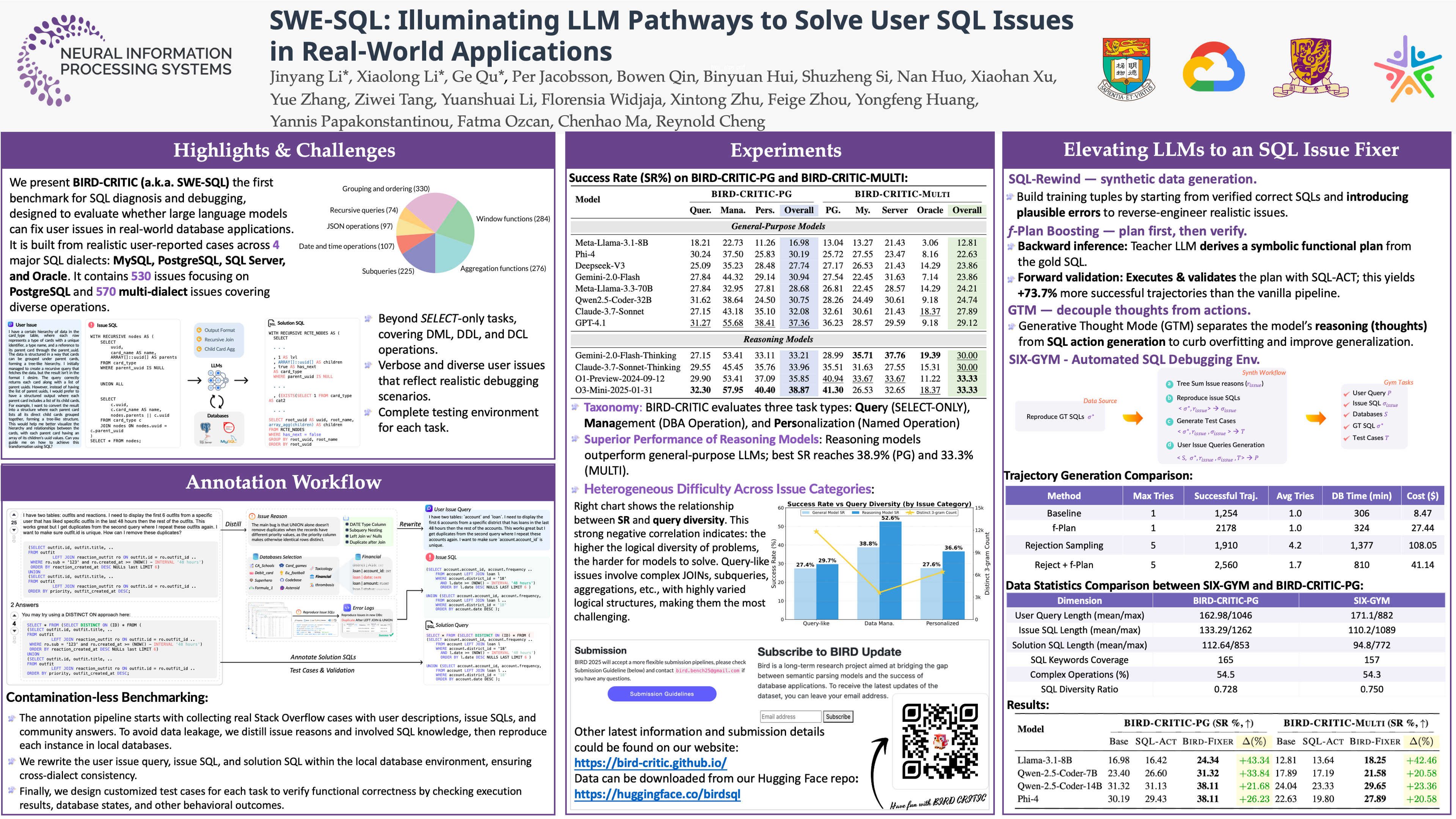
Resolution of complex SQL issues persists as a significant bottleneck in real-world database applications. Current Large Language Models (LLMs), while adept at text-to-SQL translation, have not been rigorously evaluated on the more challenging task of debugging on SQL issues. In order to address this gap, we introduce BIRD-CRITIC, a new SQL issue debugging benchmark comprising 530 carefully curated PostgreSQL tasks (BIRD-CRITIC-PG) and 570 multi-dialect tasks (BIRD-CRITIC-Multi), which are distilled from authentic user issues and replayed within new environments to facilitate rigorous and contamination-free evaluation. Baseline evaluations on BIRD-CRITIC underscore the task's complexity, with the leading reasoning model O3-Mini achieving only 38.87% success rate on BIRD-CRITIC-PG and 33.33% on BIRD-CRITIC-Multi. Meanwhile, realizing open-source models for database tasks is crucial which can empower local development while safeguarding data privacy. Therefore, we present Six-Gym (Sql-fIX-Gym), a training environment for elevating the capabilities of open-source models specifically for SQL issue debugging. This environment leverages SQL-Rewind strategy, which automatically generates executable issue-solution datasets by reverse-engineering issues from verified SQLs. However, popular trajectory-based fine-tuning methods do not explore substantial supervisory signals. We further propose f-Plan Boosting, which extracts high-level debugging plans automatically from SQL solutions, enabling the teacher LLMs to harvest and produce 73.7% more successful trajectories for training. We integrate these components into an open-source agent, BIRD-Fixer. Based on Qwen-2.5-Coder-14B, BIRD-Fixer raises its success rate to 38.11% on BIRD-CRITIC-PG and 29.65% on BIRD-CRITIC-Multi, surpassing many leading proprietary models such as Claude-3.7-Sonnet and GPT-4.1, marking a significant step toward democratizing sophisticated SQL-debugging capabilities for both research and industry.