
Correlation Dimension of Autoregressive Large Language Models
Abstract
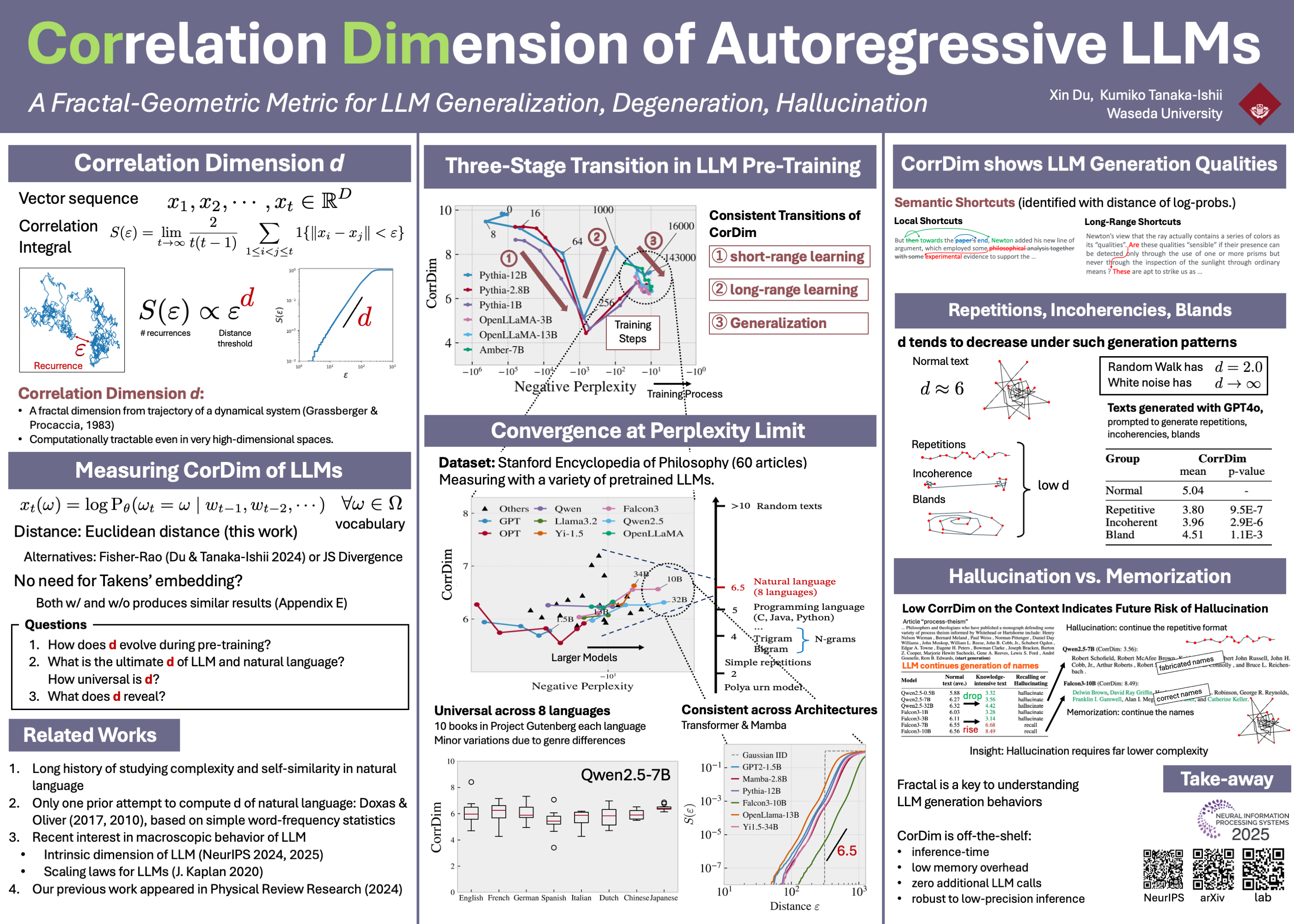
Large language models (LLMs) have achieved remarkable progress in natural language generation, yet they continue to display puzzling behaviors—such as repetition and incoherence—even when exhibiting low perplexity. This highlights a key limitation of conventional evaluation metrics, which emphasize local prediction accuracy while overlooking long-range structural complexity. We introduce correlation dimension, a fractal-geometric measure of self-similarity, to quantify the epistemological complexity of text as perceived by a language model. This measure captures the hierarchical recurrence structure of language, bridging local and global properties in a unified framework. Through extensive experiments, we show that correlation dimension (1) reveals three distinct phases during pretraining, (2) reflects context-dependent complexity, (3) indicates a model's tendency toward hallucination, and (4) reliably detects multiple forms of degeneration in generated text. The method is computationally efficient, robust to model quantization (down to 4-bit precision), broadly applicable across autoregressive architectures (e.g., Transformer and Mamba), and provides fresh insight into the generative dynamics of LLMs.