
TransMLA: Migrating GQA Models to MLA with Full DeepSeek Compatibility and Speedup
Abstract
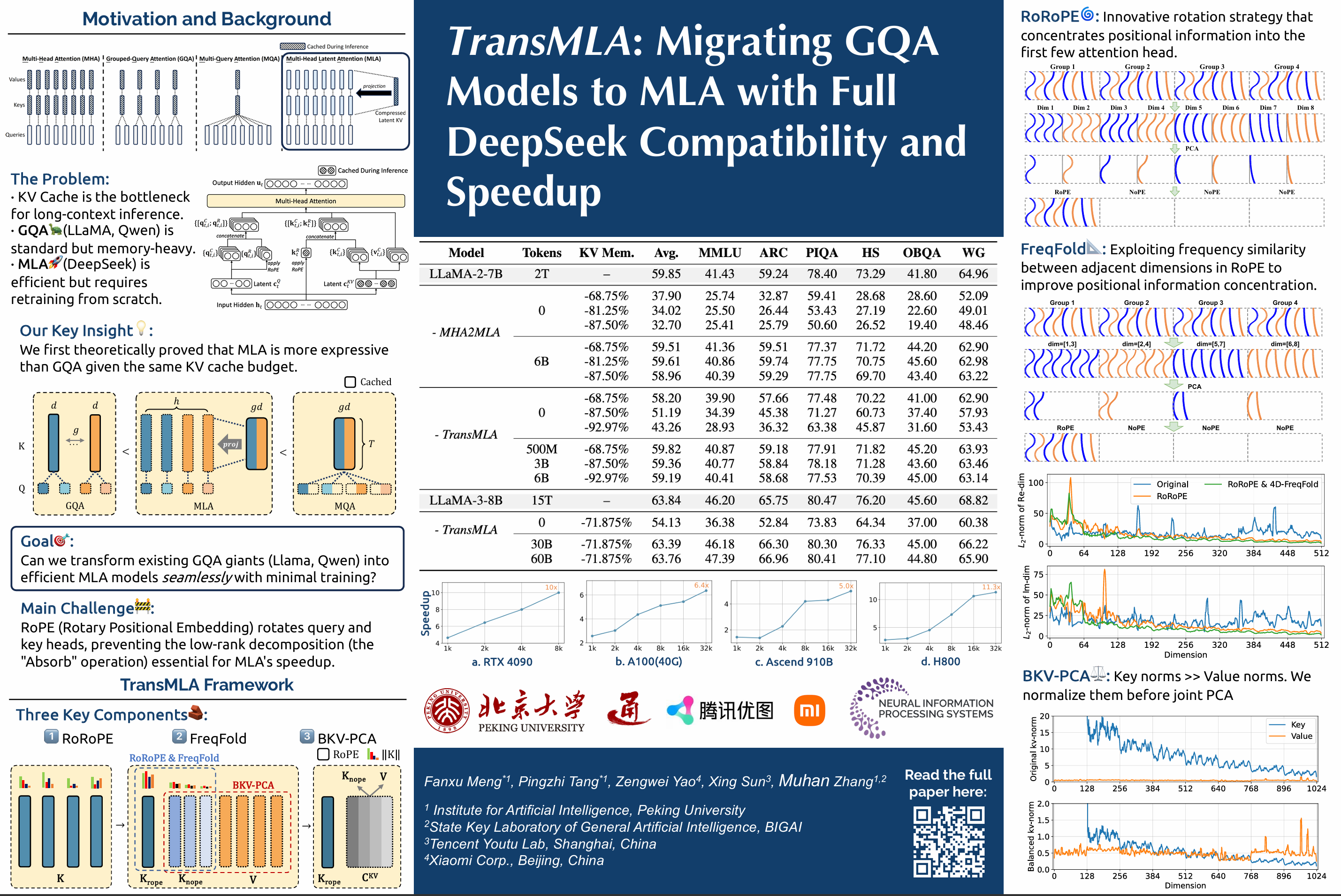
Modern large-language models often face communication bottlenecks on current hardware rather than computational limitations. Multi-head latent attention (MLA) addresses this by compressing the key-value cache using low-rank matrices, while the Absorb operation prevents the KV cache from reverting to its original size, significantly boosting both training and inference speed. Despite the success of DeepSeek V2/V3/R1, most model providers have heavily invested in optimizing GQA-based models and, therefore, lack strong incentives to retrain MLA-based models from scratch. This paper demonstrates that MLA provides superior expressive power compared to GQA with the same KV cache overhead, thereby offering a rationale for transitioning from GQA to MLA. In addition, we introduce TransMLA, a framework that seamlessly converts any GQA-based pre-trained model (e.g., LLaMA, Qwen, Gemma, Mistral/Mixtral) into an MLA-based model. For the first time, our method enables direct conversion of these models into a format compatible with DeepSeek's codebase, allowing them to fully leverage the existing, highly-optimized support for the DeepSeek architecture within inference engines like vLLM and SGlang. By compressing 93\% of the KV cache in LLaMA-2-7B, we achieve a 10x speedup with an 8K context length while maintaining meaningful output. Moreover, the model requires only 6B tokens for fine-tuning to recover comparable performance across multiple benchmarks. TransMLA provides a practical path for migrating GQA-based models to the MLA structure, and when combined with DeepSeek’s advanced optimizations—such as FP8 quantization and Multi-Token Prediction—further inference acceleration can be achieved.