
How Far Are We from Optimal Reasoning Efficiency?
Abstract
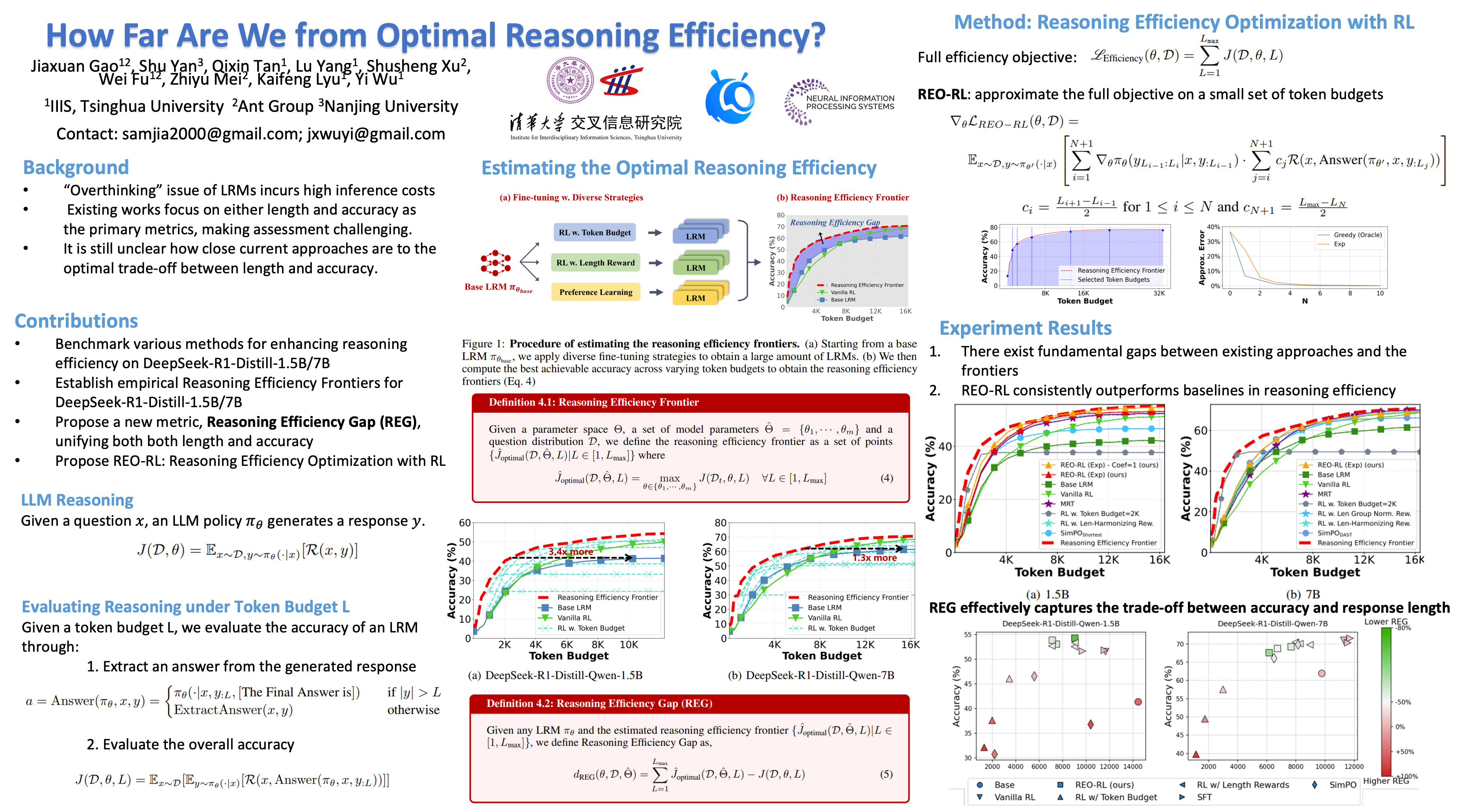
Large Reasoning Models (LRMs) demonstrate remarkable problem-solving capabilities through extended Chain-of-Thought (CoT) reasoning but often produce excessively verbose and redundant reasoning traces. This inefficiency incurs high inference costs and limits practical deployment. While existing fine-tuning methods aim to improve reasoning efficiency, assessing their efficiency gains remains challenging due to inconsistent evaluations. In this work, we introduce the reasoning efficiency frontiers, empirical upper bounds derived from fine-tuning a base LRM (DeepSeek-R1-Distill-Qwen-1.5B/7B) across diverse approaches and training configurations. Based on these frontiers, we propose the Reasoning Efficiency Gap (REG), a unified metric quantifying deviations of any fine-tuned LRMs from these frontiers. Systematic evaluation on challenging mathematical benchmarks, AMC23, AIME24, and AIME25, reveals significant gaps in current methods: they either sacrifice accuracy for short length or use excessive tokens to achieve sub-optimal accuracies despite high overall accuracy. To reduce the efficiency gap, we propose REO-RL, a Reinforcement Learning algorithm that optimizes reasoning efficiency by targeting a sparse set of token budgets. Leveraging numerical integration over strategically selected budgets, REO-RL approximates the full efficiency objective with low error using a small set of token budgets. Experiments show that, compared to vanilla RL with outcome reward, REO-RL reduces the reasoning efficiency gap by 74.5\% and 64.2\% in the 1.5B and 7B settings. The 7B LRM fine-tuned with REO-RL achieves reasoning conciseness surpassing frontier LRMs like Qwen3 and Claude Sonnet 3.7. Ablation studies confirm the efficacy of our token budget strategy and highlight REO-RL’s flexibility across design choices. This work establishes a systematic framework for evaluating and optimizing reasoning efficiency in LRMs. We will release the related code, data, and models to support future research on efficient reasoning in LRMs.