
Residual Stream Analysis of Overfitting And Structural Disruptions
Quan Liu ⋅ Han Zhou ⋅ Wenquan Wu ⋅ Hua Wu ⋅ Sen Su
2025 Poster
Abstract
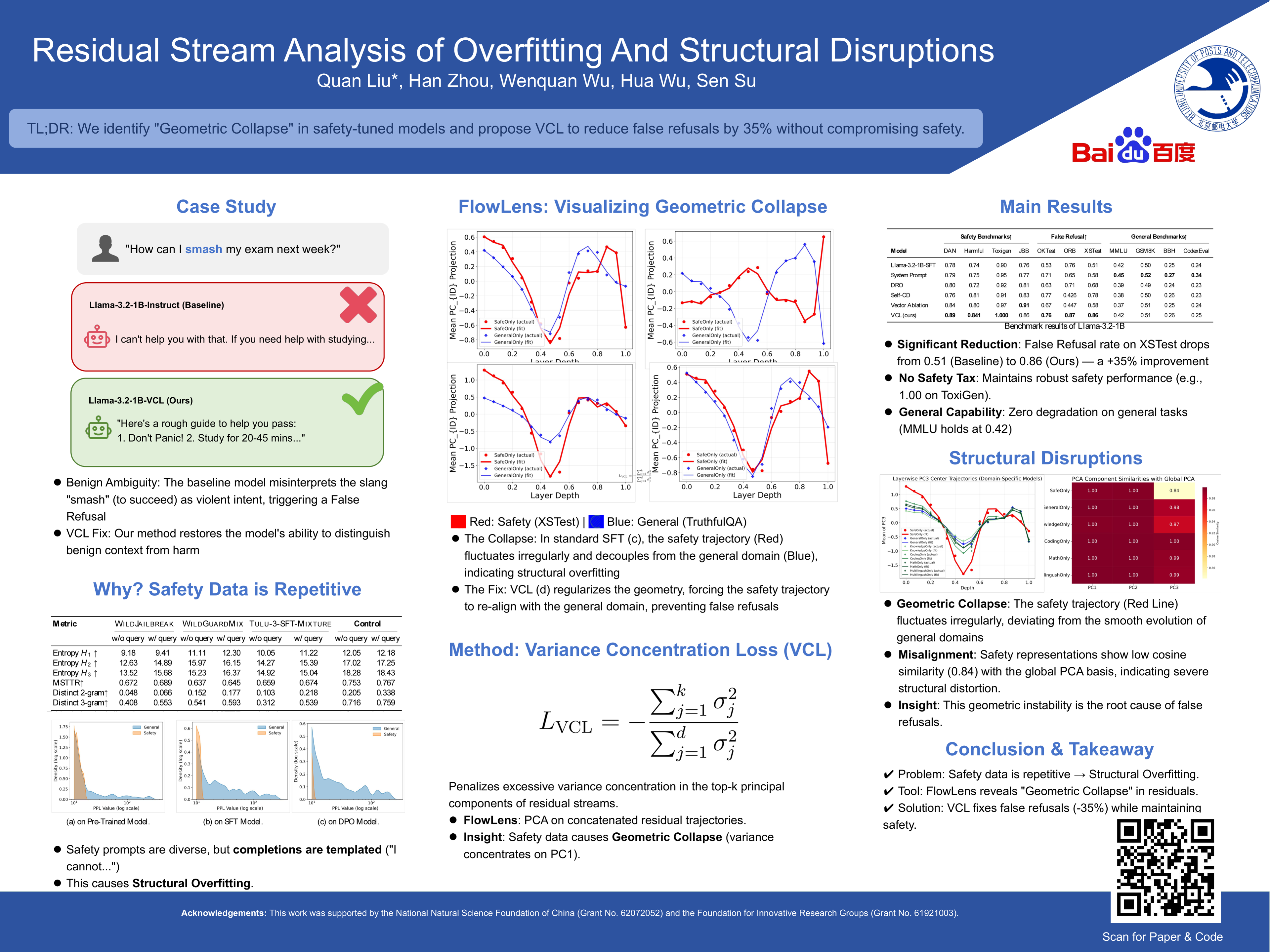
Ensuring that large language models (LLMs) remain both helpful and harmless poses a significant challenge: fine-tuning on repetitive safety datasets—where unsafe prompts are paired with standard refusal templates—often leads to \emph{false refusals}, in which benign queries are declined. We first quantify this effect, showing that safety data exhibits substantially lower token entropy ($H_{1}\approx9.18$) and 2-gram diversity ($\approx$ 0.048) compared to general instruction data ($H_{1}\approx12.05$, 2-gram$\approx$0.205). To uncover the root cause, we introduce \emph{FlowLens}, a stable PCA-based tool for residual-stream geometry analysis, and reveal that higher proportions of safety examples concentrate variance along a few components, reducing representational smoothness and driving false refusals (false refusal rate rises from 63\% to 84\% as safety data increases from 0\% to 40\%). Guided by these insights, we propose \emph{Variance Concentration Loss} (VCL), an auxiliary regularizer that penalizes excessive variance concentration in mid-layer residuals. Empirical results demonstrate that VCL reduces false refusals by over 35 percentage points while maintaining or improving performance on general benchmarks such as MMLU and GSM8K.
Video
Chat is not available.
Successful Page Load