
More effort is needed to protect pedestrian privacy in the era of AI
Abstract
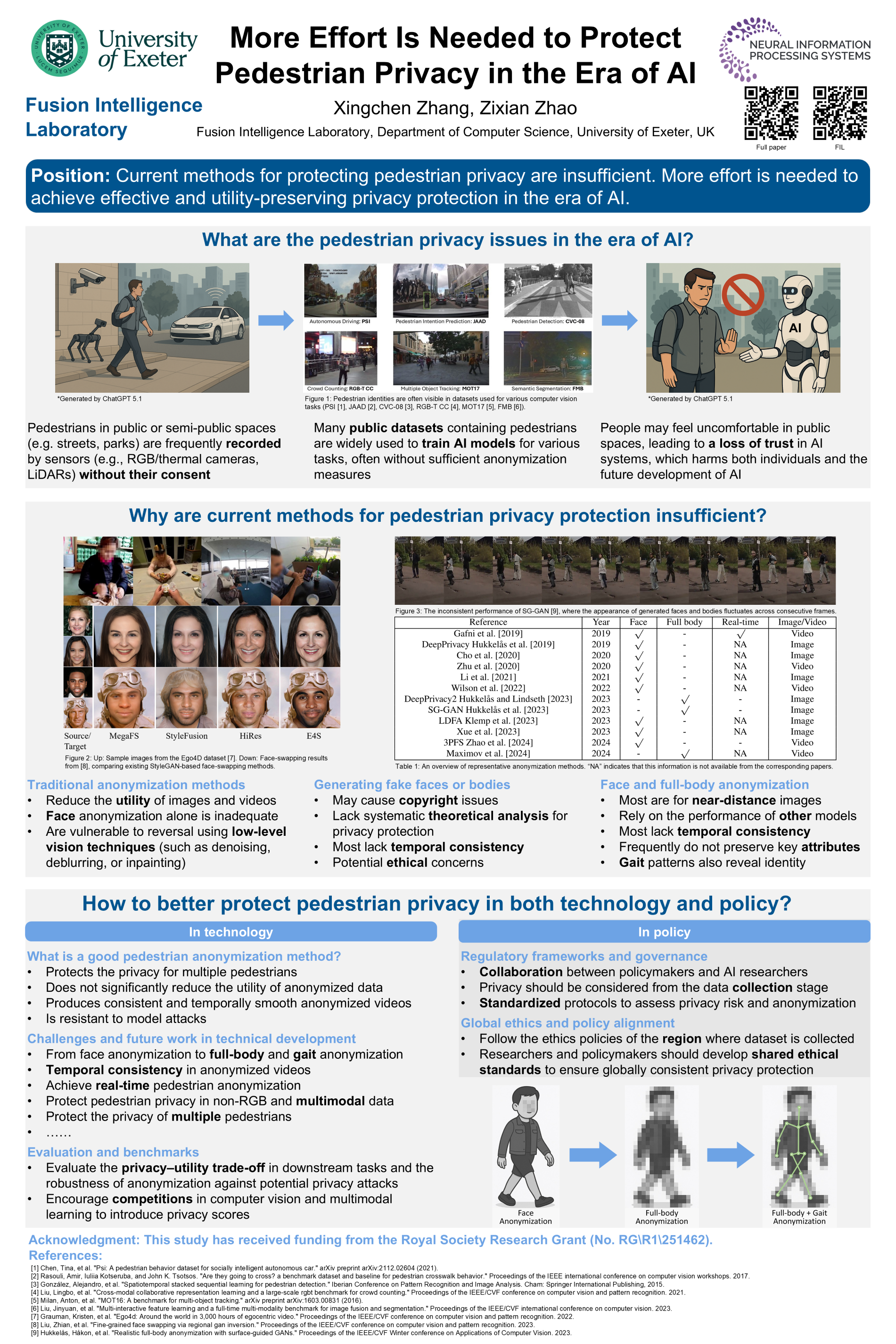
In the era of artificial intelligence (AI), pedestrian privacy is increasingly at risk. In research areas such as autonomous driving, computer vision, and surveillance, large datasets are often collected in public spaces, capturing pedestrians without consent or anonymization. These datasets are used to train systems that can identify, track, and analyze individuals, often without their knowledge. Although various technical methods and regional regulations have been proposed to address this issue, existing solutions are either insufficient to protect privacy or compromise data utility, thereby limiting their effectiveness for research. In this paper, we argue that more effort is needed to protect pedestrian privacy in the era of AI while maintaining data utility. We call on the AI and computer vision communities to take pedestrian privacy seriously and to rethink how pedestrian data are collected and anonymized. Collaboration with experts in law and ethics will also be essential for the responsible development of AI. Without stronger action, it will become increasingly difficult for individuals to protect their privacy, and public trust in AI may decline.