
Collective Bargaining in the Information Economy Can Address AI-Driven Power Concentration
Abstract
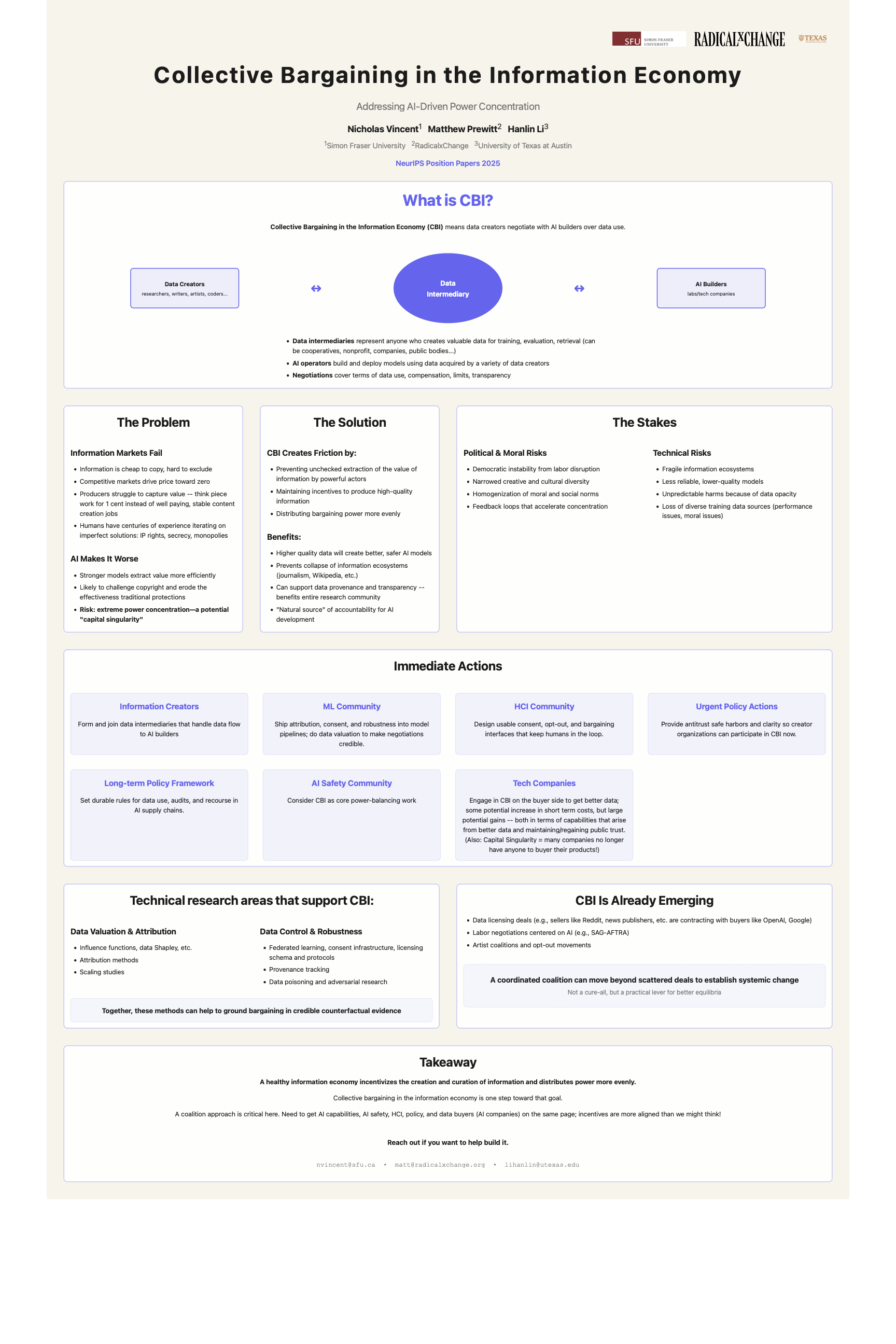
This position paper argues that there is an urgent need to restructure markets for the information that goes into AI systems. Specifically, small-to-medium sized producers of information (such as journalists, news organizations, researchers, and creative professionals) need to be able to appoint representatives who can carry out "collective bargaining" with AI product builders in order to receive a reasonable terms and a fair return on the informational value they contribute. Obstacles to this market structure can be removed through technical work that facilitates collective bargaining in the information economy (e.g., explainable data value estimation and federated data management tools) and regulatory/policy interventions (e.g., support for trusted data intermediary organizations that represent guilds or syndicates of information producers). We argue that without collective bargaining in the information economy, AI will exacerbate a large-scale "information market failure" that will lead not only to undesirable concentration of capital, but also to a potential "ecological collapse" in the informational commons. On the other hand, collective bargaining in the information economy can create market conditions necessary for a pro-social AI future. We provide concrete actions that can be taken to support a coalition-based approach to achieve this.