
Morphosyntactic Features for CEFR Text Classification of L2 Spanish: An Acquisition-Informed Comparison Against L1-Designed Readability Tools
Abstract
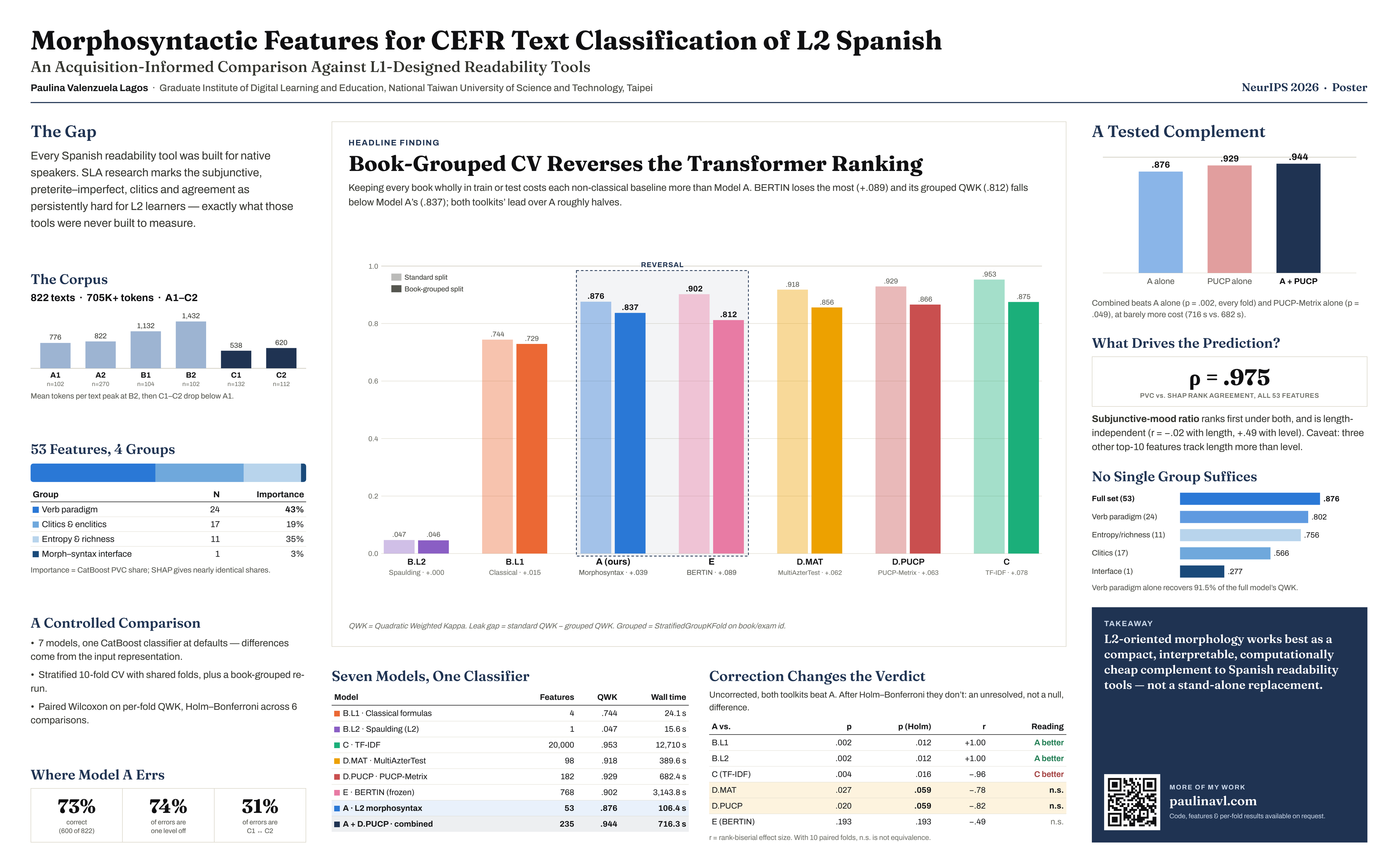
Spanish readability tools were built for native speakers, not L2 learners, leaving open whether morphosyntactic phenomena central to second language acquisition (SLA) provide signal existing tools miss. We construct an L2-oriented morphosyntactic feature set (53 features) and compare it, under matched 10-fold cross-validation with the classifier held constant, against six baselines: classical L1- and L2-designed formulas, TF-IDF, two composite Spanish toolkits, and a pretrained transformer. The morphosyntactic model (QWK~=~.876) significantly outperforms both formula baselines, ties the transformer, and is outperformed by TF-IDF and both composite toolkits, with its clearest advantage at the beginner (A1) level and at a fraction of the computational cost of every representation that beats it. A book-grouped re-evaluation shows a meaningful share of TF-IDF's advantage over the morphosyntactic model reflects exam-level vocabulary memorization, roughly halving once books are kept whole across folds. Feature-importance analysis identifies the subjunctive-mood ratio as the single strongest predictor, consistent with acquisition accounts of the subjunctive as a persistently late-acquired phenomenon, and an ablation confirms no single feature group matches the full set alone. The findings suggest L2-oriented morphology functions best as a compact, interpretable, computationally cheap complement to existing Spanish readability tools, not a stand-alone replacement.