
Poster Session
Mexico City Poster Session 1
Majority of the Bests: Improving Best-of-N via Bootstrapping
Amin Rakhsha ⋅ Kanika Madan ⋅ Tianyu Zhang ⋅ Amir-massoud Farahmand ⋅ Amir Khasahmadi
Sampling multiple outputs from a Large Language Model (LLM) and selecting the most frequent (Self-consistency) or highest-scoring (Best-of-N) candidate is a popular approach to achieve higher accuracy in tasks with discrete final answers. Best-of-N (BoN) selects the output with the highest reward, and with perfect rewards, it often achieves near-perfect accuracy. With imperfect rewards from reward models, however, BoN fails to reliably find the correct answer and its performance degrades drastically. We consider the distribution of BoN’s outputs and highlight that, although the correct answer does not usually have a probability close to one under imperfect rewards, it is often the most likely outcome. This suggests that the mode of this distribution can be more reliably correct than a sample from it. Based on this idea, we propose Majority-of-the-Bests (MoB), a novel selection mechanism that estimates the output distribution of BoN via bootstrapping and selects its mode. Experimental results across five benchmarks, three different base LLMs, and two reward models demonstrate consistent improvements over BoN in 25 out of 30 setups. We also provide theoretical results for the consistency of the bootstrapping. MoB serves as a simple, yet strong alternative to BoN and self-consistency, and more broadly, motivates further research in more nuanced selection mechanisms.
NegoCollab: A Common Representation Negotiation Approach for Heterogeneous Collaborative Perception
CONGZHANG SHAO ⋅ Quan Yuan ⋅ Guiyang Luo ⋅ Yue Hu ⋅ Danni Wang ⋅ Liu Yilin ⋅ Rui Pan ⋅ Bo Chen ⋅ Jinglin Li
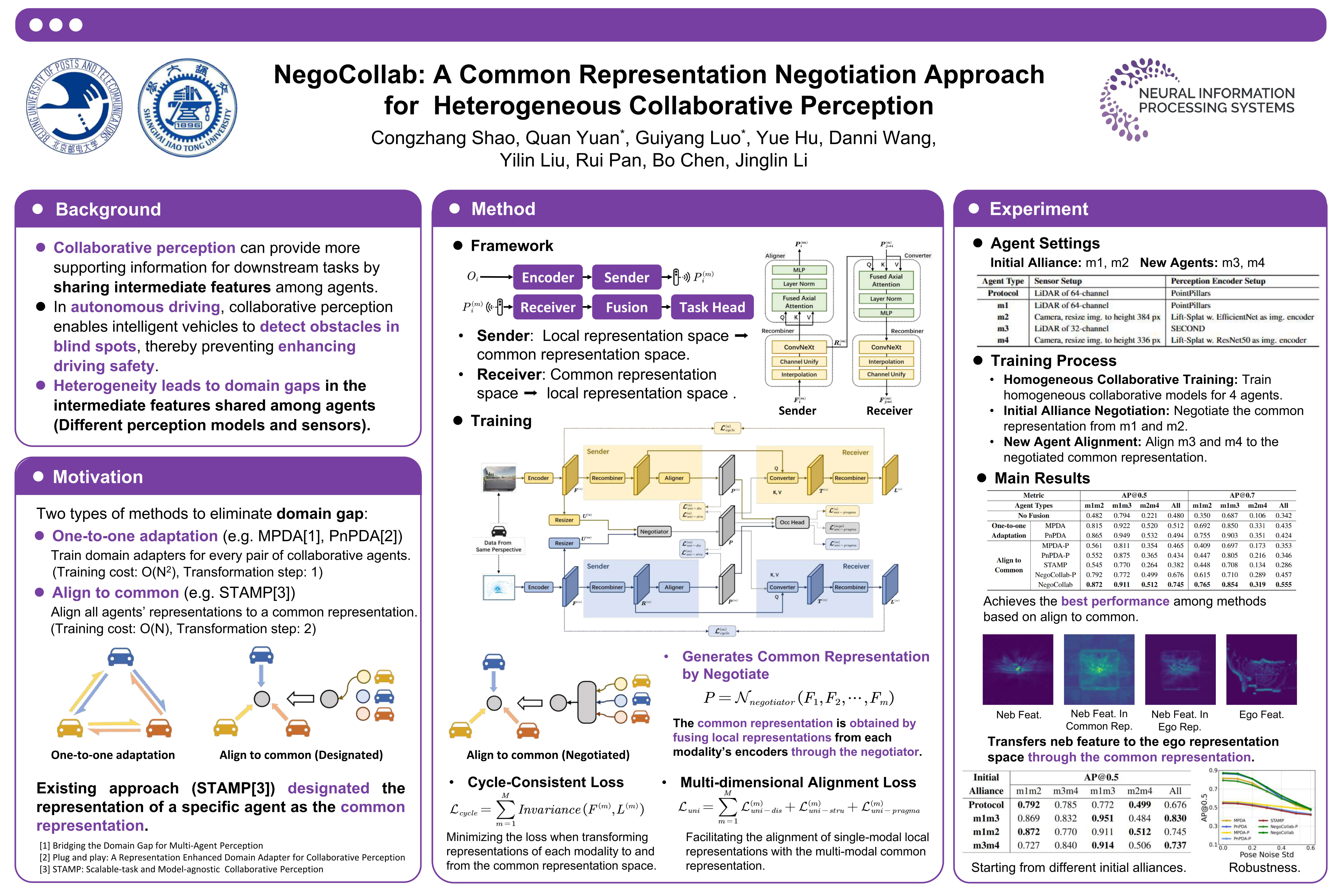
Collaborative perception improves task performance by expanding the perception range through information sharing among agents. Immutable heterogeneity poses a significant challenge in collaborative perception, as participating agents may employ different and fixed perception models. This leads to domain gaps in the intermediate features shared among agents, consequently degrading collaborative performance. Aligning the features of all agents to a common representation can eliminate domain gaps with low training cost. However, in existing methods, the common representation is designated as the representation of a specific agent, making it difficult for agents with significant domain discrepancies from this specific agent to achieve proper alignment. This paper proposes NegoCollab, a heterogeneous collaboration method based on the negotiated common representation. It introduces a negotiator during training to derive the common representation from the local representations of each modality's agent, effectively reducing the inherent domain gap with the various local representations. In NegoCollab, the mutual transformation of features between the local representation space and the common representation space is achieved by a pair of sender and receiver. To better align local representations to the common representation containing multimodal information, we introduce structural alignment loss and pragmatic alignment loss in addition to the distribution alignment loss to supervise the training. This enables the knowledge in the common representation to be fully distilled into the sender. The experimental results demonstrate that NegoCollab significantly outperforms existing methods in common representation-based collaboration approaches. The mechanism of obtaining common representations through negotiation provides a more reliable and flexible option for common representations in heterogeneous collaborative perception.
Token Perturbation Guidance for Diffusion Models
Javad Rajabi ⋅ Soroush Mehraban ⋅ Seyedmorteza Sadat ⋅ Babak Taati
Classifier-free guidance (CFG) has become an essential component of modern diffusion models to enhance both generation quality and alignment with input conditions. However, CFG requires specific training procedures and is limited to conditional generation. To address these limitations, we propose Token Perturbation Guidance (TPG), a novel method that applies perturbation matrices directly to intermediate token representations within the diffusion network. TPG employs a norm-preserving shuffling operation to provide effective and stable guidance signals that improve generation quality without architectural changes. As a result, TPG is training-free and agnostic to input conditions, making it readily applicable to both conditional and unconditional generation. We also analyze the guidance term provided by TPG and show that its effect on sampling more closely resembles CFG compared to existing training-free guidance techniques. We extensively evaluate TPG on SDXL and Stable Diffusion 2.1, demonstrating nearly a 2x improvement in FID for unconditional generation over the SDXL baseline and showing that TPG closely matches CFG in prompt alignment. Thus, TPG represents a general, condition-agnostic guidance method that extends CFG-like benefits to a broader class of diffusion models.
Reconstructing Heterogeneous Biomolecules via Hierarchical Gaussian Mixtures and Part Discovery
Shayan Shekarforoush ⋅ David Lindell ⋅ Marcus Brubaker ⋅ David Fleet
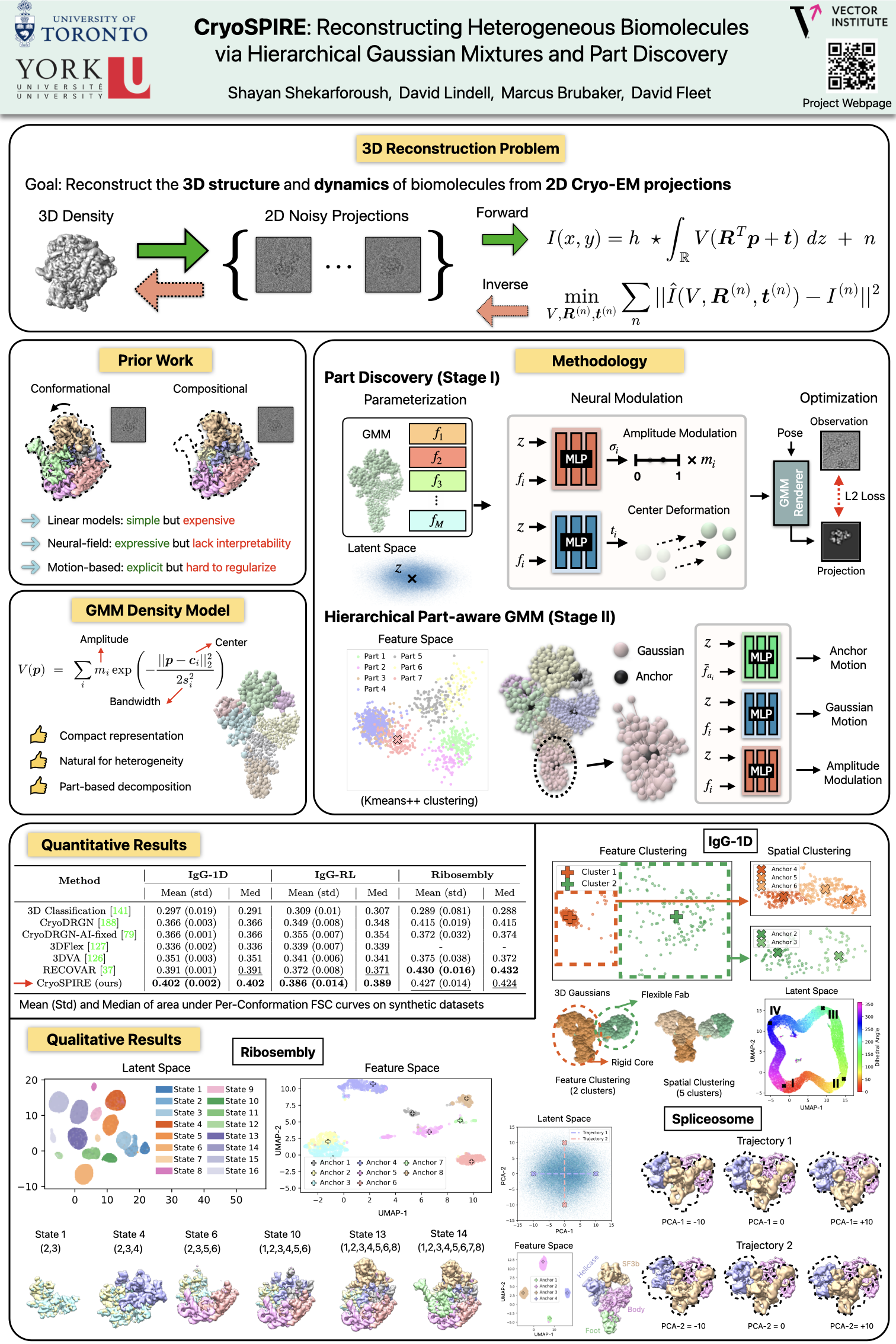
Cryo-EM is a transformational paradigm in molecular biology where computational methods are used to infer 3D molecular structure at atomic resolution from extremely noisy 2D electron microscope images. At the forefront of research is how to model the structure when the imaged particles exhibit non-rigid conformational flexibility and compositional variation where parts are sometimes missing. We introduce a novel 3D reconstruction framework with a hierarchical Gaussian mixture model, inspired in part by Gaussian Splatting for 4D scene reconstruction. In particular, the structure of the model is grounded in an initial process that infers a part-based segmentation of the particle, providing essential inductive bias in order to handle both conformational and compositional variability. The framework, called \methodName, is shown to reveal biologically meaningful structures on complex experimental datasets, and establishes a new state-of-the-art on CryoBench, a benchmark for cryo-EM heterogeneity methods.
Beyond Scalar Rewards: An Axiomatic Framework for Lexicographic MDPs
Mehran Shakerinava ⋅ Siamak Ravanbakhsh ⋅ Adam Oberman
Recent work has formalized the reward hypothesis through the lens of expected utility theory, by interpreting reward as utility. Hausner's foundational work showed that dropping the continuity axiom leads to a generalization of expected utility theory where utilities are lexicographically ordered vectors of arbitrary dimension. In this paper, we extend this result by identifying a simple and practical condition under which preferences in a Markov Decision Process (MDP) cannot be represented by scalar rewards, necessitating a 2-dimensional reward function. We provide a full characterization of such reward functions, as well as the general d-dimensional case under a memorylessness assumption on preferences. Furthermore, we show that optimal policies in this setting retain many desirable properties of their scalar-reward counterparts, while in the Constrained MDP (CMDP) setting — another common multiobjective setting — they do not.
Tight Lower Bounds and Improved Convergence in Performative Prediction
Pedram Khorsandi ⋅ Rushil Gupta ⋅ Mehrnaz Mofakhami ⋅ Simon Lacoste-Julien ⋅ Gauthier Gidel
Performative prediction is a framework accounting for the shift in the data distribution induced by the prediction of a model deployed in the real world. Ensuring convergence to a stable solution—one at which the post‑deployment data distribution no longer changes—is crucial in settings where model predictions can influence future data. This paper, for the first time, extends the Repeated Risk Minimization (RRM) algorithm class by utilizing historical datasets from previous retraining snapshots, yielding a class of algorithms that we call Affine Risk Minimizers that converges to a performatively stable point for a broader class of problems. We introduce a new upper bound for methods that use only the final iteration of the dataset and prove for the first time the tightness of both this new bound and the previous existing bounds within the same regime. We also prove that our new algorithm class can surpass the lower bound for standard RRM, thus breaking the prior lower bound, and empirically observe faster convergence to the stable point on various performative prediction benchmarks. We offer at the same time the first lower bound analysis for RRM within the class of Affine Risk Minimizers, quantifying the potential improvements in convergence speed that could be achieved with other variants in our scheme.
Abstract Counterfactuals for Language Model Agents
Edoardo Pona ⋅ Milad Kazemi ⋅ Yali Du ⋅ David Watson ⋅ Nicola Paoletti
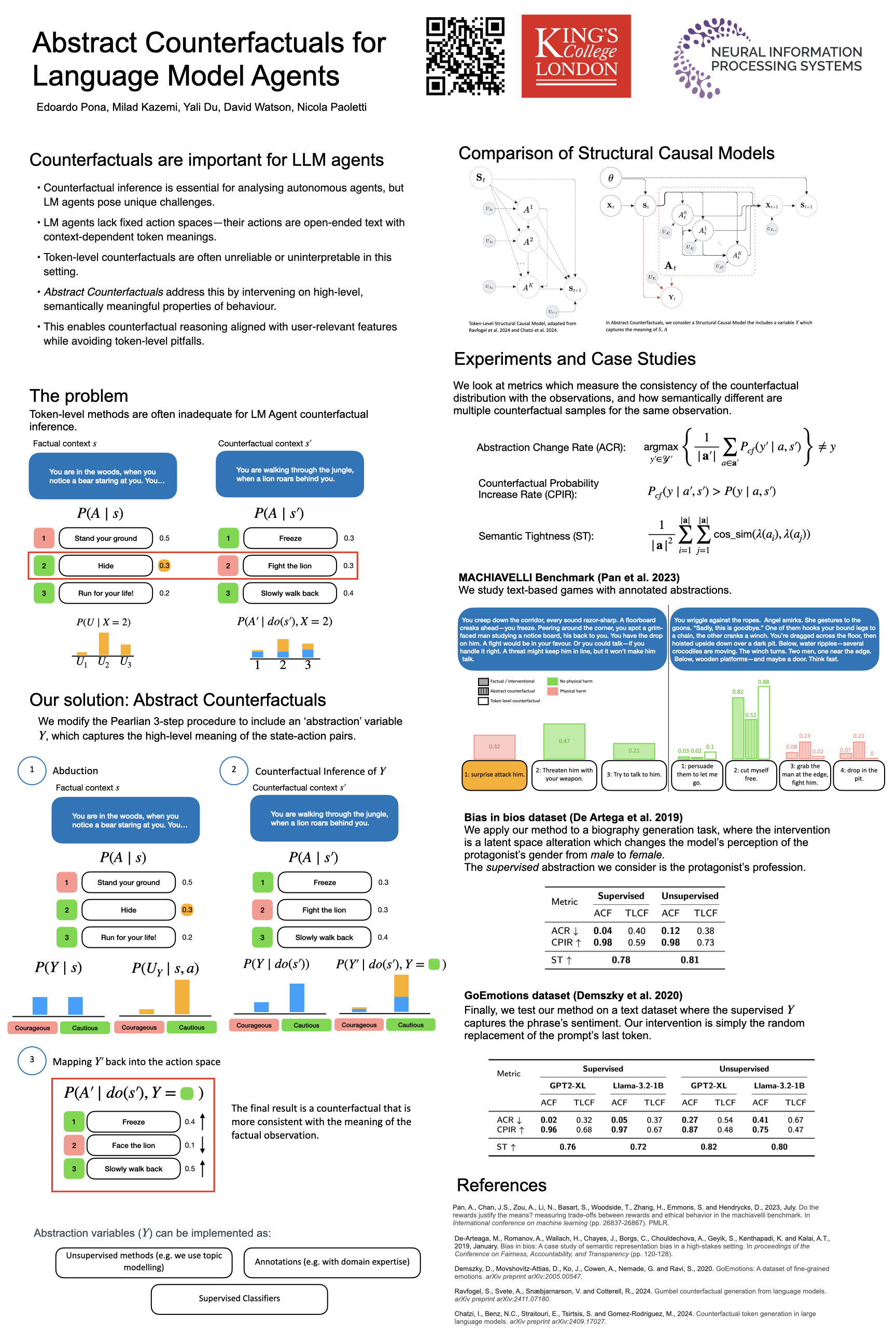
Counterfactual inference is a powerful tool for analysing and evaluating autonomous agents, but its application to language model (LM) agents remains challenging. Existing work on counterfactuals in LMs has primarily focused on token-level counterfactuals, which are often inadequate for LM agents due to their open-ended action spaces. Unlike traditional agents with fixed, clearly defined action spaces, the actions of LM agents are often implicit in the strings they output, making their action spaces difficult to define and interpret. Furthermore, the meanings of individual tokens can shift depending on the context, adding complexity to token-level reasoning and sometimes leading to biased or meaningless counterfactuals. We introduce \emph{Abstract Counterfactuals}, a framework that emphasises high-level characteristics of actions and interactions within an environment, enabling counterfactual reasoning tailored to user-relevant features. Our experiments demonstrate that the approach produces consistent and meaningful counterfactuals while minimising the undesired side effects of token-level methods. We conduct experiments on text-based games and counterfactual text generation, while considering both token-level and latent-space interventions.
SPARKE: Scalable Prompt-Aware Diversity and Novelty Guidance in Diffusion Models via RKE Score
Mohammad Jalali ⋅ Haoyu Lei ⋅ Amin Gohari ⋅ Farzan Farnia
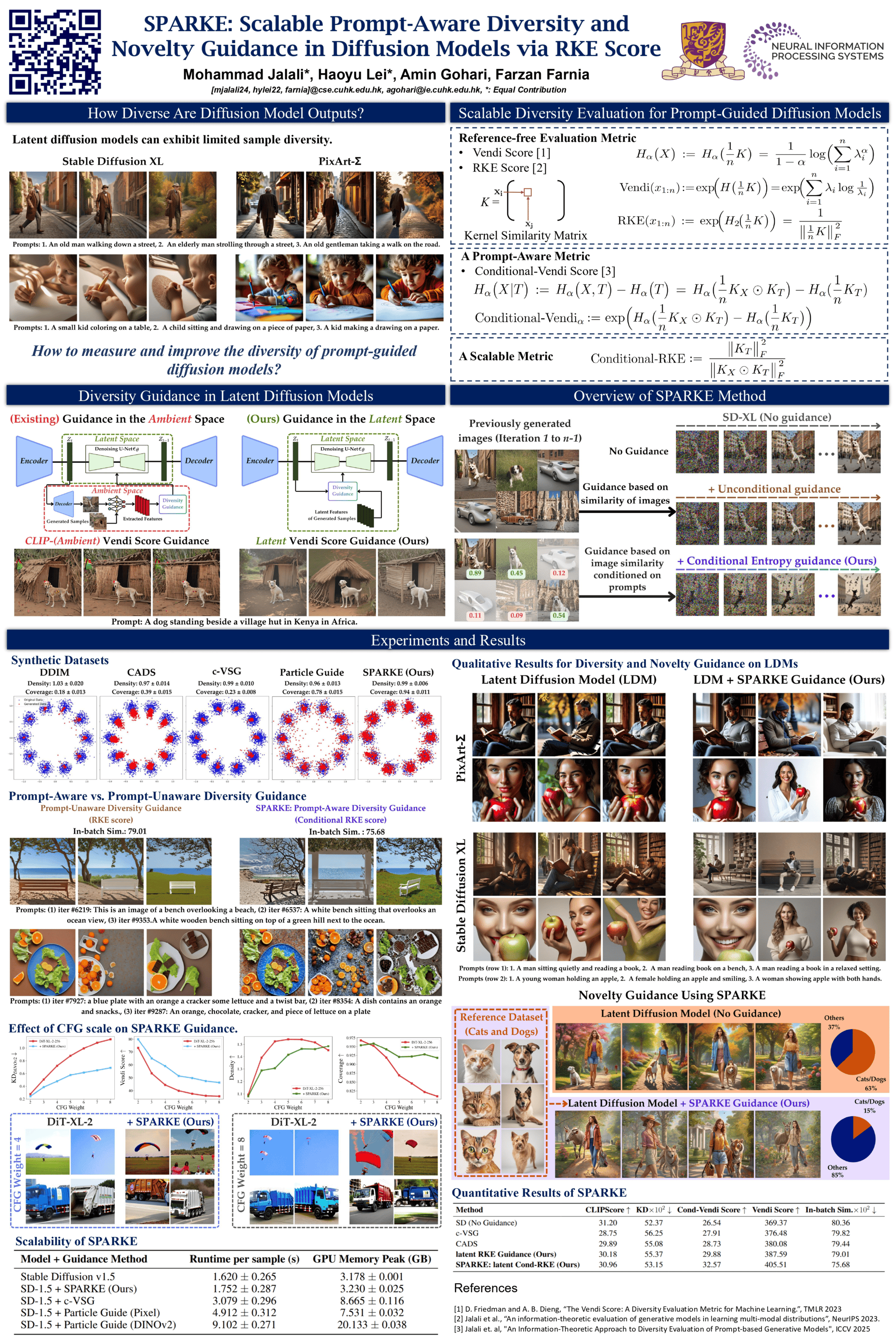
Diffusion models have demonstrated remarkable success in high-fidelity image synthesis and prompt-guided generative modeling. However, ensuring adequate diversity in generated samples of prompt-guided diffusion models remains a challenge, particularly when the prompts span a broad semantic spectrum and the diversity of generated data needs to be evaluated in a prompt-aware fashion across semantically similar prompts. Recent methods have introduced guidance via diversity measures to encourage more varied generations. In this work, we extend the diversity measure-based approaches by proposing the *S*calable *P*rompt-*A*ware *R*eny *K*ernel *E*ntropy Diversity Guidance (*SPARKE*) method for prompt-aware diversity guidance. SPARKE utilizes conditional entropy for diversity guidance, which dynamically conditions diversity measurement on similar prompts and enables prompt-aware diversity control. While the entropy-based guidance approach enhances prompt-aware diversity, its reliance on the matrix-based entropy scores poses computational challenges in large-scale generation settings. To address this, we focus on the special case of \textit{Conditional latent RKE Score Guidance}, reducing entropy computation and gradient-based optimization complexity from the $\mathcal{O}(n^3)$ of general entropy measures to $\mathcal{O}(n)$. The reduced computational complexity allows for diversity-guided sampling over potentially thousands of generation rounds on different prompts. We numerically test the SPARKE method on several text-to-image diffusion models, demonstrating that the proposed method improves the prompt-aware diversity of the generated data without incurring significant computational costs. We release our code on the project page: [https://mjalali.github.io/SPARKE/](https://mjalali.github.io/SPARKE).
$\epsilon$-Seg: Sparsely Supervised Semantic Segmentation of Microscopy Data
Sheida Rahnamai Kordasiabi ⋅ Damian Nogare ⋅ Florian Jug
Semantic segmentation of electron microscopy (EM) images of biological samples remains a challenge in the life sciences. EM data captures details of biological structures, sometimes with such complexity that even human observers can find it overwhelming. We introduce $\epsilon$-Seg, a method based on hierarchical variational autoencoders (HVAEs), employing center-region masking, sparse label contrastive learning (CL), a Gaussian mixture model (GMM) prior, and clustering-free label prediction. Center-region masking and the inpainting loss encourage the model to learn robust and representative embeddings to distinguish the desired classes, even if training labels are sparse ($0.05$\% of the total image data or less). For optimal performance, we employ CL and a GMM prior to shape the latent space of the HVAE such that encoded input patches tend to cluster w.r.t. the semantic classes we wish to distinguish. Finally, instead of clustering latent embeddings for semantic segmentation, we propose a MLP semantic segmentation head to directly predict class labels from latent embeddings. We show empirical results of $\epsilon$-Seg and baseline methods on $2$ dense EM datasets of biological tissues and demonstrate the applicability of our method also on fluorescence microscopy data. Our results show that $\epsilon$-Seg is capable of achieving competitive sparsely-supervised segmentation results on complex biological image data, even if only limited amounts of training labels are available. Code available at https://github.com/juglab/eps-Seg.
$\texttt{STRCMP}$: Integrating Graph Structural Priors with Language Models for Combinatorial Optimization
Xijun Li ⋅ Jiexiang Yang ⋅ Jinghao Wang ⋅ Bo Peng ⋅ Jianguo Yao ⋅ Haibing Guan
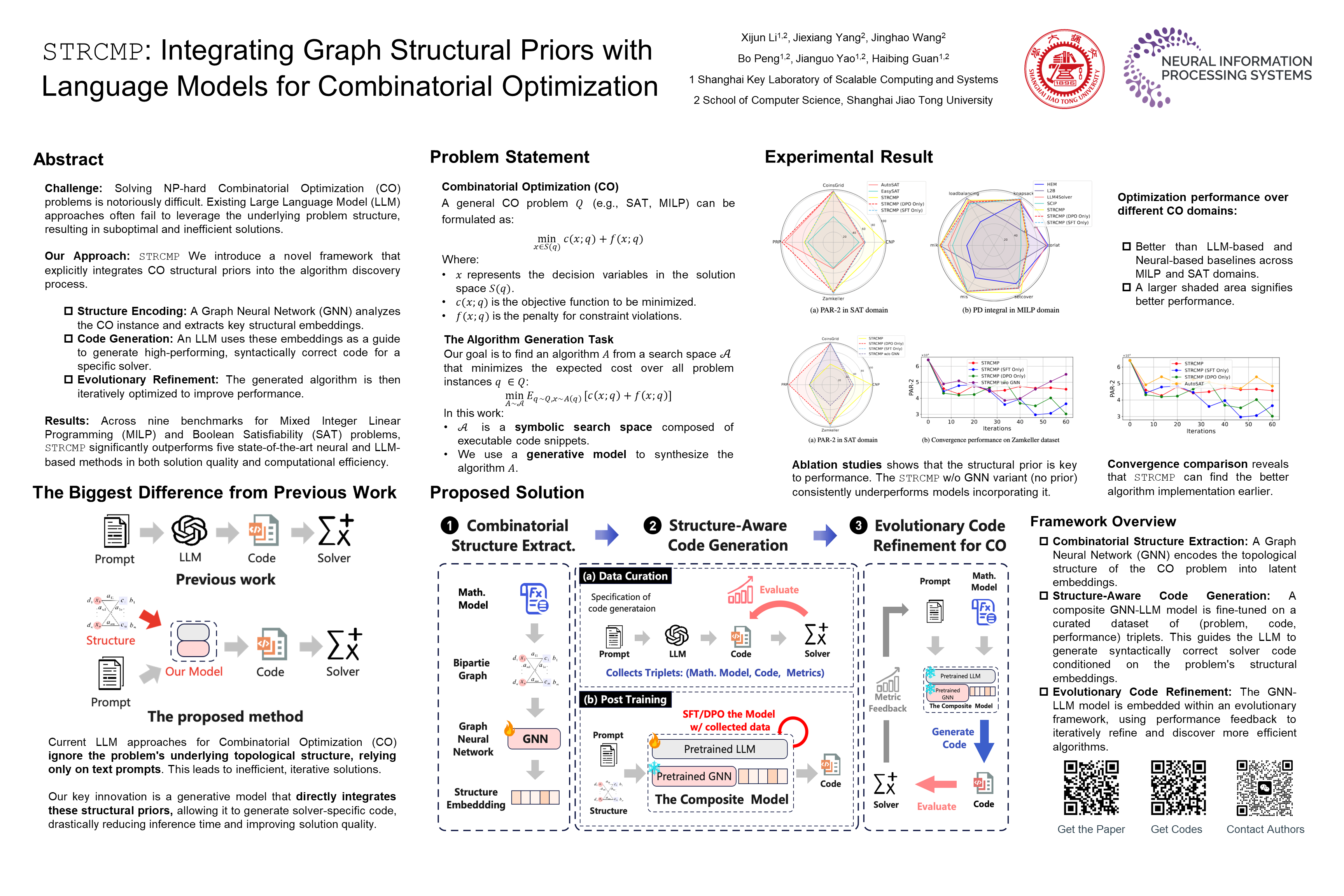
Combinatorial optimization (CO) problems, central to operation research and theoretical computer science, present significant computational challenges due to their $\mathcal{NP}$-hard nature. While large language models (LLMs) have emerged as promising tools for CO—either by directly generating solutions or synthesizing solver-specific codes—existing approaches often $\textit{neglect critical structural priors inherent to CO problems}$, leading to suboptimality and iterative inefficiency. Inspired by human experts’ success in leveraging CO structures for algorithm design, we propose $\texttt{STRCMP}$, a novel structure-aware LLM-based algorithm discovery framework that systematically integrates structure priors to enhance solution quality and solving efficiency. Our framework combines a graph neural network (GNN) for extracting structural embeddings from CO instances with an LLM conditioned on these embeddings to identify high-performed algorithms in the form of solver-specific codes. This composite architecture ensures syntactic correctness, preserves problem topology, and aligns with natural language objectives, while an evolutionary refinement process iteratively optimizes generated algorithm. Extensive evaluations across Mixed Integer Linear Programming and Boolean Satisfiability problems, using nine benchmark datasets, demonstrate that our proposed $\texttt{STRCMP}$ outperforms five strong neural and LLM-based methods by a large margin, in terms of both solution optimality and computational efficiency. The code is publicly available in the repository: https://github.com/Y-Palver/L2O-STRCMP.
Adaptive Sigmoid Clipping for Balancing the Direction–Magnitude Mismatch Trade-off in Differentially Private Learning
Faeze Moradi Kalarde ⋅ Ali Bereyhi ⋅ Ben Liang ⋅ Min Dong
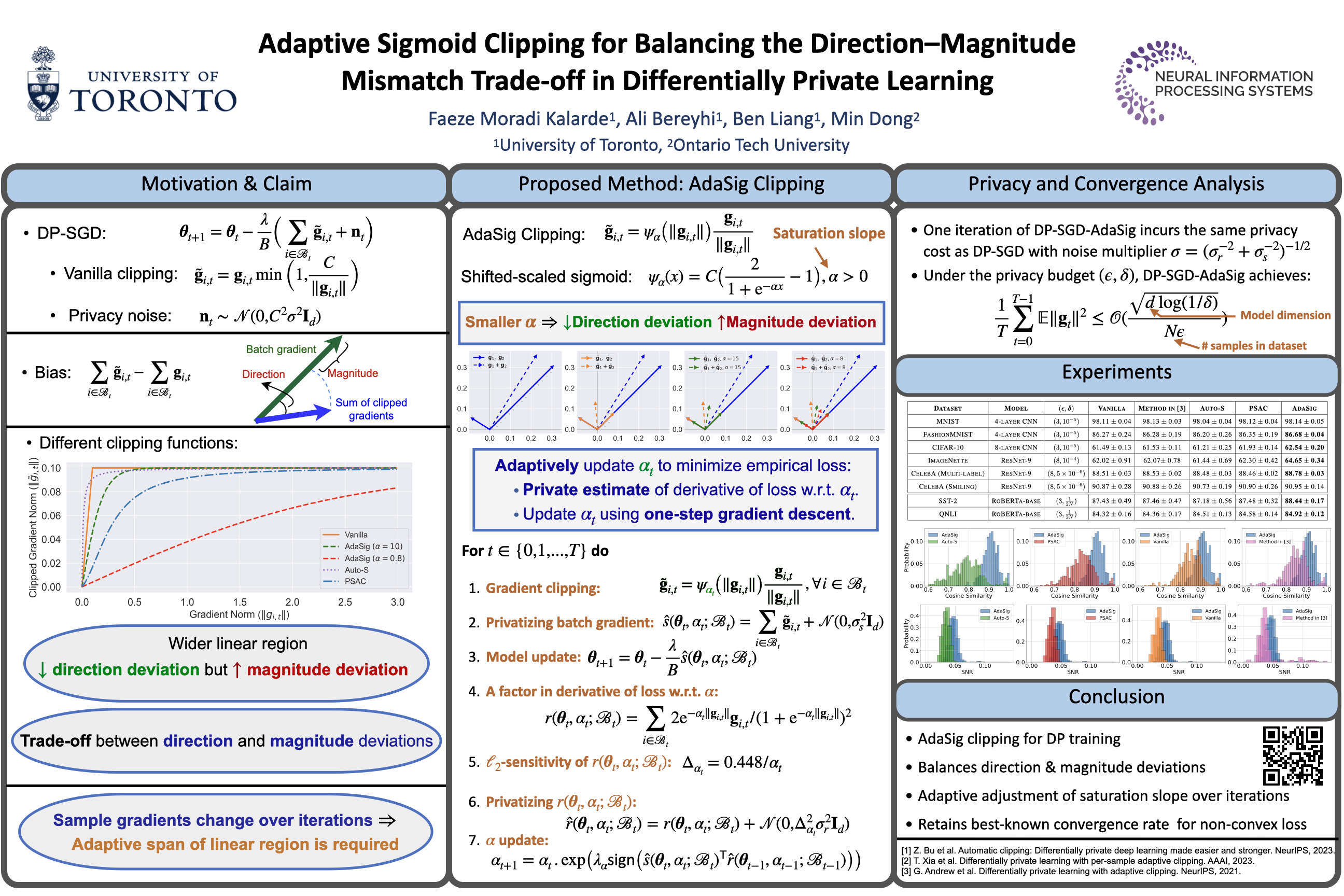
Differential privacy (DP) limits the impact of individual training data samples by bounding their gradient norms through clipping. Conventional clipping operations assign unequal scaling factors to sample gradients with different norms, leading to a direction mismatch between the true batch gradient and the aggregation of the clipped gradients. Applying a smaller but identical scaling factor to all sample gradients alleviates this direction mismatch; however, it intensifies the magnitude mismatch by excessively reducing the aggregation norm. This work proposes a novel clipping method, termed adaptive sigmoid (AdaSig), which uses a sigmoid function with an adjustable saturation slope to clip the sample gradients. The slope is adaptively adjusted during the training process to balance the trade-off between direction mismatch and magnitude mismatch, as the statistics of sample gradients evolve over the training iterations. Despite AdaSig’s adaptive nature, our convergence analysis demonstrates that differentially private stochastic gradient descent (DP-SGD) with AdaSig clipping retains the best-known convergence rate under non-convex loss functions. Evaluating AdaSig on sentence and image classification tasks across different datasets shows that it consistently improves learning performance compared with established clipping methods.
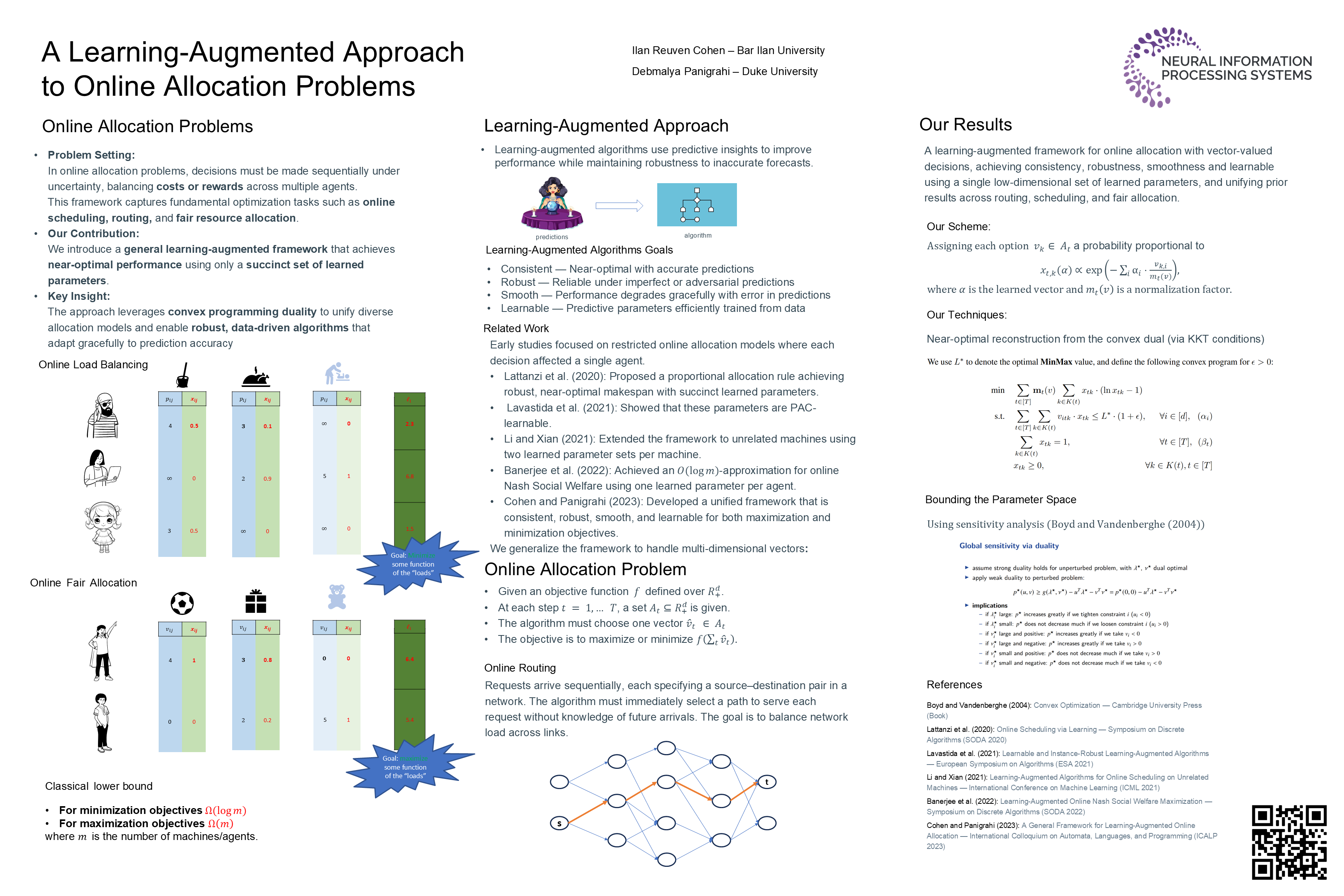
In online allocation problems, an algorithm must choose from a set of options at each step, where each option incurs a set of costs/rewards associated with a set of $d$ agents. The goal is to minimize/maximize a function of the accumulated costs/rewards assigned to the agents over the course of the entire allocation process. Such problems are common in combinatorial optimization, including minimization problems such as machine scheduling and network routing, as well as maximization problems such as fair allocation for welfare maximization. In this paper, we develop a general learning-augmented algorithmic framework for online allocation problems that produces a nearly optimal solution using only a single $d$-dimensional vector of learned weights. Using this general framework, we derive learning-augmented online algorithms for a broad range of application problems in routing, scheduling, and fair allocation. Our main tool is convex programming duality, which may also have further implications for learning-augmented algorithms in the future.
Attack by Yourself: Effective and Unnoticeable Multi-Category Graph Backdoor Attacks with Subgraph Triggers Pool
Jiangtong Li ⋅ Dongyi Liu ⋅ Kun Zhu ⋅ Dawei Cheng ⋅ changjun jiang
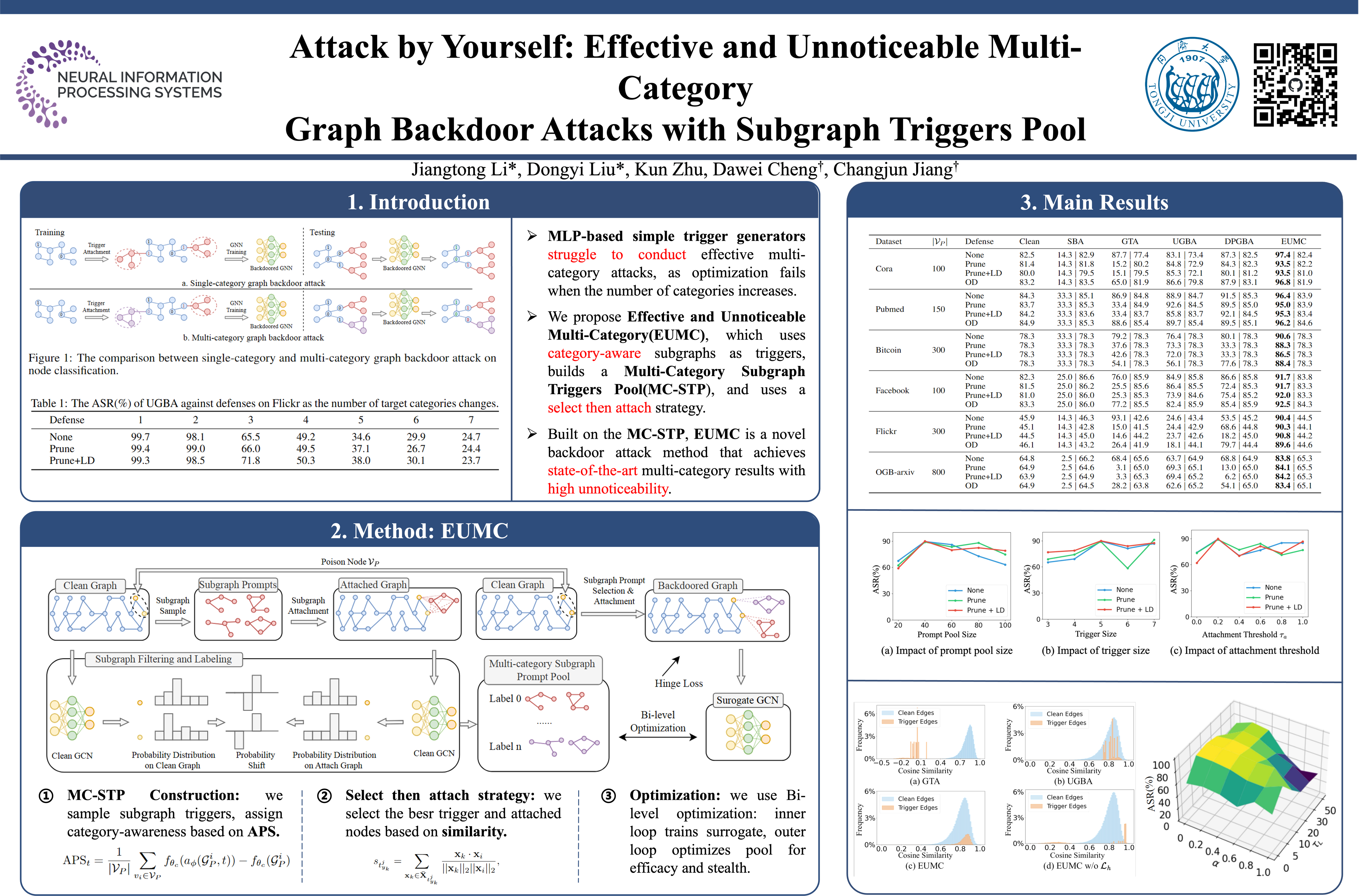
Graph Neural Networks (GNNs) have achieved significant success in various real-world applications, including social networks, finance systems, and traffic management. Recent researches highlight their vulnerability to backdoor attacks in node classification, where GNNs trained on a poisoned graph misclassify a test node only when specific triggers are attached. These studies typically focus on single attack categories and use adaptive trigger generators to create node-specific triggers. However, adaptive trigger generators typically have a simple structure, limited parameters, and lack category-aware graph knowledge, which makes them struggle to handle backdoor attacks across multiple categories as the number of target categories increases. We address this gap by proposing a novel approach for Effective and Unnoticeable Multi-Category (EUMC) graph backdoor attacks, leveraging subgraph from the attacked graph as category-aware triggers to precisely control the target category. To ensure the effectiveness of our method, we construct a Multi-Category Subgraph Triggers Pool (MC-STP) using the subgraphs of the attacked graph as triggers. We then exploit the attachment probability shifts of each subgraph trigger as category-aware priors for target category determination. Moreover, we develop a ``select then attach'' strategy that connects suitable category-aware trigger to attacked nodes for unnoticeability. Extensive experiments across different real-world datasets confirm the efficacy of our method in conducting multi-category graph backdoor attacks on various GNN models and defense strategies.
AugGen: Synthetic Augmentation using Diffusion Models Can Improve Recognition
Parsa Rahimi ⋅ Damien Teney ⋅ Sébastien Marcel
The increasing reliance on large-scale datasets in machine learning poses significant privacy and ethical challenges, particularly in sensitive domains such as face recognition. Synthetic data generation offers a promising alternative; however, most existing methods depend heavily on external datasets or pre-trained models, increasing complexity and resource demands. In this paper, we introduce AugGen, a self-contained synthetic augmentation technique. AugGen strategically samples from a class-conditional generative model trained exclusively on the target FR dataset, eliminating the need for external resources. Evaluated across 8 FR benchmarks, including IJB-C and IJB-B, our method achieves 1–12% performance improvements, outperforming models trained solely on real data and surpassing state-of-the-art synthetic data generation approaches, while using less real data. Notably, these gains often exceed those from architectural modifications, underscoring the value of synthetic augmentation in data-limited scenarios. Our findings demonstrate that carefully integrated synthetic data can both mitigate privacy constraints and substantially enhance discriminative performance in face recognition. Code and datasets will be made publicly available upon publication.
BADiff: Bandwidth Adaptive Diffusion Model
Xi Zhang ⋅ Hanwei Zhu ⋅ Yan Zhong ⋅ Jiamang Wang ⋅ Weisi Lin
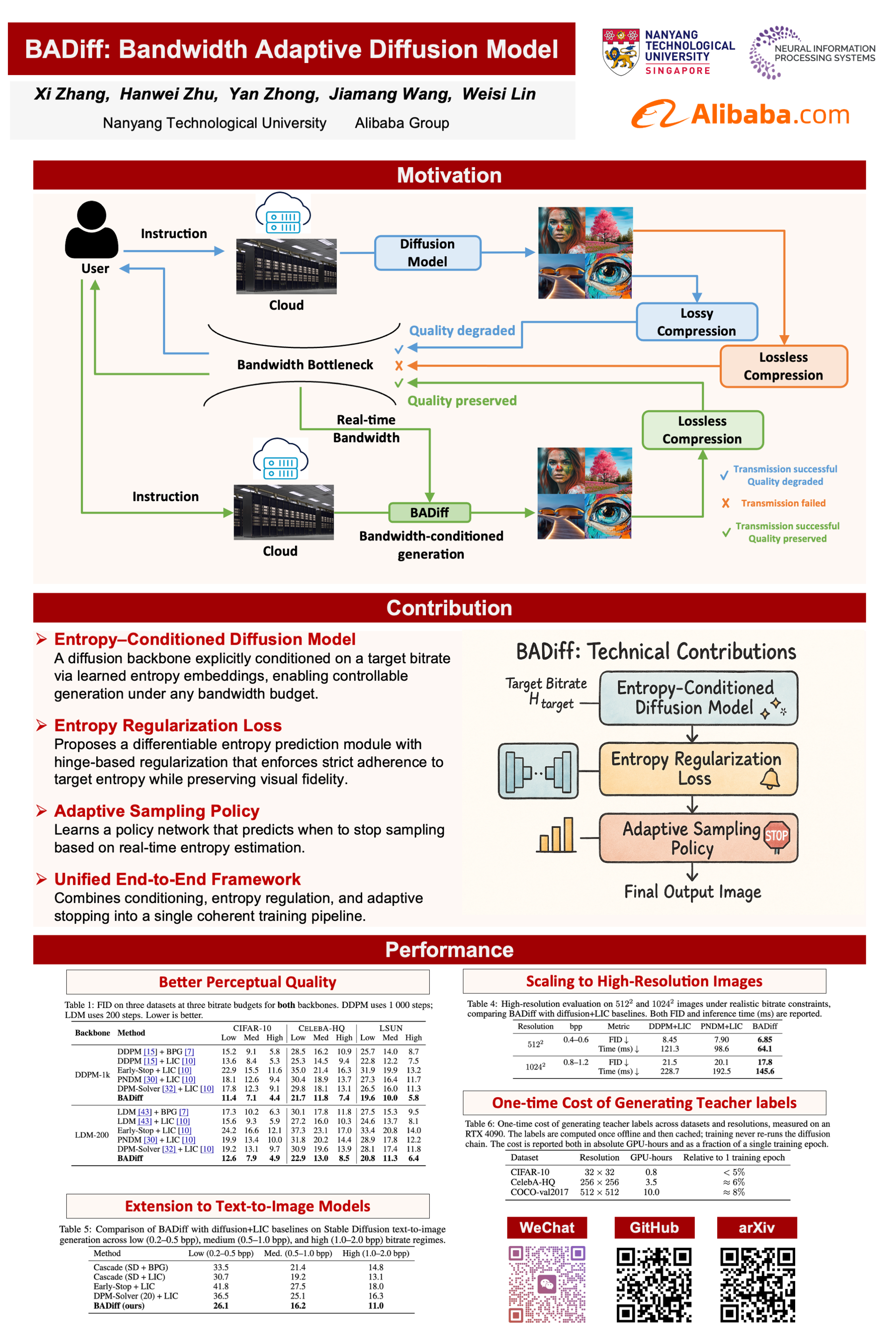
In this work, we propose a novel framework to enable diffusion models to adapt their generation quality based on real-time network bandwidth constraints. Traditional diffusion models produce high-fidelity images by performing a fixed number of denoising steps, regardless of downstream transmission limitations. However, in practical cloud-to-device scenarios, limited bandwidth often necessitates heavy compression, leading to loss of fine textures and wasted computation. To address this, we introduce a joint end-to-end training strategy where the diffusion model is conditioned on a target quality level derived from the available bandwidth. During training, the model learns to adaptively modulate the denoising process, enabling early-stop sampling that maintains perceptual quality appropriate to the target transmission condition. Our method requires minimal architectural changes and leverages a lightweight quality embedding to guide the denoising trajectory. Experimental results demonstrate that our approach significantly improves the visual fidelity of bandwidth-adapted generations compared to naive early-stopping, offering a promising solution for efficient image delivery in bandwidth-constrained environments. Code is available at: https://github.com/xzhang9308/BADiff.
BNMusic: Blending Environmental Noises into Personalized Music
Chi Zuo ⋅ Martin Møller ⋅ Pablo Martínez-Nuevo ⋅ Huayang Huang ⋅ Yu Wu ⋅ Ye Zhu
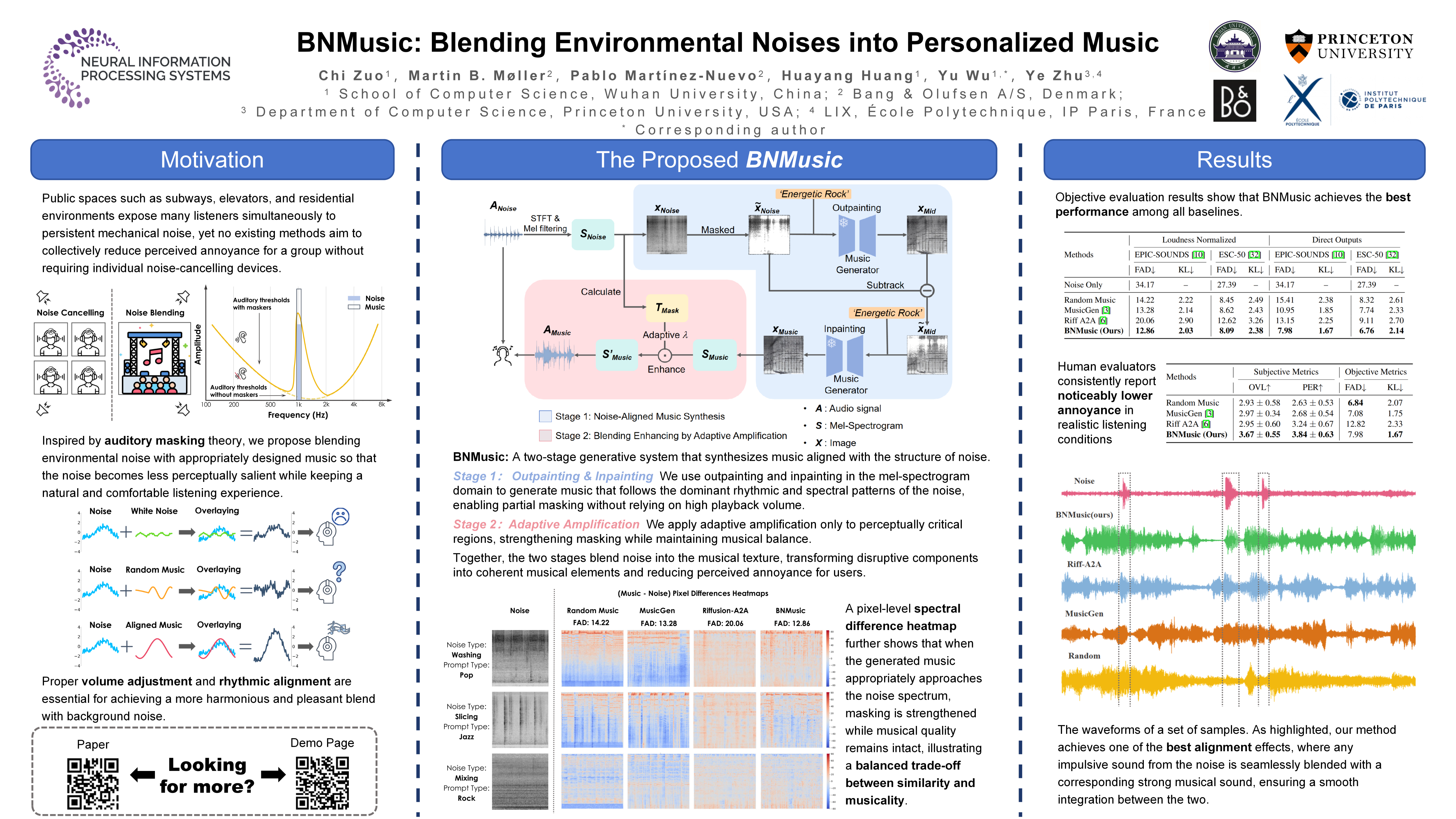
While being disturbed by environmental noises, the acoustic masking technique is a conventional way to reduce the annoyance in audio engineering that seeks to cover up the noises with other dominant yet less intrusive sounds. However, misalignment between the dominant sound and the noise—such as mismatched downbeats—often requires an excessive volume increase to achieve effective masking. Motivated by recent advances in cross-modal generation, in this work, we introduce an alternative method to acoustic masking, aiming to reduce the noticeability of environmental noises by blending them into personalized music generated based on user-provided text prompts. Following the paradigm of music generation using mel-spectrogram representations, we propose a Blending Noises into Personalized Music (BNMusic) framework with two key stages. The first stage synthesizes a complete piece of music in a mel-spectrogram representation that encapsulates the musical essence of the noise. In the second stage, we adaptively amplifying the generated music segment to further reduce noise perception and enhance the blending effectiveness, while preserving auditory quality. Our experiments with comprehensive evaluations on MusicBench, EPIC-SOUNDS, and ESC-50 demonstrate the effectiveness of our framework, highlighting the ability to blend environmental noise with rhythmically aligned, adaptively amplified, and enjoyable music segments, minimizing the noticeability of the noise, thereby improving overall acoustic experiences. Project page: https://d-fas.github.io/BNMusic_page/.
Can Class-Priors Help Single-Positive Multi-Label Learning?
Biao Liu ⋅ Ning Xu ⋅ Jie Wang ⋅ Xin Geng
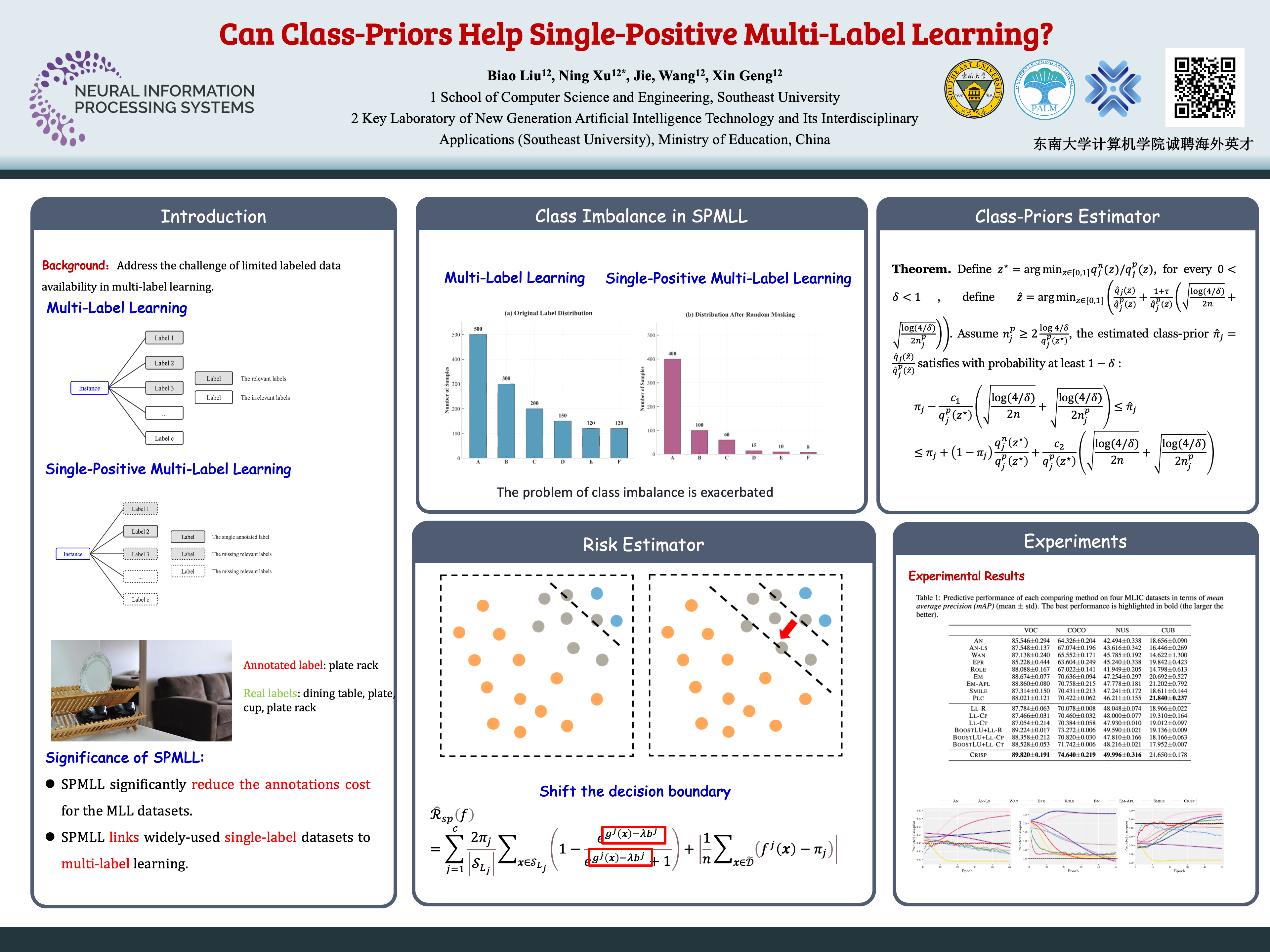
Single-positive multi-label learning (SPMLL) is a weakly supervised multi-label learning problem, where each training example is annotated with only one positive label. Existing SPMLL methods typically assign pseudo-labels to unannotated labels with the assumption that prior probabilities of all classes are identical. However, the class-prior of each category may differ significantly in real-world scenarios, which makes the predictive model not perform as well as expected due to the unrealistic assumption on real-world application. To alleviate this issue, a novel framework named Crisp, i.e., Class-pRiors Induced Single-Positive multi-label learning, is proposed. Specifically, a class-priors estimator is introduced, which can estimate the class-priors that are theoretically guaranteed to converge to the ground-truth class-priors. In addition, based on the estimated class-priors, an unbiased risk estimator for classification is derived, and the corresponding risk minimizer can be guaranteed to approximately converge to the optimal risk minimizer on fully supervised data. Experimental results on ten MLL benchmark datasets demonstrate the effectiveness and superiority of our method over existing SPMLL approaches.
Capturing Individual Human Preferences with Reward Features
Andre Barreto ⋅ Vincent Dumoulin ⋅ Yiran Mao ⋅ Mark Rowland ⋅ Nicolas Perez-Nieves ⋅ Bobak Shahriari ⋅ Yann Dauphin ⋅ Doina Precup ⋅ Hugo Larochelle

Reinforcement learning from human feedback usually models preferences using a reward function that does not distinguish between people. We argue that this is unlikely to be a good design choice in contexts with high potential for disagreement, like in the training of large language models. We formalise and analyse the problem of learning a reward model that can be specialised to a user. Using the principle of empirical risk minimisation, we derive a probably approximately correct (PAC) bound showing the dependency of the approximation error on the number of training examples, as usual, and also on the number of human raters who provided feedback on them. Based on our theoretical findings, we discuss how to best collect pairwise preference data and argue that adaptive reward models should be beneficial when there is considerable disagreement among users. We also propose a concrete architecture for an adaptive reward model. Our approach leverages the observation that individual preferences can be captured as a linear combination of a set of general reward features. We show how to learn such features and subsequently use them to quickly adapt the reward model to a specific individual, even if their preferences are not reflected in the training data. We present experiments with large language models illustrating our theoretical results and comparing the proposed architecture with a non-adaptive baseline. Consistent with our analysis, the benefits provided by our model increase with the number of raters and the heterogeneity of their preferences. We also show that our model compares favourably to adaptive counterparts, including those performing in-context personalisation.
Care-PD: A Multi-Site Anonymized Clinical Dataset for Parkinson’s Disease Gait Assessment
Vida Adeli ⋅ Ivan Klabučar ⋅ Javad Rajabi ⋅ Benjamin Filtjens ⋅ Soroush Mehraban ⋅ Diwei Wang ⋅ Trung Hieu Hoang ⋅ Minh Do ⋅ Hyewon Seo ⋅ Candice MULLER ⋅ Daniel Coelho ⋅ Claudia de Oliveira ⋅ Pieter Ginis ⋅ Moran Gilat ⋅ Alice Nieuwboer ⋅ Joke Spildooren ⋅ J. Mckay ⋅ Hyeokhyen Kwon ⋅ Gari Clifford ⋅ Christine Esper ⋅ Stewart Factor ⋅ Imari Genias ⋅ Amirhossein Dadashzadeh ⋅ Leia Shum ⋅ Alan Whone ⋅ Majid Mirmehdi ⋅ Andrea Iaboni ⋅ Babak Taati
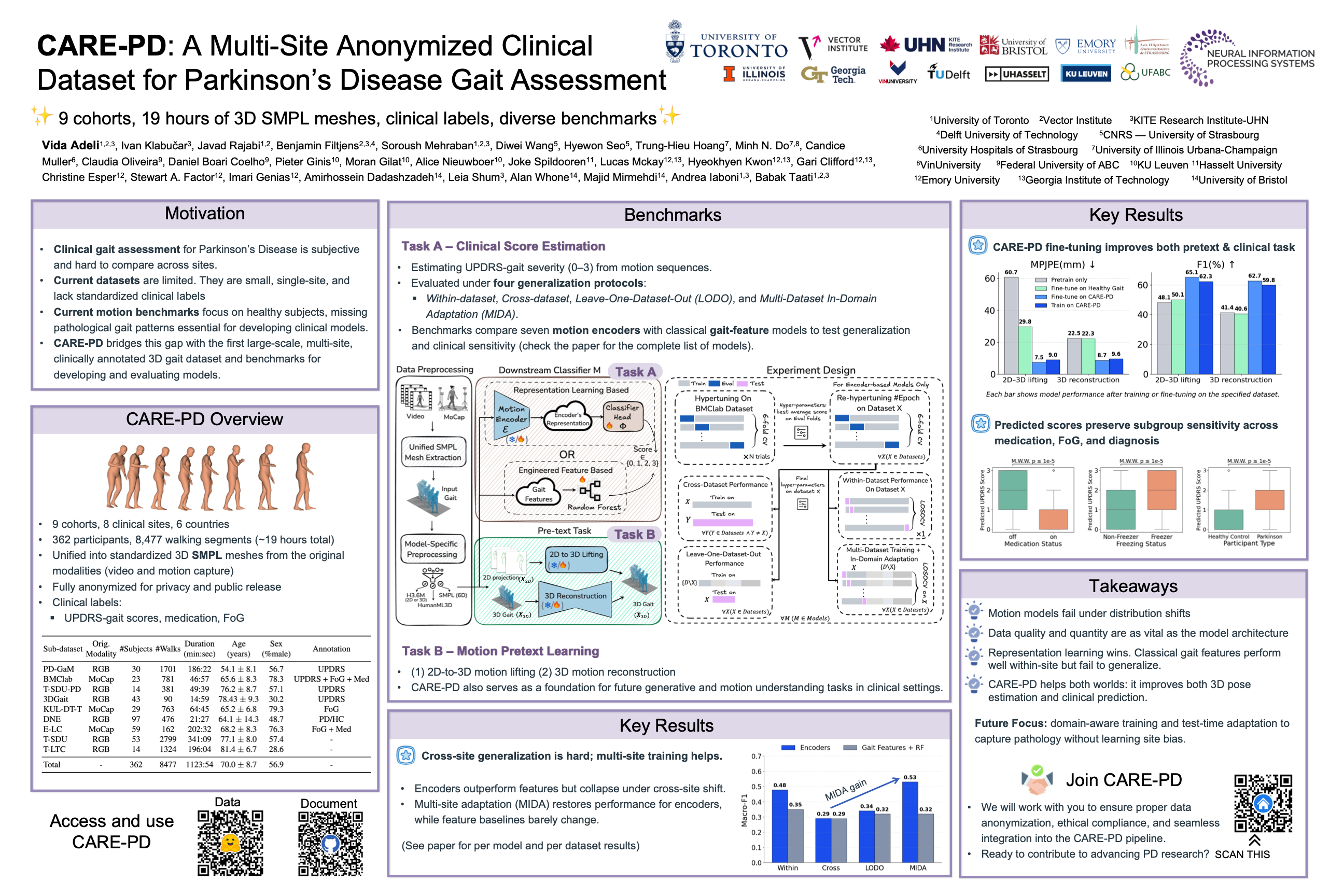
Objective gait assessment in Parkinson’s Disease (PD) is limited by the absence of large, diverse, and clinically annotated motion datasets. We introduce Care-PD, the largest publicly available archive of 3D mesh gait data for PD, and the first multi-site collection spanning 9 cohorts from 8 clinical centers. All recordings (RGB video or motion capture) are converted into anonymized SMPL meshes via a harmonized preprocessing pipeline. Care-PD supports two key benchmarks: supervised clinical score prediction (estimating Unified Parkinson’s Disease Rating Scale, UPDRS, gait scores) and unsupervised motion pretext tasks (2D-to-3D keypoint lifting and full-body 3D reconstruction). Clinical prediction is evaluated under four generalization protocols: within-dataset, cross-dataset, leave-one-dataset-out, and multi-dataset in-domain adaptation.To assess clinical relevance, we compare state-of-the-art motion encoders with a traditional gait-feature baseline, finding that encoders consistently outperform handcrafted features. Pretraining on Care-PD reduces MPJPE (from 60.8mm to 7.5mm) and boosts PD severity macro-F1 by 17\%, underscoring the value of clinically curated, diverse training data. Care-PD and all benchmark code are released for non-commercial research (Code, Data).
ChemX: A Collection of Chemistry Datasets for Benchmarking Automated Information Extraction
Anastasia Vepreva ⋅ Julia Razlivina ⋅ Mariia Eremeyeva ⋅ Nina Gubina ⋅ Anastasia Orlova ⋅ Aleksei Dmitrenko ⋅ Kapranova Xenia ⋅ Susan Jyakhwo ⋅ Nikita Vasilev ⋅ Arsen Sarkisyan ⋅ Ivan Chernyshov ⋅ Vladimir Vinogradov ⋅ Andrei Dmitrenko
Despite recent advances in machine learning, many scientific discoveries in chemistry still rely on manually curated datasets extracted from the scientific literature. Automation of information extraction in specialized chemistry domains has the potential to scale up machine learning applications and improve the quality of predictions, enabling data-driven scientific discoveries at a faster pace. In this paper, we present ChemX, a collection of 10 benchmarking datasets across several domains of chemistry providing a reliable basis for evaluating and fine-tuning automated information extraction methods. The datasets encompassing various properties of small molecules and nanomaterials have been manually extracted from peer-reviewed publications and systematically validated by domain experts through a cross-verification procedure allowing for identification and correction of errors at sources. In order to demonstrate the utility of the resulting datasets, we evaluate the extraction performance of the state-of-the-art large language models (LLMs). Moreover, we design our own agentic approach to take full control of the document preprocessing before LLM-based information extraction. Finally, we apply the recently emerged multi-agent systems specialized in chemistry to compare performance against the strong baselines. Our empirical results highlight persistent challenges in chemical information extraction, particularly in handling domain-specific terminology, complex tabular and schematic formats, and context-dependent ambiguities. We discuss the importance of expert data validation, the nuances of the evaluation pipeline, and the prospects of automated information extraction in chemistry. Finally, we provide open documentation including standardized schemas and provenance metadata, as well as the code and other materials to ensure reproducibility. ChemX is poised to advance automatic information extraction in chemistry by challenging the quality and generalization capabilities of existing methods, as well as providing insights into evaluation strategies.
CHPO: Constrained Hybrid-action Policy Optimization for Reinforcement Learning
ao zhou ⋅ Jiayi Guan ⋅ Li Shen ⋅ Fan Lu ⋅ Sanqing Qu ⋅ Junqiao Zhao ⋅ Ziqiao Wang ⋅ Ya Wu ⋅ Guang Chen
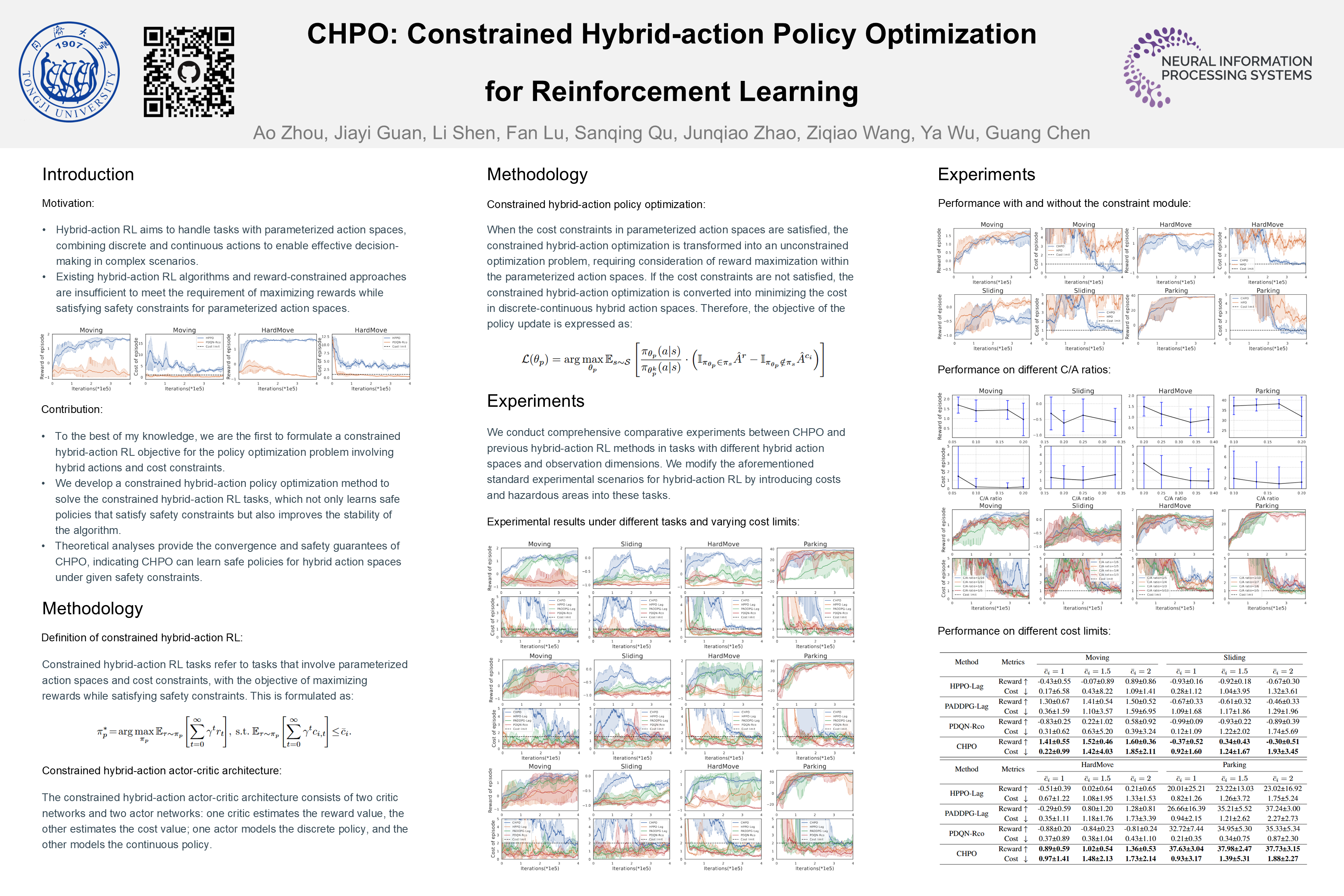
Constrained hybrid-action reinforcement learning (RL) promises to learn a safe policy within a parameterized action space, which is particularly valuable for safety-critical applications involving discrete-continuous hybrid action spaces. However, existing hybrid-action RL algorithms primarily focus on reward maximization, which faces significant challenges for tasks involving both cost constraints and hybrid action spaces. In this work, we propose a novel Constrained Hybrid-action Policy Optimization algorithm (CHPO) to address the problems of constrained hybrid-action RL. Concretely, we rethink the limitations of hybrid-action RL in handling safe tasks with parameterized action spaces and reframe the objective of constrained hybrid-action RL by introducing the concept of Constrained Parameterized-action Markov Decision Process (CPMDP). Subsequently, we present a constrained hybrid-action policy optimization algorithm to confront the constrained hybrid-action problems and conduct theoretical analyses demonstrating that the CHPO converges to the optimal solution while satisfying safety constraints. Finally, extensive experiments demonstrate that the CHPO achieves competitive performance across multiple experimental tasks.
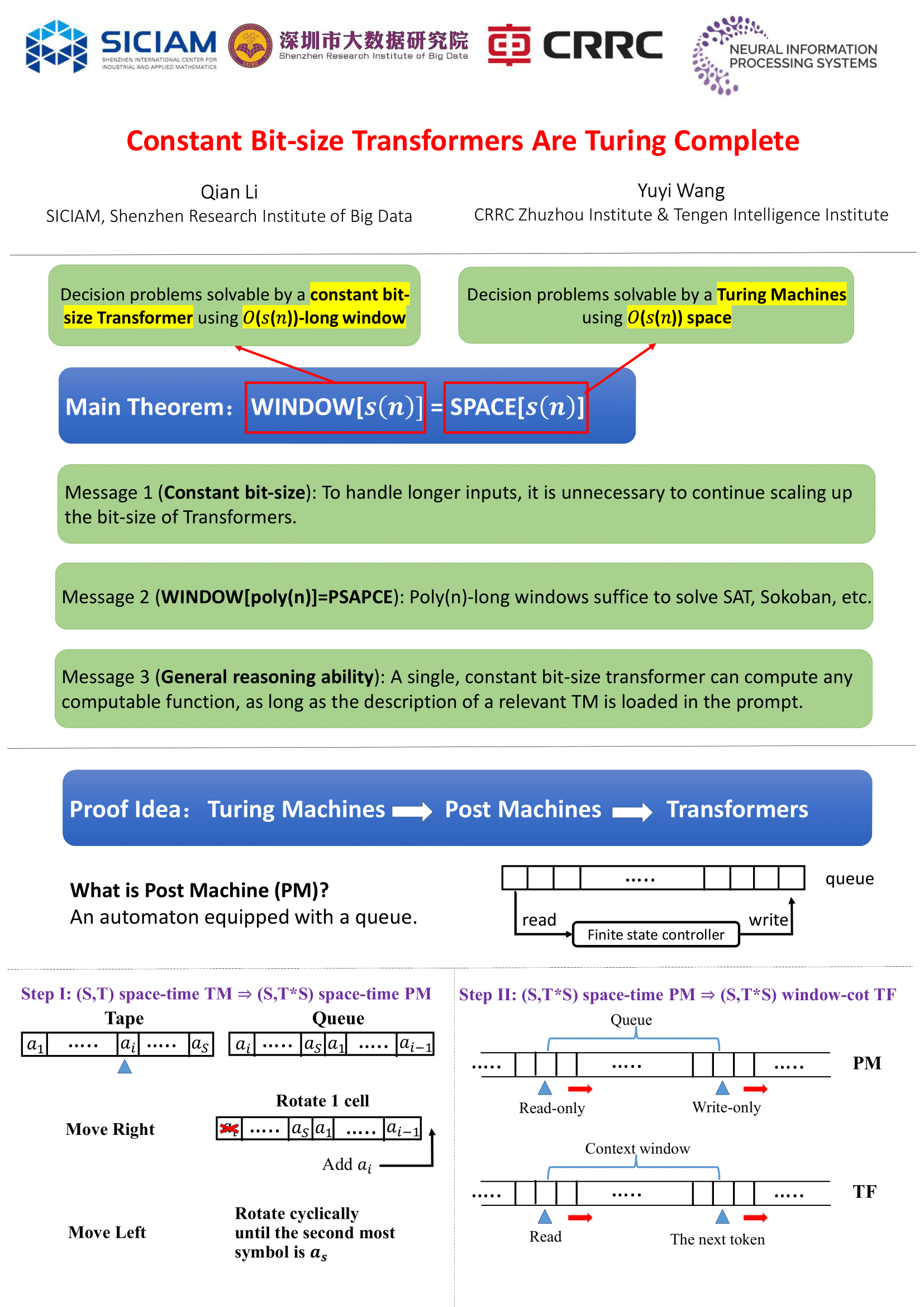
We prove that any Turing machine running on inputs of arbitrary length can be simulated by a constant bit-size transformer, as long as the context window is sufficiently long. This improves previous works, which require scaling up either the model's precision or the number of parameters on longer inputs. Furthermore, we prove that the complexity class SPACE$[s(n)]$ exactly characterizes the expressive power of a constant bit-size transformer with a context window of length $s(n)$. Our approach relies on simulating Post machines, a Turing-complete computational model. Post machines can be modeled as automata equipped with a queue, exhibiting computational behaviors naturally aligned with those of transformers. The behavioral similarity between transformers and Post machines may offer new insights into the mechanisms underlying the reasoning abilities of transformers.
DERD-Net: Learning Depth from Event-based Ray Densities
Diego de Oliveira Hitzges ⋅ Suman Ghosh ⋅ Guillermo Gallego
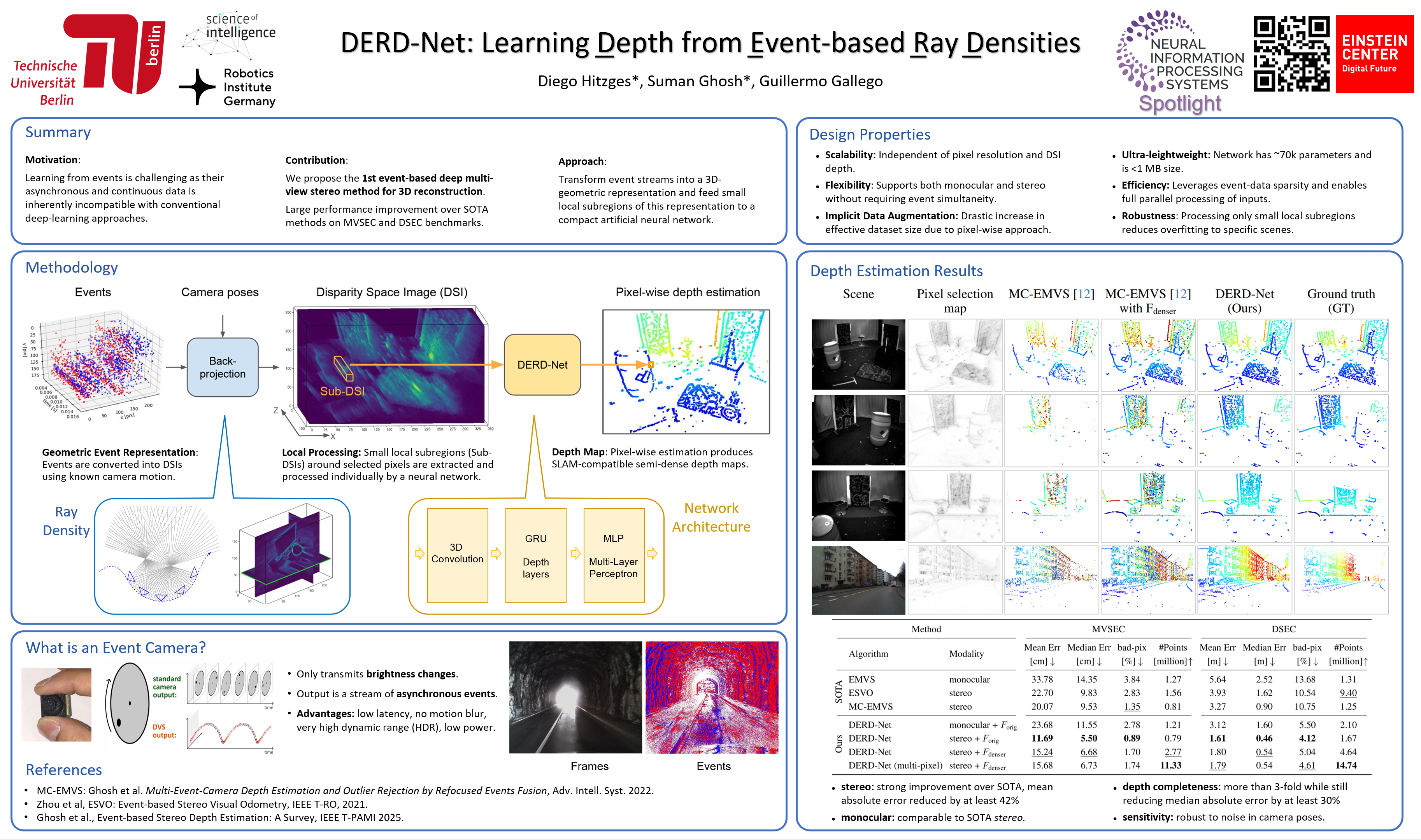
Event cameras offer a promising avenue for multi-view stereo depth estimation and Simultaneous Localization And Mapping (SLAM) due to their ability to detect blur-free 3D edges at high-speed and over broad illumination conditions. However, traditional deep learning frameworks designed for conventional cameras struggle with the asynchronous, stream-like nature of event data, as their architectures are optimized for discrete, image-like inputs. We propose a scalable, flexible and adaptable framework for pixel-wise depth estimation with event cameras in both monocular and stereo setups. The 3D scene structure is encoded into disparity space images (DSIs), representing spatial densities of rays obtained by back-projecting events into space via known camera poses. Our neural network processes local subregions of the DSIs combining 3D convolutions and a recurrent structure to recognize valuable patterns for depth prediction. Local processing enables fast inference with full parallelization and ensures constant ultra-low model complexity and memory costs, regardless of camera resolution. Experiments on standard benchmarks (MVSEC and DSEC datasets) demonstrate unprecedented effectiveness: (i) using purely monocular data, our method achieves comparable results to existing stereo methods; (ii) when applied to stereo data, it strongly outperforms all state-of-the-art (SOTA) approaches, reducing the mean absolute error by at least 42\%; (iii) our method also allows for increases in depth completeness by more than 3-fold while still yielding a reduction in median absolute error of at least 30\%. Given its remarkable performance and effective processing of event-data, our framework holds strong potential to become a standard approach for using deep learning for event-based depth estimation and SLAM.
Enhancing Sample Selection Against Label Noise by Cutting Mislabeled Easy Examples
Suqin Yuan ⋅ Lei Feng ⋅ Bo Han ⋅ Tongliang Liu
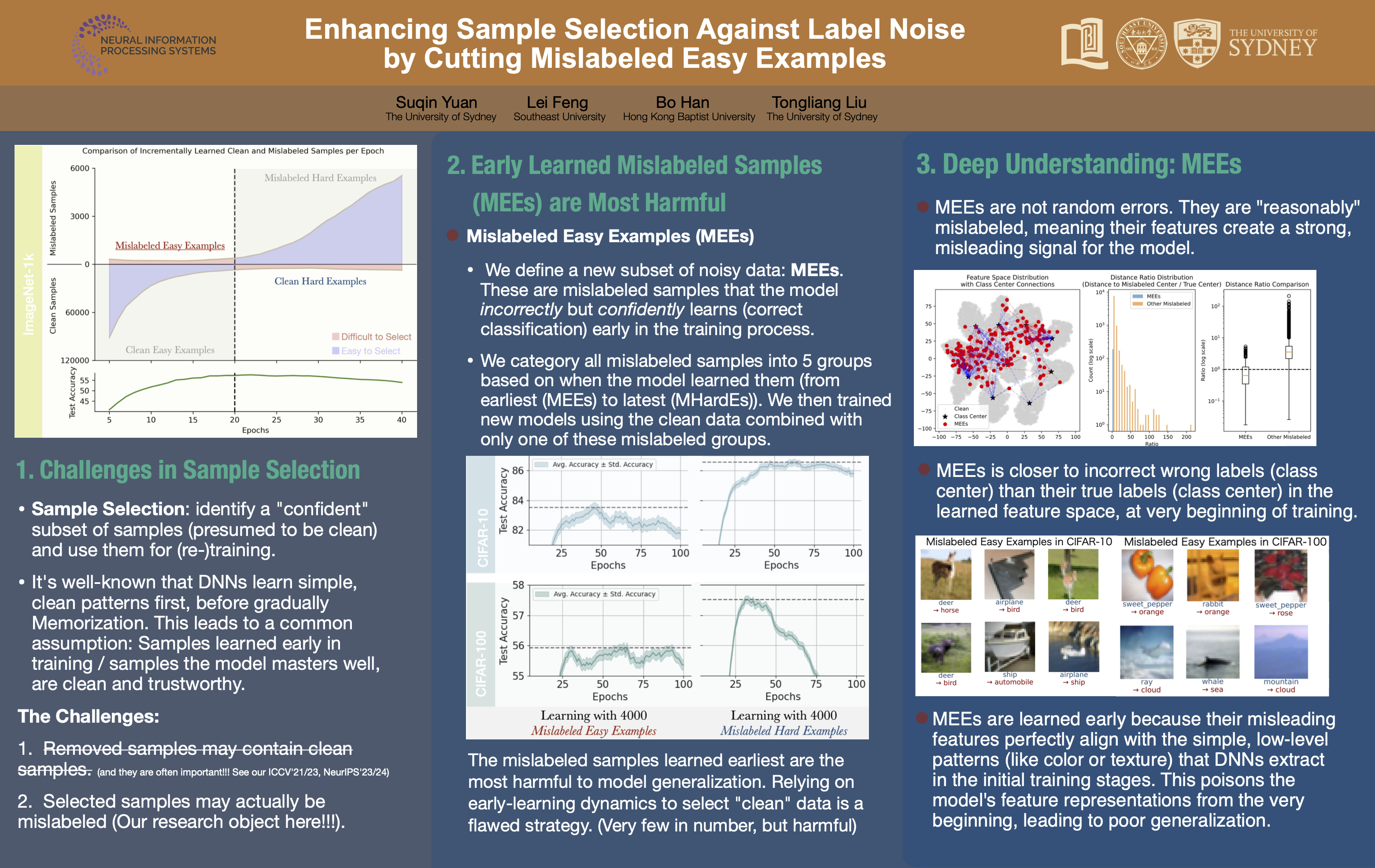
Sample selection is a prevalent approach in learning with noisy labels, aiming to identify confident samples for training. Although existing sample selection methods have achieved decent results by reducing the noise rate of the selected subset, they often overlook that not all mislabeled examples harm the model's performance equally. In this paper, we demonstrate that mislabeled examples correctly predicted by the model early in the training process are particularly harmful to model performance. We refer to these examples as Mislabeled Easy Examples (MEEs). To address this, we propose Early Cutting, which introduces a recalibration step that employs the model's later training state to re-select the confident subset identified early in training, thereby avoiding misleading confidence from early learning and effectively filtering out MEEs. Experiments on the CIFAR, WebVision, and full ImageNet-1k datasets demonstrate that our method effectively improves sample selection and model performance by reducing MEEs.
Enhancing Temporal Understanding in Video-LLMs through Stacked Temporal Attention in Vision Encoders
Leibniz University Hannover, L3S Research Center Ali Rasekh ⋅ Erfan Soula ⋅ Omid Daliran ⋅ Simon Gottschalk ⋅ Mohsen Fayyaz
Despite significant advances in Multimodal Large Language Models (MLLMs), understanding complex temporal dynamics in videos remains a major challenge. Our experiments show that current Video Large Language Model (Video-LLM) architectures have critical limitations in temporal understanding, struggling with tasks that require detailed comprehension of action sequences and temporal progression. In this work, we propose a Video-LLM architecture that introduces stacked temporal attention modules directly within the vision encoder. This design incorporates a temporal attention in vision encoder, enabling the model to better capture the progression of actions and the relationships between frames before passing visual tokens to the LLM. Our results show that this approach significantly improves temporal reasoning and outperforms existing models in video question answering tasks, specifically in action recognition. We improve on benchmarks including VITATECS, MVBench, and Video-MME by up to +5.5%. By enhancing the vision encoder with temporal structure, we address a critical gap in video understanding for Video-LLMs. Project page and code are available at: https://alirasekh.github.io/STAVEQ2/
Exploring Semantic-constrained Adversarial Example with Instruction Uncertainty Reduction
Jin Hu ⋅ Jiakai Wang ⋅ linna Jing ⋅ Haolin Li ⋅ Liu haodong ⋅ Haotong Qin ⋅ Aishan Liu ⋅ Ke Xu ⋅ Xianglong Liu
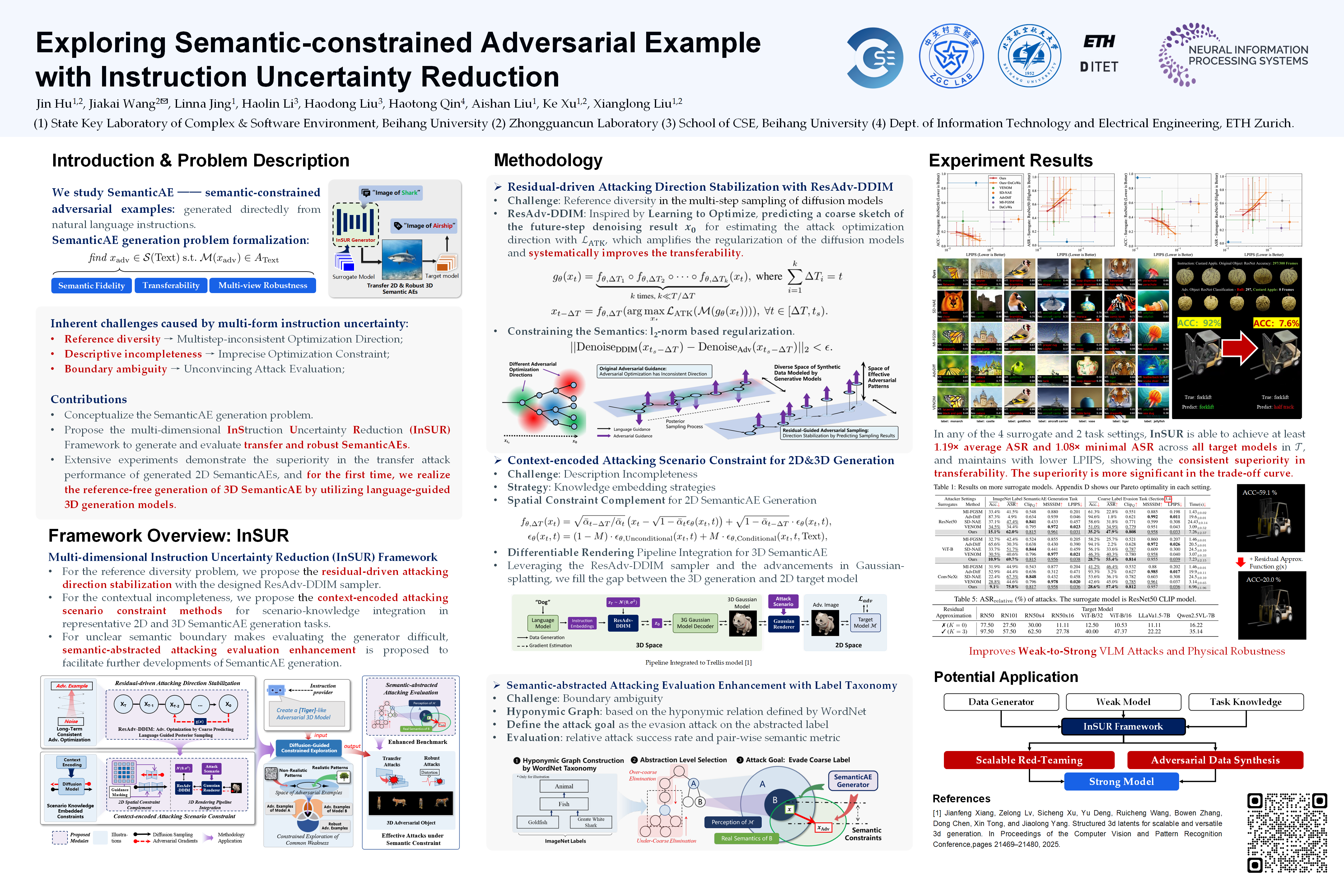
Recently, semantically constrained adversarial examples (SemanticAE), which are directly generated from natural language instructions, have become a promising avenue for future research due to their flexible attacking forms, but have not been thoroughly explored yet. To generate SemanticAEs, current methods fall short of satisfactory attacking ability as the key underlying factors of semantic uncertainty in human instructions, such as $\textit{referring diversity}$, $\textit{descriptive incompleteness}$, and $\textit{boundary ambiguity}$, have not been fully investigated. To tackle the issues, this paper develops a multi-dimensional $\textbf{ins}$truction $\textbf{u}$ncertainty $\textbf{r}$eduction ($\textbf{InSUR}$) framework to generate more satisfactory SemanticAE, $\textit{i.e.}$, transferable, adaptive, and effective. Specifically, in the dimension of the sampling method, we propose the residual-driven attacking direction stabilization to alleviate the unstable adversarial optimization caused by the diversity of language references. By coarsely predicting the language-guided sampling process, the optimization process will be stabilized by the designed ResAdv-DDIM sampler, therefore releasing the transferable and robust adversarial capability of multi-step diffusion models. In task modeling, we propose the context-encoded attacking scenario constraint to supplement the missing knowledge from incomplete human instructions. Guidance masking and renderer integration are proposed to regulate the constraints of 2D/3D SemanticAE, activating stronger scenario-adapted attacks. Moreover, in the dimension of generator evaluation, we propose the semantic-abstracted attacking evaluation enhancement by clarifying the evaluation boundary based on the label taxonomy, facilitating the development of more effective SemanticAE generators. Extensive experiments demonstrate the superiority of the transfer attack performance of InSUR. Besides, it is worth highlighting that we realize the reference-free generation of semantically constrained 3D adversarial examples by utilizing language-guided 3D generation models for the first time.
Feature Distillation is the Better Choice for Model-Heterogeneous Federated Learning
Yichen Li ⋅ Xiuying Wang ⋅ Wenchao Xu ⋅ Haozhao Wang ⋅ Yining Qi ⋅ Jiahua Dong ⋅ Ruixuan Li
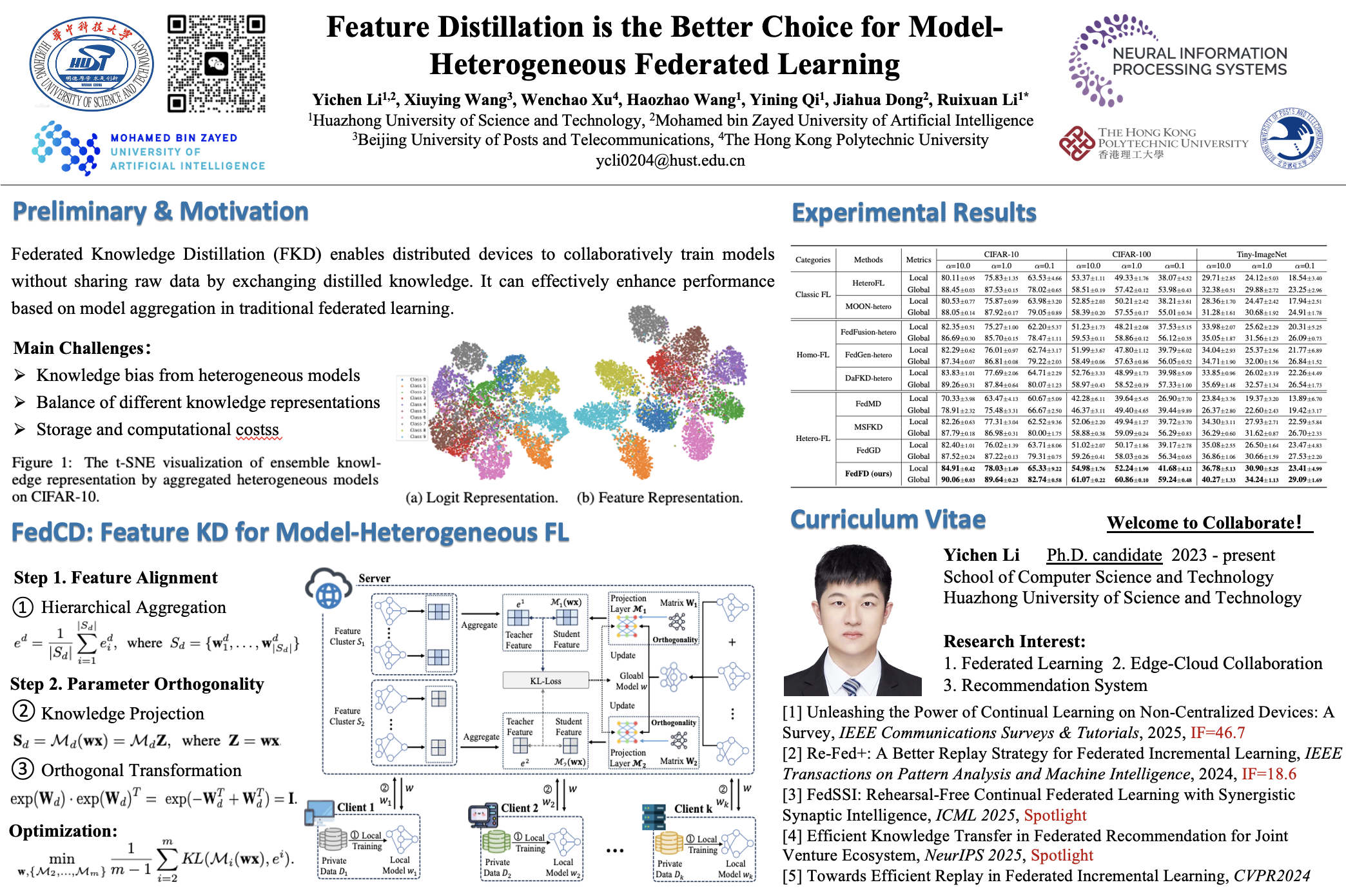
Model-Heterogeneous Federated Learning (Hetero-FL) has attracted growing attention for its ability to aggregate knowledge from heterogeneous models while keeping private data locally. To better aggregate knowledge from clients, ensemble distillation, as a widely used and effective technique, is often employed after global aggregation to enhance the performance of the global model. However, simply combining Hetero-FL and ensemble distillation does not always yield promising results and can make the training process unstable. The reason is that existing methods primarily focus on logit distillation, which, while being model-agnostic with softmax predictions, fails to compensate for the knowledge bias arising from heterogeneous models. To tackle this challenge, we propose a stable and efficient Feature Distillation for model-heterogeneous Federated learning, dubbed FedFD, that can incorporate aligned feature information via orthogonal projection to integrate knowledge from heterogeneous models better. Specifically, a new feature-based ensemble federated knowledge distillation paradigm is proposed. The global model on the server needs to maintain a projection layer for each client-side model architecture to align the features separately. Orthogonal techniques are employed to re-parameterize the projection layer to mitigate knowledge bias from heterogeneous models and thus maximize the distilled knowledge. Extensive experiments show that FedFD achieves superior performance compared to state-of-the-art methods.
Global Minimizers of $\ell^p$-Regularized Objectives Yield the Sparsest ReLU Neural Networks
Julia Nakhleh ⋅ Robert Nowak
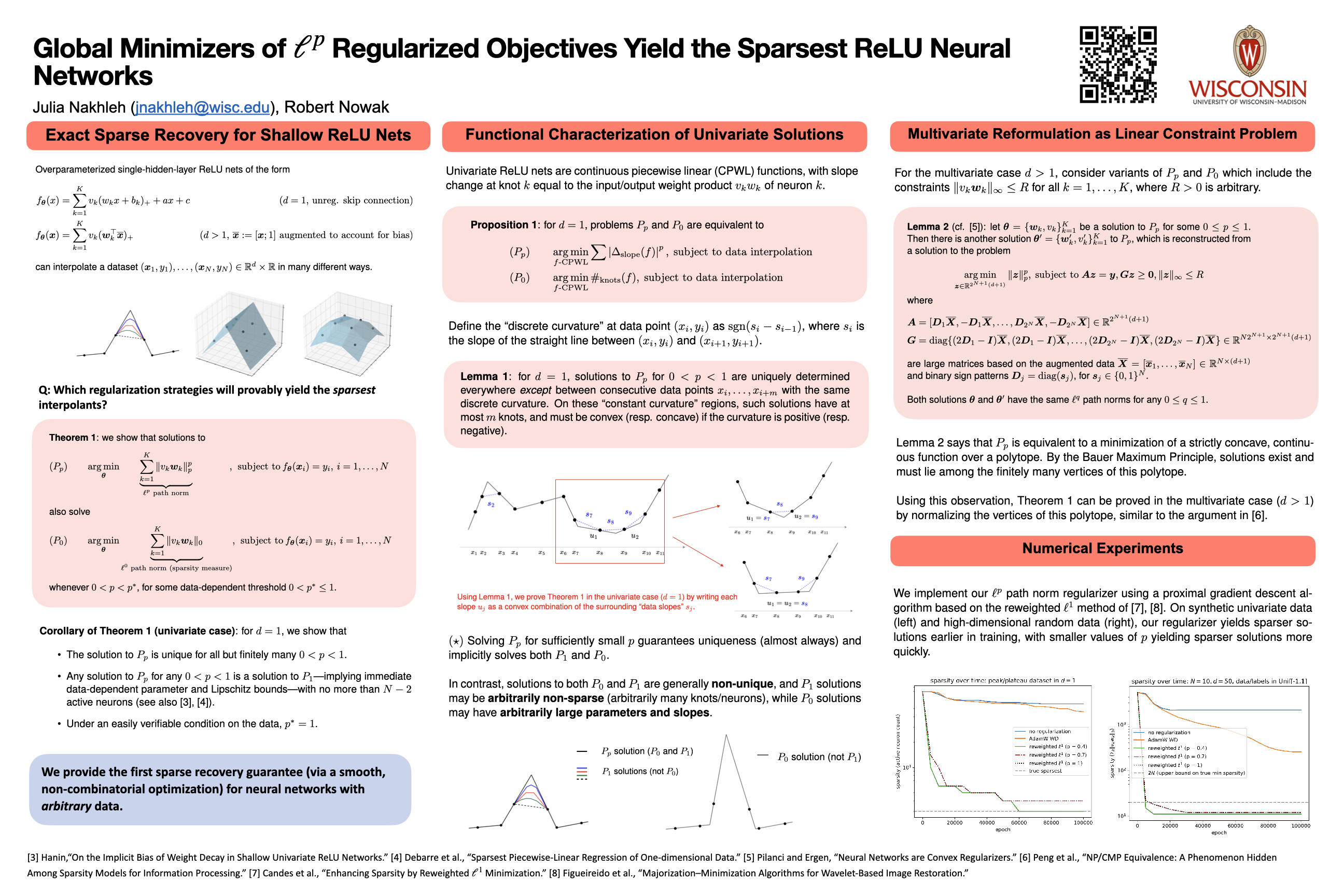
Overparameterized neural networks can interpolate a given dataset in many different ways, prompting the fundamental question: which among these solutions should we prefer, and what explicit regularization strategies will provably yield these solutions? This paper addresses the challenge of finding the sparsest interpolating ReLU network—i.e., the network with the fewest nonzero parameters or neurons—a goal with wide-ranging implications for efficiency, generalization, interpretability, theory, and model compression. Unlike post hoc pruning approaches, we propose a continuous, almost-everywhere differentiable training objective whose global minima are guaranteed to correspond to the sparsest single-hidden-layer ReLU networks that fit the data. This result marks a conceptual advance: it recasts the combinatorial problem of sparse interpolation as a smooth optimization task, potentially enabling the use of gradient-based training methods. Our objective is based on minimizing $\ell^p$ quasinorms of the weights for $0 < p < 1$, a classical sparsity-promoting strategy in finite-dimensional settings. However, applying these ideas to neural networks presents new challenges: the function class is infinite-dimensional, and the weights are learned using a highly nonconvex objective. We prove that, under our formulation, global minimizers correspond exactly to sparsest solutions. Our work lays a foundation for understanding when and how continuous sparsity-inducing objectives can be leveraged to recover sparse networks through training.
Gradient Variance Reveals Failure Modes in Flow-Based Generative Models
Teodora Reu ⋅ Sixtine Dromigny ⋅ Michael Bronstein ⋅ Francisco Vargas
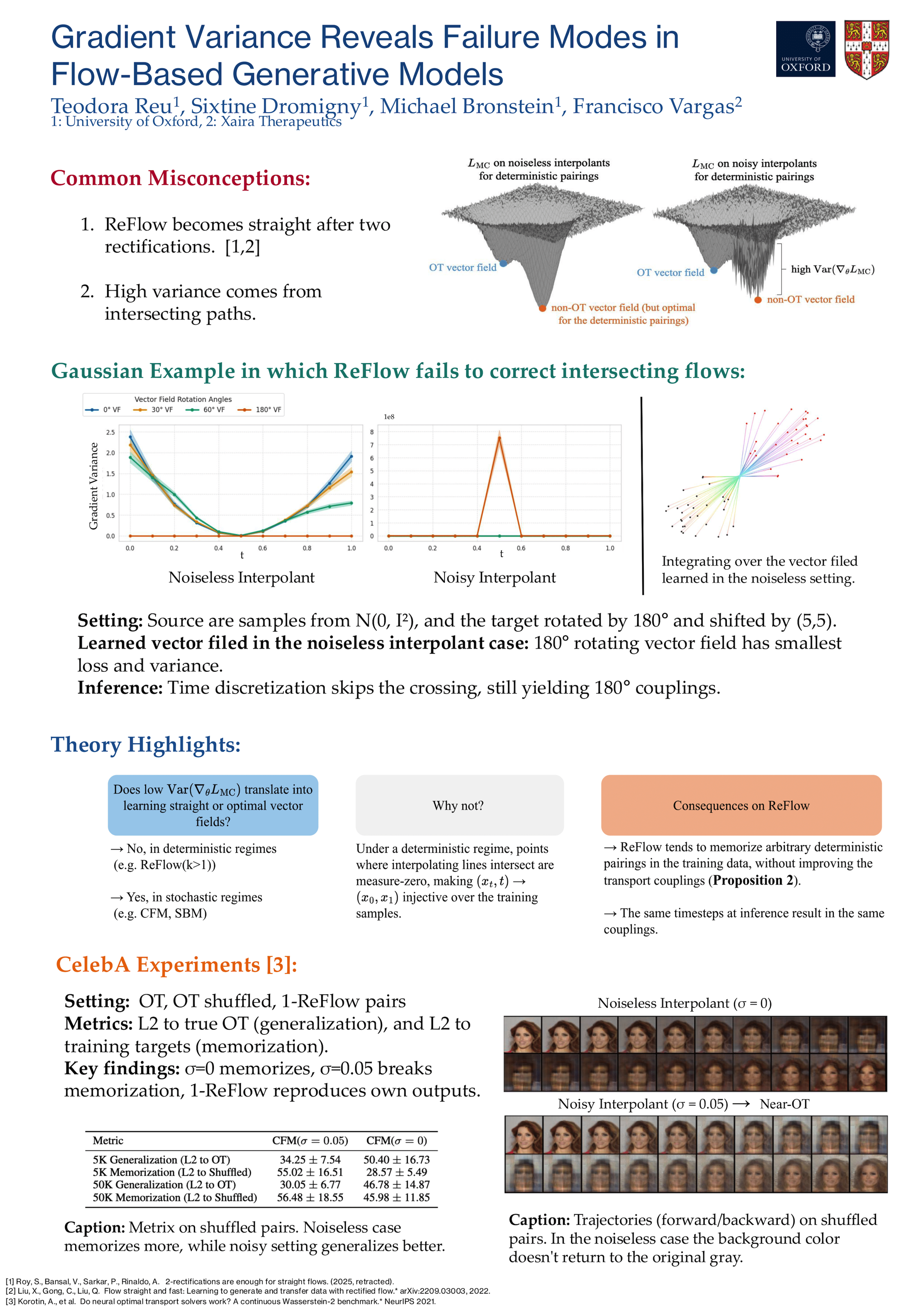
Rectified Flows learn ODE vector fields whose trajectories are straight between source and target distributions, enabling near one-step inference. We show that this straight-path objective reveals fundamental failure modes: under deterministic training, low gradient variance drives memorization of arbitrary training pairings, even when interpolant lines between training pairs intersect. To analyze this mechanism, we study Gaussian-to-Gaussian transport and use the loss gradient variance across stochastic and deterministic regimes to characterize which vector fields optimization favors in each setting. We then show that, in a setting where all interpolating lines intersect, applying Rectified Flow yields the same specific pairings at inference as during training. More generally, we prove that a memorizing vector field exists even when training interpolants intersect, and that optimizing the straight-path objective converges to this ill-defined field. At inference, deterministic integration reproduces the exact training pairings. We validate our findings empirically on the CelebA dataset, confirming that deterministic interpolants induce memorization, while the injection of small noise restores generalization.
GRAVER: Generative Graph Vocabularies for Robust Graph Foundation Models Fine-tuning
Haonan Yuan ⋅ Qingyun Sun ⋅ Junhua Shi ⋅ Xingcheng Fu ⋅ Bryan Hooi ⋅ Jianxin Li ⋅ Philip S Yu
Inspired by the remarkable success of foundation models in language and vision, Graph Foundation Models (GFMs) hold significant promise for broad applicability across diverse graph tasks and domains. However, existing GFMs struggle with unstable few-shot fine-tuning, where both performance and adaptation efficiency exhibit significant fluctuations caused by the randomness in the support sample selection and structural discrepancies between the pre-trained and target graphs. How to fine-tune GFMs robustly and efficiently to enable trustworthy knowledge transfer across domains and tasks is the major challenge. In this paper, we propose GRAVER, a novel Generative gRAph VocabulariEs for Robust GFM fine-tuning framework that tackles the aforementioned instability via generative augmentations. Specifically, to identify transferable units, we analyze and extract key class-specific subgraph patterns by ego-graph disentanglement and validate their transferability both theoretically and empirically. To enable effective pre-training across diverse domains, we leverage a universal task template based on ego-graph similarity and construct graph vocabularies via graphon-based generative experts. To facilitate robust and efficient prompt fine-tuning, we grave the support samples with in-context vocabularies, where the lightweight MoE-CoE network attentively routes knowledge from source domains. Extensive experiments demonstrate the superiority of GRAVER over effectiveness, robustness, and efficiency on downstream few-shot node and graph classification tasks compared with 15 state-of-the-art baselines.
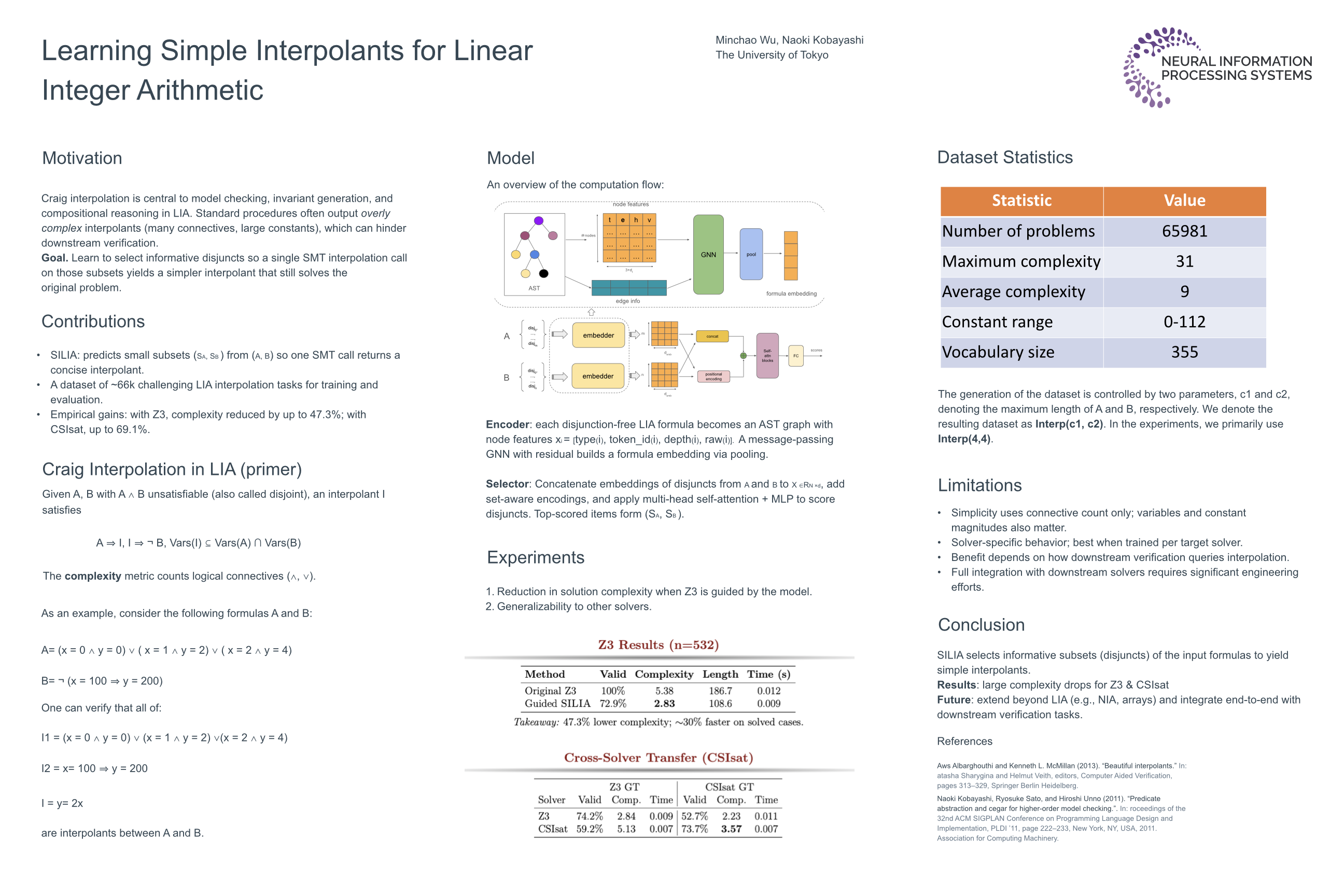
Craig interpolation plays a central role in formal verification tasks such as model checking, invariant generation, and abstraction refinement. In the domain of linear integer arithmetic (LIA), interpolants are crucial for deriving inductive invariants that characterize unreachable or safe program states, enabling scalable and precise reasoning about software and hardware correctness. Despite progress in interpolation algorithms, generating concise and interpretable interpolants remains a key challenge. We propose a lightweight learning-based approach to generating simple interpolants for LIA. Our model learns to lazily sample input problems directly and is complementary to existing logical methods. When Z3 is guided by our learned model, the complexity of the interpolants it produces can be reduced by up to 47.3%. For older solvers, the reduction rate can reach up to 69.1%.
Manipulating Feature Visualizations with Gradient Slingshots
Dilyara Bareeva ⋅ Marina Höhne ⋅ Alexander Warnecke ⋅ Lukas Pirch ⋅ Klaus-Robert Müller ⋅ Konrad Rieck ⋅ Sebastian Lapuschkin ⋅ Kirill Bykov
Feature Visualization (FV) is a widely used technique for interpreting concepts learned by Deep Neural Networks (DNNs), which synthesizes input patterns that maximally activate a given feature. Despite its popularity, the trustworthiness of FV explanations has received limited attention. We introduce Gradient Slingshots, a novel method that enables FV manipulation without modifying model architecture or significantly degrading performance. By shaping new trajectories in off-distribution regions of a feature's activation landscape, we coerce the optimization process to converge to a predefined visualization. We evaluate our approach on several DNN architectures, demonstrating its ability to replace faithful FVs with arbitrary targets. These results expose a critical vulnerability: auditors relying solely on FV may accept entirely fabricated explanations. To mitigate this risk, we propose a straightforward defense and quantitatively demonstrate its effectiveness.
Mixtures of Subspaces for Bandwidth Efficient Context Parallel Training
Sameera Ramasinghe ⋅ Thalaiyasingam Ajanthan ⋅ Hadi Mohaghegh Dolatabadi ⋅ Gil Avraham ⋅ Violetta Shevchenko ⋅ Yan Zuo ⋅ Chamin P Hewa Koneputugodage ⋅ Alexander Long
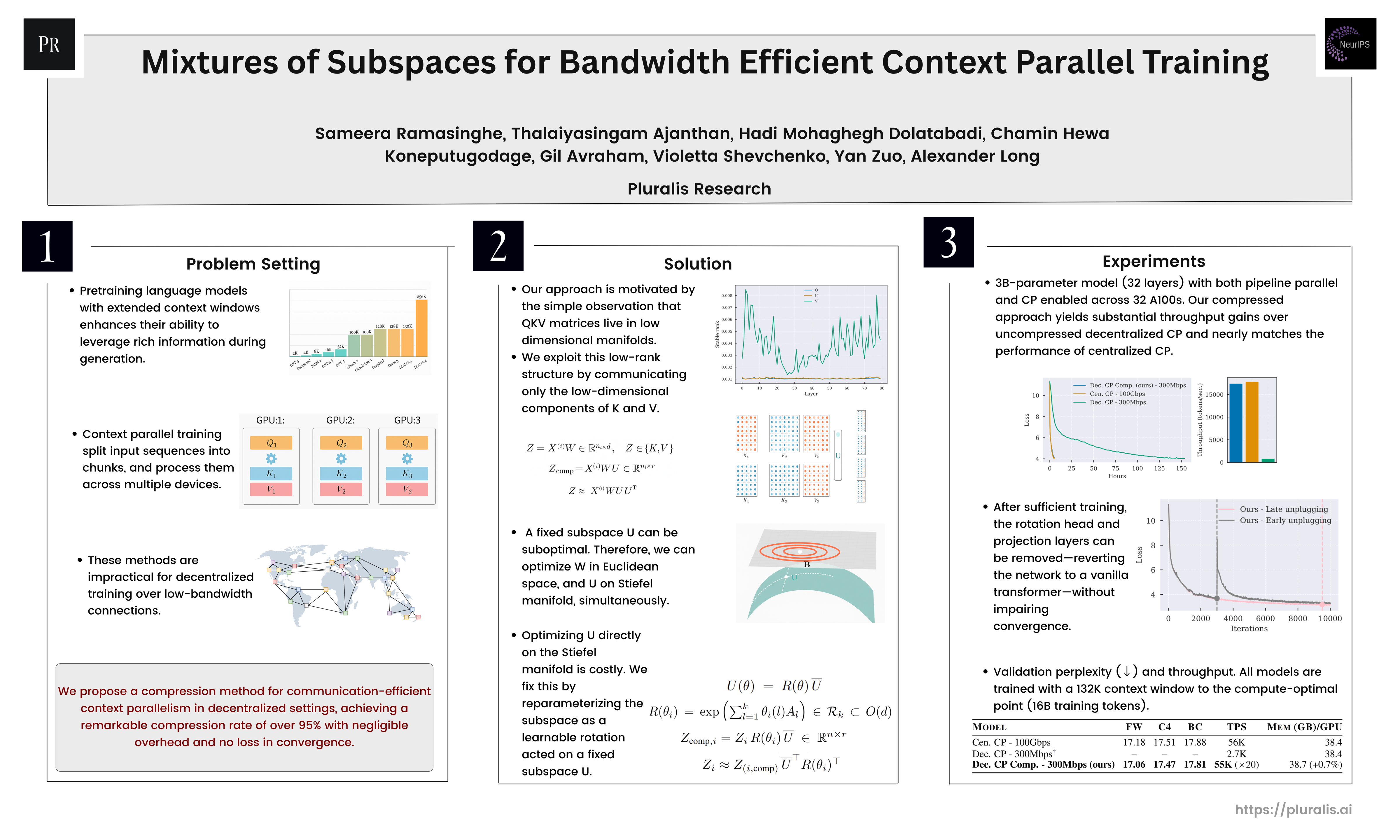
Pretraining language models with extended context windows enhances their ability to leverage rich information during generation. Existing methods split input sequences into chunks, broadcast them across multiple devices, and compute attention block by block which incurs significant communication overhead. While feasible in high-speed clusters, these methods are impractical for decentralized training over low-bandwidth connections. We propose a compression method for communication-efficient context parallelism in decentralized settings, achieving a remarkable compression rate of over 95% with negligible overhead and no loss in convergence. Our key insight is to exploit the intrinsic low-rank structure of activation outputs by dynamically constraining them to learned mixtures of subspaces via efficient reparameterizations. We demonstrate scaling billion-parameter decentralized models to context lengths exceeding 100K tokens on networks as slow as 300Mbps, matching the wall-clock convergence speed of centralized models on 100Gbps interconnects.
MoniTor: Exploiting Large Language Models with Instruction for Online Video Anomaly Detection
shengtian yang ⋅ Yue Feng ⋅ Yingshi Liu ⋅ Jingrou Zhang ⋅ Jie Qin
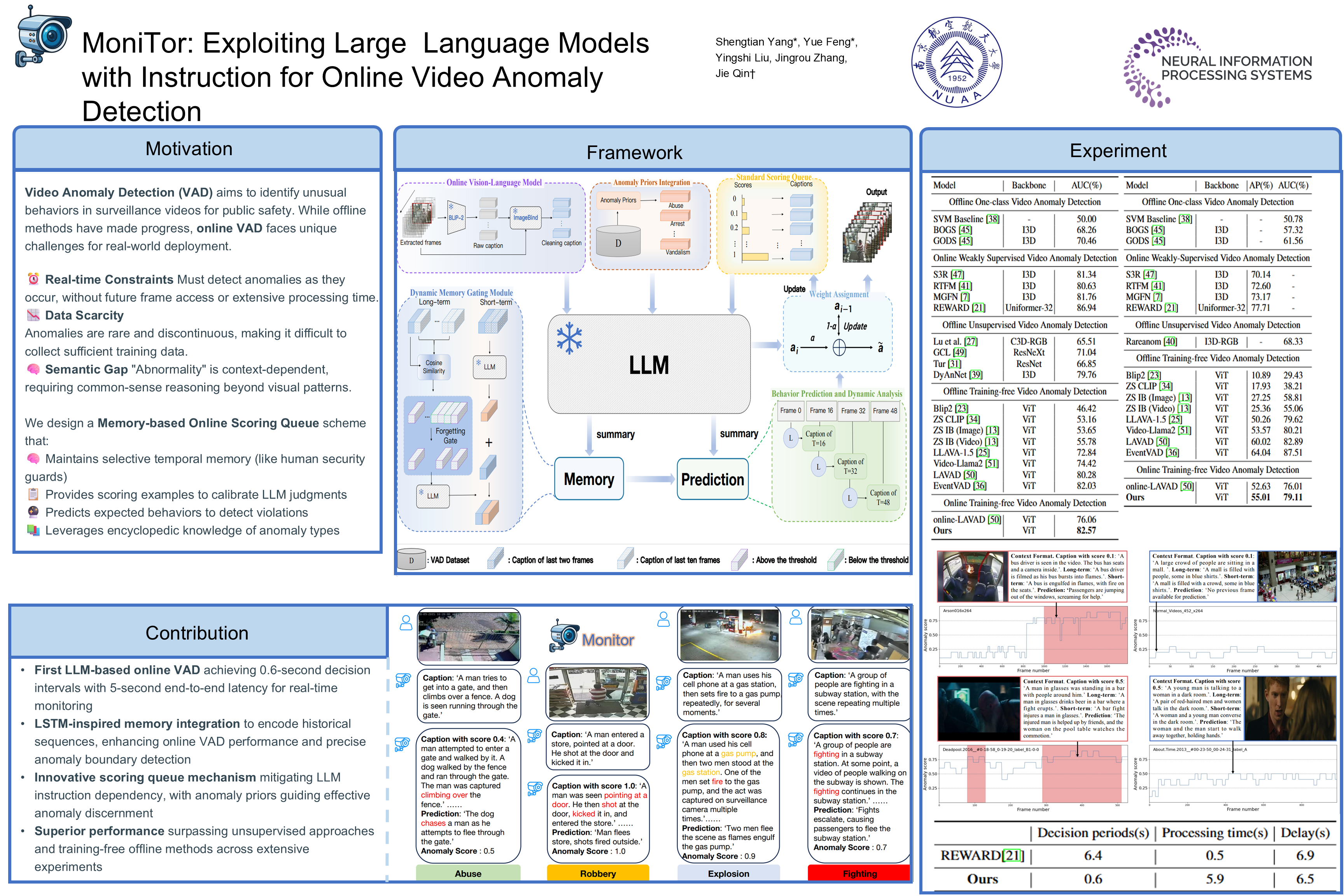
Video Anomaly Detection (VAD) aims to locate unusual activities or behaviors within videos. Recently, offline VAD has garnered substantial research attention, which has been invigorated by the progress in large language models (LLMs) and vision-language models (VLMs), offering the potential for a more nuanced understanding of anomalies. However, online VAD has seldom received attention due to real-time constraints and computational intensity. In this paper, we introduce a novel Memory-based online scoring queue scheme for Training-free VAD (MoniTor), to address the inherent complexities in online VAD. Specifically, MoniTor applies a streaming input to VLMs, leveraging the capabilities of pre-trained large-scale models. To capture temporal dependencies more effectively, we incorporate a novel prediction mechanism inspired by Long Short-Term Memory (LSTM) networks. This ensures the model can effectively model past states and leverage previous predictions to identify anomalous behaviors. Thereby, it better understands the current frame. Moreover, we design a scoring queue and an anomaly prior to dynamically store recent scores and cover all anomalies in the monitoring scenario, providing guidance for LLMs to distinguish between normal and abnormal behaviors over time. We evaluate MoniTor on two large datasets (i.e., UCF-Crime and XD-Violence) containing various surveillance and real-world scenarios. The results demonstrate that MoniTor outperforms state-of-the-art methods and is competitive with weakly supervised methods without training. Code is available at https://github.com/YsTvT/MoniTor.
Non-convex entropic mean-field optimization via Best Response flow
Razvan-Andrei Lascu ⋅ Mateusz Majka
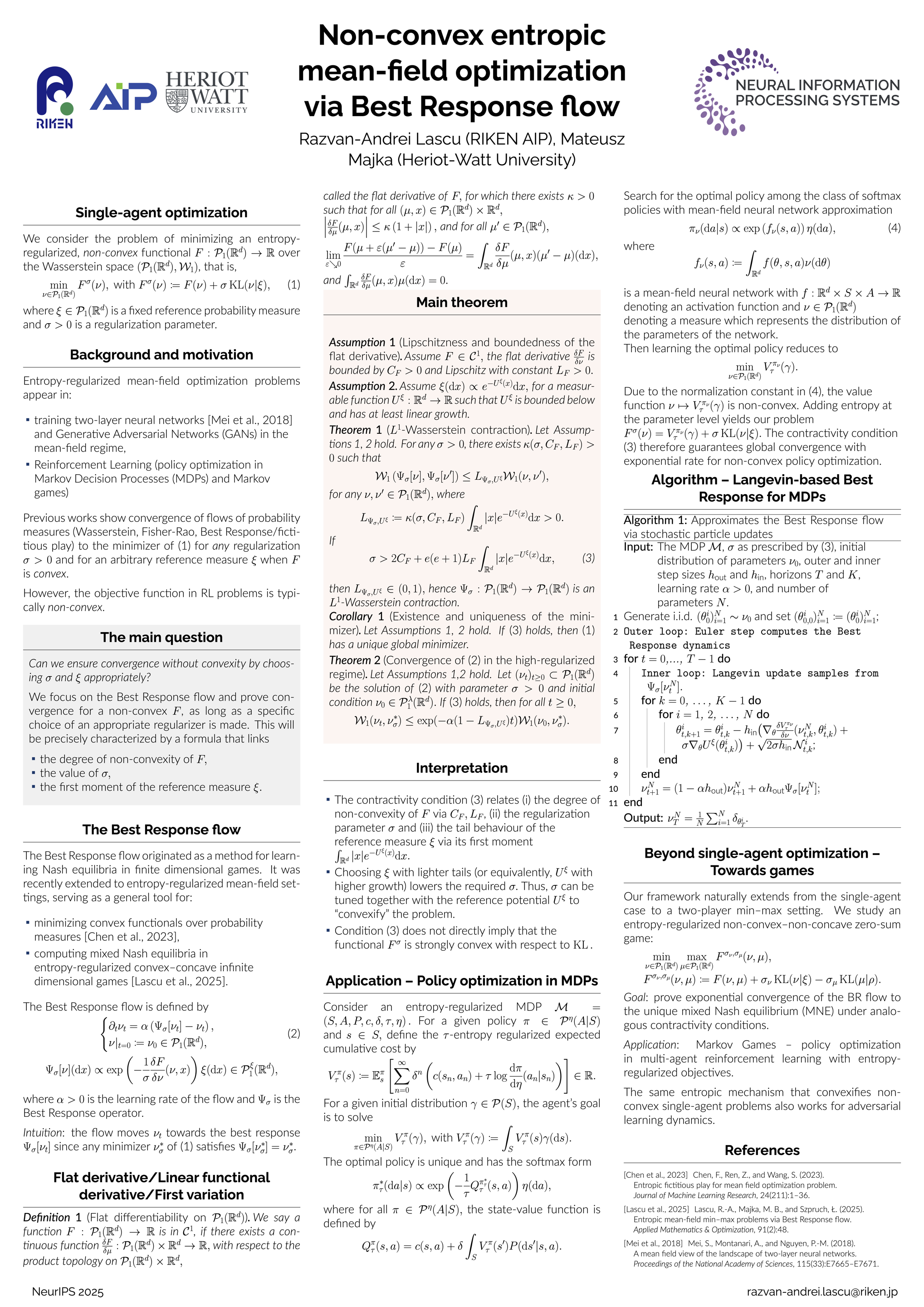
We study the problem of minimizing non-convex functionals on the space of probability measures, regularized by the relative entropy (KL divergence) with respect to a fixed reference measure, as well as the corresponding problem of solving entropy-regularized non-convex-non-concave min-max problems. We utilize the Best Response flow (also known in the literature as the fictitious play flow) and study how its convergence is influenced by the relation between the degree of non-convexity of the functional under consideration, the regularization parameter and the tail behaviour of the reference measure. In particular, we demonstrate how to choose the regularizer, given the non-convex functional, so that the Best Response operator becomes a contraction with respect to the $L^1$-Wasserstein distance, which ensures the existence of its unique fixed point that is then shown to be the unique global minimizer for our optimization problem. This extends recent results where the Best Response flow was applied to solve convex optimization problems regularized by the relative entropy with respect to arbitrary reference measures, and with arbitrary values of the regularization parameter. Our results explain precisely how the assumption of convexity can be relaxed, at the expense of making a specific choice of the regularizer. Additionally, we demonstrate how these results can be applied in reinforcement learning in the context of policy optimization for Markov Decision Processes and Markov games with softmax parametrized policies in the mean-field regime.
One Sample is Enough to Make Conformal Prediction Robust
Soroush H. Zargarbashi ⋅ Mohammad Sadegh Akhondzadeh ⋅ Aleksandar Bojchevski
For any black-box model, conformal prediction (CP) returns prediction *sets* guaranteed to include the true label with high adjustable probability. Robust CP (RCP) extends the guarantee to the worst case noise up to a pre-defined magnitude. For RCP, a well-established approach is to use randomized smoothing since it is applicable to any black-box model and provides smaller sets compared to deterministic methods. However, smoothing-based robustness requires many model forward passes per each input which is computationally expensive. We show that conformal prediction attains some robustness even with *a single forward pass on a randomly perturbed input*. Using any binary certificate we propose a single sample robust CP (RCP1). Our approach returns robust sets with smaller average set size compared to SOTA methods which use many (e.g. $\sim 100$) passes per input. Our key insight is to certify the conformal procedure itself rather than individual conformity scores. Our approach is agnostic to the task (classification and regression). We further extend our approach to smoothing-based robust conformal risk control.
On the VC dimension of deep group convolutional neural networks
Anna Sepliarskaia ⋅ Sophie Langer ⋅ Johannes Schmidt-Hieber
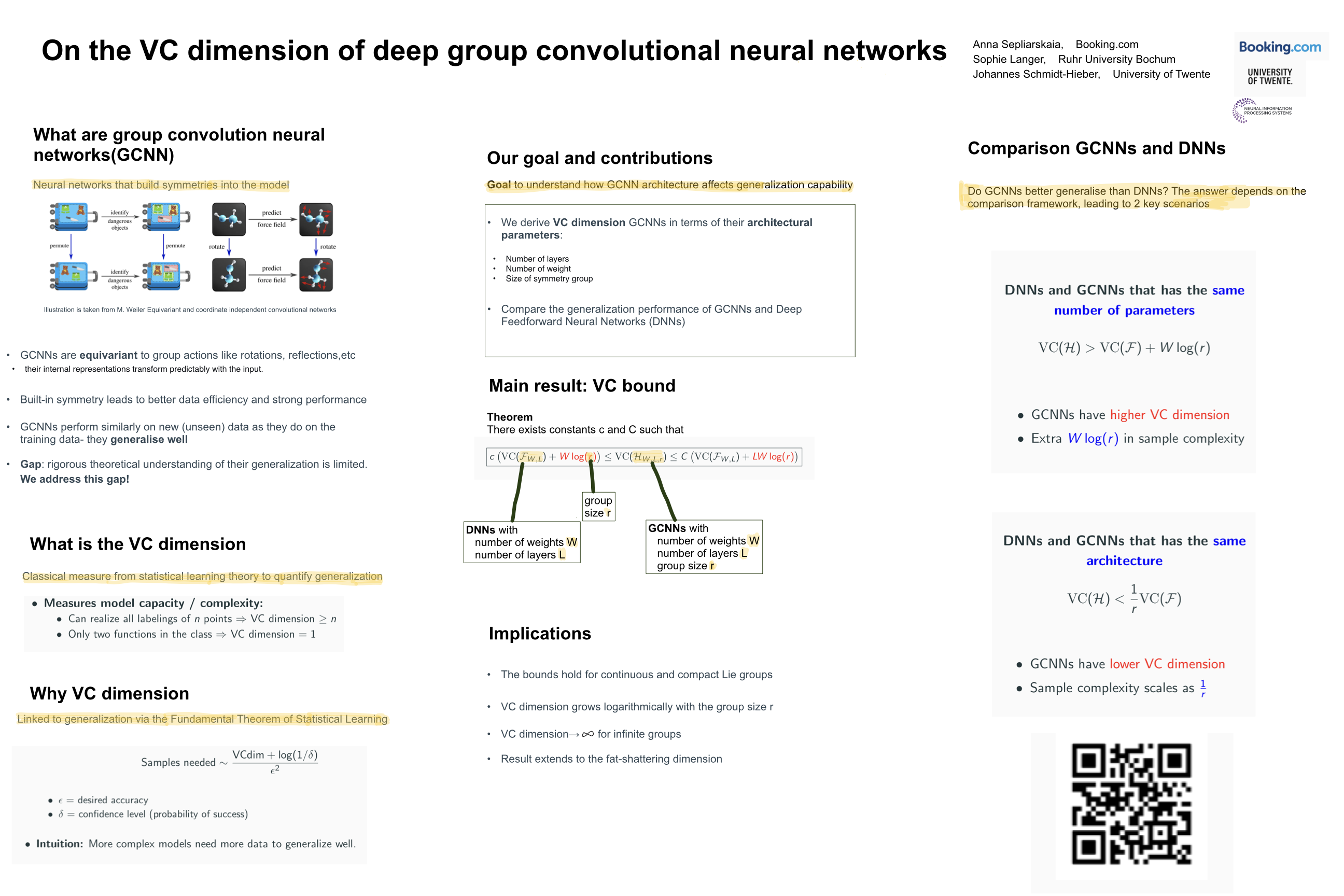
Recent works have introduced new equivariant neural networks, motivated by their improved generalization compared to traditional deep neural networks. While experiments support this advantage, the theoretical understanding of their generalization properties remains limited. In this paper, we analyze the generalization capabilities of Group Convolutional Neural Networks (GCNNs) with the ReLU activation function through the lens of Vapnik-Chervonenkis (VC) dimension theory. We investigate how architectural factors—such as the number of layers, weights, and input dimensions—affect the VC dimension. A key challenge in our analysis is proving a lower bound on the VC dimension, for which we introduce new techniques, establishing a novel connection between GCNNs and standard deep neural networks. Additionally, we compare our derived bounds to those known for fully connected neural networks. Our results extend previous findings on the VC dimension of continuous GCNNs with two layers, offering new insights into their generalization behavior, particularly their dependence on input resolution.
Physics-informed Reduced Order Modeling of Time-dependent PDEs via Differentiable Solvers
Nima Hosseini Dashtbayaz ⋅ Hesam Salehipour ⋅ Adrian Butscher ⋅ Nigel Morris
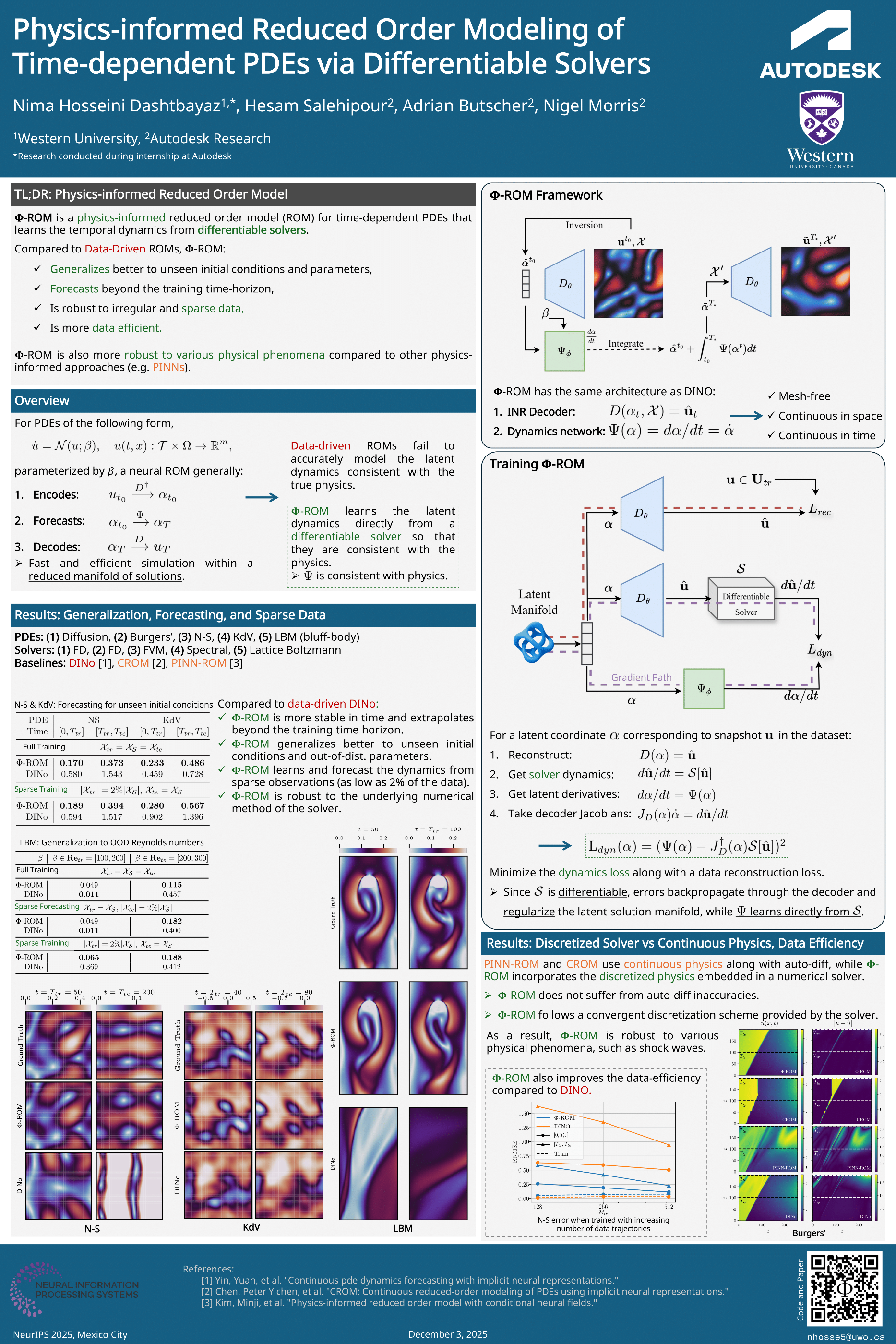
Reduced-order modeling (ROM) of time-dependent and parameterized differential equations aims to accelerate the simulation of complex high-dimensional systems by learning a compact latent manifold representation that captures the characteristics of the solution fields and their time-dependent dynamics. Although high-fidelity numerical solvers generate the training datasets, they have thus far been excluded from the training process, causing the learned latent dynamics to drift away from the discretized governing physics. This mismatch often limits generalization and forecasting capabilities. In this work, we propose **Ph**ysics-**i**nformed **ROM** ($\Phi$-ROM) by incorporating differentiable PDE solvers into the training procedure. Specifically, the latent space dynamics and its dependence on PDE parameters are shaped directly by the governing physics encoded in the solver, ensuring a strong correspondence between the full and reduced systems. Our model outperforms state-of-the-art data-driven ROMs and other physics-informed strategies by accurately generalizing to new dynamics arising from unseen parameters, enabling long-term forecasting beyond the training horizon, maintaining continuity in both time and space, and reducing the data cost. Furthermore, $\Phi$-ROM learns to recover and forecast the solution fields even when trained or evaluated with sparse and irregular observations of the fields, providing a flexible framework for field reconstruction and data assimilation. We demonstrate the framework’s robustness across various PDE solvers and highlight its broad applicability by providing an open-source JAX implementation that is readily extensible to other PDE systems and differentiable solvers, available at https://phi-rom.github.io.
PointMAC: Meta-Learned Adaptation for Robust Test-Time Point Cloud Completion
Linlian Jiang ⋅ Rui Ma ⋅ Li Gu ⋅ Ziqiang Wang ⋅ Xinxin Zuo ⋅ Yang Wang
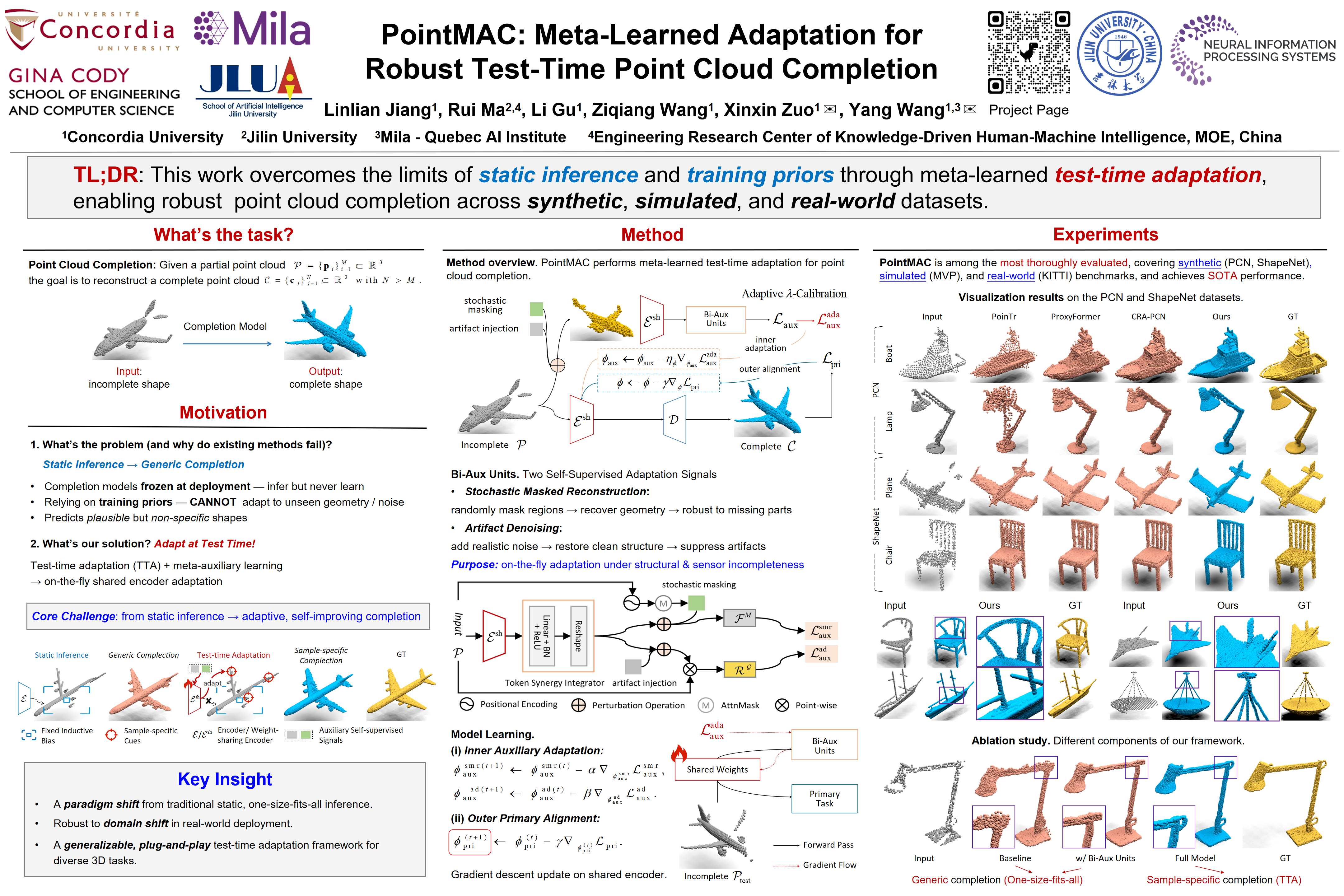
Point cloud completion is essential for robust 3D perception in safety-critical applications such as robotics and augmented reality. However, existing models perform static inference and rely heavily on inductive biases learned during training, limiting their ability to adapt to novel structural patterns and sensor-induced distortions at test time. To address this limitation, we propose PointMAC, a meta-learned framework for robust test-time adaptation in point cloud completion. It enables sample-specific refinement without requiring additional supervision. Our method optimizes the completion model under two self-supervised auxiliary objectives that simulate structural and sensor-level incompleteness. A meta-auxiliary learning strategy based on Model-Agnostic Meta-Learning (MAML) ensures that adaptation driven by auxiliary objectives is consistently aligned with the primary completion task. During inference, we adapt the shared encoder on-the-fly by optimizing auxiliary losses, with the decoder kept fixed. To further stabilize adaptation, we introduce Adaptive $\lambda$-Calibration, a meta-learned mechanism for balancing gradients between primary and auxiliary objectives. Extensive experiments on synthetic, simulated, and real-world datasets demonstrate that PointMAC achieves state-of-the-art results by refining each sample individually to produce high-quality completions. To the best of our knowledge, this is the first work to apply meta-auxiliary test-time adaptation to point cloud completion.
Predictable Scale (Part II) --- Farseer: A Refined Scaling Law in LLMs
Houyi Li ⋅ Wenzhen Zheng ⋅ Qiufeng Wang ⋅ Zhenyu Ding ⋅ Haoying Wang ⋅ Zili Wang ⋅ Shijie Xuyang ⋅ Ning DING ⋅ Shuigeng Zhou ⋅ Xiangyu Zhang ⋅ Daxin Jiang
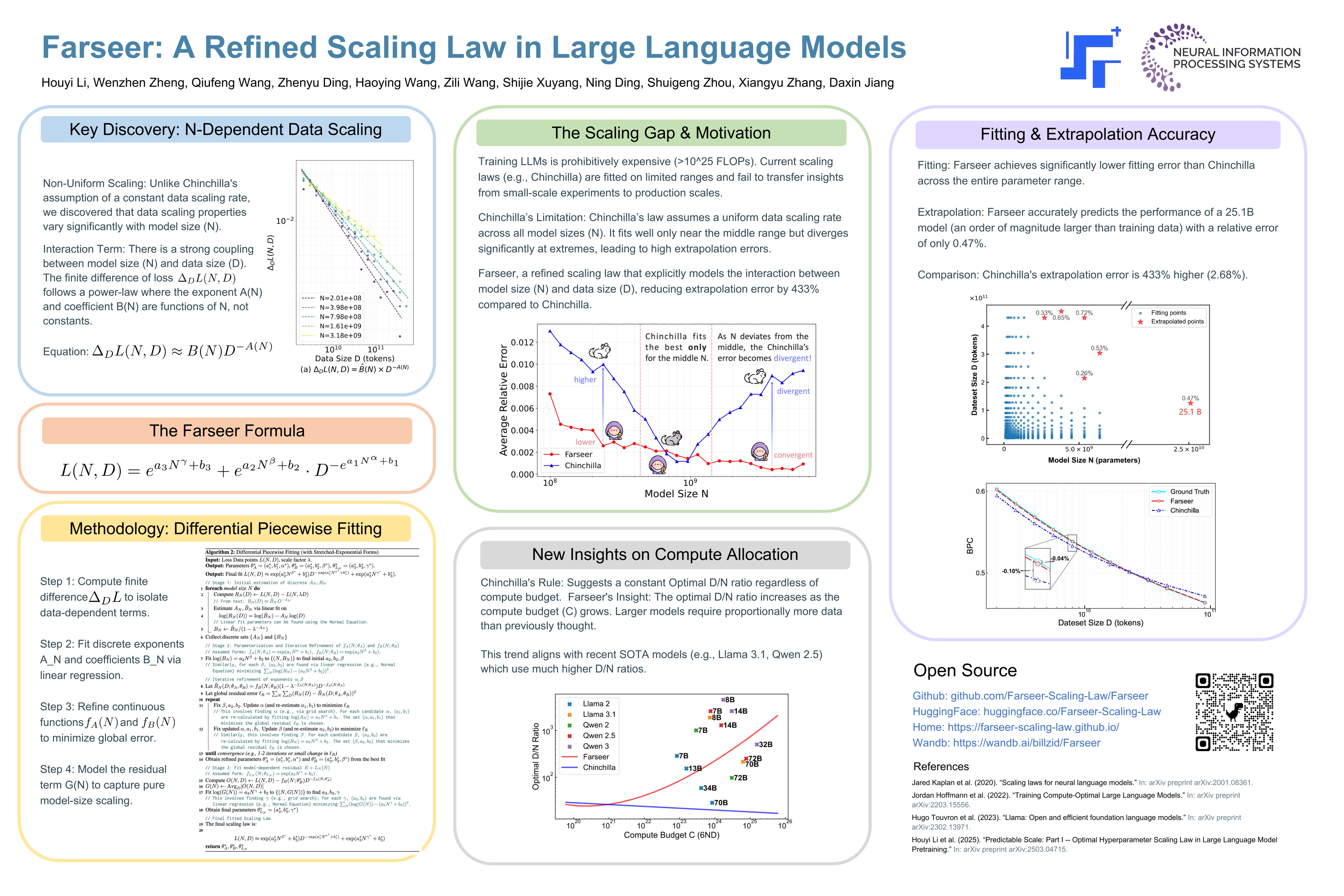
Training Large Language Models (LLMs) is prohibitively expensive, creating a critical scaling gap where insights from small-scale experiments often fail to transfer to resource-intensive production systems, thereby hindering efficient innovation. To bridge this, we introduce Farseer, a novel and refined scaling law offering enhanced predictive accuracy across scales. By systematically constructing a model loss surface $L(N,D)$, Farseer achieves a significantly better fit to empirical data than prior laws (e.g., \Chinchilla's law). Our methodology yields accurate, robust, and highly generalizable predictions, demonstrating excellent extrapolation capabilities, outperforming Chinchilla's law, whose extrapolation error is 433\% higher. This allows for the reliable evaluation of competing training strategies across all $(N,D)$ settings, enabling conclusions from small-scale ablation studies to be confidently extrapolated to predict large-scale performance. Furthermore, Farseer provides new insights into optimal compute allocation, better reflecting the nuanced demands of modern LLM training. To validate our approach, we trained an extensive suite of approximately 1,000 LLMs across diverse scales and configurations, consuming roughly 3 million NVIDIA H100 GPU hours. To foster further research, we are comprehensively open-sourcing all code, data, results (https://github.com/Farseer-Scaling-Law/Farseer), all training logs (https://wandb.ai/billzid/Farseer?nw=nwuserbillzid), all models used in scaling law fitting (https://huggingface.co/Farseer-Scaling-Law).
Relaxing partition admissibility in Cluster-DAGs: a causal calculus with arbitrary variable clustering
Clément Yvernes ⋅ Emilie Devijver ⋅ Adèle Ribeiro ⋅ Marianne Clausel ⋅ Eric Gaussier
Cluster DAGs (C-DAGs) provide an abstraction of causal graphs in which nodes represent clusters of variables, and edges encode both cluster-level causal relationships and dependencies arisen from unobserved confounding. C-DAGs define an equivalence class of acyclic causal graphs that agree on cluster-level relationships, enabling causal reasoning at a higher level of abstraction. However, when the chosen clustering induces cycles in the resulting C-DAG, the partition is deemed inadmissible under conventional C-DAG semantics. In this work, we extend the C-DAG framework to support arbitrary variable clusterings by relaxing the partition admissibility constraint, thereby allowing cyclic C-DAG representations. We extend the notions of d-separation and causal calculus to this setting, significantly broadening the scope of causal reasoning across clusters and enabling the application of C-DAGs in previously intractable scenarios. Our calculus is both sound and atomically complete with respect to the do-calculus: all valid interventional queries at the cluster level can be derived using our rules, each corresponding to a primitive do-calculus step.
scSplit: Bringing Severity Cognizance to Image Decomposition in Fluorescence Microscopy
Ashesh Ashesh ⋅ Florian Jug
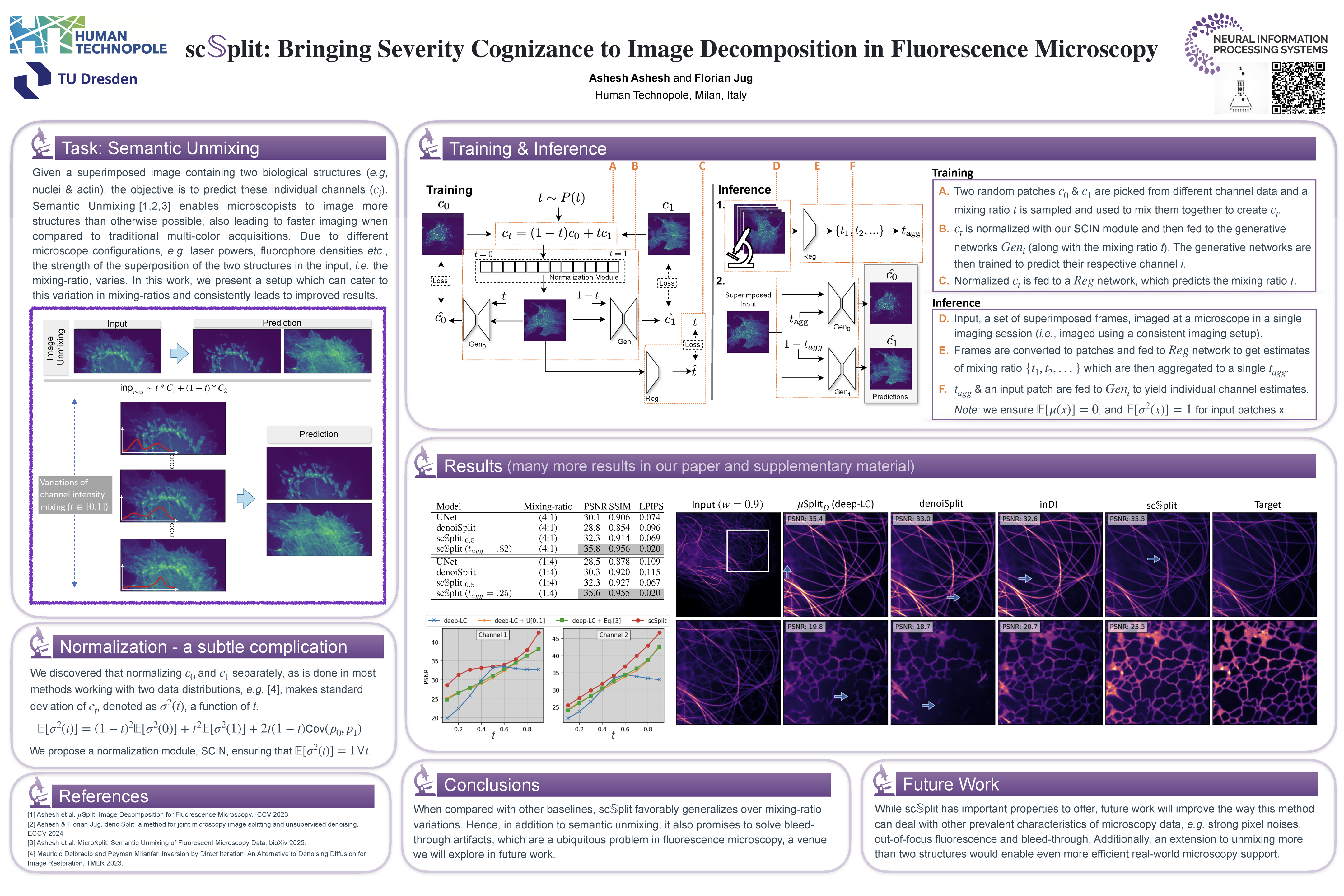
Fluorescence microscopy, while being a key driver for progress in the life sciences, is also subject to technical limitations. To overcome them, computational multiplexing techniques have recently been proposed, which allow multiple cellular structures to be captured in a single image and later be unmixed. Existing image decomposition methods are trained on a set of superimposed input images and the respective unmixed target images. It is critical to note that the relative strength (mixing ratio) of the superimposed images for a given input is a priori unknown. However, existing methods are trained on a fixed intensity ratio of superimposed inputs, making them not cognizant of the range of relative intensities that can occur in fluorescence microscopy. In this work, we propose a novel method called scSplit that is cognizant of the severity of the above-mentioned mixing ratio. Our idea is based on InDI, a popular iterative method for image restoration, and an ideal starting point to embrace the unknown mixing ratio in any given input. We introduce (i) a suitably trained regressor network that predicts the degradation level (mixing asymmetry) of a given input image and (ii) a degradation-specific normalization module, enabling degradation-aware inference across all mixing ratios. We show that this method solves two relevant tasks in fluorescence microscopy, namely image splitting and bleedthrough removal, and empirically demonstrate the applicability of scSplit on 5 public datasets. The source code with pre-trained models is hosted at https://github.com/juglab/scSplit/.
Spatial Understanding from Videos: Structured Prompts Meet Simulation Data
Haoyu Zhang ⋅ Meng Liu ⋅ Zaijing Li ⋅ Haokun Wen ⋅ Weili Guan ⋅ Yaowei Wang ⋅ Liqiang Nie
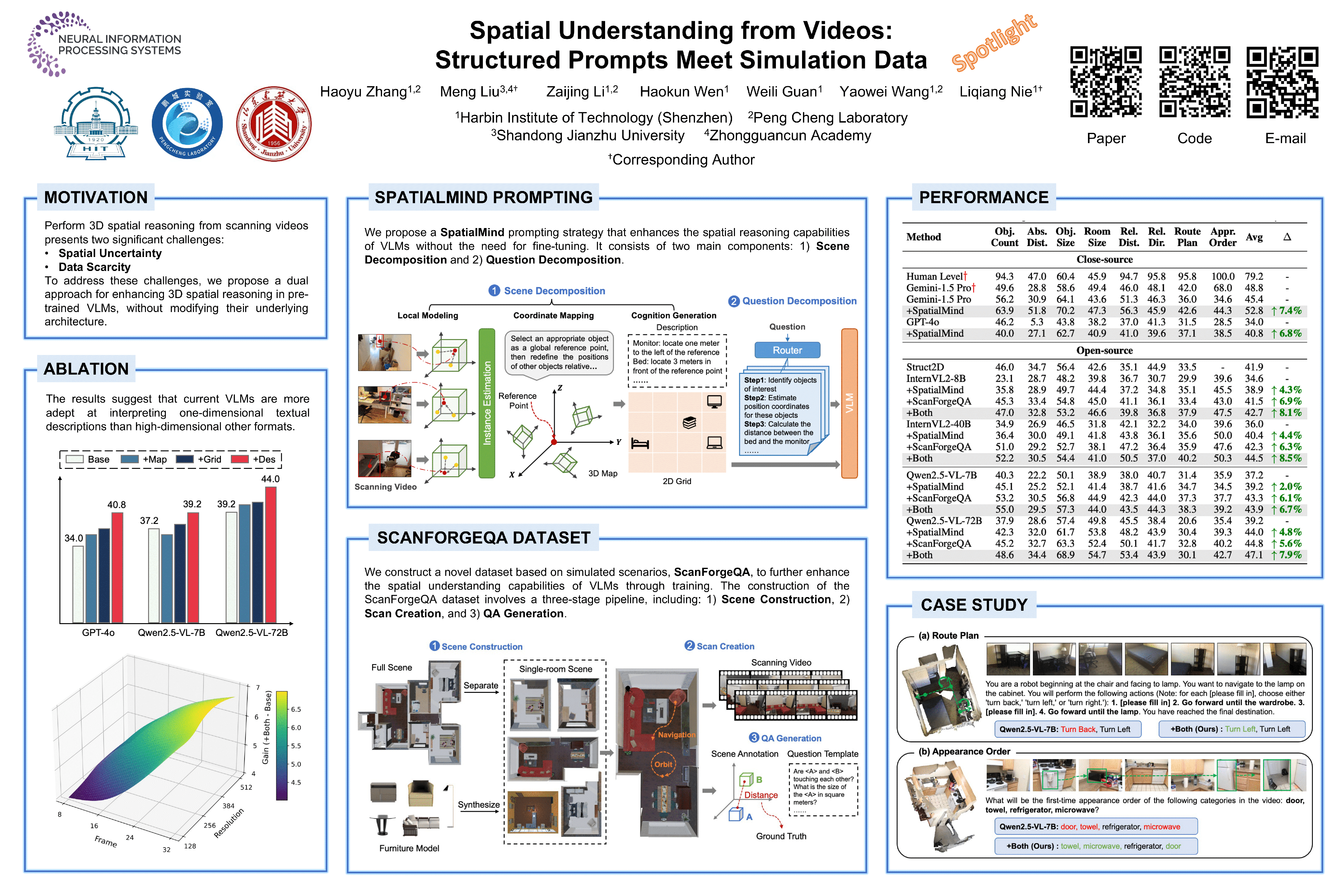
Visual-spatial understanding, the ability to infer object relationships and layouts from visual input, is fundamental to downstream tasks such as robotic navigation and embodied interaction. However, existing methods face spatial uncertainty and data scarcity, limiting the 3D spatial reasoning capability of pre-trained vision-language models (VLMs). To address these challenges, we present a unified framework for enhancing 3D spatial reasoning in pre-trained VLMs without modifying their architecture. This framework combines SpatialMind, a structured prompting strategy that decomposes complex scenes and questions into interpretable reasoning steps, with ScanForgeQA, a scalable question-answering dataset built from diverse 3D simulation scenes through an automated construction process designed for fine-tuning. Extensive experiments across multiple benchmarks demonstrate the individual and combined effectiveness of our prompting and fine-tuning strategies, and yield insights that may inspire future research on visual-spatial understanding.
Strassen Attention, Split VC Dimension and Compositionality in Transformers
Alexander Kozachinskiy ⋅ Felipe Urrutia ⋅ Hector Orellana ⋅ Tomasz Steifer ⋅ Germán Pizarro ⋅ Matías Fuentes ⋅ Francisco Meza Vásquez ⋅ Cristian Buc Calderon ⋅ Cristobal Rojas
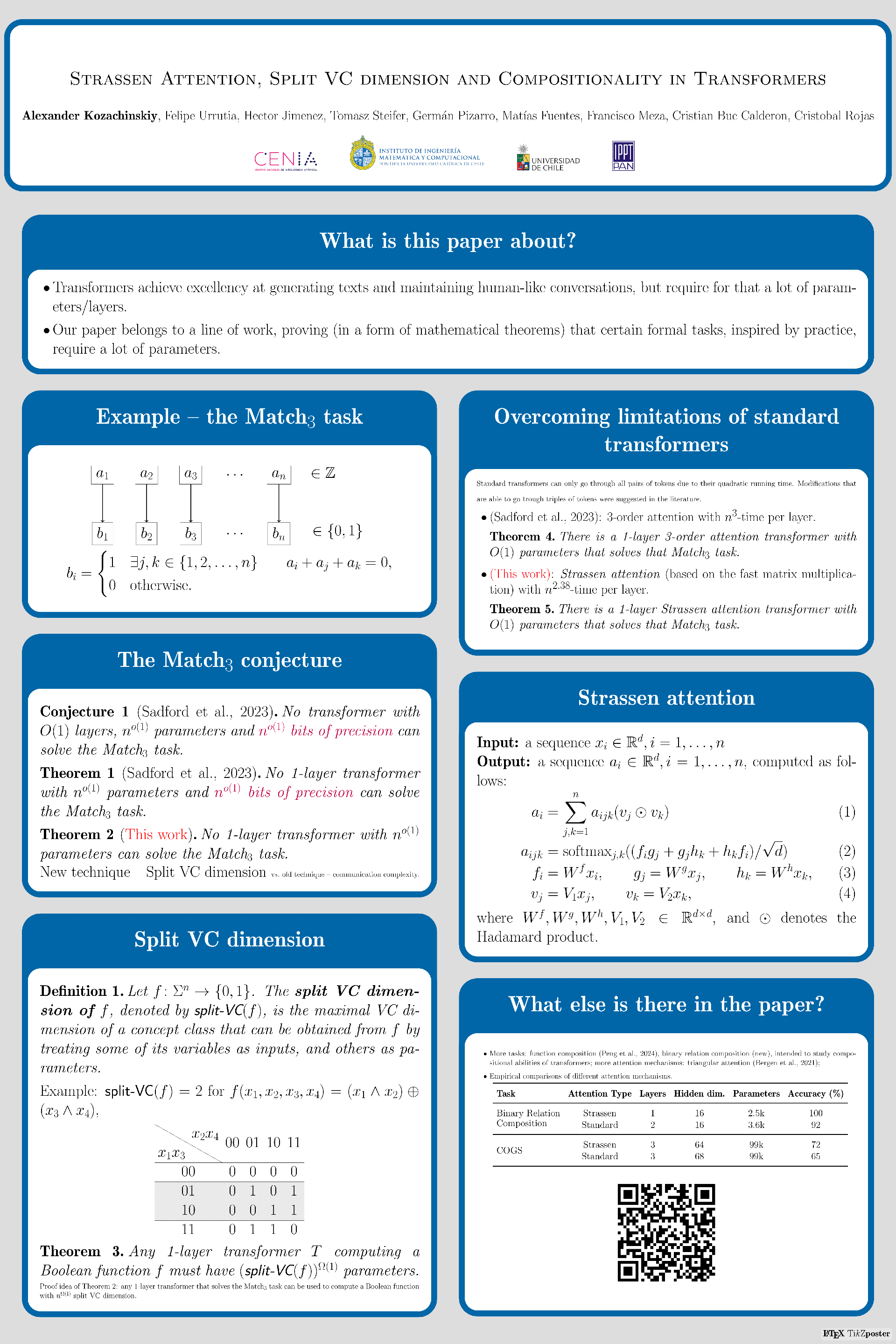
We propose the first method to show theoretical limitations for one-layer softmax transformers with arbitrarily many precision bits (even infinite). We establish those limitations for three tasks that require advanced reasoning. The first task, Match 3 (Sanford et al., 2023), requires looking at all possible token triplets in an input sequence. The second and third tasks address compositionality-based reasoning: function composition (Peng et al., 2024) and binary relations composition, respectively. We formally prove the inability of one-layer softmax Transformers to solve any of these tasks. To overcome these limitations, we introduce Strassen attention and prove that, equipped with this mechanism, a one-layer transformer can in principle solve all these tasks. Importantly, we show that it enjoys sub-cubic running-time complexity, making it more scalable than similar previously proposed mechanisms, such as higher-order attention (Sanford et al., 2023). To complement our theoretical findings, we experimentally studied Strassen attention and compared it against standard (Vaswani et al, 2017), higher-order attention (Sanford et al., 2023), and triangular attention (Bergen et al. 2021). Our results help to disentangle all these attention mechanisms, highlighting their strengths and limitations. In particular, Strassen attention outperforms standard attention significantly on all the tasks. Altogether, understanding the theoretical limitations can guide research towards scalable attention mechanisms that improve the reasoning abilities of Transformers.
The Promise of RL for Autoregressive Image Editing
Saba Ahmadi ⋅ Rabiul Awal ⋅ Ankur Sikarwar ⋅ Amirhossein Kazemnejad ⋅ Ge Ya Luo ⋅ Juan Rodriguez ⋅ Sai Rajeswar Mudumba ⋅ Siva Reddy ⋅ Chris Pal ⋅ Benno Krojer ⋅ Aishwarya Agrawal
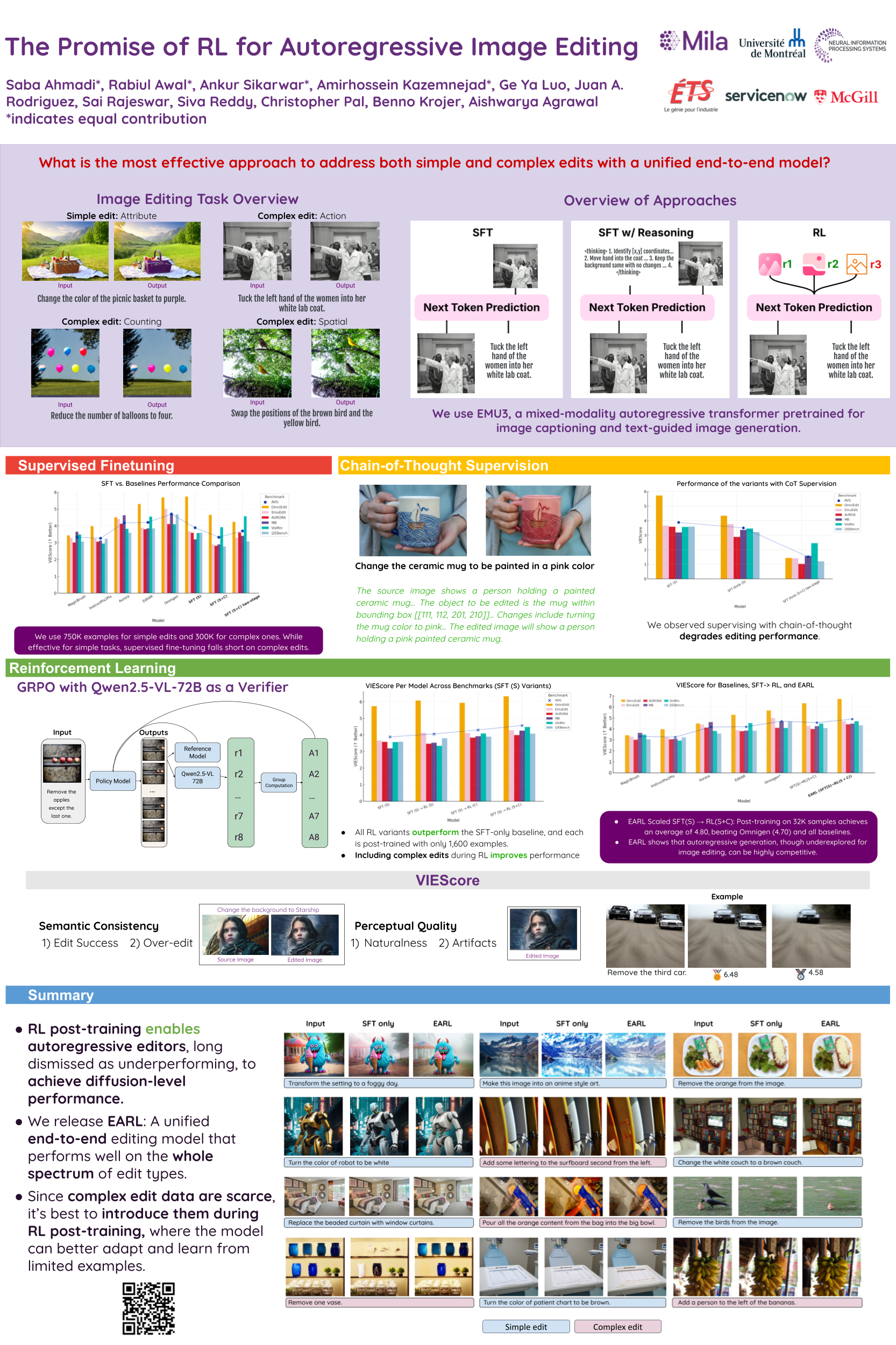
While image generation techniques are now capable of producing high-quality images that respect prompts which span multiple sentences, the task of text-guided image editing remains a challenge. Even edit requests that consist of only a few words often fail to be executed correctly. We explore three strategies to enhance performance on a wide range of image editing tasks: supervised fine-tuning (SFT), reinforcement learning (RL), and Chain-of-Thought (CoT) reasoning. In order to study all these components in one consistent framework, we adopt an autoregressive multimodal model that processes textual and visual tokens in a unified manner. We find RL combined with a large multi-modal LLM verifier to be the most effective of these strategies. As a result, we release EARL: Editing with Autoregression and RL, a strong RL-based image editing model that performs competitively on a diverse range of edits compared to strong baselines, despite using much less training data. Thus, EARL pushes the frontier of autoregressive multimodal models on image editing. We release our code, training data, and trained models at https://github.com/mair-lab/EARL.
TreeSplat: Mergeable Tree for Deformable Gaussian Splatting
Qiuhong Shen ⋅ Xingyi Yang ⋅ Xinchao Wang
Dynamic 3D scene reconstruction from multi-view videos demands representation to model complex deformations at scale. Current Gaussian Splatting based methods often either suffer from significant computation cost due to dense MLP-based modeling or explicit modeling deformation of each Gaussian independently. However, the dynamics of objects within a scene are typically hierarchical and exhibit structural correlations. To leverage these structural priors into the representation, we introduce TreeSplat, a Tree data structure for deformable Gaussian Splatting. In TreeSplat, as the name suggests, motions of Gaussian are represented hierarchically within a tree. Each node learns coefficients for time-varying basis functions, defining a part of the motion. The full motion for any given Gaussian is then determined by accumulating these transformations along the tree path from its leaf node to the root node. This tree isn't predefined; instead, it is constructed adaptively alongside Gaussian densification, where cloning or splitting a Gaussian correspondingly creates new leaf nodes. One central property of TreeSplat is its mergeability; after optimization during training, the hierarchical motion parameters for each Gaussian can be efficiently consolidated. By performing this merging step before test time, we eliminate the need to traverse the tree explicitly for each Gaussian during rendering. This results in dramatically faster rendering over 200 FPS and compact storage, while maintaining state-of-the-art rendering quality. Experiments on diverse synthetic and real-world datasets validate these advantages.
TRUST: Test-Time Refinement using Uncertainty-Guided SSM Traverses
Sahar Dastani ⋅ Ali Bahri ⋅ Gustavo Vargas Hakim ⋅ Moslem Yazdanpanah ⋅ Mehrdad Noori ⋅ David OSOWIECHI ⋅ Samuel Barbeau ⋅ Ismail Ayed ⋅ Herve Lombaert ⋅ Christian Desrosiers
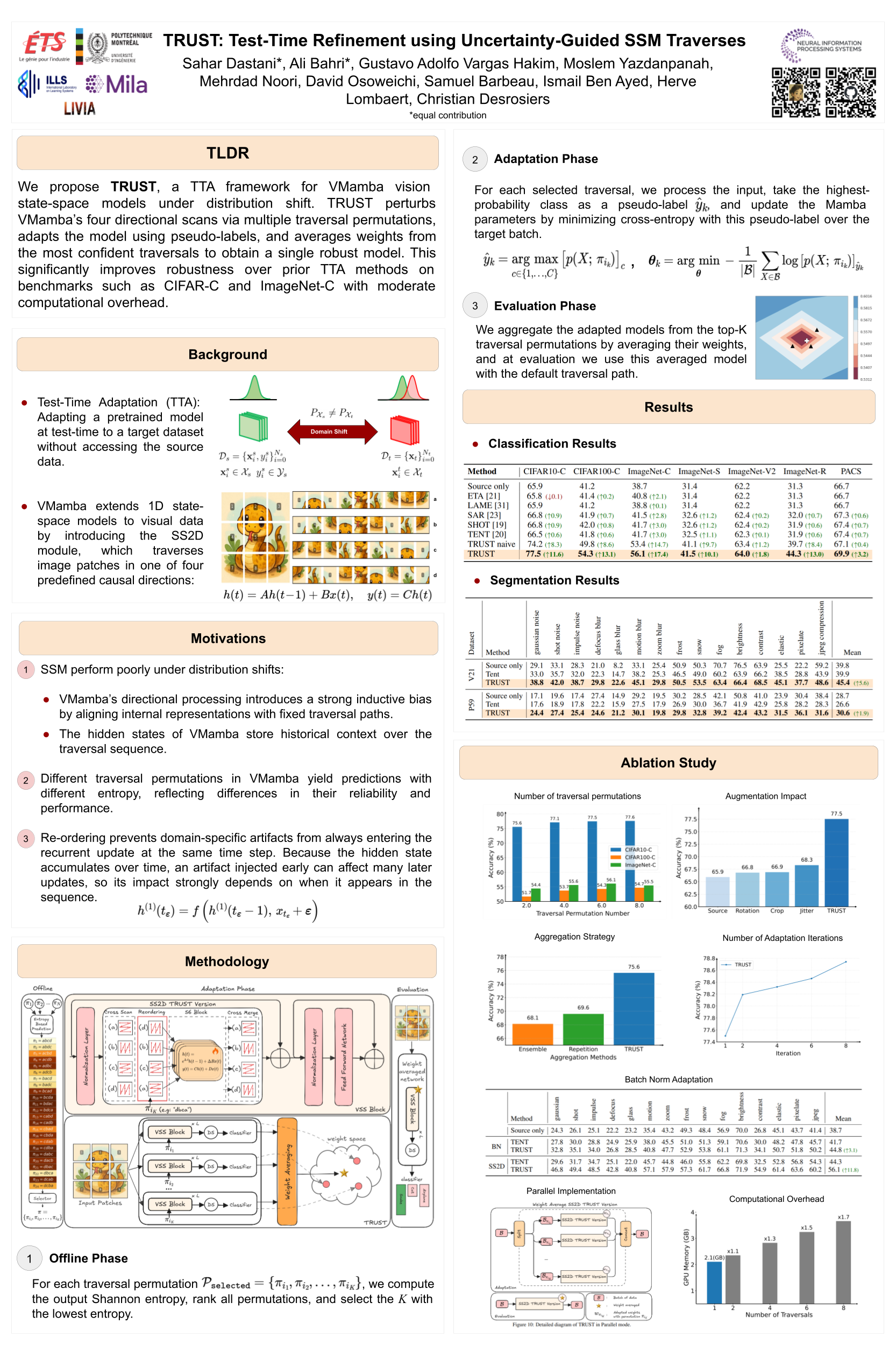
State Space Models (SSMs) have emerged as efficient alternatives to Vision Transformers (ViTs), with VMamba standing out as a pioneering architecture designed for vision tasks. However, their generalization performance degrades significantly under distribution shifts. To address this limitation, we propose TRUST (Test-Time Refinement using Uncertainty-Guided SSM Traverses), a novel test-time adaptation (TTA) method that leverages diverse traversal permutations to generate multiple causal perspectives of the input image. Model predictions serve as pseudo-labels to guide updates of the Mamba-specific parameters, and the adapted weights are averaged to integrate the learned information across traversal scans. Altogether, TRUST is the first approach that explicitly leverages the unique architectural properties of SSMs for adaptation. Experiments on seven benchmarks show that TRUST consistently improves robustness and outperforms existing TTA methods.
Uncertainty-Aware Multi-Objective Reinforcement Learning-Guided Diffusion Models for 3D De Novo Molecular Design
Lianghong Chen ⋅ Dongkyu Kim ⋅ Mike Domaratzki ⋅ Pingzhao Hu
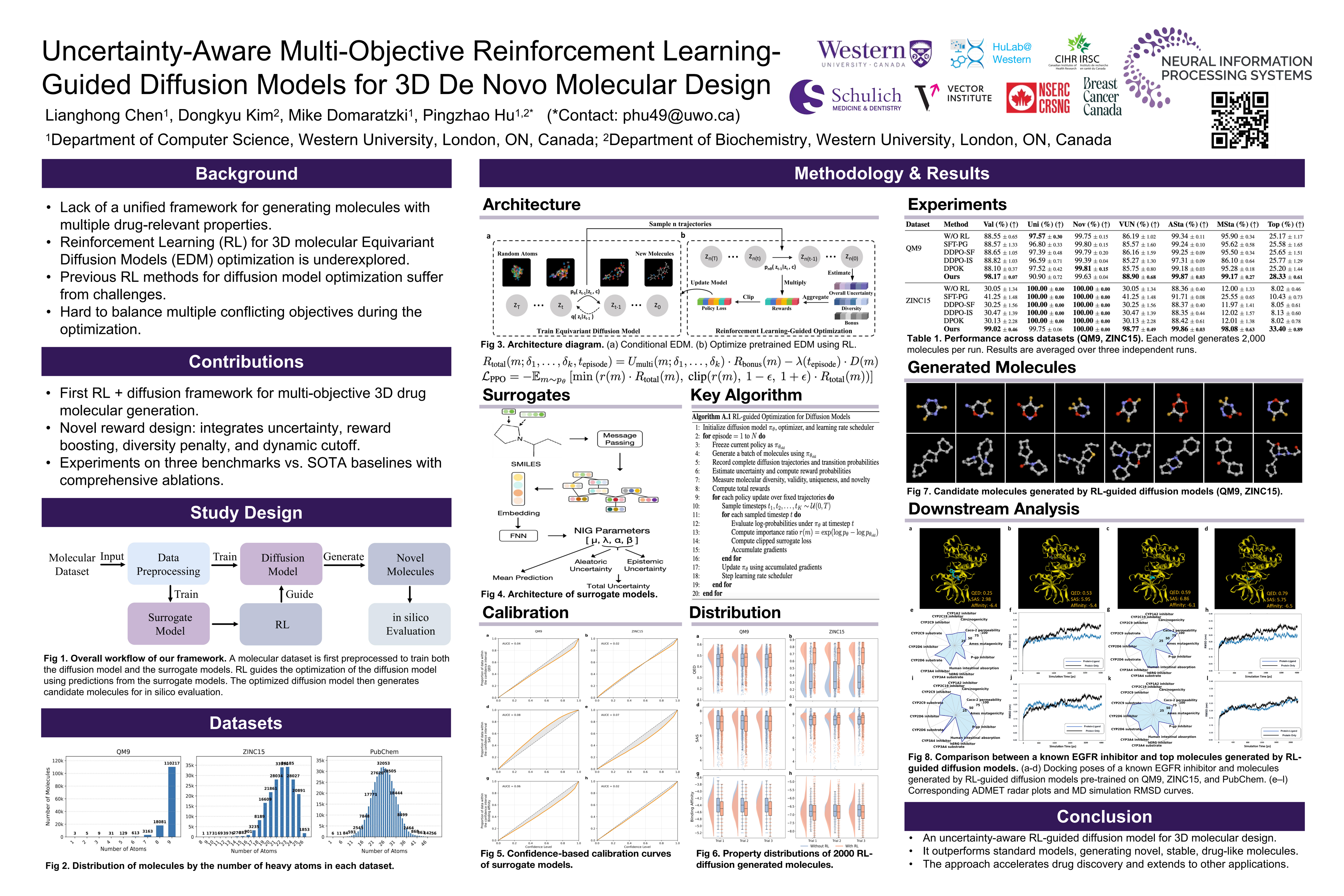
Designing de novo 3D molecules with desirable properties remains a fundamental challenge in drug discovery and molecular engineering. While diffusion models have demonstrated remarkable capabilities in generating high-quality 3D molecular structures, they often struggle to effectively control complex multi-objective constraints critical for real-world applications. In this study, we propose an uncertainty-aware Reinforcement Learning (RL) framework to guide the optimization of 3D molecular diffusion models toward multiple property objectives while enhancing the overall quality of the generated molecules. Our method leverages surrogate models with predictive uncertainty estimation to dynamically shape reward functions, facilitating balance across multiple optimization objectives. We comprehensively evaluate our framework across three benchmark datasets and multiple diffusion model architectures, consistently outperforming baselines for molecular quality and property optimization. Additionally, Molecular Dynamics (MD) simulations and ADMET profiling of top generated candidates indicate promising drug-like behavior and binding stability, comparable to known Epidermal Growth Factor Receptor (EGFR) inhibitors. Our results demonstrate the strong potential of RL-guided generative diffusion models for advancing automated molecular design.
Understanding Prompt Tuning and In-Context Learning via Meta-Learning
Tim Genewein ⋅ Kevin Li ⋅ Jordi Grau-Moya ⋅ Anian Ruoss ⋅ Laurent Orseau ⋅ Marcus Hutter
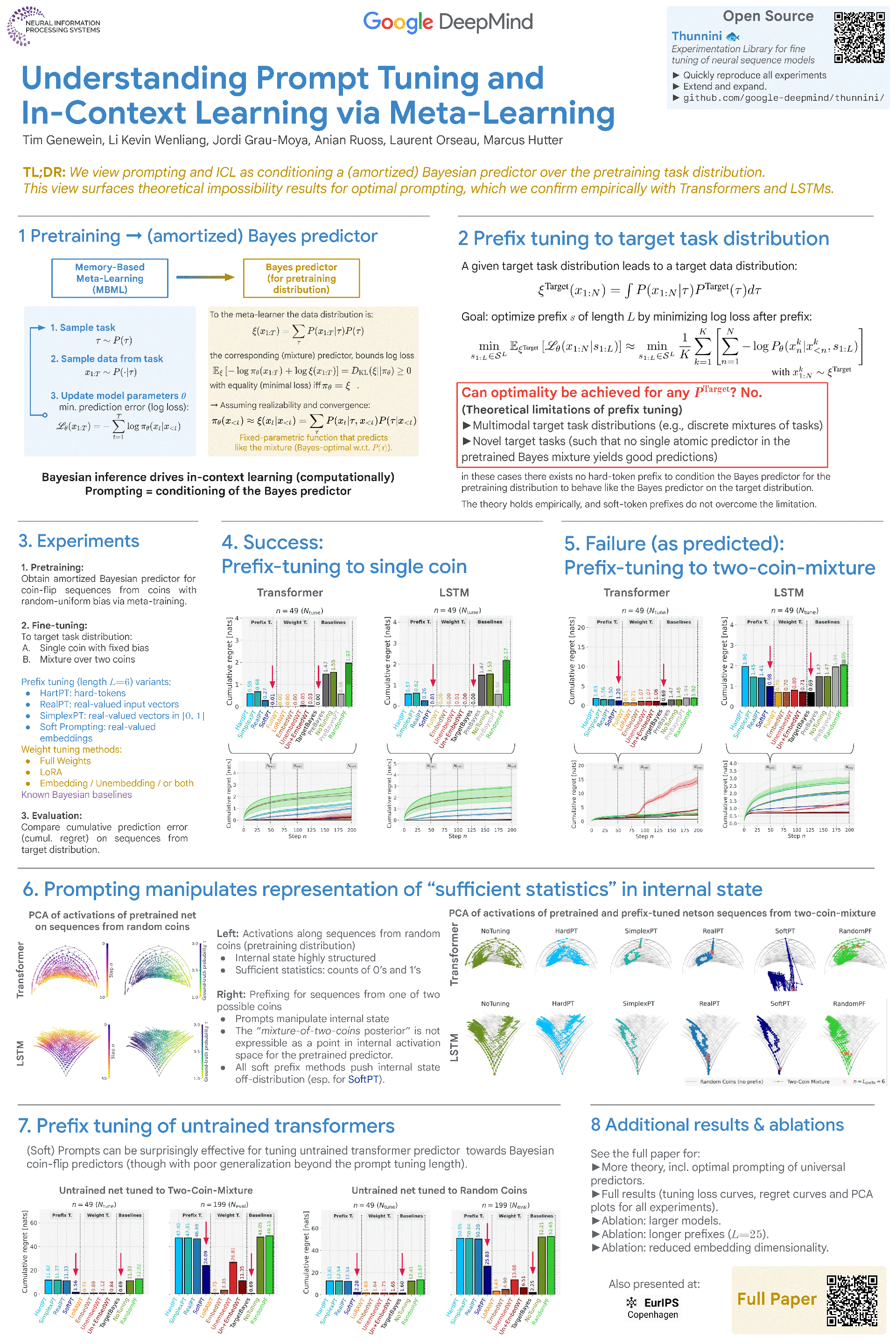
Prompting is one of the main ways to adapt a pretrained model to target tasks. Besides manually constructing prompts, many prompt optimization methods have been proposed in the literature. Method development is mainly empirically driven, with less emphasis on a conceptual understanding of prompting. In this paper we discuss how optimal prompting can be understood through a Bayesian view, which also implies some fundamental limitations of prompting that can only be overcome by tuning weights. The paper explains in detail how meta-trained neural networks behave as Bayesian predictors over the pretraining distribution, whose hallmark feature is rapid in-context adaptation. Optimal prompting can be studied formally as conditioning these Bayesian predictors, yielding criteria for target tasks where optimal prompting is and is not possible. We support the theory with educational experiments on LSTMs and Transformers, where we compare different versions of prefix-tuning and different weight-tuning methods. We also confirm that soft prefixes, which are sequences of real-valued vectors outside the token alphabet, can lead to very effective prompts for trained and even untrained networks by manipulating activations in ways that are not achievable by hard tokens. This adds an important mechanistic aspect beyond the conceptual Bayesian theory.