
Efficient Low Rank Attention for Long-Context Inference in Large Language Models
Abstract
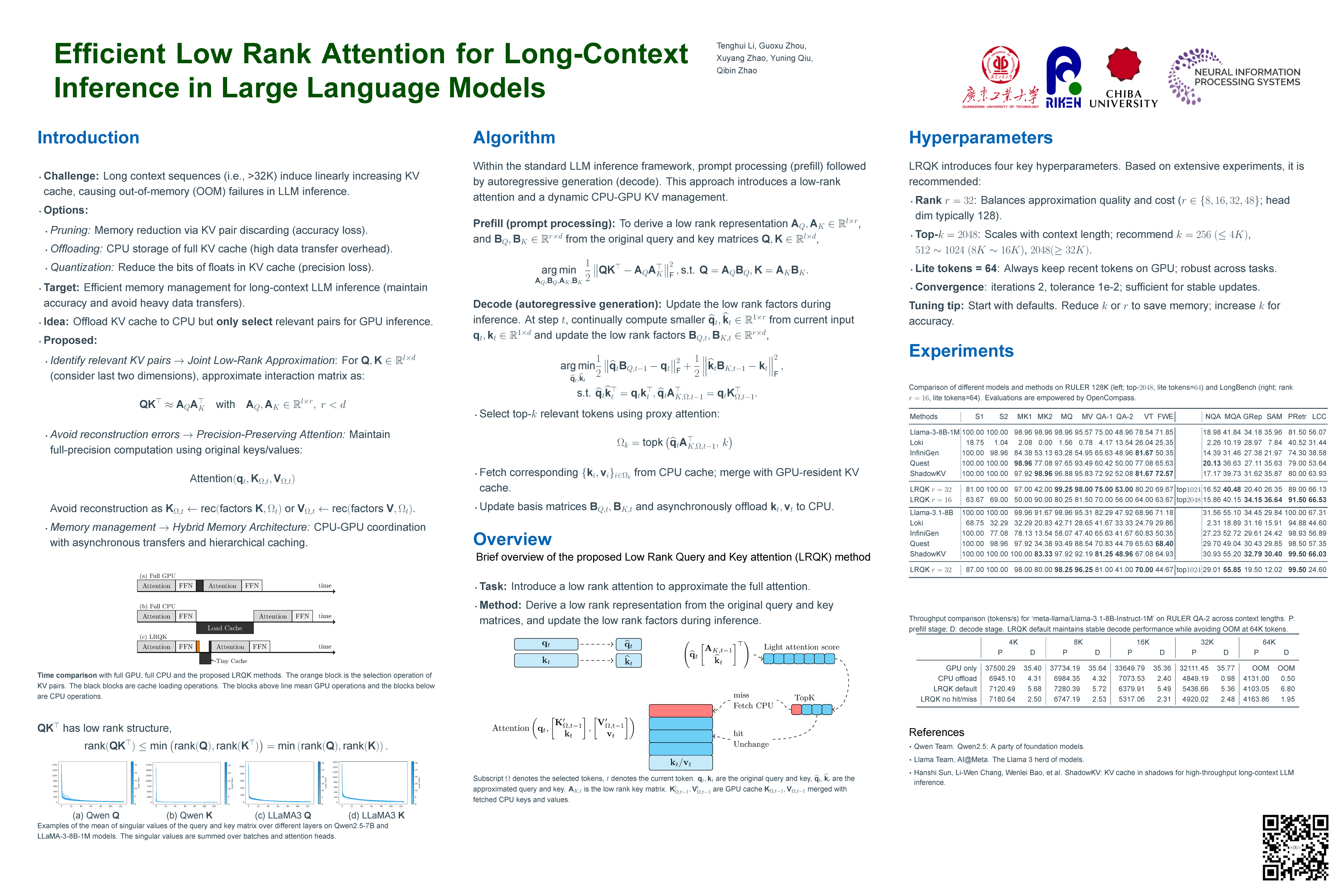
As the length of input text increases, the key-value (KV) cache in LLMs imposes prohibitive GPU memory costs and limits long-context inference on resource constrained devices. Existing approaches, such as KV quantization and pruning, reduce memory usage but suffer from numerical precision loss or suboptimal retention of key-value pairs. In this work, Low Rank Query and Key attention (LRQK) is introduced, a two-stage framework that jointly decomposes full-precision query and key matrices into compact rank-(r) factors during the prefill stage, and then employs these low-dimensional projections to compute proxy attention scores in (\mathcal{O}(lr)) time at each decode step. By selecting only the top-(k) tokens and a small fixed set of recent tokens, LRQK employs a mixed GPU-CPU cache with a hit-and-miss mechanism where only missing full-precision KV pairs are transferred, thereby preserving exact attention outputs while reducing CPU-GPU data movement. Extensive experiments on the RULER and LongBench benchmarks with LLaMA-3-8B and Qwen2.5-7B demonstrate that LRQK matches or surpasses leading sparse-attention methods in long context settings, while delivering significant memory savings with minimal accuracy loss. Our code is available at \url{https://github.com/tenghuilee/LRQK}.