
The Curvature Shadow: An Apparent Failure of Maximum-Entropy Equilibrium Selection is a Removable Artifact
Abstract
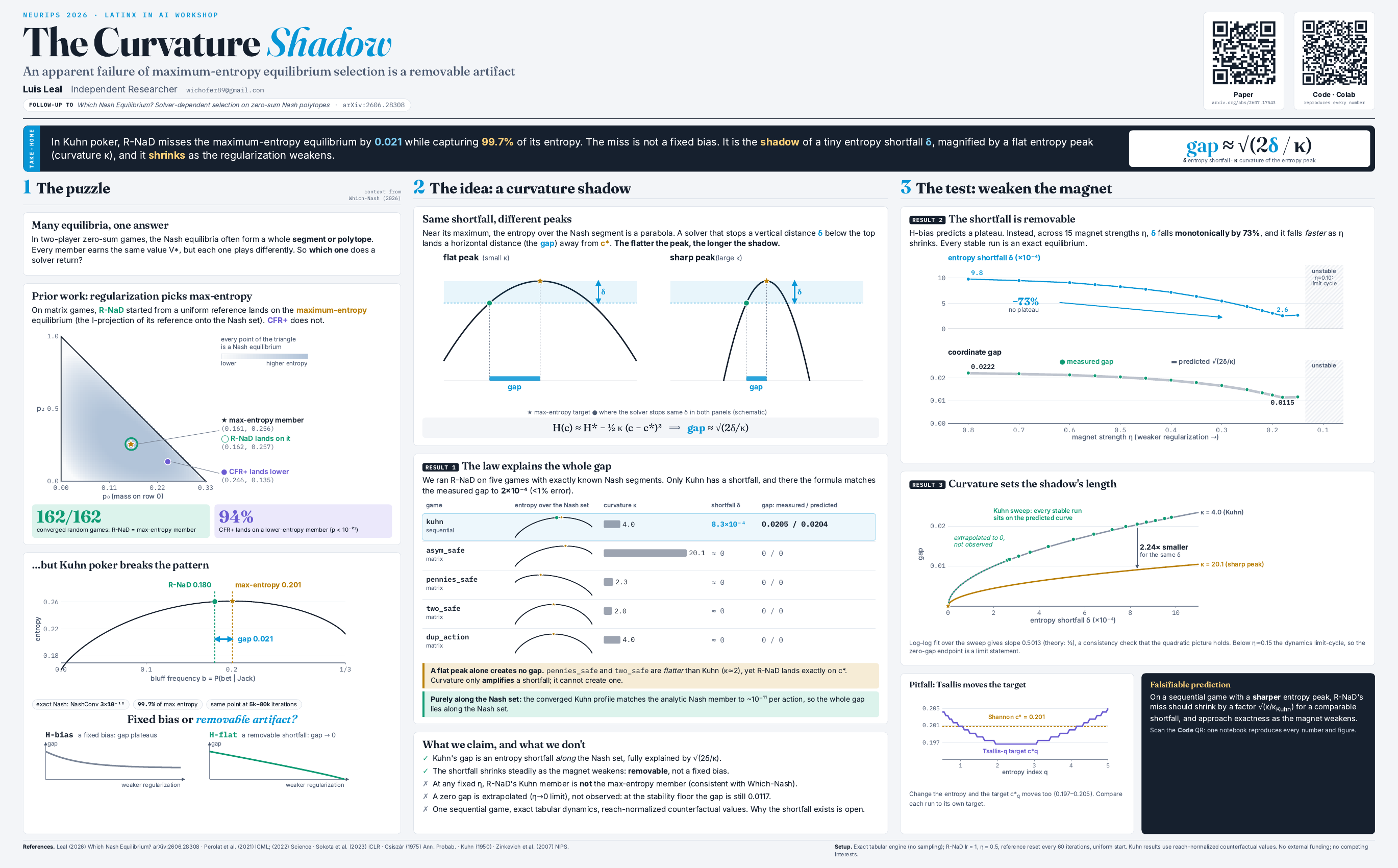
In two-player zero-sum games whose Nash equilibria form a convex set, regularized solvers such as Regularized Nash Dynamics (R-N aD) empirically select the maximum-entropy member—the information projection (I-projection) of a uniform reference onto the Nash set. On a panel of small games this match is exact, with one apparent exception: in Kuhn poker R-N aD lands at bluff coordinate 0.180 while the maximum-entropy member sits at 0.201, a coordinate gap of ≈ 0.021, even though R-N aD attains 99.7% of the maximum entropy. We ask whether this gap is a genuine selection bias or an artifact, and answer it quantitatively. We show that for selection p on a one-dimensional Nash manifold the coordinate gap factorizes as gap ≈ 2δ/κ, where δ is the solver’s entropy shortfall and κ is the curvature of the entropy landscape at its peak. Across five games this relation holds to within 2 × 10 −4 (< 1% relative error). The four matrix games have δ ≈ 0 (R-N aD reaches the maximum-entropy member exactly) and therefore no gap regardless of curvature; only the sequential game (Kuhn) has δ > 0. A causal sweep of the magnet strength drives δ → 0 and the gap toward zero along the predicted curve (fitted gap-vs.-δ scaling exponent 0.50, R 2 > 0.999999, against the exact H-flat prediction of 1/2), until the dynamics destabilize at a stability floor—behavior consistent with a removable shortfall and inconsistent with a fixed bias. We quantify the curvature half of the law from measured curvatures and flag a moving-target pitfall in the natural Tsallis-entropy experiment. The Kuhn gap is thus the curvature-shadow of a small, removable entropy shortfall on an unusually flat peak; the I-projection account is upheld up to a flatness-limited residual.