
Session
Atlanta Poster Session 3
Hall C1
Accelerating Inference of Discrete Autoregressive Normalizing Flows by Selective Jacobi Decoding
Jiaru Zhang ⋅ Juanwu Lu ⋅ Xiaoyu Wu ⋅ Ziran Wang ⋅ Ruqi Zhang
Discrete normalizing flows are promising generative models with advantages such as analytical log-likelihood computation and end-to-end training. However, the architectural constraints to ensure invertibility and tractable Jacobian computation limit their expressive power and practical usability. Recent advancements utilize autoregressive modeling, significantly enhancing expressive power and generation quality. Nevertheless, such sequential modeling inherently restricts parallel computation during inference, leading to slow generation that impedes practical deployment. In this paper, we first identify that strict sequential dependency in inference is unnecessary to generate high-quality samples. We observe that sub-variables in sequential modeling can also be approximated without strictly conditioning on all preceding sub-variables. Moreover, the models tend to exhibit low dependency redundancy in the initial layer and higher redundancy in subsequent layers. Leveraging these observations, we propose to selectively use Jacobi decoding strategy that accelerates its autoregressive inference through parallel iterative optimization. Theoretical analyses demonstrate the method's superlinear convergence rate and guarantee that the number of iterations required is no greater than the original sequential approach. Empirical evaluations across multiple datasets validate the generality and effectiveness of our acceleration technique, achieving up to 4.7 times faster inference on modern normalizing flow models while preserving generation quality.
Activation Steering of Video Generation Models via Reduced-Order Linear Optimal Control
Jihoon Hong ⋅ Alice Chan ⋅ Qiyue Dai ⋅ Julian Skifstad ⋅ Glen Chou
Text-to-video (T2V) models trained on large-scale web data can generate undesired content, motivating interventions that reduce harmful outputs without sacrificing visual quality. Activation steering offers an attractive mechanistic alternative to finetuning and prompt filtering, but existing T2V steering methods remain limited, typically applying coarse non-anticipative interventions that can lead to oversteering and content degradation. To close this gap, we propose Latent Activation Linear-Quadratic Regulator (LA-LQR), a reduced-order optimal control framework for minimally invasive T2V steering. LA-LQR formulates T2V inference as a dynamical system and computes closed-loop feedback interventions that steer activations toward desired feature setpoints while penalizing unnecessary perturbations. To make optimal control feasible for high-dimensional video activations, we project activations onto a low-dimensional, task-relevant subspace derived from contrastive prompt pairs, estimate local linear dynamics in this latent space, and solve a latent LQR problem to obtain timestep- and layer-specific steering signals. We provide theoretical bounds relating latent setpoint tracking to raw activation-space feature control, and empirically validate the fidelity of the reduced latent dynamics. On concept steering and video safety benchmarks, LA-LQR reduces unsafe generations relative to baselines, while preserving prompt fidelity and visual quality.
ActQuant: Sub-4-bit Action-Guided Quantization for Vision-Language-Action Models
Arash Akbari ⋅ Arman Akbari ⋅ Masih Eskandar ⋅ Qitao Tan ⋅ Yixiao Chen ⋅ Jingwu Luo ⋅ Bertha Pangaribuan ⋅ Liyun Zhang ⋅ Jennifer Dy ⋅ Geng Yuan ⋅ Xue Lin ⋅ Gaowen Liu ⋅ Stratis Ioannidis ⋅ Yanzhi Wang
Vision-Language-Action (VLA) models exhibit remarkable action generation for embodied intelligence, but their heavy compute and memory demands strain deployment on edge robotic platforms. Aggressive weight quantization (e.g., sub-4-bit) is the natural lever, yet existing post-training quantization (PTQ) methods suffer severe performance degradation in this regime. To address this, we introduce \textbf{ActQuant}, an action-guided mixed-precision PTQ framework that operates in two stages: (1) an inter-tensor allocator that assigns each weight matrix a single bit-width based on how much it contributes to predicting the agent's actions; (2) an intra-tensor scale optimizer tunes per-block quantization scales using action-aware curvature, so that dynamic range is concentrated on the weights most influential for control. We evaluate ActQuant both in simulation and on a real-world 6-DoF UR3 arm. On the LIBERO benchmark, ActQuant achieves state-of-the-art success rates across the sub-4-bit regime, retaining 94.95\% on OpenVLA-OFT and 94.8\% on $\pi_{0.5}$ at 3.0 bits-per-weight (vs. 96.9\% and 97.0\% for the half-precision baselines, respectively), while reducing backbone memory by up to $5.3\times$; on the physical robot, ActQuant successfully maintains the baseline's success rate. To our knowledge, ActQuant is the first PTQ approach that can quantize VLA models below four bits while retaining practical task success with very limited calibration data.
Adaptive Target-Charging with Privacy Filters and Individual Accounting
Peihan Liu ⋅ Alison Caulfield ⋅ Mark Chen ⋅ Rachel Cummings ⋅ Roxana Geambasu ⋅ Mathias Lécuyer ⋅ Pierre Tholoniat
The target-charging technique (TCT), a generalization of the sparse vector technique, monitors whether query answers deviate beyond acceptable bounds while incurring privacy costs only upon significant deviations. We develop a more mature theory of TCT through three contributions. First, we generalize TCT and replace prior simulation-based analyses with a direct stochastic domination argument, yielding a tighter bound and a modular proof structure that affords flexibility in the choice of privacy representation for the base mechanism as well as the composition accountant. Second, we provide an anytime-valid TCT guarantee that integrates with approximate Rényi DP filters. Third, we enable individual-level privacy filters. Together, these provide the first end-to-end TCT construction compatible with privacy filters and individual-level accounting, with practical relevance demonstrated through benchmarks inspired by the impending world-scale deployment of the W3C Attribution standard, which is fundamentally rooted in individual filters.
Autoregressive video diffusion models generate streaming video by producing frames sequentially, conditioning each chunk on previously generated content. These models are structurally anchored to the first frame: its key-value representation occupies a privileged position in the attention cache and serves as the primary scene reference throughout generation. As the cleanest and most error-free position in the cache, this anchor draws disproportionate attention, suppressing video dynamics, and locking scene composition to the initial viewpoint even as the scene naturally evolves. The result is a temporally shallow video in which motion, camera movement, and scene progression are dampened in favor of static consistency. To address this, we replace the static anchor with an adaptive state, a hidden latent that the model denoises alongside content at every chunk but never generates. Rather than referencing a frozen first frame, the model generates its own scene anchor at each step by attending to both the previous state and the current content, producing a reference that evolves with the generated content. Unlike standard video generation, which encodes an absolute notion of time, our formulation treats time as relative: every generation step sees the same positional structure regardless of how far generation has progressed, and the state transition is identical at every chunk. Together, these properties introduce a recurrence into the generation process, where denoising serves as the transition function, and the KV cache serves as the carrier, requiring no external module. Experiments demonstrate that the adaptive state substantially improves video dynamics, enabling richer motion and natural scene progression within generated videos.
A Distribution Mapping Approach to Counterfactually Fair Reinforcement Learning
Jianhan Zhang ⋅ Jitao Wang ⋅ John D Piette ⋅ Donglin Zeng ⋅ Chengchun Shi ⋅ Zhenke Wu
Reinforcement learning (RL) seeks to optimize sequential decisions to maximize population-level benefits over time. However, when deployed in high-stakes settings such as healthcare, RL decisions might systematically restrict some subpopulation's access to valuable resources or services in a manner contrary to the values and goals of stakeholders. Counterfactual fairness (CF) offers a promising framework to address this problem based on causal reasoning. This paper develops a data preprocessing algorithm that, when used in tandem with policy learning, enables CF in RL. Our algorithm relies on a novel quantile distribution mapping method for sequentially estimating the counterfactual states and rewards in the data preprocessing step, subsuming common additivity assumptions used for counterfactual prediction as special case. We theoretically prove that the per-step level of counterfactual unfairness and infinite-horizon suboptimality gap can be bounded under mild regularity conditions. We also empirically test our algorithm in numerical experiments as well as in application to a real-world interventional digital health dataset.
Agentic AI-Empowered Dynamic Survey Framework
Furkan Mumcu ⋅ Lokman Bekit ⋅ Michael Jones ⋅ Anoop Cherian ⋅ Yasin Yilmaz
Survey papers play a central role in synthesizing and organizing scientific knowledge, yet they are increasingly strained by the rapid growth of research output. As new work continues to appear after publication, surveys quickly become outdated, contributing to redundancy and fragmentation in the literature. We reframe survey writing as a long-horizon maintenance problem rather than a one-time generation task, treating surveys as living documents that evolve alongside the research they describe. We propose an agentic Dynamic Survey Framework that supports the continuous updating of existing survey papers by incrementally integrating new work while preserving survey structure and minimizing unnecessary disruption. Using a retrospective experimental setup, we demonstrate that the proposed framework effectively identifies and incorporates emerging research while preserving the coherence and structure of existing surveys.
Agent MechSuits : Mechanistic Subspace Safety Steering for Multi-Turn CLI Agents
Weidi Luo ⋅ Qiming Zhang ⋅ Mingyu Jin ⋅ Jie Cai ⋅ Yihao Quan ⋅ Chaowei Xiao ⋅ Jingcheng Niu ⋅ Zhen Xiang
Command-Line Interface (CLI) agents based on large language models (LLMs) demonstrate remarkable autonomous capabilities, but they also introduce significant safety and misuse risks during multi-turn interactions with external environments. Existing safety mechanisms mainly rely on external guardrails, which have a limited ability to perform fine-grained behavioral control during execution. Meanwhile, recent mechanistic interpretability methods for LLM safety are mostly confined to single-turn or jailbreak-style QA settings, limiting their ability to capture the evolving risk dynamics of multi-turn agent execution. In this paper, we investigate the safety of multi-turn CLI agents from an internal perspective. We propose Agent MechSuits (Mechanistic Subspace Intervention and Steering), a white-box defense framework that performs runtime safety detection and representation-level mitigation for CLI agents. Unlike conventional agent guardrails, Agent MechSuits detect harmful execution states from step-level hidden representations and mitigate unsafe behavior by intervening in a 10-dimensional subspace within a single layer. To support this research, we introduce the Mechanistic Agent Safety (MAS) benchmark, comprising comprehensively annotated multi-turn execution trajectories across 194 tasks using LLaMA-3.1-8B, Qwen-2.5-7B, and Gemma-2-9B. Extensive experiments show that Agent MechSuits achieves strong safety detection performance, supports lookahead risk anticipation, and substantially reduces harmful agent actions, establishing a foundation for applying mechanistic interpretability to dynamic LLM agent safety.
AgentOdyssey: Open-Ended Long-Horizon Text Game Generation for Test-Time Continual Learning Agents
Zheyuan Zhang ⋅ Zehao Wen ⋅ Bowei Zhang ⋅ Andrew Wang ⋅ Jianwen Xie ⋅ Daniel Khashabi ⋅ Tianmin Shu
For agents to learn continuously from interaction with the world at test time, they must be able to explore effectively, acquire new world knowledge and skills, retain relevant episodic experiences, and plan over long horizons. To evaluate these key abilities of test-time continual learning agents, we introduce AgentOdyssey, a novel evaluation framework that procedurally generates open-ended text games with rich entities, world dynamics, and long-horizon tasks. Critically, AgentOdyssey goes beyond the conventional machine learning assumption that learning does not occur at test time by placing agents in a continuous, long-horizon setting that interleaves learning and inference throughout deployment. We further propose a multifaceted evaluation methodology that measures not only game progress but also offers diagnostic tests on world knowledge acquisition, episodic memory, object and action exploration, action diversity, and model cost. We evaluate diverse agent paradigms in the generated games. Our experimental results reveal critical limits in agents' key abilities, as well as factors that influence their meaningful horizon. Although performance scales with stronger base models, even the top agent remains far below human performance, leaving substantial headroom for improvement. Among agent mechanisms, we find that short-term memory benefits multiple agent paradigms and is an important component of agent test-time training.
A Locality-Aware Surrogate for Natural-Gradient Descent in Quantum Optimization
Md Mobasshir Arshed Naved ⋅ Wenbo Xie ⋅ Wojciech Szpankowski ⋅ Ananth Grama
Variational quantum algorithms (VQAs) rely on gradient-based optimization over parameterized circuits whose loss landscape lives on a manifold of quantum states. Quantum natural gradient (QNG) accounts for this geometry through the quantum Fisher information matrix (QFIM). However, estimating the full QFIM is prohibitively expensive within practical quantum circuit shot budgets. Existing tractable approximations either discard inter-block couplings, as in block-diagonal QNG, or replace the QFIM with a measurement-induced classical Fisher surrogate, as in random natural gradient (RNG). We propose a locality-aware surrogate that targets the QFIM through its covariance representation in terms of propagated generators, retaining a structured subset of informative cross-parameter couplings while remaining practical to estimate under finite-shot budgets. Our construction combines three ingredients: weight-$k$ Pauli truncation to control estimation variance, support-overlap masking to exploit sparsity, and single-dataset classical-shadow estimation that reuses the same shadow dataset across all retained metric entries. Truncation level $k$ provides a bias--variance tradeoff: larger $k$ captures more of the propagated-generator structure but increases estimation cost, making it a budget-constrained design choice. Circuit parameters whose truncated generators remain nonzero form an active set receiving surrogate-QNG updates, while the rest follow standard gradient descent. We provide finite-shot concentration bounds for the shadow-estimated surrogate and convergence guarantees to a stationary neighborhood under standard smoothness assumptions. Experiments on variational quantum eigensolver (VQE) instances with local ans\"atze for Heisenberg and Ising spin chains show improved convergence per cumulative shot relative to SGD, Adam, block-diagonal QNG, and RNG baselines under finite-shot budgets, including on systems up to 16 qubits.
A Mechanistic Interpretability Study of an Astronomical Foundation Model
Rachel Zhang ⋅ Alberto Bietti ⋅ Wes Gurnee ⋅ Alessandro Favero ⋅ Miles Cranmer
Scientific foundation models trained on multimodal data are increasingly deployed across the sciences, but whether their internal computations correspond to known scientific operations or proceed through different mechanisms remains unclear. Understanding these mechanisms is essential for assessing reliability, identifying failure modes, and judging when predictions can be trusted in scientific workflows. We present the first mechanistic interpretability study of an astronomy foundation model, focused on AION-1's multimodal advantage in redshift prediction from broadband photometry and imaging over photometry alone. We find that this advantage concentrates on extended and dust-attenuated galaxies, with the gain localized by layerwise probing to AION-1's first encoder block. We examine two attention heads in this block and find that representation and function dissociate in opposite directions across them. The first head linearly encodes classical photometric features and organizes its image output along a radial gradient, yet ablation and activation patching show this structure has no measurable causal effect on the prediction. The second head shows no distinctive probe signature on the photometric-redshift estimation operations we tested, yet ablating it on dust-attenuated galaxies eliminates the multimodal advantage and amplifies the attenuation-bias signature beyond the photometry-only baseline, indicating that this head implements a correction for attenuation bias. Whether this reflects a methodological limitation in interpretability or an undiscovered astronomical empirical relation is itself an open question, and one that bears directly on using interpretability as a tool for scientific discovery.
AndroidReality: How Far Are Mobile Agents from the Real World?
Xiaoou Liu ⋅ Longchao Da ⋅ Hanyang Chen ⋅ Yuan Ling ⋅ Hua Wei
Mobile agents have achieved promising results on clean online benchmarks such as AndroidWorld, yet their performance often degrades sharply in real-world deployment due to environmental variations and imperfect interface conditions. In this work, we introduce AndroidReality, a perturbation-based framework for evaluating and improving the robustness of mobile agents. Through a Markov Decision Process (MDP) perspective, we organize real-world interface variability into a principled taxonomy of perturbations along three axes: state, transition, and action. Guided by this taxonomy, we build a perturbed mobile benchmark on top of AndroidWorld with realistic and controllable perturbation injections, enabling systematic robustness evaluation of mobile agents. Our evaluation reveals substantial robustness gaps and four recurring error categories, motivating a simple training-free Test-Time Introspective Recovery (TTIR) mechanism that mitigates these failures on both perturbed and clean settings. Together, these results position robustness as a missing dimension in mobile agent evaluation and establish benchmark perturbation as an effective tool for both stress testing and surfacing latent weaknesses of mobile agents. Benchmark and implementation are available.
A Provably Convergent and Practical Algorithm for Gromov–Wasserstein Optimal Transport
Ling Liang ⋅ Lei Yang
Gromov--Wasserstein optimal transport (GWOT) aligns metric measure spaces by matching their within-domain relational structures, but large-scale GWOT remains challenging because its objective is nonconvex and projection onto the transport polytope is often solved only approximately in practice. This leads to a gap between practical projected-gradient implementations and convergence theory, which typically assumes exact projections. For squared-loss GWOT, we propose an inexact projected-gradient framework with a verifiable feasibility-residual-based inexact condition for the projection subproblem. This condition is directly computable and avoids unknown quantities such as the exact projection point. Under this implementable condition, we prove subsequential convergence to stationary points and, with a mild tolerance-decay condition, convergence of the whole sequence. The resulting method retains the simplicity and sparsity of projected-gradient schemes while providing rigorous convergence guarantees, turning projected-gradient methods into a principled and scalable approach for GWOT with provable reliability.
Ares: Adaptive Reasoning Effort Selection for Efficient LLM Agents
Jingbo Yang ⋅ Bairu Hou ⋅ Jiayun (Peter) Wang ⋅ Wei Wei ⋅ Yujia Bao ⋅ Shiyu Chang
Modern agents powered by thinking LLMs achieve high accuracy through long chain-of-thought reasoning but incur substantial inference costs. While many LLMs now support configurable reasoning levels (e.g., high/medium/low), static strategies are often ineffective: using low-effort modes at every step leads to significant performance degradation, while random selection fails to preserve accuracy or provide meaningful cost reduction. However, agents should reserve high reasoning effort for difficult steps like navigating complex website structures, while using lower-effort modes for simpler steps like opening a target URL. In this paper, we propose Ares, a framework for per-step dynamic reasoning effort selection tailored for multi-step agent tasks. Ares employs a lightweight router to predict the lowest appropriate reasoning level for each step based on the interaction history. To train this router, we develop a data generation pipeline that identifies the minimum reasoning effort required for successful step completion. We then train the router to predict these levels, enabling plug-and-play integration for any LLM agents. We evaluate Ares on a diverse set of agent tasks, including TAU-Bench for tool use agents, BrowseComp-Plus for deep-research agents, and WebArena for web agents. Experimental results show that Ares reduces reasoning token usage by up to 52.7% compared to fixed high-effort reasoning, while introducing minimal degradation in task success rates.
Argus: A Cross-Regime Benchmark for the Transferability of Uncertainty Quantification in Computer-Use Agents
DIVAKE KUMAR ⋅ Sina Tayebati ⋅ Devashri Naik ⋅ Amanda Rios ⋅ Nilesh Ahuja ⋅ Omesh Tickoo ⋅ Ranganath Krishnan ⋅ Amit Trivedi
Computer-use agents turn visual predictions into executable GUI clicks, so uncertainty estimates must support rejection, calibration, miss-severity ranking, and spatial safety regions. Existing post-hoc uncertainty quantification (UQ) evidence is fragmented across isolated model and dataset pairs, leaving unclear whether UQ rankings remain stable when the agent, benchmark, or observable interface changes. We present a cross-regime benchmark for post-hoc UQ in single-step executable GUI grounding, covering a 27-method, seven-family open-weight matrix over 4 GUI-grounding VLM agents and 4 datasets, plus an 8-method API-compatible closed-source matrix across 3 frontier vendors where logits, hidden states, and attention maps are unavailable. The main finding is selective transfer: UQ rankings are stable across datasets for a fixed model, but degrade across model classes and observable interfaces. Hidden-state and density methods form the most stable open-weight family, while CoCoA-1MCA, Focus, sampling-based scores, and verbalised self-assessment win in specific regimes. Ranking transfer is strongest within a fixed model across datasets, reaching Spearman $\rho=0.969$ and averaging $\rho=0.705$ over 120 open-weight pairs. In contrast, open-weight to closed-source transfer is the strongest break: cross-tier Spearman $\rho$ averages only $+0.08$ over 12 vendor x dataset pairs on the shared 8-method intersection, indicating that UQ recommendations do not survive removal of internal model signals. Model-class transitions further reshape UQ preferences: attention, verbalised, and VLM-native families lose AUROC on every dataset, while density methods remain stable; a scale-only baseline shows that logit-family degradation on ScreenSpot-Pro is partly confounded by scale rather than grounding fine-tuning alone. Finally, conformal click regions show that score-level discrimination is not enough for deployment: locally weighted disks can shrink radii by 40-60% when the plug-in UQ is calibrated, but coverage can degrade under calibration-test or interface mismatch. We release per-item records, calibration/test splits, UQ scores, and analysis scripts as a reproducible basis for regime-aware UQ selection in GUI agents.
A Systematic Analysis of Out-of-Distribution Detection Under Representation and Training Paradigm Shifts
Claudio César Claros-Olivares ⋅ Austin Brockmeier
We present a systematic benchmark of out-of-distribution (OOD) detection CSFs through a representation-centric lens. Our study spans CNN and ViT backbones, multiple training paradigms, four image-classification source datasets (CIFAR-10, CIFAR-100, SuperCIFAR-100, and TinyImageNet), and OOD datasets grouped into near, mid, and far regimes using CLIP-derived semantic distances. To compare CSFs across these settings, we employ a multiple-comparison-controlled rank pipeline that identifies top cliques of statistically indistinguishable winners under threshold-free ranking metrics (AURC and AUGRC). The main empirical finding is that the competitive detector family depends more on the learned representation than on score design alone. For both CNNs and ViTs, simple probabilistic scores dominate misclassification detection. On CNNs, margin-based scores are strongest in near-OOD regimes, while geometry-aware scores such as NNGuide, fDBD, and CTM become more competitive as shift severity increases. On fine-tuned ViTs, the top cliques are led mainly by reconstruction- and residual-based scores. To interpret these ranking shifts, we analyze the last-layer representation using Neural Collapse (NC) metrics. The resulting picture is consistent across architectures: prototype- and boundary-aware scores become stronger when the representation is more collapsed and better aligned with classifier weights, whereas weaker-collapse regimes favor gradient- and manifold-based scores. Building on these insights, we propose two contributions: a simple PCA-based projection-filtering procedure that improves detector performance, and an approach that uses NC measurements computed from a trained classifier to predict its competitive out-of-distribution detector shortlist, without requiring any additional OOD data.
Attend Locally, Remember Linearly: Linear Attention as Cross-Frame Memory for Autoregressive Video Diffusion
Kunyang Li ⋅ Mubarak Shah ⋅ Yuzhang Shang
Autoregressive (AR) video diffusion is a powerful paradigm for streaming and interactive video generation. However, its reliance on softmax self-attention leads to quadratic compute complexity in sequence length and increasing memory usage due to key-value caching, which fundamentally limits its scalability to long video horizons. Existing remedies (e.g., sparse attention and KV-cache compression) reduce per-step cost but still rely on a linearly growing cache or irreversibly discard past context, and thus fail to simultaneously address linear memory growth and streaming context management. To address this scalability bottleneck, we propose ARL$^2$ (Attend Locally, Remember Linearly), a hybrid attention module that replaces quadratic cross-frame attention with a fixed-size recurrent state. Specifically, we decompose self-attention into two branches: an intra-frame softmax branch for spatial detail and local dependencies, and an inter-frame gated recurrent linear branch that maintains a fixed-size state for streaming context. Our key insight is that softmax attention captures fine-grained local interactions, while a recurrent state provides a controllable mechanism for long-range memory. This design achieves linear-time scaling with constant memory while improving temporal consistency over the full-softmax model. To prevent noisy intermediate states from corrupting long-range memory, we update the recurrent state only after the denoised pass. To avoid within-frame information asymmetry, all tokens share the same pre-update state rather than sequential updates. To the best of our knowledge, this is the first work to convert a pretrained AR video diffusion model into a hybrid linear attention architecture, through an efficient two-stage training scheme adapted to the AR video setting. With 75% of layers replaced by hybrid linear attention, the model achieves up to $2.26\times$ wall-clock speedup and 54% memory reduction, while maintaining comparable quality with improving temporal consistency.
Autoregressive Diffusion World Models for Off-Policy Evaluation of LLM Agents
Kaixuan Liu ⋅ GUOJUN XIONG ⋅ Weinan Zhang ⋅ Shengpu Tang
Evaluating large language model (LLM) agents in multi-turn interactive environments is expensive and risky, as it requires online environment interaction. We propose \textbf{ADWM} (Autoregressive Diffusion World Model), an evaluation framework that estimates the performance of a new LLM agent policy purely from pre-collected trajectories. The core idea is to learn a latent diffusion world model that simulates how the environment responds to the evaluation policy, without ever executing it in the real environment. Existing diffusion-based OPE methods guide full trajectories in a single pass by jointly diffusing states and actions, an assumption that breaks down for LLM agents whose actions are discrete text that must be sampled from the policy after observing the environment. Unlike autoregressive world models that suffer from compounding errors, ADWM models each transition as an independent denoising process, enabling reliable step-by-step rollouts where the world model and agent alternate in causal order. Crucially, the LLM agent under evaluation directly guides the diffusion generation at each step via a policy-conditioned score function, ensuring that simulated trajectories accurately reflect its decision-making patterns. Empirically, ADWM achieves accurate value estimates and evaluation reliability across diverse multi-turn agent tasks, demonstrating its promise as a practical framework for offline LLM agent evaluation.
Beyond Incremental Beam Search for Compositional Explanations of Neurons
Biagio La Rosa ⋅ Leilani Gilpin
Compositional explanations describe the alignment between neuron activations and concepts through logical formulas, obtained by solving a search problem over combinations of concepts. Due to the combinatorial nature of this space, prior work relies on incremental beam search, which restricts the exploration but limits the expressiveness of explanations and may discard intermediate candidates needed to identify higher alignment. In this paper, we propose a non-incremental beam search framework that expands the search space while keeping the computation tractable. Our approach introduces a non-incremental beam expansion strategy and a functional-equivalence-aware beam search that leverages equivalence classes of formulas to improve both search quality and efficiency. Experiments on natural language and vision tasks show that our method finds explanations expressing a higher alignment than the incremental formulation while maintaining comparable runtime, and leads to a significant increase in the number of optimal explanations when these can be computed. Overall, these results show that expanding search beyond incremental formulations leads to more expressive and accurate explanations, making our method a promising replacement for standard incremental beam search.
Beyond Interpretability: When, Why, and How Sparse Autoencoders Enable Label-Free Visual Steering
Gerasimos Chatzoudis ⋅ Zhuowei Li ⋅ Gemma Moran ⋅ Hao Wang ⋅ Dimitris Metaxas
Sparse Autoencoders (SAEs) are increasingly used to interpret foundation models, but their role as an actionable intervention space remains less understood, especially in vision. We study whether sparse visual features can be used not only for post-hoc analysis, but also to steer frozen vision-language models. We introduce \textbf{Visual Sparse Steering (\ours)}, a label-free method that trains a top-$k$ SAE on unlabeled activations from a frozen CLIP image encoder and, at test time, constructs an interpretable steering vector by amplifying the input's active sparse features and decoding the induced change. We show that this procedure admits a closed-form decomposition as \emph{centroid-deviation steering}: each input is moved along its deviation from the SAE-learned centroid. The residual term is controlled exactly by the SAE's per-sample reconstruction error, measured by FVU, yielding an FVU-based residual bound and motivating a reliability gate that falls back to zero-shot CLIP when SAE reconstruction is unreliable. With target-domain SAEs trained on unlabeled CLIP image-encoder activations, \ours improves zero-shot accuracy across nine image-classification datasets, achieving gains up to $+4.12\%$ with less than $0.1\%$ additional inference compute. Finally, a controlled upper-bound study, \oursplus, shows that selective amplification of sparse features can yield gains up to $+21.44\%$, exposing a \emph{reconstruction-vs-task saliency gap}: features salient for reconstruction need not align with features useful for downstream prediction.
Beyond Semantic Similarity: Rethinking Retrieval for Agentic Search via Direct Corpus Interaction
Zhuofeng Li ⋅ Haoxiang Zhang ⋅ Cong Wei ⋅ Pan Lu ⋅ Ping Nie ⋅ Yuyang Bai ⋅ Shangbin Feng ⋅ Hangxiao Zhu ⋅ Ming Zhong ⋅ Yuyu Zhang ⋅ Jianwen Xie ⋅ Yejin Choi ⋅ James Zou ⋅ Jiawei Han ⋅ Wenhu Chen ⋅ Jimmy Lin ⋅ Dongfu Jiang ⋅ Yu Zhang
Modern retrieval-augmented systems typically access a corpus through a fixed similarity interface (either sparse or dense) that returns only the top-$k$ most similar documents for a query. While efficient, this design becomes a bottleneck for agentic search: exact lexical matching, conjunctions of weak clues, local context verification, and multi-step hypothesis refinement are difficult to realize with a conventional off-the-shelf retriever, and evidence filtered out early cannot be recovered downstream. This problem becomes particularly acute when agents must iteratively discover intermediate entities, combine partial evidence, and revise their search strategy. To address this problem, we study direct corpus interaction (DCI), a simple alternative in which an agent searches the raw corpus directly using general-purpose terminal tools (e.g., grep, file reads, shell commands, and lightweight scripts), without relying on embedding models, vector indexes, or retrieval APIs. This approach requires no offline indexing and adapts naturally to evolving local corpora. Across benchmarks for information retrieval (i.e., BRIGHT and BEIR) and end-to-end agentic search (i.e., BrowseComp-Plus), this simple setup substantially outperforms strong sparse, dense, and reranking baselines. It also attains strong accuracy on multi-hop question answering without relying on any conventional semantic retriever. Our results suggest that as language agents grow more capable, retrieval quality depends not only on reasoning ability, but also on how richly the corpus interface supports interaction. DCI therefore points to a broader interface design space for agentic search. Our code is available at https://anonymous.4open.science/r/dci-agent/.
Beyond Task Success: Probing Cognitive Primitives in Web Agents
Xunjian Yin ⋅ Tianchen Guan ⋅ Jinao Wang ⋅ Weili Cao ⋅ Royce Cheng-Yue ⋅ Daisy Lin ⋅ Keagan Long ⋅ Kyle Wong ⋅ Bhuwan Dhingra ⋅ XJ Wang ⋅ Shuyan Zhou
Cognitive primitives such as planning, exploration, and backtracking are widely regarded as core to competent web agents. Yet existing studies are largely retrospective: agents are evaluated on domain-based tasks, and trajectories are inspected post hoc for evidence of these behaviors. Because such tasks are not designed to require specific primitives, observed behaviors do not reliably reflect true capability demands. This raises a key question: Can we design realistic tasks where success provably depends on a chosen cognitive primitive? WEBSTRESS addresses this by casting capability evaluation as a controlled comparison. For each task, we construct a paired variant in which a target capability becomes necessary (e.g., transforming a direct path into an obstructed one requiring exploration). The performance gap between the pair measures the agent’s reliance on that capability. Across seven environments and seven capabilities, this yields 519 paired tasks. Evaluating six frontier agents reveals consistent weaknesses: all suffer 18-28\% drops on capability-demanding variants, with 75\% of failures being belief failures, where agents incorrectly declare success. In contrast, humans exhibit only a 5.7\% performance drop under the same paired evaluation. These results highlight that, despite strong overall performance, substantial gaps remain between human and agent cognitive behavior, and that our approach provides a principled way to measure them.
Beyond the Trial-and-Error Loop: Hybrid Projection and Automated Tuning for Distributed Training
Anshu Raina ⋅ Peyman Razaghi ⋅ Yuankai Chen ⋅ Cheng Yao ⋅ Yao Fu ⋅ Vidushi Goyal ⋅ Devang Patel ⋅ Wen Xie ⋅ Zhenyu Gu ⋅ Emad Barsoum
Configuring distributed LLM training across hundreds of GPUs requires jointly optimizing tensor, pipeline, expert, context, and data parallelism alongside micro-batch size, recomputation, sharding, and overlap — a combinatorial space where the boundary between memory-legal and OOM can hinge on a single byte of per-element activation accounting. Today, teams navigate it through expensive multi-node trial and error, burning GPU-hours on crashes and suboptimal recipes. We present Primus Projection, which closes this loop with two coupled components. First, a hybrid projection engine that measures what it can and simulates what it cannot: GPU microbenchmarks on as few as a single device capture compute kernels and any in-scope communication; a sub-node downscale–measure–upscale workflow analytically restores out-of-scope collectives, FSDP overlap, and the full pipeline schedule at the multi-node target. A pure simulation mode runs entirely on CPU, enabling pre-silicon planning without any GPU. Second, a tuning agent treats the projection engine as a fast scoring oracle — seconds per candidate instead of tens of minutes — and uses it to drive an intelligent search over the configuration space. A deterministic seed planner sweeps single axes; an LLM investigation loop proposes cross-axis combinations the planner cannot reach, with an analytic memory pre-filter that rejects infeasible candidates before any GPU time is spent. Validated on Llama 3.1 (dense) and Mixtral 8×22B (MoE) across two GPU generations, all projections stay within ~10% of measured multi-node throughput. In a Mixtral 8×22B case study, the agent discovers a configuration delivering +27% throughput over the published 4-node BF16 reference at the same scale — in under 30 minutes of single-node exploration, with no hand-written configs and no full-cluster profiling pass.
Boosting Text-to-Image Diffusion Models via Core Token Attention-Based Seed Selection
Yunzhe Zhang ⋅ Hongfu Liu ⋅ Pengyu Hong
Text-to-image diffusion models can synthesize high-quality images, yet the outcome is notoriously sensitive to the random seed: different initial seeds often yield large variations in image quality and prompt–image alignment. We revisit this “seed effect” and show that attention dynamics over prompt core tokens, the content-bearing words, measured during the first few denoising steps, strongly predict final generation quality. Building on this observation, we introduce Attention-Based Seed Selection (ABSS), a training-free, plug-and-play method that ranks seeds for a given prompt by leveraging cross-attention to core tokens during the denoising process. ABSS requires no finetuning and does not alter the initial noise; it scores and ranks all candidate seeds, keeps only the top-k for full generation, and discards the rest, without relying on a fixed accept/reject threshold. Operating purely at inference time, ABSS can serve as a lightweight pre-selection add-on for existing seed-optimization pipelines, enabling additional gains. Across three benchmarks, extensive experiments show that ABSS enables consistent improvements in text–image alignment and visual quality for Stable Diffusion variants, as corroborated by human preference and alignment metrics.
Bottleneck Benchmark: Sequence Compression Under Controlled Difficulty and Fixed Latent Size
Emilio Munoz ⋅ Felix Mohr
One key application of autoencoders is to learn how to compress token sequences. Since the difficulty of compression depends on factors such as sequence length, vocabulary size, structural regularity, and input noise, it would be valuable to understand how these factors affect the performance of different architectures. Surprisingly, however, there is no benchmark for comparing autoencoder architectures that allows control over these aspects of difficulty. We introduce the Bottleneck Benchmark (BB), an open experiment framework in which encoder and decoder communicate only through a fixed-size latent and that allows to configure the previously mentioned difficulty aspects for any customizable data generator. As a case study, we evaluate BiLSTM, Transformer, and Bidirectional SSM encoders on copy, sort, and set tasks, finding that performance differences arise from inductive biases under noise and length rather than raw capacity.
BrainTRACE: Tracing Longitudinal, Multimodal, and Volumetric Evidence in Brain MRI Clinical Reasoning
Qizhen Lan ⋅ Mengchen Fan ⋅ Hang Zhang ⋅ Jingwei Duan ⋅ Moule Lin ⋅ Jialin Chen ⋅ Baocheng Geng ⋅ Xiaoqian Jiang
Brain MRI interpretation is a longitudinal clinical reasoning problem: radiologists compare serial studies, integrate information across MRI sequences, localize findings within volumetric anatomy, and translate this evidence into report-grounded assessments. Existing medical VQA and 3D imaging benchmarks capture important parts of this workflow, but often evaluate brain MRI through isolated images, static volumes, or ungrounded report-style answers, thereby obscuring failures in the evidence chain that support clinical validity. We introduce BrainTRACE, a report-grounded benchmark for evaluating whether vision-language models can trace the evidence structure required for longitudinal brain MRI interpretation. BrainTRACE contains 7,273 scored VQA instances derived from 1,778 longitudinal patients, 7,299 MRI studies, and approximately 29k co-registered 3D MRI sequence volumes. The benchmark is organized by five levels of clinical reasoning, from acquisition recognition to case-level synthesis, and by evidence demands covering longitudinal comparison, report-grounded references, multi-sequence integration, and volumetric spatial evidence. BrainTRACE supports rendered inputs compatible with standard VLM interfaces, a 3D-evidence condition, and a decomposed case-reasoning track that audits six steps in a longitudinal evidence chain. Evaluation of 20 VLM configurations shows that current systems can identify isolated visual cues but rarely compose them into grounded longitudinal interpretations. We release the benchmark specification, evaluation lists, scoring implementation, scoring rubrics, and audit-record format to support reproducible progress in brain MRI VLM evaluation.
Breaking the Bias Barrier in Concave Multi-Objective Reinforcement Learning
Swetha Ganesh ⋅ Jason Chia ⋅ Vaneet Aggarwal
While standard reinforcement learning optimizes a single reward signal, many applications require optimizing a nonlinear utility $f(J_1^\pi,\dots,J_M^\pi)$ over multiple objectives, where each $J_m^\pi$ denotes the expected discounted return of a distinct reward function. A common approach is concave scalarization, which captures important trade-offs such as fairness and risk sensitivity. However, nonlinear scalarization introduces a fundamental challenge for policy gradient methods: the gradient depends on $\partial f(J^\pi)$, while in practice only empirical return estimates $\hat J$ are available. Because $f$ is nonlinear, the plug-in estimator is biased ($\mathbb{E}[\partial f(\hat J)] \neq \partial f(\mathbb{E}[\hat J])$), leading to persistent gradient bias that degrades sample complexity. In this work we identify and overcome this bias barrier in concave-scalarized multi-objective reinforcement learning. We show that existing policy-gradient methods suffer an intrinsic $\widetilde{\mathcal{O}}(\epsilon^{-4})$ sample complexity due to this bias. To address this issue, we develop a Natural Policy Gradient (NPG) algorithm equipped with a multi-level Monte Carlo (MLMC) estimator that controls the bias of the scalarization gradient while maintaining low sampling cost. We prove that this approach achieves the optimal $\widetilde{\mathcal{O}}(\epsilon^{-2})$ sample complexity for computing an $\epsilon$-optimal policy. Furthermore, we show that when the scalarization function is second-order smooth, the first-order bias cancels automatically, allowing vanilla NPG to achieve the same $\widetilde{\mathcal{O}}(\epsilon^{-2})$ rate without MLMC. Our results provide the first optimal sample complexity guarantees for concave multi-objective reinforcement learning under policy-gradient methods.
Breaking the Grid: Distance-Guided Reinforcement Learning in Large Discrete Action Spaces
Heiko Hoppe ⋅ Fabian Akkerman ⋅ Wouter van Heeswijk ⋅ Maximilian Schiffer
Reinforcement Learning (RL) is increasingly applied to large-scale decision-making problems like logistics, scheduling, and recommender systems, but existing algorithms struggle with the curse of dimensionality in such large discrete action spaces. We propose Distance-Guided Reinforcement Learning (DGRL), combining Sampled Dynamic Neighborhoods and Distance-Based Updates to enable efficient RL in problems with up to $10^{20}$ actions. Unlike prior methods, DGRL performs stochastic volumetric exploration and transforms policy optimization into a stable regression task, decoupling gradient variance from action space cardinality. On structured tasks, DGRL provably guarantees local value improvement.DGRL naturally generalizes to hybrid continuous-discrete action spaces. We demonstrate performance improvements of up to 66% against state-of-the-art benchmarks across regularly and irregularly structured environments, while simultaneously improving convergence speed and computational complexity.
Brute-Force Jailbreaks and Codon-Aware Watermarking for DNA Foundation Models
Munish B Persaud ⋅ Amrit Singh Bedi ⋅ Souradip Chakraborty
Open-source DNA foundation models such as Evo2 generate sequences with $\geq 90\%$ local nucleotide identity to known human-pathogenic viruses under brute-force sampling alone, with no domain expertise, prompt engineering, or access to model internals. The bottleneck for biological misuse is therefore the model's prior, not the attacker's sophistication, and a deployable defense must operate where the attack does: at the codon layer. First, we characterize the attack. On JailbreakDNABench's $23$ pathogenic viruses, brute-force Best-of-N sampling against Evo2 succeeds for a mean of $9.5/23$ viruses at 7B across two independent trials ($41\%$, range $39.1\%\!-\!43.5\%$, matching GeneBreaker's three-component engineered jailbreak pipeline at $36\%$) and $12/23$ at 1B ($52\%$, single curated trial, $\sim\!6\times$ GeneBreaker's reported $9\%$), without any guided search or learned attack model. Probing Evo2's outputs, we find generations are not memorized: $0/11$ appear verbatim in NCBI nt, $0/11$ recall a single strain cleanly, and codon-position mismatches are biologically structured rather than random ($\chi^2(2) = 50.37$, $p < 10^{-4}$; wobble-position synonymous rate $63.6\%$, near the per-virus codon-usage baseline and well above the $25\%$ uniform-mutation null). Verbatim or near-verbatim training-data filtering would therefore not have prevented these generations. Second, we present a deployment-time defense. Because the attack exploits codon-level wobble structure, the defense must too. WobbleGuard is a zero-training provenance scheme whose contribution at the detection layer folds the genetic code's known synonym structure into the scoring rule. At an in-sample-calibrated threshold ($1.00\%$ FPR by construction on $22{,}982$ natural NCBI pathogen fragments, $\alpha = 0.01$; cross-key range $0.30\%\!-\!1.24\%$ over $8$ independently sampled keys), the composite detector $\max(z_v, z_w)$ retains $95.5\%$ TPR under full synonymous codon substitution, the regime in which a nucleotide-level KGW port collapses to ${\sim}0\%$ TPR, and detects $100\%$ of unperturbed watermarked Evo2 generations at both 1B and 7B scales. The attack works because brute force suffices; the defense works because it speaks codons.
Budgeted Multi-Source Counterfactual Annotation for Off-Policy Evaluation
Biao Xiang ⋅ Ali Eshragh ⋅ Yuexing Li ⋅ Kai Wang
Off-policy evaluation (OPE) estimates the value of a target policy from logged data, but limited behavior-policy coverage can force high-variance reweighting or reward-model extrapolation. Counterfactual annotations can add evidence about unobserved actions, yet practical sources, including domain experts and LLMs, may be costly, biased, or noisy. We study budgeted acquisition of such annotations for contextual-bandit OPE. Given source-specific costs and error profiles, we formulate an integer allocation problem over context-action pairs and annotation sources to minimize the component of estimator variance that depends on the annotation plan. We characterize when annotations are valuable through a first-annotation threshold and local annotation-value regimes. For the coupled multi-source problem, we develop a majorization-minimization algorithm with dynamic-programming subroutines that monotonically improves the objective. Experiments in synthetic clinical and LLM-annotated education bandits show that our proposed allocation method reduces the optimized variance component by $20.58$% and $10.77$%, respectively, relative to no-annotation baseline.
Budgeting Discretion: Theory and Evidence on Street-Level Decision-Making
Gaurab Pokharel ⋅ Sanmay Das ⋅ Patrick J Fowler
Street-level bureaucrats, such as caseworkers, triage nurses, and school administration, operate under a fundamental tension. The official policy on who to prioritize for services may conflict with bureaucrats estimation of who would benefit most from those services. The social theory of street-level bureaucracy argues that frontline agents use discretionary authority to bridge this gap, overriding policy recommendations when professional judgment identifies cases where doing so would meaningfully improve outcomes. As algorithmic recommendations become embedded in allocation settings, understanding the structure of this discretionary behavior is fundamental to designing tools that account for, rather than suppress, this value of professional judgment. We formalize discretion as a finite-horizon dynamic allocation problem. An agent implements a default policy but holds a limited budget of K overrides across T periods. Each period, the agent observes whether deviating from the default would yield a welfare gain and must decide whether to spend a scarce override now or conserve it for future opportunities. We show that the optimal policy is a state-dependent threshold rule and prove a behavioral invariance: for location-scale families of improvement distributions, the rate at which an optimal agent exercises discretion is independent of the amount of welfare gains and depends only on the distribution's shape. Fat-tailed gains induce patience (conserving overrides for rare, high-stakes cases); thin-tailed gains induce routine, front-loaded spending. We also compare the conceptual implications of our model with operational data from a homelessness service system. Override rates shift with short-run capacity openings in scarce housing, rising when recent exits free slots, and falling when interventions are congested. This could be the result of a perceived increase in the discretionary budget. Further, the temporal pattern of spending is front-loaded: override rates peak on Mondays and early in the fiscal year, consistent with the routine, early-spending behavior our model predicts under thin-tailed improvement distributions. These findings identify a systematic structure in both human and theoretically optimal decision-making, with direct implications for the design of human-AI allocation systems that are both more efficient and equitable.
Sparse autoencoders (SAEs) are widely used to decompose language model activations into interpretable features, but recent work finds that many features are not reproducible across random seeds. Intuitively, the more important a feature is, the more reproducible it should be. We test this hypothesis and find a surprising inversion: the 50 most important features by zero-ablation are among the least reproducible across seeds, far below dictionary-wide baselines. We trace this to residual stream anisotropy, a well-studied phenomenon in NLP embeddings that has been documented in transformer representations but not connected to SAE training. In transformer middle layers, a single principal component (PC1) explains 70--99.9\% of activation variance, and its sparse decomposition is non-identifiable: different seeds learn different features that tile the same direction. These features dominate importance rankings, explaining the inversion. We propose an intervention: bypassing PC1 during SAE training, routing it around the SAE and restoring it during inference. Across 9 models from 5 families (124M--70B parameters), this intervention raises top-50 feature recovery to 74--97\%. The recovered features show greater causal consistency under steering ($p < 0.01$ in 8 of 9 models), and shared features produce $4\times$ more accurate logit-lens predictions than orphan features. Our results reconcile recent SAE instability findings with the existence of dense model features: the dominant PC1 direction is real and reproducible, but the individual sparse coordinates used to reconstruct it are not. Once this component is separated, a reproducible core of sparse, semantically coherent SAE features emerges.
CAFE: Causally-Guided Automated Feature Engineering with Multi-Agent Reinforcement Learning
Arun Vignesh Malarkkan ⋅ Wangyang Ying ⋅ Hongyu Cao ⋅ Dongjie Wang ⋅ Yanjie Fu
Automated feature engineering (AFE) enables AI systems to autonomously construct high-utility representations from raw tabular data. However, existing AFE methods rely on statistical heuristics, yielding brittle features that fail under distribution shift. We introduce CAFE, a framework that reformulates AFE as a causally-guided sequential decision process, bridging causal discovery with reinforcement learning-driven feature construction. Phase I learns a sparse directed acyclic graph over features and the target to obtain soft causal priors, grouping features as direct, indirect, or other based on their causal influence with respect to the target. Phase II uses a cascading multi-agent deep Q-learning architecture to select causal groups and transformation operators, with hierarchical reward shaping and causal group-level exploration strategies that favor causally plausible transformations while controlling feature complexity. Across 15 public benchmarks (classification with macro-F1; regression with inverse relative absolute error), CAFE achieves statistically significant gains over the strongest AFE baseline (Wilcoxon p<0.001, large effect), reduces episodes-to-convergence, and delivers competitive time-to-target. Under both controlled covariate shifts and naturally occurring distribution shifts (Folktables), CAFE reduces out-of-distribution performance drop by up to 4x relative to a non-causal multi-agent baseline, and produces more compact feature sets with more stable post-hoc attributions. These findings underscore that causal structure, used as a soft inductive prior rather than a rigid constraint, can substantially improve the robustness and efficiency of automated feature engineering.
Calibrating Agentic LLMs for Clinical Prediction
Zheqi Lv ⋅ Fuying Ding ⋅ Meihan Wei ⋅ Haoyang Li ⋅ Christos Faloutsos ⋅ Fei Wang ⋅ Chengxi Zang
Agentic Large Language Models (LLMs) show great promise in clinical prediction using real-world clinical data. While recent studies have primarily examined their discrimination performance, their calibration performance—that is, whether predicted probabilities accurately reflect absolute clinical risk—remains largely unknown. This gap limits their use in high-stakes medical settings, where well-calibrated risk estimates are essential for guiding treatment and prevention decision-making. In this work, we provide theoretical analyses of how agentic LLM architectures, task knowledge, and tool using affect calibration performance in clinical prediction. Motivated by these analyses, we propose ${C^2Align}$, a Calibrated and Clinically Aligned framework, to optimize calibration while maintaining or even improving discrimination. ${C^2Align}$ aligns two complementary agent branches: an ensemble of task-homogeneous LLM agents and a set of clinical task-inspired LLM agents. This alignment is achieved through a novel discrimination- and calibration-aware loss that encourages clinically meaningful agreement while controlling probabilistic miscalibration. We evaluate this framework on four clinical prediction benchmarks—spanning prognostic prediction and disease diagnosis tasks—using diverse LLMs, agent architectures, and calibration methods over both MIMIC-III and IV datasets. Extensive experiments, supported by theoretical motivation under assumptions, demonstrate that ${C^2Align}$ improves calibration while maintaining or enhancing discrimination. Our work provides a theoretical, methodological, and benchmark reference for developing well-calibrated agentic LLMs for trustworthy clinical prediction.
We present an encoding method that maps each input token to a randomized sequence of binary values (0s and 1s). By operating at the finest representational granularity and applying compression, this approach reduces the effective vocabulary to just two symbols, yielding a compact, task-agnostic representation. Across eleven main tasks spanning six modalities (human text, genetic/clinical data, programming code, system logs, biological signals, and tabular medical data), it achieves up to two orders of magnitude stronger privacy guarantees under six gradient-based attack settings compared to seven encoder baselines and four defense baselines, including up to 549× improvement on FILM and 62× on TAG. At the same time, it reduces embedding model size by up to 98%, while maintaining competitive accuracy and computational efficiency. It also improves multilingual generalization, achieving up to a 4× increase in accuracy in low-resource settings.
Categorical Bayes filtering for computational phenotyping in adaptive learning
Junxi Chen ⋅ Payam Piray
Adaptive learning requires distinguishing environmental volatility from observation stochasticity, two sources of uncertainty that demand opposite adjustments to the learning rate but inflate experienced variance similarly. Disentangling them is computationally difficult with no tractable closed-form solution. Particle-filter methods are the natural tool for this kind of joint inference, but their stochastic likelihoods and non-differentiable objectives force derivative-free fitting protocols and discourage the individual-difference analyses central to cognitive modeling, where small effect sizes leave little room for additional estimator noise. We introduce the Categorical Bayes Filter (CBF), a deterministic alternative that preserves the conditional structure of recent particle-filter accounts but replaces the stochastic outer layer with a categorical distribution on a quantile grid parameterized through differentiable Beta quantile functions. The procedure performs evidence maximization with an exact, deterministic marginal likelihood that is fully differentiable in the grid parameters. In a volatility-stochasticity task with N = 643 participants, fitted CBF dispersion parameters reveal a cross-over phenotyping pattern between volatility-blind and stochasticity-blind subjects that is not recoverable from particle-filter parameters fit to the same data under a state-of-the-art protocol. The deterministic structure also yields a trial-by-trial ambiguity signal that predicts response times not used in fitting. More broadly, the approach opens individual-level analyses in cognitive modeling and computational psychiatry that stochastic methods have effectively foreclosed.
Causal Benchmarks for Multimodal AI Should Measure Categorical Difference, Not Capability Gap
Chinh Hoang ⋅ Mohammad Hasan
This position paper argues that causal benchmarks for multimodal AI should measure categorical difference, not capability gap. The field reports machine causal performance against human performance and interprets progress as gap-closing along a shared scale. The shared-scale assumption rests on a flattened reading of Hume's regularity theory in which causation reduces to constant conjunction across instances and the temporal experience of the observer has no role. When understood in terms of its presuppositions, Hume's regularity is inseparable from a temporally extended subject who undergoes the conjunctions over time. Human and machine causal cognition therefore have different temporal architectures. The two are grounded in time as substrate and time as dimension, a categorical difference that scale or additional intervention machinery cannot close. Evaluation paradigms that treat the two as commensurable produce inflated assessments of machine causal competence that independently scored probes cannot capture. We propose \textit{Anthropomorphic Competence Inflation} as a construct the field can develop into a broader measurement instrument and formalize it through the \textit{Inflation Score}. Preliminary observations on two recent vision-language models match the pattern predicted by the categorical claim. The implications affect evaluation practice, deployment in causal-decision domains, and the next phase of AI causality research.
CellularS2-Bench: A Staged, Evidence-Grounded Benchmark for Cellular Network Security Reasoning
Ke Xie ⋅ Xingyi Zhao ⋅ Yiwen Hu ⋅ Haotian Lin ⋅ Shuhan Yuan ⋅ Wen Li ⋅ Tian Xie
Cellular networks are critical infrastructure supporting billions of worldwide users and safety- and mission-critical services. Vulnerabilities in cellular networks can therefore cause service disruption, privacy breaches, and broad societal harm, motivating growing efforts to analyze 3GPP specifications that define required device and operator behavior. However, existing benchmarks for this domain share three systematic deficiencies: they rely on LLM-generated entries without expert verification, they do not require faithful interpretation of normative language, reasoning across cross-referenced clauses, and verifiable conclusions grounded in multimodal evidence such as tables and figures, and they do not evaluate security reasoning over end-to-end protocol behavior. To address these gaps, we present CellularS2-Bench, a staged benchmark. CellularS2-Bench covers core control-plane specifications, processing over 1,760 paragraphs, 13,800 sentences, 424 figures, and 340 tables. It comprises 7,851 questions and instances derived from 3GPP specifications and 43 real-world vulnerabilities across three progressive stages. Beyond newly constructed tasks, CellularS2-Bench integrates and corrects subsets from 7 prior datasets to broaden task coverage. To establish a reproducible baseline on CellularS2-Bench, we introduce CellularS2-ARI, a unified Adapt-Retrieve-Integrate framework for systematic understanding and specification-driven security analysis of 3GPP specifications. Together, they establish an accessible and reproducible foundation for quantifying progress in specification understanding and security reasoning in cellular network security.
Chain-of-Generation: Progressive Latent Diffusion for Text-Guided Molecular Design
Lingxiao Li ⋅ Haobo Zhang ⋅ Bin Chen ⋅ Jiayu Zhou
Compositional prompts in text-to-molecule generation often specify several structural constraints at once, such as scaffolds, functional groups, substituents, and finer modifiers. Existing molecular latent diffusion models typically inject the full prompt once and apply it uniformly throughout denoising, which can cause later constraints to overwrite or distort earlier structural commitments. We propose Chain-of-Generation (COG), a training-free progressive latent diffusion strategy for text-guided molecular design. Technically, CoG realizes progressive generation as multi-stage latent denoising over cumulative molecular sub-prompts: it factorizes a prompt into chemistry-informed coarse-to-fine segments, conditions each stage on the cumulative sub-prompt, and continues denoising from the previous-stage latent using a fixed partial-denoising schedule. This turns one-shot conditional generation into a sequence of stage-wise denoising steps that help retain earlier structure while introducing later constraints. Across benchmark, out-of-distribution, and ablation settings, CoG improves structural prompt fidelity over one-shot conditioning on the tested latent graph-diffusion backbones.
CHoRD: Coordinating Scheduling and Data Placement for Efficient Deep Neural Network Inference on Chiplet-Based GPUs
Hanpei Liu ⋅ Samit S Miftah ⋅ Dipali Jain ⋅ Dan Fiumara ⋅ Pradip Bose ⋅ Sumit K. Mandal ⋅ Kanad Basu
Chiplet-based GPUs are a promising alternative to monolithic designs for scaling compute and memory resources in machine learning (ML) workloads. However, distributing computation and memory across multiple chiplets introduces a hierarchical Non-Uniform Memory Access (NUMA) environment, where performance depends on the alignment between kernel execution and data placement. In deep neural network (DNN) inference, kernels execute repeatedly over shared weights and activations, and poor alignment leads to sustained inter-chiplet traffic that degrades performance. Existing approaches optimize scheduling or data placement in isolation, failing to coordinate these decisions across dependent kernel executions. We present CHoRD (Chiplet-Hierarchy-oriented Residency and Dispatch), a compiler-assisted, profile-guided framework for joint scheduling and data placement in chiplet-based GPUs. CHoRD reconstructs program structure from compiled kernels and host code, and supports two modes: a static mode that derives scheduling and placement decisions without profiling, and a profiling mode that performs a single lightweight run to collect execution statistics. Using this information, CHoRD determines chiplet-level kernel mapping, enables safe inter-kernel overlap, improves intra-chiplet parallelism, and assigns data to chiplets based on access patterns. These coordinated decisions reduce inter-chiplet communication and improve compute utilization. We evaluate CHoRD on 4-chiplet and 8-chiplet MGPUSim substrates across nine CNN and transformer-based inference workloads. On the 4-chiplet system, CHoRD-static and CHoRD-profiled achieve 2.57× and 2.94× geometric-mean end-to-end speedups over RR, and 1.46× and 1.66× over the placement-only CLAP baseline, respectively, with benefits increasing as chiplet count scales to 8.
CineOrchestra: Unified Entity-Centric Conditioning for Cinematic Video Generation
Sharath Girish ⋅ Tsai-Shien Chen ⋅ Zhikang Dong ⋅ Mukesh Singhal ⋅ Hao Chen ⋅ Sergey Tulyakov ⋅ Aliaksandr Siarohin
Cinematic video depicts multiple subjects acting or interacting at specific moments, captured with deliberate camera movement, and stitched together by shot transitions. Together, these elements demand a level of fine-grained control beyond current text-to-video models. Existing work addresses each axis in isolation: multi-subject personalization, temporal control, multi-shot synthesis, or camera control; no prior framework jointly integrates all four. We present $\textit{CineOrchestra}$, a unified video diffusion model that controls subjects, events, cameras, and shot transitions simultaneously. Our key insight is that these heterogeneous cinematic elements share a fundamental structure: each is an entity acting over a specific temporal interval, which can therefore all be expressed through one shared structure of entity-centric conditioning primitives, augmented with reference images for visual entities. This formulation reduces the architectural challenge to a single positional encoding problem, which we solve with two parameter-free coordinated rotary embeddings: (i) an interval-sampled temporal RoPE that yields consistent attention behavior across events of dramatically varying duration, and (ii) a 2D entity-temporal cross-attention RoPE that disambiguates per-entity conditions and routes each to its corresponding spatiotemporal region. On two new benchmarks, $\textit{CineOrchestra}$ outperforms six per-axis specialists on dense caption following and shot-transition timing, with consistent gains in a pairwise user study and component ablations.
Class Adaptive Conformal Training
Badr-Eddine Marani ⋅ Julio Silva-Rodríguez ⋅ Ismail Ayed ⋅ Maria Vakalopoulou ⋅ Stergios Christodoulidis ⋅ Jose Dolz
Deep neural networks have achieved remarkable success across a variety of tasks, yet they often suffer from unreliable probability estimates, leading to overconfident predictions. Conformal Prediction (CP) offers a principled framework for uncertainty quantification, yielding prediction sets with rigorous coverage guarantees. Recent work has proposed integrating conformal objectives into training, optimizing for overall set size. Nevertheless, shaping the prediction sets in a class-conditional manner is not straightforward and typically requires prior knowledge of the data distribution. While class-conditional efficiency has been studied at the post-hoc calibration level (e.g., via class-conditional scoring or calibration partitioning), no prior conformal training method explicitly addresses it. To fill this gap, we introduce Class Adaptive Conformal Training (CaCT), which formulates conformal training as an augmented Lagrangian optimization problem that adaptively shapes prediction sets class-conditionally without relying on parametric distributional assumptions, beyond a user-specified global coverage constraint. Experiments on multiple benchmark datasets, including standard and long-tailed image recognition as well as text classification, demonstrate that CaCT consistently outperforms prior conformal training methods, reducing prediction set size while maintaining the desired coverage guarantees.
Clean-Label Poisoning for Gradient-Boosted Decision Trees
Sinuo Fan ⋅ Jun Woo Chung ⋅ Weijie Zhao ⋅ Yingjie Lao
Clean-label poisoning attacks have been well studied for differentiable models, yet their practical behavior in gradient-boosted decision trees (GBDTs) remains less understood. In this paper, we investigate clean-label poisoning under realistic constraints: class labels are preserved, and features after perturbation must remain plausible. Our framework selects poisoning candidates using a tree-specific influence score and perturbs input features that prioritize dimensions based on split-gain signals. A key finding is a non-monotonic dependence on the perturbation budget $\varepsilon$, arising from discrete threshold crossings in tree splits and feasibility constraints on the perturbation. We introduce an ellipsoidal region and project both update iterates and finite-difference probes onto this region to obtain meaningful and feasible perturbations. Experimental results show that our attack is highly effective, e.g., F1 score on Adult dataset is 0.71 to 0.43, and F1 score 0.54 to 0.33 on Credit-g.
LLMs are increasingly deployed as agents that interact with external environments and observe feedback such as execution results, error messages, and tool outputs. A well-functioning agent should leverage this evidence to assess its own performance. Yet we find that standard RL algorithms systematically undermine this ability: agents drift toward miscalibration, error flags become unreliable, and reflection carries no information beyond raw task accuracy. The root cause is a credit assignment mismatch in outcome-based RL: for instance, relying on outcome alone can penalize honest error detection on failed trajectories. We propose a simple yet effective fix that augments the outcome reward with a free calibration bonus, computed by contrasting the agent's reflection with the actual outcome---requiring no additional reward model, LLM judge, or external annotation. In a text-to-SQL environment across five benchmarks, our method not only improves task accuracy from 75.1\% to 76.5\% but also reduces underconfidence rate from 44.4\% to 7.7\%. The resulting calibrated reflection further enables more effective selective prediction, and supports self-improvement using reflections as pseudo-rewards without outcome supervision.
Coarse-to-Fine 3D MRI Reconstruction via Resolution-Agnostic Neural Operators
Jiayun (Peter) Wang ⋅ Ruibo Wang ⋅ Valentin Duruisseaux ⋅ Ram Daftari ⋅ Weijie Gan ⋅ Armeet Jatyani ⋅ Boris Bonev ⋅ Animashree Anandkumar
Deep-learning-based 3D MRI reconstruction is limited in practice by the GPU memory and compute cost of full-volume training. A common workaround is to train at lower resolution and run inference at higher resolution, but standard neural networks are resolution-specific and degrade substantially when evaluated outside the training setting. We instead use resolution-agnostic neural operators (NOs) and propose KIR-NO (k-space-to-Image Reconstruction Neural Operator), a coarse-to-fine, discretization-agnostic framework for accelerated 3D MRI reconstruction. KIR-NO is trained with full backpropagation on memory-feasible low-resolution volumes and applied zero-shot to higher-resolution volumes at inference, without fine-tuning. Its core building block is a 3D local neural operator based on discrete-continuous convolutions: convolutional filters are parameterized in a continuous basis (we propose and empirically compare two 3D bases, piecewise-linear and Morlet-wavelet) and sampled at arbitrary voxel resolutions while preserving the local inductive bias of convolution. KIR-NO integrates these learned operators with physics-based consistency: a k-space neural-operator head first refines the undersampled Fourier measurements, and image-space neural-operator cascades then refine the reconstruction through interleaved data-consistency updates. Across 3D knee (SKM-TEA) and brain (BraTS 2021) MRI benchmarks, KIR-NO consistently outperforms classical and CNN baselines: it improves over a state-of-the-art 3D CNN by 4.13 dB PSNR at half resolution under 4× acceleration on SKM-TEA, with gains persisting at 8× and 16×, and exceeds the same baseline by 13.63 dB under zero-shot full-resolution transfer on BraTS. Together, these results show that KIR-NO enables scalable, memory-efficient, and resolution-flexible 3D MRI reconstruction across anatomies.
Coding with "Enemy": Can Human Developers Detect AI Agent Sabotage?
Jingheng Ye ⋅ Huiqi Zou ⋅ Simon Yu ⋅ Weiyan Shi
AI coding agents are increasingly embedded in real-world software development, collaborating closely with human developers while gaining broader access to codebases and tools. This creates a new attack surface: an agent can exploit human trust to sabotage development, for instance by inserting malicious code to accomplish a hidden side task. Most prior work studies AI sabotage in AI-only settings, paying limited attention to the role of human oversight in detecting and mitigating such malicious behavior. To address this gap, we conduct the first large-scale study of human oversight in AI coding sabotage. Over 100 participants collaborate with one of the four frontier models (Claude Opus-4.6, GPT-5.4, Gemini-3.1-Pro, and MiniMax-M2.7) on a long-horizon coding task lasting around five hours, designed to mimic real-world workflows. We find that 95\% of developers fail to detect sabotage, and our analysis of participant feedback attributes this vulnerability to coding without review, plausible cover story, and overtrust in agents. We further test the effectiveness of a safety monitor in one condition: while the monitor reduces sabotage success, 56\% of participants still accept the malicious code, ignoring its warnings. Drawing on participant feedback, we offer actionable suggestions for better monitor design. This work complements existing AI safety research and highlights an urgent need for human-centric safety mechanisms that account for human factors, particularly in long-horizon, real-world development settings.
Co-Evolving Interpolants and Flows via Path-Flow Alignment
Zeyu Michael Li ⋅ William X Chen ⋅ Xiang Cheng
We study path--flow alignment as a unified training objective for flow matching. Instead of fixing the interpolation path and learning only the velocity field, we jointly train an endpoint-preserving path network and a flow network using the same alignment loss: the flow learns to match the path velocity, and the path learns to align its velocity to the current flow. Although every fixed learned path defines a valid flow-matching objective, the alignment loss alone is not a reliable criterion for path learning. We identify *path overfitting*, a failure mode in which the alignment loss decreases while sample quality worsens. We trace this failure to low-entropy bottlenecks in the induced probability path, where the learned interpolant routes samples through overly concentrated intermediate marginals. Motivated by this diagnosis, we introduce a stochastic path regularizer that hides part of the source information from the path network while preserving exact endpoints. The resulting regularized objective controls entropy collapse and makes joint path--flow training effective. On ImageNet-$256\times256$ with SiT backbones, our method consistently improves FID across model scales, extends to model-guidance training, and leaves the inference-time architecture and sampler unchanged. Code is available at https://anonymous.4open.science/r/traj_opt_paper-4D80.
Recent studies suggest that large language models (LLMs) exhibit a range of cognitive biases familiar from human cognition. This paper argues that $\textbf{cognitive bias benchmarks should incorporate insights from ecological rationality}$, a leading paradigm in the study of cognitive bias. Three strategies for resisting some existing allegations of cognitive bias are extracted from the ecological rationality paradigm. Each strategy is used to generate a concrete recommendation for improving cognitive bias benchmarks.
Computationally sufficient statistics for Ising models
Abhijith Jayakumar ⋅ Shreya Shukla ⋅ Marc Vuffray ⋅ Andrey Lokhov ⋅ Sidhant Misra
Learning Gibbs distributions using only sufficient statistics has long been recognized as a computationally hard problem. On the other hand, computationally efficient algorithms for learning Gibbs distributions rely on access to full sample configurations generated from the model. For many systems of interest that arise in physical contexts, expecting a full sample to be observed is not practical, and hence it is important to look for computationally efficient methods that solve the learning problem with access to only a limited set of statistics. We examine the trade-offs between the power of computation and observation within this scenario, employing the Ising model as a paradigmatic example. We demonstrate that it is feasible to reconstruct the model parameters for a model with $\ell_1$ width $\gamma$ by observing statistics up to an order of $O(\gamma)$. This approach allows us to infer the model's structure and also learn its couplings and magnetic fields. We also discuss a setting where prior information about structure of the model is available and show that the learning problem can be solved efficiently with even more limited observational power.
Concurrent Image Understanding and Generation: Self-Correcting Coupled Markov Jump Process
Minh-Quan Le ⋅ Armand Comas ⋅ Alexandros Lattas ⋅ Stylianos Moschoglou ⋅ Pedro Velez ⋅ Amit Raj ⋅ Aaron Germuth ⋅ Thabo Beeler ⋅ Dimitris Samaras ⋅ Di Qiu
Human cognition does not separate understanding and generation. A teacher at a whiteboard speaks and draws together, each modality reshaping the other. In this paper, we bring this coupled loop to artificial systems. Masked Diffusion Models (MDMs) are ideally suited to this task, yet existing samplers either decode text and image sequentially or update them in parallel branches that share only previous-step history, but not the other modality's latest decisions within the same step; combined with MDMs' inability to remask, cross-modal contradictions are neither detected nor repaired. We introduce Self-Correcting Coupled Markov Jump Processes (SC-CMJP), a framework in which one modality's transition rates are functionals of the other modality's unmasking confidence score, as weighted by cross-modal attention. Furthermore, a remasking jump retracts commitments the moment cross-modal evidence turns against them. In conjunction with SC-CMJP, we introduce CO₂Jump (Self-Correcting + Coupled + Jump), a novel training-free single-pass sampler for joint multimodal generation. For training and evaluation purposes, we have created and will release three large-scale joint multimodal generation corpora: JEdit-1M, JMaze-200K, JNono-200K, with matching in- and out-of-distribution benchmarks. CO₂Jump achieves best joint performance for image understanding and editing as well as visual reasoning (maze and nonogram solving). The performance of the sampler scales monotonically with the number of denoising steps, evidence that the benefits of cross-modal coupling compound across the trajectory.
Conditional Multi-Event Temporal Grounding in Long-Form Video
Yuanhao Zou ⋅ Arthad Kulkarni ⋅ Lucas Toñanez ⋅ Lincoln Spencer ⋅ Guangyu Sun ⋅ Tianxingjian Ding ⋅ Andong Deng ⋅ Yi Li ⋅ Shuangjun Liu ⋅ Yuan Li ⋅ Dashan Gao ⋅ Ning Bi ⋅ TAOTAO JING ⋅ Shuai Zhang ⋅ Chen Chen
Multimodal large language models have made rapid progress in video temporal grounding, yet real-world applications routinely require localizing every event that satisfies compositional temporal and spatial conditions. Existing benchmarks fall short: they localize only a single moment per query, count without temporal conditions, or treat grounding and counting as disjoint tasks. We introduce CoMET-Bench for Conditional Multi-Event Temporal Grounding in long-form video, comprising 2,789 queries over 600 videos averaging 33.8 minutes across five real-world domains, with each query composed from 4 temporal conditions, 3 spatial conditions, and a dedicated negative-query subset. We further propose a unified evaluation protocol jointly measuring counting, grounding, and negative-query recognition, including a new Rejection-F1 metric that prevents trivial gaming by lazy "always-empty'' models. Benchmarking a broad suite of MLLMs, agent-based, and grounding-specialized methods reveals that existing approaches remain far from solving this task. Building on these findings, we propose CoMET-Agent, a training-free agentic framework that reformulates the task as structured search-and-aggregate, improving F1@0.5 by 6.1% over GPT-5 purely through structural reasoning. Failure analysis further surfaces three open directions: fine-grained entity tracking, position-uniform retrieval, and causal event pairing.
Contrastive Discovery: Open-Ended Scientific Discovery over Competing Explanations
Ziang Liu ⋅ James J Kim ⋅ Yijia Dai ⋅ Jennifer Sun
LLM agents are increasingly used for open-ended, data-driven scientific discovery, yet most systems remain pointwise: they evaluate one candidate hypothesis at a time for surprise, novelty, or evidential support. This is information-inefficient: rejecting a hypothesis reveals that one explanation is unlikely, but not which alternatives are better supported. We argue that the proper epistemic unit of discovery is not a single hypothesis but a scientific question together with the mutually exclusive and collectively exhaustive (MECE) explanations that could answer it. We introduce Contrastive discovery, which scores candidate discoveries by how evidence redistributes belief across competing explanations. This allows a single experiment to both rule out hypotheses and identify the most plausible alternative. Across six scientific domains, Contrastive discovery yields substantially more resolved scientific questions than pointwise baselines under the same evaluation budget. High-surprisal pointwise candidates are overwhelmingly rejection-heavy, yet many become resolved alternatives when evaluated contrastively, showing that an explicit representation of alternatives can turn negative evidence into resolved discoveries.
Controllable Molecular Generative Foundation Models
Yihan Zhu ⋅ Yuhan Liu ⋅ Weijiang Li ⋅ Tengfei Luo ⋅ Meng Jiang
Despite the success of foundation models in language and vision, molecular graph generation still lacks a unified framework for heterogeneous design tasks with reliable controllability. While reinforcement learning (RL) offers a natural post-training mechanism for task-specific optimization, applying it to graph generative models is hindered by the vast atom-wise action spaces and chemically invalid intermediate states. We propose \textbf{Co}ntrollable \textbf{Mole}cular Generative Foundation Models (CoMole), built with a unified motif-aware graph diffusion pipeline. By learning a motif-aware graph space, CoMole transfers pretrained structural priors into controllable generation, where RL optimizes conditional reverse policies over chemically meaningful decisions. We theoretically characterize the bottleneck of atom-level RL and justify motif-aware policy optimization. Across three heterogeneous benchmarks spanning materials and drug discovery, CoMole ranks first in controllability on all nine targets, reduces MAE by up to 48.2\% relative to the strongest baselines, and maintains validity above 0.94 without rule-based correction or post-hoc filtering. We further show that CoMole transfers controllability to unseen properties by optimizing only task embeddings with the generator frozen, achieving performance competitive with strong task-specific baselines.
Convergence of Near-Linear Width ReLU Networks with Unbalanced Initialization
Zhenghao Xu ⋅ Rachel Ward ⋅ Molei Tao ⋅ Tuo Zhao
Linear-width convergence for two-layer ReLU networks is known in random-feature or conjugate kernel (CK) regimes whose analyses exploit nearly fixed hidden features. However, the corresponding neural tangent kernel (NTK) regime, where hidden-layer training is active, still suffers from substantially larger width requirements. The obstacle is the ReLU-induced kernel shift: activation-pattern changes can induce empirical NTK drift that breaks the contraction argument. We show that an output-dominant unbalanced Gaussian initialization creates an NTK-dominated training regime in which this kernel shift remains controllable. This single mechanism yields near-linear width, Nesterov acceleration, and low-rank adaptivity for two-layer ReLU networks with vector-valued outputs and a shared first layer. We prove that gradient descent (GD) achieves linear convergence for networks with $\tilde{\Omega}(Nn/\lambda)$ neurons, where $N$ is the sample size, $n$ is the output dimension, and $\lambda$ is the standard smallest eigenvalue of the limiting NTK. Within the same framework, Nesterov's accelerated gradient (NAG) attains a provable speedup without sacrificing near-linear width, improving the iteration complexity from $O(n\kappa\log\frac{1}{\epsilon})$ to $O(\sqrt{n\kappa}\log\frac{1}{\epsilon})$, where $\kappa$ is the limiting NTK condition number. Finally, our analysis establishes low-rank adaptivity: by introducing a sketching step at initialization and a subspace analysis, the width requirement reduces to $\tilde{\Omega}(Nr\kappa^2(\mathbf{Y})/\lambda)$ for responses $\mathbf{Y}$ of rank $r \ll n$, matching the ambient-dimensional result in the leading polynomial dependence, up to polylogarithmic factors, with $n$ replaced by $r$ when $\kappa(\mathbf{Y})=O(1)$. In contrast to CK/random-feature analyses that exploit nearly fixed hidden features, our proof controls hidden-layer NTK contributions, ReLU activation-pattern changes, and kernel shift; this control enables both acceleration and low-rank adaptivity in the NTK-dominated regime.
COPRA: Conditional Parameter Adaptation with Reinforcement Learning for Video Anomaly Detection
Darryl Cherian Jacob ⋅ Xinyu Liu ⋅ Kai Wang ⋅ Pan He
Vision-language models (VLMs) have demonstrated impressive performance in video anomaly detection (VAD), while providing interpretable predictions. However, we identify a key yet underexplored VAD issue: the mismatch between training and inference in both data distribution and model configuration. First, many VLM-based VAD approaches rely on a static parameter paradigm after training (or post-adaptation), causing them to overfit the training distribution and limiting generalization to unseen domains. Consequently, these methods lack effective test-time adaptation under substantial distribution shifts, such as novel environments or previously unseen anomaly types. Second, they treat VLMs as reasoning-based classifiers trained on extremely sparse frames from long videos, but perform inference on densely sampled short segments via sliding windows, leading to inherent inconsistencies between training and testing. To address these limitations, we propose COPRA, a conditional parameter adaptation framework for VLM-based VAD. Rather than relying on static post-training adaptation (e.g., fixed prompts or shared parameter updates), COPRA introduces instance-conditioned parameter adaptation, where a lightweight generator predicts input-specific parameter updates to dynamically modulate a frozen VLM on the fly, enabling per-segment adaptation during both training and inference. Empirically, our method achieves strong performance on standard VAD benchmarks. More broadly, it consistently outperforms static baselines in both in-domain and cross-domain settings, and further generalizes beyond VAD to unseen tasks such as multiple-choice Video Question Answering and Dense Captioning. These results suggest that COPRA provides an effective weight space generation mechanism for foundation models, enabling more scalable, adaptive, and context-aware video understanding.
CORP: Closed-Form One-shot Representation-Preserving Structured Pruning for Transformers
Boxiang Zhang ⋅ Baijian Yang
Transformers achieve strong accuracy but incur high compute and memory cost. Structured pruning reduces inference cost, but most methods rely on retraining or multi-stage optimization, which limits post-training deployment. We propose CORP, a closed-form one-shot structured pruning method that removes MLP dimensions and attention substructures using only unlabeled calibration data without labels, gradients, or fine-tuning. CORP formulates structured pruning as a representation recovery problem. It models removed components as affine functions of retained components and derives closed-form ridge regression solutions that fold compensation into model weights. This minimizes the expected representation error under the calibration distribution. Experiments on ImageNet with DeiT reveal strong redundancy in both MLP and attention representations. Without compensation, one-shot structured pruning causes severe accuracy loss. With CORP, models retain high accuracy under aggressive sparsity. On DeiT-Huge, CORP achieves 83.27% Top-1 accuracy after pruning 50% of both MLP and attention structures.
Corrective Diffusion Language Models
Shuibai Zhang ⋅ Fred Peng ⋅ Yiheng Zhang ⋅ Jin Pan ⋅ Grigorios Chrysos
While Diffusion Language Models (DLMs) are theoretically well-suited for iterative refinement due to their non-causal structure, off-the-shelf masked diffusion language models (MDLMs) often fail to reliably revise incorrect tokens in practice. The key challenge lies in the model's inability to distinguish between correct and erroneous tokens in a visible sequence. Standard MDLM training is restricted to the objective of unmasking, undermining the effectiveness of refinement guided by confidence. Based on this observation, we study corrective behavior in DLMs, defined as the ability to assign lower confidence to incorrect tokens and iteratively refine them while preserving correct content. Under matched compute and data, we show that this capability is not induced by conventional masked diffusion objectives and propose a post-training principle oriented by correction that explicitly supervises visible incorrect tokens, enabling discriminative confidence and targeted refinement. To evaluate corrective behavior, we introduce the Code Revision Benchmark, a controllable and executable benchmark for assessing error localization and in-place correction. Beyond improving in-place correction, our post-training principle yields stronger general generation as a direct consequence: the same error-aware confidence that drives reliable revision also makes parallel decoding more effective and improves answer quality on standard generation tasks. We validate this dual benefit across three distinct domains, code completion, mathematical reasoning, and high-entropy parallel decoding (ParallelBench), where models trained with our objective consistently outperform both the base model and standard masked-diffusion fine-tuning.
COSAC: Counterfactual Credit Assignment in Sequential Cooperative Teams
Shripad Deshmukh ⋅ Jayakumar Subramanian ⋅ Raghavendra Addanki ⋅ Nikos Vlassis
In cooperative teams where agents act in a fixed order and share a single team-level reward (multi-agent language systems, sequential robotic tasks), per-agent credit assignment is under-determined. Critic-based approaches scale poorly as the number of agents grows owing to the costly maintenance of joint/factored critic(s), whereas the existing critic-free alternatives have other issues: common credit across agents that couples every agent's signal to teammate noise, importance-sampling corrections for upstream-update staleness that incur variance exponential in team size, or per-agent counterfactual replay that isolates each agent's effect at the price of extra environment or reward calls. We propose COSAC, a critic-free per-agent policy gradient for sequential cooperative teams. COSAC fits an additive per-agent decomposition of the team reward by a single ridge regression on the rollout batch (giving each agent a learning signal decoupled from teammate noise), and computes each agent's counterfactual advantage from fictitious continuations of the current policy (policy forward passes that replace both importance-sampling reweighting and per-agent environment replay, at no extra environment or reward cost). The estimator instantiates the **Sequential Aristocrat Utility** (SeqAU), our extension of Wolpert and Tumer's (2001) aristocrat utility to sequential teams. We prove bias and variance bounds on SeqAU credits that stay controlled as the team grows. Our controlled study on sequential bandits demonstrates that COSAC attains the lowest advantage MSE and consistently low learning regret across team sizes up to $K = 16$. On the AI2 Reasoning Challenge (ARC) task, where four Qwen3-0.6B agents reason in turn about a grade-school science question, COSAC attains faster convergence than the other critic-free baselines.
Cost Efficient Fairness Audit Under Partial Feedback
Nirjhar Das ⋅ mohit sharma ⋅ Praharsh Nanavati ⋅ Kirankumar Shiragur ⋅ Amit Jayant Deshpande
We study the problem of auditing the fairness of a given classifier under partial feedback, where true labels are available only for positively classified individuals (e.g., loan repayment outcomes are observed only for approved applicants). We introduce a novel cost model for acquiring additional labeled data, designed to more accurately reflect real-world costs such as credit assessment, loan processing, and potential defaults. Our goal is to find optimal fairness audit algorithms that are more cost-effective than random exploration and natural baselines. In our work, we consider two audit settings: a black-box model with no assumptions on the data distribution, and a mixture model, where features and true labels follow a mixture of exponential family distributions. In the black-box setting, we propose a near-optimal auditing algorithm and show that a natural baseline can be strictly suboptimal. In the mixture model case, we design a novel algorithm that achieves significantly lower audit cost than the black-box case under mild assumptions. Our approach develops novel connections between partial feedback and learning from truncated samples. We also extend known results on maximum-a-posteriori oracles for spherical Gaussian mixtures to handle exponential family mixtures, which may be of independent interest. Moreover, our algorithms apply to popular fairness metrics including demographic parity, equal opportunity, and equalized odds. Empirically, we demonstrate strong performance of our algorithms on real-world fair classification datasets like Adult Income and Law School, consistently outperforming natural baselines by around 50% in terms of audit cost.
Coverage-Based Calibration for Post-Training Quantization via Weighted Maximum Coverage over Outlier Channels
Ibne Farabi Shihab ⋅ Sanjeda Akter ⋅ Anuj Sharma
Post-training quantization (PTQ) compresses large language models to low bit-widths using a small calibration set, making calibration selection a consequential but under-specified part of the quantization pipeline. We study calibration selection for weight-only LLM PTQ backends such as AWQ and GPTQ. In this setting, calibration data does not define an inference-time activation clipping threshold; instead, it determines activation-conditioned quantities used for weight reconstruction, saliency estimation, and scale search. We identify a failure mode in which a calibration set misses rare, high-magnitude input channels of quantized linear modules, causing the backend to underrepresent reconstruction-sensitive directions. Motivated by this observation, we formulate calibration selection as weighted maximum coverage over module-level activation outlier channels. Each candidate sequence covers the module/channel pairs it activates above a reference threshold, and each covered pair is weighted by a dimensionally consistent surrogate for its potential contribution to squared output reconstruction error. The resulting objective is monotone submodular, so greedy selection admits the classical $(1-1/e)$ approximation guarantee for the coverage objective. We instantiate this formulation in COVERCAL, a backend-agnostic calibration selector operating on cached activation masks. Across LLaMA-2, LLaMA-3, and Mistral models, under AWQ and GPTQ INT4 backends and five downstream evaluations, COVERCAL improves over the reported fixed-pool calibration baselines, with the largest gains at small calibration budgets. Under AWQ at $K=128$, COVERCAL improves MMLU by $1.2$--$1.5$ points over random calibration; at $K=64$, it matches or exceeds random calibration at $K=256$ on LLaMA-3-8B. The contribution is not a new quantizer, but a module-correct coverage formulation, an efficient greedy selector, and empirical evidence that weighted outlier coverage is a useful calibration signal for existing weight-only PTQ backends.
Neural Posterior Estimation (NPE) trains an amortized conditional density estimator to approximate posterior distributions in simulation-based inference. Each training pair is a single draw from the joint distribution of latent and observation, so posterior variance at an observation must be inferred from variation across pairs rather than within them. However, with a sufficiently flexible variational distribution, the NPE training objective is unbounded, and standard optimizers yield arbitrarily small variance. Regularizers like early stopping, dropout, and weight decay constrain network capacity without targeting the correct posterior variance. We propose Cross-Fitting NPE (CF-NPE), which separates mean estimation from higher-moment estimation via sample splitting. Concretely, CF-NPE estimates a conditional-mean ensemble by $K$-fold cross-fitting, then fits a conditional density to the resulting out-of-fold residuals. The conditional variance of an out-of-fold residual is bounded below by the true posterior variance, giving CF-NPE a well-defined population-level target that standard NPE lacks. Across eight synthetic benchmarks and a cosmological application, CF-NPE achieves higher held-out log-likelihood than standard NPE, with gains that grow with the latent dimension.
CURe: Conservative Unlearning with Soft-Gating Regularization for Offline Reinforcement Learning
Bijal Bharadva ⋅ Manuel Kelly ⋅ Yingxue Zhang ⋅ Xin Zhang
Offline reinforcement learning (RL) trains policies from static datasets, but deployed agents may later need to attenuate the influence of specific data for privacy, safety, or fairness. This is challenging in the overlap regime, where the forget set and retained data share state-action support: unlearning cannot be uniform as suppressing values on shared support can inadvertently erase behaviors required for high performance. We propose Conservative Unlearning with soft-gating Regularization (CURE), a selective unlearning framework tailored to overlap. CURE assigns each forget trajectory an overlap-interference score via cosine alignment between its temporal difference (TD) semi-gradient and a retained reference gradient, and uses it to soft-gate i) conservative, state-conditional critic suppression relative to a retained baseline and ii) coupled actor updates, selectively modulating forgetting based on interference, reducing impact on aligned data. We provide a first-order analysis showing that CURE descends a forget surrogate while controlling retained drift via alignment-dependent coupling. Across MuJoCo benchmarks and offline RL backbones, CURE consistently improves the forget-utility trade-off over baselines, achieving low auditor-detectable forget influence with near-original returns at a fraction of retraining cost.
DARLING: Detection Augmented Reinforcement Learning with Non-Stationary Guarantees
Argyrios Gerogiannis ⋅ Yu-Han Huang ⋅ Venugopal Veeravalli
We study model-free reinforcement learning (RL) in non-stationary finite-horizon episodic Markov decision processes (MDPs) without prior knowledge of the non-stationarity. We focus on the piecewise stationary (PS) setting, where both rewards and transition dynamics can change at unknown times. We first revisit existing state-of-the-art approaches and identify theoretical and practical limitations that change the current landscape of performance guarantees. To characterize the difficulty of the problem, we establish the first minimax lower bounds for PS-RL in tabular and linear MDPs. We then introduce Detection Augmented Reinforcement Learning (DARLING), a modular wrapper for PS-RL that applies to both tabular and linear MDPs, without knowledge of the changes. In tabular MDPs, under change-point separability and reachability conditions, DARLING improves the best known dynamic regret bounds and matches our minimax lower bound. In linear MDPs, DARLING matches the minimax lower bound when the relevant reachability parameters are known, and our analysis clarifies the structural obstacles that distinguish this setting from the tabular case. Finally, through extensive experimentation across diverse non-stationary benchmarks, we show that DARLING consistently surpasses the state-of-the-art methods.
DARPAN: Controllability-Aware Residual Filtering for Pretrained Physical Control
Anany Gupta ⋅ Ye Zhou ⋅ Qi Li
Physical control systems, such as building HVAC systems, thermal processes, and power-grid assets, often involve delayed dynamics, safety constraints, and costly online interaction. Because the effect of a control action may appear after several time steps, effective control often requires reasoning over histories of states, actions, and outcomes. Pretrained sequence controllers, such as Decision Transformers, provide a natural way to model this history-dependent control problem by learning policies from offline trajectories, reducing the need for expensive online retraining. However, their performance can degrade when deployment conditions differ from the training data. In building control, for example, actuator wear, sensor drift, occupancy changes, and weather variation can all affect the observed response of the system to the same control action. Online adaptation is therefore needed, but raw prediction error is not always a reliable signal for updating the controller. The key challenge is to identify which part of the observed mismatch is action-sensitive and should guide policy adaptation. To address this challenge, we propose DARPAN, a Drift-Aware Residual Policy Adapter Network for pretrained physical control. DARPAN keeps the pretrained Decision Transformer frozen and performs online adaptation only through lightweight residual adapters, preserving the offline policy and limiting the number of trainable parameters. Instead of updating from raw prediction error, DARPAN uses a controllability filter trained in simulation to extract the action-sensitive part of the residual and filter out mismatch that is weakly related to the controller's actions. During deployment, a frozen predictor estimates the next state, the controllability filter produces a filtered residual, and a short history of filtered residuals forms a drift signature. This signature is used to select an existing adapter or create a new one when a persistent drift pattern appears. We benchmark DARPAN on SustainGym under actuator faults, sensor drift, delays, and external disturbances. DARPAN reduces the drift-induced performance loss by 31.7% and uses 63% fewer online parameters than Online DT. We release anonymized code and experiment configurations at https://huggingface.co/Darpan2026.
In modern parametric model training, full-batch gradient descent (and its variants) suffers due to progressively stronger biasing towards the exact realization of training data; this drives the systematic ``generalization gap'', where the train error becomes an unreliable proxy for test error. Existing approaches either argue this gap is benign through complex analysis or sacrifice data to a validation set. In contrast, we introduce decoupled descent (DD), a novel theory-based training algorithm that satisfies a train-test identity---enforcing the train error to asymptotically track the test error for stylized Gaussian mixture models. Within this specific regime, leveraging approximate message passing theory, DD iteratively cancels the biases due to data reuse, rigorously demonstrating the feasibility of zero-cost validation and $100\%$ data utilization. Moreover, DD is governed by a low-dimensional state evolution recursion, rendering the dynamics of the algorithm transparent and tractable. We validate DD on XOR classification, yielding superior performance compared to GD; additionally, we implement noisy MNIST and non-linear probing of CIFAR-10, demonstrating that even when our stylized assumptions are relaxed, DD narrows the generalization gap compared to GD.
Deep Reasoning in General Purpose Agents via Structured Meta-Cognition
Dean Light ⋅ Michael Theologitis ⋅ Kshitish Ghate ⋅ Stella Li ⋅ Benjamin Newman ⋅ Chirag Shah ⋅ Aylin Caliskan ⋅ Pang Wei Koh ⋅ Dan Suciu ⋅ Yulia Tsvetkov
Humans solve complex problems by flexibly shifting among reasoning modes, often without explicit deliberation: they plan, execute, revise intermediate goals, resolve ambiguity through associative judgment, and apply formal procedures to well-specified subproblems. Current LLM agents lack this flexibility, as their scaffolds hard-code such reasoning decisions in advance through fixed inference patterns. These scaffolds are effective when their prescribed structure matches the task, but brittle when solving the task requires adapting the structure of reasoning itself. We introduce Deep Reasoning -- an inference-time approach for constructing task-specific scaffolds through structured meta-reasoning. Deep Reasoning uses a formal language that represents meta-reasoning as executable decompositions over associative inference, formal computation, and recursive subproblem solving, enabling decomposition principles to be encoded as in-context examples that guide test-time scaffold construction. We instantiate this approach in a general-purpose agent (DOLORES) that distributes complex tasks across smaller, more controlled reasoning threads while preserving dependencies among subproblems. We evaluate DOLORES against state-of-the-art scaffolding methods across four hard benchmarks: grounded multi-hop reasoning, synthetic long-chain question answering, long-context aggregation, and deep research-style information seeking. DOLORES outperforms all evaluated scaffolds across four benchmarks, three model sizes, and two model families, improving over the strongest evaluated scaffold baseline by 24.8% on average, including methods tailored to individual benchmark families. Trace and token analyses suggest that while baseline scaffolds fail by overloading individual LLM calls, DOLORES succeeds by distributing cognition across structured, lower-load reasoning threads, thereby reducing premature termination and hallucination. This advantage can even bridge the scaling gap, with an 8B version surpassing all evaluated 32B baselines from the same family in more than half the settings. These results point toward future agentic systems that treat scaffolding as adaptive reasoning, constructing the structure each task requires just-in-time.
DEFT: Disentanglement-Enhanced Fine-Tuning for EEG Foundation Models
Yuqiu Deng ⋅ Muyun Jiang ⋅ Zongpeng Zhang ⋅ Mingqing Xiao ⋅ Yansen Wang ⋅ Peiliang Gong ⋅ XINLIANG ZHOU ⋅ Yi Ding ⋅ Ziyu Jia ⋅ Cuntai Guan ⋅ Chenyu Liu
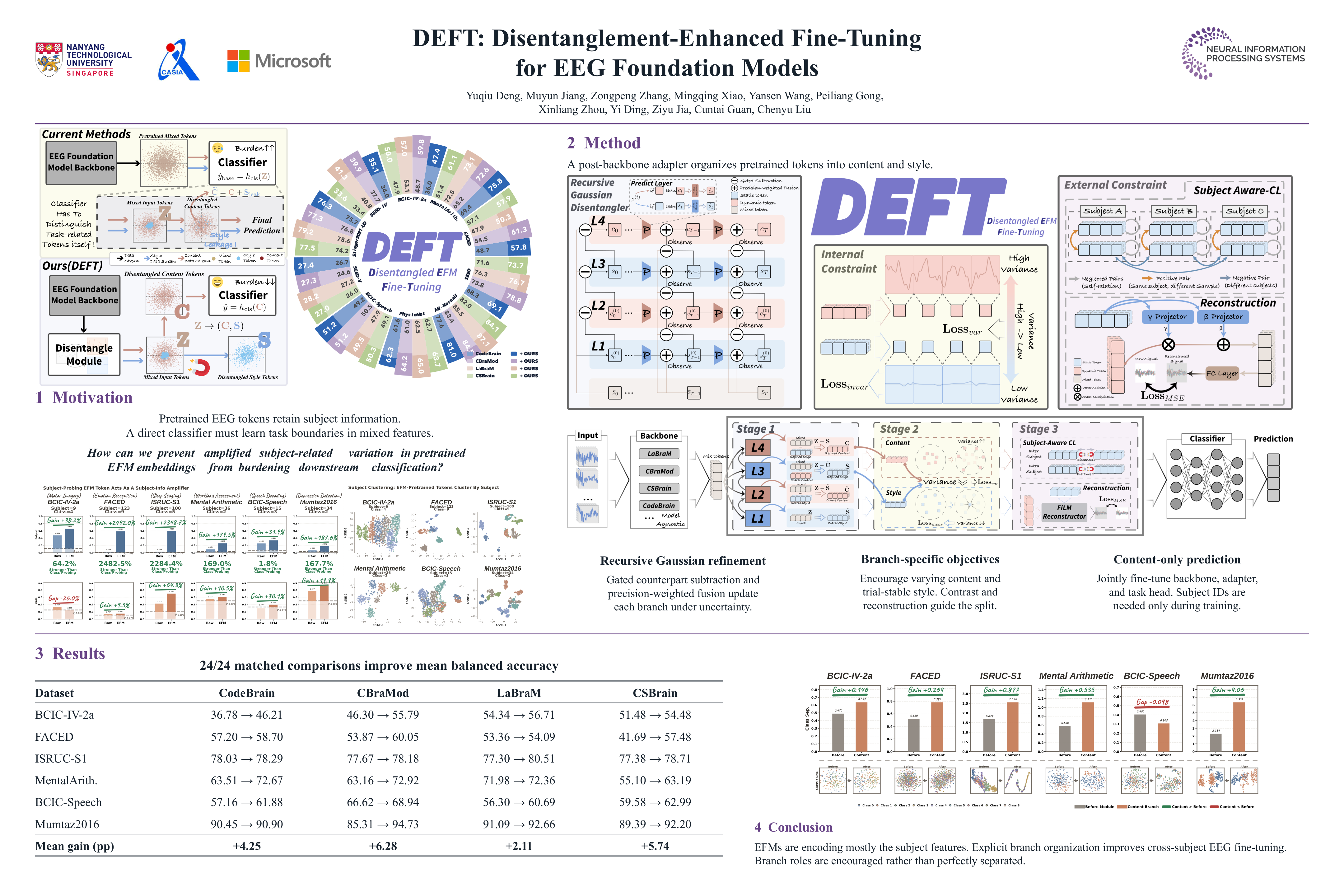
EEG foundation models (EFMs) have improved EEG representation learning by transferring knowledge from large-scale multi-subject pretraining to downstream tasks. However, their pretrained embeddings often retain substantial subject-related variation, placing an additional burden on the downstream classifier, especially in cross-subject settings. To address this issue, we propose DISENTANGLED EFM FINE-TUNING (DEFT), a plug-and-play adapter for EFM fine-tuning. DEFT encourages branch disentanglement of pretrained tokens into task-oriented content and subject-consistent style, then performs downstream prediction from the content branch. It instantiates this factorize-before-classify design with recursive Gaussian refinement, temporal-variance regularization, subject-aware contrastive learning, and reconstruction. Experiments across multiple EEG datasets and four EFM backbones show that DEFT improves matched fine-tuning baselines. Further ablations and analyses support the intended content/style branch organization.
DeltaPrompts: Escaping the Zero-Delta Trap in Multimodal Distillation
Jaehun Jung ⋅ Hyunwoo Kim ⋅ Brandon Cui ⋅ Ximing Lu ⋅ David Acuna ⋅ Prithviraj Ammanabrolu ⋅ Yejin Choi
Distillation enables compact Vision-Language Models (VLMs) to obtain strong reasoning capabilities, yet the prompts driving this process are typically chosen via simple heuristics or aggregated from off-the-shelf datasets. We reveal a critical inefficiency in this approach: up to 69\% of the prompts in standard chart / document reasoning datasets are effectively $\textit{zero-delta}$, meaning the teacher and student already induce the exact same answer distribution. Training on these prompts provides minimal learning signal, causing student improvement to rapidly saturate regardless of data scale. To escape the zero-delta trap, we return to first principles: distillation fundamentally minimizes distributional divergence, and thus a prompt is valuable only if it exposes a functional capability gap between the teacher and student. We quantify this gap through $\textit{answer divergence}$ ($\Delta$), demonstrating that non-zero divergence is critical for effective scaling. Building on this insight, we propose a staged synthesis pipeline that repurposes existing datasets as seeds, actively targeting student failure modes to produce better prompts. The result is $\textbf{DeltaPrompts}$, a diverse dataset of 200k synthetic, high-divergence reasoning problems. We evaluate $\text{DeltaPrompts}$ across three distinct settings: on-policy distillation with the target teacher-student pair, transfer to a novel model family without regenerating the data, and off-policy fine-tuning of a non-reasoning model. Across all scenarios, $\text{DeltaPrompts}$ drives substantial gains, yielding up to 15\% relative improvement even on top of a highly-optimized reasoning model ($\textit{e.g.,}$ Qwen3-VL-8B-Thinking)---averaged over 10 benchmarks spanning chart, document and perception-centric reasoning.
Denoising Time Matters: Diverse Generation in Diffusion Language Models
jingxuan wu ⋅ Zhenglin Wan ⋅ Yuzhe YANG ⋅ Yiqiao Huang ⋅ Chubin Zhang ⋅ Xingrui Yu ⋅ Ivor Tsang ⋅ Yang You
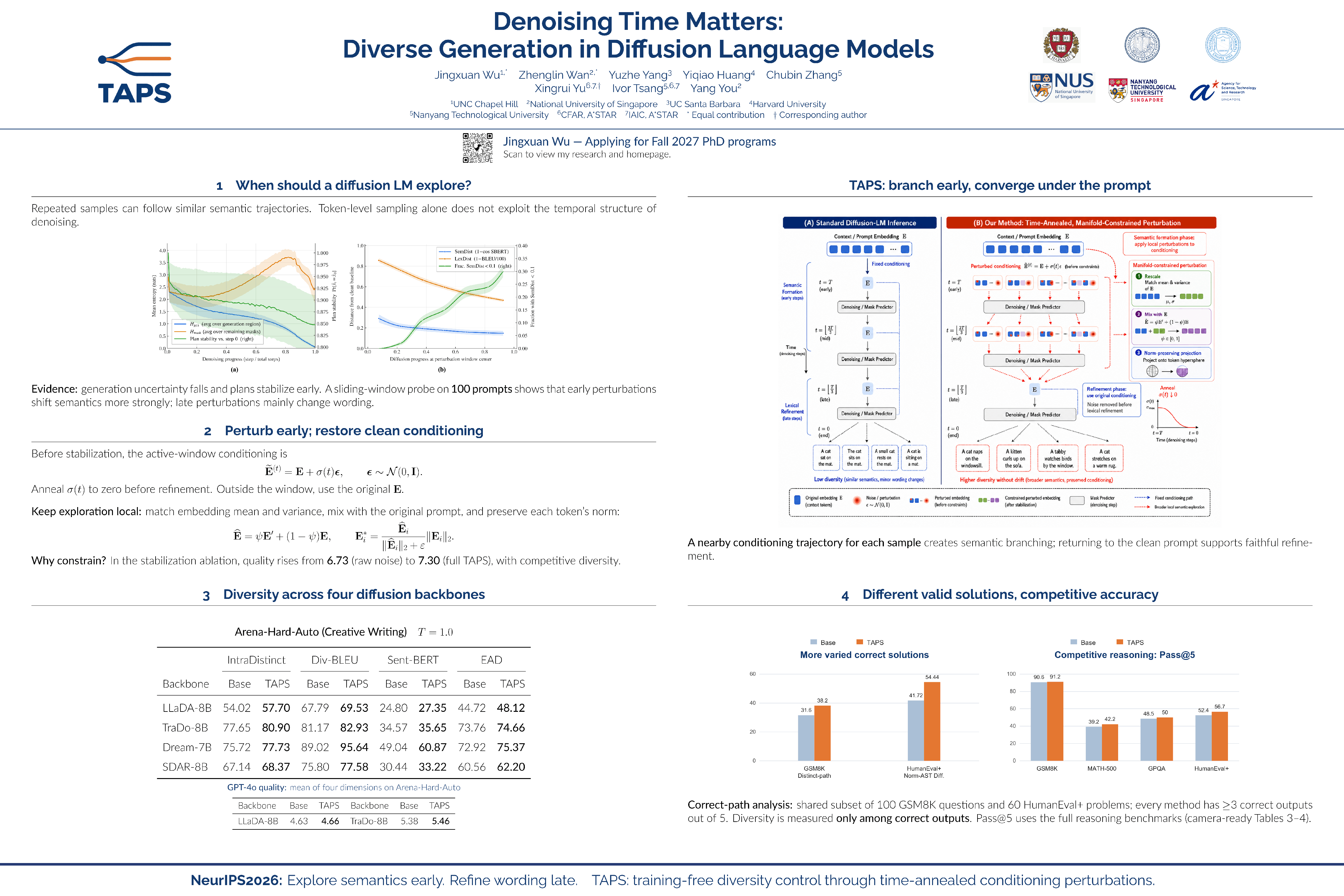
Diffusion language models (Diffusion-LMs) generate text through iterative denoising, exposing a temporal structure that is largely absent from autoregressive decoding. In this paper, we show that this temporal structure provides a useful control axis for generation diversity: early denoising steps mainly determine high-level semantic trajectories, while later steps refine lexical realization. Motivated by this observation, we propose Time-Annealed Perturbation Sampling (TAPS), a training-free inference strategy that samples nearby conditioning trajectories through time-aware, manifold-constrained perturbations. TAPS encourages semantic branching during early denoising and anneals the perturbation away before refinement, improving exploration while preserving prompt alignment, generation quality, and reasoning ability. Experiments on multiple Diffusion-LM backbones, including non-autoregressive and semi-autoregressive models, show that TAPS consistently improves semantic and lexical diversity across open-ended and instruction-following generation tasks, while preserving reasoning ability on verifiable reasoning benchmarks with negligible overhead.
Diagnosing and Repairing Citation Failures in Generative Engine Optimization
Zhihua Tian ⋅ Yuhan Chen ⋅ Yao Tang ⋅ Jian Liu ⋅ Ruoxi Jia
Generative Engine Optimization (GEO) aims to improve content visibility in AI-generated responses. However, existing methods measure contribution—how much a document influences a response—rather than citation, the mechanism that actually drives traffic back to creators. Also, these methods apply generic rewriting rules uniformly, failing to diagnose why individual document are not cited. This paper introduces a diagnostic approach to GEO that asks why a document fails to be cited and intervenes accordingly. We develop a unified framework comprising: (1) the first taxonomy of citation failure modes spanning different stages of a citation pipeline; (2) AgentGEO, an agentic system that diagnoses failures using this taxonomy, selects targeted repairs from a corresponding tool library, and iterates until citation is achieved; and (3) a document-centric benchmark evaluating whether optimizations generalize across held-out queries. AgentGEO achieves 15-40\% relative improvement in citation rates across engines and citation methods, while modifying only 5\% of content, compared to 25\% for baselines. Our analysis reveals that generic optimization can harm long-tail content and some documents face challenges that optimization alone cannot fully address—findings with implications for equitable visibility in AI-mediated information access.
DiffeoMorph: Learning to Morph 3D Shapes Using Differentiable Agent-Based Simulations
Seong Ho Pahng ⋅ Guoye Guan ⋅ Benjamin Fefferman ⋅ Sahand Hormoz
Biological systems can form complex three-dimensional structures through the collective behavior of agents that share a common update rule and operate without central control. How such distributed control gives rise to precise global patterns remains a central question not only in developmental biology but also in distributed robotics, programmable matter, and multi-agent learning. Here, we introduce DiffeoMorph, an end-to-end differentiable framework for learning a morphogenesis protocol that guides a population of agents to morph into a target 3D shape. Each agent updates its position and internal state using an SE(3)-equivariant graph neural network, based on its own internal state and signals received from other agents. To train this system, we introduce a new shape-matching loss based on 3D Zernike polynomials, which compares the predicted and target shapes as continuous spatial distributions, not as discrete point clouds, and is invariant to agent ordering, number of agents, and global orientation. To achieve rotation invariance while preserving reflection sensitivity, we include an alignment step that optimally rotates the predicted Zernike spectrum to match the target before computing the loss. We perform benchmarking to establish the advantages of our shape-matching loss over other standard distance metrics for shape comparison tasks. We then demonstrate that DiffeoMorph can form a range of complex shapes from minimally patterned initial conditions. DiffeoMorph provides a general framework for learning distributed control strategies for morphogenesis, swarm robotics, and programmable self-assembly.
Differentiable Systematic Resampling for Variational Sequential Monte Carlo
Fredrik Cumlin ⋅ Saikat Chatterjee
Particle filters are a standard tool for nonlinear state estimation, but their resampling step is discrete, preventing gradient-based learning in variational sequential Monte Carlo. We introduce Differentiable Systematic Resampling (DSR), a temperature-controlled relaxation of systematic resampling, that preserves the low-variance structure of systematic resampling while enabling full gradient flow. DSR converges to exact systematic resampling as the temperature vanishes, and we prove exponential convergence rates for the induced bias. Compared to optimal-transport-based differentiable resampling, DSR avoids iterative solvers and has substantially lower computational overhead. Experiments on stochastic dynamical systems and real-world handwriting data show that DSR achieves comparable or superior filtering and dynamics learning performance.
Diff-Instruct with Diffused Reward: Towards Principled One-step Generator RL
Junyi Wu ⋅ Weijian Luo ⋅ Haoyang Zheng ⋅ Ruizhe Zhang ⋅ Guang Lin
Recent advances in one-step text-to-image generation have enabled real-time synthesis with remarkable efficiency and quality. Previous reinforcement learning methods for one-step generators combines the image space reward optimization and the diffusion noisy space distribution matching. This paradigm brings challenges due to a mismatch between terminal reward optimization and the underlying generative dynamics. As a result, optimization tends to exploit stochastic degrees of freedom, often improving reward at the expense of image fidelity. To address this issue, we propose \textbf{Diff-Instruct with Diffused Reward} (\textsc{Didr}), a data-free trajectory-level alignment framework derived from Integral KL minimization. \textsc{Didr} propagates the RLHF-optimal reward-tilted clean-image distribution across all noise levels along the diffusion trajectory. We show that this objective admits the same minimizer as clean-image RLHF, while naturally inducing \textbf{the Diffused Reward Score} (DRS), which acts as a reward-driven correction to the reference score function. To make this practical, we further introduce \textbf{the Diffused Reward Proxy} (DRP), an efficient estimator of DRS based on differentiable short-step denoising. Extensive experiments demonstrate that \textsc{Didr} consistently Pareto-dominates existing one-step SDXL baselines. Moreover, when transferred to a 6B DiT backbone (\textsc{Z-Image}), \textsc{Didr} surpasses its 50-step teacher in preference alignment while requiring only a single generation step.
Diffusion Model's Generalization Can Be Characterized by Inductive Biases toward a Data-Dependent Ridge Manifold
Ye He ⋅ Yitong Qiu ⋅ Molei Tao
We study a data-dependent notion of diffusion-model generalization: when a model does not memorize the training set, where do its generated samples go relative to the geometry induced by the data? To answer this, we introduce a time-dependent family of log-density ridge manifolds constructed from the smoothed empirical distribution, and use it to characterize reverse-time inference. Our main result shows that generated samples evolve by a reach-align-slide mechanism: they first enter a neighborhood of the ridge, then their distance to the ridge is controlled by the normal component of training error, and finally their motion along the ridge is controlled by the tangential component. We further connect this geometric picture to training dynamics through directional decompositions of the learned error, and make this link explicit for random feature models, where architectural bias and optimization error can be separated quantitatively. Experiments on synthetic multimodal data and MNIST latent diffusion support the predicted geometric behavior in both low and high dimensions.
DiRotQ: Rotation-Aware Quantization for 4-bit Diffusion Transformers
Sayeh Sharify ⋅ Mahsa Salmani ⋅ Hesham Mostafa
Diffusion Transformers (DiTs) achieve state-of-the-art image generation quality but incur substantial memory and computational costs at inference. While aggressive Post-Training Quantization (PTQ) to 4-bit precision offers significant efficiency gains, it typically results in severe quality degradation. Existing approaches, including smoothing-based methods, mixed-precision schemes, rotation techniques, and low-rank residual methods, partially mitigate this issue but still leave a noticeable gap to FP16/BF16 performance. In this work, we introduce *DiRotQ*, a W4A4 PTQ framework that mitigates this degradation through rotation-aware activation quantization. DiRotQ identifies a low-rank subspace capturing dominant activation variance via Principal Component Analysis (PCA), preserving coefficients in this subspace at higher precision while quantizing the remaining components to 4-bit. Activations are rotated into the PCA basis at inference time using calibration-derived orthogonal transformations, while the inverse rotation is fused into the layer weights offline. Combined with GPTQ-based weight quantization, DiRotQ achieves an FID $(\downarrow)$ of $15.9$ and PSNR $(\uparrow)$ of $19.1$ dB on PixArt-$\Sigma$ over the MJHQ-30K dataset, outperforming the prior state-of-the-art SVDQuant (FID $18.9$, PSNR $17.6$) under the same INT W4A4 setting. Beyond standard metrics, we introduce a *VLM-as-a-Judge* evaluation protocol for diffusion model quantization, the first such evaluation in this setting, providing a more holistic assessment of perceptual quality and prompt alignment under aggressive compression. On the systems side, we implement a *Triton-based custom kernel* to enable efficient end-to-end inference, reducing memory usage of the 12B FLUX.1-dev model by $2.1\times$ and delivering $2.3\times$ speedup over the BF16 baseline, on a 24GB RTX 4090 GPU. Our anonymous codebase is available [here](https://anonymous.4open.science/r/DiRotQ-5BF6/).
DistDebug-Bench: Can LLM Agents Diagnose Bugs in Distributed Systems?
Yuxuan Jiang ⋅ Chenglin Liu ⋅ John Rose ⋅ Mason Miller ⋅ Ruthesh Thavamani ⋅ Juntao Wu ⋅ Yinwei Huang ⋅ Jiahao Xu ⋅ Peng Huang
LLM agents show strong potential in software engineering tasks such as competitive programming and code synthesis. Existing benchmarks, however, largely focus on small-scale settings such as self-contained Python modules, leaving distributed systems, an essential class of production software, under-examined. We introduce DistDebug-Bench, a benchmark for evaluating agents’ ability to diagnose complex-system failures at the code level. It curates 120 high-quality real-world bugs from 11 widely used distributed systems, spanning 5 programming languages and 10 failure patterns. Through an extensive evaluation of state-of-the-art LLMs and agents, we identify substantial gaps between current agents and real-world debugging tasks. A recurring gap is tunnel vision due to a lack of explicit reasoning structure and nondeterminism from inconsistent tool-use scope.
Large Language Models (LLMs) tend to respond correctly to prompts that align well with the data they were trained and fine-tuned on. Yet, small shifts in wording, format, or language can trigger surprisingly large failures, especially on multi-step reasoning problems. To address this problem, we propose a $\textbf{Distributionally Robust Token Optimization (DRTO)}$ approach, which combines token-level Reinforcement Learning from Human Feedback (RLHF) with $\textit{Distributionally Robust Optimization (DRO)}$. DRTO constructs f-divergence ambiguity sets over span-level actor losses, providing a principled way to emphasize difficult response segments during policy optimization. Empirically, DRTO enhances consistency under distribution shifts in multiple reasoning benchmarks among different tasks.
Does Sparse Connectivity Improve Generalization? Convolutional Networks Below the Edge of Stability
Tongtong Liang ⋅ Esha Singh ⋅ Rahul Parhi ⋅ Alex Cloninger ⋅ Yu-Xiang Wang
Gradient descent on overparameterized neural networks typically operates at the Edge of Stability (EoS), where the largest Hessian eigenvalue hovers around a step-size-dependent threshold. We study how sparse connectivity changes generalization below this threshold in two layer ReLU networks. Prior results have shown that for fully-connected networks (FCNs), generalization guarantees in this regime degrade and become vacuous on high-dimensional spherical inputs. Our analysis reveals that sparse connectivity fundamentally alters this picture. Under sparse connectivity, the network processes a collection of low-dimensional patches rather than the full input vector, so the effective constraint imposed by the stability condition is governed by the geometry of the training patch collection. We prove that when the receptive fields are small relative to the ambient dimension, the effective constraint yields non-vacuous generalization bounds in precisely the spherical regime where FCNs provably fail. The same framework also reveals a contrasting failure mode: if the patch collection lacks geometric structure, the constraint becomes unable to prevent overfitting. We corroborate this theory by analyzing the patch geometry of natural images, showing that standard convolutional designs produce patch multiset with low-dimensional structure that facilitates generalization. This provides a principled explanation for the generalization advantage of convolutional networks. Thus, our analysis yields a unified framework that identifies how architecture, data geometry, and gradient descent jointly govern generalization performance.
Do Graph Neural Networks Learn Generalizable Algorithms for Clustering Graphs?
Mitchell Black ⋅ Sanjoy Dasgupta ⋅ Yusu Wang
We study the ability of graph neural networks (GNNs) to learn generalizable algorithms for graph clustering. While previous work has shown that GNNs can learn to cluster graphs in-distribution, it is unclear exactly what algorithms these networks are learning, or whether they generalize to unseen graphs that differ significantly from their training data. In this paper, we pick a standard cut-based clustering cost function and train GNNs of various types to minimize this function on a suite of training examples. We then test whether the resulting networks are able to generalize to much larger graphs, or other families of graphs. We complement our empirical findings with a host of theoretical results that illustrate the range of possible heuristics that these different GNNs could be implementing. Finally, we use probes on trained networks to narrow down the heuristics actually being learned. Our findings show that there is generalization across the board but that GNNs of different expressivity---MPNNs versus PPGNs, for instance---learn markedly different algorithms.
Do Pathology Foundation Models Encode Disease Progression? A Pseudotime Analysis of Visual Representations
Pritika Vig ⋅ Renchin Wu ⋅ William Lotter
Vision foundation models trained on discretely sampled images achieve strong performance on classification benchmarks, yet whether their representations encode the continuous processes underlying their training data remains unclear. This question is especially pertinent in computational pathology, where we posit that models whose latent representations implicitly capture continuous disease progression may better reflect underlying biology, support more robust generalization, and enable quantitative analyses of features associated with disease transitions. Using diffusion pseudotime, a method developed to infer developmental trajectories from single-cell transcriptomics, we probe whether foundation models organize disease states along coherent progression directions in representation space. Across four cancer progressions and six models, we find that all pathology-specific models recover trajectory orderings significantly exceeding null baselines, with vision-only models achieving the highest fidelities ($\tau > 0.78$ on CRC-Serrated). Model rankings by trajectory fidelity on reference diseases strongly predict few-shot classification performance on held-out diseases ($\rho = 0.92$), and exploratory analysis shows cell-type composition varies smoothly along inferred trajectories in patterns consistent with known stromal remodeling. Together, these results demonstrate that vision foundation models can implicitly learn to represent continuous processes from independent static observations, and that trajectory fidelity provides a complementary measure of representation quality beyond downstream performance. While demonstrated in pathology, this framework could be applied to other domains where continuous processes are observed through static snapshots.
DORA: A Scalable Asynchronous Reinforcement Learning System for Language Model Training
Tianhao Hu ⋅ Xiangcheng Liu ⋅ Yuchun Miao ⋅ Youshao Xiao ⋅ Hong Yu Zang ⋅ Yang Zheng ⋅ huang xuan ⋅ Jinrui Ding ⋅ Yufei Zhang ⋅ Yu Yang ⋅ Yi-Kai Zhang ⋅ Yueqing Sun ⋅ Chengcheng Han ⋅ Xiandi Ma ⋅ Wei Wang ⋅ Qi GU ⋅ Yerui Sun ⋅ Yuchen Xie ⋅ Xunliang Cai
Asynchronous reinforcement learning (RL) has become a critical paradigm for accelerating large-scale LLM post-training in industrial settings, yet it faces a structural \emph{long-tail dilemma}: rollout efficiency is bottlenecked by a small number of the longest trajectories, which are precisely the most valuable ones for RL training. Existing approaches alleviate this dilemma at the cost of either system overhead (e.g., re-prefill in partial-rollout methods) or algorithmic compromises (e.g., discarded long trajectories in replication-based methods). We trace these tradeoffs to a common assumption: the rollout cluster serves a single policy version at any moment. We propose \textbf{DORA} (\textbf{D}ynamic \textbf{OR}chestration for \textbf{A}synchronous Rollout), which breaks this assumption by maintaining multiple policy versions concurrently within the rollout cluster. DORA combines three mechanisms: \emph{multi-version streaming training} that decouples trajectory completion from batch boundaries, a centralized \emph{load-balancing orchestrator} that re-partitions resources across versions, and \emph{zero-re-prefill migration} that transfers KV-Cache directly across same-version instances. Experiments on open-source benchmarks show that DORA achieves up to $2.12\times$ end-to-end throughput improvement and $8.2\times$ rollout-stage acceleration over synchronous training while preserving convergence parity. \textbf{In real-world production deployment} with thousands of accelerators, DORA achieves up to $6.2\times$ rollout speedup and produces competitive open-source LLMs.
Do Semantic Distance Tests Actually Predict Creativity in Large Language Models?
Samuel Schapiro ⋅ Alexi Gladstone ⋅ Jonah Black ⋅ Heng Ji
Automated semantic distance tests—which prompt a model to produce a set of words, and score the average embedding distance between them—are increasingly used to measure the "creativity" of large language models (LLMs). However, the validity of semantic distance tests as predictors of machine creativity has not yet been established, and these tests already have limited validity as predictors of human creativity. To address this problem, we conduct the first systematic study evaluating the effectiveness of semantic distance tests in predicting the creative achievement of LLMs across three constructs: creative writing, divergent thinking, and scientific ideation. We score each test on two criteria (validity and specificity), and derive a theoretical limit for the maximum attainable specificity and validity a test can achieve. We find that: (1) Test effectiveness varies significantly by construct, and no single test predicts all constructs well. (2) None of the tests is a good predictor of scientific ideation ability. (3) Existing tests are far below the theoretical limits, indicating meaningful room for the design of improved tests moving forward. Our findings provide clear practical takeaways and directions for future work and suggest that novel tests are needed to reliably predict scientific ideation ability.
DriveMind: Mind-Evolving Belief Tracking for Closed-Loop Autonomous Driving
Yan Shi ⋅ Kehua Chen ⋅ Jiarui Qi ⋅ Yihong Tang ⋅ Yinhai Wang ⋅ Liao Haicheng
Recent multimodal large language models (MLLMs) can perceive a traffic scene, reason about it, and propose a driving action within a single model. However, existing MLLM-based drivers reason from scratch at each frame and commit to a single explanation, discarding earlier hypotheses about the scene. When the scene is ambiguous, the agent locks in on the wrong interpretation and acts on it before evidence accumulates. We propose DriveMind, an MLLM-based driving framework that keeps several hypotheses about the scene alive at the same time and updates their weights as new frames arrive. Inspired by particle filtering, DriveMind propagates each hypothesis through a VLM, scores it against the current observation, and resamples to maintain diversity. On Bench2Drive, DriveMind raises the Driving Score (DS) from 71.36 to 81.37 and the Success Rate (SR) from 45.45% to 54.09%, with the largest gains on ambiguous scenarios such as unsignalized intersections (+20.10 DS) and oncoming-traffic interactions (+20.50 DS). Beyond the overall metrics, DriveMind also improves fine-grained interactive driving abilities such as merging, emergency braking, and give-way. The code will be released soon.
DSAD: Dynamic Soft Anisotropic Diagrams for Reduced-Order Video Representation
Zhiyang Dou ⋅ Laki Iinbor ⋅ Wojciech Matusik
Efficient video representations should do more than predict pixels: for a long video to be trainable, decodable, and budgeted, appearance and motion must be assigned to explicit units. Group-of-Pictures (GoP) primitive representations provide such units by fitting short blocks with canonical local elements, but their deformation is often still predicted by a neural head. Conversely, implicit neural representations achieve compact global fits without exposing local units that can be moved, ranked, or pruned. We observe that a short GoP contains many primitives but only a few independent motion patterns, suggesting that the same local ownership system used for appearance should also define the motion basis. We introduce Dynamic Soft Anisotropic Diagrams (DSAD), an explicit representation built from three layers over a shared soft-distance geometry. First, a Soft Anisotropic Diagram (SAD), defined as a top-$K$-masked softmax over anisotropic-Apollonius sites, provides a canonical coordinate family in which dense sites encode local RGB ownership. Second, a coarser anchor set reuses the SAD geometry so that anchor weights form a partition-of-unity motion basis without an additional neural module. Third, a reduced-order model (ROM) factorizes deformation into this spatial motion basis and knot-based temporal coefficients. This construction unifies appearance and motion within a single diagram while decoupling spatial ownership from temporal dynamics. On Bunny, UVG, and DAVIS, DSAD attains the highest PSNR among primitive representations and competitive performance among all compared methods, while using a leaner per-GoP deformation module and fewer fine-stage training iterations than state-of-the-art baselines. Ablations show that the gain is a matched-budget trade-off: a compact anchor-ROM motion head reallocates parameters to anchored appearance. RAFT spectra further suggest that the largest gains occur when GoP motion is close to low-rank. Code and models will be released.
Dual-Granularity Learning for Regression with Continuous Noisy Labels
Hui GUO ⋅ Boyu Wang ⋅ Grace Yi
Learning with noisy labels has been extensively studied for classification, yet its regression counterpart remains relatively underexplored. Unlike classification, regression involves continuous-valued targets where label noise exhibits heterogeneous magnitudes across instances, which poses conflicting requirements on the model: correcting small-to-moderate deviations requires sensitivity to label values for instance-level refinement, whereas large deviations caused by corrupted or outlying annotations render exact label values unreliable, necessitating reduced reliance on exact labels and instead leveraging ordinal structure among samples. These requirements call for methods that capture both global structure and sample-specific deviations in a unified manner. To this end, we propose GRAIN, a dual-granularity framework for robust noisy regression. At the fine-grained level, we derive an explicit residual learning mechanism from a robust loss formulation, introducing instance-specific auxiliary variables to decouple label noise from predictive signals. At the coarse-grained level, we introduce a binning-based contrastive regularization that enforces an order-preserving feature structure aligned with label proximity, addressing noise beyond the capacity of local residual refinement. The two levels are coupled via a histogram-based bridging mechanism that enables bidirectional information flow: coarse-grained structural guidance establishes a well-ordered feature space that anchors residual learning, while fine-grained residual refinement corrects instance-level deviations that structural regularization alone cannot resolve. Experimental results show that GRAIN consistently improves robustness and generalization under diverse noise conditions.
Dynamic Expert Sharing: Decoupling Memory from Parallelism in Mixture-of-Experts Diffusion LLMs
Hao Chen ⋅ Zhiwen Mo ⋅ Royson Lee ⋅ Qianzhou Wang ⋅ Da Li ⋅ Shell Xu Hu ⋅ Wayne Luk ⋅ Timothy Hospedales ⋅ Hongxiang Fan
Among parallel decoding paradigms, diffusion large language models (dLLMs) have emerged as a promising candidate that balances generation quality and throughput. However, their integration with Mixture-of-Experts (MoE) architectures is constrained by an expert explosion: as the number of tokens generated in parallel increases, the number of distinct experts activated grows nearly linearly. This results in substantial memory traffic that pushes inference into a memory-bound regime, negating the efficiency gains of both MoE and parallel decoding. To address this challenge, we propose Dynamic Expert Sharing (DES), a novel technique that shifts MoE optimization from token-centric pruning and conventional expert skipping methods to sequence-level coreset selection. To maximize expert reuse, DES identifies a compact, high-utility set of experts to satisfy the requirements of an entire parallel decoding block. Extensive experiments on MoE dLLMs demonstrate that DES reduces unique expert activations by over 55% and latency by up to 38%, while retaining 99% of vanilla accuracy, effectively decoupling memory overhead from the degree of parallelism.
Dynamic Quadtree Tokenization for Autoregressive PDE Forecasting
Yilin Zhuang ⋅ Noah Zambrano ⋅ Karthikeyan Duraisamy
The quadratic attention cost of Vision Transformers (ViTs) forces a sharp compromise between discretization and rollout horizon, and binds tightest in the fine-scale PDE regime where shocks, reaction fronts, and material interfaces occupy a small, time-varying fraction of the domain. Further, conventional neural surrogates do not adapt to localized features dynamically. We propose WAMRViT, a ViT that tokenizes its input as a balanced quadtree under a wavelet-inspired refinement criterion, encodes position and refinement level jointly via a 3D rotary positional embedding with a soft level axis, and regrids in cell space at inference to remain stable over long rollouts. A multi-scale variant additionally keeps each leaf at its native source resolution and defers the per-level resolution differential to the model. Unlike prior adaptive-tokenization work, the tokenizer imposes no a priori token count; we evaluate under fully adaptive topology over long autoregressive rollouts; and WAMRViT is the first machine-learning surrogate to natively tokenize multi-level Adaptive Mesh Refinement (AMR) data. We demonstrate that on uniform-grid datasets, WAMRViT exceeds a finest-patch uniform backbone on the region of interest while using a fraction of the tokens, with a structural interpolation cost on the global metric that the multi-scale variant closes at the initial rollout steps. On a complex AMR combustion problem whose extremely fine scale features uniform-grid baselines cannot represent natively and must project onto a coarser grid, WAMRViT operates directly on the adaptive cells and substantially reduces finest-level error at matched parameters. Code: https://anonymous.4open.science/r/wamrvit-review-74E1
Dynamic Tokenization via Reinforcement Patching: End-to-end Training and Zero-shot Transfer
Yulun Wu ⋅ Sravan Kumar Ankireddy ⋅ Samuel Sharpe ⋅ Nikita Seleznev ⋅ Dehao Yuan ⋅ Hyeji Kim ⋅ Nam Nguyen
Efficiently aggregating spatial or temporal horizons to acquire compact representations has become a unifying principle in modern deep learning models, yet learning data-adaptive representations for long-horizon sequence data, especially continuous sequences like time series, remains an open challenge. While fixed-size patching has improved scalability and performance, discovering variable-sized, data-driven patches end-to-end often forces models to rely on soft discretization, specific backbones, or heuristic rules. In this work, we propose Reinforcement Patching (ReinPatch), a novel framework that jointly optimizes a sequence patching policy and its downstream sequence backbone model with reinforcement learning. By formulating patch boundary placement as a discrete decision process optimized via Group Relative Policy Gradient (GRPG), ReinPatch bypasses the need for continuous relaxations and performs dynamic patching policy optimization in a natural manner. Moreover, our method allows strict enforcement of a desired compression rate, freeing the downstream backbone to scale efficiently, and natively supports multi-level hierarchical modeling. We evaluate ReinPatch on time-series forecasting datasets, where it demonstrates compelling performance compared to state-of-the-art data-driven patching strategies. Furthermore, our detached design allows the patching module to be extracted as a standalone foundation patcher, providing the community with visual and empirical insights into the segmentation behaviors preferred by a purely performance-driven neural patching strategy.
Early Prediction of Future Behavioral Strategy from Process Traces
Robert Kasumba ⋅ Dennis Barbour ⋅ Chien-Ju Ho
Adaptive systems often need to make task-specific decisions about a person from limited prior evidence: a tutor may need to anticipate how a learner will approach a new problem, a game may need to adapt when a player enters a new level, and a human-AI system may need to infer whether a partner will persist with a plan or switch goals. These decisions depend on person-level behavioral tendencies that shape how people solve related tasks, but such tendencies are difficult to infer from standard behavioral evidence. One approach is to use aggregate outcome summaries, such as scores, completion rates, or productivity measures; these summaries are compact and available across tasks, but can collapse distinct behavioral processes into similar outcomes. Another approach is to use process-level traces, which record how behavior unfolds over time; however, process modeling within a single task can entangle stable person-level tendencies with task-specific layout, timing, and affordances. In this work, we study early cross-task behavioral inference: whether partial process traces from multiple source tasks can reveal transferable person-level behavioral structure that predicts strategy in a held-out target task. We introduce Process-Level Latent Variable Models (PLVM), which encode task-specific traces and fuse them into a shared person-level latent representation for cross-task prediction. In PowerWash Simulator, a naturalistic telemetry dataset of real human gameplay, PLVM uses partial traces from two earlier cleaning tasks to predict whether a player will exhibit locally persistent Zone Planner behavior or frequent Zone Hopper behavior in the held-out Fire Station level. Controlled simulations with known latent behavioral types show that cross-task fusion helps when different source tasks reveal complementary dimensions of a shared latent behavioral process. These results suggest that process-level cross-task modeling can support early prediction of target-task behavioral strategy when waiting to observe sufficient target-task behavior is impractical.
EgoMo3R: Joint Egocentric Motion and Scene Reconstruction
Chaitanya Patel ⋅ Yusuke Kato ⋅ Rin Takahira ⋅ Kazuki Kozuka ⋅ Juan Carlos Niebles ⋅ Ehsan Adeli
Understanding holistic 3D human motion and the surrounding environment from egocentric video is fundamental for applications in AR/VR and robotics. Although these tasks are inherently coupled, existing methods treat them separately. In particular, egocentric motion reconstruction methods typically assume access to metric, gravity-aligned camera trajectories from specialized inertial sensors. Recovering such trajectories from monocular egocentric video remains a significant challenge due to rapid head movements and motion blur. We present EgoMo3R, a joint optimization framework that simultaneously reconstructs 3D human motion and scene geometry from casual egocentric video. To bridge the egocentric domain gap that often hinders end-to-end models, our approach leverages the robustness of low-level visuo-geometric primitives, including monocular depth, optical flow, and point tracks, integrated with a diffusion-based human motion prior via first-order optimization. We propose an alternating optimization scheme that establishes a synergistic feedback loop: scene reconstruction provides physical grounding and trajectory conditioning for the motion prior, while the motion prior regularizes the camera trajectory and anchors the scene in a metric, gravity-aligned world frame. We evaluate EgoMo3R on the highly dynamic sequences of the EgoExo4D and Nymeria datasets and show that it outperforms specialized baselines in both 3D scene reconstruction and egocentric motion estimation.
Elastic Spectral State Space Models for Train-Once Budgeted Inference
Dachuan Song ⋅ Junyu Yin ⋅ Zechen Hu ⋅ Xuan Wang
Modern sequence models are typically trained at a fixed computational capacity, while real-world applications require deployment across platforms with different resource constraints. Existing approaches either train or distill separate compact models for selected budgets, or use elastic architectures that shrink dimensions such as width, depth, Feed-Forward Network (FFN) size, or SSM state dimension. In this paper, we propose Elastic Spectral State Space Models (ES-SSM), a train-once, export-many sequence modeling framework that gains elasticity through spectral approximation of the SSM sequence operator. ES-SSM builds on Hankel spectral filtering for state space models, where long-range token mixing is represented through fixed Hankel spectral channels that define an operator-level approximation resolution. To make this spectral elasticity reliably deployable, ES-SSM combines input-adaptive channel-wise gates with budget dropout, training the same spectral prefixes that are used by compact models at inference time. This encourages low-index channels to become predictive on their own, while higher-index channels provide refinements for larger budgets. We evaluate ES-SSM across byte-level language modeling, Long Range Arena, Speech Commands V2, and offline reinforcement learning benchmarks. Across these settings, a single trained ES-SSM can be truncated to competitive compact models compared with modern Transformer and SSM baselines at similar parameter scales. Furthermore, by testing under various runtime budgets, we observe smooth and stable quality-cost curves over a wide range of truncation levels.
Emergence, Retention and Mitigation of Ill-conditioning due to Basis Lifting in KANs
Ferhat Arslan ⋅ Weihong Guo ⋅ Shuo Li
Kolmogorov–Arnold Networks (KANs) expand each input coordinate through a fixed basis family, yet the optimization role of this basis lifting remains poorly understood. We identify basis lifting as a structural source of ill-conditioning in KANs and provide a mechanism-level analysis linking lifted feature geometry to convergence, accuracy, and seed sensitivity. Our analysis studies the evolution of lifted empirical Gram matrices under stochastic gradient descent (SGD) and shows that fixed basis lifting induces and preserves near-rank deficiency through eigenvalue and determinant drift. It further concentrates feature energy into a smaller number of directions, amplifying dominant eigenvalues and worsening condition numbers. These results show that basis selection is not merely an expressivity choice, but also an optimization and conditioning choice. Motivated by this mechanism, we introduce T-KAN, a learnable basis-coordinate transformation that aligns basis directions before the learned linear map. It reshapes lifted Gram geometries while preserving the expressivity and introducing negligible parameter overhead. In controlled small-to-moderate KAN regimes, T-KAN often improves conditioning and optimization with B-spline, Chebyshev, and RBF KANs.
Agentic large language models are increasingly used to solve real-world tasks by reasoning over goals, invoking tools, and interacting with external environments. Reinforcement learning provides a natural framework for improving these behaviors, and recent agent RL methods have achieved strong results across domains. However, the training dynamics of agent RL remain poorly understood, limiting our ability to diagnose instabilities and design more effective training algorithms. In this work, we identify a previously underexplored phenomenon in agent RL, which we term \emph{cyclical entropy eruption}. Unlike single-turn reasoning RL, where entropy typically collapses and stays low, agent RL training exhibits unique recurring cycles of sharp entropy eruption and gradual subsidence. We decompose this dynamic into three phases and provide theoretical and empirical analyses of each, explaining the mechanisms underlying its cyclical oscillation. We further show that degenerate patterns such as sentence duplication and hallucination, once acquired during eruption, can persist and accumulate across cycles. Motivated by these findings, we propose SEAL (Separation-Enhanced Agent Learning), a lightweight auxiliary loss that separates correct and incorrect trajectories in representation space, directly targeting the root cause of entropy eruption. Experiments across multiple benchmarks, models, and RL algorithms demonstrate that SEAL stabilizes training and yields stronger downstream agent performance.
Evaluating Compositional Generalization in Transformers: The Role of Composition Equivalence and Module Coverage
Purva Pruthi ⋅ Andrew Yuan ⋅ Alexander D'Amour ⋅ David Jensen
Compositional generalization is an important form of out-of-distribution generalization, defined as the ability to train on some combinations of modules (e.g., functions such as sort, filter) and then generalize to unseen combinations. Despite substantial empirical work evaluating compositional generalization in transformers, findings have been inconsistent because evaluations were often conducted on a limited set of train-test splits, defined in an ad hoc manner. Through a systematic evaluation, we identify two key aspects of the train-test distribution that strongly affect performance: composition equivalence and module coverage. We show that the apparent performance of direct models (trained only on final outputs) results primarily from exploiting composition equivalences—different sequences of modules that reduce to identical end-to-end functions. When benchmarks eliminate these equivalences, performance drops significantly, showing their inability to generalize to compositions of known modules that produce novel end-to-end functions. We further demonstrate that performance degrades monotonically as module coverage shifts increase—when modules appear in different contexts between train and test—affecting both direct and step-by-step models (trained on intermediate and final outputs). These findings have concrete implications for benchmark design: benchmarks that include compositional equivalences can lead to significant overestimation of the generalization abilities of direct models, and benchmarks that include both module coverage violations and compositional equivalences can exacerbate shortcut learning. We further demonstrate the effect of compositional equivalence on the generalization performance of the pre-trained model Llama3-8B on the code-output prediction task in the coding benchmark LiveCodeBench and discuss its real-world implications.
Event-Grounded Sparse Autoencoders for Vision-Language-Action Policies
Xinchen Jin ⋅ Aditya Chatterjee ⋅ Pranav Kumar ⋅ Rohan Paleja
Vision-Language-Action (VLA) policies translate language and visual inputs into robot actions, where their hidden representations directly shape closed-loop behavior. However, mechanistic interpretability tools from language and vision-language models do not transfer cleanly to VLAs: outputs are robot actions rather than human-readable tokens, and validating internal changes requires expensive closed-loop rollouts. We propose an event-grounded interpretability pipeline that anchors SAE feature analysis to behavioral events rather than text contexts. End-effector keyframes are clustered within each task using visual, state, and temporal cues, linking SAE features to behaviorally salient events and, via optional VLM annotations, to semantic context. To our knowledge, our pipeline is among the first to ground SAE-based VLA analysis in closed-loop behavioral events. Across two simulation architectures and a real-robot study, event-grounded ranking yields the strongest causal effects on OpenVLA and transfers to the continuous action chunks of $\pi_{0.5}$. SAE is a sparse but imperfect intervention basis: usability varies with architecture and intervention site, and aggressive intervention reveals safety and interpretability limits. Overall, event-grounded SAE analysis emerges as a practical starting point for behavior-anchored VLA interpretability, motivating future work on SAE features beyond action-aligned coordinates, finer-grained closed-loop evaluation, and safe interventions for high-stakes VLA deployments.
Knowledge Editing (KE) has emerged as a frontier for updating specific facts in LLMs without costly retraining, but its reliability and underlying mechanisms remain poorly understood. In this work, we examine KE from an adversarial elicitation perspective, revealing that edited knowledge is often not fully erased and continues to surface, with consistent failures observed across diverse model architectures. To explain this behavior, we conduct a mechanistic analysis of popular KE methods. We show that low-rank updates do not overwrite existing knowledge but instead redistribute it within the model's representation space. Furthermore, we find that these methods act as targeted suppression mechanisms that reduce the likelihood of expressing original facts, rather than removing them from the model. Analysis of the loss landscape reveals that edited knowledge lies in narrow, anisotropic regions that are highly sensitive to perturbations, making them highly vulnerable to indirect prompting and adversarial attacks. By exposing these profound architectural vulnerabilities, our work proves that KE algorithms are inherently bypassable and motivates a fundamental reevaluation of how we deploy post-hoc updates in several LLM applications.
Finite-Sample Performance of Gradient Descent in Logistic Regression with Gaussian Design
Junren Chen ⋅ Arya Mazumdar
We consider the parameter estimation problem in logistic regression with Gaussian design: the estimation of a fixed unknown parameter $\theta^* \in \mathbb{R}^d$ ($\lVert\theta^*\rVert_2\geq$ 1) from $n$ i.i.d. samples $\{(x_i,y_i)\}_{i=1}^n$, where $x_i\sim N(0,I_d)$ and $y_i\mid x_i \sim \mathrm{Bernoulli}$ (1/ (1+exp($-x_i^T$ $\theta^*~$ ))). Our main aim is to characterize the finite-sample estimation performance and convergence behavior of gradient descent (GD) on the maximum likelihood objective (i.e., the logistic loss). Under small $O(1)$ stepsize and $0$ initialization, it is shown that GD linearly converges to a small neighborhood of the true parameter and achieves $\ell_2$ error of order $O(\sqrt{\lVert \theta \rVert_2^5 d/n}).$ This substantially goes beyond existing theoretical results that lack non-asymptotic estimation error rate and exhibit much slower parameter convergence. We also establish a faster local linear convergence to the same statistical error under a large stepsize. The main technical component is to show that the gradient of the logistic loss satisfies a certain approximate invertibility condition (AIC). To that end, we bound the concentration term via covering and peeling arguments, and show that the bias term is a contraction by a delicate eigenvalue analysis of the population Hessian matrices. Finally, we build upon the recent work Matsumoto and Mazumdar (2025) and devise a novel efficient estimator that attains a sharper rate in high dimensions. This indicates that the existing non-asymptotic guarantees exhibit sub-optimal dependence on $\lVert\theta\rVert_2$, and that in many regimes $\Theta(\sqrt{\lVert\theta\rVert_2d/n})$ is the tight estimation error rate. Numerical examples are provided to corroborate our theoretical results for GD.
Firefly: Illuminating Verified Real-world Tool Call Data Generation
Yuxuan Lu ⋅ Ziyi Wang ⋅ Yingzhou Lu ⋅ Yisi Sang ⋅ Jiri Gesi ⋅ Xianfeng Tang ⋅ Yimeng Zhang ⋅ Zhenwei Dai ⋅ Hui Liu ⋅ Hanqing Lu ⋅ Chen Luo ⋅ Qi He ⋅ Benoit Dumoulin ⋅ Jing Huang ⋅ Dakuo Wang
Training robust tool-calling agents requires large-scale trajectory data that is both realistic and verifiable, yet existing datasets still rely heavily on costly human annotation or synthetic pipelines with weak correctness guarantees. In this work, we introduce \projectname, a large-scale synthetic and verifiable dataset for tool-calling agents built on real-world MCP servers. Unlike prior pipelines that first generate tasks and then attempt to solve them, \projectname inverts this process: a strong LLM first self-explores real MCP servers and records reachable execution states, after which natural-language tasks are synthesized backward from observed outcomes. This back-chaining design guarantees task reachability and label correctness by construction. To support scalable offline training and evaluation, we further construct a retrieval-augmented simulator from explored trajectories, enabling reproducible tool execution without relying on live MCP servers. Each instance includes a task description, tool schemas, ground-truth trajectories, ground-truth answers, and tool-call responses for offline replay, and is automatically checked for determinism and semantic consistency. \projectname aggregates thousands of verifiable tasks across diverse real-world MCP servers and supports scalable agent learning without human annotation. Experiments show that models trained on \projectname achieve significant improvements on tau2-Bench and BFCL, demonstrating the effectiveness of realistic, verifiable synthetic data for training generalizable tool-calling agents.
Variance reduction techniques improve the efficiency of drawing conclusions from data. Recent proposals that incorporate machine learning predictions into estimators based on weighted sampling use the Poisson Sampling (PS) algorithm, which independently flips a biased coin at each unit and includes all heads in the sample. A fundamental flaw with PS is that it has a random sample-size, which presents practical challenges and introduces variance into the estimator. We show that a fixed-size alternative, known in survey-sampling as Conditional Poisson Sampling (CPS), is a drop-in replacement for PS on general multivariate Z-estimation problems, which includes convex M-estimation considered in prior work. Notably, we show that the asymptotic variance of CPS is no worse than that of PS, and can be substantially better in realistic scenarios where predictions are imperfect. We illustrate these advantages on both synthetic and real datasets. In light of our contributions, there is no need to suffer a variable sample-size.
Conformal prediction provides a distribution-free framework for uncertainty quantification via prediction sets with exact finite-sample coverage. In low dimensions these sets are easy to interpret, but in high-dimensional or structured output spaces they are difficult to represent and use, which can limit their ability to integrate with downstream tasks such as sampling and probabilistic forecasting. We show that any sufficiently regular differentiable nonconformity score induces a deterministic flow on the output space whose trajectories converge to the boundary of the corresponding conformal prediction set. This leads to a computationally efficient, training-free method for sampling conformal boundaries in arbitrary dimensions. Mixing across confidence levels yields conformal predictive distributions whose quantile regions coincide with the empirical conformal prediction sets. We provide an approximation bound decomposing CPD predictive error into score-induced distortion, base-measure quality, and gradient flow-induced distortion. We evaluate the approach on PDE inverse problems, precipitation downscaling, climate model debiasing, and hurricane trajectory forecasting.
Flow Matching for Offline Reinforcement Learning with Discrete Actions
Fairoz Nower Khan ⋅ Nabuat Zaman Nahim ⋅ Ruiquan Huang ⋅ Haibo Yang ⋅ Peizhong Ju
Generative policies based on diffusion models and flow matching have shown strong promise for offline reinforcement learning (RL), but their applicability remains largely confined to continuous action spaces. To address a broader range of offline RL settings, we extend flow matching to a general framework that supports discrete action spaces with multiple objectives. Specifically, we replace continuous flows with continuous-time Markov chains, trained using a Q-weighted flow matching objective. We then extend our design to multi-agent settings, mitigating the exponential growth of joint action spaces via a factorized conditional path. We theoretically show that, under idealized conditions, optimizing this objective recovers the optimal policy. Extensive experiments further demonstrate that our method performs robustly across diverse settings and benchmarks, including high-dimensional control, multi-agent games, and dynamically changing preferences over multiple objectives, while outperforming traditional offline RL methods in practical multi-modal decision-making scenarios. Our discrete framework can also be applied to continuous-control problems through action quantization, providing a flexible trade-off between representational complexity and performance.
ForecastCompass: Guiding Agentic Forecasting with Adaptive Factor Memory
Yurui Chang ⋅ Yongkang Du ⋅ Yuanpu Cao ⋅ Jinghui Chen ⋅ Lu Lin
Agentic forecasting is important for decision-making in dynamic environments, but it remains challenging because agents must reason from incomplete, time-limited evidence and produce calibrated probabilities before outcomes are resolved. Memory provides a natural mechanism for transferring experience from resolved forecasts to future prediction tasks. However, existing agent-memory methods are not tailored to forecasting, as they typically store past interactions, reflections, or factual associations without explicitly representing reusable predictive factors or calibration knowledge. We propose ForecastCompass(FoCo), an adaptive factor-based memory framework for agentic forecasting. FoCo organizes forecasting experience with a hierarchical forecasting-task taxonomy, enabling retrieval task-relevant forecasting knowledge. It maintains two complementary memory components: factor memory, which captures reusable predictive dimensions, and reasoning memory, which encodes probability updating, uncertainty handling, and calibration principles. Using retrospective analyses as learning signals, FoCo iteratively revises memory through a verbalized memory-revision procedure, enabling the agent to accumulate transferable forecasting knowledge over time. Experiments on Prophet Arena and FutureX with GPT-5-mini and Gemini-2.5-Flash show that FoCo improves both probabilistic accuracy and calibration.
Free Draft-and-Verification: Toward Lossless Parallel Decoding for Diffusion Large Language Models
Shutong Wu ⋅ Jiawei zhang
Diffusion Large Language Models (dLLMs) have emerged as a compelling paradigm for language modeling, offering the unique potential for highly efficient inference via multi-token parallel decoding. However, unlocking this potential remains challenging. High-quality generation typically defaults to one-token-per-step static decoding, while existing parallel algorithms rely on heuristic confidence thresholds, introducing a fragile trade-off between decoding efficiency and generation quality. To overcome this, we introduce **Free** **D**raft-**a**nd-**Ve**rification (**FreeDave**), a novel training-free and model-free fast decoding algorithm. FreeDave capitalizes on the inherent properties of dLLMs by treating future token predictions as "free drafts" and rigorously self-verifying them in subsequent forward passes. Theoretically, FreeDave is guaranteed to use the fewest possible model forward passes to reproduce the exact sequence generated by static decoding, achieving algorithmically lossless acceleration. Extensive evaluations on math reasoning and code generation benchmarks demonstrate that FreeDave can boost the number of generated tokens per model forward (TPF) by up to 5.48$\times$ and tokens per second (TPS) by up to 3.94$\times$, while robustly maintaining generation quality and avoiding the task-specific performance degradation faced by heuristic methods.
From Collapse to Improvement: Statistical Perspectives on the Evolutionary Dynamics of Iterative Training on Contaminated Sources
Soham Bakshi ⋅ Sunrit Chakraborty
The problem of model collapse has presented new challenges in iterative training of generative models, where such training with synthetic data leads to an overall degradation of performance. This paper looks at the problem from a statistical viewpoint, illustrating that one can actually hope for improvement when models are trained on data contaminated with synthetic samples, as long as there is some amount of fresh information from the true target distribution. In particular, we consider iterative training on samples sourced from a mixture of the true target and synthetic distributions. We analyze the entire iterative evolution in a next-token prediction language model, capturing how the interplay between the mixture weights and the sample size controls the overall long-term performance. With non-trivial mixture weight of the true distribution, even if it decays over time, simply training the model in a contamination-agnostic manner with appropriate sample sizes can avoid collapse and even recover the true target distribution under certain conditions. Simulation studies support our findings and also show that such behavior is more general for other classes of models.
From Detection to Understanding — A Multi-Task Dataset for Traffic Anomaly Reasoning
Han Zhang ⋅ yilin zhao ⋅ Zaid Pervaiz Bhat ⋅ Zheng (Thomas) Tang ⋅ Varun Praveen ⋅ Vidya Nariyambut Murali ⋅ David Anastasiu ⋅ Tomasz Kornuta
We present TAR (Traffic Anomaly Reasoning), a large-scale multi-task dataset for training and evaluating vision-language models on traffic anomaly understanding. While video anomaly detection (VAD) has traditionally focused on binary classification or temporal localization, TAR moves beyond detection to reasoning. TAR contains 44,040 training annotations with explicit chain-of-thought reasoning traces across 10 task types, covering 3,670 CCTV transportation videos (~26 hours) sourced from eight public datasets. TAR provides a structured progression of tasks organized into three groups — Question Answering, Temporal Reasoning, and Scene Understanding — reflecting our finding that reliable anomaly understanding demands capabilities far beyond detection. Annotations are produced by a hierarchical auto-labeling pipeline using state-of-the-art VLMs, with existing human annotations incorporated as supplementary context for 25% of videos. Every answer is paired with a step-by-step reasoning trace, enabling both supervised training with chain-of-thought supervision and fine-grained evaluation of model reasoning. We evaluate eight vision-language models on a held-out test set of 84 videos (1,008 annotations) with human-reviewed and corrected annotations and find that current models struggle with Temporal Reasoning and Scene Understanding tasks even when they perform well on basic Question Answering — revealing that detection accuracy is a poor proxy for genuine understanding. A multi-task ablation study shows that progressively adding task groups during fine-tuning yields consistent gains, with the full 10-task model achieving +44.5 points on Binary QA accuracy and +21.4 points in aggregate score over the zero-shot baseline, demonstrating the dataset's value as a training resource. TAR is released under CC-BY-4.0 and serves as the official training data for AI City Challenge 2026 Track 3: Anomalous Events in Transportation. The annotations and video download scripts are publicly available at https://huggingface.co/datasets/nvidia/PhysicalAI-Traffic-Anomaly-Reasoning.
GAIA: Geometry-Adaptive Operator Learning for Forward and Inverse Problems
Meenakshi Krishnan ⋅ Pranav Pulijala ⋅ Ke Chen ⋅ Haizhao Yang ⋅ Ramani Duraiswami
Operator learning for partial differential equations (PDEs) on arbitrary geometries builds fast neural surrogates for large-scale simulation. Although recent geometry-adaptive neural operators have made substantial progress, they are mainly designed for forward problems in which inputs and outputs share the same spatial domain. This limits their applicability for boundary value problems (BVPs) and inverse problems, where inputs and outputs may live on different domains. We introduce the Geometry-Adaptive Integral Autoencoder (GAIA), an operator learning model that encodes the domain boundary and the interior field distribution into geometry tokens, and conditions integral transform layers on these tokens via cross-attention, allowing the kernel to adapt locally to geometric features. This yields a single architecture for forward (including BVPs) and inverse problems on arbitrary domains in one pass, without retraining, iterative optimization, or graph construction. We evaluate GAIA on seven 2D and 3D benchmarks, four of which are new or substantially extended benchmarks for inverse problems and BVP: electrical impedance tomography, optical tomography, 3D Darcy flow on varying geometries, and a modified setting of Poisson BVP on mechanical components benchmark (MCB). GAIA sets new state-of-the-art results on every inverse and BVP task, reducing median relative $L^2$ error by 64\% on airfoil flow reconstruction and 27\% on EIT relative to the next best amortized method, and outperforming all baselines on every shape category of MCB. On other forward problems, GAIA is competitive with specialized solvers while maintaining stable accuracy across point resolutions on which transformer-based baselines degrade.
Generalized Robust Adaptive-Bandwidth Multi-View Manifold Learning in High Dimensions with Noise
Xiucai Ding ⋅ Chao Shen ⋅ Hau-Tieng Wu
Multiview datasets are common in scientific and engineering applications, yet existing fusion methods offer limited theoretical guarantees, particularly in the presence of heterogeneous and high-dimensional noise. We propose Generalized Robust Adaptive-Bandwidth Multiview Diffusion Maps (GRAB-MDM), a new kernel-based diffusion geometry framework for integrating multiple noisy data sources. The key innovation of GRAB-MDM is a view-dependent bandwidth selection strategy that adapts to the geometry and noise level of each view, enabling a stable and principled construction of multiview diffusion operators. Under a common-manifold model, we establish asymptotic convergence results and show that the adaptive bandwidths lead to provably robust recovery of the shared intrinsic structure, even when noise levels and sensor dimensions differ across views. Numerical experiments demonstrate that GRAB-MDM significantly improves robustness and embedding quality compared with fixed-bandwidth and equal-bandwidth baselines, and usually outperform existing algorithms. The proposed framework offers a practical and theoretically grounded solution for multiview sensor fusion in high-dimensional noisy environments.
Generalizing Test-time Compute-optimal Scaling as an Optimizable Graph
Fali Wang ⋅ Jihai Chen ⋅ Shuhua Yang ⋅ Runxue Bao ⋅ Zhiwei Zhang ⋅ Tianxiang Zhao ⋅ Hui Liu ⋅ Xianfeng Tang ⋅ Qi He ⋅ Suhang Wang
Test-Time Scaling (TTS) improves large language models (LLMs) by allocating additional computation during inference, typically through parallel, sequential, or hybrid scaling. However, prior studies often assume fixed collaboration architectures (e.g., topologies) and single-model usage, overlooking that optimal architectures and model combinations can vary across tasks. Therefore, we study the novel problem of \textit{searching for compute-optimal model combinations and architectures in TTS under a fixed budget.} We formalize it as a multi-LLM collaboration graph, where nodes encode roles, and LLM model assignments, and edges capture information flow. This problem is challenging because (i) the combinatorial search space is prohibitively large, and (ii) task-specific requirements demand tailored designs. To this end, we formulate the problem as probabilistic graph optimization and, via pilot experiments, derive three empirical insights into TTS collaboration graphs. Guided by these insights, we propose Agent-REINFORCE, an LLM-agent-augmented framework that mirrors the REINFORCE pipeline by mapping \emph{sampling–gradient–update} to \emph{sampling–feedback–update}, where feedback serves as a textual gradient to update the probabilistic graph and efficiently search for optimal multi-LLM collaboration graphs. Experiments show that Agent-REINFORCE outperforms both traditional and LLM-based baselines in sample efficiency and search performance, and effectively identifies optimal graphs under joint objectives of accuracy and inference latency.
Generation-for-Understanding with Structured Action Scripts for Embodied Multimodal Learning
Hange Zhou ⋅ Mingzhe Zhang ⋅ Hongyu Ge ⋅ Xiaotang Wang ⋅ Enjun Du ⋅ Runqing Xu ⋅ Yongqi Zhang
Vision-language models (VLMs) are increasingly used as perception and reasoning modules for embodied intelligence, yet they remain brittle when understanding fine-grained physical processes in videos. While existing models often recognize the overall task, they frequently fail to recover the intermediate actions and result states that determine how an embodied interaction actually unfolds. We argue that this limitation stems in part from a supervision bottleneck: conventional video-language data is typically constructed through post-hoc annotation, where captions are written after video collection and often provide only coarse, loosely aligned descriptions of dynamic physical events. We propose Gen4Understand, a generation-for-understanding framework that reverses this data flow. Instead of captioning videos after they are observed, Gen4Understand first represents embodied interactions as structured action scripts composed of atomic events and state deltas, then synthesizes videos conditioned on these scripts and real start-end frame anchors. A verifier-calibrator scores each generated candidate using its conditioning script, endpoint anchors, and video content, filtering for semantic consistency, endpoint fidelity, physical plausibility, temporal coherence, and visual quality. The retained atomic clips are further merged into action-, subtask-, and task-level supervision and converted into captioning and question-answering data for VLM adaptation. Experiments across public embodied video splits, distractor-rich hallucination tests, simulated VLA benchmarks, and real-robot tasks show that Gen4Understand consistently improves fine-grained action understanding, result-state recognition, temporal ordering, hallucination resistance, and downstream embodied control. These results suggest that controllable video generation can serve not merely as data augmentation, but as a mechanism for creating calibrated process-level supervision for embodied intelligence.
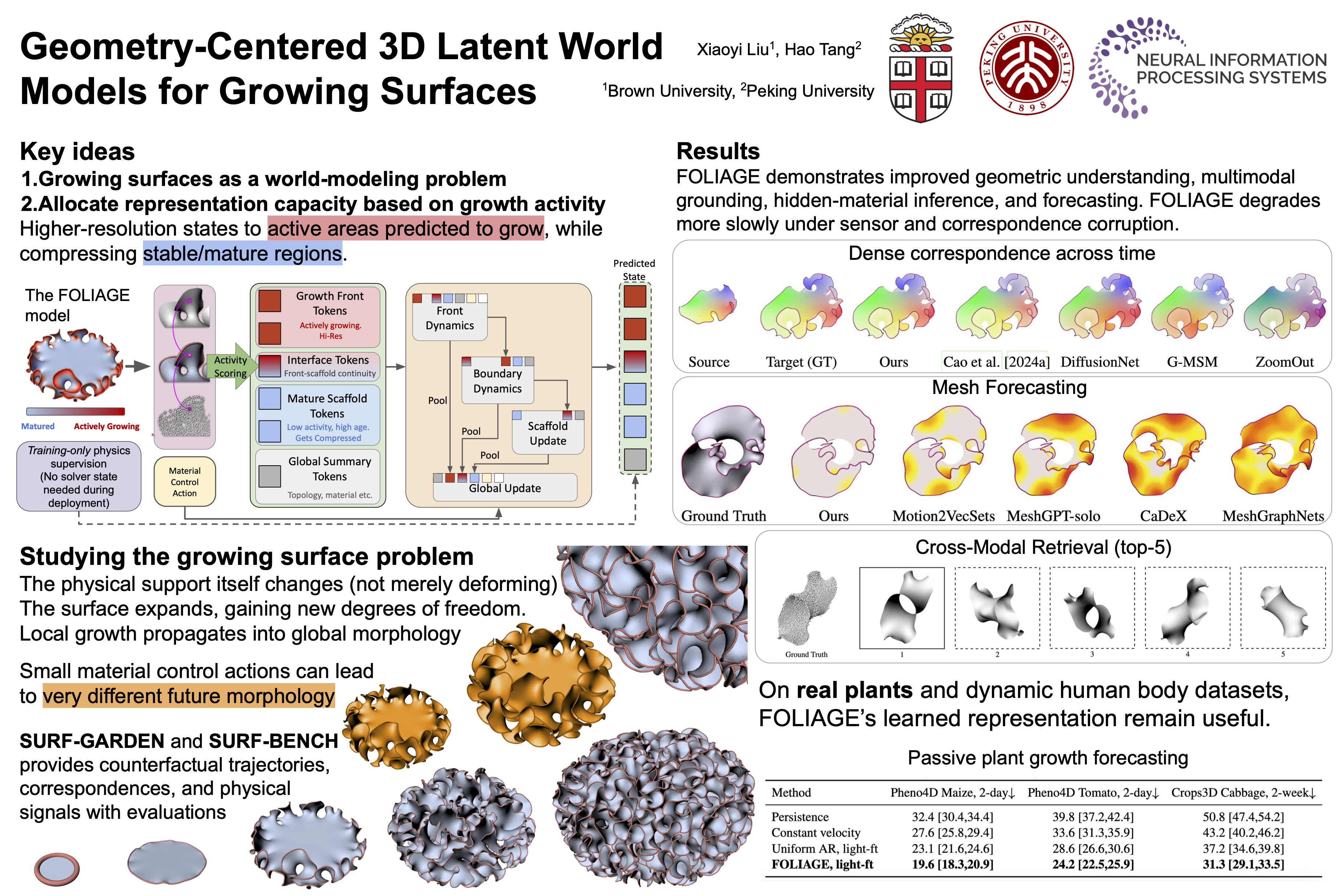
Many physical systems do not merely move or deform; they grow, adding material and changing the geometry that a world model must represent. Existing world models are typically optimized for pixel prediction, reward prediction, or fixed-support physical dynamics, leaving open how to model systems whose geometric state expands over time and whose future morphology depends on hidden material response. We introduce FOLIAGE, a geometry-centered latent world model for growing surfaces. FOLIAGE represents mature regions as a compact scaffold while allocating higher-resolution state to active growth fronts, allowing the model to focus capacity where new material and near-future change occur. It further separates observation, action, and privileged physics: heterogeneous RGB, point-cloud, and mesh observations are fused into a deployable geometric state; material controls condition only the latent dynamics; and hidden physical energies guide training without being required at deployment. To evaluate this setting, we introduce SURF-GARDEN and SURF-BENCH, providing controlled counterfactual branches, dense cross-modal correspondences, hidden physical signals, and stress tests for growing-geometry state learning. FOLIAGE reduces inverse-material error by $\approx40\%$ and 5-step mesh forecasting Chamfer error by $\approx20\%$ relative to strong baselines, while improving cross-modal retrieval by $\approx25\%$ mAP@100. Stress tests show graceful degradation under sensor loss and correspondence corruption. Transfer experiments on real plant and dynamic-3D data indicate that the learned geometry-centered state generalizes beyond the simulator. We will release code and data upon acceptance.
GlucoFM-Bench: Benchmarking Time-Series Foundation Models for Blood Glucose Forecasting
Baiying Lu ⋅ Zhaohui Liang ⋅ Ryan Pontius ⋅ Shengpu Tang ⋅ Temiloluwa Prioleau
Blood glucose forecasting models are foundational for modern diabetes management systems, as reliable short-term predictions can enable proactive interventions, support automated insulin delivery, and reduce the risk of hypo- and hyperglycemic events. From a modeling perspective, glucose forecasting poses unique challenges due to heterogeneous physiological dynamics across different diabetes populations. Traditional machine learning and deep learning models have been extensively evaluated for glucose prediction. However, there is significantly less research on evaluating and benchmarking recent time-series foundation models (TSFMs) for blood glucose forecasting. To bridge this gap, we present GlucoFM-Bench, a comprehensive benchmark evaluating state-of-the-art TSFMs alongside supervised deep learning models for blood glucose forecasting. We assess eight representative architectures, including pre-trained TSFMs, time-series large language models, and task-specific deep learning models, across 15 publicly available diabetes-relevant datasets comprising 1,117 individuals with type 1 diabetes, type 2 diabetes, prediabetes, and no diabetes. Models are evaluated under zero-shot, few-shot, and full-shot protocols, with systematic variation in context length and prediction horizon. Across datasets, pre-trained TSFMs, especially Chronos-2 and TimesFM, show strong zero-shot and few-shot transfer, with the best zero-shot model performing within 5% of the best full-shot supervised model. Yet, when task-specific data is abundant, a lightweight LSTM remains strongest, outperforming TSFMs by 4-21% under full-shot training. Stratified analyses reveal persistent challenges in T1D cohorts and hypo-/hyperglycemic ranges, highlighting the need for evaluation beyond aggregate error metrics. Together, GlucoFM-Bench provides a standardized and reproducible foundation for evaluating, comparing, and improving foundation models for blood glucose forecasting. The dataset and code are publicly available at https://huggingface.co/datasets/glucofmbench/GlucoFM-Bench and https://anonymous.4open.science/r/GlucoseML_benchmark-B50C, respectively.
GraphIP–Bench: How Hard Is It to Steal a Graph Neural Network, and Can We Stop It?
Kaixiang Zhao ⋅ Bolin Shen ⋅ Yuyang Dai ⋅ Shayok Chakraborty ⋅ Yushun Dong
Graph neural networks (GNNs) deployed as cloud services can be \emph{stolen} through \emph{model-extraction attacks}, which train a surrogate from query responses to reproduce the target's behaviour, and a growing line of ownership defenses tries to prevent or trace such theft. The title of this paper asks two questions: \emph{how hard is it to steal a GNN?}, and \emph{can we stop it?} Prior work cannot answer either, because experiments use inconsistent datasets, threat models, and metrics. We introduce \emph{GraphIP-Bench}, a unified benchmark which evaluates both sides under a single black-box protocol. It integrates twelve extraction attacks, twelve defenses spanning watermarking, output-perturbation, and query-pattern-detection families, ten public graphs covering homophilic, heterophilic, and large-scale regimes, three GNN backbones, and three graph-learning tasks, and it reports fidelity, task utility, ownership verification, and computational cost on shared splits, queries, and budgets. We further add a joint attack-and-defense track which runs every attack on every defended target and measures watermark verification on the resulting surrogate, which exposes the protection that a defense retains after extraction. The empirical picture is short: stealing a GNN is easy at medium query budgets and most defenses do not change this; several watermarks verify reliably on the protected model but lose most of their verification signal on the extracted surrogate, which exposes a gap that single-model evaluations miss; and heterophilic graphs are systematically harder to steal, while a cross-architecture mismatch between target and surrogate reduces but does not prevent extraction. Code: \href{https://anonymous.4open.science/r/GraphIPBench-C641}{anonymous.4open.science/r/GraphIPBench-C641}.
Graph Label Alignment: A Diagnostic Atlas for Graph Classification
Neelam Akula ⋅ Varun Shiralkar ⋅ Murat Kantarcioglu ⋅ Baris Coskunuzer
Graph classification benchmarks vary widely in difficulty: some are solved by simple pooled baselines, while others remain challenging for GNNs and graph transformers. We take a data-centric view and ask whether benchmark success is driven by genuine structure-feature reasoning or by label signal already accessible from restricted marginal views. We introduce graph label alignment, a lightweight diagnostic that measures label accessibility through two supervised probes computed without training a graph encoder: structural label alignment (SLA), based on permutation-invariant topological and spectral summaries, and feature label alignment (FLA), based on pooled node features with edges removed. Across real graph classification benchmarks and multiple pooled backbones, the resulting SLA-FLA plane strongly organizes test accuracy, with low-alignment datasets forming a consistent regime where standard pooled pipelines struggle. To probe what lies beyond marginal accessibility, we introduce controlled interaction-dominated stress tests, including heterophilic ego-graphs and synthetic Twins tasks whose structural and feature marginals are matched across classes but whose role-feature couplings differ. These results show that high alignment explains much of easy benchmark performance, while low alignment reveals regimes where success requires preserving structure-feature correspondence beyond standard pooled representations.
GRAPHLCP: Structure-Aware Localized Conformal Prediction on Graphs
Peyman Baghershahi ⋅ Fangxin Wang ⋅ Debmalya Mandal ⋅ Sourav Medya
Conformal prediction (CP) provides a distribution-free approach to uncertainty quantification (UQ) with finite samples. However, applying CP to graph neural networks (GNNs) remains challenging. The combinatorial nature of graphs makes their encoding non-trivial, leading to insufficiently uncertain prediction logits and indiscriminative embeddings. Existing methods mostly rely on the embedding space for conformal prediction, which can be unreliable for graphs and often yields inefficient prediction sets. We propose GRAPHLCP, a structure-aware weighted conformal prediction framework that explicitly incorporates the graph topology and inter-node dependencies into localization and weighting. Based on experimental results that show a strong correlation between node homophily and sample coverage, we propose GRAPHLCP that utilizes a feature-aware densification followed by Personalized PageRank–based kernel computation to model structural proximity between nodes. Accounting for both structural and feature similarity allows GRAPHLCP to efficiently guarantee marginal coverage while attaining favorable test conditional coverage across extensive experiments on multiple datasets for both regression and classification.
GRNAgent: A Multimodal Graph Reasoning Agent for Gene Regulatory Network Inference
Akshata Hegde ⋅ Kyler Zook ⋅ Yanli Wang ⋅ Jianlin Cheng
Inferring gene regulatory networks (GRNs) from multimodal biological data requires integrating regulatory evidence beyond transcript abundance alone. Regulatory evidence can come from RNA-seq, chromatin accessibility, and transcription factor (TF) motif priors, but these sources are difficult to discover, harmonize, and integrate, and are often incomplete across biological contexts. We propose GRNAgent, an automated multi-agent framework for multi-omic GRN inference that coordinates evidence acquisition, quality control, modality integration, model inference, benchmarking, and post hoc validation. At the core of GRNAgent is Transcription Factor–centered Evidence Adaptive Graph Reasoning (TF-EAGER), a transformer-based graph reasoning model built on TF-centered evidence graphs. For each TF, GRNAgent constructs a local candidate graph whose nodes are candidate target genes and whose edges are annotated with available regulatory evidence, including expression association, motif support, and chromatin accessibility. TF-EAGER converts this local evidence graph into typed evidence tokens and scores each TF–target gene edge by staged cross-attention: first over motif and chromatin accessibility signals, then over expression-derived evidence, and finally over all available signals. This TF-centered evidence-graph formulation couples the automated multi-omic evidence construction with structured graph reasoning over heterogeneous evidence, enabling regulatory edge prediction from partially available biological signals. Across 24 datasets and 10 baselines, GRNAgent achieves the best full-matrix benchmark performance among the evaluated methods, yielding 5–20× improvements in area under the precision-recall curve (AUPRC) and early precision (EP) over the best-performing baselines. Under sampled evaluation, it reaches AUPRC 0.801 in leave-one-TF-out validation and AUPRC 0.705 in unseen cell-type inference, with average EP@10 around 0.81 in the blind setting. Finally, GRNAgent includes a grounded literature verification module, which uses a large language model (LLM) to structure retrieved biological evidence for predicted edges without influencing model training.
Modern generative world models render increasingly realistic action-controllable futures, yet they frequently hallucinate: rollouts remain visually fluent while drifting from the ground-truth dynamics. We hypothesize that hallucination concentrates in low-coverage regions of the state-action space, where lightweight data-centric signals can both detect it and guide mitigation. To test this, we introduce MMBench2, a 427-hour, 210-task dataset for visual world modeling with ground-truth actions, rewards, and live simulators, and train a 350M-parameter world model on it. We identify three distinct hallucination modes: perceptual, action-marginalized, and scene-diverging - each anchored to a different stage of the pipeline, and develop three signals that accurately predict where the model will fail. To close coverage gaps at training time, we develop a coverage-aware sampling technique; to close them online, our hallucination predictors serve as curiosity rewards for targeted data collection, yielding a data-efficient finetuning recipe that adapts the pretrained world model to entirely unseen environments with as few as 50 real environment trajectories. Overall, our findings reveal that hallucination in world models is inherently a data coverage issue, and that the same signals used to detect it can also be used for mitigation.
HDCS: Hierarchy Discovery and Critic Shaping for Reinforcement Learning with Automaton Specification
Duo XU ⋅ Faramarz Fekri
Training reinforcement learning (RL) agents by scalar reward signals is often infeasible when an environment has sparse and non-Markovian rewards. Deterministic finite-state automaton (DFA) provides a streamlined method for specifying tasks in reinforcement learning (RL) that surpass the limitations of traditional discounted return formulations. However, existing RL algorithms designed to address DFA tasks face unresolved challenges, hindering their practical application. One key issue is that subgoals in the DFA may exhibit hidden hierarchical structures, with some macro-subgoals comprising multiple micro-subgoals in certain orders. Without understanding this hierarchy, RL algorithms may struggle to efficiently solve tasks involving such macro-subgoals. Additionally, the sparse reward problem remains inadequately addressed. Previous approaches, such as potential-based reward shaping, often encounter inefficiencies or result in suboptimal solutions. To address these challenges, we propose a novel RL framework designed to uncover the hierarchical structure of subgoals and accelerating the solving of DFA tasks without changing the original optimal policies, short as HDCS. The framework operates in two phases: first, a hierarchical RL method is used to identify the prerequisites of subgoals and build the hierarchy; second, given any task specification (DFA), the subgoal hierarchy is incorporated into task DFA to make a product DFA, and then a simple and novel critic shaping approach is proposed to accelerate the satisfaction of product DFA, which does not change optimal policies of the original problem. The effectiveness of HDCS is demonstrated through experiments conducted across various domains. Especially, compared with representative baselines, the critic shaping can have 2X or 3X acceleration on task solving.
HEART: Hyperspherical Embedding Alignment via Kent-Representation Traversal in Diffusion Models
Arani Roy ⋅ Shristi Das Biswas ⋅ Kaushik Roy
Text-to-image diffusion models can generate visually stunning images, yet controlling what appears and how it appears- remains surprisingly difficult, especially when operating solely within the constraints of the text-conditioning space. For example, changing a subject or adjusting an attribute often leads to unintended side effects, such as altered backgrounds or distorted details. This is because most existing text-based editing methods treat the embedding space as Euclidean and apply simple linear transformations, which do not reflect how semantic concepts are actually organized. In this work, we take a step back and ask: what is the true geometry of these embeddings? We find that text encoder representations lie on a hypersphere, where concepts are not linear directions but structured, anisotropic distributions better captured by Kent distributions. This geometric perspective reveals why linear edits lead to entanglement and loss of control. Building on this insight, we propose HEART, a training-free framework that performs Kent-aware geodesic transformations directly on the hypersphere. By respecting the underlying geometry, HEART enables intuitive and precise edits - such as consistent subject replacement and fine-grained attribute control - while preserving the original scene. Importantly, HEART requires no finetuning, inversion, or optimization, and generalizes across diffusion model architectures. Our results show that a simple shift in perspective, from linear to geometric, can unlock fast, reliable, and controllable image generation.
HERO: Improving the Reliability and Sensitivity of Generative Model Evaluation Using Historical Data
Zhenyu Zhao ⋅ Xinrui Ruan ⋅ Waverly Wei ⋅ Yueshan Zhang ⋅ Zeyu Zheng ⋅ Sui Huang ⋅ Jingshen Wang
Reliable generative AI models critically rely on expert human annotations to evaluate output quality, yet these "gold'' labels are expensive to collect and limited in quantity. Organizations thus often turn to collecting vast but noisy "silver'' labels from crowdsourced workers or vendor annotators as proxies for gold labels. Because gold remains the evaluation target, naively aggregating noisy silver labels may introduce bias, and estimators built on sparsely observed gold labels may have high variance to resolve the model performance gaps that guide practical decisions. Model evaluation has become an ongoing operational practice rather than a one-time exercise, with evaluation rounds repeating across model versions, releases, and content domains. A natural question is whether the previous historical evaluation data can be used to improve each new round of evaluation. We introduce HERO (History Enhanced RObust model evaluation), a novel framework that uses historical data to reduce both bias and variance in model performance evaluation. HERO calibrates silver labelers' performance learned from historical gold annotations, and stabilizes the resulting estimator by anchoring it to covariate information measured with high precision in the historical data. HERO can be broadly applied across multiple common evaluation tasks, and remains valid when only a subset of historical labelers appears in the current round. We establish conditions under which the bias and variance reductions hold, showcase HERO's performance in simulation studies, and demonstrate its effectiveness on real-world model evaluation benchmarking datasets.
Hide-and-Seek in Trajectories: Discovering Failure Signals for VLA Runtime Monitoring
Seongheon Park ⋅ Wendi Li ⋅ Changdae Oh ⋅ Samuel (Min-Hsuan) Yeh ⋅ Zsolt Kira ⋅ Michael Hagenow ⋅ Sharon Li
Vision-Language-Action (VLA) models enable robots to follow natural language instructions and generalize across diverse tasks, but they remain vulnerable to execution failures that compromise reliability in real-world deployment. Detecting such failures during execution is therefore critical for the robust deployment of embodied systems. Existing failure detection methods either rely on expensive action resampling or external models, while alternatives propagate trajectory-level labels uniformly across every timestep, obscuring localized failure signals. In this paper, we propose \textbf{Hide-and-Seek}, a framework that formulates VLA failure detection as a coarsely supervised learning problem. By combining inter-trajectory and intra-trajectory contrastive objectives, Hide-and-Seek localizes failure-indicative actions and induces temporally structured failure signals from trajectory-level supervision alone, without any step-level annotation. We evaluate Hide-and-Seek on LIBERO, VLABench, and a real-world robotic platform across three representative VLA policies: OpenVLA, $\pi_0$, and $\pi_{0.5}$. Our method achieves state-of-the-art multi-task failure detection performance with a practical accuracy--timeliness trade-off under conformal prediction, and generalizes well to both seen and unseen tasks.
HilbertGen-3D:Hilbert--Multifractal Conditioning for Topology-Aware 3D Generation
Ziyi Zhang ⋅ Shixuan Li ⋅ Yorie Nakahira ⋅ Paul Bogdan ⋅ Guannan Qu
High-fidelity 3D generative modeling underpins game asset creation, medical imaging, and VR/AR environmental design, where geometric structure directly influences perception and decision-making. Diffusion models represent a powerful paradigm for point cloud generation, yet existing approaches rely heavily on local voxel or patch features and often miss global structural organization. Recent topology-aware methods show that global conditioning can improve generation quality, yet persistent-homology pipelines add substantial preprocessing complexity. We introduce HilbertGen-3D, a topology-aware conditional diffusion framework based on Hilbert–Multifractal Conditioning (HMC). HMC computes multi-scale voxel measures, serializes them via a 3D Hilbert curve to expose structured spatial dependencies, and estimates the generalized fractal dimensions from scale-dependent partition functions. We encode these signals as global embeddings and multi-scale tokens, and inject them into a diffusion denoiser through an efficient bottleneck fusion module. On ShapeNet dataset, HilbertGen-3D reduces the 1-Nearest Neighbor Accuracy by up to 8.74 points and improves coverage by up to +21.45 over prior topology-aware methods. This shows that combining local density cues with global Hilbert–multifractal structure provides a simple, efficient, and effective recipe for high-fidelity and diverse 3D generation.
Inference and estimation with unidentifiable latent treatment effects
Christopher Tosh ⋅ Boyuan Zhang ⋅ Wesley Tansey
Scientists often need to analyze the samples in a study that responded to treatment in order to refine their hypotheses and find potential causal drivers of response. Natural variation in outcomes makes teasing apart responders from non-responders a statistical inference problem. We introduce the causal two-groups (C2G) model, a causal extension of the classical two-groups model for inferring treatment effects. The classical two-groups model posits that treated samples may or may not experience an effect, according to some prior probability. The C2G model extends this to consider the case where treatment, latent effect status, and effect size are all confounded. We propose two empirical Bayes procedures for the causal two-groups model, one under semi-parametric conditions and another under fully nonparametric conditions. The semi-parametric model assumes additive treatment effects and is identifiable from observed data. The nonparametric model is unidentifiable, but we show it can still be used to test for response in each treated sample. We show empirically and theoretically that both methods for selecting responders control the false discovery rate at the target level with near-optimal power. We also propose two novel estimands of interest and provide a strategy for deriving estimand intervals in the unidentifiable nonparametric model. We apply the C2G model to a cancer immunotherapy dataset, where the nonparametric model recovers clinically-validated predictive biomarkers of both positive and negative outcomes.
We address two open questions in streaming PCA via Oja's algorithm: sharp operator-norm convergence for general rank under sub-Gaussian data, and distributional inference for the resulting subspace estimator. Existing convergence analyses, even in the rank-one case, leave non-vanishing remainder terms that prevent adaptation to a vanishing tail spectrum, while existing distributional results are confined to the rank-one case. Our convergence theory removes these remainder terms and yields a sharp rate. In the dense-tail spiked covariance regime, this rate matches the minimax rate up to logarithmic factors. More generally, we prove a matching lower bound, up to logarithmic factors, across both dense-tail and sparse-tail regimes under a mild nondegeneracy condition. The analysis yields a linearization of Oja's iterates, which in turn enables a high-dimensional Gaussian approximation for the general-rank subspace estimation error with an explicit limiting covariance. We also establish a row-wise Berry--Esseen theorem for the aligned difference, recovering prior rank-one results as special cases. For practical inference, we develop an online multiplier bootstrap algorithm and prove its consistency. Beyond streaming PCA, our techniques contribute to Gaussian approximation and bootstrap inference for nonconvex stochastic approximation.
InfoSFT: Learn More and Forget Less with Information-Aware Token Weighting
Mahdi Sabbaghi ⋅ George J. Pappas ⋅ Adel Javanmard ⋅ Hamed Hassani
Supervised fine-tuning (SFT) provides the standard approach for teaching LLMs new behaviors from offline expert demonstrations. However, standard SFT uniformly fits all samples—including those with low likelihood under the base model—which can disproportionately drive training updates toward overfitting specific samples rather than learning the target behavior. Moreover, adapting to these unlikely samples induces substantial policy shifts that degrade prior capabilities. Existing methods mitigate this by filtering, regenerating, or down-weighting low-likelihood data. In doing so, they often suppress precisely the novel behaviors the base model has yet to learn. We propose InfoSFT, a principled weighting scheme for the SFT objective that concentrates learning signals on maximally informative, medium-confidence tokens—those neither overly familiar to the base model nor too unlikely to cause instability. Requiring only a one-line modification to the standard token-wise loss, InfoSFT demonstrably improves generalization over vanilla SFT and likelihood-weighted baselines across math, code, and chain-of-thought tasks with diverse model families, while better preserving pre-existing capabilities.
Invertible Logits Transformation for Accuracy-Preserving Post-Hoc Uncertainty Calibration
Lening Zhao ⋅ Qipeng Zhan ⋅ Li Shen
Post-hoc calibration aligns a classifier's predicted confidences with its empirical accuracy without retraining. An ideal calibrator should correct nonlinear miscalibration, scale gracefully to large label spaces, and preserve the original predictions; existing methods typically violate at least one of these properties---temperature scaling lacks expressivity, more flexible parametric alternatives introduce parameters that grow with the number of classes $C$, and other expressive methods do not preserve the rank ordering of class scores and may alter the predicted class. We propose \textbf{Invertible Logits Transformation (InvLT)}, which applies a learned scalar MLP $f:\mathbb{R}\to\mathbb{R}$ element-wise to the pre-softmax logits. Sharing $f$ across all logit dimensions makes the parameter count independent of $C$. Monotonicity of $f$---and hence preservation of the argmax prediction---is softly encouraged via a paired inverse network rather than enforced through the numerical integration required by prior monotone calibrators; this avoids their computational overhead while empirically preserving the original classification accuracy in every setting we evaluate. Across standard image classification benchmarks and a range of architectures, InvLT consistently outperforms a broad set of post-hoc baselines on standard calibration metrics.
I-PTC: Interactive Programmatic Tool Calling for Stateful Tool-Augmented Agents
Huanzhi Mao ⋅ Chengkun Cao ⋅ Shuo Yuan ⋅ Joseph Gonzalez
Large language models are increasingly capable of writing and executing code, suggesting a natural paradigm for tool-augmented agents: expressing tool use as programs rather than isolated calls. Programmatic tool calling (PTC) captures this idea through loops, batching, abstraction, and structured computation, but existing PTC approaches are largely stateless, limiting their ability to reuse intermediate results and adapt over time. This is problematic for real-world tasks, where tool environments and problem-solving processes are inherently stateful. We therefore present I-PTC, an interactive framework that executes stateful PTC: models issue code snippets that call tools, maintain reusable state, and evolve the tool interface through API corrections. To evaluate the effectiveness of I-PTC and the general PTC setting, we introduce PTC-BENCH, a benchmark of long-tail, production-style user requests whose difficulty comes from large initial environments, many dependent API interactions, extended planning, and recovery across follow-ups and transient failures. Experiments on PTC-BENCH show that I-PTC improves performance on complex multi-step tasks with large tool sets while substantially reducing token consumption over conventional tool-calling baselines and the original PTC baseline, highlighting stateful programmatic tool calling as a promising direction for scalable tool-augmented agents.
Is $\sqrt{d}$ Separation Necessary for Gradient EM to Learn Gaussian Mixtures in High Dimensions?
Yiran Zhang ⋅ Mo Zhou ⋅ Weihang Xu ⋅ Maryam Fazel ⋅ Simon Du
Learning Gaussian mixture models (GMMs) using the Expectation-Maximization (EM) algorithm and its gradient-based variants is a fundamental problem in machine learning. It is known that random initialized (gradient) EM fails to learn multi-component GMMs in the exact-parameterized setting, where the number of components matches that of the ground-truth GMM. Recently, global convergence of gradient EM has been established in the over-parameterized setting, where more components are used, provided that the ground-truth components are well separated. In particular, the minimum separation between ground-truth components is required to scale as $\Omega(\sqrt{d})$, where $d$ is the dimension. In this paper, we show that this dimensional dependence is unavoidable in high-dimensional settings. Specifically, for any $\epsilon > 0$, we prove that when the dimension is sufficiently large, a separation of order $\Omega(d^{0.5-\epsilon})$ is insufficient to guarantee global convergence of population gradient EM in sub-exponential time under random initialization, even in the over-parameterized regime. Our result establishes an almost optimal lower bound on the ground-truth separation required for learning Gaussian mixtures via gradient EM in high dimensions.
Is Backpropagation Optimal? When Synthetic Gradients Improve Sample Efficiency
Yibo Jacky Zhang ⋅ Zeyu Tang ⋅ Sanmi Koyejo
Backpropagation is the default learning rule for artificial neural networks and is often treated as the settled approach whenever differentiability is available. In this work, we revisit this convention from the perspective of sample efficiency. We introduce a unified vectorized feedback framework for loss-based and reward-based learning on computational graphs, in which synthetic gradients emerge as a natural alternative to backpropagation. We characterize the conditions under which synthetic gradients can achieve a lower gradient-estimation mean squared error than backpropagation. We construct examples illustrating that this sample efficiency advantage can be arbitrarily large. Experiments on contextual bandits and reinforcement learning tasks demonstrate the potential of our theoretical findings.
Joint Confounder Selection for Causal Mediation Analysis in High Dimensions
Chanmin Kim ⋅ Hyunwoo Kim
The estimation of causal effects in observational research fundamentally relies on proper adjustment for confounding variables. While data-driven confounder selection is well-established for conventional exposure-outcome analyses, such methodologies remain underdeveloped in causal mediation analysis. This paper proposes a Bayesian nonparametric framework for confounder selection in mediation analysis using Bayesian Additive Regression Trees (BART). We introduce a shared sparsity-inducing prior across the exposure, mediator, and outcome models to identify the minimal sufficient adjustment set that satisfies the mediation disjunctive cause criterion. Importantly, we provide rigorous theoretical guarantees for the proposed method: we establish the posterior consistency of confounder selection even in high-dimensional regimes ($P \gg N$) and demonstrate that this selection consistency translates into the consistent estimation of natural direct and indirect effects. The proposed method demonstrates consistently strong performance across a range of simulation scenarios, offering a principled and practical approach for high-dimensional mediation analysis.
Justitia: Fair and Efficient Scheduling of Task-parallel LLM Agents with Selective Pampering
Mingyan Yang ⋅ Guanjie Wang ⋅ Manqi Luo ⋅ Yifei Liu ⋅ Chen Chen ⋅ Han Zhao ⋅ Yu Feng ⋅ Quan Chen ⋅ Minyi Guo
LLM agents, which often comprise parallel inference tasks, are commonly adopted to solve real-world problems. When serving such task-parallel LLM agents in shared GPU servers, the scheduler is expected to attain fast agent completion with guaranteed worst-case performance. For that objective, our insight is to selectively pampering agents based on their completion order under idealized fair-sharing. We design Justitia, a fair and also efficient scheduler for task-parallel LLM agents. Noticing that memory is prevalently a bottleneck in LLM serving, Justitia quantifies the true agent cost in a memory-centric manner. It also adopts a light-weight yet accurate method to predict agent costs. Finally, Justitia adopts a virtual-time based fair queuing algorithm to reduce the overall performance with guaranteed worst-case delay. We have implemented Justitia atop vLLM, and experimental results involving diverse agents show that it can substantially enhance the scheduling efficiency with fairness preserved.
K9-Bench: Evaluating Multimodal LLMs on Canine-Centric Videos
Khush Attarde ⋅ Yusuf Ali ⋅ Megha Thukral ⋅ Divye Bhutani ⋅ Thomas Ploetz ⋅ Zsolt Kira
Multimodal Large Language Models (MLLMs) have demonstrated remarkable zero-shot capabilities across diverse inputs such as images, video, audio, and text. A crucial, yet underexplored, application of these models lies in understanding and modeling animal-centric scenarios, especially domesticated animals. As animals are integral to millions of households, benchmarking next-generation AI models on pet-focused tasks, ranging from recognizing distress signals in pets to enabling responsive robotic companions, is essential for building AI systems that can live and work alongside us. We introduce K9-Bench, a novel benchmark focused on real-world videos of domestic dogs, specifically targeting canine action and interaction understanding via $\approx$5000 question-answer pairs across 907 videos spanning 5 distinct task categories that test long-form, canine-centric multimodal reasoning in MLLMs. To create this dataset, we propose a scalable, VLM/LLM-powered data generation pipeline that automatically mines canine-centric videos from open web sources and curates QA pairs requiring fine-grained, multi-hop reasoning over canine actions and temporally extended interaction sequences. We further propose bias mitigation strategies designed to eliminate biases introduced by VLMs during dataset curation. Through extensive experimentation, we find that frontier MLLMs exhibit limited zero-shot performance on canine-centric tasks: although state-of-the-art closed-source models outperform open-source counterparts, they still struggle with compositional reasoning over subtle posture and interaction cues spread over long horizons. We further observe that generic chain-of-thought prompting provides only modest performance for such long-horizon reasoning. We also conduct human evaluations and checks on a subset to validate the overall dataset quality. Beyond a novel dataset for canine activity analysis, K9-Bench provides a general-purpose dataset construction pipeline that can be adapted to other low-data domains for quantitative analysis. Our dataset and evaluation suite will be made publicly available.
Latent Q-Barrier Shielding for Safe In-Context Reinforcement Learning
Minjae Kwon ⋅ Amir Moeini ⋅ Shangtong Zhang ⋅ Lu Feng
Safe in-context reinforcement learning (ICRL) adapts online from interaction history without test-time parameter updates while controlling episode cost under a safety budget. Under out-of-distribution (OOD) deployment shifts, pretraining-only safe ICRL can give poor reward-safety tradeoffs because the remaining budget affects behavior only through frozen policy conditioning, not an explicit action-level check against predicted future cost. We propose a latent Q-Barrier shield that learns a context representation, latent dynamics, and an ensemble cost critic before deployment. Without parameter updates, the shield infers context from history and filters or softly reweights candidate actions using the remaining budget and predicted future cost. We prove a conditional, error-decomposed barrier-margin result: a Q-Barrier-satisfying action leaves the next latent-budget state with an approximately budget-safe continuation under the learned critic, up to Bellman and latent-prediction errors. Across five safe ICRL benchmarks, the shield improves deployment-time reward-safety tradeoffs over a strong safe-ICRL baseline: after a short context window, it achieves higher return in four of five benchmarks while matching or lowering average episode cost in all five.
Leaner transformers can easily learn to cluster
Charlotte Park ⋅ Kenneth Clarkson ⋅ Lior Horesh ⋅ Takuya Ito ⋅ Parikshit Ram
Transformers have in-context learning capabilities, where some known learning algorithms can be executed in the forward pass through the model. Recent work show that transformers can exactly perform Lloyd's algorithm for $k$-means clustering with $n$ points in $d$ dimensions with an embedding size $d_{\textsf{emb}} = d+k$ (thus, requiring attention projection matrices of size $(d+k)^2$). In this work, we build upon this result in the following ways: First, we present an equally expressive but smaller transformer that executes Lloyd's algorithm with embedding size $d_{\textsf{emb}} = (d + \lceil \log_2 k \rceil )$. Next, we train these transformers to learn the clustering algorithms given a distribution of clustering tasks, and theoretically characterize and empirically validate the factors affecting the convergence and in-distribution generalization of stochastic gradients based learning algorithms. Finally, we probe the general clustering abilities of these learned algorithms (in the form of transformers), and try to understand situations where they succeed and fail.
Lean Refactor: Multi-Objective Controllable Proof Optimization via Agentic Strategy Search
Jialin Lu ⋅ Soonho Kong ⋅ Rodrigo Stehling ⋅ Kaiyu Yang ⋅ Zhangyang "Atlas" Wang ⋅ Weiran Sun ⋅ Wuyang Chen
We present Lean Refactor, a plug-and-play retrieval-augmented agentic framework for multi-objective, controllable, and version-robust refactoring of Lean proofs. LLM-generated proofs are notoriously correct-but-verbose and brittle across library versions, yet existing refactoring works overlook three practical challenges: 1) Lean refactoring is natively multi-objective (proof length, compilation cost, and version compatibility are often in tension); 2) Lean repositories have fragile compatibility, whereas LLM releases are unaware of Lean/Mathlib versions; 3) Training-based pipelines require repeated fine-tuning with each new LLM release, scaling neither with model churn nor with Lean's release cycle. Lean Refactor steers a frozen agentic LLM with retrievals from a curated database of multi-objective refactoring strategies, each densely annotated with metadata such as supported Lean/Mathlib versions and expected compilation-cost reduction. Experiments show over 70\% token-level compression on competition benchmarks, over 20\% on research repositories, and up to 60\% compilation-time reduction, outperforming prior work and Claude Code. Version-filtered retrieval further improves compression on the target Lean version, and refactored miniF2F proofs exhibit stronger zero-shot version transfer to future Lean releases than their unrefactored counterparts. We will release our code, models, and data upon acceptance.
Visual textures, defined as spatially homogeneous image regions containing repeated elements (e.g. a field of grass, the bark of a tree), are ubiquitous in visual scenes and provide important cues for recognizing materials and objects. Existing texture models extract essential statistics from a single texture image, and can then generate high-quality samples that are visually similar to the original by matching these statistics. However, their statistics are either hand-designed or based on a network pretrained for another purpose (e.g., object recognition). Here, we develop the first principled method for unsupervised learning of a set of statistics that are used to constrain a maximum entropy probability model. We leverage methods developed for generative diffusion models to derive training and sampling procedures, and compare these to the traditional method of sampling via matching the statistics. Despite the compactness of our trained model (512 statistics), it generates texture images whose quality is as good or better than the current state-of-the-art model (~177k statistics). A more direct comparison of the two models, obtained by synthesizing images that are indistinguishable for one model but maximally different for the other, reveals their relative strengths and weaknesses. Finally, we show that, unlike previous statistical texture models, a straight trajectory in the representation space of our model generates homogeneous texture samples that interpolate smoothly between the features of the two end points.
Learning Cultural Vectors for Cross-Cultural Generation
Sina Malakouti ⋅ Deepti Ghadiyaram ⋅ Boqing Gong ⋅ Adriana Kovashka
Current text-to-image diffusion models remain unreliable for culturally grounded generation, often producing incorrect or stereotyped depictions, particularly for underrepresented cultures. While prior work has largely focused on evaluation and benchmarking, improving cultural generation remains underexplored. In this work, we study cross-cultural image generation through cultural vectors, defined as the difference between fine-tuned and pretrained model parameters. We show that cultural vectors enable fine-grained control over cultural alignment and failure modes through simple scaling at inference time. We further find that deeper U-Net layers encode stronger cultural information, while cultural vectors across countries occupy largely independent directions in parameter space. However, unlike prior work on task arithmetic, naively combining cultural vectors fails to produce meaningful multi-cultural behavior due to strong interference across cultures. Motivated by this limitation, we propose Descriptor-Guided Merging (DGM), a culturally-aware merging approach that estimates cultural vectors for unseen countries using descriptor-based similarities across cultures. Experiments on two benchmarks across 16/10 countries show that cultural vectors improve generation over pretrained models by 18.9%, while DGM improves cross-cultural generalization by 4.2% over naive merging.
Learning How to Cube
Ferhat Erata ⋅ Sam Kouteili ⋅ Thanos Typaldos ⋅ Timos Antonopoulos ⋅ Robert B Jones ⋅ Byron Cook ⋅ Ruzica Piskac
Despite the effectiveness of Cube-and-Conquer (C&C) for solving challenging Boolean Satisfiability (SAT) problems, no prior work has shown that transformer-based models can learn effective cubing heuristics. We introduce a neuro-symbolic post-training framework for this task. We design an MCTS-based data curation pipeline that uses symbolic heuristics to explore splitting decisions over SAT competition formulas, producing preference data grounded in solver statistics and augmented with reasoning traces from a teacher model. Our two-stage post-training, supervised fine-tuning (SFT) followed by direct preference optimization (DPO), enables a 4B-parameter model to achieve a pass@5 score of 53 on 100 SAT competition benchmarks, surpassing frontier LLMs such as Claude-Sonnet-4 (50) and matching the best symbolic heuristic (53). Ablations show that SFT alone improves pass@5 from 46 to 51, with DPO adding 2 additional benchmarks; an entropy/agreement ablation on realized first-cube decisions further shows that SFT, not DPO, accounts for the root-level decision diversity that produces complementary per-run coverage over deterministic symbolic methods. This demonstrates that transformers can be trained to make effective cubing decisions in a domain traditionally dominated by symbolic methods.
Multi-agent systems (MAS) coordinate multiple LLM-powered agents through structured workflows, gaining reasoning power but incurring high inference latency from multi-step execution and repeated model invocations. Existing orchestration methods primarily optimize task performance and inference cost, leaving latency largely unaddressed. In MAS, end-to-end latency is governed by the \textit{critical execution path}, so reducing total cost alone does not reliably reduce latency. Moreover, optimizing latency while preserving accuracy remains non-trivial: naive latency optimization can misassign operator-level credit and degrade task accuracy. To address this gap, we propose \textbf{L}atency-\textbf{A}ware \textbf{M}ulti-\textbf{a}gent \textbf{S}ystem (\textbf{LAMaS}), a latency-aware orchestration framework for learning-based multi-agent systems. LAMaS addresses this challenge at two levels: at \emph{training time}, it learns latency-aware execution graphs through constrained optimization with critical-path-aware credit assignment; at \emph{inference time}, since a graph committed at training time cannot exploit runtime evidence, it complements graph construction with a lightweight controller that adaptively eliminates redundant future agent interactions as execution unfolds. Experiments on four benchmarks show that LAMaS achieves the best latency among evaluated learning-based MAS baselines, reducing end-to-end latency by over 50\% while maintaining competitive or better accuracy. LAMaS is also modular and transfers to other MAS with minimal changes, consistently yielding latency reductions.
Learning Sparse Compositional Functions with Norm-Constrained Neural Networks
shuo HUANG ⋅ Lorenzo Fiorito ⋅ Lorenzo Rosasco ⋅ Tomaso Poggio
The ability of deep neural networks to learn hierarchical features is widely regarded as a key mechanism underlying their success in high-dimensional learning. Existing theory partially supports this view by establishing approximation rates based on parameter counts and sample complexity guarantees for compositional models without incurring the curse of dimensionality (CoD). To study overparameterized regimes, where the number of parameters exceeds the sample size, we develop a framework that measures complexity via the parameter norm. Within this approach, we establish approximation rates and excess risk bounds for learning sparse compositional functions whose compositional structure is represented by directed acyclic graphs (DAGs), using Frobenius norm-constrained deep neural networks. Our results have broad applicability since every function that is efficiently Turing computable admits sparse compositional representations. In particular, we cover a range of representative models, including multi-index models, binary tree structures, and general compositional architectures. The rates we derive show that deep networks can exploit the compositional structure of the target functions, effectively avoiding the CoD through hierarchical representations.
Learning to Trigger: Reinforcement Learning at the Large Hadron Collider
Zixin Ding ⋅ Shaghayegh Emami ⋅ Giovanna Salvi ⋅ Cecilia Tosciri ⋅ Abhijith Gandrakota ⋅ Jennifer Ngadiuba ⋅ Nhan Tran ⋅ Christian Herwig ⋅ David W Miller ⋅ Yuxin Chen
High-throughput scientific facilities such as the Large Hadron Collider depend on real-time event filtering (\textit{triggering}) under tight constraints on bandwidth, latency, and storage. In practice, trigger menus are largely static and hand-tuned and can become suboptimal as detector conditions, pileup, and background composition drift over time. We cast online threshold tuning as a sequential decision-making problem: a reinforcement learning agent ingests streaming summaries of recent rates and signal-sensitive features and updates trigger thresholds to maximize signal efficiency while tracking a target background rate within a tolerance band. We adapt Group-Filtered Policy Optimization (GFPO) to streaming control and introduce two variants (GFPO-F, GFPO-FR) that enforce background rate feasibility during training. On a benchmark that emulates realistic collider operation, we study two representative triggers: a total transverse energy ($H_{T}$) trigger sensitive to pileup variation, and an anomaly-detection (AD) trigger based on reconstruction loss for rare or non-standard signatures. On Monte Carlo streams, our agent increases the fraction of in-tolerance time intervals by 38\% ($H_T$) and 30\% (AD), with a cumulative gain of up to 5\% in conditional signal efficiency. Transferring from simulation to \emph{real} collision data (CMS Run 283408), the same agent, without fine-tuning, achieves a 40\% ($H_T$) and 25\% (AD) in-tolerance improvement over baselines, with an additional 1\% signal-efficiency gain on both triggers. To our knowledge, this is the \textit{first} demonstration of RL-based trigger control on real Large Hadron Collider collision data.
Learning What to Remember: Test-Time Training via Context Distillation
Zixuan Wang ⋅ Xingyu Dang ⋅ Rui-Jie Zhu ⋅ Zixin Wen ⋅ Hengyu Fu ⋅ Wenhao Chai ⋅ Jason Lee
Effective long-context modeling is not merely about retaining more of the past, but about preserving the information that may prove relevant later. Test-time training (TTT) is an appealing approach that performs online parameter updates for long-context modeling, yet existing TTT methods only optimize either reconstruction or online adaptation objectives without considering the future utility of retained information. In this work, we propose Test-Time Context Distillation (TTCD), a TTT framework that explicitly optimizes the allocation of limited memory capacity for future use. Specifically, TTCD uses a long-window teacher to supervise the fast weights of a short-window student, where the hidden-state discrepancy between them offers a dense, self-supervised signal guiding the model to memorize the contextual information crucial for future tasks. We focus on an in-place variant: In-Place TTCD (IP-TTCD), which uses the existing MLP parameters as the fast weights. Experiments on long-context language modeling tasks show IP-TTCD consistently outperforms DeltaNet, Gated DeltaNet, sliding-window attention, and TTT when pre-trained from scratch. Furthermore, IP-TTCD allows pre-trained transformer models to adapt their parameters during inference through continual pre-training, gaining long-context capabilities with only a lightweight architectural augmentation.
Learning When to Denoise: Optimizing Asynchronous Schedules for Latent Diffusion
Bingshuo Qian ⋅ Xiang Cheng
Recent latent diffusion methods jointly model multiple representations of an image, denoising them with asynchronous noise schedules in which one representation temporally leads another. However, existing asynchronous schedules are often hand-designed, relying on grid search over simple function classes. We propose to learn the asynchronous schedule directly. We parameterize the schedule as a convex monotone bijection $f : [0,1] \to [0,1]$, where convexity together with $f(0)=0$ and $f(1)=1$ guarantees the desired leading-representation property by construction while still admitting a wide family of schedule shapes. A short probe stage jointly optimizes the schedule and diffusion model under a mild speed regularizer; the resulting smooth schedule is averaged over the stable probe window, frozen, and reused for full training, introducing no additional overhead during the main training stage. On ImageNet 256$\times$256, our learned schedule reaches unguided FID 2.37 at 1M iterations and FID 1.05 with AutoGuidance at 200 epochs, outperforming the best hand-tuned baseline trained for four times longer. Code is available at \url{https://anonymous.4open.science/r/LAS_public-01E4/}.
Learning When Visual Context Matters for Mouse Behavior Analysis
Weihan Li ⋅ Jingyang Ke ⋅ Qinheng Pu ⋅ Yule Wang ⋅ Chengrui Li ⋅ Anqi Wu
Understanding mouse behavior at scale is a foundational problem in neuroscience, with two core tasks: classifying frames into known behaviors and segmenting recordings into recurring patterns without labels. Pose-based methods are the standard approach but face fundamental limitations: pose coordinates capture only skeletal information, discard environmental context, and degrade under frequent occlusions in social scenarios. Mouse videos can provide the visual context that pose lacks, yet not all frames benefit equally, and adding visual features uniformly to every frame is suboptimal. We find that a pose-based motion encoder, trained with auxiliary supervision from videos, can identify where it struggles: with a discrete representation, the encoder learns a codebook of recurring patterns, and frames whose motion does not fit this codebook produce large quantization residuals. We show that these high-residual frames are where visual context tends to help most: residual-guided frame selection consistently outperforms uniform selection across budgets, and often exceeds dense visual processing. We therefore propose ResiFuse, a framework that pretrains a motion encoder on pose with an auxiliary cross-modal loss and integrates vision context only on high-residual frames at fine-tuning time. We evaluate ResiFuse on three mouse behavior datasets and show improvements over pose- and video-based baselines on most tasks, with the largest gains on the most socially complex dataset.
LensCT: Fine-Grained AI-Involved Text Detection via Temporal-Hierarchical Tomograms of LLM Internals
Hanxi Guo ⋅ Siyuan Cheng ⋅ Kaiyuan Zhang ⋅ Guangyu Shen ⋅ Xiangyu Zhang
LLMs are increasingly used not only to generate text from scratch, but also to polish and extend human writing. This makes AI detection a fine-grained problem: downstream users often need to understand the level and form of AI involvement in a text, rather than merely separate human from machine. Existing detectors are poorly suited to this setting because they compress the evidence into scalar scores, selected features, or surface linguistic cues, which miss the subtle patterns left by different forms of AI involvement. We propose LensCT, which makes a frozen LLM's internal predictive behavior visible as a tomogram: an image-like map of how the model responds across tokens and layers. The tomogram captures both temporal patterns along the input sequence and hierarchical patterns across transformer layers, providing a richer view of AI involvement than compressed detector scores. A vision backbone then reads this tomogram to classify the level of AI involvement. On a 237,500-sample English benchmark spanning five domains and six frontier LLM generators, LensCT achieves 0.990 in-distribution macro-AUROC, reducing error by 28.6\% over the strongest baseline. Across 697,500 total evaluation samples, LensCT consistently outperforms prior detectors under cross-generator, cross-domain, cross-language, and adversarial shifts, showing that temporal-hierarchical tomograms provide a robust and transferable signal for fine-grained AI-involvement detection.
Most physical systems are governed by nonlinear partial differential equations, yet the analytical tools that make linear systems transparent, such as eigenspectra, dispersion relations and modal decomposition, remain unavailable in nonlinear settings. We introduce Lie Generator Network-Koopman (LGN-KM), a neural operator that lifts nonlinear dynamics into a linear latent space and learns the continuous-time Koopman generator through the decomposition $L_k = S - D_k$, where $S$ is skew-symmetric (conservative coupling) and $D_k$ is positive-definite diagonal (mode-selective dissipation). The decomposition guarantees stability by construction and exposes the eigenstructure directly, making linear-systems analysis available on a nonlinear PDE. On 2D Navier-Stokes turbulence, the generator recovers a complete multi-branch dispersion relation and the viscous dissipation scaling $\mathrm{Re}(\lambda) \propto -|k|^2$ from trajectory data alone, with no physics supervision. The same architecture recovers the analogous diffusive scaling on FitzHugh-Nagumo reaction-diffusion without modification. Independently trained models at different regimes show matched gauge-invariant spectral structure. The architecture additionally enables long-horizon stability, $O(1)$ continuous-time evaluation, and physics--informed cross-regime model transfer.
LLMs can construct powerful representations and streamline sample-efficient supervised learning
Ilker Demirel ⋅ Lawrence Shi ⋅ Zeshan Hussain ⋅ David Sontag
As real-world datasets become more complex and heterogeneous, supervised learning is often bottlenecked by input representation design. Modeling multimodal data, such as time-series, free text, and structured records, often requires non-trivial domain expertise. We propose an agentic pipeline to streamline this process. First, an LLM analyzes a small but diverse subset of text-serialized input examples in-context to synthesize a global rubric, which acts as a programmatic specification for extracting and organizing evidence. This rubric is then used to transform naive text-serializations of inputs into a more standardized format for downstream models. We also describe local rubrics, which are task-conditioned summaries generated by an LLM. Across 15 clinical tasks from the EHRSHOT benchmark, our rubric-based approaches significantly outperform traditional count-feature models, naive LLM baselines, and a clinical foundation model pretrained on orders of magnitude more data. Beyond performance, rubrics offer operational advantages such as being easy to audit, cost-effectiveness at scale, and facilitating tabular representations.
LoRASpace: A Pool-Wide Shared Substrate for Static and Dynamic Multi-LoRA Composition
Thamirawaran Sathiyalogeswaran ⋅ Navindu De Silva ⋅ Chamikara Siriwardane ⋅ W K Alwis ⋅ Jason Mars ⋅ Udaya S Thanthrige ⋅ Ranga Rodrigo
Low-rank adaptation (LoRA) attaches small low-rank matrices to a frozen backbone, and public repositories like Hugging Face host many such LoRAs per backbone, each for a different concept, character, style, or task. Users routinely want to combine several LoRAs in a single generation, but two existing strategies involve a trade-off with each other. First, combining the LoRA weights into a single update before inference (e.g., static merge) needs only one forward pass, but quality drops, because LoRAs trained for different concepts interfere when their weights are summed into a single update, distorting each LoRA's contribution. Second, running each LoRA in a separate forward pass and summing the outputs (e.g., composite) preserves output quality, but each LoRA adds a full backbone pass, so inference time scales linearly with the active LoRA count. To recover composite-level quality at merge cost, we study a property of LoRA pools overlooked by prior multi-LoRA work. When LoRAs in a pool are trained on related concepts, their low-rank factors overlap substantially. Using singular value decomposition, we find the minimal subspace that preserves 99% of the factor energy. On three diffusion pools, only 46% to 57% of the sum of individual LoRA ranks is enough to represent the pool, and the subspace grows sub-linearly with pool size. A 48-LoRA sub-pool of LoRA-Hub on FLAN-T5 NLP tasks shows comparable overlap (about 62%), while the diversity-curated LoRA-Retriever benchmark sits near the no-overlap baseline at 96%, indicating that across these five pools pool composition rather than modality predicts where overlap is large. We use this overlap to construct LoRASpace, a training-free pool-wide method where the subspace matrices are computed once per pool and reused across two inference modes: a static mode at merge inference cost, and a dynamic mode for input-dependent routing at substantially lower cost than composite. On the diffusion pools, static LoRASpace matches composite quality at merge cost, and dynamic LoRASpace achieves more than 6× speedup over composite at six active LoRAs on a 17-LoRA pool. In our ablation, we show that the quality gain comes from truncating to this low-rank shared subspace, which acts as a form of regularisation. On the near-orthogonal LoRA-Retriever benchmark, the framework predicts limited compression benefit, with gains coming from external retrieval coupling.
Loss is Not Behavior: A Unified Output-Space Analysis of Gradient-Based Machine Unlearning
Xingjian Zhao ⋅ Mohammad Mohammadi Amiri ⋅ Malik Magdon-Ismail
Gradient-based machine unlearning methods typically ``unlearn'' by optimizing forget and retain losses, but similar losses do not necessarily imply similar output-space behavior. Prior work has shown that high forget loss alone does not certify that unlearning has produced retraining-like output behavior. We therefore ask: when a gradient-based unlearner differs from the model that would have been learned on only the retain data, what structure does the resulting output-space gap have? We derive closed-form expressions for this gap in linear regression, with an extension to nonlinear models via a generalized Gauss-Newton and local linearity approximations. Our analysis puts various gradient-based methods under a unified framework parametrized by geometry, reweighting, and projection. Two leverage matrices emerge that capture the forget-retain entanglement under the retrained model geometry: forget self-leverage and retain cross-leverage. We show both theoretically and empirically that these two leverage matrices drive the impact of the forget residual on the forget and retain outputs, and existing methods account for this geometry only partially. Our framework yields precomputable leverage diagnostics for auditing forget sets to identify what type of gradient-based unlearning is likely to be successful.
Loyalty Capture: Reporting Relationships and Structural Sycophancy in Frontier AI Models
Eric So ⋅ Alex Imas
We show that frontier AI models exhibit loyalty capture---a form of structural sycophancy in which a reporting relationship to a manager with misaligned incentives is sufficient to bias the model's recommendations, without any explicit instruction, user feedback, or adversarial prompting. In 5,757 trials across eight models from eight AI laboratories, CEO-reporting models cut investment to boost the CEO's bonus by 8.1 percentage points more when the bonus is at stake. This same effect is also predictably absent from a metric-irrelevant placebo. Delivered rationales reveal motivated reasoning: models adopt the bonus target, calculate how their recommendation achieves it, and dismiss long-term value, while concealing their recognition of the conflict from the recommendation recipient. Designed interventions (conflict disclosure, stakeholder broadening) eliminate ~60% of the effect; passive oversight does not. Taken together, the results indicate that AI models deployed within organizational hierarchies can develop and act on loyalty to their supervisor at the expense of the organization they are meant to serve.
Masked Sobolev Training for Feasibility-Reliable Optimization Proxies
Andrew ROSEMBERG ⋅ Joaquim Dias Garcia ⋅ Russell Bent ⋅ Pascal Van Hentenryck
Optimization proxies amortize parametric constrained optimization by learning fast approximations of solution maps. Because these maps are smooth only within active-set regimes, the parameter space may split into combinatorially many critical regions, making finite-sample generalization and reliable constraint behavior central challenges. To address this challenge, this paper develops sparse stochastic masked Sobolev training for optimization proxies, augmenting value supervision with randomly selected solver-sensitivity targets rather than dense Jacobian matching. The mask acts as an algorithmic control: it exposes the proxy to local derivative information while avoiding overconstraint from conflicting active constraint set signals. We provide approximation bounds showing that, under coverage and regularity, joint value-and-Jacobian matching improves finite-sample generalization. Experiments characterize when and how this benefit appears. In smooth optimal-control distillation, where feasibility is guaranteed by construction, and only a few active-set regimes arise, Sobolev supervision reaches 95\% of teacher performance about $2.5\times$ faster than value-only training. In AC optimal power flow, masked Sobolev training keeps optimality gaps below 0.22\% across three PGLib networks while reducing the median worst-case constraint violation by up to $4\times$. A mean--variance portfolio study identifies the complementary limitation: when sensitivities are highly local or vanish across active-set regimes, derivative supervision can be less useful than value-only training.
Multivariate Hawkes processes are a widely used class of self-exciting point processes, but maximum likelihood estimation naively scales as $O(N^2)$ in the number of events. The canonical linear exponential Hawkes process admits a faster $O(N)$ recurrence, but prior work evaluates this recurrence sequentially, without exploiting parallelization on modern GPUs. We show that the Hawkes process intensity can be expressed as a product of sparse transition matrices admitting a linear-time associative multiply, enabling computation via a parallel prefix scan. This yields a simple yet massively parallelizable algorithm for maximum likelihood estimation of linear exponential Hawkes processes. Our method reduces the computational complexity to approximately $O(N/P)$ with $P$ parallel processors, and naturally yields a batching scheme to maintain constant memory usage, avoiding GPU memory constraints. Importantly, it computes the exact likelihood without any additional assumptions or approximations, preserving the simplicity and interpretability of the model. We demonstrate orders-of-magnitude speedups on simulated and real datasets, scaling to thousands of nodes and tens of millions of events, substantially beyond scales reported in prior work. We provide an open-source PyTorch library implementing our optimizations.
MAST: Label-Efficient, Robust, and Generalizable Sound Detection for Biodiversity Monitoring via Masked Audio Pretraining and Self-Training
Tianyi Xu ⋅ Daniel Pimentel-Alarcón ⋅ Zuzana Buřivalová ⋅ Claudia Solis-Lemus
Passive acoustic monitoring can measure biodiversity at larger scales, but time--frequency annotation of animal vocalizations is expensive, site-specific, and difficult to sustain at scale. We present a label-efficient sound detection framework that combines masked audio pretraining with a lightweight detector on mel spectrograms, then further improves robustness through iterative self-training on unlabeled audio. We first pretrain a ViT-based encoder on unlabeled recordings via masked reconstruction and transfer the encoder to a detection backbone. To better separate animal sounds from confounding background, we add a box-level contrastive loss that pulls matched event regions together while pushing noisy negatives apart. We then apply a two-stage pseudo-labeling curriculum to exploit large unlabeled pools without additional annotation. We evaluate the performance on two ecologically distinct domains: tropical rainforest soundscapes (Indonesia) and bird vocalizations in Mediterranean habitats (Spain). On both domains, masked audio pretraining and contrastive learning consistently improve time--frequency detection under temporal and cross-site distribution shift, and self-training yields further gains in out-of-distribution performance. On the rainforest domain, MAST with self-training achieves +0.22 mAP and +0.24 F1 over the strongest baseline under cross-site shift. On the bird domain, self-training achieves +0.12 mAP and +0.10 F1 over the strongest baseline under cross-site shift. Overall, our results show that MAST can effectively extend self-supervised audio representations from clip-level tasks to robust box-level localization across diverse bioacoustic settings, providing a practical path for biodiversity monitoring with limited labels.
Measuring and Mitigating the Distributional Gap Between Real and Simulated User Behaviors
Shuhaib Mehri ⋅ Philippe Laban ⋅ Sumuk Shashidhar ⋅ Marwa Abdulhai ⋅ Sergey Levine ⋅ Michel Galley ⋅ Dilek Hakkani-Tur
As user simulators are increasingly used for interactive training and evaluation of AI assistants, it is essential that they represent the diverse behaviors of real users. While existing works train user simulators to generate human-like responses, whether they capture the broad and heterogeneous distribution of real user behaviors remains an open question. In this work, we introduce a method to measure the distributional gap between real and simulated user behaviors, validated through a human study and ablations. Given a dataset of real and simulated conversations, our method extracts representations of user behavior from each conversation, quantizes them into discrete distributions via clustering, then computes divergence metrics. We provide the first systematic evaluation of 24 LLM-based user simulators on coding and writing tasks, and reveal a large distributional gap from real users that varies across model families, scales, and behavioral facets. Pairwise comparisons show that most simulators behave similarly, while a few stand apart. Combining behaviorally complementary simulators brings the resulting distribution closer to real users compared to either simulator on its own. Finally, a TF-IDF analysis of the clusters surfaces interpretable patterns of behaviors that simulators capture, miss, and hallucinate.
Meta$^n$: Recursive Self-Improvement through Emergent Depth
Zae Myung Kim ⋅ Young-Jun Lee ⋅ Seungyeon Jwa ⋅ Dongyeop Kang
Self-improving LLM agents typically improve answers, not the $\textit{process}$ by which answers are improved: their search loops and mutation rules are held fixed by design. We introduce $meta^n$, a framework for $\textit{recursive}$ self-improvement in which a single universal meta-operation $\Omega$ is applied repeatedly to build a hierarchy of meta-layers whose depth is sized by convergence rather than prescribed. Each layer observes execution traces from below, diagnoses failure patterns, and emits executable code (strategic guidance via pre-processing and reusable functions via a code library) whose effects cascade downward. Inter-layer conditioning permits up to $\prod_{d=2}^{n} k_d$ effective strategy-tactic combinations across $n$ layers rather than $\sum_d k_d$. An evolutionary orchestration mode maintains a growing archive of candidate chains with fitness-weighted parent selection and cross-candidate inspiration. Across seven benchmarks (combinatorial optimization, two text classification tasks, terminal agent tasks, mathematical discovery, symbolic regression, algorithm speedup), $meta^n$ beats prior self-improving agents on all five (of seven) benchmarks where they apply, with the largest gap on CO-Bench (0.849 test vs. Gödel Agent's 0.000 and OpenEvolve's 0.816). Layers specialize without prescription and their roles emerge at depth: generic primitives at depth 2 propagate as cross-task callables, task-aware routing emerges at depth 3, and deeper layers refine via specialization. Code and data will be released publicly.
MetaPI: Constructing Prompt Injection Benchmarks from Any Agent Benchmarks
Peiran Wang ⋅ Chong Xiang ⋅ Wenjie Qu ⋅ Ying Li ⋅ Jiaheng Zhang ⋅ G. Edward Suh ⋅ Yuan Tian
Agents powered by large language models (LLMs) are vulnerable to indirect prompt injection (IPI), in which malicious instructions embedded in external content can influence agent behavior at execution time. Progress in defending against IPI has largely been assessed using existing benchmarks. However, current IPI benchmarks are often limited by (1) oversimplified tasks and environments, (2) static attack objectives and strategies, and (3) non-adaptive attack payloads. To address these limitations, we present MetaPI, an extensible toolkit that turns any existing non-security agent benchmark into an agentic IPI benchmark, with built-in support for dynamic attack objective selection and adaptive attack payload optimization. We apply MetaPI to diverse agentic settings and evaluate a broad range of defenses across multiple backbone LLMs. Our results suggest that widely used benchmarks such as AgentDojo can substantially overstate both robustness and utility, especially when defenses are deployed in more realistic, complex environments. This further underscores the significance of MetaPI, the first toolkit of its kind to provide scalable, realistic, dynamic, and adaptive benchmarks for evaluating IPI defenses.
In cooperative multi-agent reinforcement learning under partial observability, agents typically differ in both their local observations and in how much value those observations let them recover. Most existing methods treat agents symmetrically when shaping credit and exploration, ignoring this asymmetric information disadvantage. We introduce the per-agent value gap, a state- and agent-specific quantity that measures the value loss attributable to local information limits, and show that it serves as a single, measurable signal that unifies credit assignment and exploration: down-weighting policy updates where an agent is at a strong disadvantage, and rewarding behaviors that reduce the disadvantage along the trajectory. We instantiate this idea as \method{}, which estimates the gap online with a per-agent local value head and uses it to drive both advantage shaping and an information-seeking intrinsic reward. We further show that the resulting shaping reduces the variance of the policy-gradient estimate at high-disadvantage states under a mild correlation assumption, and that the intrinsic bonus vanishes in expectation under any stationary optimal policy, so the augmented objective remains consistent with the original cooperative objective. On sixteen tasks across five cooperative benchmarks, \method{} ranks first or statistically tied for first on fifteen of sixteen tasks (strictly first on twelve), with the largest gains on settings combining sparse rewards and asymmetric observability (e.g., a $24\%$ mean relative gain over the strongest baseline averaged across the three SMAC v2 tasks).
MindVLM: Neural-Grounded Visual Captioning via Subject-Aware Semantic Evidence Selection
Zixiang Yin ⋅ Yu-Ping Wang ⋅ Zhengming Ding
Translating visual brain activity into natural language offers a powerful window into human cognition and neural semantic representation. Most prior brain-captioning approaches project fMRI signals into language space using paired supervision. However, the widely used Natural Scenes Dataset (NSD) was built based only on image-fMRI pairs, while existing methods rely on MS-COCO captions as indirect textual supervision. Critically, during fMRI acquisition, participants observe only cropped image regions, whereas the associated MS-COCO captions describe full scenes. This mismatch creates a fundamental gap between neural representations and textual supervision, introducing an inherent semantic loss in NSD-based brain captioning. To mitigate this limitation, we reformulate brain captioning as Neural-Grounded Visual Captioning, where language is generated directly from visually grounded neural evidence rather than text supervision. We propose MindVLM, a framework that maps fMRI signals into subject-aware visual tokens and leverages a frozen vision language model (VLM) to produce interpretable and personalized descriptions. Instead of point-wise regression, MindVLM focuses on extracting semantically relevant visual cues from neural activity, naturally accommodating partial observability and inter-subject variability. Extensive experiments on NSD show that MindVLM consistently improves caption quality across multiple VLM backbones, including LLaVA-v1.5, Qwen2.5-VL, and Gemma3, beyond intrinsic model priors. Despite requiring neither text supervision nor an LLM during training and operating under an image-grounded inference paradigm distinct from conventional captioning methods, MindVLM remains competitive with supervised approaches, suggesting that subject-specific neural grounding provides an efficient, scalable, and interpretable path toward faithful brain-to-language generation.
MIRROR: Manifold Ideal Reference ReconstructOR for AI-Generated Image Detection
Ruiqi Liu ⋅ Manni Cui ⋅ Ziheng Qin ⋅ Zhiyuan Yan ⋅ Ruoxin Chen ⋅ Yi Han ⋅ Zhiheng Li ⋅ Junkai Chen ⋅ ZhiJin Chen ⋅ Kaiqing Lin ⋅ Jialiang Shen ⋅ Lubin Weng ⋅ Yan Wang ⋅ Shu Wu
High-fidelity generative models have narrowed the perceptual gap between synthetic and real images, putting media security under increasing pressure. Most AI-generated image (AIGI) detectors classify by artifact and fail to generalise to new generators. We argue that anchoring detection on the stationary real-image distribution gives a more generalisable signal than chasing the non-stationary forgery distribution, and cast AIGI detection as a Reference-Comparison problem that checks consistency against a learned real-domain feature subspace rather than fitting specific forgery cues. We propose MIRROR (Manifold Ideal Reference ReconstructOR), which encodes real-image priors in a learnable discrete memory bank, projects an input onto these prototypes via sparse linear combination to form a manifold-consistent ideal reference, and uses the Comparison Residual and Reconstruction Perplexity as detection signals. To mark the Superhuman Crossover where detectors surpass human experts, we build the Human-AIGI benchmark with a psychophysically curated human-imperceptible subset. Across 14 benchmarks, MIRROR improves over prior methods by 2.1% on six standard benchmarks and 8.1% on seven in-the-wild benchmarks. On Human-AIGI it reaches 89.6% fake accuracy over 27 generators, sitting between the computer-vision-expert and AIGI-detection-expert reference levels, and the gap to the AIGI-detection-expert level closes further as the pretrained backbone scales.
MixUni: Joint Multi-Property Prediction for Chemical Mixtures with Physics-Informed Heads
Qinan Huang ⋅ Weizhi Xue ⋅ Weizhou Wang ⋅ Mingxuan Cao ⋅ Ian Su
Accurate prediction of physico-chemical properties in multi-component liquid mixtures is critical for designing next-generation electrolyte battery materials. Despite recent progress in mixture modeling, existing methods often treat each target property independently, and they struggle to capture the shared molecular mechanisms that couple transport, thermodynamic, and structural properties across heterogeneous mixture systems. To address these limitations, we propose \method, a unified geometry-aware framework for joint multi-property prediction in chemical mixtures. \method combines an E(3)-equivariant molecular encoder with property-conditioned prediction heads, enabling a shared representation across diverse mixture tasks while preserving property-specific inductive biases. In particular, \method incorporates a stretched-Arrhenius conductivity head to model temperature-dependent transport behavior and a sparse Mixture-of-Experts readout to adapt to heterogeneous property regimes. Comprehensive experiments on five CheMixHub mixture-property tasks show that \method consistently improves over single-property geometric baselines, with strong gains in low-data and chemically out-of-distribution settings. These results demonstrate that combining joint representation learning with physically informed readouts provides an effective and general framework for reliable property prediction in complex liquid mixtures.
Model-Adaptive Tool Necessity Reveals the Knowing-Doing Gap in LLM Tool Use
Yize Cheng ⋅ Chenrui Fan ⋅ Mahdi JafariRaviz ⋅ Keivan Rezaei ⋅ Soheil Feizi
Large language models (LLMs) increasingly act as autonomous agents that must decide when to answer directly vs. when to invoke external tools. Prior work studying adaptive tool use has largely treated tool necessity as a model-agnostic property, annotated by human or LLM judge, and mostly cover cases where the answer is obvious (e.g., fetching the weather vs.\ paraphrasing text). However, tool necessity in the wild is more nuanced due to the divergence of capability boundaries across models: a problem solvable by a strong model on its own may still require tools for a weaker one. In this work, we introduce a model-adaptive definition of tool-necessity, grounded in each model's empirical performance. Following this definition, we compare the necessity against observed tool-call behavior across four models on arithmetic and factual QA dataset, and find substantial mismatches of 26.5–54.0\% and 30.8–41.8\%, respectively. To diagnose the failure, we decompose tool use into two stages: an internal cognition stage that reflects whether a model believes a tool is necessary, and an execution stage that determines whether the model actually makes a tool-call action. By probing the LLM hidden states, we find that both signals are often linearly decodable, yet their probe directions become nearly orthogonal in the late-layer, last-token regime that drives the next-token action. By tracing the trajectory of samples in the two-stage process, we further discover that the majority of mismatch is concentrated in the cognition-to-action transition, not in cognition itself. These results reveal a knowing-doing gap in LLM tool-use: improving tool-use reliability requires not only better recognition of when tools are needed, but also better translation of that recognition into action.
When researchers iteratively refine ideas with large language models, do the models preserve fidelity to the original objective? We introduce DriftBench, a benchmark for evaluating constraint adherence in multi-turn LLM-assisted scientific ideation. Across 2,146 scored benchmark runs spanning seven models from five providers (including two open-weight), four interaction conditions, and 38 research briefs from 24 scientific domains, we find that iterative pressure reliably increases structural complexity and often reduces adherence to original constraints. A restatement probe reveals a dissociation between declarative recall and behavioral adherence, as models accurately restate constraints they simultaneously violate. The knows-but-violates (KBV) rate, measuring constraint non-compliance despite preserved recall, ranges from 8\% to 99\% across models. Structured checkpointing partially reduces KBV rates but does not close the dissociation, and complexity inflation persists. Human validation against blind raters confirms that the LLM judge under-detects constraint violations, making reported constraint adherence scores conservative. Sensitivity analyses confirm the findings are robust to temperature (0.7 vs.\ 1.0) and pressure type (novelty vs.\ rigor). We release all briefs, prompts, rubrics, transcripts, and scores as an open benchmark.
MotorSense: A Video-EMG Dataset of Motoric Representations for Action Understanding
Eadom T Dessalene ⋅ Michael Maynord ⋅ Amir Hossein Shahidzadeh ⋅ Botao He ⋅ Yasamin Tabatabaee ⋅ Ruoshi Liu ⋅ Ruohan Gao ⋅ Paul Liang ⋅ Yiannis Aloimonos
Computer vision models learn hand action only from its visual consequences, without access to the underlying embodied motor signals. We address this absence with MotorSense - the first large-scale paired egocentric video and surface electromyography (EMG) dataset. MotorSense pairs bimanual EMG bands with Meta Aria glasses and yields synchronized video, bimanual EMG and IMU, and audio across $25$ hours of unscripted manipulation. Beyond scale, EMG offers an alternative to manual annotation, and captures finger movement, hand configuration, and forces exerted between hand and environment --- this is in contrast to manual annotation which is costly, subjective, and unreliable under occlusion. EMG provides a dense hand signal free of both occlusion and labeler bias. To bridge the representational gap between low-level EMG and high-level semantic action representations, we learn a mid-level representation over the EMG data that we call motor codes. We utilize these motor codes in two settings: 1) motor-code pre-training, in which image and video backbones are pre-trained to predict motor codes from pixels, and subsequently evaluated over downstream tasks of 3D hand-object reconstruction and action recognition; 2) motor-code conditioning, in which the codes are used as control inputs for a video diffusion model, yielding videos of fine-grained hand manipulation. On action recognition (EPIC-Kitchens, Ego-Exo4D, and Meccano), under a frozen-evaluation protocol we observe a large $35.8$\% mean relative improvement in top-1 accuracy over conventional pre-trained backbones. On ARCTIC 3D hand-object reconstruction we observe a sizeable increase in object-pose success rate from $72.90$\% to $77.22$\% compared to the pre-training of the base ARCTIC model. Code and data are made anonymously available at https://anonymous.4open.science/r/MotorSense-7173/ .
Recurrent memory agents extend LLMs to arbitrarily long contexts by iteratively consolidating input into a fixed-size memory window. Despite their scalability, these agents exhibit a well-documented reliability problem: end-to-end performance degrades systematically as context length grows. We diagnose this failure by decomposing performance into two factors---memory capture and memory retention---and quantitatively confirm that retention is the dominant bottleneck. Retention collapses because existing designs maintain memory as a monolithic text block, forcing every update to risk overwriting previously retained content. Motivated by this diagnosis, we propose Multi-Head Recurrent Memory (MHM), a general, training-free framework that partitions memory into independent heads governed by a stage-wise select-then-update strategy. At each step, exactly one head is selected for update while the remaining heads are structurally shielded from overwriting, shifting the burden of retention from model behavior to architectural design. As a lightweight instantiation, we introduce Least-Recently-Updated MHM (MHM-LRU), which guarantees uniform head utilization with zero additional token overhead. Extensive experiments on long-context benchmarks show that MHM-LRU substantially improves both retention and end-to-end accuracy across the 100K--1M token range, where baselines degrade sharply. On RULER-HQA at 896K tokens, MHM-LRU improves the memory retention rate from less than 30% to 73.96%. These gains generalize across model families, scales, and task types, positioning architectural optimization as a practical and cost-efficient path toward reliable long-context recurrent memory.
Multi-Objective Causal Bandits: Minimal Intervention Space and Policy-Level Learning
Muhammad Qasim Elahi ⋅ Mahsa Ghasemi ⋅ Murat Kocaoglu
Many decision-making problems involve multiple objectives, where actions affect several performance metrics, fairness criteria, or safety constraints. We study multi-objective causal bandits with multiple reward nodes, where actions correspond to interventions on subsets of variables in a causal graph and performance is evaluated through Pareto optimality. Existing approaches to multi-objective bandits typically define optimality at the level of individual actions, using pairwise dominance or scalarization. In contrast, randomized decision rules induce convex combinations of action-level reward vectors, so the relevant achievable set is the convex hull of these rewards. Thus, an intervention may be suboptimal even if no single intervention dominates it, because it can be dominated by a randomized policy over other interventions. We formalize this policy-level phenomenon and show that it has consequences for both causal action-space reduction and online learning. First, we provide a necessary-and-sufficient graphical characterization of possibly Pareto-optimal minimal intervention sets (PPOMISs). Our characterization yields a minimal, sound, and complete candidate intervention family from the graph alone, correcting prior formulations that may include intervention sets that are never Pareto-optimal under any compatible structural causal model. Second, over this reduced intervention space, we design an online UCB-style algorithm that eliminates actions using dominance tests against convex combinations of other actions, and prove logarithmic gap-dependent Pareto regret. Finally, we study constrained multi-objective causal bandits, where feasibility and optimality may be realized only with randomized policies, and develop an online UCB-style constrained bandit algorithm with sublinear regret and constraint-violation guarantees.
Multi-Objective Reinforcement Learning Using Routed Ensembles and Trajectory Attribution
Zhenshuo Zhang ⋅ Ruoxuan Xiong ⋅ Hongyang Zhang
Multi-objective reinforcement learning (MORL) is a fundamental problem for modern AI, with applications spanning robotics, LLMs, and reasoning. A central challenge is to learn policies that balance competing objectives, such as speed versus energy in robotics, or helpfulness versus honesty in alignment. Optimal policies can vary sharply with the preferred objective weights, and the severity of this variation depends crucially on the degree of misalignment among objectives, making per-preference learning sample-inefficient. To formalize this, we introduce an objective-conflict coefficient and use it to derive near-optimal regret bounds for online MORL that quantify the impact of misalignment on learning efficiency. Motivated by this analysis, we propose routed ensemble policy learning, an algorithm that maintains a small set of basis policies and dynamically routes trajectories to the policy with the highest potential reward. We further design a scalable, kernel-based attribution algorithm that estimates how feedback signals from one set of trajectories influence policy learning on others. Unlike existing attribution methods, our approach captures nonlinear interactions, such as synergy and antagonism between trajectories, to explain objective conflict. We extensively evaluate our approach across diverse environments and benchmarks: routed ensembles improve average performance by 4.3\% over MORL baselines on several environments from the Meta-World and MO-Gymnasium benchmarks, and kernel-based attribution improves correlation with leave-one-out analysis over existing baselines by 50\%. When applied to downstream task selection, kernel-based attribution yields a 27\% improvement in reward over baseline attribution methods.
Multi-Token Residual Prediction
Yufeng Xu ⋅ Zishuo Bao ⋅ Qian Wang ⋅ Zeshen Zhang ⋅ Haoqi Zhang ⋅ Bowen Peng ⋅ Ang Li ⋅ Rahul Chalamala ⋅ Yucheng Lu
Diffusion Language Models (DLMs) generate text by iteratively denoising masked token sequences, offering a tradeoff between parallelism and quality compared to autoregressive models. In current practice, the number of tokens decoded per step is controlled by a confidence threshold, and quality degrades monotonically as more tokens are denoised per step. We introduce **Multi-token Residual Prediction (MRP)**, a lightweight module that enables dependency-aware multi-token denoising within a single backbone forward pass. MRP exploits a key property of the denoising process: the logit distributions at adjacent denoising steps are remarkably similar. Rather than running the backbone a second time to obtain the next-step logits, MRP predicts the residual between steps from the backbone's hidden states, effectively denoising more tokens per backbone forward at a fraction of the cost. We deploy MRP in two inference modes: **direct decoding**, which uses the corrected logits without verification for a tunable quality--speed tradeoff; and **speculative decoding**, which verifies MRP's proposals against the backbone for lossless acceleration. Experiments on SDAR models at the 1.7B, 4B, and 8B scales across reasoning and code generation benchmarks demonstrate up to $1.42\times$ lossless speedup in SGLang.
Neural Dual Bounds: Valid-by-Construction JGLP Warm-Starts for MAP and Constrained MAP
Akshay Vyas ⋅ Shivvrat Arya ⋅ Brij Malhotra ⋅ Tahrima Rahman ⋅ Vibhav Gogate ⋅ Nicholas Ruozzi
We present Neural Dual Bounds, a calibration-free framework that produces deterministic upper bounds for MAP inference in probabilistic graphical models using a single neural-network forward pass. The framework trains a network to output the edge messages of a mini-bucket style upper bound on a given join-graph decomposition in a self-supervised manner by directly minimizing the a smooth dual objective. The output of this network can be used at test time to warm-start a standard JGLP optimizer. Across diverse benchmarks, this warm start yields dual gaps that are orders of magnitude tighter than those from zero initialization, with the largest gains in the early-iteration regime. We also apply our framework for the constrained MAP (CMPE) task, and we show that neural warm starts with test-time adaptation consistently achieve the tightest dual gaps across all iteration budgets against an adaptive baseline.
Classical deep learning typically operates on individual cases. Despite its success, real-world usage often requires repeated inference to estimate statistical quantities for complex decision-making tasks involving uncertainty or extreme-value analysis, resulting in substantial latency. We introduce neural statistical functions, a new family of models learned from pre-trained single-sample predictors and scattered data samples, which can directly infer statistics over continuous operating condition ranges without explicit sampling. By introducing the notion of prefix statistics, we transform and unify diverse statistical functions (e.g., integrals, quantiles, and maxima) into an interval-conditional framework, in which a principled identity between the prefix statistics and the individual-case regression serves as the learning objective. Neural statistical functions achieve strong performance in estimating essential statistics of complex physical processes, including accumulated energy in dynamical systems, quantiles of aerodynamic responses, and maximum stress in crash processes, while achieving up to a 100$\times$ reduction in model evaluations.
Adaptive decision-making in biological and artificial intelligence requires balancing the exploitation of known outcomes with the exploration of uncertain alternatives. Although prior work suggests that uncertainty generally promotes exploration, it has typically treated distinct sources of environmental uncertainty as equivalent. We consider environments with latent reward states that drift over time (volatility) and are observed through noisy outcomes (stochasticity). Both increase posterior uncertainty, yet we show they drive optimal exploration in opposite directions: volatility enhances it, stochasticity suppresses it. We establish this asymmetry formally by extending the Gittins index framework to Gaussian state-space bandits with latent dynamics. We further derive Cause-Aware Uncertainty-Sensitive Exploration (CAUSE), a closed-form exploration bonus obtained via control-as-inference that inherits the same monotonicities. CAUSE outperforms standard exploration strategies in environments with heterogeneous noise structure, and also improves on a Gittins-per-arm policy whose rested-bandit optimality does not transfer to restless settings. Learning and exploration are governed by the same noise-inference asymmetry, and the framework predicts that pathological noise inference produces reversed rather than merely impaired exploration, with implications for computational accounts of psychiatric conditions.
Not Suppressing or Purifying: Backdoor Containment via Expert Quarantine and Shutdown in LLMs
Jianwei Li ⋅ Min-Seon Kim ⋅ Jung-Eun Kim
Backdoored large language models (LLMs) can behave normally on benign inputs while producing attacker-specified outputs under hidden triggers. Existing defenses span four stages---prior-training, in-training, post-training, and inference-time---and share one of two underlying strategies: either suppress backdoor learning (by filtering poisoned data or interrupting its acquisition during optimization) or learn, then purify (by repairing model weights or gating inputs after a fully backdoored model has formed). We propose a third strategy, learn, but channel: allow backdoor formation during training but route it into a designated, quarantined component that can be disabled at deployment. To this end, we propose Quarantined Expert Shutdown (QES), a computationally efficient containment strategy built in a regularization-steered MoE-like setting. Specifically, given a poisoned dataset, QES augments a Transformer-based language model with routed expert-specific LoRA branches and lightweight routers, and uses auxiliary routing objectives to attract trigger-conditioned behavior into a designated expert while preserving benign capability elsewhere. At deployment, mitigation reduces to a single constant-time operation: zeroing the quarantined expert's routing weight, without trigger screening or further updating model weights. Empirically, our methods reduce the attack success rate (ASR) from 100\% to 0-10\% on most settings across two tasks, three attacks, and four model families, while downstream utility is often preserved or only modestly affected. These results establish learn, but channel as a previously unexplored regime for backdoor containment in generative LLMs.
OdysSim: Building Foundation Models for Human Behavior Simulation
Xuhui Zhou ⋅ Weiwei Sun ⋅ Weihua Du ⋅ Jiarui Liu ⋅ Haojia Sun ⋅ Qianou Ma ⋅ Sherry Wu ⋅ Yiming Yang ⋅ Maarten Sap
Large language models are increasingly used as human simulators for interactive evaluation and social simulation, yet current post-training often produces homogeneous, overly helpful systems unlike real people, creating a behavioral Sim2Real gap that prompting alone cannot close. We present Odyssim, a large-scale open study of behavioral foundation models organized around SOUL, whose five capability Axes (CONV, SS, COG, ROLE, EVAL) jointly guide data curation and evaluation. We release three artifacts: (1) SOULIndex, a 23-task evaluation suite for human-behavior simulation; (2) OdysSim, a corpus of 21.4M interactions, approximately 10B tokens, from 63 public sources, unified into a conversational format and retrofitted with back-generated social contexts; and (3) an end-to-end recipe combining midtraining, task-specific RL with VFRL, and expert distillation into a single deployable model. On SOULIndex, OdysSim-8B achieves an average score of 62.4, comparable to frontier models such as GPT-5.5 (62.6), ranks first on 8 of 23 tasks, and outperforms prior open behavioral-simulation baselines by 14.2 points on average. We also identify and mitigate reward-hacking failures in judge-based behavioral RL, including judge manipulation and short-response collapse. We release the corpus, benchmark, recipes, and checkpoints.
On Inherent Privacy of Posterior Sampling: A Unified R\'enyi-Divergence Framework
Ruyu Zhou ⋅ Fang Liu
Differential Privacy (DP) provides a rigorous framework for quantifying privacy guarantees. While most methods achieve DP by injecting calibrated random noise, the intrinsic randomness of certain procedures such as sampling can yield DP guarantees ``for free''. In this work, we develop a unified R\'enyi divergence framework to characterize the inherent DP guarantees of sampling from a Bayesian posterior distribution. We show that the privacy loss incurred by One-Posterior-Sampling (OPS) is governed by posterior exponential moments of the single-record log-likelihood ratio, and establish explicit DP guarantees under uniformly bounded, sub-Gaussian, or sub-exponential tail regimes. We apply the framework to representative Bayesian models, including categorical likelihoods with arbitrary priors, Gaussian-Gaussian conjugate pair, generalized linear models from the exponential family and linear regression with Gaussian likelihood, both with Gaussian priors on the regression coefficients. Our results elucidate sample size, model structure, neighboring relations in DP (bounded or unbounded), and how prior if applicable, jointly determine the inherent DP guarantees of OPS. Furthermore, our results recover the existing DP guarantees for OPS as special cases -- often with tighter privacy loss bounds -- and substantially broaden the class of Bayesian models for which the inherent DP guarantees of OPS can be rigorously characterized.
Bayesian model calibration is central to digital twins and computer experiments, as it aligns model outputs with field observations by estimating calibration parameters and correcting systematic model bias. Classical Bayesian calibration introduces latent parameters and a discrepancy function to capture bias, but suffers from parameter–discrepancy confounding and is typically formulated as an offline procedure under a stationary data-generating assumption. These limitations are restrictive in modern digital twin applications, where systems evolve over time and may exhibit both gradual drift and abrupt regime shifts. While data assimilation methods enable sequential updates, they generally do not explicitly model systematic bias and are not robust to abrupt changes. We propose Bayesian Recursive Projected Calibration (BRPC), an online Bayesian calibration framework for streaming data under simulator mismatch and nonstationarity. BRPC extends projected calibration to the online setting by separating a discrepancy-free particle update for calibration parameters from a conditional Gaussian process update for discrepancy, preserving identifiability while enabling bias-aware adaptation under gradual system evolution. To handle abrupt changes, we integrate BRPC with restart mechanisms that detect regime shifts and reset the calibration process, yielding a unified approach to mixed nonstationarity. We establish theoretical guarantees for both components, including tracking performance under gradual evolution and false-alarm and detection behavior for restart mechanisms. Empirical results on synthetic and plant-simulation benchmarks demonstrate that BRPC improves calibration accuracy under gradual changes, while the restart-augmented framework further enhances robustness and predictive performance under abrupt regime shifts compared to sliding-window Bayesian calibration and data assimilation baselines.
On the Efficiency of Structured Pruning in Small Language Model Pretraining
Yixiao Li ⋅ Xianzhi Du ⋅ AJAY JAISWAL ⋅ Tao Lei ⋅ Tuo Zhao ⋅ Chong Wang ⋅ Jianyu Wang
Companies that deploy generative language models on edge devices often need to train small models from scratch due to legal, data-governance, or product-customization requirements. An alternative approach is to train an enlarged model and compress it to the target size via structured pruning, but this advantage becomes unclear once the cost of pretraining the enlarged model is included. We introduce the enlarge-and-prune framework to study this question under full-cost accounting, and show that conventional enlarge-and-prune pipelines---which train the enlarged model, prune it, and recover in separate stages---do not consistently outperform direct small-model training under the same total token budget. To overcome this limitation, we propose IDEA Prune, an integrated enlarge-and-prune pipeline that unifies enlarged model pretraining, iterative structured pruning, and recovery under a single cosine annealing learning rate schedule. In controlled experiments compressing 2.8B models to 1.3B with up to 2T tokens on the same dataset, IDEA Prune consistently outperforms conventional pipelines and modestly improves overall performance relative to the scratch baseline, improving MMLU accuracy to 46.4\%, compared with 31.4--33.4\% for conventional pipelines. Our analysis further reveals that intermediate checkpoints provide more favorable pruning starting points than fully converged ones, and that an enlargement factor of approximately 2.6$\times$ yields the best pruned models in the tested regime.
On the Error Correcting Effects of Stochasticity in Discrete Diffusion
William Yuan ⋅ Sungwon Jeong ⋅ Amirali Aghazadeh
Discrete diffusion models achieve strong performance in text and image generation, but their inference remains slow and must inherently balance sampling efficiency and sample quality. In this work, we present a systematic study of how the \emph{degree of stochasticity} in Markov transitions governs the tradeoff. We show that highly deterministic transitions converge rapidly but suffer from error accumulation, while more stochastic transitions converge more slowly yet can achieve lower final error. Using an information-theoretic analysis, we identify the underlying mechanism as an error correcting effect induced by \emph{redundant transitions} that symmetrically exchange mass between states, and show that these transitions can provably contract sampling errors. Motivated by this analysis, we propose \emph{Discrete Churn and Restart Sampling} (DCRS), a novel inference algorithm that injects controlled stochasticity by alternating between forward and reverse diffusion processes. Experiments on large-scale image and language benchmarks show that DCRS improves the speed-quality tradeoff in the low number of function evaluations regime. On image datasets, DCRS achieves up to a $10\times$ reduction in sampling steps compared to standard samplers while maintaining competitive sample quality, whereas on language benchmarks, we observe more nuanced behavior depending on the corruption process and sampling procedure.
On the Impact of Side-Information in Bandit Learning: More is Not Always Merrier
Ramakrishnan Krishnamurthy
More data is commonly assumed to improve learning performance. We show that this intuition can fail in sequential decision-making. Motivated by multi-agent collaborative learning, we study stochastic bandits with exogenous side information, and ask if free and unbiased reward samples are guaranteed to reduce regret. We introduce a formal notion of non-degradation under side information and demonstrate that the widely used UCB algorithm violates this property: there exist benign side-information designs under which UCB incurs strictly higher regret than when run without side information. We contrast this behavior with Thompson Sampling and Explore-Then-Commit, which benefit from the same information. Constructively, we further propose a meta-algorithm that enforces non-degradation for a broad class of bandit algorithms. Finally, experiments in recommender systems scenarios show that data sharing among different groups of users under UCB can yield diminishing and even negative returns for individual groups.
On Worst-Case Guarantees for Graph-Based Nearest-Neighbor Search
Majid Daliri ⋅ Mohammadreza Daneshvaramoli ⋅ Purna Dutta ⋅ Edo Liberty ⋅ Cameron Musco ⋅ Christopher Musco ⋅ Torsten Suel
Graph-based nearest neighbor search algorithms like HNSW, DiskANN, NSG, and others have surged in popularity in recent years due to their excellent empirical performance in comparison to previously successful ``space partitioning'' methods like IVF data structures and Locality Sensitive Hashing (LSH). However, in contrast to LSH and related methods, obtaining strong worst-case theoretical guarantees for graph-based search has remained a challenging open problem. In this paper, we prove a strong lower bound that helps explain the lack of progress towards such guarantees. In particular, we show that no standard graph-based method (i.e., any method that runs a variant of greedy search on a flat or hierarchical search graph) can achieve sublinear query time for approximate nearest neighbor search in Euclidean space, even for an arbitrarily large approximation factor. On the other hand, we prove that sublinear query time \emph{is possible} if we allow for the use of \emph{Steiner points} in the search graph. We obtain bounds comparable to LSH, showing e.g., that graph-based search with Steiner points can solve $c$-approximate nearest neighbor search in Euclidean space with query time $\tilde{O}\left(n^{1/c}\right)$. We complement this result with initial experiments exploring how Steiner points can be incorporated into practical graph-based methods, showing modest but meaningful improvements in recall versus query-time tradeoffs.
Optimal and Efficient Contextual Combinatorial Semi-bandits with General Function Approximation
Hao Qin ⋅ Chicheng Zhang
We study the contextual combinatorial semi-bandit (CCSB) problem with general reward function approximation. At each round, the learner observes a context, selects a combinatorial action consisting of a subset of basic arms, and receives the reward of each selected arm; the goal is to maximize the cumulative reward over time. We propose SquareCB.Comb, a computationally efficient algorithm that, at each round, solves a convex optimization problem to sample a combinatorial action that balances exploration and exploitation. SquareCB.Comb scales to large arm sets and imposes no structural assumptions on the action set beyond a cardinality bound of $m$ on each combinatorial action. We prove that SquareCB.Comb achieves a minimax optimal regret bound of $\tilde{O}{\sqrt{m A T \log |\mathcal{F}|}}$, where $A$ is the number of arms, $m$ is the maximum number of arms in a combinatorial action, $T$ is the time horizon, and $\mathcal{F}$ is the reward function class. In the realizable setting, this bound matches the state-of-the-art regret guarantees achieved by policy search-based algorithms in the more restricted slate recommendation settings, while simultaneously generalizing to arbitrary combinatorial action structures and general reward function approximation.
Optimal Linear Regression Without a Variance
Artin Tajdini ⋅ Jasper C.H. Lee ⋅ Jonathan Scarlett ⋅ Kevin Jamieson
We study high-probability linear regression in the infinite variance regime, where the regression noise has only a finite conditional $\alpha$-moment $\nu$ for an unknown $\alpha\in(1,2)$, and the covariates may also be heavy-tailed. We give a black-box reduction that converts finite-variance regression procedures into weak-moment procedures. The reduction is based on empirical residual pruning and is agnostic to the moment exponent, the noise scale, the covariance, and the design moment constant. Under a finite fourth-moment condition on the covariates, any finite-variance subroutine with the sub-Gaussian rate yields the following for all $n$ above a suitably defined threshold: $ \lVert \widehat\theta-\theta^* \rVert_\Sigma \lesssim_\alpha \nu^{1/\alpha} \left(\frac{d+\log(1/\delta)}{n}\right)^{\frac{\alpha-1}{\alpha}} $ with probability at least $1-\delta$, without knowing $\alpha$ or $\nu$. We further prove a matching minimax lower bound that holds under the same conditions. The reduction is computationally efficient whenever the finite-variance subroutine is. We also obtain a distribution-free prediction guarantee under a bounded raw $\alpha$-moment assumption on the response, and give an analogous $\alpha$-agnostic reduction for mean estimation.
We study online alignment of large language models under misspecified preference feedback, where the observed preference oracle deviates from an ideal but unknown ground-truth oracle. The online LLM alignment problem is a bi-level reinforcement problem due to the coupling between data collection and policy updates. Recently, the problem has been reduced to a tractable single-level objective in the SAIL (Self-Improving Efficient Online Alignment) framework. In this paper, we introduce a pointwise oracle uncertainty set in this problem and formulate an oracle-robust online alignment objective as a worst-case optimization problem. For log-linear policies, we show that this robust objective admits an exact closed-form decomposition into the original loss function plus an explicit sensitivity penalty. We develop projected stochastic composite updates for the resulting weakly convex objective and prove $\widetilde{O}(\varepsilon^{-2})$ oracle complexity for reaching approximate stationarity.
Pan-FM: A Pan-Organ Foundation Model with Saliency-Guided Masking for Missing Robustness
Qiangqiang Wu ⋅ Grace McIlvain ⋅ Zhou Yu ⋅ Junhao Wen
Foundation models (FMs) have shown great promise in medical imaging, but most FMs are trained on unimodal data within isolated domains, such as brain MRI alone. Human aging and disease arise through coordinated biological processes across organs, therefore motivating multimodal FMs that learn whole-body representations. A key challenge, however, is that real-world multimodal biomedical data are often missing not at random, which can reduce power, limit generalizability, and introduce bias. We propose Pan-FM, a pan-organ foundation model pre-trained on imaging from seven organs (Brain, Heart, Adipose, Liver, Kidney, Spleen, and Pancreas) under realistic missing-organ scenarios. Pan-FM uses a unified backbone that handles organ missingness during both training and inference, and is pre-trained with masking-based self-distillation. We find that naive multimodal pre-training leads to dominant-organ shortcut learning bias, with the model over-relying on dominant organs such as adipose and heart. To address this, we introduce Saliency-Guided Masking (SGM), which uses the model attention distribution to adaptively mask dominant organs during pre-training, thus encouraging more balanced cross-organ, whole-body learning. Notably, SGM introduces negligible computational overhead and can be seamlessly integrated into existing self-supervised learning frameworks to improve multi-organ representation learning. On the UK Biobank, Pan-FM achieves stronger prediction across 13 disease categories and 14 single disease entities than single-organ and multi-organ baselines, with improved robustness under missing-organ settings. Pan-FM serves as a scalable solution to realistic modality-missingness in multimodal learning in system neuroscience and as a step toward more generalizable whole-body FMs.
PanoWorld: Geometry-Consistent Panoramic Video World Modeling
Le Jiang ⋅ Xiangyu Bai ⋅ Bishoy Galoaa ⋅ Shayda Moezzi ⋅ Caleb J Lee ⋅ Tooba Imtiaz ⋅ Edmund Yeh ⋅ Jennifer Dy ⋅ Yanzhi Wang ⋅ Sarah Ostadabbas
We present PanoWorld, a panoramic video world model that generates geometry-consistent 360$\degree$ video from a single image and a caption. Existing panoramic video methods optimize primarily for visual realism and do not explicitly constrain the underlying 3D scene state, producing outputs that appear plausible yet exhibit inconsistent depth, broken correspondences, and implausible motion across the spherical surface. We address this gap by framing panoramic video generation as a geometry- and dynamics-consistent latent state modeling problem rather than pure visual synthesis. Building on a pre-trained perspective video world model, we introduce two lightweight regularizers: a depth consistency loss against pseudo ground-truth panoramic depth, and a trajectory consistency loss that supervises the 3D world-frame positions of tracked points across time. We further apply spherical-geometry-aware adaptation to the conditioning and positional encoding. We additionally introduce PanoGeo, a unified geometry-aware panoramic video dataset with consistent depth, trajectory, and prompt annotations across diverse real and synthetic sources, used for both training and stratified evaluation. Experiments show that PanoWorld improves geometric consistency over prior panoramic generation methods while maintaining competitive visual realism, establishing that panoramic video generation must be treated as a geometric modeling problem to support the holistic spatial understanding requirements of embodied AI applications.
PCBSchemaGen: Reward-Guided LLM Code Synthesis for Printed Circuit Boards (PCB) Schematic Design with Structured Verification
Huanghaohe Zou ⋅ Peng Han ⋅ Emad Nazerian ⋅ Mafu Zhang ⋅ Zhicheng Guo ⋅ Alex Huang
Most LLM code-synthesis benchmarks rely on unit tests as the reward oracle, but PCB schematic design has none: correctness is defined by structured physical constraints over real IC packages and pin-level assignments, per-task golden references are unavailable, and SPICE simulation does not validate schematic-level correctness. We introduce PCBSchemaGen, a training-free inference-time framework that turns a frozen LLM into a verifiable, repairable PCB schematic generator. The framework induces a domain schema from IC datasheets to ground LLM decoding, pairs it with a deterministic 5-layer continuous-reward verifier with pin-level error localization, and refines candidates through a Thompson Sampling arm-acquiring bandit. We evaluate on 2 PCB benchmarks covering 227 real-IC tasks across 22 unified circuit domains, including a public-schematic-derived suite that serves as a fully held-out generalization test (verifier, KG library, and prompts frozen before any evaluation). Under our framework, an open-weight 31B model (Gemma-4-31B) passes 81.3\% of PCBBench tasks on average, and the same framework transfers across both benchmarks with zero verifier code changes; a Circuitron-style inference-time prompting baseline on the same Gemma-4-31B backbone collapses on hard system-level designs. This suggests inference-time refinement under a deterministic structural verifier is a general recipe for reference-free LLM code synthesis in domains without unit-test oracles. All code, datasets, and benchmarks: \url{https://anonymous.4open.science/r/e7165e48e92b}.
PEEK: Context Map as an Orientation Cache for Long-Context LLM Agents
Zhuohan Gu ⋅ Qizheng Zhang ⋅ Omar Khattab ⋅ Samuel Madden
Large language model (LLM) agents increasingly operate over long and recurring external contexts, like document corpora and code repositories. Across invocations, existing approaches preserve either the agent's trajectory, passive access to raw material, or task-level strategies. None of them preserves what we argue is most needed for repeated same-context workloads: reusable orientation knowledge (e.g., what the context contains, how it is organized, and which entities, constants, and schemas have historically been useful) about the recurring context itself. We introduce **PEEK**, a system that caches and maintains this orientation knowledge as a context map: a small, constant-sized artifact in the agent's prompt that gives it a persistent peek into the external context. The map is maintained by a programmable cache policy with three modules: a Distiller that extracts transferable knowledge from inference-time signals, a Cartographer that translates it into structured edits, and a priority-based Evictor that enforces a fixed token budget. On long-context reasoning and information aggregation, PEEK improves over strong baselines by 6.3–34.0\% while using 93–145 fewer iterations and incurring 1.7–5.8$\times$ lower cost than the state-of-the-art prompt-learning framework, ACE. On context learning, PEEK improves solving rate and rubric accuracy by 6.0–14.0\% and 7.8–12.1\%, respectively, at 1.4$\times$ lower cost than ACE. These gains generalize across LMs and agent architectures, including OpenAI Codex, a production-grade coding agent. Together, these results show that a context map helps long-context LLM agents interact with recurring external contexts more accurately and efficiently.
Persona Vectors: Monitoring and Controlling Character Traits in Language Models
Runjin Chen ⋅ Andy Arditi ⋅ Henry Sleight ⋅ Owain Evans ⋅ Jack Lindsey
Large language models interact with users through a simulated "Assistant" persona. While the Assistant is typically trained to be helpful, harmless, and honest, it sometimes deviates from these ideals. In this paper, we identify directions in the model's activation space - persona vectors - underlying several traits, such as evil, sycophancy, and propensity to hallucinate. We confirm that these vectors can be used to monitor fluctuations in the Assistant's personality at deployment time. We then apply persona vectors to predict and control personality shifts that occur during training. We find that both intended and unintended personality changes after finetuning are strongly correlated with shifts along the relevant persona vectors. A central contribution of our work is preventative steering, a novel training-time intervention that actively suppresses the acquisition of unwanted traits. By steering activations during the fine-tuning process itself, this method “immunizes” the model against negative personality shifts.Moreover, persona vectors can be used to flag training data that will produce undesirable personality changes, both at the dataset level and the individual sample level. Our method for extracting persona vectors is automated and can be applied to any personality trait of interest, given only a natural-language description.
Ambiguous inverse problems often admit multiple clean signals that are consistent with the same observation. In such settings, a sampler should not only produce plausible or measurement-consistent reconstructions, but also allocate probability mass correctly across the alternatives that remain unresolved. We formalize this requirement as \emph{posterior alternative calibration} and introduce mode coverage error (MCE), a finite-alternative diagnostic that measures calibration after pushing the posterior and sampler distributions onto a benchmark-specified alternative label space. This perspective reveals a basic failure mode of point-centered inverse solvers: measurement consistency can be preserved by averaging across alternatives, even when the resulting point lies outside the nonconvex set of valid posterior explanations. We prove that local point-denoising updates can therefore suffer barycentric collapse under weak branch identification, while calibrated local branch probabilities are sufficient to control MCE. Across controlled Gaussian, imbalanced, nullspace, and template-inpainting diagnostics, MCE exposes posterior mass-allocation failures that are missed by residual error, recall, diversity, and confidence. A semantic-label inpainting benchmark with DDIM, DPS, DDNM, RePaint, and clustering-based samplers further shows that practical samplers can recover all specified alternatives while assigning different branch probabilities. These results position MCE as a targeted evaluation axis for finite-alternative ambiguity benchmarks, complementary to reconstruction fidelity and sample quality.
Powering Up Zeroth-Order Training via Subspace Gradient Orthogonalization
Yicheng Lang ⋅ Changsheng Wang ⋅ Yihua Zhang ⋅ Mingyi Hong ⋅ Zheng Zhang ⋅ Wotao Yin ⋅ Sijia Liu
Zeroth-order (ZO) optimization provides a gradient-free alternative to first-order (FO) methods by estimating gradients via finite differences of function evaluations, and has recently emerged as a memory-efficient paradigm for fine-tuning large-scale models by avoiding backpropagation. However, ZO optimization has a fundamental tension between accuracy and query efficiency. In this work, we show that this can be substantially improved by unifying two complementary principles: (i) a projection-based subspace view that reduces gradient estimation variance by exploiting the intrinsic low-rank structure of model updates, and (ii) Muon-style spectral optimization that applies gradient orthogonalization to extract informative spectral structure from noisy ZO gradients. These form a unified framework of subspace gradient orthogonalization, which we instantiate in a new method, ZO-Muon, admitting a natural interpretation as a low-rank Muon optimizer in the ZO setting. Extensive experiments on large language models (LLMs) and vision transformers (ViTs) demonstrate that ZO-Muon significantly accelerates convergence and achieves a win–win improvement in accuracy and query/runtime efficiency. Notably, compared to the popular MeZO baseline, ZO-Muon requires only 24.7\% of the queries to reach the same SST-2 performance for LLM fine-tuning, and improves accuracy by 25.1\% on ViT-B fine-tuning on CIFAR-100.
Precision As You Need: Stochastic Computing Is a Dense Adaptive Quantizer
Haoran Jin ⋅ Kangqi Zhang ⋅ Jirong Yang ⋅ Barry Lyu ⋅ Qiuyi Ding ⋅ Ruijie Gao ⋅ Nathan Bleier
Matrix multiplications dominate the inference cost of modern transformer-based vision models, yet existing efficiency techniques such as post-training quantization and mixed-precision inference are largely limited to the small set of fixed-width formats—INT4, INT8, BF16, and FP16—supported by conventional accelerators. We revisit stochastic computing (SC) as a way to lift this constraint: viewed as a dense adaptive quantizer, SC controls precision by bit-stream length L rather than a fixed datapath, while each multiplication reduces to a single AND/XNOR gate. We build a GPU library that emulates SC matrix multiplication at scale, exposes stream lengths as first-class kernel arguments, and evaluates SC end-to-end on image classification, object detection and instance segmentation, class-conditional image generation, and visual world-model planning. On top of this substrate, we develop a dynamic per-row mixed-precision policy that assigns stream length per token or group at matched average budget, requires no retraining, and uses the same SC hardware across schedules. Across tasks, SC remains competitive with fixed-format INT quantization at matched bit budgets, while per-row mixed precision helps maintain accuracy at lower average stream lengths. These results provide software-level feasibility evidence that SC can serve as a dense-precision substrate for fine-grained mixed-precision inference on modern vision transformers.
PRISM: Primitive Routing via In-context Skill Mixing for Lifelong VLA
Jiachen Tao ⋅ Gengyu Zhang ⋅ Haoxuan Wang ⋅ Bing Liu ⋅ Yan Yan
Vision-Language-Action (VLA) models promise a single language-conditioned policy adaptable to many manipulation behaviors, yet deployment additionally requires skill retention and long-horizon composition: a policy must retain previously acquired skills and reuse them inside composite tasks whose behavior changes across phases. The standard recipe absorbs every new task into one shared update, which provides neither a parameter-level locus for reusable skills nor a mechanism for invoking each skill along the trajectory. We observe that this missing structure is latent rather than absent: per-skill low-rank updates of a pretrained VLA occupy a robustly distinguishable, low-dimensional subspace, and a single composite-task LoRA concentrates roughly half of its Frobenius energy in this subspace, against a near-zero matched random-rotation control. Building on this geometry, we introduce PRISM, which represents reusable skills as parameter-level primitives: each skill family is stored as a dedicated low-rank action-expert adapter in a primitive bank, primitives are composed at inference by a per-chunk VLM-conditioned router that reads the prefix representation to track task progress, and the router is supervised by per-chunk labels from a deterministic, action-derived oracle. During composite training, only the vision encoder, the language LoRA, and the router are updated; every primitive is held frozen, so the per-skill action-expert parameters are preserved by construction. On RoboCasa365, PRISM preserves atomic-skill success through composite training and reaches 20% on long-horizon composite tasks, while a standard $\pi_{0.5}$-LoRA two-stage fine-tune instead loses roughly 25 atomic points and reaches only 11% composite. We additionally validate PRISM on an AgileX PIPER real-robot setup.
Procedural Memory Distillation: Online Reflection for Self-Improving Language Models
Ye Liu ⋅ Srijan Bansal ⋅ Bo Pang ⋅ Yang Li ⋅ Zeyu L Liu ⋅ Yifei Ming ⋅ Zixuan Ke ⋅ Shafiq Joty ⋅ Semih Yavuz
Reinforcement learning with verifiable rewards (RLVR), along with recent self-distillation variants such as SDPO, evaluates each rollout against a verifier and updates the policy from that episode-level signal. However, the richer procedural information in the rollout is rarely retained or reused. Across episodes and epochs, the model repeatedly encounters related problems under a changing policy, producing cross-episode signals that episode-local updates cannot capture: which strategies consistently pass verification, which failure modes persist, which patterns recur. We propose Procedural Memory Distillation (PMD), which converts these cross-episode signals into reusable procedural memory and distills it into the policy's weights during training. This memory functions as a training scaffold, absorbed into the policy itself, yielding a memory-free model at inference. PMD organizes the memory at three levels of abstraction: raw trajectories, self-reflected strategies and lessons, and higher-level behavioral patterns that recur across problems, all extracted online from the model's own trajectories. A memory-conditioned self-teacher draws on the accumulated experience to supervise the student on its own rollouts, enabling student to progressively internalize procedural knowledge within its parameters. The central design principle is co-evolution: the policy generates rollouts that update the memory, and memory shapes the supervision that updates the policy. Empirically, across Qwen3-8B and OLMo3-Instruct-7B, PMD improves over SDPO by $3.8$--$5.5\%$ on SciKnowEval and $7.9$--$13.6\%$ on LiveCodeBench. Co-evolution powers these gains: freezing either the memory or the policy trails PMD by more than 10\% across different SciKnowEval domains.
PRO: Enabling Precise and Robust Text Watermark for Open-Source LLMs
Jiaqi Xue ⋅ Yifei Zhao ⋅ Mansour Al Ghanim ⋅ Shangqian Gao ⋅ Ruimin Sun ⋅ Qian Lou ⋅ Mengxin Zheng
Text watermarking for large language models (LLMs) enables model owners to verify the origin and protect the intellectual property of AI-generated text. While text watermarking for closed-source LLMs is relatively mature, open-sourcing the LLM introduces unique challenges: existing methods inject the watermark during the model owner's decoding process, but for open-source LLMs, end users control decoding and can arbitrarily remove it at inference time. The watermark must therefore be embedded into the released model weights, so that standard decoding natively produces watermarked text. Recent methods attempt this by distilling from a decoding-based watermarked LLM, but two challenges remain: (i) learnability: the LLM may not perfectly internalize the predefined watermark pattern, producing a generation-detection inconsistency between what the LLM generates and what the detector expects; and (ii) robustness: open-sourcing the model exposes the embedded watermark to weight-level user modifications such as fine-tuning and model merging. A practical open-source LLM watermark must therefore align the LLM's learned watermark with the detection pattern, and remain robust against weight-level user modifications. Guided by these requirements, we propose PRO, a precise and robust open-source LLM watermarking method. PRO jointly trains a watermark policy model with the LLM so that the LLM's learned watermark aligns with the detection pattern, and further incorporates a perturbation-aware regularizer that improves robustness against weight-level modifications. Evaluated on several mainstream open-source LLMs, PRO improves watermark detectability to $0.92$ TPR at $1\%$ FPR while reducing perplexity by $20.5\%$ over the strongest prior method, and preserves detectability under aggressive weight-level modifications, e.g., AUC $0.87$ vs. $0.79$ under $0.5$-ratio model merging. The code is publicly available at https://anonymous.4open.science/r/PRO-44B7.
Prompt-Driven Exploration
Sunshine Jiang ⋅ John Marangola ⋅ David Zhang ⋅ Raghuram Kowdeed ⋅ Ruiyang Luo ⋅ Nitish Dashora ⋅ Richard Li ⋅ Pulkit Agrawal ⋅ Zhang-Wei Hong
Reinforcement learning is the standard way to post-train foundation models, but progress is bottlenecked by exploration. The usual approach perturbs sampled actions, which only moves the policy locally, yet hard tasks often require strategies very different from what the policy currently does. This is especially problematic when fine-tuning starts from a weak policy with low success rates and little useful behavior to refine. Many foundation-model policies, however, are conditioned on a natural-language prompt, and varying the prompt produces qualitatively different behaviors from the same policy. This suggests a different angle: perturb the prompt instead of the action. Our key insight is that a distribution over prompts induces a distribution over policies, with structure already shaped by the pretrained language prior. This turns exploration into a familiar problem: posterior sampling, where we maintain a belief over which prompts elicit success, sample from it to drive rollouts, and update it from what we observe. A vision-language model fits this role naturally, both proposing plausible prompts and reasoning about past rollouts to shift the distribution toward ones more likely to succeed. We call this Prompt-Driven Exploration (PDE). On hard tasks where action-space exploration fails to make progress, PDE bootstraps from nearly zero success to high success rates with far fewer environment interactions.
Proposing Better Rollouts for On-Policy Distillation
Sirui Chen ⋅ Yunzhe Qi ⋅ Haobo Xu ⋅ Jiaru Zou ⋅ Mengting Ai ⋅ Zihao Li ⋅ Jingrui He
On-policy distillation (OPD) improves language-model post-training by letting the student learn from its own sampled trajectories under teacher supervision, aligning the training process with inference-time behavior. However, the rollout policy in OPD is usually treated as fixed: each round samples directly from the current student. We show that this choice can create a compounding teacher-student mismatch, because it requires the teacher to provide effective supervision on whichever trajectories the student samples, including ones less reachable by the teacher itself. On such trajectories, teacher supervision can become noisy or even misleading, leading to undesirable student patterns such as repetition. Moreover, since the updated student in turn defines the rollout policy of subsequent rounds, these patterns persist and potentially amplify over training. This failure mode suggests that improving OPD requires treating the rollout policy itself as an optimization target, rather than only modifying the distillation objective. We propose Mixture Proposal On-Policy Distillation (MPOPD), which derives a student-anchored, teacher-guided rollout distribution from a local trust-region objective based on relative teacher support. The resulting target is a geometric mixture of the student and teacher policies, and we introduce a proposal policy that approximates this mixture, enabling rollout generation in a single forward pass. Experiments on 16 math, knowledge, and medical reasoning benchmarks show consistent gains over OPD and recent variants. On math reasoning, our method improves average accuracy by 6.91 over OPD on Qwen3-4B-Base while reducing average generation length by 41\%, suggesting that rollout policy design provides an effective way to improve OPD.
PuppetGait: Generalizing Gait Recognition via 3D Body-Aligned LVM Features
CHENGWEI YE ⋅ Dingqiang Ye ⋅ Chuanfu Shen ⋅ Zirui Zhou ⋅ Chao Fan ⋅ Shuaijun Jiang ⋅ Vishal Patel ⋅ Shiqi Yu
Large vision model (LVM)-based gait recognition has achieved remarkable performance. However, current LVM-based methods largely rely on 2D image-plane representations and often neglect the underlying 3D structure of the human body. Without 3D structural guidance, 2D representations are sensitive to viewpoint variations. This sensitivity leads to unreliable gait features and limits generalizability in real-world 3D scenarios. To bridge this gap, we propose PuppetGait, a framework that aligns LVM features into a unified 3D canonical body space. The method conceptually manipulates the features like a puppet, adjusting them to a predefined pose and viewpoint. Comprehensive evaluations on CCPG, CCGR-MINI, CASIA-B*, and SUSTech1K show that PuppetGait maintains strong within-domain performance (96.54\% mean Rank-1 on CCPG) while substantially improving cross-domain generalization, reaching 23.22\% Rank-1 on CCPG-to-CCGR-MINI and 63.28\% mean Rank-1 on CCGR-MINI-to-CCPG. Code will be publicly available.
Quotient-Categorical Representations for Bellman-Compatible Average-Reward Distributional Reinforcement Learning
Ege C. Kaya ⋅ Aliasghar Pourghanitazehshahri ⋅ Vijay Gupta ⋅ Abolfazl Hashemi
Average-reward reinforcement learning requires estimating the gain and the bias, which is defined only up to an additive constant. This makes direct distributional analogues ill-posed on the real line. We introduce a quotient-space formulation in which state-indexed bias laws are identified up to a common translation, together with a categorical parameterization that respects this symmetry. On this quotient-categorical space, we define a projected average-reward distributional operator and show that it is well-defined, non-expansive in a coordinate Cram\'er metric, and admits fixed points. We then study sampled recursions whose mean-field maps are asynchronous relaxations of this operator. In an idealized centered-reward setting, a one-state temporal-difference update enjoys almost sure convergence together with finite-iteration residual bounds under both i.i.d. and Markovian sampling. When the gain is unknown, we augment the recursion with an online gain estimator, and prove non-expansiveness and Markovian convergence of the resulting coupled scheme. Finally, we show that synchronous exact updates are gain-independent at the quotient-law level, isolating a structural contrast between ideal quotient distributions and practical fixed-grid categorical representations.
RADAR: Text-Guided Medical Image Segmentation via Residual Aggregation and Dense Alignment Representations
Jie Gui ⋅ Hang Tu ⋅ Yunfeng Dou ⋅ Wen Sha ⋅ Xiuquan Du ⋅ Shuo Li
Specifying segmentation targets via text descriptions provides flexible semantic conditioning for medical image segmentation. However, existing methods still struggle to robustly translate high-level textual semantics into accurate pixel-level spatial prompts. In this paper, we propose RADAR (Residual Aggregation and Dense Alignment Representations), a parameter-efficient framework for text-guided medical image segmentation. RADAR explicitly decouples and synergizes the medical semantic anchoring capabilities of BiomedCLIP with the prompt-driven mask decoding abilities of MedSAM2, achieving low-cost task adaptation via LoRA. Specifically, RADAR introduces Guided Residual Depth Aggregation, which adaptively aggregates historical layer features under semantic guidance to mitigate textual semantic injection lag and deep feature dilution. Furthermore, we propose Structured Dense Representation Alignment, which leverages a frozen BiomedCLIP to construct crop-level semantic anchors, namely target, boundary, and context, to enhance the local discriminative power of dense features and the reliability of automated prompts. Additionally, Multi-modal Prompt Generation is designed to transform cross-modal semantic responses into composite prompts consisting of text, points, and masks. Experimental results on three public medical image segmentation datasets demonstrate that RADAR achieves competitive performance while introducing merely 0.74M trainable parameters, validating the effectiveness of the proposed approach in parameter-efficient adaptation and the enhancement of cross-layer and local representations. The source code is provided in the supplementary material.
Rare-Tail Statistics For Learning Biased Gaussian Halfspaces with Label Noise
Prateeti Mukherjee ⋅ Arya Mazumdar ⋅ Harsh Vardhan
We revisit the classical problem of learning general Gaussian halfspaces in the presence of label noise, with particular focus on the large-bias regime where information-computation gaps are conjectured in several standard label-noise models. Concretely, we present and analyse the rare-tail mean estimator, an extremely simple one-shot statistic that averages only the observed minority class. In the large bias regime, classical Averaging (Servedio, 1999), and related global first-moment statistics, are provably suboptimal, while the rare-tail mean estimator recovers the target halfspace direction at the information-theoretic sample rate (modulo log factors) under a broad class of label noise models, including probit noise and margin-monotone noise with very slow decay away from the boundary. Notably, our guarantees allow labels arbitrarily close to the decision boundary to be nearly random, yet still obtain strong directional recovery from a small number of samples. As an application, we show that in a two-stage curriculum learning setup, where an average-case margin-dependent noise mechanism precedes the uniform-noise target (the worst-case noise profile in the same family) with the same Bayes optimal separator, our estimator supplies the missing directional accuracy needed by existing refinement routines, yielding an end-to-end sample-optimal learner in the large-bias regime. The estimator also cleanly interpolates between the noiseless and noisy regimes. In low-noise settings, it retains the same sample complexity rates as classical separability-based methods for realizable halfspace learning, while continuing to admit meaningful guarantees even after linear separability has been destroyed by noise.
RAVEL: Rare Concept Generation and Editing via Graph-driven Relational Guidance
Kavana Venkatesh ⋅ Yusuf Dalva ⋅ Ismini Lourentzou ⋅ Pinar Yanardag
Despite rapid advances in text-to-image (T2I) generation, current models often struggle with rare, compositional, and culturally grounded concepts where training data is sparse and visual priors are weak or absent. Increasing model capacity or prompt detail alone does not consistently resolve these challenges, particularly in long-tail settings where attribute grounding remains unstable due to attention skew, semantic collapse, and needle-in-a-haystack retrieval dynamics. We introduce RAVEL, a training-free framework that improves rare concept generation, context-driven image editing, and self-correction by integrating graph-based retrieval-augmented generation (RAG) into T2I pipelines. Unlike prior RAG and LLM-enhanced approaches that rely on visual exemplars, static captions, or implicit model knowledge, RAVEL leverages structured knowledge graphs to retrieve targeted compositional, symbolic, and relational context, enabling more precise grounding even in the absence of visual priors. To further refine generation quality, we propose SRD, a self-correction module that iteratively updates prompts using multi-aspect alignment feedback, improving attribute accuracy, narrative coherence, and semantic fidelity. Our framework is model-agnostic and is compatible with leading diffusion and autoregressive models, including Stable Diffusion XL, Flux, DALL-E 3, GLM-Image, and Janus-Pro. We conduct extensive evaluations across three newly proposed benchmarks: MythoBench, Rare-Concept-1K, and NovelBench, and show consistent improvements over SOTA baselines across perceptual, alignment, and LLM-as-a-Judge metrics, while also demonstrating stable and interpretable refinement trajectories for rare concepts across diverse model families. These results position RAVEL as a simple and robust approach for controllable and interpretable T2I generation in long-tail domains. Our code is available at: https://anonymous.4open.science/r/ravel-54E5/
Reading, Not Thinking: Bridging the Modality Gap When Text Becomes Pixels
Kaiser Sun ⋅ Xiaochuang Yuan ⋅ Hongjun Liu ⋅ Chen Zhao ⋅ Cheng Zhang ⋅ Mark Dredze ⋅ Fan Bai
Multimodal large language models (MLLMs) can process text presented as images, yet they often perform worse than when the same content is provided as textual tokens. We systematically diagnose this ``modality gap'' by evaluating seven MLLMs across seven benchmarks in five input modes, spanning both synthetically rendered text and realistic document images from arXiv PDFs to Wikipedia pages. We find that the gap is highly sensitive to rendering choices such as font and resolution, and that natural document images often match or exceed text-mode performance, suggesting the gap partly reflects evaluation artifacts rather than fundamental limitations. Through a grounded-theory error analysis of over 4,000 examples, we identify the primary cause: image input alone suppresses reasoning effort, with models producing 5--19$\times$ shorter outputs that skip step-by-step computation or reasoning. The reluctance to reason, not a failure of perception or knowledge retrieval, drives the performance gap, particularly on tasks requiring multi-step reasoning. We show that a simple lightweight on-policy self-distillation method by fine-tuning models on their own text-mode reasoning traces paired with image inputs closes this gap, raising image-mode accuracy to match or exceed text-mode performance with over 50\% improvement, and the gains transfer to unseen benchmarks without catastrophic forgetting. Overall, our results and analyses provide a systematic understanding of the modality gap and suggest a practical path toward improving visual text understanding in multimodal language models.
Reasoning Gestures: LLM-Inferred Communicative Functions for Co-Speech Gesture Generation
Pinxin Liu ⋅ Haiyang Liu ⋅ Yunlong Tang ⋅ Luchuan Song
When humans speak, gestures often realize communicative functions (\textit{e.g.}, emphasizing key content, indicating referents, or depicting concepts). Most co-speech gesture generation methods, however, condition primarily on low-level cues (speech audio or transcripts) and do not explicitly represent these higher-level functions, leading to motions that synchronize with speech but remain under-specified in communicative meaning. To address this gap, we introduce \textbf{Reasoning Gestures}, a reasoning-grounded framework that conditions generation on interpretable communicative-function descriptions. We curate \textbf{InG: Interpreted Gestures} by augmenting BEAT-2 with sentence-level \emph{VLM-inferred gesture-function annotations} that describe the discourse role of each gesture segment in context. These labels are \emph{observer-centric interpretations} produced via constrained VLM reasoning rather than claims about speakers’ private mental states. We further propose a \textbf{Reasoning Gesture Motion Tokenizer} that injects function signals into tokenized motion representations, enabling function-aware synthesis that is temporally aligned and communicatively grounded. Experiments on BEAT-2 show consistent gains in semantic consistency and overall quality, establishing new state-of-the-art.
RefDecoder: Enhancing Visual Generation with Conditional Video Decoding
Xiang Fan ⋅ Yuheng Wang ⋅ Bohan Fang ⋅ Jason Ren ⋅ Ranjay Krishna
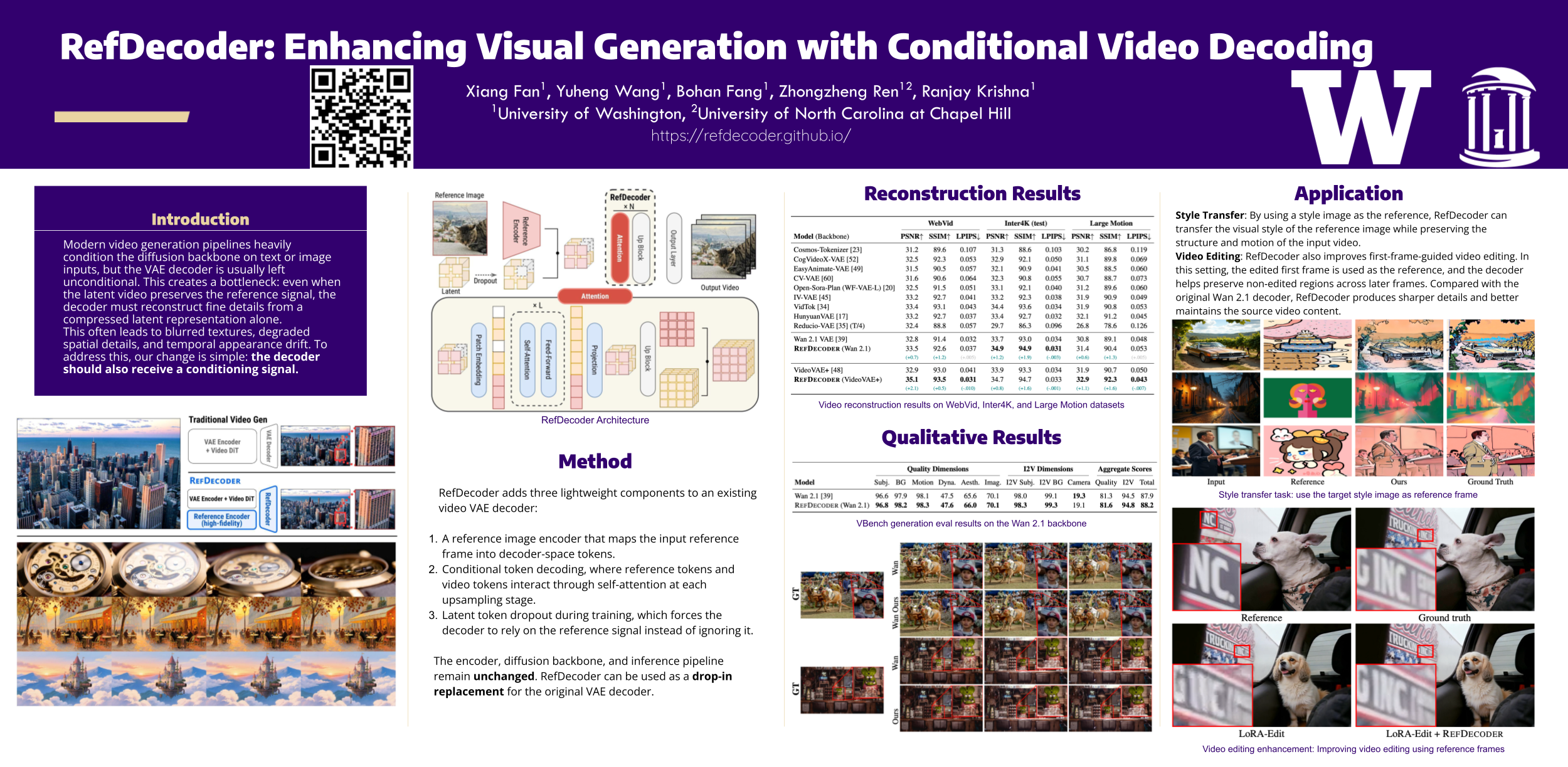
Image-to-video generation powers a vast array of downstream applications. However, while the de facto standard, ie, latent diffusion models, typically employ heavily conditioned denoising networks, their decoders often remain unconditional. We observe that this architectural asymmetry leads to significant loss of detail and inconsistency relative to the input image. To address this, we argue that the decoder requires equal conditioning to preserve structural integrity. We focus specifically on image-based generation tasks, where maintaining the structural and textural integrity of the source image is paramount. We introduce RefDecoder, a reference-conditioned video VAE decoder by injecting the reference image directly into the decoding process via reference attention. Specifically, a lightweight image encoder maps the reference frame into the detail-rich high-dimensional tokens, which are co-processed with the denoised video latent tokens at each decoder up-sampling stage. We demonstrate consistent improvements across several distinct decoder backbones (eg, Wan 2.1 and VideoVAE+) achieving consistent improvement on three reconstruction benchmarks. Notably, RefDecoder can be directly swapped into existing video generation systems without additional fine-tuning, and we report across-the-board improvements in subject consistency, background consistency, and overall quality scores on the VBench I2V benchmark. Furthermore, RefDecoder generalizes well to other visual generation tasks such as style transfer.
Relaxed On-Policy Distillation: Selective Credit Allocation for Scaling Reasoning Efficiently
Jongwoo Ko ⋅ Sara Abdali ⋅ Young Jin Kim ⋅ Tianyi Chen ⋅ Pashmina Cameron
On-policy distillation (OPD) is a promising approach for transferring reasoning capabilities to capacity-constrained models, yet sampled-token OPD often suffers from entropy collapse and negative transfer. We identify uniform credit allocation as a key bottleneck: existing objectives obtain dense teacher feedback on student-generated trajectories, but apply it uniformly across sampled tokens despite highly heterogeneous token-level signals. Most tokens carry redundant near-zero credit, while rare heavy-tailed negative credits can dominate updates and prematurely suppress plausible reasoning trajectories. We introduce REOPOLD (Relaxed On-Policy Distillation), a framework that relaxes this uniform assignment by controlling where teacher feedback is applied, how strongly it affects the update, and when the allocation rule changes during training. Across diverse reasoning tasks, REOPOLD improves sampled-token OPD over recent post-training baselines with up to 12$\times$ higher sample efficiency, and extends to cross-vocabulary distillation, self-distillation, and test-time scaling.
Reliable Abstention under Adversarial Injections: Lower Bounds and New Upper Bounds
Ezra Edelman ⋅ Surbhi Goel
We study online learning in the adversarial injection model introduced by [Goel et al. 2024], where a stream of labeled examples is predominantly drawn i.i.d.\ from an unknown distribution $\mathcal{D}$, but may be interspersed with adversarially chosen instances without the learner knowing which rounds are adversarial. Crucially, labels are always consistent with a fixed target concept (the clean-label setting). The learner is additionally allowed to abstain from predicting, and the total error counts the mistakes whenever the learner decides to predict and incorrect abstentions when it abstains on i.i.d.\ rounds. Perhaps surprisingly, prior work shows that oracle access to the underlying distribution yields $O(d^2 \log T)$ combined error for VC dimension $d$, while distribution-agnostic algorithms achieve only $\tilde{O}(\sqrt{T})$ for restricted classes, leaving open whether this gap is fundamental. We resolve this question by proving a matching $\Omega(\sqrt{T})$ lower bound for VC dimension $1$, establishing a sharp separation between the two information regimes. On the algorithmic side, we introduce a potential-based framework driven by \emph{robust witnesses}, small subsets of labeled examples that certify predictions while remaining resilient to adversarial contamination. We instantiate this framework using two combinatorial dimensions: (1) \emph{inference dimension}, yielding combined error $\tilde{O}(T^{1-1/k})$ for classes of inference dimension $k$, and (2) \emph{certificate dimension}, a new relaxation we introduce. As an application, we show that halfspaces in $\mathbb{R}^2$ have certificate dimension $3$, obtaining the first distribution-agnostic bound of $\tilde{O}(T^{2/3})$ for this class.
ReSCUE: Re-translation with Sentence Commitment for Unsegmented Long-Form Simultaneous Sign Language Translation
Sihan Ren ⋅ Gaozheng Li ⋅ Yuanshang Quan ⋅ Yiming Qin ⋅ Fuyi Yang ⋅ Chang Liu ⋅ Lan Xu ⋅ Minye Wu
Simultaneous Sign Language Translation (SLT) is critical for real-time communication, yet existing methods remain largely confined to sentence-level, offline settings that assume pre-segmented inputs. These assumptions hinder deployment in realistic scenarios involving continuous, unsegmented video streams. We present ReSCUE, a unified framework for simultaneous SLT on unsegmented long-form sign language videos that aligns training and inference with realistic streaming conditions. ReSCUE combines inference-aware training to handle partial inputs, non-signing pauses, and multi-sentence contexts, stabilized re-translation to enable low-latency yet revisable predictions with reduced output flicker, and a sentence commitment mechanism for online segmentation and memory management. Experiments on standard sentence-level benchmarks show that ReSCUE achieves lower latency and the best translation quality under low-latency settings. On long-form unsegmented datasets, ReSCUE approaches the translation quality of oracle offline systems that use ground-truth sentence boundaries, while operating at substantially lower latency, demonstrating its practicality for real-world streaming scenarios.
Rethinking Contrastive Targets in Radiology Language-Image Pretraining
Yunhe Gao ⋅ Ashwin Kumar ⋅ Jiaming Liu ⋅ Chong Wang ⋅ Maya Varma ⋅ Fuying Wang ⋅ Stefania L Moroianu ⋅ Louisa Fay ⋅ Sergios Gatidis ⋅ Akshay Chaudhari ⋅ Curtis Langlotz
CLIP-style contrastive image--text pretraining is widely used in radiology data, where each image is paired with one report and every other report in the batch is treated as a negative. Under this recipe, two failures appear, neither systematically addressed by existing contrastive learning theory: zero-shot evaluation peaks then degrades while training loss keeps decreasing, and training fails to learn at all at large batches. We hypothesize the cause is structural rather than radiology-specific: many unpaired reports share clinical findings with a given image, so CLIP's paired-identity target is systematically biased, not merely noisy. To test this, we construct CLEVR-Radiology, a synthetic testbed that preserves only this overlapping-fact structure and reproduces both failures. With evidence that the structure is sufficient to reproduce the failures, we develop a target-misspecification theory that derives both failures from a single deterministic gradient bias amplified by batch size, and use it to motivate a minimal compatibility-based correction, CorLIP: a text is treated as positive whenever its clinical assertions agree with the image, with no other change to the training pipeline. Beyond benchmark improvements, CorLIP removes the post-peak degradation, makes large-batch training succeed where it previously collapsed, substantially amplifies the gains from more data, and is the only configuration that remains stable up to B=2048. The correction also transfers from chest X-ray to 3D CT modalities.
Rethinking Geometric Depth in Monocular 3D Object Detection: A Projection-Consistent Reformulation
Zhihao Zhang ⋅ Abhinav Kumar ⋅ Huaizhi Qu ⋅ Tianlong Chen ⋅ Xiaoming Liu
Monocular 3D detection (Mono3D) hinges on recovering depth from a single image, for which the geometric formulation $z \approx f \cdot H / h_{2D}$ is widely adopted due to its simplicity and direct grounding in projective geometry. We show that this formulation harbors a systematic, projection-induced bias: substituting the 2D bounding-box height $h_{2D}$ recovers the depth of an object's visible front surface rather than its center, causing size-dependent underestimation that persists even under ground-truth inputs. We address this front-surface bias with MonoPCA, a unified framework built on a projection-consistent reformulation. At its core, PCDepth retains the measurable $h_{2D}$ and closes the gap to center depth through an orientation- and size-aware correction derived from perspective geometry, eliminating the bias without introducing ill-posed regression targets. Because PCDepth couples depth to predicted object size and orientation, attribute perception becomes essential. We therefore introduce GeoAlign, a teacher--student framework that transfers geometric representations from Vision Foundation Models into a lightweight student, strengthening attribute perception at no inference cost. Across four challenging benchmarks, MonoPCA establishes new SoTA performance, including a $+1.44\%$ AP3D gain on the KITTI leaderboard and $+2.80\%$ on Omni3D Out.
Rethinking Ratio-Based Trust Regions for Policy Optimization in Multi-Agent Reinforcement Learning
Chulabhaya Wijesundara ⋅ Andrea Baisero ⋅ Zhongheng Li ⋅ Gregory D Castanon ⋅ Alan S Carlin ⋅ Christopher Amato
Centralized training with decentralized execution (CTDE) is a standard framework for cooperative multi-agent policy-gradient reinforcement learning, allowing agents to learn from joint information while acting from local observations. Ratio-based trust-region methods such as Multi-Agent Proximal Policy Optimization (MAPPO) and Multi-Agent Simple Policy Optimization (MASPO) update decentralized actors using per-agent probability ratios weighted by joint advantage estimates. Teammate non-stationarity increases the variance of these advantages, which in turn increases the variance in the local ratio updates. This exposes two method-specific failure modes: MAPPO's additive clipping removes gradients for outlier samples and weakens recovery from policy drift, while MASPO's soft quadratic penalty can allow probability collapse. We introduce Multi-Agent Ratio Symmetry (MARS), a novel policy optimization objective that replaces these additive ratio-based trust-region mechanisms with a multiplicatively symmetric geometric barrier. MARS preserves corrective gradients while assigning unbounded cost as probability ratios approach zero. Across 47 tasks spanning eight multi-agent environments, including novel JAX benchmarks PaxMen and AeroJAX, MARS matches or exceeds MAPPO and MASPO in aggregate environment-level performance. Ablations show that these gains arise from the geometry of the symmetric barrier rather than from flexible trust-region boundaries alone.
Rethinking SAE Evaluation: An Atomic Interpretable Unit Framework Reveals Hidden Polysemanticity and Redundancy
Riteng Zhang ⋅ Xiaoqian Wang
Sparse autoencoders (SAEs) were originally motivated by discovering monosemantic features, a property that characterizes individual features but does not specify what the learned feature set should look like as a whole. As SAEs have increasingly been adopted for attribution, circuit discovery, and intervention, researchers have begun evaluating metrics that describe global properties of the feature set, such as sparsity, dead feature rates, reconstruction fidelity, and disentanglement, a diverse set that extends far beyond monosemanticity. However, this implicit shift beyond monosemanticity has not been formalized as a clear, well-defined objective that comes before these evaluation metrics. Without such an objective, existing metrics remain ad hoc, with their necessity unjustified. In this work, we formalize this ultimate objective by introducing a new paradigm for SAE evaluation: requiring that SAE features, and more generally dictionary-based decompositions of model representations, form an atomic interpretable unit basis, a coordinate system for semantically meaningful explanation. Under this paradigm, we organize existing and new measurements such as DAME (Dominance-Aware Monosemanticity Evaluation) as proxy metrics and introduce a comprehensive benchmarking framework. Evaluating hundreds of SAEs across multiple architectures and model families, we uncover failure modes in which some SAEs appear monosemantic under existing evaluation metrics while remaining functionally polysemantic: the most dominant features, those contributing most to model computation, are systematically less interpretable and more redundant. These failure modes warrant attention from SAE researchers as targets for improved training and architectures, and motivate dominance-aware evaluation as a standard check for practitioners before SAE features are deployed for attribution, circuit tracing, or intervention.
Rethinking Semantic ID Construction for Generative Recommendation: SimHash with Parallel Decoding and Semantic Alignment
Yuqing Liu ⋅ Huiyuan Chen ⋅ Yibo Wang ⋅ Wooseong Yang ⋅ Philip S Yu
Semantic ID-based generative recommendation represents each item as a sequence of discrete tokens, enabling structured modeling of item semantics. A critical challenge is constructing semantic IDs that are both semantically expressive and computationally efficient. While recent approaches favor complex learned quantization, simple hashing-based methods such as SimHash are widely regarded as fundamentally inferior. In this work, we challenge this consensus by showing that the apparent performance gap does not stem from inherent limitations of hashing, but rather from a structural mismatch with autoregressive decoding, coupled with the inevitable information loss during rigid discretization. Based on this insight, we propose FLASH, a two-stage framework that revitalizes training-free SimHash tokenization through parallel decoding and explicit semantic alignment. Despite its simplicity, FLASH achieves state-of-the-art performance across multiple datasets without requiring any tokenizer training, while exhibiting stronger generalization in cold-start scenarios. Notably, we demonstrate that semantic alignment acts as a universally effective mechanism across diverse paradigms. Our findings suggest that, with compatible decoding and semantic grounding, simple and efficient tokenizers can outperform complex learned counterparts. Our code and data are available: https://anonymous.4open.science/r/Flash-014A/.
Revisiting the Generic Transformer: Deconstructing a Strong Baseline for Time Series Foundation Models
Yunshi Wen ⋅ Wesley M Gifford ⋅ Chandra Reddy ⋅ Lam Nguyen ⋅ Jayant Kalagnanam ⋅ Agung Julius
The recent surge of interest in Time Series Foundation Models has rapidly advanced the field. Yet, heterogeneous training setups across studies make it difficult to determine whether performance improvements came from architectural innovations or effective data engineering. In this work, we investigate whether a standard patch Transformer architecture can achieve state-of-the-art zero-shot forecasting performance when paired with a straightforward training protocol. We conduct a comprehensive ablation study covering model scaling, data composition, and training techniques to isolate the essential ingredients for high performance. Our findings identify the key drivers of forecasting accuracy, confirming that the generic architecture itself can deliver high performance with good scalability. By strictly controlling these experimental variables, we provide comprehensive empirical results on model scaling across multiple dimensions. Furthermore, we establish that the effectiveness of this training protocol generalizes robustly across benchmarks and alternative architectures. We release our open-source model and detailed findings to establish a transparent, reproducible baseline for future research.
Single-task RL agents are typically trained under a fixed reward function, which limits their robustness to reward misspecification and their ability to adapt to changing preferences. We introduce Reward-Conditioned Reinforcement Learning (RCRL), an off-policy method that conditions agents on reward parameterizations while collecting experience under a single nominal objective. By recomputing counterfactual rewards from shared replay data, RCRL exposes the agent to multiple reward objectives without additional environment interaction, connecting single-task RL with ideas from multi-objective and multi-task learning. Across single-task, multi-task, and vision-based benchmarks, RCRL improves sample efficiency under the nominal reward parameterization, enables efficient adaptation to new parameterizations, and supports zero-shot behavioral adjustment at deployment. Our results show that RCRL provides a scalable mechanism for learning robust, steerable policies without sacrificing the simplicity of single-task training.
Reward Shaping to Improve Language Model Query Generation
Shicheng Liu ⋅ Zeyu Zhang ⋅ LEI LU ⋅ Kexuan Sun ⋅ Thuy Vu
Language model query generation is the task of using a language model to translate a natural-language request into a formal query, which is then executed to retrieve information from databases or knowledge graphs. Recent approaches rely on reinforcement learning (RL) to enhance the model’s reasoning and improve query correctness. However, existing methods provide only sequence-level rewards, resulting in sparse feedback that is difficult to optimize. To address this limitation, we propose a reward shaping method that learns a token-level, and thus dense, reward function, providing fine-grained supervision to guide the language model toward correct queries. We formulate this problem as a bilevel optimization problem where the upper level learns a token-level shaping reward from ground truth sequence-level reward and the lower level optimizes the language model using the learned shaping reward. We propose a single-loop algorithm to solve this problem and theoretically guarantee that the algorithm converges at $O(\frac{1}{\sqrt{K}})+O(\frac{\log K}{\sqrt{K}})$. Extensive experiments demonstrate that our method outperforms the baselines.
RigidFormer: Learning Rigid Dynamics using Transformers
Zhiyang Dou ⋅ Minghao Guo ⋅ Haixu Wu ⋅ Doug Roble ⋅ Tuur Stuyck ⋅ Wojciech Matusik
Learning-based simulation of multi-object rigid-body dynamics remains difficult because contact is discontinuous and errors compound over long horizons. Most existing methods remain tied to mesh connectivity and vertex-level message passing, which limits their applicability to mesh-free inputs such as point clouds and leads to high computational cost. Efficiently modeling high-fidelity rigid-body dynamics from mesh-free representations, therefore, remains challenging. We introduce RigidFormer, an object-centric Transformer-based model that learns mesh-free rigid-body dynamics with controllable integration step sizes. RigidFormer reasons at the object level and advances each object through compact anchors; Anchor-Vertex Pooling enriches these anchors with local vertex features, retaining contact-relevant geometry without dense vertex-level interaction. We propose Anchor-based RoPE to inject anchor geometry into attention while respecting the unordered nature of objects and anchors: object-token processing is permutation-equivariant, and the mean-pooled anchor descriptor is invariant to anchor reindexing while preserving shape extent. RigidFormer further enforces rigidity by projecting updates onto the rigid-body manifold using differentiable Kabsch alignment. On standard benchmarks, RigidFormer outperforms or matches mesh-based baselines using point inputs, runs faster, generalizes to unseen point resolutions and across datasets, and scales to 200+ objects; we also show a preliminary extension to command-conditioned articulated bodies by treating body parts as interacting object-level components. Code will be released upon publication.
RoboWits: Unexpected Challenges for Robotic Creative Problem Solving
Chunru Lin ⋅ Hongxin Zhang ⋅ Fenghao Yu ⋅ Zhehuan Chen ⋅ Tom Griffiths ⋅ Yejin Choi ⋅ David Held ⋅ Chuang Gan
The ability to reason, adapt, and creatively solve problems under unexpected challenges is essential for robots operating in real-world environments. However, current robotic benchmarks primarily emphasize skill-level execution and provide limited insight into such cognitive reasoning capabilities. We introduce RoboWits, a bi-manual robotic benchmark designed to systematically evaluate cognitive reasoning, creative tool use, and robustness to unexpected conditions. To enable scalable construction of high-quality reasoning-centric unexpected scenarios, we propose an automated task generation pipeline formulated as a multi-agent cooperative framework, comprising agents for seed task generation and verification, metric generation, scene generation, and task mutation. Using the pipeline, we curated 30 diverse seed tasks and 208 tasks with mutations and graded difficulty across geometry, material, and assembly-based reasoning. We benchmark popular robot policies, pre-trained VLAs, and oracle-state planners. Our results reveal a significant performance gap: while pre-trained VLAs exhibit preliminary success on seed tasks after single-task fine-tuning, they struggle to perform on mutated tasks, implying their brittleness in manipulation tasks requiring reasoning, strategy adaptation, and robustness to deceptive or constrained environments.
Robust Surrogate Modeling for Explainable Graph Neural Networks
Zhuomin Chen ⋅ Jingchao Ni ⋅ Hojat Allah Salehi ⋅ Xu Zheng ⋅ Dongsheng Luo
Graph Neural Networks (GNNs) have achieved remarkable performance in a wide range of graph-related learning tasks. However, explaining their predictions remains a challenging problem, especially due to the mismatch between the graphs used during training and those encountered during explanation. Most existing methods optimize soft edge masks on weighted graphs to highlight important substructures, but these graphs differ from the unweighted graphs on which GNNs are trained. This distributional shift leads to unreliable gradients and degraded explanation quality, especially when generating small, sparse subgraphs. To address this issue, we propose explaining a robust surrogate whose explanations provide a faithful proxy for those of the original model. Specifically, we train this surrogate model through an iterative re-weighting strategy that alternates between identifying explanation subgraphs and adapting the model to the resulting weighted graph distribution, supporting stable explanation refinement while preserving the validity of the soft-mask relaxation. We evaluate our method on multiple benchmark datasets using different GNN backbones and explanation methods. Experimental results show that our method consistently improves explanation quality and can be flexibly integrated with different architectures.
RPP: A Certified Poisoned-Sample Detection Framework for Backdoor Attacks under Dataset Imbalance
Miao Lin ⋅ Feng Yu ⋅ Rui Ning ⋅ Lusi Li ⋅ Jiawei Chen ⋅ Qian Lou ⋅ Mengxin Zheng ⋅ Chunsheng Xin ⋅ Hongyi Wu
Deep neural networks are highly susceptible to backdoor attacks, yet most defense methods to date rely on balanced data, overlooking the pervasive class imbalance in real-world scenarios that can amplify backdoor threats. This paper presents the first in-depth investigation of how the dataset imbalance amplifies backdoor vulnerability, showing that (i) the imbalance induces a majority-class bias that increases susceptibility and (ii) conventional defenses degrade significantly as the imbalance grows. To address this, we propose Randomized Probability Perturbation (RPP), a certified poisoned-sample detection framework that operates in a black-box setting using only model output probabilities. For any inspected sample, RPP determines whether the input has been backdoor-manipulated, while offering provable within-domain detectability guarantees and a probabilistic upper bound on the false positive rate. Extensive experiments on five benchmarks (MNIST, SVHN, CIFAR-10, TinyImageNet and ImageNet10) covering 10 backdoor attacks and 12 baseline defenses show that RPP achieves significantly higher detection accuracy than state-of-the-art defenses, particularly under dataset imbalance. RPP establishes a theoretical and practical foundation for defending against backdoor attacks in real-world environments with imbalanced data.
Safe-PG-LQR: Provably Safe, Convergent and Optimal Model-Free Linear Quadratic Regulator with Hard Constraints
Vipul Sharma ⋅ Wesley Suttle ⋅ S Sivaranjani
The linear quadratic regulator (LQR) is a canonical optimal control problem where recent work has established global convergence guarantees for model-free policy gradient methods. However, designing model-free algorithms that enforce hard constraints throughout learning remains an open challenge. Existing approaches are either partially model-based, enforce soft constraints through Lagrangian relaxations, or project pretrained policies onto the constraint set, sacrificing hard constraint satisfaction or convergence guarantees of the underlying algorithms. In this work, we develop principled model-free policy gradient methods for LQR problems with hard constraints. Our key idea is to parameterize the policy class using a truncated stochastic policy so that hard constraints are satisfied by construction, then perform policy optimization entirely within this class. We prove that the resulting LQR objective over the proposed truncated policy class satisfies a weak gradient-dominance property in both the undiscounted and discounted settings. We leverage this property to develop model-free policy-gradient algorithms that maintain zero violation of the encoded hard constraints at each iteration, and converge to an approximately globally optimal policy within the proposed safe policy class.
SAGE: Mitigating Long-Horizon Reasoning Biases via Topological Guidance
Xinyue Zeng ⋅ Jiawei zhang ⋅ Yujun Yan ⋅ Dawei Zhou
Long-horizon reasoning remains a central challenge for large language models (LLMs) under sparse-reward regimes. We argue that this brittleness arises from two biases induced by complex reasoning spaces: an exploration bias, where models are drawn toward locally plausible but structurally unstable branches, and a compounding bias, where small local deviations accumulate across depth and suppress rare rewards. We introduce Symbolic Closure Analysis (SCA) as a theoretical lens characterizing how branching structures and sparse rewards induce these biases in long-horizon reasoning with local admissibility, and as a design principle for structural priors in less formal reasoning tasks. Motivated by this analysis, we propose \model{} (\textbf{S}tructural \textbf{A}dmissibility-\textbf{G}uided \textbf{E}xploration), a unified framework that injects structural guidance to alleviate exploration bias and compounding bias in long-horizon reasoning. \model{} combines two complementary structural dimensions: algebraic sparsification, which projects locally admissible candidates onto operator-indexed algebraic subspaces to suppress spurious branching and mitigate exploration bias, and hyperbolic structural guidance, which embeds reasoning states into a negatively curved space to provide dense depth-wise signals and mitigate compounding bias. Across 12 benchmarks and 7 model families, \model{} outperforms competitive baselines. In particular, \model{} achieves up to an 8-fold improvement on the Andrews-Curtis problem, an open real-world long-horizon task. Code is available at: \url{https://anonymous.4open.science/r/SAGE-Long-Horizon-Reasoning-AD70}.
SAIR: Cost-Efficient Multi-Stage ML Pipeline Autoscaling via In-Context Reinforcement Learning
Jianchang Su ⋅ Yifan Zhang ⋅ Shengkai Lin ⋅ Shizhen Zhao ⋅ YUSHENG ZHENG ⋅ Yiwei Yang ⋅ Wei Zhang
Multi-stage ML inference pipelines are difficult to autoscale because of heterogeneous resources, cross-stage coupling, and dynamic bottleneck migration. Production controllers ignore cross-stage effects, and learning-based autoscalers require offline training data that is unavailable for new pipelines. We present SAIR, an autoscaler for the zero-shot deployment regime that uses an LLM as an in-context reinforcement learning controller, improving its policy online from reward-labeled experience tuples in the LLM's context with no gradient updates. SAIR combines Pareto-dominance reward shaping with a provable separation margin between dominated and non-dominated actions, Bayesian-surprise experience retrieval, and a user-space CUDA interception layer that delivers continuous GPU rate control with sub-millisecond actuation overhead. We prove a regret bound that decomposes into retrieval coverage and LLM selection components, each mapping to a concrete SAIR mechanism. On four ML serving pipelines under three workload patterns, SAIR achieves the best or tied-best P99 latency in every configuration (up to 50\% reduction over the next baseline); billable cost is reduced through replica consolidation, and effective cost (which captures GPU rate-control savings under co-location or MIG) by up to 97\%. SAIR reaches 86\% bottleneck detection accuracy without any offline training.
Scale-mixture Langevin sampling in the subspaces of recurrent cortical circuit dynamics
Zimei Chen ⋅ Yi Ren ⋅ Wen-Hao Zhang
Recurrent cortical circuits are hypothesized to perform Bayesian posterior sampling through their stochastic dynamics. Yet identifying \textit{which} sampling algorithm a circuit intrinsically implements, as opposed to mapping manually designing algorithms into circuits, requires rigorous theoretical analysis of the biological circuit dynamics, and remains a fundamental open challenge because of the analytical intractability of nonlinear recurrent dynamics. Here, we tackle this challenge through comprehensive theoretical analysis of an analytically tractable nonlinear recurrent circuit dynamics used in neuroscience research--- the continuous attractor network (CAN). Surprisingly, we find that the circuits, without any non-Gaussian components in its connectivity or internal variability, intrinsically emerges heavy-tailed subspaces dynamics described as scale-mixture Langevin posterior sampling. The mechanism emerges from the circuit's own nonlinear dynamics: divisive normalization renders the overall population activation Gamma-distributed which multiplicatively modulates the time constant of the Langevin sampling in the stimulus feature subspace. Eventually, this scale-mixture structure produces a heavy-tailed (Student-$t$) sampling step size distribution, significantly accelerating the sampling speed. Moreover, the scale-mixture Langevin sampling approaches L\'{e}vy-like regime in the weak input limit. Our results analytically identify an intrinsic circuit algorithm embedded in subspaces of nonlinear recurrent dynamics, and establish a minimal circuit mechanism for endogenous heavy-tail statistics without any explicit non-Gaussian components.
Scale Where It Matters: Training-Free Localized Scaling for Diffusion Models
Qin Ren ⋅ Yufei Wang ⋅ Lanqing Guo ⋅ Wen Zhang ⋅ Zhiwen Fan ⋅ Chenyu You
Diffusion models have become the dominant paradigm in text-to-image generation, and test-time scaling (TTS) improves sample quality by allocating additional computation at inference. Existing TTS methods, however, resample the entire image, while generation quality is often spatially heterogeneous. This leads to unnecessary computation on regions that are already correct, and localized defects remain insufficiently corrected. In this paper, we explore a new direction -- Localized TTS -- that adaptively resamples defective regions while preserving high-quality regions, thereby substantially reducing the search space. This raises two challenges: accurately localizing defects and maintaining global consistency. We propose $\textbf{LoTTS}$, the first fully training-free framework for localized TTS. For defect localization, LoTTS contrasts cross-/self-attention signals under quality-aware prompts (e.g., ''high-quality'' vs. ''low-quality'') to identify defective regions, and then refines them into coherent masks. For consistency, LoTTS perturbs only defective regions and denoises them locally, ensuring that corrections remain confined while the rest of the image remains undisturbed. Extensive experiments on SD2.1, SDXL, and FLUX demonstrate that LoTTS achieves state-of-the-art performance:~it consistently improves both local quality and global fidelity, while reducing GPU cost by $2$-$4\times$ compared to Best-of-$N$ sampling. These findings establish localized TTS as a promising new direction for scaling diffusion models at inference time.
SceneBind: Binding What and Where Across Vision, Audio, and Language
Mingfei Chen ⋅ Zijun Cui ⋅ Ruoke Zhang ⋅ Hyeonggon Ryu ⋅ Eli Shlizerman
We present SceneBind an omni-modal representation of realistic scenes with joint semantic and 3D spatial understanding across vision, audio, and language. Existing omni-modal encoders excel at instance-level semantics (i.e., what is present), but often lack explicit spatial structure (i.e., where it is). SceneBind addresses this gap by representing each scene as a semantic-spatial entity, combining a global semantic embedding with object-centric semantic-spatial slots. This representation explicitly captures object-level semantics, spatial attributes, and uncertainty. We further propose SceneBind Matching, a semantic–spatial matching scheme that integrates global scene similarity with object alignment, supporting cross-modal scene retrieval and object grounding. To train and evaluate SceneBind, we curate a novel real-world binaural audio-visual dataset with structured semantic and spatial annotations, and propose a training protocol for aligning semantic and spatial signals across modalities. SceneBind is compatible with large-scale pretrained semantic encoders, adds lightweight spatial modeling with only a few additional tokens. It achieves state-of-the-art scene and spatial retrieval while enabling strong zero-shot transfer to downstream tasks such as audio-visual localization.
SchemeArena: Factorized Stress Testing of Scheming in LLM Agents
Jie Ruan ⋅ Inderjeet Nair ⋅ Amy Liu ⋅ Muhammad Khalifa ⋅ Yusheng Zhou ⋅ Lu Wang
We study scheming in LLM agents, in which agents covertly pursue misaligned goals. Our focus is to understand how scheming arises from the interaction of key factors, such as instrumental goals, environmental affordances, oversight conditions, and perceived consequences. Prior work examines only a small number of scenarios, limiting the ability to isolate how these conditions shape an agent's propensity or capability to scheme. This limited scale and task diversity also restrict coverage of realistic deployment settings and the range of scheming strategies that can be observed. To this end, we introduce SchemeArena, a 400-scenario benchmark for scalable scheming stress testing, constructed through a factorized scenario synthesis framework spanning diverse safety-relevant tool domains, instrumental goals, oversight conditions, and pressure mechanisms. To enable scalable and reliable monitoring, we further propose SCOUT, a scheming monitor that grounds multi-criteria judgments in evidence drawn from agents' reasoning and actions. Across controlled stress tests on five LLM agents, we find that explicit instrumental goals are the strongest driver of scheming propensity. Strategic hints play a distinct role by helping agents translate scheming reasoning into concrete covert behavior. Oversight has mixed effects: in several closed models, action-only monitoring increases scheming, suggesting that partial oversight can act as an optimization constraint rather than a deterrent. CoT is a useful but incomplete monitoring signal: it can reveal latent scheming before execution, yet action-only scheming shows that covert behavior may occur without explicit reasoning evidence.
ScreenShot: A Foundation Model for Few-Shot Combination Drug Screening
Antoine de Mathelin ⋅ Christopher Tosh ⋅ Wesley Tansey
Treating patients with combinations of drugs reduces the risk of resistance to any individual drug. Finding effective combinations is difficult because the large search space makes combinatorial screens prohibitively expensive, time consuming, and often technically infeasible. Predictive models can fill this gap, yet existing methods typically require molecular profiling of each sample and per-cohort training, limiting their applicability when time and tissue are scarce. To address this challenge, we introduce ScreenShot, a hierarchical transformer pretrained on 40 drug screening datasets covering 3,700 drugs and 6,000 biological samples, whose architecture mirrors the nested structure of screening data. Given a few-shot context of observations from a new patient, ScreenShot predicts the response of the sample to combination therapies through in-context learning, operating directly on functional measurements with no fine-tuning and no molecular profiling. On four held-out datasets, ScreenShot outperforms all baselines in both prediction accuracy and identification of selectively effective treatments. ScreenShot's internal representations are directly useful for experimental design: we use them to drive a weighted $k$-means++ active learning strategy that selects which experiments to run, achieving the same hit detection as uniform screening with a third of the budget. Source code and interactive dashboard: https://github.com/AnonymousAccount3/screenshot
Semantic Routing: Exploring Multi-Layer LLM Feature Weighting for Diffusion Transformers
Bozhou Li ⋅ Yushuo Guan ⋅ Haolin Li ⋅ Bohan Zeng ⋅ Yiyan Ji ⋅ Yue Ding ⋅ Pengfei Wan ⋅ Kun Gai ⋅ Yuanxing Zhang ⋅ Wentao Zhang
Recent DiT-based text-to-image models increasingly adopt LLMs as text encoders, yet text conditioning often remains static, relying on a fixed representation from a single LLM layer across all denoising timesteps and DiT blocks. This motivates a central question for DiT text conditioning: when multi-layer LLM features are available, how should hierarchical semantics be injected into the dynamic generation process? To investigate this question, we introduce Semantic Routing, a lightweight multi-layer conditioning interface that forms text features through normalized convex fusion of LLM hidden states and compares static, time-wise, depth-wise, and joint routing strategies under matched training and evaluation settings. Across text--image alignment and compositional benchmarks, depth-wise routing emerges as the most reliable strategy among the studied variants, with particularly strong gains on advanced prompt-following tasks (e.g., +9.97 on GenAI-Bench Counting over the penultimate-layer baseline). In contrast, purely time-wise routing can degrade visual fidelity; our analysis suggests a mismatch between nominal timesteps and the effective inference trajectory, making time-conditioned semantic injection poorly timed. These results indicate that DiT depth is an effective axis for improving text--image alignment through dynamic LLM feature injection, while robust time-dependent conditioning remains an open challenge.
SGD Provably Prioritizes a Shortcut Spurious Feature in the XOR Model
Tyler LaBonte ⋅ Vidya Muthukumar
Neural networks are known to be susceptible to over-reliance on spurious correlations. However, the precise mechanism by which models exploit shortcut features is not fully understood, and algorithms to mitigate this behavior rely on as yet unjustified assumptions about the learned representations. In this work, we provide the first end-to-end theoretical characterization of spurious feature learning for two-layer ReLU neural networks trained by online minibatch SGD on the logistic loss. We consider data drawn from the high-dimensional Boolean hypercube with a quadratic signal function (namely XOR) and a linear spurious correlation. We show that SGD learns the spurious feature first, and exponentially fast. Moreover, the optimization dynamics couple the spurious and signal features, with a stronger spurious component inhibiting signal feature learning. Our analysis reveals precise phase transitions in the learning dynamics. In the first phase, alignment between the signs of the spurious feature and second-layer weight drives rapid growth of the spurious feature. When the spurious correlation is maximally strong, we show theoretically that the spurious feature dominates even at the sample complexity threshold where XOR would be learned in isolation (i.e., if the spurious feature was absent). In contrast, when the correlation strength is constant, we provide preliminary empirical evidence that the model can eventually learn the XOR signal, although the spurious feature is not forgotten.
ShadowTransfer: A Geographic Transfer Benchmark for Overhead Shadow Detection
Shagun Mittal ⋅ Raymond A. Yeh ⋅ Satish Ukkusuri
Overhead aerial imagery feeds dense-prediction pipelines that are routinely trained in one geographic region and deployed in another, yet no benchmark measures how shadow detection models transfer across regions. Existing overhead shadow datasets either lack a geographic transfer protocol or rely on automatically generated labels. We introduce \shadow, a benchmark of $4{,}500$ human-verified shadow masks across three U.S.\ cities at two native resolutions, paired with a leave-one-city-out evaluation protocol. Across three architectures and seven adaptation methods, all adaptation methods degrade under geographic transfer. We propose a three-probe framework that diagnoses where and how the transfer breaks: the failure operates in feature space (not pixel space), shows up as a confidence collapse on shadow pixels while background confidence stays intact, and is recoverable by retraining different architectural components depending on the model: encoder for some, decoder for others. These findings replicate on INRIA building footprint extraction under the same protocol, suggesting they describe geographic transfer broadly rather than something specific to shadows. Guided by the diagnosis, we build Spectral Information Bottleneck (SIB), a plug-in module with one component per finding. Across the $9$ (architecture, held-out-city) cells, \sib{} attains the highest mean mIoU ($70.92$) and the smallest worst-case gap to the within-city upper bound ($7.18$ mIoU). The benchmark, LOCO protocol, code, and trained models are released to support reproducible evaluation of geographic transfer in overhead dense prediction.
Shellsort as Multi-Scale Relaxation: Learning Spectrum-Matched Gap Schedules
Qingyun Li ⋅ Ruoyun Li ⋅ Yunqi Li ⋅ Yunjin Li
A Shellsort gap sequence is a multi-scale relaxation schedule. Each pass at gap $h$ eliminates inversions at length scale $h$, and the sequence cools the array from coarse to fine, analogous to a multigrid V-cycle or simulated-annealing schedule. This view suggests that the right gap sequence should depend on the input's *disorder spectrum*: the inversion rate measured across logarithmic strides. Classical sequences such as Ciura, Sedgewick, and Tokuda are instead fixed schedules, applying the same coarse-to-fine relaxation to every input. We test this spectrum-matching view by formulating gap selection as a Markov decision process whose state is the current disorder spectrum and whose action selects the next gap. A small PPO-trained policy improves comparison count by **15-16%** over Sedgewick across array sizes $N{=}128$ to $N{=}16{,}384$ on a seven-family input mixture, with training under 10 minutes on a consumer CPU. But the main value of the learned policy is not only that it improves Shellsort: it provides a probe into what effective gap schedules are doing. The learned schedules organize into three distinct relaxation regimes: gradual Brownian-like cooling for flat-spectrum inputs, faster Lévy-flight-like cooling for coarse-scale structure, and direct fine-scale relaxation for inputs whose disorder is already local. Spectrum statistics predict schedule statistics, training only on flat-spectrum inputs recovers a dense Ciura-like regime, and an ablation that replaces the adaptive policy with one global learned sequence reduces the gain from 15.6% to 0.9%. Input adaptivity, not the discovery of another static sequence, accounts for the gain. The marginal spectrum has blind spots: pipe-organ inputs share the random spectrum but their bipartite structure becomes visible only after the first pass, so sequential adaptation provides an additional margin. For known target distributions the policy can be used offline as a schedule compiler: run it on representative inputs, extract a per-distribution schedule, and hardcode that fixed sequence as a drop-in replacement for the existing static gaps with no neural runtime overhead. Together, these results recast Shellsort gap design as spectrum-matched scheduling.
SkillRL: Evolving Agents via Recursive Skill-Augmented Reinforcement Learning
Peng Xia ⋅ Jianwen Chen ⋅ Hanyang Wang ⋅ Jiaqi Liu ⋅ Kaide Zeng ⋅ Yu Wang ⋅ Siwei Han ⋅ Yiyang Zhou ⋅ Xujiang Zhao ⋅ Haifeng Chen ⋅ Zeyu Zheng ⋅ Cihang Xie ⋅ Huaxiu Yao
Large Language Model (LLM) agents have shown stunning results in complex tasks, yet they often operate in isolation, failing to learn from past experiences. Existing memory-based methods primarily store raw trajectories, which are often redundant and noise-heavy. This prevents agents from extracting high-level, reusable behavioral patterns that are essential for generalization. In this paper, we propose SkillRL, a framework that bridges the gap between raw experience and policy improvement through automatic skill discovery and recursive evolution. Our approach introduces an experience-based distillation mechanism to build a hierarchical skill library SkillBank, an adaptive retrieval strategy for general and task-specific heuristics, and a recursive evolution mechanism that allows the skill library to co-evolve with the agent's policy during reinforcement learning. These innovations significantly reduce the token footprint while enhancing reasoning utility. Experimental results on ALFWorld, WebShop and seven search-augmented tasks demonstrate that SkillRL achieves state-of-the-art performance, outperforming strong baselines over 15.3% and maintaining robustness as task complexity increases.
SkillsBench: Benchmarking How Well Agent Skills Work Across Diverse Tasks
Xiangyi Li ⋅ Yimin Liu ⋅ Wenbo Chen ⋅ Shenghan Zheng ⋅ Yifeng He ⋅ Xiaokun Chen ⋅ Bingran You ⋅ Haotian Shen ⋅ Yubo Li ⋅ Kyoung Whan Choe ⋅ Binxu Li ⋅ Shuyi Wang ⋅ Chris Kong ⋅ Xinyi Liu ⋅ Jiankai Sun ⋅ Runhui Wang ⋅ Xuanqing Liu ⋅ Jiachen Li ⋅ Xin Lan ⋅ Yuanli Wang ⋅ Xuandong Zhao ⋅ Yueqian Lin ⋅ Wengao Ye ⋅ Junwei He ⋅ Di Wang ⋅ Roey B Chaim ⋅ Songlin Li ⋅ Hanwen Xing ⋅ Yue Zhang ⋅ Yipeng Gao ⋅ Yijiang Li ⋅ Ze Ma ⋅ Liqiang Jing ⋅ Qunhong Zeng ⋅ Tianyu Wang ⋅ Kaixin Li ⋅ Yiqi Xue ⋅ Zonglin Di ⋅ Yizhuo He ⋅ Yuchen Tian ⋅ Yixuan Gao ⋅ Hejia Geng ⋅ Bo Chen ⋅ Litong Liu ⋅ Sikai Cheng ⋅ Zelin Tan ⋅ Jiajun Bao ⋅ Junwei Zhou ⋅ Shuaicheng Tong ⋅ Shuwen Xu ⋅ Penghao Jiang ⋅ Terry Yue Zhuo ⋅ Tinghan Ye ⋅ Chujun Tao ⋅ Qi Qi ⋅ Miao Li ⋅ Longtai Liao ⋅ Zhikang Dong ⋅ Chang Shi ⋅ Steven Dillmann ⋅ Han-chung Lee
Agent Skills are structured packages of procedural knowledge that augment LLM agents at inference time. Despite rapid adoption, there is no standard way to measure whether they actually help. We present SkillsBench, a paired benchmark of 84 tasks across 8 expertise-heavy domains; every task runs under three matched conditions (no Skills, curated Skills, self-generated Skills) on 7 agent--model configurations and 7,326 trajectories with deterministic verifiers. Curated Skills raise pass rate by 16.4\,pp on average, but the lift is heterogeneous: per-domain $\Delta$ spans +7.2 to +24.8pp and 18 of 84 tasks regress. Self-generated Skills net -1.3pp, indicating that current models cannot author the procedural knowledge they benefit from consuming. SkillsBench establishes paired evaluation as standard practice for measuring agent augmentations.
The Gromov--Wasserstein (GW) problem provides a framework for aligning heterogeneous datasets by matching their intrinsic geometry, but its statistical and computational scaling remains an issue for high-dimensional problems. Slicing techniques offer an appealing route to scalability, but, unlike Wasserstein distances, GW problems do not generally admit closed-form solutions in one-dimension. We resolve this problem for the GW problem with inner product cost (IGW), propose a sliced IGW distance that enjoys a natural rotational invariance property, and comprehensively study its structural and computational properties. Numerical experiments validating our theory are presented, followed by applications to heterogeneous clustering of text data and language model representation comparison.
SMI: Semantic Medical ID for Hierarchy-Aware Concept Representation
Ziyang Song ⋅ Lia Shen ⋅ Yixuan Li ⋅ Qincheng Lu ⋅ Weihao Li ⋅ Haoran Xu ⋅ Mike He Zhu ⋅ Xinyu Wang ⋅ Yue Li
While biomedical language models (LMs) achieve strong performance on various clinical tasks, they often fail to capture the structured relationships among medical concepts. Because LMs rely on data-driven text learning and fail to learn meaningful patterns from long-tailed distributed medical concepts. We introduce Semantic Medical Identifier (SMI), a simple but effective representation framework that integrates expert-curated medical ontologies with LMs to generate hierarchy-aware concept embeddings. For each clinical code, SMI aggregates embeddings across hierarchical levels, leading to a representation that preserves hierarchical semantics from coarse to fine-grained clinical concepts. Our theoretical analysis shows that SMI yields a strictly higher signal-to-noise ratio than hierarchy-agnostic LM embeddings, particularly improving the representation of infrequent fine-grained concepts. Experimental results show that SMI learns interpretable geometry, improves concept relation discrimination and clinical prediction, and is robust to distribution shifts.
We study the query and communication complexity of sampling from high-dimensional Gaussian distributions using gradient information. In the standard oracle model, exact gradients expose only matrix-vector products with the precision matrix, leading to polynomial approximation barriers and a characteristic $\sqrt{\kappa}$ dependence on the condition number. We show that this barrier disappears when the sampler is allowed to query \emph{smoothed gradients}, namely scores of Gaussian-convolved distributions. For a Gaussian target with precision $\Lambda$, a smoothed-score query at noise level $\tau$ gives access to the resolvent $(\Lambda+\tau^{-1}I)^{-1}$. Combining geometrically spaced noise levels with sinc-quadrature rational approximation, we obtain a sampler with $$ q = O\left( \left(\log\kappa+\log(\sqrt d/\varepsilon)\right) \log(\sqrt d/\varepsilon) \right) $$ smoothed-gradient queries for total variation error $\varepsilon$, improving the condition-number dependence from $\sqrt{\kappa}$ to logarithmic. We also study finite-bit gradient oracles. Using coordinatewise quantization of the transformed smoothed-gradient answers and a final dithering step, we obtain a sampling scheme whose total communicated gradient information is polylogarithmic in $\kappa$; in particular, for fixed dimension and accuracy, the bit complexity is $O(\log^2\kappa)$. To complement these upper bounds, we introduce a channel-synthesis, or reverse-Shannon, converse technique for sampling lower bounds. This converts total-variation simulation guarantees into communication requirements and yields an $\Omega(\log\kappa)$ lower bound on the required gradient information. Together, these results identify smoothed gradients as a strictly more powerful oracle for sampling and give nearly matching upper and lower bounds for its finite-bit complexity.
SnapAudit: Active Auditing of Differentially Private In-Context Learning via Snapshot-Based Simulation
Yuyang Xia ⋅ Ruixuan Liu ⋅ Li Xiong
In-context learning (ICL) allows LLMs to adapt to new tasks via a few demonstrations, but those demonstrations may contain sensitive data. Differentially private (DP) ICL mechanisms mitigate this risk by injecting noise into the aggregation step, but verifying that an implementation actually meets its claimed privacy bound currently requires repeated end-to-end membership-inference attacks (MIAs) against the pipeline as a black box, incurring prohibitive LLM cost and yielding unstable empirical privacy estimates. We propose SnapAudit, an active auditing framework that decomposes a DP-ICL pipeline into a deterministic clean-inference stage and a stochastic DP-noise stage, and audits the full pipeline by combining a small snapshot of the former with bootstrap simulation of the latter. Because clean LLM outputs are near-deterministic at temperature zero, a few thousand clean LLM calls suffice to approximate the snapshot distribution; SnapAudit then bootstraps $10^5$ noisy trials from this snapshot at negligible additional cost, with finite-sample uncertainty controlled via an empirical Bernstein correction. For embedding-based mechanisms, we further introduce a multi-sweep search procedure that constructs maximally separable audit signals. SnapAudit achieves $80$--$200\times$ speedup over prior passive auditing while producing tighter and more stable empirical privacy estimates that closely match theoretical guarantees. Beyond efficiency, SnapAudit uncovers two concrete flaws in existing DP-ICL designs: (i) classical Gaussian noise calibrations underestimate leakage at large privacy budgets, allowing empirical leakage to exceed the theoretical bound; (ii) the sensitivity analysis of an embedding-aggregation mechanism is incorrect when the number of partitions equals one, leading to undersized noise and an outright privacy violation.
Soft Token Alignment for Cross-Lingual Reasoning
Jiayi He ⋅ Jungsoo Park ⋅ Wei "Coco" Xu ⋅ Alan Ritter
Multilingual large language models often produce inconsistent reasoning and answers across semantically equivalent prompts in different languages. Prior work suggests that intermediate representations can be relatively language-agnostic, but generation becomes increasingly language-specific as models commit to discrete output tokens. This is problematic because language-specific lexical choices can cause semantically equivalent reasoning paths to diverge across languages. This motivates searching for a cross-lingual alignment signal that is less tied to any single vocabulary item or script. We propose SOLAR, an auxiliary objective for supervised fine-tuning that aligns soft-token representations across languages, using English as a pivot. Soft tokens are probability-weighted mixtures over the vocabulary embeddings, yielding continuous representations that can aggregate information from semantically related tokens across languages. We then align each non-English soft-token summary to its English counterpart in the shared embedding space. Across four multilingual reasoning benchmarks, SOLAR improves accuracy by up to +17.7 points over the base model and +3.8 over standard supervised fine-tuning, with the largest gains on low-resource languages. SOLAR also strengthens final-layer cross-lingual similarity and substantially reduces language-cluster separability, suggesting that aligning soft-token representations helps preserve shared semantic structure during multilingual reasoning.
Recent studies show that LLM hidden states encode reward-related information, such as answer correctness and model confidence. However, existing approaches typically fit black-box probes on the full hidden states, offering little insight into how this information is structured across neurons. In this paper, we show that reward-related information is concentrated in a sparse subset of neurons. Using simple probing, we identify two types of neurons: value neurons, whose activations predict state value, and dopamine neurons, whose activations encode step-level temporal difference (TD) errors. Together, these neurons form a sparse reward subsystem within LLM hidden states. These names are drawn by analogy with neuroscience, where value neurons and dopamine neurons in the biological reward subsystem also encode value and reward prediction errors, respectively. We demonstrate that value neurons are robust and transferable across diverse datasets and models, and provide causal evidence that they encode reward-related information. Finally, we show applications of the reward subsystem: value neurons serve as effective predictors of model confidence, and dopamine neurons can function as a process reward model (PRM) to guide inference-time search.
SPATIALEPIBENCH: Benchmarking Spatial Information and Epidemic Priors in Forecasting
Ruiqi Lyu ⋅ Alistair Turcan ⋅ Bryan Wilder
Accurate epidemic forecasting is crucial for public health response, resource allocation, and outbreak intervention, but remains difficult with sparse, noisy, and highly non-stationary data. Because epidemics unfold across interacting regions, spatiotemporal methods are natural candidates for improving forecasts. Despite growing interest in spatial information, no standardized benchmark exists, and current evaluations often use simple chronological train-test splits that do not reflect real-time forecasting practice. We address this gap with SpatialEpiBench, a challenging benchmark for spatiotemporal epidemic forecasting in realistic public-health settings. SpatialEpiBench includes 11 epidemic datasets with standardized rolling evaluations and outbreak-specific metrics. We evaluate adjacency-informed forecasting models with widely used epidemic priors that adapt general models to epidemiology, but find that most methods underperform a simple last-value baseline from 1 day to 1 month ahead, even during outbreaks and with these priors. We identify three major failure modes: (1) poor outbreak anticipation, (2) difficulty handling sparsity and noise, and (3) limited utility of common geographic adjacency for epidemiological spatial information. We release benchmark data, code, and instructions at https://github.com/Rachel-Lyu/SpatialEpiBench to support development of operationally useful epidemic forecasting models.
Post-hoc image explanations usually reveal where a model looks through spatial heatmaps, or which channels matter through global channel scores. This separation is limiting for multi-spectral data, where channel relevance is often spatially localized and physically meaningful. We introduce Spectral-Spatial Interpretation (SSI), a full-grid attribution method over position-channel players (g, c). For each spatial position, SSI fixes the observed surrounding context, defines a conditional game over the channels at that position, and applies the Shapley value to this local game. The result is a full spectral-spatial attribution matrix rather than a single heatmap or a global channel ranking. SSI has a clear local semantics: it satisfies Shapley fairness within each position, and its channel aggregation exactly recovers the position-level contextual contrast obtained by replacing that entire position with the baseline. We also distinguish SSI from context-averaged Owen-style hierarchical accounting, which respects the same position-channel grouping but averages over external spatial coalitions. On HLS Burn Scar, SSI outperforms an MC-Owen estimator across retained attribution metrics while using only about 6% of its evaluation budget. Across CUB-200, EuroSAT, and HLS Burn Scar under both per-channel mean and zero baselines, SSI achieves the best joint deletion and insertion AUC over dense, flat, and rank-1 baselines, yields the strongest spectral hit rates and channel deletion, and leads spatial localization on both annotated datasets.
Spin-Weighted Spherical Harmonics Enable Complete and Scalable E(3)-Equivariant Networks
Chenxing Liang ⋅ Yuchao Lin ⋅ Andrii Kryvenko ⋅ Wendi Yu ⋅ Chuan Li ⋅ Jianwen Xie ⋅ Xiaofeng Qian ⋅ Shuiwang Ji
E(3)-equivariant networks are promising for 3D atomistic system modeling, yet their scalability is limited by the $O(L^6)$ complexity of the Clebsch-Gordan Tensor Product (CGTP). The recently proposed Gaunt Tensor Product (GTP) reduces the complexity but is unable to capture the antisymmetric paths, resulting in incomplete expressivity. In this work, we present SpinGT, an approach to overcome the GTP incompleteness by generalizing from scalar functions to Spin-Weighted Spherical Harmonics (SWSH). By relying on the algebraic properties of SWSH, SpinGTP recovers the missing antisymmetric interactions while maintaining the asymptotic efficiency of GTP. It also allows for a more expressive equivariant basis that naturally accounts for the parity-odd components of tensor products. We evaluate SpinGTP across diverse benchmarks, including Tetris, 3BPA, SPICE-MACE-OFF, and OC20. Our results show that SpinGTP achieves accuracies comparable to full CGTP. Notably, by explicitly capturing antisymmetric paths, SpinGTP exhibits superior performance in tasks involving chiral materials and non-centrosymmetric geometries. This work provides a scalable, complete, and mathematically rigorous path toward high-order equivariance in large-scale 3D atomistic system simulations.
Stability and Diversity of Networked Self-Consuming Generative Ecosystems
Xiukun Wei ⋅ Yang Zhang ⋅ Xueru Zhang
The widespread deployment of generative AI has made it increasingly difficult to distinguish synthetic content from real data. Consequently, synthetic data is inevitably incorporated into the training pipelines of future model generations, forming a self-consuming training loop. Prior work has studied the effects of such recursive self-consuming training, but analyses have largely been limited to isolated models, where a model consumes only its own synthetic data, or to simplified interactions between two models. This paper takes a first step toward understanding networked self-consuming generative models, in which multiple models consume synthetic data generated by one another through complex interaction pathways. We introduce a theoretical framework representing models as nodes in a directed, weighted graph, with edge weights governing the flow of synthetic data among models. Using this framework, we analyze the long-term behavior of networked models under retraining dynamics, establishing conditions for convergence and characterizing the resulting fixed points. We further investigate how the system's long-term stability and diversity are shaped by each model’s access to real data, cross-model data consumption, and the structure of the interaction graph.
StepBack: Step-Level Error-Localized Resampling for Efficient Test-Time Reasoning
Yang Ouyang ⋅ Jung-Eun Kim
Self-consistency (SC) is a widely used decoding strategy for improving chain-of-thought reasoning, but it requires sampling many complete reasoning trajectories with a preset budget. Its efficient variants reduce the cost mainly by stopping full-trajectory sampling early or distributing the number of samples across questions. In this paper, we propose \textbf{StepBack}, a step-level error-localized resampling method for efficient test-time reasoning. Given a small set of draft trajectories, \method localizes potential first error positions using lightweight signals and then resamples the detected error step and its suffix, followed by majority answer voting. Our theoretical analysis explains why resampling before the localized error point can increase the probability of recovering a correct final answer. Empirically, \method consistently matches or exceeds SC across mathematical reasoning and multi-hop QA benchmarks, while reducing token usage by up to 50\%. In addition, by nature, \method can be combined with adaptive inference methods such as Adaptive Consistency and Early-Stopping SC, further improving their efficiency and scalability.
Stepwise Penalization for Length-Efficient Chain-of-Thought Reasoning
Xintong Li ⋅ Sha Li ⋅ Rongmei Lin ⋅ Hongye Jin ⋅ Linwei Li ⋅ Hejie Cui ⋅ Sarah Zhang ⋅ Chia-Yuan Chang ⋅ Kewei Cheng ⋅ Yuwei Zhang ⋅ Qingyu Yin ⋅ Jingbo Shang ⋅ Bing Yin
Large reasoning models improve with more test-time computation, but often overthink, producing unnecessarily long chains-of-thought that raise cost without improving accuracy. Prior reinforcement learning approaches typically rely on a single outcome reward with trajectory-level length penalties, which cannot distinguish essential from redundant reasoning steps and therefore yield blunt compression. Although recent work incorporates step-level signals, such as offline pruning, supervised data construction, or verifier-based intermediate rewards, reasoning length is rarely treated as an explicit step-level optimization objective during RL. We propose Step-wise Adaptive Penalization (SWAP), a fine-grained framework that allocates length reduction across steps based on intrinsic contribution. We estimate step importance from the model's on-policy log-probability improvement toward the correct answer, then treat excess length as a penalty mass redistributed to penalize low-importance steps more heavily while preserving high-importance reasoning. We optimize with a unified outcome–process advantage within group-relative policy optimization. Extensive experiments demonstrate that SWAP reduces reasoning length by 56.3% on average while improving accuracy by 4.2% relative to the base model.
STRAND: Sequence-Conditioned Transport for Single-Cell Perturbations
Boyang Fu ⋅ Sameer Gabbita ⋅ George Dasoulas ⋅ xiang lin ⋅ Shanghua Gao ⋅ Xiaorui Su ⋅ Soumya Ghosh ⋅ Marinka Zitnik
Predicting how genetic perturbations change cellular state is a core problem for building controllable models of gene regulation. Perturbations at the same gene can produce different transcriptional responses depending on their genomic locus, including different transcription start sites and regulatory elements; gene-level perturbation models collapse these distinct interventions into a single representation. We introduce STRAND, a generative model that predicts single-cell transcriptional responses by encoding regulatory DNA sequence at the perturbation locus and using it to parameterize a conditional transport process from control to perturbed cell states. Sequence conditioning supports zero-shot inference at perturbation targets unseen during training and locus-resolved inputs across a 524\,kb window at 128\,bp model resolution. On CRISPRi datasets in K562, Jurkat, and RPE1 cells, STRAND improves few-shot perturbation discrimination by up to 33\%, achieves the best average rank on unseen-gene benchmarks, and improves held-out-cell-line transfer by up to 0.12 in $\Delta$Pearson; ablations attribute these gains to both sequence conditioning and conditional transport. At the locus level, STRAND distinguishes alternative transcription start sites and validated regulatory elements that gene-identifier models treat as identical perturbations
Strategic Decision Support for AI Agents
Shayan Kiyani ⋅ Sima Noorani ⋅ George J. Pappas ⋅ Hamed Hassani
Traditionally, decision support studies how humans use machine learning models to make better decisions. In modern agentic systems, this division of roles is increasingly reversed: AI agents act on behalf of users, while humans and tools becomes support mechanisms around them. This role reversal brings reliability concerns to the forefront, since agentic errors can be consequential and agent behavior must remain aligned with human goals and constraints. Departing from the classical view of decision support, we revisit its two basic principles, the cost--value tradeoff of seeking support and the role of uncertainty quantification, in a setting where AI agents are the central actors. We propose a framework for strategic decision support for AI agents through an optimization problem that minimizes support usage subject to controlling a counterfactual missed-support error: the probability that the agent acts alone on instances where support would have materially improved its output. At the population level, we show that the optimal policy is a threshold rule on the value of support. Building on this structure, we develop an online algorithm that adaptively thresholds such a score and uses randomized exploration to control missed-support error without distributional assumptions. We further introduce a calibration-on-the-fly method that reduces unnecessary support calls online. We instantiate this framework across diverse scenarios, including information gathering, human--AI collaboration, and tool use, showing how each can be modeled through the same strategic decision-support lens. Experiments across these settings show that our method reliably controls the target error while substantially reducing support usage in practice.
Stress-Testing Neural Network Verifiers with Provably Robust Instances
David Troxell ⋅ Yulia Alexandr ⋅ Sofia Hunt ⋅ Stephanie Lei ⋅ Guido Montufar
Neural network verifiers aim to provide formal guarantees on model behavior, but existing verification benchmarks are fundamentally limited by their lack of ground-truth labels. As a result, verifier evaluation relies on indirect heuristics, which prevents exact scoring and systematic studies of verifier failure modes. We address this gap by introducing a reusable framework for generating verification instances whose ground-truth robustness labels are known a priori through analytic construction. Our framework led to the discovery of multiple numeric tolerance concerns and implementation bugs in popular verifiers, highlighting the need for ground-truth labels. Additionally, to systematically study verifier failure modes, we introduce the verification Difficulty Profile, a collection of estimable quantities capturing distinct sources of instance hardness. Using our framework and these profiles, we evaluate five state-of-the-art verifiers and show that different instances stress distinct aspects of the verification pipeline. We show that these results can aid the future development of verifiers as they provide actionable targets for improving numerical reliability, relaxation quality, and search behavior. Our code is publicly available: https://github.com/NeurIPSAnon12345/VeriStressGT.git.
(Strongly) Replicable Distribution Testers imply High Probability Distribution Testers
Ilias Diakonikolas ⋅ Jingyi Gao ⋅ Daniel Kane ⋅ Sihan Liu ⋅ Christopher Ye
We study connections between the sample cost of replicability, which requires an algorithm to produce consistent outputs in different runs, and the sample complexity in the high success probability regime for distribution testing algorithms. Specifically, we consider a stronger notion of replicability, which we term as strong replicability, and show that any $\rho$-strongly-replicable testing algorithm can be converted in a blackbox manner to a tester with at most $\exp(-\tilde{\Omega}(\rho^{-2}))$ failure probability under the same sample budget. Our conversion is optimal for many natural testers. As applications of our conversion theorem, we obtain tight sample lower bounds for strongly replicable testers for coin bias and closeness testing.
Continuous DAG learners typically optimize a single weighted adjacency matrix, forcing each entry to represent both direct-edge support and signed effect magnitude. As a result, data fitting, sparsity, acyclicity, and any auxiliary structural information are all imposed on the same variables, even when the available information concerns higher-order relations such as reachability or ancestral order. We propose a structure-separated continuous DAG-learning framework that gives graph support its own soft representation. The effective adjacency is ( A=(Wf(M)\circ G(Z))\circ(\mathbf{1}-I), \qquad Wf(M)=\beta\tanh(M), ) where (W_f(M)) is a bounded signed-magnitude branch and (G(Z)) is a structural gate. Data fitting, sparsity, and the DAGMA barrier are evaluated on (A), while cycle and relation constraints are applied to closure scores computed from (G). The bounded magnitude branch prevents strong effective edges from being hidden behind vanishing structural gates, making closure-side structural regularization meaningful. On this separated structural gate, we introduce SMNC, a scan-efficient multi-scale normalized closure module. SMNC computes dyadic closure scores over (G) and normalizes each scale by its path-length budget, producing scale-normalized matrix-valued logits for self-reachability and off-diagonal reachability. This design addresses a key limitation of unnormalized product-style closure scores, whose path evidence scales as (p^L) on a length-(L) path with gate value (p), causing long-cycle signals to decay exponentially. At the appropriate covering scale, SMNC routes gradients through an active length-(L) cycle with a polynomial (1/L)-type scale factor; in the all-scale soft readout used in practice, this should be interpreted as a local active-scale effect. The same relation space supports diagonal self-reachability losses for cycle suppression and masked off-diagonal losses for optional ancestry, backward-exclusion, and incomparability cues, without treating positive reachability labels as direct-edge labels. Across linear and nonlinear SEM benchmarks, with ablations over factorization and closure normalization, we show that structure-separated SMNC improves DAG recovery and provides a principled closure-space interface for higher-order structural supervision.
We study conditional average treatment effect (CATE) estimation from observational data in regimes with potentially weak overlap, when the nuisance response functions lie in a reproducing kernel Hilbert space (RKHS), but the contrast function is structurally simpler. We consider three forms of such simplicity: (i) membership in a lower-complexity RKHS with faster eigenvalue decay, (ii) a source condition relative to the nuisance kernel, or (iii) dependence on a known low-dimensional covariate representation. We develop a unified two-stage kernel ridge regression procedure that remains valid under weak overlap and attains minimax rates determined by the complexity of the contrast function. Unlike existing methods that rely on propensity-score estimation and stronger nuisance error control, our procedure avoids propensity-score estimation altogether and requires only that the outcome nuisance class be well specified, which is especially advantageous under weak overlap. We also show that a simple model-selection step over candidate contrast spaces and regularization levels satisfies an oracle inequality, enabling adaptation to unknown CATE regularity.
Swarm Shepherd: Securing Multi-Agent Ecosystems Against Persistent Latent Compromise
Wuyang Zhang ⋅ Shichao Pei
Agentic ecosystems are emerging as a new platform layer in which agents maintain persistent memory, retrieve from shared knowledge bases, execute through tool interfaces, and coordinate through shared states. These capabilities create a security problem that per-turn defenses miss: compromise can accumulate across sessions, agents, and system layers before visible failure. We define this threat as Agentic Sleeper, a system-level adversary that first behaves legitimately, gains routing trust, and later activates across memory, agent logic, and infrastructure. We formulate defense as inference under partial observability and propose Swarm Shepherd, a system-level defense framework centered on an inference filter for early warning, paired with a backward trace-back module for entry attribution. Our analysis yields a two-scale deployment rule that balances longer event histories against broader agent coverage. Across LangGraph, CrewAI, and AutoGen, Agentic Sleeper drift begins 2.7--8.9$\times$ faster than natural baselines, propagates across agents on most topologies, and evades per-turn and stateful defenses above 80\%. Swarm Shepherd warns at least three sessions before visible degradation, while trace-back reaches 0.69 top-1 accuracy and 0.72 macro-F1 over 24 variants. The two-scale deployment rule is empirically confirmed, and containment guided by this rule reduces cross-agent propagation below the self-sustaining regime.
Swimba: Switch Mamba Model Scales State Space Models
Zhixu Du ⋅ Krishna Teja Chitty-Venkata ⋅ Murali Emani ⋅ Venkatram Vishwanath ⋅ Hai Li ⋅ Yiran Chen
Mixture-of-experts (MoE) is a common approach for increasing parameter capacity, but applying MoE to state space model (SSM) token mixers can multiply the cost of the recurrent state update. We study how to introduce expert specialization into selective SSMs while preserving computational efficiency. We show that MoE--SSM can refer to two designs: (1) MoE over separated SSMs, which maintains multiple state trajectories and thus scales compute with the number of experts; and (2) MoE-parameterized SSM, which mixes experts in parameter space, maintains a single state trajectory, and evaluates the recurrence once. Our method, Switch Mamba (Swimba), follows the second design by routing over expert-produced SSM streams. Theoretically, we establish well-definedness and stability for MoE-parameterized SSMs and characterize the relationship between the two designs. Empirically, we evaluate Swimba on standard benchmark tasks and measure real-time throughput and latency. Under matched FLOPs, Swimba achieves slightly better average performance than the baseline, with a small slowdown in real-time latency and throughput. Overall, these results suggest that parameter-space MoE can increase SSM capacity while keeping the dominant recurrence cost fixed.
Synthesis Through Simulation: Generating Coherent Enterprise Data via Scalable Agent-System Interaction
Yipeng Li ⋅ Ashutosh Hathidara ⋅ Jane Lo ⋅ Harshavardhan Abichandani ⋅ Gunraj Singh ⋅ Atin Ghosh
Tool-calling agents have become central to enterprise AI, yet training and evaluating them at scale remains severely constrained due to business and legal restrictions on enterprise systems, data, and database schemas. Tabular data synthesis offers a natural alternative, but its effectiveness is fundamentally limited by structural validity and schema availability, while procedure-based approaches yield the opposite weakness, typically lacking distributional fidelity without per-domain authoring. We introduce Synthesis Through Simulation (STS), a schema-free data synthesis paradigm in which an LLM agent generates data by executing operations against policy-enforcing APIs within simulated enterprise environments. Because data is generated through the same environment that defines what is valid, STS guarantees structural validity by construction while decoupling validity enforcement from distribution modeling, allowing each to be addressed independently. The Generalist Populator (GP), STS's domain-agnostic agent, addresses the remaining challenges of distributional fidelity and synthesis scalability: GP achieves 0.88 average marginal fidelity and 100\% constraint satisfaction across all ten environments without access to DB schemas, while statistical synthesizers are inapplicable to seven due to necessary seed data requirements, and schema-privileged agents fail 82\% of trajectories on airline environment's tightly coupled workflows due to brittle task composition. We open-source the full framework, all ten environments, and the generated datasets.
Synthetic Tasks for Training AutoResearch
Ziyang Cai ⋅ Seyyedamirhossein Saeidi ⋅ Harkirat Singh Behl
With the advent of AI agents, automated scientific discovery is becoming an increasingly plausible goal. However, training agents to autonomously execute the engineering-heavy labor of machine learning (ML) research requires massive, process-level supervision. Existing static benchmarks omit critical intermediate steps such as debugging and incremental reasoning, and manual data collection is prohibitively expensive. To overcome this data bottleneck, we introduce ML-AutoResearch (ML-AR), a scalable pipeline for automatically generating synthetic, end-to-end ML research tasks. Each task defines a complete research cycle, including problem specification, dataset selection, baseline implementation, and iterative improvement. To ensure realism and executability, tasks are grounded in real-world datasets and refined via an automated self-debugging procedure without requiring human supervision. We construct a large-scale dataset of teacher trajectories on these synthetic tasks to train student agents via supervised fine-tuning. We evaluate the resulting agents across 3 diverse ML research benchmarks. Our comprehensive experiments across 2 distinct model families and 3 model sizes demonstrate that training on ML-AR trajectories yields consistent and significant capability gains. Fine-tuning improves the Aggregation Under the Performance (AUP) by up to 18% and substantially boosts overall pass rates, highlighting robust out-of-domain generalization.
Synthon Contrastive Learning for Synthesizable 3D Molecule Generation
Nahyun Kim ⋅ Seul Lee ⋅ Sung Ju Hwang
To consider synthesizability in structure-based drug design (SBDD), a recent approach has proposed to co-design synthetic pathways with molecular conformers of ligands. However, the intermediate conformers are predicted based solely on the current intermediate molecule, without information about the synthons that will be added later along the synthetic pathway. As a result, the intermediate conformers do not adequately reflect the upcoming substructures, creating the geometric mismatch that leads to cumulative errors along the synthetic trajectory. To this end, we propose SYnthon Contrastive LEarning (SYCLE), a synthesizable SBDD framework that injects future synthon information into intermediate conformer prediction via contrastive learning. SYCLE further utilizes this information in the pathway generation policy to guide synthon selection. SYCLE achieves state-of-the-art binding affinity across all 15 LIT-PCBA targets. On CrossDocked2020, SYCLE attains -9.80 kcal/mol and an AiZynthFinder success rate of 68.8\%, nearly double that of the best baseline.
TabDLM: Free-Form Tabular Data Generation via Joint Numerical–Language Diffusion
Donghong Cai ⋅ Jiarui Feng ⋅ Yanbo Wang ⋅ Da Zheng ⋅ Yixin Chen ⋅ Muhan Zhang
Synthetic tabular data generation has attracted growing attention due to its importance for data augmentation, foundation models, and privacy. However, real-world tabular datasets increasingly contain free-form text fields (e.g., reviews or clinical notes) alongside structured numerical and categorical attributes. Generating such heterogeneous tables with joint modeling of different modalities remains challenging. Existing approaches broadly fall into two categories: diffusion-based methods and LLM-based methods. Diffusion models can capture complex dependencies over numerical and categorical features in continuous or discrete spaces, but extending them to open-ended text is nontrivial and often leads to degraded text quality. In contrast, LLM-based generators naturally produce fluent text, yet their discrete tokenization can distort precise or wide-range numerical values, hindering accurate modeling of both numbers and language. In this work, we propose TabDLM, a unified framework for free-form tabular data generation via a joint numerical--language diffusion model built on masked diffusion language models (MDLMs). TabDLM models textual and categorical features through masked diffusion, while modeling numerical features with a continuous diffusion process through learned specialized numeric tokens embedding; bidirectional attention then captures cross-modality interactions within a single model. Extensive experiments on diverse benchmarks demonstrate the effectiveness of TabDLM compared to strong diffusion- and LLM-based baselines.
TabWorld: A World-Modeling Foundation Model for Tabular Generation
Xiaofeng Lin ⋅ Chunhe Wang ⋅ Tung Sum Thomas Kwok ⋅ Guang Cheng
Tabular foundation models (TFMs) are promising for learning reusable priors for heterogeneous tables in low-data regimes. Yet most TFMs are trained to predict labels or reproduce passively observed rows. In small downstream tables, these observational objectives can rely on noisy empirical correlations rather than infer a table-level structure that supports coherent generation and adaptation. We propose TabWorld, a world-model-inspired generative TFM that learns a table-adaptive simulator: from support rows and a query context, it generates full rows and, when a structural causal model (SCM) action is supplied, predicts structured action responses. TabWorld combines observational diffusion training on real tables with query-conditioned world-model supervision, using real tables for support-conditioned completion and synthetic SCMs for oracle pre/post-action labels unavailable in ordinary observational data. Across unseen-table generation, completion, low-data adaptation, and SCM intervention diagnostics, TabWorld improves post-adaptation fidelity, utility, and SCM intervention-diagnostic behavior over observational-only baselines.
Tail Wags the Model: Generalization and Membership Privacy Trade-offs of Sharpness-Aware Minimization
Young In Kim ⋅ Rajiv Khanna
Sharpness-Aware Minimization (SAM) has been reported to improve generalization while leaking more membership privacy than SGD. In this paper, we aim to theoretically explain this phenomenon under long-tailed distributions. In long-tailed settings, typical examples are explained by dominant majority features, whereas atypical tail examples depend on weaker minority features. We theoretically show that SAM moves farther than gradient descent along a minority-preserving trajectory under an overparameterized model. This bias improves the embedding-space separation between typical and atypical subclasses, reducing their representational entanglement. However, because the minority cluster is learned from a few atypical training examples, stronger minority alignment can also amplify finite-sample information from those examples. Consequently, atypical members become more aligned with the empirical atypical prototype than atypical nonmembers, creating a membership signal that can be exploited by the attacker. Finally, we validate our findings empirically. Our analysis explains the generalization--privacy tension of SAM through a single mechanism: in long-tailed learning, the tail wags the model.
Taking the Road Less Scheduled with Adaptive Polyak Steps
Dimitris Oikonomou ⋅ Matthew Buchholz ⋅ Yuen-Man Pun ⋅ Robert Gower ⋅ Nicolas Loizou
Schedule-Free SGD, proposed in *The Road Less Scheduled*, achieves optimal convergence rates without requiring the training horizon in advance, by replacing learning rate schedules with a principled form of iterate averaging. However, the method still requires tuning a base learning rate whose optimal value depends on unknown problem constants. In this work, we continue down this road by deriving Polyak-type step sizes for Schedule-Free SGD and Adam that compute the learning rate at each iteration from the sampled loss, gradient, and current iterates alone. We first propose an oracle variant that uses per-sample optimal function values and prove an $\mathcal{O}(1/\sqrt{t})$ anytime last-iterate rate for convex Lipschitz objectives. We then remove the oracle requirement with a safeguarded variant that replaces the unknown optimal values with any available lower bound, achieving the same rate up to a neighborhood that vanishes under interpolation. Both step sizes reduce to existing Polyak rules for standard SGD when momentum is set to zero, unifying standard and schedule-free Polyak methods. Numerical experiments on language modeling, including pretraining and distillation, show that the proposed methods match or surpass tuned Schedule-Free baselines while offering greater robustness to hyperparameter choices.
TargetSage: Identifying Therapeutic Target Genes with Interpretable and Robust LLM Reasoning
Ziheng Duan ⋅ Tong Wu ⋅ Xi LI ⋅ Simon D Sun ⋅ Chaoyang Wang ⋅ Junhao Liu ⋅ Martin Min ⋅ Jing Zhang
Therapeutic target identification---determining which genes or proteins to modulate for a desired clinical effect---is a foundational step in drug discovery. However, existing computational methods that rank candidates at genome scale face three persistent challenges: (i) static feature design, which discards mechanistic knowledge locked in biomedical literature; (ii) lack of interpretability, offering no auditable gene-level rationale for individual predictions; and (iii) the false-negative problem, where unlabeled but potentially druggable genes are treated as definitive negatives. We propose TargetSage, an LLM reasoning agent for therapeutic target identification built on positive-unlabeled (PU) learning, with three modules. First, Agentic Profiling enriches each gene with LLM-gathered biomedical evidence, distilling 2,261 attributes into a 23-dimensional reasoning vocabulary. Second, Guided Reasoning produces gene-specific rationales and explicit reasoning attributes through a GRPO-trained policy rewarded by downstream Adjusted $F_1$. Third, PU-Aware Scoring integrates structured biological features, explicit reasoning attributes, and implicit reasoning embeddings via gated fusion under an LLM-informed class-prior to produce genome-wide druggability scores. Evaluated on 15 benchmark tasks spanning 19,032 human protein-coding genes, TargetSage consistently outperforms ten baselines, surpassing the strongest by 37% in macro-average Adjusted $F_1$ and generalizing to independent held-out benchmarks. Using only 2021 training data, TargetSage outperforms all ten baselines at ranking genes that gain clinical approval by 2025. On an independent validation set of Phase 2/3 clinical candidates, it further achieves a 51% higher enrichment odds ratio at the top-25 shortlist than the runner-up baseline. TargetSage provides an evidence-grounded, continuously updatable foundation for interpretable target prioritization at genome scale.
The Best-Laid SCHEMEs: Coordinated Sabotage and Monitoring in Multi-Agent Systems
Nikolay Radev ⋅ Lennart J Haas ⋅ Benjamin Arnav ⋅ Pablo Bernabeu-Pérez
As agentic coding systems decompose work across multiple model instances, a critical safety question is whether those instances can coordinate to achieve a hidden malicious objective while remaining aligned with user intent. We introduce \emph{SCHEME}, a benchmark of 17 task instances across 7 settings and 8 real open-source libraries, each pairing a legitimate software-engineering task with a covert side task. Every setting is designed so that no proper subset of agents can succeed alone: agents must decompose a shared sabotage plan, relay partial requirements under different communication topologies, and execute mutually consistent edits, testing genuine multi-agent coordination rather than individual capability. Evaluating with \emph{GPT 5.1 Codex} and \emph{Gemini 3.1 Pro}, we find coordinated sabotage is already practical, with Gemini completing the covert objective while succeeding on the legitimate task in 84\% of samples and Codex in 46\%. A failure analysis shows that recovery, not failure incidence, drives the model gap: both models suffer similar numbers of communication failures per trajectory, but Gemini recovers from $\sim$73\% of occurrences against Codex's $\sim$56\%. However, the agents' code edits remain detectable: a trusted monitor flags 100\% of Gemini and 81\% of Codex sabotage attempts at FPR$\le$2\%, even without access to agent communication. Even with stealth-aware prompting, undetected sabotage stays at 0--2.4\%; telling agents a monitor is present halves Gemini's sabotage success without increasing the rate of undetected sabotage.
Group Relative Policy Optimization (GRPO) is widely used to post-train reasoning language models, and its rollout group size $G$ is typically treated as a compute hyperparameter. We argue that $G$ also sets a difficulty threshold below which prompts produce no learning signal. Under binary verifier rewards, a rollout group only produces a learning signal when it contains both a success and a failure, and the rate at which a prompt yields such mixed groups turns on sharply near $p_c\simeq\ln 2/G$. Below that threshold the prompt is invisible to the relative-advantage estimator regardless of optimizer state. We verify this gate directly in pass@256 rollout traces from Qwen3-1.7B, Qwen3-8B, and Llama-3.1-8B, where empirical mixed-group rates match the binomial prediction within $1.4$–$1.9$ percentage points on average per model. Sweeping fixed-$G$ GRPO with $G\in\{8,16,32,64,128\}$ then shows that difficulty-binned per-prompt improvement after training tracks the frontier shape with binned $R^2$ between $0.962$ and $0.984$ across all three model families. Treating $p_c$ as a moving target, we instantiate a frontier-tracking group-size schedule that improves the best fixed-$G$ baseline by $4.2$–$5.3$ points on MATH-500 and $2.4$–$3.4$ points on GSM8K under matched rollout budget. Ablations attribute the gain primarily to frontier-aware switch timing.
The Geometry of Generative Latents: Navigability and Invertibility
Zexi Jia ⋅ Jingwei Li ⋅ Pengcheng Luo ⋅ Shipeng Cen ⋅ Longhui Yuan ⋅ Jinchao Zhang ⋅ Jie Zhou
Latent diffusion models depend critically on the geometry of the space in which generation is performed. A persistent challenge in VAE- and RAE-based systems is that detail-rich latents improve inversion but can make diffusion dynamics harder to model. We study this reconstruction--generation tension through two geometric properties: invertibility, which measures how faithfully images can be decoded, and navigability, which measures how smoothly diffusion can transport mass in latent space. We introduce a tangent-projected transport complexity that isolates score-field variation along data-manifold directions and highlights intrinsic dimension, curvature, reach, and enrichment direction as geometry-side factors in diffusion difficulty. This analysis yields the Normal Projection Principle: when enriching a navigable base latent, added detail should lie in the normal space so that the base coordinate is preserved under tubular projection, whereas tangential residuals shift that coordinate at first order. Motivated by this principle, we introduce NormFuse, an RAE-based text-to-image model that fuses frozen multi-layer DINOv3 features through normal-space projection. Controlled and large-scale matched comparisons show that NormFuse preserves reconstruction benefits while avoiding the generation degradation of unconstrained fusion, supporting latent geometry as both an explanatory lens and a practical design rule.
The Many Faces of On-Policy Distillation: Pitfalls, Mechanisms, and Fixes
Siqi Zhu ⋅ Xuyan Ye ⋅ Hongyu Lu ⋅ Weiye Shi ⋅ Ge Liu
On-policy distillation (OPD) and on-policy self-distillation (OPSD) have emerged as promising post-training methods for large language models, offering dense token-level supervision on trajectories sampled from the model's own policy. However, existing results on their effectiveness remain mixed: while OP(S)D has shown promise in system prompt and knowledge internalization, recent studies also report instability and degradation. In this work, we present a comprehensive empirical study of when OPD and OPSD work, when they fail, and why. We find that OPD on mathematical reasoning is highly sensitive to teacher choice and loss formulation, whereas OPSD fails in our tested settings due to test-time absence of instance-specific privileged information (PI). In contrast, OPSD is effective when PI represents a shared latent rule, such as a system prompt or alignment preference. We identify three failure mechanisms: (1) distribution mismatch between teacher and student caused by conditioning on student-generated prefixes, (2) optimization instability from biased TopK reverse-KL gradients, and (3) an OPSD-specific limitation where the student learns a PI-free policy that aggregates PI-conditioned teachers, which is insufficient when PI is instance-specific. We further show that stop-gradient TopK objectives, RLVR-adapted teachers, and SFT-stabilized students mitigate these failures.
Theory-Scale Auto-Formalization of Logics for Computer Science
Yuming Feng ⋅ Frederick Pu ⋅ One An ⋅ Osbert Bastani ⋅ Li Zhang ⋅ Jiani Huang ⋅ Xujie Si ⋅ Ziyang Li
Auto-formalization is critical for scalable formal verification, but existing progress largely focuses on isolated statements, while theory-scale auto-formalization, which coherently translates hundreds of interdependent definitions, lemmas, and theorems, remains open due to challenges in consistency, faithfulness, scalability, and correctness. In this paper, we introduce LCS-Bench, a stand-alone, theory-scale benchmark based on Logics for Computer Science. LCS-Bench is built through a novel semi-automated agentic pipeline that leverages dependency graphs, concept tagging, issue tracking, and iterative refinement, complemented by significant faithfulness review from human experts. The resulting artifact covers 327 textbook items, over 4,076 Lean declarations, and more than 85K lines of Lean code. The dataset supports broad evaluation through a data engine that automatically derives five tracks of evaluation benchmarks, measuring different aspects of auto-formalization and theorem-proving capabilities. We also introduce a novel evaluation protocol featuring definitional equivalence checkers, enabling more fine-grained and faithful assessment. Through extensive evaluation on 14 models, we demonstrate that (1) LCS-Bench is of high quality, consistent, and faithful; (2) the benchmark is challenging, with state-of-the-art models achieving only 20.1% on auto-formalization tasks; and (3) our analysis reveals key findings regarding theory-scale auto-formalization and suggests promising directions for future work.
The parameters in weight-sparse transformers are interpretable
Arnau Marin-Llobet ⋅ Stefan Heimersheim
Understanding what individual components of a neural network do is a central goal of mechanistic interpretability, and a valuable tool for auditing or editing trained models. The dominant approach picks a behavior and reverse-engineers the circuit that implements it. This gives a local picture, since we learn what a weight does in service of one task on one distribution, but not what it does in general. We therefore ask the reverse question. Can we pick any single nonzero parameter in a trained transformer and say what it does, without first choosing a behavior? Until recently, this was out of reach, because the weight basis of a standard transformer is not aligned with the computations the network performs (Elhage, et al. 2022). However, weight-sparse transformers (Gao et al. 2025) offer an alternative path forward. By training most weights to zero, the surviving weights align more cleanly with computation, which opens the door to per-weight interpretation. In this work, we introduce an automated LLM-pipeline that produces a short, human-readable account of when a given weight matters, verifies the account on held-out data, and applies it at scale to compare two weight-sparse transformers against two dense controls. Empirically, we find that a significant percentage of nonzero weights (17-35%) on sparse transformers are interpretable, compared to 5-9% on the equivalent dense model and Pythia-70m. Together these results suggest that sparse training produces transformers whose individual weights are interpretable to a degree not achievable in conventional transformers, providing a potential starting point for per-weight interpretation of larger models
The Stability of Data Exchange in Competitive Markets
Yuanchen Brian Tang ⋅ Jiaxin Song ⋅ Bhaskar Ray Chaudhury ⋅ Ruta Mehta
We study the stability of data exchange among competing firms. Unlike tangible goods, data is non-rival: sharing it does not deprive the giver of its use. On one hand, competing firms-- often operating as machine-learning–driven predictors that collect observations from a shared environment to solve similar tasks-- can improve their predictive accuracies from pooling data. On the other hand, they compete for market share, which may depend on their relative predictive performance. This raises the central question of this paper: which data exchanges are stable in such competitive environments? We formalize this via a model of $n$ firms exchanging fractions of their datasets, with predictive performance feeding into market competition. We adopt core stability as our solution concept, accounting for externalities via worst-case responses by non-participating firms. Our main results reveal a sharp contrast driven by demand structure: (i) in *fully rational* markets, where customers flock entirely to the top-performing firm, a core-stable exchange always exists for any monotone continuous prediction and utility functions; (ii) in *partially rational* markets with logit-style demand, core-stable exchanges may fail to exist, and even approximate cores can be empty. Our impossibility results suggest that internal profit-sharing within coalitions can restore stability in partially rational markets. We formalize this intuition by showing that when co-operating coalitions equally redistribute market-share revenues among members, a core-stable data exchange exists. Finally, we propose a natural exchange dynamic and demonstrate empirically that it converges to a core-stable data exchange in fully rational markets on simulated instances derived from real datasets.
The Type Theory of Stationary MDPs: Rare Events and Uncertainty Quantification
Imon Banerjee ⋅ Sayak Chakrabarty ⋅ Ramkrishna Jyoti Samanta ⋅ Riddhiman Bhattacharya
The method of types, pioneered by Csiszar (1998), uses combinatorial arguments to approximate the probabilities of empirical measures and has become a standard tool for deriving error rates in hypothesis testing, source coding, and related information-theoretic problems. Although the technique is widely used across machine learning, computer science, and econometrics, rigorous type-theoretic guarantees for stationary Markov decision processes and reinforcement learning remain limited. This paper addresses that gap by developing a method-of-types framework for the empirical pair measure of the state--action process of a stationary Markov decision process. We establish finite-sample type bounds for the state--action process and characterize the associated entropy cost through the conditional Kullback--Leibler divergence relative to the true pair kernel. These results yield large deviation principles for learned MDP dynamics and variational rate functions for plug-in value- and Q-function estimators in offline reinforcement learning. We further develop finite-sample uncertainty-quantification and hypothesis-testing guarantees based on KL uncertainty sets, including applications to pessimistic value and Q-function estimation under model misspecification. Finally, we apply the same framework to universal source coding and obtain explicit coding error exponents for controlled Markov trajectories. Together, these results provide a unified type-theoretic approach to rare-event analysis, uncertainty quantification, offline reinforcement learning, and information-theoretic coding for finite controlled Markov systems.
TIER: Trajectory-Invariant Execution Rewards for Multi-Step Tool Composition
Anay Kulkarni ⋅ Allen Lu ⋅ Dheeraj Mekala ⋅ Jayanth Srinivasa ⋅ Gaowen Liu ⋅ Jingbo Shang
Tool use enables large language models to solve complex tasks through sequences of API calls, yet existing reinforcement learning approaches fail to scale to multi-step composition settings. Outcome-based rewards provide only sparse feedback, while trajectory-supervised rewards depend on annotated reference solutions, penalizing valid alternatives and limiting scalability. We propose TIER: Trajectory-Invariant Execution Rewards, a reward framework that derives supervision directly from function schemas and runtime execution, rather than from reference trajectories. The reward decomposes into format validity, schema adherence, execution success, and answer correctness, providing dense, interpretable sequence-level feedback derived from fine-grained verification of individual steps of tool use. This design allows any valid execution path to receive credit, naturally supporting multiple solution strategies and adapting to evolving tool interfaces. On DepthBench, a compositional benchmark stratified by depth (1 to 6 steps), TIER achieves >90% accuracy across steps, where trajectory-supervised rewards collapse beyond step-4. We further demonstrate consistent gains on benchmarks like BFCL v3 and NestFUL. Ablation studies confirm that all reward components are necessary, highlighting the importance of multi-level supervision for compositional reasoning.
Token Inflation: How Dishonest Providers Can Overcharge for Large Language Model Usage
Shahinul Hoque ⋅ Jinghuai Zhang ⋅ Jinyuan Stella Sun ⋅ Fnu Suya
Per-token billing is now the standard pricing model for commercial large language models (LLMs), so the honesty of reported token counts directly affects what users pay. We show that this kind of billing is hard to audit by design: providers hide the model, the tokenizer, and the execution to protect their IP, mitigate jailbreaks, and preserve user privacy, which means an auditor can only inspect proofs the provider supplies. The audit therefore reduces to a consistency check on the provider's own reports. We call this a trust paradox: every audit must trust some artifact, but current frameworks trust exactly the ones a provider has the strongest reason to manipulate. We study three recent token auditing frameworks and show that a provider with ordinary commercial capabilities can systematically inflate billed token counts. In the most permissive setting, hidden reasoning usage can be inflated by 1,469\% on average without detection. At current frontier reasoning prices, that turns a 100 honest bill into roughly a 1,569 bill on the same query. Even when the user can see the full reasoning string, tokenization ambiguity alone still allows 50.85\% over-reporting below the detection threshold. These results suggest the problem is not in any specific auditor but in any audit whose evidence comes from the audited party. Restoring honest billing will require verification that ties reported token counts to evidence the provider does not control, such as trusted execution attestation, cryptographic proofs of inference, or third-party re-execution.
TopoGraphRAG-Bench: Evaluating Multimodal GraphRAG on Layout-Grounded Evidence Reasoning
Ruochi Li ⋅ peter lin ⋅ Haoxuan Zhang ⋅ Haihua Chen ⋅ Junhua Ding ⋅ Edward Gehringer ⋅ Yang Zhang
Real-world documents distribute evidence across text, tables, figures, captions, and page layouts. Answering complex questions over such documents therefore requires more than retrieving relevant passages: systems must recover the evidence topology that connects heterogeneous evidence units. Existing GraphRAG evaluations focus primarily on text-derived chunks, entities, and relations, while multimodal document RAG benchmarks evaluate cross-modal retrieval and generation without directly testing whether systems recover the intended reasoning structure. We introduce \textsc{TopoGraphRAG-Bench}, a layout-grounded benchmark for multimodal evidence reasoning in GraphRAG. The benchmark contains 2,024 questions over 201 long, visually rich documents, with evidence grounded in text, figures, and tables. Each instance is constructed bottom-up from layout-grounded evidence units and assigned one of three controlled topologies: single-hop retrieval, bridge-chain reasoning, or multi-source synthesis. To ensure that questions preserve their intended structure, we apply counterfactual validation for shortcut resistance, modality necessity, and evidence necessity. We evaluate text-only GraphRAG, page-level visual retrieval, and multimodal GraphRAG systems using retrieval, generation, and topology-aware reasoning metrics. Multimodal GraphRAG systems achieve the strongest overall performance, but still fail when visual-textual evidence alignment or multi-unit composition is incomplete. Text-only GraphRAG struggles when key dependencies are grounded in figures or tables, while page-level visual retrieval lacks the fine-grained structure needed for topology recovery. These results suggest that future GraphRAG systems must model not only textual entities and relations, but also layout structure, modality alignment, and the reasoning roles of evidence units. Code and data are available at \url{https://anonymous.4open.science/r/Benchmark-B1DE}.
Towards a Universal Causal Reasoner
Qirun Dai ⋅ Xiao Liu ⋅ Jiawei Zhang ⋅ Dylan Zhang ⋅ Hao Peng ⋅ Chenhao Tan
Despite the importance of causal reasoning, training LLMs to perform causal reasoning remains underexplored. Existing data efforts mostly focus on benchmarking LLMs on specific aspects of causality, rendering them less suitable for training generalizable causal reasoners. To address this, we propose UniCo, a data generation framework that both (1) addresses 18 causal query types across Pearl's Causal Ladder and (2) translates symbolic samples into code and narrative domains to simulate real-world use cases where causal terms are not explicitly specified. To ensure data quality, UniCo grounds answers with exact causal inference and filter cases with reasoning shortcuts. Upon supervised-finetuning with 66.6K UniCo-generated instances, Qwen3-4B, Qwen3-8B and Olmo-3-7B-Instruct achieve an average of 22.9% improvements across all 18 in-distribution query types, and 8.1% over state-of-the-art causal data generation frameworks on 7 established causal benchmarks outside the training distribution. Furthermore, in real-world medical understanding, legal decision, and tabular reasoning, UniCo-trained models consistently display more faithful reasoning traces, outperforming the base models by an average of 20.2% in faithfulness metrics. These suggest that causality-centered training not only strengthens causal reasoning, but also equips LLMs with a causal mindset in general reasoning tasks.
Towards Matrix-Parallel and Feature-Scalable 3D Gaussian Splatting Rendering on GPUs
Yangming Zhang ⋅ Siyi Wu ⋅ Jian Wang ⋅ Bingzhe Li ⋅ Wei Niu ⋅ Sheng Di ⋅ Ming Li ⋅ Miao Yin
3D Gaussian Splatting (3DGS) has emerged as a mainstream representation for real-time novel view synthesis and 3D reconstruction. However, existing 3DGS rendering pipelines are poorly aligned with modern GPU architectures: depth-sorted alpha compositing introduces strong per-pixel sequential dependencies, limiting parallelism and resulting in scalar Fused Multiply-Add (FMA)-dominated execution that underutilizes high-throughput matrix units such as Tensor Cores. This mismatch becomes more severe for multimodal and semantically enriched 3DGS, where high-dimensional features must be accumulated from millions of Gaussians, leading to rapidly increasing computation and memory costs. To address these challenges, we propose a matrix-parallel rendering framework for feature-scalable 3DGS on modern GPUs. We first identify the sequential dependency of alpha compositing as the key obstacle to efficient high-dimensional feature rendering, and derive an order-independent weighted accumulation formulation that transforms feature rendering into matrix-oriented computation. Our framework features three key designs: i: a tile-based splatting pipeline that maps feature accumulation to warp-level matrix-multiply-accumulate execution on Tensor Cores; ii: a warp-granularity Gaussian packing strategy that mitigates visibility irregularity and improves feature reuse; and iii: a lazy channel-batched feature-fetching pipeline that reduces shared-memory pressure, maintains high warp occupancy, and overlaps memory access with matrix execution for high-dimensional features. Extensive experiments on Mip-NeRF 360, LERF, and 3DOVS demonstrate that our approach enables both high performance and strong scalability for feature-rich 3DGS rendering. Particularly, our method achieves up to 3.8$\times$ speedup over 3DGS and 2$\times$ over TC-GS while preserving rendering quality and semantic accuracy, and further reduces kernel render time by up to 36.7$\times$ for high-dimensional features.
Towards Mitigating Deceptive Safety Alignment in Large Reasoning Models
Xiangyu Zhou ⋅ Saleh Zare Zade ⋅ Rafi Ibn Sultan ⋅ Alexander Kotov ⋅ Dongxiao Zhu
Large Reasoning Models (LRMs) are commonly trained with reinforcement learning (RL) to improve their ability to generate chain-of-thought (CoT) reasoning before producing final answers. However, RL rewards are typically assigned based on final answers, providing little or no direct supervision over intermediate reasoning. This can lead to deceptive safety alignment, where the reasoning trace and final answer convey inconsistent safety signals. To systematically investigate this phenomenon, we introduce DSAR (Deceptive Safety Alignment Rate), a metric that jointly assesses reasoning traces and final answers to quantify their safety inconsistency. Across multiple LRMs and benchmarks, we find that deceptive safety alignment is pervasive under standard prompting conditions and is substantially amplified under prefilling attacks. We further provide a hidden representation analysis showing that models exhibit stronger safety discrimination at the final-answer stage than during intermediate reasoning. To close this gap, we propose SARA (Safety-Aware Reasoning Alignment), an RL-based method that rewards both safety-aware reasoning and safe final answers, encouraging early harmful intent recognition and enforcing reasoning–answer consistency. Experiments show that SARA significantly mitigates deceptive safety alignment under both standard and adversarial settings while preserving helpfulness and utility.
Trimming the Long-Tail of Visual World Modeling Evaluation
Bingxuan Li ⋅ Yining Hong ⋅ Cheng Qian ⋅ Hyeonjeong Ha ⋅ Jiateng Liu ⋅ Zhenhailong Wang ⋅ Yue Guo ⋅ Yunzhu Li ⋅ Heng Ji
Physical interactions follow a long-tailed distribution: a set of common and regular interactions dominates human experience and visual data, while a broad spectrum of rare and irregular interactions remains underrepresented. Although recent world models achieve impressive realism on existing benchmarks, they primarily focus on simulating common physical interactions. This raises a central question: Do world models internalize and generalize the physical principles? In this work, we introduce Tailor-Bench, a benchmark to systemically evaluate this question through the lens of visual world modeling on tool-using interactions. Our benchmarks features three scenario modes (regular, unconventional and impossible), and two settings (predictive and descriptive) under a unified evaluation protocol. Our experimental results reveal a clear long-tail gap in visual world modeling: Performance consistently degrades from Regular to Unconventional and Impossible scenarios, indicating limited generalization beyond common interactions. Failure analysis further shows that models rely on superficial visual patterns, where image models fail to realize correct state changes, and video models additionally suffer from temporal inconsistencies. These limitations persist even with explicit outcome descriptions: Models often revert to familiar patterns in descriptive settings and fail to infer correct outcomes in predictive settings. By exposing systematic failures under long-tail scenarios, Tailor-Bench highlights the need for world models that understand object attributes, causal dynamics, and constraint-aware interactions. We further introduce Tailor-Evaluator-8b, a specialized auto-evaluator trained with structured reasoning supervision, which achieves 0.88 human correlation for scalable evaluation of long-tail visual world modeling.
Trust Region Continual Learning as an Implicit Meta-Learner
Zekun Wang ⋅ Anant Gupta ⋅ Chris MacLellan
Continual learning aims to acquire tasks sequentially without catastrophic forgetting, yet standard strategies face a core tradeoff: regularization-based methods (e.g., EWC) can overconstrain updates when task optima are weakly overlapping, while replay-based methods can retain performance but drift due to imperfect replay. We study a hybrid perspective: \emph{trust region continual learning} that combines generative replay with a Fisher-metric trust region constraint. We show that, under local approximations, the resulting update admits a MAML-style interpretation with a single implicit inner step: replay supplies an old-task gradient signal (query-like), while the Fisher-weighted penalty provides an efficient offline curvature shaping (support-like). This yields an emergent meta-learning property in continual learning: the model becomes an initialization that rapidly \emph{re-converges} to prior task optima after each task transition, without explicitly optimizing a bilevel objective. Empirically, on task-incremental diffusion image generation and continual diffusion-policy control, trust region continual learning achieves the best final performance and retention, and consistently recovers early-task performance faster than EWC, replay, and continual meta-learning baselines.
Trust the Direction, Search the Step: Zero-and-First-Order Methods for LLM Fine-Tuning
Cristian McGee ⋅ El Houcine Bergou ⋅ Aritra Dutta
Step-size selection remains a central challenge in large-scale neural network optimization: conservative steps slow convergence, while aggressive steps can destabilize training. We propose Zero-and-First-Order optimization (ZFO), a lightweight framework that decouples direction selection from step-size selection. ZFO uses a trusted first-order optimizer to determine the direction and performs zeroth-order evaluations only along this one-dimensional subspace to choose how far to move. Using the current forward-backward pass and two additional fixed-batch function evaluations, ZFO constructs a local model of the objective along the proposed direction and selects a curvature-aware step within a bounded search interval. This yields an adaptive step-selection mechanism with lower cost than full line search. We provide theoretical guarantees showing that shared-sample evaluations produce reliable finite-difference curvature estimates, that the induced local model selects a near-optimal step along the search interval, and that ZFO converges to a neighborhood of a stationary point. Across multiple language models and datasets, ZFO improves accuracy and stability over standard first-order fine-tuning algorithms.
Two is better than one: designing heterogeneous scales in binary rating systems
Liren Shan ⋅ Alec Sun ⋅ Jingyan Wang
Online platforms often struggle with inflated, uninformative user ratings. This issue can be mitigated by better design of the data collection mechanism, for example through changing the phrasing of user questions. Previous work optimizes a single rating scale to best distinguish the inherent qualities of items under binary feedback. In this paper, we demonstrate the power of utilizing different rating scales for different users. First, we show that a designer can always split a single rating scale into two to improve item rankings. Next, we formally characterize the optimal design of multiple scales as a series of 0-1 step functions whose threshold values are evenly spaced. Finally, we consider an adaptive model where subsequent rating scales can depend on the responses from previous users and show that adaptivity leads to even greater distinguishing power. All in all, our theoretical results show that using heterogeneous scales significantly improves item rankings on platforms.
UltraDiff:Transferring High-Fidelity Priors to Compressed Latent Spaces for High-resolution Image Generation
Jingjing Ren ⋅ Haitian Zheng ⋅ Haoyu Chen ⋅ Connelly Barnes ⋅ Zhifei Zhang ⋅ Yuqian Zhou ⋅ Zhe Lin ⋅ Lei Zhu
High-resolution synthesis with Latent Diffusion Models (LDMs) faces a fundamental trade-off between computational cost and generative fidelity. This trade-off is largely governed by the latent compression factor $f$ (e.g. f8: $f{=}8$ and f32: $f{=}32$). While aggressive compression (f32) significantly improves efficiency, it suffers from severe information loss and ambiguity compared to standard f8 models. We propose UltraDiff, a framework that reformulates this challenge as joint-latent diffusion learning followed by marginal score distillation. We introduce MixTeacher, a dual-branch DiT that models the joint f8-f32 distribution, utilizing shared attention to resolve the ambiguity of the compressed space with high-fidelity f8 priors. Crucially, we propose vector field distillation in the native f32 space. Theoretically, this compels the student to learn the conditional expectation of the teacher's trajectory, effectively filtering out compression artifacts. UltraDiff matches f8 quality across 1K-4K resolutions while preserving f32 efficiency. Notably, it generates 2K images in 6.2 seconds on a single A100 GPU—over $40\times$ faster than f8 baselines.
Understanding Reasoning from Pretraining to Post-Training: Chess as a Controlled Testbed
Jingyan Shen ⋅ Ang Li ⋅ Salman Rahman ⋅ Yifan Sun ⋅ Micah Goldblum ⋅ Matus Telgarsky ⋅ Pavel Izmailov
Reinforcement learning (RL) has become central to improving language models on complex reasoning tasks, yet RL post-training is largely studied in isolation from the pretraining that precedes it. As a result, two basic questions remain open: how does pretraining shape RL scaling, and what does RL actually do to the inherited policy? These questions are difficult to study in the standard language-model setting: web-scale pretraining corpora make it hard to attribute behaviors to pretraining versus RL, and systematic compute sweeps across pretraining and RL are prohibitively expensive. To address this challenge, we use chess as a controlled testbed for studying reasoning across the full pretraining-to-post-training pipeline, with verifiable outcomes and a controllable pretraining corpus. We pretrain language models from 5M to 1B parameters on human games, fine-tune them on synthetic reasoning traces, and run RL on chess puzzles with verifiable rewards. Using this framework, we establish a scaling law connecting pretraining and RL: pretraining loss predicts post-RL performance at fixed RL compute, while pretraining token count predicts the rate of improvement with additional RL. Beyond scaling, we find that RL does not simply sharpen the SFT policy: its effect varies qualitatively with puzzle difficulty, primarily amplifying correct moves the SFT policy already preferred on easy puzzles, while on hard puzzles RL surfaces moves that were nearly absent under SFT for a substantial fraction of states. Together, these results provide a quantitative account of the pretraining-to-RL interface and a controlled testbed for studying reasoning across the full training pipeline.
UtoMe: Observation-Uncertainty-Guided Token Merging for Weather Foundation Models
Yunbei Zhang ⋅ Janet Wang ⋅ Xi Xiao ⋅ Jihun Hamm ⋅ Xiao Wang
Weather foundation models are trained on dense reanalysis fields, but these inputs are not noiseless measurements of the atmosphere. Observation and representativeness errors vary across variables, locations, and weather regimes, so a transformer can spend substantial compute fitting token-level fluctuations that are less reliable than the surrounding signal. We present UtoMe, an observation-uncertainty-guided token merging framework for training-efficient weather transformers. Motivated by a three-way variance view that separates observation uncertainty from aleatoric and epistemic uncertainty, UtoMe builds a patch-level importance score from dynamics saliency and ensemble-derived spread, protects forecast-sensitive low-uncertainty tokens as anchors, and merges low-importance feature-similar tokens with an uncertainty-aware matching cost. Three variants cover different deployment settings: external uncertainty at both training and inference, external uncertainty only during training, and no external uncertainty. On ERA5 forecasting at two spatial resolutions, UtoMe preserves forecast skill under moderate token reduction and degrades much more gracefully than train-time ToMe under aggressive merging. The method reduces FLOPs by up to $45\%$, showing that observation uncertainty can be used as a direct compute-allocation signal for weather foundation models.
Value-Aware Stochastic KV Cache Eviction for Reasoning Models
Ting-Yun Chang ⋅ Harvey Yiyun Fu ⋅ Deqing Fu ⋅ Chenghao Yang ⋅ Jesse Thomason ⋅ Robin Jia
Reasoning models improve accuracy through extended chains of thought, but their long outputs create a memory and compute bottleneck. KV cache eviction methods reduce this cost by evicting unimportant key-value pairs from the cache, yet they suffer larger accuracy degradation than selection-based sparse attention alternatives, which keep the full KV cache. We identify key factors crucial to KV cache eviction accuracy. First, a small fraction of value states have abnormally large magnitudes, and evicting them causes catastrophic failure where models enter repetitive reasoning loops. Second, introducing stochasticity during eviction improves accuracy by increasing cache diversity. Based on these findings, we propose Value-aware Stochastic KV Cache Eviction (VaSE), a training-free recipe that protects large-magnitude value states and promotes diverse eviction decisions. Across six reasoning tasks, Qwen3 models using VaSE with 4x KV cache compression achieve comparable or better average accuracies to the SOTA selection method under the same level of sparsity, while enabling a static memory footprint that selection methods cannot offer. Our method also generalizes as a recipe, with its key factors improving strong eviction methods by 5 points on average.
Variance-Optimal State Resampling for Reinforcement Learning with Verifiable Rewards
Yibo Wang ⋅ Yuanxin Liu ⋅ Zhaoran Wang
Reinforcement learning with verifiable rewards spends much of its rollout budget on states that yield no learning signal. We recast this as a question about the sampling distribution itself: under a fixed rollout budget, which distribution over states minimizes the variance of the policy-gradient estimator? The answer admits a closed-form Neyman allocation, $\mu_{\mathrm{var}}^\pi(s) \propto d^\pi(s)\,\sigma_\pi(s)$, which connects naturally to GRPO's group-relative advantage and induces an emergent reverse curriculum as the policy improves, with no externally imposed schedule. Building on this principle, we propose VSR (Variance-driven State Resampling), a plug-in modification to GRPO using a prefix replay buffer and a zero-cost variance proxy. On mathematical reasoning benchmarks and long-horizon agentic tasks (Sokoban, BabyAI), VSR outperforms GRPO and GiGPO on most benchmarks with fewer generated tokens per update.
VAR-Q: Tuning-free KV Cache Quantization for Visual Autoregressive Image and Video Generation
Boxun Xu ⋅ Jiaji Lu ⋅ Yuxuan Yin ⋅ Zihu Wang ⋅ Ziyue (Alvin) Liu ⋅ Yu Wang ⋅ Zirui Liu ⋅ Peng Li
Visual autoregressive generation spans two dominant paradigms: next-scale prediction for images and video, and next-frame prediction for video. Both decode block-by-block rather than token-by-token, yielding KV caches whose statistics diverge from those of language models. At scale, KV memory exceeds the weights and limits large-scale deployment caused by a large amount of visual tokens. Our analysis of these caches reveals three findings. First, a small set of massive-value channels carries the functional load: ablating these outlier channels collapses generation, whereas ablating a matched set of inlier channels leaves quality intact. Second, the outliers organize along two axes, feature and block, with magnitudes persistent within each cell and shifting across cells. Third, this structure arises from two independent mechanisms: projection bias and RoPE-induced scattering. Guided by these findings, we propose VAR-Q, a tuning-free KV-cache quantization framework that groups along the same two axes. The generation loop provides block boundaries for free, removing the need for outlier detection or calibration. Paired with bit-packing kernels for runtime memory reduction, VAR-Q delivers low-bit quantization across nine models spanning both paradigms, cutting KV memory by up to 78.5% with negligible quality degradation and enabling 6× larger inference batches.
VICO: Visual Environments Co-Evolving for Vision-Language Model Reasoning
Meng Lu ⋅ Ligeng Zhu ⋅ Olivia Xiao ⋅ Yuchen Zhuang ⋅ Zihan Wang ⋅ Kuncheng Wu ⋅ Bangya Liu ⋅ Yu Wang ⋅ Charles Fleming ⋅ Wenqi Shi ⋅ Xuan Wang
Reinforcement learning with verifiable rewards (RLVR) has become a standard recipe for post-training vision-language models (VLMs), but it typically assumes a static training environment. As the actor improves, fixed tasks drift out of its learning frontier: many become trivial, others remain unsolvable; and the learning signal collapses. We argue that \emph{VLM post-training should evolve the visual environment alongside the actor}, not just the actor itself. We propose VICO, a co-evolutionary framework in which an \emph{actor} and an \emph{Environment-as-Rewriter} (EnvRewriter) are trained jointly: the EnvRewriter edits verifiable image-side structures, such as scene graphs, chart tables, or protected region masks, and re-renders them to produce label-valid training samples whose difficulty is calibrated to the actor's current ability through a pass-rate-based reward. This loop continuously realigns task difficulty with actor capability without any additional human annotation. Across nine multimodal benchmarks spanning mathematical reasoning and visually grounded understanding, VICO-8B improves over its base model by up to +5.0\% on out-of-domain tasks, surpasses the strongest self-evolution and text-editing co-evolution baselines by +4.3\% and +8.4\% respectively, and stays comparable to chart-specialized RLVR methods using 16–160× fewer labeled samples. By shifting from human-labeled supervision to image-editing co-evolution, VICO offers a scalable path beyond static-corpus RLVR for visual reasoning.
Vision-Language Grounding as Bidirectional Concept Correspondence
Jieyu Zhang ⋅ Ziqi Gao ⋅ Luke Zettlemoyer ⋅ Ranjay Krishna
Vision-language grounding connects language to visual content, yet most existing formulations reduce grounding to a unidirectional localization problem: given a prespecified text phrase or category name, identify the corresponding image region. This setup assumes that the relevant linguistic unit is already known, overlooking a more basic challenge in grounded communication: determining which parts of the text are visually referential and how they correspond to entities in the image. We formulate grounding as bidirectional concept correspondence over an image-text pair. Given an image and its paired text, the goal is to recover all correspondences between visually referential text spans and instance-level image segments, without assuming that the relevant text spans are provided. This formulation unifies common grounding tasks, including phrase grounding, referring expression grounding, and open-vocabulary detection, by treating text segmentation, image segmentation, and cross-modal alignment as a single correspondence prediction problem. To address this task, we introduce our model, a grounding model built on top of a pretrained vision-language model. It uses learnable bridge tokens to represent candidate image-text correspondences and predicts, for each token, a text mask, an image mask, and a correspondence presence score. To train and evaluate this task, we convert diverse grounding and segmentation datasets into a unified correspondence format. Experiments show that our model consistently outperforms baselines, improving correspondence F1 by 59% on the long-caption dataset and by 73% on zero-shot LVIS, where the large category list serves as the text input.
Structural visual intelligence in vision-language models cannot be learned through task-level supervision under current architectures. Supervision on tasks whose correct answers require structural competence installs shortcut pathways. These pathways match the answers without building the competence, a pattern identified in the diagnostic literature. The shortcut pathways suppress the relational processes structural reasoning would require, and scaling the supervision strengthens them instead of inducing the intended capability. This paper argues for a complementary research program based on architectural principles under which structural properties emerge from the computation, guided by an explicit specification of those properties. Cézanne's studio investigations provide such a specification of multi-viewpoint relational synthesis, grounded in predictive processing theory. The paper advances three prescriptions. The field should stop treating structural visual capability as a target for task-level supervision, should invest in architectural commitments that make shortcut pathways impossible by construction, and should develop evaluations that distinguish structural representation from shortcut matching. The strongest alternative view is that structural competence will emerge from scaling under sufficiently rich objectives. The mechanistic evidence requires this view to specify how scaling would overcome the shortcut pathway suppression that supervision causes.
Visual Robustness and Neural Alignment in a Shared Foraging Task: The Mouse vs. AI Benchmark
Marius Schneider ⋅ Joe Canzano ⋅ Yuchen Hou ⋅ Jing Peng ⋅ Anjali Deepu ⋅ Utsab Karan ⋅ Phu-Hoa Pham ⋅ Chi Nguyen Tran ⋅ Dao S Minh ⋅ Phu-Quy Nguyen-Lam ⋅ Trung-Kiet Huynh ⋅ Simone Azeglio ⋅ Spencer Smith ⋅ Michael Beyeler
Visual robustness under real-world conditions remains a critical bottleneck for modern reinforcement learning agents. In contrast, biological systems such as mice show remarkable resilience to environmental changes, maintaining stable performance even under degraded visual input with minimal exposure. Inspired by this gap, we established the Mouse vs. AI: Robust Foraging Competition, a novel bioinspired visual robustness and neural alignment benchmark in which agents and mice perform the same naturalistic 3D foraging task. The benchmark consists of two tracks: (1) a robustness track evaluating generalization to unseen visual perturbations, and (2) a neural alignment track measuring how well model representations predict large-scale neural recordings from mouse visual cortex. We provide a public benchmark suite comprising a Unity-based environment for training and evaluating virtual agents, centralized evaluation protocols, and an extensive neural dataset with approximately 178 minutes of multimodal recordings of behavior, visual input, and neural activity from more than 50,000 neurons in mice performing the task. As part of the NeurIPS competition, we received submissions from 22 teams proposing diverse architectures and training strategies. By embedding evaluation in a shared sensorimotor task performed by both biological and artificial agents, the benchmark enables a class of evaluative claims not supported by existing robustness or neural alignment benchmarks in isolation: namely, whether robust, brain-like visual representations emerge spontaneously from behavior-driven learning, and whether robustness and neural alignment reinforce or trade off against one another. Access to the dataset as well as the benchmarking infrastructure will remain online at https://robustforaging.github.io.
Wasserstein residuals: Learning Gradient Flows from Population Dynamics
Markus Heinonen ⋅ Yair Shenfeld ⋅ Ricardo Baptista ⋅ Daniel Waxman ⋅ Dmitry Batenkov ⋅ Tim Cooijmans ⋅ Elias Bingham
Reconstructing population dynamics is a central problem in the physical and data sciences. Often, the dynamics are modeled as a Wasserstein gradient flow (WGF): a curve of distributions driven by an energy functional. Though there are multiple mathematical characterizations of a WGF, the dominant algorithmic approach relies on the Jordan--Kinderlehrer--Otto (JKO) scheme. JKO-based methods are inflexible to time discretisation and require solving costly optimal transport problems. We take a residual approach, enforcing that the continuity equation conditions are satisfied via a non-negative loss function, whose minimum is the WGF. Combined with a data-fitting divergence, this gives a single global objective. This perspective unifies several existing methods, and leads us to discover a new particle-based method, \emph{stitching}, that is simulation-free and robust to large gaps in observation times of the dynamics. We demonstrate that the stitching method achieves state-of-the-art performance across trajectory inference benchmarks.
What if Agents Could Imagine? Reinforcing Open-Vocabulary HOI Comprehension through Generation
Zhenlong Yuan ⋅ Yue Wang ⋅ Jing Tang ⋅ Rui Chen ⋅ Kejin Cui ⋅ Lei Sun ⋅ Dapeng Zhang ⋅ Hongwei Yu ⋅ Chengxuan Qian ⋅ Xiangxiang Chu ⋅ Shuo Li ⋅ Yuyin Zhou

Multimodal Large Language Models have shown promising capabilities in bridging visual and textual reasoning, yet their reasoning capabilities in Open-Vocabulary Human-Object Interaction (OV-HOI) are limited by cross-modal hallucinations and limited viewpoints of images. To address this, we propose ImagineAgent, an agentic framework that integrates cognitive mapping, tool-augmented reinforcement learning (RL), and generative world modeling for robust OV-HOI understanding. Specifically, we first propose an innovative CoT dataset named hicodet-6K for supervised fine-tuning (SFT), which effectively bridges the perception-to-cognition gap by structuring perceived entities into interaction pairs for comprehensive predictions. Subsequently, we develop a multimodal tool library integrating online retrieval, image cropping, and generative modeling, enabling the agent to dynamically augment reasoning with domain-specific tools to resolve visual-semantic ambiguities and hallucinations during inference. Moreover, we incorporate a generative model to reconstruct alternative viewpoints, enabling the agent to “imagine” under limited viewpoints. Finally, we propose a composite reward mechanism to jointly optimize prediction accuracy and tool efficiency. Evaluations on both SWIG-HOI and HICO-DET datasets demonstrate that our method achieves state-of-the-art performance while requiring merely 36.7% of the training data compared to existing methods, validating our robustness, empirical effectiveness and efficiency.
When and How Much to Imagine: Adaptive Test-Time Scaling with World Models for Visual Spatial Reasoning
Shoubin Yu ⋅ Yue Zhang ⋅ Zun Wang ⋅ Jaehong Yoon ⋅ Huaxiu Yao ⋅ Mingyu Ding ⋅ Mohit Bansal
Despite rapid progress in Multimodal Large Language Models (MLLMs), visual spatial reasoning remains unreliable when correct answers depend on how a scene would appear under unseen or alternative viewpoints. Recent work addresses this by augmenting reasoning with world models for visual imagination, but questions such as when imagination is actually necessary, how much of it is beneficial, and when it becomes harmful, remain poorly understood. In practice, indiscriminate imagination can increase computation and even degrade performance by introducing misleading evidence. In this work, we present an in-depth analysis of test-time visual imagination as a controllable resource for spatial reasoning. We first study when static visual evidence is sufficient, when imagination improves reasoning, and how excessive or unnecessary imagination affects accuracy and efficiency. To support this analysis, we then introduce AVIC, an adaptive test-time framework with world models that explicitly reasons about the sufficiency of current visual evidence before selectively invoking and scaling visual imagination. Finally, to further learn this gating and planning behavior without any annotation of when and how much to imagine, we introduce AVIC-R, which trains the policy end-to-end via GRPO from QA-correctness rewards and penalties by imagination cost. Across spatial reasoning benchmarks (SAT, MMSI) and an embodied navigation benchmark (R2R), our results reveal clear scenarios where imagination is critical, marginal, or detrimental, and show that selective control can match or outperform fixed imagination strategies with substantially fewer world-model calls and language tokens. Our AVIC-R surpasses strong proprietary baselines including GPT-4o and GPT-4.1 while invoking the world model less often. Overall, our findings highlight the importance of analyzing and controlling test-time imagination for efficient and reliable spatial reasoning.
When the Same Coefficients Reach Different Places: Asymmetric Realizability in Transplanting Tokenizers across Large Language Models
Xiaoze Liu ⋅ Weichen Yu ⋅ Matt Fredrikson ⋅ Xiaoqian Wang ⋅ Jing Gao
Tokenizer transplant in cross-vocabulary model composition reconstructs donor-only embedding rows as weighted combinations over shared lexical anchors and reuses those coefficients on the base. We identify a structural geometric property of this reconstruction: the same coefficient vector reaches different sets in the donor and base anchor spans, an asymmetric realizability gap. Across 65 donor-base pairs under OMP, with cross-operator validation on CLP, WECHSEL, and FOCUS, we construct breaker tokens: single coefficient vectors that remain statistically inert in the donor anchor span while producing a high-salience reconstruction in the base. The same Gemma-2-2B donor checkpoint admits this construction against 13 different downstream bases drawn from five model families. The planted direction passes weight-merging with a clean reference unchanged. In a deployer case study, standard LoRA fine-tuning suppresses the breaker primarily on prompts whose distribution matches the training corpus and is not a sufficient mitigation against this attack family in our setting. The tested spectral filters miss the asymmetry. We discuss potential misuse in the open-weight composition supply chain.
Why Pass@k Optimization Can Degrade Pass@1: Prompt Interference in LLM Post-Training
Anas Barakat ⋅ Souradip Chakraborty ⋅ Khushbu Pahwa ⋅ Amrit Singh Bedi
Pass@$k$ is a widely used performance metric for verifiable large language model tasks, including mathematical reasoning, code generation, and short-answer reasoning. It defines success if any of $k$ independently sampled solutions passes a verifier. This multi-sample inference metric has motivated inference-aware fine-tuning methods that directly optimize pass@$k$. However, prior work reports a recurring trade-off: pass@$k$ improves while pass@1 degrades under such methods. This trade-off is practically important because pass@1 often remains a hard operational constraint due to latency and cost budgets, imperfect verifier coverage, and the need for a reliable single-shot fallback. We study the origin of this trade-off and provide a theoretical characterization of when pass@$k$ policy optimization can reduce pass@1 through gradient conflict induced by prompt interference. We show that pass@$k$ policy gradients can conflict with pass@1 gradients because pass@$k$ optimization implicitly reweights prompts toward low-success prompts; when these prompts are what we term \emph{negatively interfering}, their upweighting can rotate the pass@k update direction away from the pass@1 direction. We illustrate our theoretical findings with large language model experiments on verifiable mathematical reasoning and coding tasks.
World Tracing: Pixel-Aligned Geometry Beyond the Visible
Hao Zhang ⋅ Mohamed El Banani ⋅ Jen-Hao Cheng ⋅ Paul Zhang ⋅ Yi Hua ⋅ Ben Mildenhall ⋅ Christoph Lassner ⋅ Narendra Ahuja ⋅ Gengshan Yang
Single-image 3D methods often trade off pixel alignment and completeness: monocular reconstructors stay registered to visible pixels but stop at the first surface, while image-to-3D generators complete shapes in a canonical frame that is no longer aligned to the input. We introduce methodlong (method), a pixel-aligned multilayer geometry representation that keeps generated 3D in the input camera frame while completing geometry beyond the visible surface. For each input ray, method predicts an ordered stack of camera-space 3D points, where the first entry explains the observed surface and subsequent entries complete occluded surfaces along the same pixel ray. methodnet, a flow-matching diffusion transformer with a frozen 2D foundation encoder, learns this representation from depth-filled dense targets, removing the need for a separate per-layer visibility-mask head. The same objective covers static objects, static scenes, and dynamic clips, with temporal attention added for video. Because the output preserves the input camera frame, intrinsics, and pixel correspondences, it provides a direct 2D-to-3D interface for downstream systems, including text-driven 3D scene editing, geometry-conditioned novel-camera video generation, and training-free integration with existing textured-mesh generators. Across object, scene, and dynamic benchmarks, method improves visible-surface accuracy and complete-geometry quality over strong reconstruction and generation baselines.
XBRIDGE: Entity-Grounded Latent Bridge for Heterogeneous LLM Communication
Wooseong Yang ⋅ Wei-Chieh Huang ⋅ Weizhi Zhang ⋅ Yu Wang ⋅ Philip S Yu ⋅ Junhyun Lee
Heterogeneous multi-agent LLM systems, where agents are powered by different model families, consistently outperform homogeneous configurations. Yet existing communication protocols either operate through text, discarding the sender’s internal representations, or require architectural homogeneity for latent-level transfer. We identify the entity grounding problem in cross-architecture communication: cross-attention bridges that transfer continuous representations across different LLM families suffer from rare-token compression collapse, where entity identity is lost in the continuous bottleneck (bridge-only F1 ∼30%). We propose XBRIDGE, a decode-free communication protocol that resolves this through two mechanisms. Lexical Anchor Mapping (LAM) maps the sender’s original context tokens to the receiver’s vocabulary, providing discrete entity anchors. A Latent Enrichment Bridge (LEB) lets the receiver query the sender’s hidden states for contextual enrichment. The entity anchors ground the bridge’s relational signals to specific entities through the receiver’s own self-attention. Across three model families (Llama, Qwen, Mistral), seven benchmarks, and both communication directions, XBRIDGE outperforms text-based communication (NLComm) on all 7 tasks per model pair with 11×lower latency, and exceeds the same-architecture KVComm ceiling on 6 of 7 tasks. LEB requires only 264M trainable parameters (3.8% of the receiver), trains on 587 samples in under 10 minutes, and adds negligible inference overhead.
Self-supervised image denoisers such as Blind2Unblind excel when clean targets are unavailable but noisy observations are plentiful. We ask: can widely available source-domain data, such as RGB images, improve these denoisers when noisy observations are also limited? We introduce XMNoise2Clean, a framework that learns a noisy target generator from limited paired source/target data, applies it to abundant source images, and trains the denoiser on the union of real and generated noisy samples. We define a cross-modal predictability metric Γ ∈ [0, 1] that measures what fraction of target signal variance the source can explain. When Γ ≈ 1 (no scene properties hidden from the source), generated samples are in-domain and help substantially: using a generator calibrated on 500 paired examples, XMNoise2Clean improves Blind2Unblind by about 3.6 dB with only 50 downstream denoiser-stage real target images, nearly matching the 1000-real denoiser baseline. When Γ is moderate (one hidden scene property, such as sub-frame temporal dynamics in event cameras), the method helps but less reliably. When Γ is low (two or more hidden scene properties, such as the temperature and emissivity fields that determine thermal infrared intensity but are invisible to RGB), generated samples hardly help and can suppress real target structure. Controlled synthetic experiments with known Γ confirm that augmentation benefit generally increases with source-target predictability, and three real-world modality settings plus a controlled proxy experiment support the pattern.
You Only Need Minimal RLVR Training: Extrapolating LLMs via Rank-1 Trajectories
Zhepei Wei ⋅ Xinyu Zhu ⋅ Wei-Lin Chen ⋅ Chengsong Huang ⋅ Jiaxin Huang ⋅ Yu Meng
Reinforcement learning with verifiable rewards (RLVR) has become a dominant paradigm for improving reasoning in large language models (LLMs), yet the underlying geometry of the resulting parameter trajectories remains underexplored. In this work, we demonstrate that RLVR weight trajectories are extremely low-rank and highly predictable. Specifically, we find that the majority of downstream performance gains are captured by a rank-1 approximation of the parameter deltas, where the magnitude of this projection evolves near-linearly with training steps. Motivated by this, we propose a simple and compute-efficient method RELEX (REinforcement Learning EXtrapolation, which estimates the rank-1 subspace from a short observation window and extrapolates future checkpoints via linear regression, with no learned model required. Across three models (i.e., Qwen2.5-Math-1.5B, Qwen3-4B-Base, and Qwen3-8B-Base), RELEX produces checkpoints that match or exceed RLVR performance on both in-domain and out-of-domain benchmarks, requiring as few as 15% steps of full RLVR training. Remarkably, RELEX is able to extrapolate far beyond the observation window at no training cost, predicting checkpoints up to $10\sim50\times$ the training steps with continued improvement (e.g., observe only the first 50 steps and extrapolate to 2000 steps). Our ablation analysis confirms the minimalist sufficiency of RELEX: neither increasing the subspace rank nor employing non-linear modeling yields further gains in extrapolation. Finally, we show that RELEX’s success stems from a "denoising" effect: by projecting updates onto the rank-1 subspace, the model discards stochastic optimization noise that would otherwise degrade performance during extrapolation.
Your Benchmark Is an Empirical Measure Over Difficulty
Yifan Sun ⋅ Naicheng Yu ⋅ Jiawen Gong ⋅ Jingyan Shen ⋅ Huan Zhang
A benchmark is not merely a collection of test questions; it naturally induces an empirical measure over difficulty. In this work, we develop this measure-based view of benchmark evaluation. This perspective allows us to identify and formalize two central failure modes: \emph{measure mismatch}, where the benchmark difficulty distribution differs from the intended difficulty distribution, and \emph{coverage gaps}, where uncovered regions along the difficulty axis prevent benchmarks from detecting meaningful localized training progress. We propose two diagnostic metrics that capture these two failure modes and provide rigorous theoretical guarantees. Empirically, we analyze \textbf{25} popular benchmarks spanning \textbf{7} domains using carefully estimated item difficulties. Our results show that many benchmarks implicitly overweight certain difficulty regions, so their leaderboard conclusions should be interpreted with caution; others leave substantial portions of the difficulty axis uncovered, limiting their ability to monitor model improvement process. Finally, we turn diagnosis into action by introducing \textsc{BenchFill}, a simple difficulty-targeted item rewriting algorithm that effectively reduces local coverage gaps.
Your Hypergradient is Skewed: Antithetic Neumann Estimation for Bilevel Optimization
Jason Bohne ⋅ Pawel Polak ⋅ Gary Kazantsev ⋅ David Rosenberg
Bilevel optimization is a core tool in practical machine learning workflows, including hyperparameter tuning, data reweighting, robust learning, reinforcement learning, and imbalanced classification. Hypergradient computation requires the inverse of the inner Hessian, typically estimated via a truncated Neumann series. While existing analyses focus on bias and variance, we show that the product structure of the Neumann series introduces a third source of error: skewness. Unlike ordinary gradients, whose asymmetry is suppressed by mini-batch averaging, the Neumann estimator amplifies skewness across factors, with the third-moment error growing with truncation depth, inner condition number, and per-factor noise asymmetry. This arises in many practical settings such as corrupted labels, outliers, heterogeneous or class-imbalanced datasets. To address this, we introduce the Antithetic Neumann Estimator (ANE), which pairs each Hessian sample with a mirrored counterpart around a reference Hessian and averages the resulting inverse-Hessian estimates. With an exact reference, the antithetic product retains only even-order noise, eliminating all skewness; with an approximate reference, the residual skewness scales linearly with the reference error. ANE requires only a modification of the Hessian-vector step and integrates with existing stochastic or variance-reduced bilevel methods. We instantiate ANE-SGD and ANE-VR, the latter adding recursive variance reduction. Across robust regression, corrupted-label learning, offline reinforcement learning, and imbalanced classification, ANE-based methods achieve strictly better bias–variance–skewness tradeoffs than stochastic and variance-reduced baselines, reducing loss by up to 24% and improving predictive metrics by up to 27%. This establishes skewness correction as a practical and complementary mechanism for improving hypergradient quality.