
A deep learning approach to recover conditional independence graphs
Harsh Shrivastava ⋅ Urszula Chajewska ⋅ Robin Abraham ⋅ Xinshi Chen
Keywords:
Deep Learning
Conditional Independence graphs
Unrolled Algorithms
Graphical Lasso
Sparse graphs
Abstract
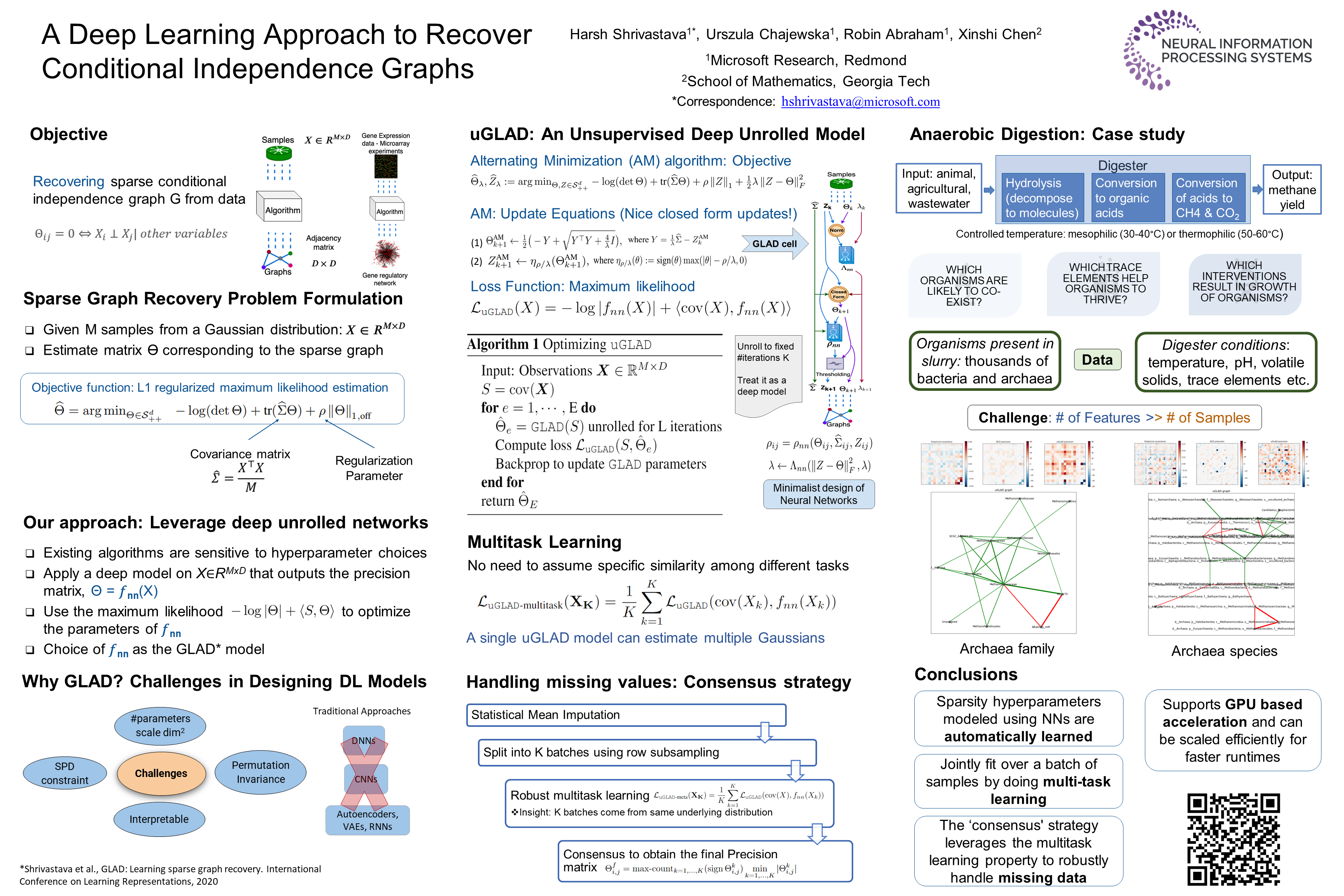
Probabilistic Graphical Models are generative models of complex systems. They rely on conditional independence assumptions between variables to learn sparse representations which can be visualized in a form of a graph. Such models are used for domain exploration and structure discovery in poorly understood domains. This work introduces a novel technique to perform sparse graph recovery by optimizing deep unrolled networks. Assuming that the input data $X\in\mathbb{R}^{M\times D}$ comes from an underlying multivariate Gaussian distribution, we apply a deep model on $X$ that outputs the precision matrix $\Theta$. Then, the partial correlation matrix `$\rho$' is calculated which can also be interpreted as the conditional independence graph. Our model, \texttt{uGLAD}, builds upon and extends the state-of-the-art model \texttt{GLAD} to the unsupervised setting. The key benefits of our model are (1) \texttt{uGLAD} automatically optimizes sparsity-related regularization parameters leading to better performance than existing algorithms. (2) We introduce multi-task learning based `consensus' strategy for robust handling of missing data in an unsupervised setting. We evaluate performance on synthetic Gaussian, non-Gaussian data generated from Gene Regulatory Networks, and present a case study in anaerobic digestion.
Chat is not available.
Successful Page Load