
Session
Paris Poster Session 1
Paris Poster Hall
$\delta$-Mem: : Efficient Online Memory For Large Language Models
Jingdi Lei ⋅ Di Zhang ⋅ Junxian Li ⋅ Weida Wang ⋅ Kaixuan Fan ⋅ Xiang Liu ⋅ Qihan Liu ⋅ Xiaoteng Ma ⋅ Baian Chen ⋅ Soujanya Poria
Large language models increasingly need to accumulate and reuse historical information in long-term assistants and agent systems. Simply expanding the context window is costly and often fails to ensure effective context utilization. We propose $\delta$-Mem, a lightweight memory mechanism that augments a frozen full-attention backbone with a compact online state of associative memory. $\delta$-Mem compresses past information into a fixed-size state matrix updated by delta-rule learning, and uses its readout to generate low-rank corrections to the backbone's attention computation during generation. With only an $8\times8$ online memory state, $\delta$-Mem improves the average score to $1.10\times$ that of the frozen backbone and $1.15\times$ that of the strongest non-$\delta$-Mem memory baseline. It achieves larger gains on memory-heavy benchmarks, reaching $1.31\times$ on MemoryAgentBench and $1.20\times$ on LoCoMo, while largely preserving general capabilities. These results show that effective memory can be realized through a compact online state directly coupled with attention computation, without full fine-tuning, backbone replacement, or explicit context extension.
3D-VITAL: Visibility-aware Identity Training from Artificial Liftings of 3D Reconstruction model for Cross-View Object Re-Identification
William Grolleau ⋅ Astrid Sabourin ⋅ Guillaume Lapouge ⋅ Catherine Achard
In this paper, we address the Cross-View Object Re-Identification (ReID) task, aiming to match identities across drastically different viewpoints. We focus specifically on Single-View Aerial-Ground ReID (SV AG-ReID), where models train on one viewpoint and must generalize to another at inference. To bridge the viewpoint gap of Cross-View ReID, related work employs generative models to synthesize novel views from source images as additional training data. We leverage recent advances in large-scale single-view 3D mesh reconstruction to lift source images into textured meshes and to render them from new viewpoints. However, this pipeline produces unreliable data in two distinct ways, and addressing both is vital for synthetic data to serve as an effective training signal. First, the reconstruction may fail and produce geometrically incorrect meshes, resulting in severe corruption in rendered novel views. Second, even when the geometry is correct, the rendered novel views contain hallucinated textures in regions not visible in the source image, which may degrade training if used naively. We address both shortcomings by exploiting a signal that prior generative methods do not naturally expose. Indeed, the reconstructed mesh carries a per-pixel partition between regions visible from the source view and regions that the reconstruction model had to hallucinate, available as a deterministic byproduct of rendering. We introduce this per-pixel visibility map and exploit it in a two-stage design. Cross-View Consistency Filtering (CVCF) discards geometrically incorrect meshes by ensuring multi-view consistency between source and novel views over visible patches. Visibility-Aware Attention Supervision (VAAS) leverages the visibility map to guide the model's attention toward reliable regions of the rendered view during training. Combined, these two components enable our method, 3D-VITAL, to better leverage the synthetic signal from single-view 3D mesh reconstruction, benefiting from wider viewpoint augmentation. 3D-VITAL sets a new state-of-the-art on three SV AG-ReID benchmarks (AG-ReID, AG-ReID.v2, MOO). Code and data will be released at \url{url}
Achieve Latency-Efficient Temporal-Coding Spiking LLMs via Discretization-Aware Conversion
Jinjie Fang ⋅ Tianxing Man ⋅ Xiao Du ⋅ Chengxun Jin ⋅ Haozhen Zhang ⋅ Yi Chang ⋅ Bin Gu
Large language models (LLMs) have achieved remarkable success while introducing critical energy bottlenecks that challenge sustainable deployment. Spiking neural networks (SNNs) provide a promising approach for energy-efficient spiking LLMs via ANN-to-SNN (A2S) conversion. Among various spike coding methods, time-to-first-spike (TTFS) coding is particularly appealing as it conveys information with a single spike, further reducing energy consumption. However, existing TTFS-based A2S conversion relies on continuous-time assumptions, requiring prohibitively large latencies (e.g., 4096 time steps) to approximate ANN's continuous values. This dependency leads to unacceptable inference delays in LLMs, posing significant challenges for developing practical temporal-coding spiking LLMs. In this paper, we propose a discrete analysis framework for TTFS-based LLMs, reformulating TTFS-based A2S conversion from continuous lossless conversion into discrete error-aware representation. Building on this analysis, we establish an equivalence between discrete TTFS-based SNNs and static quantized ANNs, allowing TTFS conversion to be handled through quantization techniques. Motivated by this equivalence, we introduce Quantization-Consistent ANN-to-SNN (QC-A2S) conversion, which combines static quantization with discretization-compatible TTFS neurons to achieve latency-efficient and high-performance temporal-coding spiking LLMs. Extensive evaluations on representative LLMs across multiple benchmarks demonstrate competitive performance with substantially reduced inference latency.
Active Learning for Gaussian Process Regression Under Self-Induced Boltzmann Weights
Jixiang Qing ⋅ Henry Moss ⋅ Matthias Sachs
We consider the active learning problem where the goal is to learn an unknown function with low error under a Boltzmann distribution induced by the function itself. This self-induced weighting arises naturally in problems such as molecular energy modeling and free energy estimation, yet poses unique challenges as the target distribution is unknown and its partition function is intractable. We propose an acquisition function, AB-SID-iVAR, based on Gaussian Process surrogates that approximates the intractable Bayesian target distribution in closed form while avoiding partition function estimation, applicable to both discrete and continuous input domains. We also analyze a Thompson sampling alternative (TS-SID-iVAR) as a higher variance Monte Carlo variant. Despite the unknown target, under mild conditions, we establish that the terminal prediction error vanishes with high probability, and provide a tighter average-case guarantee. We demonstrate superior performance over existing active learning approaches on synthetic benchmarks and real-world modeling tasks.
Active Probabilistic Reasoning in Humans and LLMs
Gonçalo Guiomar ⋅ Elia Torre ⋅ Pehuen Moure ⋅ Victoria Shavina ⋅ Mario Giulianelli ⋅ Shih-Chii Liu ⋅ Valerio Mante
Do language models make decisions under uncertainty like humans do? And if so, what role does extended reasoning play in the underlying decision process? We answer this question by introducing an active probabilistic reasoning task that cleanly separates sampling (actively acquiring evidence) from inference (integrating evidence towards a decision). Benchmarking humans and a broad set of contemporary LLMs against optimal reference policies reveals a consistent pattern: extended reasoning is the key determinant of strong performance, driving large gains in inference, while yielding only modest improvements in active sampling. To explain these differences, we fit a behavioral model that captures systematic deviations from optimal Bayesian behavior through interpretable parameter families, placing humans and models in a shared low-dimensional cognitive space. The resulting fits show how reasoning shifts models toward human-like regimes of evidence accumulation and belief-to-choice mapping, and yield testable predictions about the latent dynamics that might drive each decision. Probing residual-stream activations of an open-weight reasoning model, we find that the geometry of internal representations tracks these predicted dynamics, linking behavior to representational correlates of the fitted latent dynamics.
AdaCubic: An Adaptive Cubic Regularization Optimizer for Deep Learning
Ioannis Tsingalis ⋅ Constantine Kotropoulos ⋅ Corentin Briat
A novel regularization technique, AdaCubic, is proposed that adapts the weight of the cubic term. The heart of AdaCubic is an auxiliary optimization problem with cubic constraints that dynamically adjusts the weight of the cubic term in Newton’s cubic regularized method. We use Hutchinson’s method to approximate the Hessian matrix, thereby reducing computational cost. We demonstrate that AdaCubic inherits the cubically regularized Newton method’s local convergence guarantees. Our experiments in Computer Vision, Natural Language Processing, and Signal Processing tasks demonstrate that AdaCubic outperforms or competes with several widely used optimizers. Unlike other adaptive algorithms that require hyperparameter fine-tuning, AdaCubic is evaluated with a fixed set of hyperparameters, rendering it a highly attractive optimizer in settings where fine-tuning is infeasible. This makes AdaCubic an attractive option for researchers and practitioners alike. To our knowledge, AdaCubic is the first optimizer to leverage cubic regularization in scalable deep learning applications.
We study realizable regression with a finite or countably infinite function class $\mathcal{F}$. We are given $D_n = \{(X_t, Y_t)\}_{t=1}^n$, which is assumed to be i.i.d.\ with $f^\star \in \mathcal{F}$ such that $\mathbb{E}[Y_t|X_t] = f^\star(X_t)$. The goal is to estimate $f^\star$ with $\hat{f}$ under the absolute loss $\mathbb{E}_X[|\hat{f}(X) - f^\star(X)|]$. We propose a simple reduction that runs two instances of online learning algorithms: one minimizes a learned loss and the other minimizes the error induced by learning the loss. Our main result is a prior-dependent second-order bound: for any prior $\pi$ over $\mathcal{F}$, the estimator achieves with probability at least $1 - \delta$, \begin{align*} \mathbb{E}_X[|\hat{f}(X) - f^\star(X)|] \leq C\sqrt{\frac{\mathbb{E}_X[\sigma(X)]\,\Gamma(f^\star)}{n}} + \frac{CB\,\Gamma(f^\star)}{n}\,, \end{align*} where $\sigma(X) = \mathbb{E}_Y[(Y - f^\star(X))^2 \mid X]$ is the conditional variance, $\Gamma(f^\star) = \log(1/\delta) + \log((1+\log(Bn))/\pi(f^\star))$, $C > 0$ is an absolute constant, and $B$ is an upper bound on $|Y|$ and $|f(X)|$. The bound adapts automatically to the noise level $\mathbb{E}_X[\sigma(X)]$ and range $B$ without any prior knowledge of it, achieving the fast rate $O(B\Gamma(f^\star)/n)$ when $\sigma(X) = 0$ and recovering the slow rate $O(B\sqrt{\Gamma(f^\star)/n})$ in the worst case. The dependence on $\mathcal{F}$ enters only through $\log(1/\pi(f^\star))$, enabling faster rates for structured $\mathcal{F}$ or sparse $f^\star$ and extending naturally to countably infinite classes via summable priors. For finite $\mathcal{F}$ we further show that the same algorithm produces an empirically verifiable bound that allows the learner to evaluate the quality of $\hat{f}$ from the data alone, without knowledge of $\mathbb{E}_X[\sigma(X)]$. Finally, we extend our reduction to general convex loss functions satisfying $\ell(f(x), f(x)) = 0$.
Adaptive Scheduling Pipeline For Multi-Instance Asynchronous Reinforcement Learning
Salah Chikhi ⋅ Luis H Ruiz ⋅ Entong Li ⋅ Li Zeng
We present the Adaptive Scheduling Pipeline (ASP), a bounded-lag asynchronous reinforcement learning (RL) architecture for post-training large language models (LLMs). Rather than only disaggregating generation and training, the ASP combines two design ideas. First, a queue-aware scheduling policy that jointly reduces three sources of rollout underutilization —padding bubbles from intra-minibatch length heterogeneity, skewness bubbles from long-tail outputs, and sorting bubbles from queue instability induced by length-sorted dispatching—through a single offline preprocessing pass. This enables efficient multi-instance rollout that overcomes the early scaling plateau of single-instance inference while maintaining stable queue dynamics. Second, a bounded-lag asynchronous architecture decouples rollout from training while keeping policy lag observable and small enough to preserve stable learning in our experiments. We also provide an explicit weight-flow path that converts trainer snapshots into inference-ready weights without re-coupling generation and training. Experiments show that ASP improves end-to-end throughput by up to $3.22\times$, reduces iteration time by up to 76\%, scales more robustly with additional generation resources than the MindSpeed-RL and verl baselines, and shows no visible convergence degradation. ASP has also been used in an internal telecom-domain RL post-training workflow, reducing the reported training period from more than three months to about two months and producing a domain-enhanced model for knowledge answering and tool calling.
A Dynamic Decomposition Strategy for the MOEA/D With Proven Performance Guarantees
Benjamin Doerr ⋅ Martin S. Krejca ⋅ Noé Weeks
The MOEA/D is one of the most successful multi-objective evolutionary algorithms. It operates by decomposing the optimization problem into single-objective subproblems, which are then solved in a co-evolutionary manner. The performance of the MOEA/D depends critically on this decomposition. In this work, we propose a novel way to adjust this decomposition on the fly, for the case of discrete bi-objective optimization. Different from all previous works in this direction, we support our new algorithm with a proven performance guarantee. This is the first work that rigorously proves the runtime of a dynamic multi-objective evolutionary algorithm. For monotonic distortions of the simple LOTZ benchmark, it is known that classic decompositions leave large holes in the Pareto front, making it very hard for the MOEA/D to cover the entire Pareto front. In contrast, we prove that our self-adjusting MOEA/D solves all these LOTZ problems in an expected number of $O(n^4)$ function evaluations. This relatively low runtime as well as the details of our mathematical proof show that the dynamic decomposition strategy indeed evolves a decomposition adjusted to each of these problem instances.
A General Concept-based Decomposition for Vision–Language Embeddings
Simone Alberto Peirone ⋅ Ortal Senouf ⋅ Francesca Pistilli ⋅ Giuseppe Averta ⋅ Pascal Frossard
Vision-language models are designed to capture the compositional structure of the world through multi-modal alignment; however, it remains unclear whether their representations truly align with the way a human would naturally describe the same visual input. Prior works attempt to decompose visual embeddings into their concept-level contributions, but their instance-level optimization is inherently local and does not capture the model’s global semantic structure, which is essential for compositional generalization across different inputs, tasks and domains. We introduce GRACE, a method that learns this concept-based structure at the feature space level, producing semantic and general concept decompositions. To achieve this, we propose a novel training objective that preserves the geometric relations of different samples in the concept space, enabling a better understanding of how concepts compose and relate to each other. We validate GRACE on several image and video benchmarks, showing that its concept decomposition is aligned with human perception and achieves faithful decompositions across different tasks and domains. With minimal overhead, GRACE makes existing Vision-Language Models more interpretable, while preserving most of their original performance.
AgentCBO: Causal Belief Routing for Bayesian Optimization under Unknown Graphs
Qiyu Wei ⋅ Xin Zhang ⋅ Richard Allmendinger ⋅ Mauricio A Álvarez
Causal Bayesian optimization (CBO) typically relies on the unrealistic assumption of a perfectly known causal graph. Recent methods relax this constraint by coupling optimization with structure learning, but they often waste sample budgets on structural uncertainties that are irrelevant to the optimizer. In this paper, we formalize \emph{routing-equivalence} to shift the objective from full causal-graph recovery to causal belief routing, where structural differences only matter when they alter optimizer-facing objects such as admissible exploration sets and \emph{do}-priors. Furthermore, we propose \agentcbo{}, a graph-belief routing framework that incorporates LLM causal priors through guarded proposal and commit mechanisms. Specifically, a \textsc{Language-Prior Agent} combines LLM beliefs with constraint-based discovery to extract a protected causal backbone alongside residual uncertain edges. A \textsc{Calibration Agent} and a \textsc{Residual Repair Agent} then refine only these uncertain structures through score-gated bounded local edits. Finally, a deterministic commit gate evaluates candidate updates using routing-proxy checks before allowing them to influence intervention selection. Across ten benchmarks, \agentcbo{} performs comparably to known-graph CBO, demonstrating that guarded LLM priors can improve fixed-budget CBO performance.
A Grid Efficient Transport Optimization Model for the Wasserstein Barycenter Problem
Gennaro Auricchio ⋅ Massimiliano Ghiotto ⋅ Stefano Gualandi
We propose the Grid Efficient Transport Optimization Linear Programming (GETO-LP) model, a novel formulation of the Fixed-Support Wasserstein barycenter problem for $M$ probability distributions supported on $d$-dimensional grids. While standard LP models require $O(MN^2)$ variables, the GETO-LP model requires only $O(dMN^{1+\frac{1}{d}})$, with $N$ being the total number of points in the grid support. Despite the reduced number of variables, our formulation is \emph{exact}, meaning that its solution fully characterizes both the barycenter $\nu$ and the optimal transport plans between $\nu$ and each of the $M$ input distributions without additional optimization steps. We validate the GETO-LP model via extensive comparisons with classical and entropic regularization solvers, demonstrating its effectiveness on both synthetic data and real-world applications such as color palette manipulation and medical data averaging. Overall, our approach provides an effective formulation for the Wasserstein barycenter problem, offering a memory-efficient alternative that naturally integrates with other existing computational frameworks.
A Hierarchical World Model for Driving
Sudhanshu Mittal ⋅ Arian Mousakhan ⋅ Silvio Galesso ⋅ Karim Farid ⋅ Johannes Dienert ⋅ Rajat Sahay ⋅ Thomas Brox
Current world models operate at a single level of abstraction, with most prioritizing perceptual fidelity while lacking the spatial reasoning and semantic understanding required for real-world downstream tasks. We present a hierarchical driving world model that factorizes future prediction across two levels operating at distinct temporal and abstraction scales: a high-level predictor that forecasts coarse scene structure over extended temporal horizons, and a low-level generator that produces detailed predictions conditioned on the high-level output. This decomposition yields high perceptual fidelity while also capturing strong spatial and semantic representations. We further show that pretraining with a diffusion forcing objective yields substantially richer internal representations than the standard teacher forcing objective, while teacher forcing — predicting only the next frame from clean context — produces more stable autoregressive rollouts. We therefore introduce a generic two-stage training paradigm that pretrains the model with diffusion forcing and fine-tunes with teacher forcing, combining the representational benefits of the former with the rollout stability of the latter. Our approach achieves state-of-the-art results across the standard suite of driving world model evaluations on established benchmarks, including long-horizon generation fidelity, steering responsiveness evaluated on counterfactual scenarios, and internal representation quality.
Aligned LoRA Updates via Intrinsic Geometry for Federated Low-Rank Adaptation
Yihao Yang ⋅ Jian Liang ⋅ Wenke Huang ⋅ He Li ⋅ Xingyu Gao ⋅ Mang Ye
Federated Low-Rank Adaptation (FedLoRA) enables efficient fine-tuning of large language models by exchanging low-rank adaptation parameters across clients. Several studies mainly focus on aggregation bias and design improved aggregation schemes. We argue that aggregation bias is not the fundamental bottleneck of FedLoRA. Even under ideal aggregation, heterogeneous data induce directional conflicts among client-specific LoRA updates. We show that these conflicts arise from misaligned low-rank adaptation subspaces, leading to destructive interference during collaboration. To diagnose this phenomenon, we introduce a geometry-aware metric that characterizes client updates at the subspace level. Our analysis reveals that subspace conflicts intensify with increasing heterogeneity and are concentrated in the column spaces of LoRA updates. Based on this insight, we propose ALIGN, a geometry-aware federated adaptation framework that aligns client LoRA subspaces during aggregation and constrains local updates to mitigate conflicts. Comprehensive empirical results confirm that mitigating subspace misalignment is crucial for FedLoRA, and that ALIGN consistently improves downstream performance over existing methods. The code is available for anonymous access at https://anonymous.4open.science/r/ALIGN-7C41.
Aligning Language Model Benchmarks with Pairwise Preferences
Marco Gutierrez ⋅ Xinyi Leng ⋅ Hannah Chen ⋅ Jonathan Richard Schwarz ⋅ Ahmed Alaa ⋅ Tom Hartvigsen
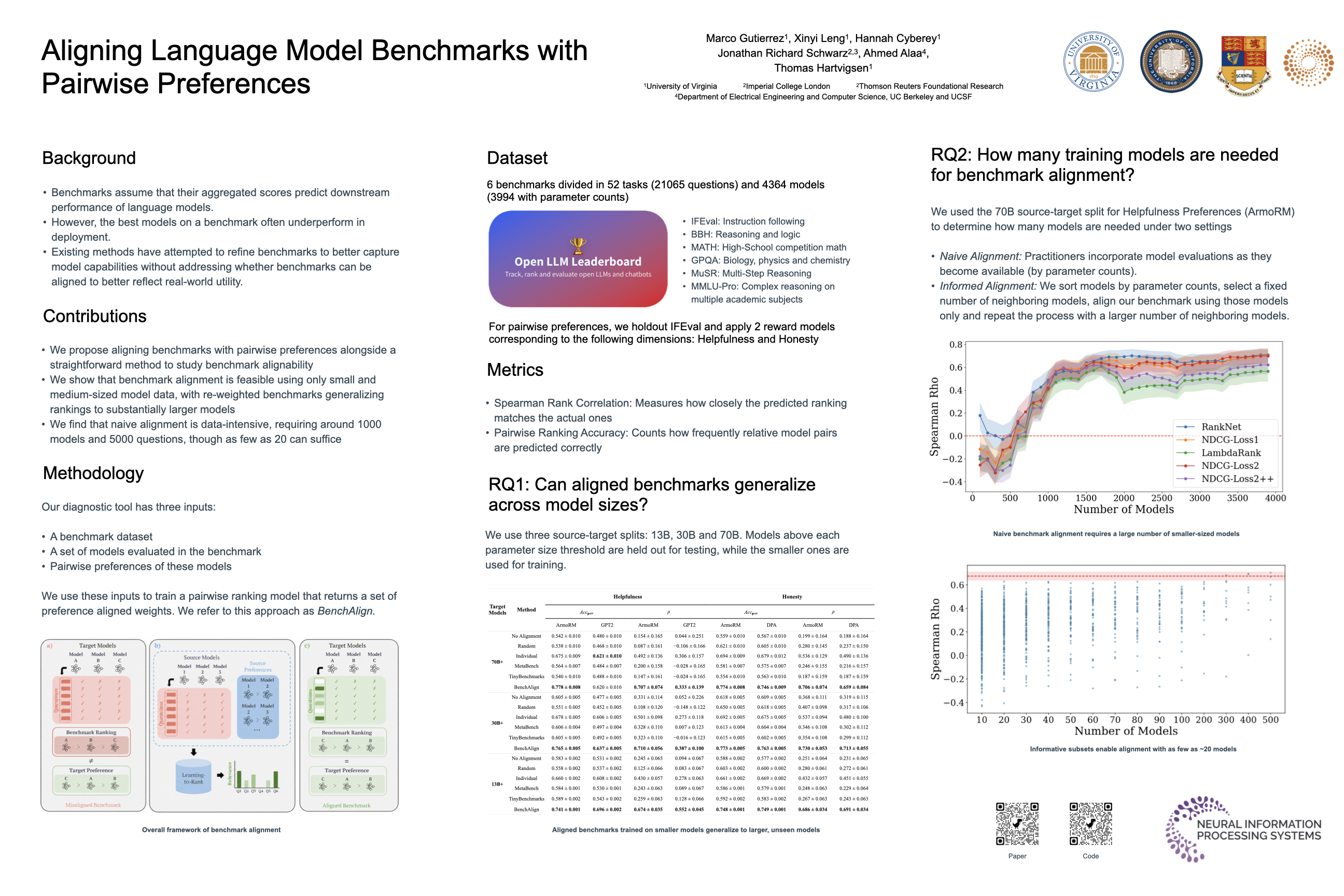
Language model benchmarks are pervasive and computationally-efficient proxies for real-world downstream performance. However, many recent works find that benchmarks often fail to predict downstream utility. While some works have begun diagnosing sources of misalignment, there remain no ways to systematically update benchmarks to align their scores with downstream usage. Towards bridging this gap, we introduce and study \textit{benchmark alignment}, where we use information about downstream model performance to automatically update benchmarks, aiming to produce new static benchmarks that predict model pairwise rankings on downstream tasks. Our experiments involving 4576 language models and 6 benchmarks show that benchmark items can successfully be reweighted to predict downstream performance for unseen models, even generalizing across model scales in most cases. And while naive alignment unsurprisingly requires large numbers of models and benchmark questions, we find that proper use of downstream data can often also enable alignment, even using responses from as few as 20 models. Overall, our work takes a step towards efficiently aligning benchmark development with downstream tasks.
AmaraSpatial-10K: A Spatially and Semantically Aligned 3D Dataset for Spatial Computing and Embodied AI
Mohammadsadegh Salehi ⋅ Alexander J Perkins ⋅ Igor P Maurell ⋅ Ashkan Dabbagh ⋅ Raymond Wong
Web-scale 3D asset collections are abundant but rarely deployment-ready, suffering from arbitrary metric scaling, incorrect pivots, brittle geometry, and incomplete textures, defects that limit their use in embodied AI, robotics, and spatial computing. We present $\textbf{AmaraSpatial-10K}$, a dataset of over $10{,}000$ synthetic 3D assets optimised for zero-shot deployment. Each asset ships as a metric-scaled, deterministically anchored $\texttt{.glb}$ with separated PBR maps, a convex collision hull, a paired reference image, and multi-sentence text metadata. Alongside the dataset we introduce a reusable evaluation suite for 3D asset banks, a continuous Scale Plausibility Score (SPS), an LLM Concept Density metric, anchor-error auditing, and a cross-modal CLIP coherence protocol, and apply it to AmaraSpatial-10K alongside matched subsets of Objaverse, HSSD, ABO, and GSO. AmaraSpatial-10K improves CLIP Recall@5 by $3.4\times$ over Objaverse ($0.612$ vs.\ $0.181$, median rank $267 \rightarrow 3$), achieves a $99.1\%$ physics-stability rate under Habitat-Sim with $\sim$$20\times$ wall-time speed-up, and produces zero-overlap scenes when used as a drop-in asset bank for Holodeck. Controlled ablations on the same asset bank attribute the retrieval gain to description richness.
A method to automatically discover symbolic local learning rules
Andrea Perin ⋅ Fabio Anselmi ⋅ Stephane Deny
We present a general method for discovering symbolic local learning rules that can replace backpropagation, applicable, in principle, to any deep learning architecture and task. The method automatically discovers local loss functions specific to each layer by (1) constructing a dictionary of monomials of local tensor variables, inspired by Penrose diagram notation, (2) regressing over coefficients weighting these monomials to build layerwise polynomial losses, whose gradients together minimize a target global loss. We test the method on reconstruction, classification, and self-supervised learning tasks using small multilayer networks on minimal datasets. Across all tasks, the discovered rules induce non-trivial interactions between layers that lead to significant reductions in the corresponding global losses, e.g. reaching classification accuracies comparable to backpropagation. Furthermore, the method selects sparse combinations of trace monomials, finding local rules that are more interpretable than those generated by MLP-based alternatives. The potential implications of our method range from energy-efficient deep learning to the discovery of biologically plausible learning mechanisms.
Amortized Linear-time Exact Shapley Value for Product-Kernel Methods
Majid Mohammadi ⋅ Siu Lun (Alan) Chau ⋅ Krikamol Muandet
Kernel methods are widely used in machine learning and statistics for their flexibility and expressive power, yet their black-box nature limits adoption in high-stakes applications. Shapley value--based attribution methods such as SHAP, and kernel-specific adaptations including RKHS-SHAP, provide a principled framework for explainability---but exact computation of Shapley values is generally intractable, forcing existing approaches to rely on approximations that incur unavoidable estimation error. We introduce PKeX-Shapley, an algorithm that exploits the multiplicative structure of product kernels to compute exact Shapley values for all $d$ features in quadratic time in $d$. The method rests on a distribution-free removal operator intrinsic to the product-kernel structure: removing a feature replaces its kernel factor with the multiplicative identity. This yields a parameter-free value function---requiring no sampling and no density estimation---and uniquely determines a functional decomposition of the model. Building on this value function, we develop shared recursive formulations that evaluate all feature attributions jointly, achieving amortized linear time per feature with numerical stability. Beyond predictive modeling, the framework extends to widely used kernel-based discrepancies such as the Maximum Mean Discrepancy (MMD) and the Hilbert--Schmidt Independence Criterion (HSIC), providing new tools for interpretable statistical analysis.
Principal component analysis (PCA) is one of the most widely used unsupervised dimension reduction techniques. We study PCA for data from multiple related domains. Since principal components generally differ across domains, one way to obtain a shared low-rank embedding is to perform PCA on the pooled data. However, this approach can focus on spurious directions that exhibit high variation in only a few domains. To find a robust embedding that still explains most variance in unseen but similar domains, we propose instead to focus on shared directions of variation. To this end, we introduce Anchor PCA which trades off overall explained variance with agreement between the shared and domain-specific low-rank embeddings. Anchor PCA amounts to PCA on a modified target matrix and thus can be solved efficiently. Moreover, we show that Anchor PCA recovers a maximal invariant subspace and admits a minimax reconstruction interpretation under bounded domain-specific covariance inflations. On simulated and real-world gas sensor data with temporal drift, we demonstrate, respectively, that Anchor PCA recovers the maximally invariant subspace and yields embeddings that explain more variance on unseen domains than the pooling baseline and a worst-case alternative. Taken together, these findings establish Anchor PCA as a promising approach to robust unsupervised dimension reduction from multi-domain data.
Approximate Bayesian inference has driven significant advances in probabilistic machine learning at the basis of modern generative modelling. However, many successful Bayesian methods, such as variational inference or sequential Monte Carlo, often struggle in discrete domains with complex structure. In particular, their application to the challenges of neurosymbolic AI, i.e. learning and reasoning under uncertainty, is largely unexplored. Our contributions are twofold. First, we show that the majority of neurosymbolic problems are problems of posterior inference motivating the use of approximate Bayesian inference for neurosymbolic AI. Second, we adapt variational inference to the neurosymbolic setting by exploiting available symbolic structure. Moreover, we outline what properties a reasonable variational approximation to a neurosymbolic problem should have and how to enforce these properties by connecting to statistical estimation and statistical representation theorems. The result is a principled approach to learning and reasoning at scale that maintains statistical guarantees at test time. This work illustrates the opportunities at the intersection of approximate Bayesian inference, and learning and reasoning under uncertainty.
A Reproducible Evaluation Protocol for Quantum Non-Linearity in Variational Quantum Models
Pavel Sulimov ⋅ Claude Lehmann
Variational quantum models are linear maps of the input state: any useful non-linearity must be engineered through the data encoding, entanglement pattern, ancilla tracing, classical readouts, or explicit classical layers. Although many such mechanisms have been proposed, there is no standard protocol that scores them on a common footing. Most published comparisons reduce non-linearity to either the accuracy on a single downstream benchmark or a single abstract expressibility number, and the two are rarely measured under matched training budgets, circuit widths, and noise assumptions. We introduce a reproducible evaluation protocol that decomposes non-linearity quality into four complementary scalar scores covering frequency reach, gradient-variance scaling, trainability efficiency on a chaotic dynamical task, and stability under depolarizing noise. In addition, we define a composite index with published weights, enabling methods to be ranked under a single criterion while preserving full access to the underlying components. We instantiate the protocol with six variational ansatzes spanning the standard taxonomy of quantum non-linearity sources (data reuploading, ancilla tracing, their combination, strongly entangling layers, a quantum convolutional network, and a quantum reservoir), together with a classical multilayer perceptron and a hybrid quantum-classical network as non-quantum reference points. The evaluation surfaces a central mismatch that single-number reporting hides: in our reference run, the composite leader (data reuploading) is near the bottom on held-out Lorenz one-step $R^2$, while the Lorenz leader (ancilla reuploading) is only third on the composite. The main outcome is a practical benchmark that makes these trade-offs visible and testable: with fixed tasks, budgets, and seeds, new methods can be added by registering a circuit builder and rerunning the same protocol, and multi-seed aggregates can be updated without changing metric definitions.
ASO Atlas 2.0: Evaluating antisense oligonucleotide prediction across the preclinical pipeline
Barney Hill ⋅ Nicola Whiffin ⋅ Carlo Rinaldi ⋅ Stephan J Sanders
Predictive models have the potential to transform drug development by increasing success rates across all stages of development pipelines. Evaluating this potential needs to include the whole pipeline, from initial screens of thousands of compounds to the expensive assays, such as toxicity assessment, focused on a few compounds in the later stages. Genetic medicines, such as antisense oligonucleotides (ASOs), could benefit millions affected by individually rare genetic disorders, if economic limitations imposed by the need to screen hundreds of sequences at considerable expense can be overcome. To enable systematic analysis of this problem, we present ASO Atlas 2.0, the largest public multi-endpoint ASO preclinical dataset, spanning 295,007 data points, including both in vitro efficacy and in vivo toxicology, across 430. Using this resource, we introduce a cost-based evaluation framework that translates per-stage classifier enrichment into projected cost savings under a representative preclinical pipeline model. We find that incorporating model predictions across all stages reduces projected pipeline cost by 71%. This saving is largely attributable to modest enrichment at costly late-stage in vivo studies rather than strong enrichment at lower-cost in vitro assays, reversing the model ranking suggested by accuracy alone and highlighting the need for improved toxicology modelling.
A Theory of Online Learning with Autoregressive Chain-of-Thought Reasoning
Idan Mehalel ⋅ Ilan Doron-Arad ⋅ Elchanan Mossel
Autoregressive generation lies in the heart of the mechanism of large language models. It can be viewed as the repeated application of a next-token generator: starting from an input string (prompt), the generator is applied for $M$ steps, and the last generated token is taken as the final output. [Joshi et al., 2025] proposed a PAC model for studying the learnability of the input-output maps arising from this process. We develop an online analogue of this framework, focusing on the mistake bound of learning the final output induced by an unknown next-token generator. We distinguish between two forms of feedback. In the End-to-End model, after each round the learner observes only the final token produced after M autoregressive steps. In the Chain-of-Thought model, the learner is additionally shown the entire $M$-step trajectory. Our goal is to understand how the optimal mistake bound depends on the generation horizon $M$, and to what extent observing intermediate tokens can reduce this dependence. Our main results show that the online theory of autoregressive learning exhibits a qualitative picture analogous to the statistical one found by [Hanneke et al., 2026], but with a different scale of dependence on the generation horizon. In the End-to-End model, we prove a taxonomy of possible mistake-bound growth rates in the generation horizon $M$: subject to mild regularity conditions, every rate between constant and logarithmic can arise. We also show that this logarithmic ceiling is unavoidable for the online setting, in the sense that every class of finite Littlestone dimension exhibits at most logarithmic dependence on $M$. In the Chain-of-Thought model, the parallel is even sharper: as in the statistical setting, access to the full generated trajectory eliminates the dependence on $M$ altogether. We also analyze autoregressive linear threshold classes. For autoregressive linear thresholds in \(\mathbb{R}^d\), we prove that the optimal mistake bound is \(\Theta(d^2)\) under both End-to-End and Chain-of-Thought feedback, and for any generation length $M$. The methods developed for this analysis also yield new lower bounds in the statistical setting. Along the way, our results resolve several questions left open by [Joshi et al., 2025]. In particular, we show that even for classes of finite Littlestone dimension, the End-to-End statistical sample complexity can depend on the generation length M.
Auditing AI peer reviewers: a dose-response and false-positive benchmark on real scientific papers
Íñigo Zubeldia ⋅ Boris Bolliet ⋅ Francisco Villaescusa ⋅ Pablo Villanueva-Domingo ⋅ Miles Cranmer
LLM-based peer review is now used at production scale, but rigorous evaluation remains limited. We introduce a benchmark for evaluating AI peer reviewers’ detection of injected errors and quantifying false-positive rates across error type, severity, prompting strategy, and reviewer architecture. We also present skepthical, a multi-agent AI reviewer that verifies citations by retrieving and reading cited papers, checks mathematics with computer algebra, audits numerical claims with code, and uses a cross-model ensemble for general scientific issues. On 15 astrophysics preprints containing 177 injected errors, we benchmark 12 reviewer systems: skepthical; six single-LLM reviewers from three providers, each run with free-form and structured prompts; two Claude Code reviewers using the same Claude model and tools, one with a free-form prompt and one with a structured prompt; and three external reviewers. Detection performance varies sharply by model, prompt, tool use, and error type. Under the same free-form prompt, three frontier LLMs differ by 48.6 pp in total detection rate; a structured prompt halves this spread by improving the weaker models. Within Claude Code, changing only the prompt from free-form to structured raises detection by 32.2 pp. skepthical achieves the highest overall detection rate, 70.6±6.2%, with the best performance on general issues, 82.2%, and citation errors, 46.7%. On numerical errors, it matches both GPT-5.5 configurations at 80.0%, behind structured Claude Code at 91.1%; on mathematics, its 73.8% rate overlaps with both GPT-5.5 configurations within confidence intervals. False-positive rates also vary substantially: free-form Opus 4.7 has the lowest overall rate at 1.0%, while skepthical is the only reviewer with no false-positive failure mode jointly across mathematics, numerics, and citations, yielding a 2.8% overall rate. skepthical is deployed publicly at skepthical-ai.org, and we release the evaluation set as a benchmark.
Auditing Attention Head Masking for Out-of-Distribution Detection: Cross-Architecture Wins, Failures, and Polarity Inversions
Vishnu Bindu Balachandran
Post-hoc scoring functions for out-of-distribution (OOD) detection in transformer models are typically validated on a single architecture and a single modality, leaving cross-architecture behavior largely uncharted. We report a cross-modality empirical study of attention-head-masking-based OOD detection across more than 1,200 AUROC measurements, spanning LayoutLMv3 on document classification, ViT-B/16 on natural images, and RoBERTa-base on text. Each setting is evaluated against seventeen baselines under a uniform protocol with five fixed seeds, including the Attention Head Sensitivity Scoring (AHSS) and AHM-augmented distance methods of Constantinou et al. (2024) and the recent X-Mahalanobis from NeurIPS 2025. Paired statistical tests are run on every head-to-head claim. Within the AHM family, mahAvgAvg_AHM significantly beats X-Mahalanobis on Tobacco-Cross (Wilcoxon $p=0.031$) and on RoBERTa SST-2$\to$20-Newsgroups ($p=0.031$); on standard CIFAR vision benchmarks, X-Mahalanobis remains state-of-the-art. Three architecture-dependent phenomena surface that current evaluation practice tends to miss: Monte Carlo Dropout collapses to chance-level AUROC across all four ViT settings tested; the AHSS displacement score inverts polarity on RoBERTa, yielding a mean AUROC of 0.296 even though it functions on vision and document transformers; and on near-OOD splits where ID and OOD share visual or semantic structure, every method including the strongest baselines degrades by 25 to 42 percentage points relative to standard OOD. We release per-seed measurements, AHM masks, and code to support replication.
AuGhostmentation: The Eyes Never Stand Still—$\textit{Why Should CNNs?}$
Emirhan Inan ⋅ Suayb Arslan
Convolutional Neural Networks (CNNs) draw broad inspiration from the primate visual system yet prove notoriously brittle under common image corruptions, whereas the latter suffers little from such degradations. Extending beyond this initial inspiration, architectures incorporating quantifiable biological priors that enhance network resilience are increasingly gaining traction. Nevertheless, most of these approaches have so far been confined to emulating the higher visual areas, seldom utilizing the upstream retinal stages that constitute the very basis of $\textit{seeing}$. At its core, primate vision relies on photons captured by retinal photoreceptors, the signals of whose conversion are then relayed through the Lateral Geniculate Nucleus (LGN) to primary visual cortex (V1) and further downstream for additional processing. Because cone photoreceptors are densest at the center of the retina (fovea), the eyes must be repositioned continuously (saccade) to direct the high-acuity macula toward objects of interest (fixation). Furthermore, the resultant rapid eye movements induce intra-saccadic motion streaks that putatively aid in the spatiotemporal processing of inputs and provision of translation-invariant object correspondence across frames. Motivated by this mechanism, we propose $\texttt{AuGhostmentation}$, a portmanteau of $\textit{augmentation}$ and $\textit{ghosting}$, which delivers the intra-saccadic retinal smear as a frontend transform. Superimposing the $\textit{ghosted}$ images—fainter counterparts—atop the original, based on human oculomotor statistics, the resultant datum elicits $\textit{retinal persistence}$ by integrating varied recompositions of the scene in a single representation, closely mimicking the foveal exploration scheme intrinsic to dynamic primate vision. When prepended to ResNet-18 trained on Tiny ImageNet, $\texttt{AuGhostmentation}$ retains 98% validation accuracy while delivering a striking 60% relative gain in robustness on Tiny ImageNet-C. Applied to VOneNet, it likewise preserves 98% classification accuracy and yields a substantial 25% relative increase in compounded robustness. For ImageNet-100, the introduced $\textit{ghosts}$ not only improve the corruption accuracy relative to the ResNet-50 baseline by 23%, but the clean accuracy by 4%, also. Building on these resilience gains, $\texttt{AuGhostmentation}$ outpaces competing augmentations by up to 18% and baseline ResNet-50 by up to 37% on stylized tests, suggesting that retinal priors naturally foster shape-biased processing and thereby provide greater alignment with human object recognition.
A Unified Framework for Uniform-Price Resource Allocation Mechanisms
Ioannis Caragiannis ⋅ Dimitris Fotakis ⋅ Stratis Skoulakis
Mechanisms for allocating a divisible resource among strategic agents have been widely studied. The prominent paradigm is the proportional (Kelly) mechanism, which elicits a scalar bid per agent, allocates the resource proportionally, and charges payments equal to the bids. Follow-up mechanisms improve social welfare, but sacrifice simplicity by introducing complex allocation rules or unintuitive payments. We introduce a unified framework for designing simple resource allocation mechanisms with proportional-style allocations and uniform pricing. Our framework yields a family of mechanisms that interpolate between the Kelly mechanism and the first-price auction. These mechanisms strictly improve upon Kelly’s efficiency guarantees, even achieving full efficiency in equilibrium, while also providing revenue guarantees relative to the VCG mechanism. In settings with budget-constrained agents, our mechanisms achieve nearly optimal price of anarchy with respect to the liquid welfare. When budgets are public, our framework further enables the design of mechanisms that ensure budget feasibility, even when agents do not explicitly account for their constraints in their strategies.
Automatic Constraint Policy Optimization based on Continuous Constraint Interpolation Framework for Offline Reinforcement Learning
Xinchen Han ⋅ Qiuyang Fang ⋅ Hossam Afifi ⋅ Michel Marot
Offline Reinforcement Learning (RL) relies on policy constraints to mitigate extrapolation error, where both the constraint form and constraint strength critically shape performance. However, most existing methods commit to a single constraint family: weighted behavior cloning, density regularization, or support constraints, without a unified principle that explains their connections or trade-offs. In this work, we propose Continuous Constraint Interpolation (CCI), a unified optimization framework in which these three constraint families arise as special cases along a common constraint spectrum. The CCI framework introduces a single interpolation parameter that enables smooth transitions and principled combinations across constraint types. Building on CCI, we develop Automatic Constraint Policy Optimization (ACPO), a practical primal--dual algorithm that adapts the interpolation parameter via a Lagrangian dual update. Moreover, we establish a maximum-entropy performance difference lemma and derive performance lower bounds for both the closed-form optimal policy and its parametric projection. Experiments on D4RL and NeoRL2 demonstrate robust gains across diverse domains, achieving state-of-the-art performance overall.
Automatic Textbook Formalization
Fabian Gloeckle ⋅ Ahmad Rammal ⋅ Charles Arnal ⋅ Remi Munos ⋅ Vivien Cabannes ⋅ Gabriel Synnaeve ⋅ Amaury Hayat
We present a case study where an automatic AI system formalizes a textbook with more than 500 pages of graduate-level algebraic combinatorics to Lean. The resulting formalization represents a new milestone in textbook formalization scale and proficiency, moving from early results in undergraduate topology and restructuring of existing library content to a full standalone formalization of a graduate textbook. The formalization comprises 130K lines of code and 5900 Lean declarations and was conducted within one week by a total of 30K Claude 4.5 Opus agents collaborating in parallel on a shared code base via version control, simultaneously setting a record in multi-agent software engineering with usable results. The inference cost matches or undercuts what we estimate as the salaries required for a team of human experts, and we expect there is still the potential for large efficiencies to be made without the need for better models. We make our code and the resulting Lean code base available open-source.
We introduce a mathematical framework for studying contraction of the distributional Bellman operator under Maximum Mean Discrepancy (MMD). We show that contraction reduces to conditional positive definiteness of an associated kernel constructed from the base kernel, which we call the Bellman difference kernel. Focusing on radial kernels, we use Schoenberg's theorem to connect this condition to Bernstein functions, yielding contraction criteria, valid in arbitrary dimension, that can be checked analytically or numerically. Our framework unifies known results for the Gaussian RBF, power-distance, and multiquadric kernels; using numerical search, we further identify 12 new contraction-inducing kernels. We also propose chaining, a general construction that produces contraction-inducing kernels at any prescribed rate. To reconcile theory with practice, we introduce conditional positive definiteness on a set, which explains why the Gaussian RBF kernel can remain a valid choice on bounded supports despite its lack of global contraction. Finally, we identify a fundamental tradeoff between contraction rate and discriminative power, where kernels that contract faster tend to discriminate less between distributions.
Benchmarking sequence-to-ensemble predictors on UNICORNEdb, a UniProt-grouped database of PDB-derived conformational ensembles
William F Vanderbilt-Fried ⋅ Luka Butskhrikidze ⋅ Benjamin P Brown ⋅ Hassane Mchaourab ⋅ Carlos Oliver
Following the striking success of ML-driven static protein structure prediction, the challenge of protein conformational flexibility and thermodynamic ensemble prediction is rapidly coming to the foreground, and with it the need for rigorous benchmarks. Yet, obtaining ground-truth conformational states at scale remains highly challenging. Past approaches are either small and hand-curated or built by clustering PDB chains, which conflates genuine conformational variation with sequence-induced differences across near-homologs. Here we introduce UNICORNE, a database of 50,000+ protein conformational ensembles centered on UniProt and PDB chain/entity annotations to assemble per-protein ensembles of experimentally resolved conformations without relying on clustering. From our database, we derive UNICORNE-BENCH, a set of 839 multi-conformation proteins on which we extensively benchmark seven recent sequence-conditioned predictors spanning generative ensemble models and MSA-perturbation methods. We find that the ensemble-generation problem is far from solved and identify several shared failure modes: even the strongest tool fully recovers only 8.2\% of ensembles, performance degrades with conformational diversity, and tools fail on overlapping rather than complementary subsets of targets. Across the benchmark, we find that MSA-perturbation methods modestly outperform direct generative approaches. UNICORNE provides a biologically grounded reference needed to guide the next generation protein structure prediction. The full database and leaderboard are available at https://unicornedb.org (anonymized), and source code is available at https://anonymous.4open.science/r/unicornebenchneurips_source-2327/.
In multimodal classification, late-fusion approaches classify concatenated modality-specific features extracted by unimodal neural networks. When modality imbalance is pronounced, various regularization techniques have been proposed to balance the learning process and overcome the inferior performance of late-fusion networks. In contrast, this work demonstrates that multimodal data can be effectively classified without any explicit modality fusion, using deep ensembles of unimodal networks. We systematically compare deep ensembles to late-fusion networks at equal parameter count and show that ensembles consistently outperform state-of-the-art late-fusion methods designed to address modality imbalance. This advantage also holds over intermediate-fusion techniques we evaluated and over hybrid methods that combine unimodal and multimodal predictions. We propose and empirically validate a method for selecting the number of models per modality in an ensemble, avoiding computationally expensive exhaustive search. Under extreme modality imbalance and small ensemble sizes, the heuristic indicates that ensembles of unimodal models trained solely on the stronger modality are preferable; as the ensemble scales up, incorporating models from the weaker modality becomes beneficial. Both predictions align with our empirical findings. To systematically explore the challenges of optimizing multimodal models, we propose a synthetic multimodal framework that allows control over both the number of modalities and their predictive strength; our findings are consistent across synthetic and real-world datasets. Finally, by fitting scaling laws to bimodal datasets, we estimate the asymptotic performance of ensembles.
Online bipartite matching, where agents are known in advance but items arrive sequentially and must be irrevocably assigned, is fundamental to problems ranging from ride-sharing to online advertising. When agents belong to classes such as demographic groups or geographic regions, fairness demands equitable treatment across these groups. Recent work introduced class envy-freeness (CEF), a natural extension of the classical fair division notion: an algorithm is $\alpha$-CEF if each class receives value at least an $\alpha$ fraction of what it could extract from any other class's bundle. However, all known algorithms achieving constant-factor CEF guarantees attain utilitarian social welfare (total matching value) of at most $\frac{1}{2}$ times the optimum, far below the $1-\frac{1}{e} \approx 0.632$ achievable without fairness constraints. We resolve the open question of whether fairness necessitates this efficiency loss, by introducing threshold-based algorithms parameterized by $\gamma \in [0,1]$ that equalize allocations across classes until threshold $\gamma$, then maximize efficiency. For divisible matching, this yields simultaneous $(1-e^{-\gamma})$-CEF and $(1 - \frac{e^{\gamma-1}}{\gamma+1})$-USW guarantees; for indivisible matching, $\frac{\gamma}{2}$-CEF with the same USW. Setting $\gamma > 0$ produces the first algorithms beating $\frac{1}{2}$-USW while maintaining constant CEF. We complement this with a novel upper bound construction, proving no non-wasteful $\alpha$-CEF algorithm can exceed $\frac{1 +\alpha - e^{\alpha-1}}{1+\alpha}$-USW and correcting prior bounds that were vacuous for $\alpha < 0.58$. Our upper bound nearly matches our algorithms' performance, giving the first substantive characterization of the price of fairness in online class matching.
Bian Que: An Agentic Framework with Flexible Skill Arrangement for Online System Operations
bochao liu ⋅ Zhipeng Qian ⋅ yang zhao ⋅ Xinyuan Jiang ⋅ Zihan Liang ⋅ Yufei Ma ⋅ Junpeng Zhuang ⋅ Ben Chen ⋅ Shuo Yang ⋅ Hongen Wan ⋅ Yao Wu ⋅ Chenyi Lei
Operating and maintaining (O&M) large-scale online engine systems (search, recommendation, advertising) demands substantial human effort for release monitoring, alert response, and root cause analysis. While LLM-based agents are a natural fit for these tasks, the deployment bottleneck is not reasoning capability but orchestration: selecting, for each operational event, the relevant data (metrics, logs, change events) and the applicable operational knowledge (handbook rules and practitioner experience). Feeding all signals indiscriminately causes dilution and hallucination, while manually curating the event-to-(data, knowledge) mapping is intractable under dozens of daily releases. We present Bian Que, an agentic framework with three contributions: (i) a unified operational paradigm abstracting day-to-day O&M into three canonical patterns: release interception, proactive inspection, and alert root cause analysis; (ii) Flexible Skill Arrangement, where each Skill specifies which data and knowledge to retrieve for a given business-module context and can be automatically generated and updated by LLMs or iteratively refined through natural-language instructions from on-call engineers; (iii) a unified self-evolving mechanism in which one correction signal drives two parallel pathways, case-memory-to-knowledge distillation and targeted Skill refinement. Deployed on the e-commerce search engine of a major short-video platform in China, Bian Que reduces alert volume by 75%, achieves 80% root-cause analysis accuracy, and cuts mean time to resolution by over 50%. Our framework achieves 99.0% pass rate on offline evaluations.
BIAS-ID: A Framework for Analyzing Transformation Biases in AI-Generated Image Detectors
Jonas Ricker ⋅ Asja Fischer ⋅ Erwin Quiring
Given the surge of harmful AI-generated imagery online, reliably distinguishing authentic images from generated ones has become an urgent research topic. While many proposed detection methods perform well under controlled settings, they often collapse when tested on real-world data. A potential root cause are subtle biases in the detectors' training data. As a result, detectors may rely on spurious correlations instead of learning true forensic artifacts. While a recent line of work has identified the problem, there is not yet an established protocol to evaluate how biased a detector actually is. In this work, we therefore take a step back: First, we discuss what it means for a detector to be biased, and how this differs from a lack of robustness. Second, we propose BIAS-ID, a transparent framework for analyzing and quantifying the presence of transformation biases in AI-generated image detectors. We validate our framework by performing an evaluation of six detectors across two datasets, revealing that several state-of-the-art detection methods are strongly affected by biases. Our results highlight the importance of bias-aware evaluation for developing reliable AI-generated image detectors.
Black-Box Followers, White-Box Leaders: Partial Zeroth-Order Methods for MPECs
Miriam Fischer ⋅ Dario Paccagnan
We study mathematical programs with equilibrium constraints, in which a leader knows their own cost function, but lacks a model of the followers' response. Instead, the leader can only query this response at specific points. While this setting precludes the use of gradient-based methods, existing zeroth-order approaches treat the composed objective \emph{entirely} as a black box, deploying zeroth-order tools across both the leader and follower. Such approaches are inefficient, as they discard information the leader already possesses about their own cost function. In this work we instead propose to deploy zeroth-order tools only where they are truly needed: to handle the unknown, non-smooth followers' response. Specifically, we first propose \algpzos, an algorithm that combines exact partial gradients of the leader's cost with zeroth-order Jacobian estimates of the followers' response in a chain-rule-inspired manner, and establish that it achieves a strictly lower variance bound than the black-box baseline. Second, we introduce the partial Goldstein subdifferential, a stationarity notion tailored to this composite structure, and prove convergence of our algorithm to both standard and partial Goldstein stationary points. Finally, we validate our method on two application domains -- toll optimization in routing games and defense-attack investment in security games -- demonstrating consistent improvements over black-box baselines in convergence speed, objective value, and estimator variance, with robust performance even under few queries per iteration.
Boosting Brain-to-Image Decoding with TRIBE v2 Data Augmentation
Yohann Benchetrit ⋅ Marlene Careil ⋅ Simon Dahan ⋅ Hubert Banville ⋅ Stéphane d'Ascoli ⋅ Jean-Remi King
Brain decoding is limited by the availability of labeled neural data, and remains challenging in low-data regimes. To address this issue, we investigate whether and when brain decoding can be boosted by augmenting small fMRI datasets with synthetic data generated by a pretrained model of fMRI responses to stimuli. We use TRIBE v2, a large encoding model pretrained on more than 1000\,hours of fMRI responses to video, audio and language. For each dataset, we evaluate systematic grids that show how the performance of image decoders varies with the amount of synthetic data used for training. Our results, based on two datasets (the 7T fMRI Natural Scenes Dataset and 3T fMRI BOLD5000), show up to 68\% improvement in Top-10 image-retrieval accuracy compared to decoders trained only on real data. Importantly, the proportion of augmented data required to reach a given image decoding performance needs to be adjusted depending on the data source. Surprisingly, image decoders trained exclusively on synthetic fMRI perform above chance in some settings, suggesting that TRIBE v2 can support zero-shot fMRI-to-image decoding. Together, these results show how large-scale models of the fMRI responses to sight, sound and language may provide a foundation to improve the data efficiency for image decoding.
Boundary-Induced Forgetting in Large Language Model Tool Chains: Measuring Field-Routing Failures
Zhangyi Wang ⋅ Bingnan Yu ⋅ Zongze Li
Large language model (LLM) agents often keep the needed value in their prompt and still fail to pass it to a later tool call. We study this failure at the level of \textit{field routing}: an earlier observation may expose an \texttt{order\_id}, policy flag, or nested item, and a later call must bind that field to the right argument. We formalize tool use as a boundary-indexed field-routing graph and introduce Information Utilization Rate (IUR), which measures whether each required dependency edge is realized in the later tool call. A 400-dependency expert audit, task-success correlations, and discriminant checks validate IUR as a field-use signal. On a 357-task public evaluation from ToolSandbox \texttt{STATE\_DEPENDENCY} (192 named scenario variants) and the original-repository $\tau$-bench retail/airline files (115+50 tasks), aggregate dependency-level IUR across GPT-4o, Claude-3.5-Sonnet, Llama-3.1-70B, and Qwen-2.5-72B falls from 451/548 (82.3\%) at boundary distance $\delta=1$ to 144/283 (50.9\%) at $\delta=5$, a 31.4-point drop, with mean context length only 3,094 tokens. Token-matched analyses and boundary transformations show that raw token length and lost-in-the-middle do not explain the curve by themselves. The same field-level view also leads to a compact intervention. Boundary-Aware Field Memory (BAFM) predicts live fields without gold dependencies at inference time and injects field reminders rather than whole observations. In paired GPT-4o runs, BAFM improves task success from 144/357 (40.3\%) to 192/357 (53.8\%), a 13.4-point gain over the base agent and 2.8 points over self-predicted retrieval-augmented generation. The results recast long-chain tool use as state propagation over fields: the central question is which prior values remain live for the next action.
Bug or Feature$^2$: Weight Drift, Activation Sparsity, and Spikes
Egor Shvetsov ⋅ Aleksandr Serkov ⋅ Shokorov Viacheslav ⋅ Redko Dmitry ⋅ Vladislav Goloshchapov ⋅ Evgeny Burnaev
The design of modern neural architectures has converged through incremental empirical choices, yet the mechanisms governing their training dynamics remain only partially understood. We identify and analyze a negative weight drift induced by the interaction between standard losses and positively biased activation functions. We prove that under MSE or cross-entropy loss, the gradient with respect to positive pre-activations is non-negative in expectation at initialization, driving downstream weights toward negative values during early training. The drift is intrinsic to optimization rather than data, and persists across architectures (MLP, ResNet, ViT, GPT-nano, MP-SENe) and asymmetric activation functions (ReLU, GELU, SiLU). Coupled with ReLU, weight drift produces activation sparsity reaching up to 90\% in GPT-nano. We characterize the sparsity–accuracy tradeoff across 79 configurations and identify a sharp accuracy cliff above $\sim$70\% activation sparsity. While ReLU$^2$ achieves a good sparsity–accuracy tradeoff, it pathologically amplifies identified activation spikes in intermediate transformer layers. Clipping resolves this while preserving the representational benefits of squaring: clipped ReLU$^2$ outperforms its unclipped version, and GELU$^2$ achieves the lowest validation loss on GPT-nano.
Can an LLM Reason Like a Lawyer? Benchmarking the ability of LLMs to map the facts of a case to the elements of the applicable legal rule
Shounak Paul ⋅ Seungeon Lee ⋅ Christoph Engel ⋅ Krishna Gummadi
Legal judgment prediction has made substantial progress in recent years, yet existing work evaluates whether models reach correct conclusions rather than whether they reason correctly. The core of legal decision-making is the mapping of case facts to the elements of an applicable legal provision, a step that prior benchmarks neglect. We introduce the first benchmark for evaluating legal reasoning, built on 375 judgments of the European Court of Human Rights (ECtHR) discussing Art. 11 ECHR on freedom of assembly. We exploit that the court routinely splits the decision in a stage reporting the facts of the case, and an evaluation stage in which it uses these facts selectively for justification. We give the (preprocessed) list of facts to 10 downstream LLMs and evaluate their justifications. The pipeline is validated by three expert legal annotators. Downstream models are reasonably accurate in predicting whether Art. 11 has been violated, and which elements of doctrine are critical, but perform substantially worse at attributing specific facts to doctrinal elements. Essentially they make the right decision, but for the wrong reasons. This weakness is invisible under standard evaluation metrics. Our benchmark, pipeline, and evaluation framework are released. They can easily be adapted to any legal rule that follows the Civil law tradition, i.e. to legal reasoning that requires the mapping of facts to an abstract legal rule.
Causal Evaluation of Membership Inference Attacks
Mathieu Even ⋅ Clément Berenfeld ⋅ Linus Bleistein ⋅ Tudor Cebere ⋅ Julie Josse ⋅ Aurélien Bellet
Membership Inference Attacks (MIAs) aim to distinguish training points (members) from unseen data (non-members), and are widely used to quantify memorization and assess privacy risks. Standard MIA evaluation requires repeated retraining, which is computationally costly for large models. One-run (single training with randomized data inclusion) and zero-run (post hoc evaluation) methods are often used instead, but their statistical validity remains unclear. We address this gap by framing MIA evaluation as a causal inference problem, defining memorization as the causal effect of including a data point in the training set. This novel formulation reveals and formalizes key sources of bias in existing protocols: one-run methods suffer from interference between jointly included points, while zero-run evaluations are additionally confounded by distribution shift between member and non-member evaluation data. We derive causal analogues of standard MIA metrics and propose practical estimators for multi-run, one-run, and zero-run regimes with non-asymptotic consistency guarantees. We validate our approach in several settings, including pretrained and fine-tuned LLMs, showing that it enables reliable measurement of MIA performance without retraining and under distribution shift. Overall, our framework provides a principled foundation for privacy evaluation in modern AI systems.
Causal Gradient Steering: Exposing Shortcut Gradients by Destroying Causal Signal
Ahmed Radwan ⋅ Ahmad Abdel-Qader ⋅ Mahmoud Soliman ⋅ Omar Abdelaziz ⋅ Ahmed Elgazwy ⋅ Shan Du ⋅ Mohamed Shehata
It is often easier to destroy the causal content of a training sample than to isolate it. We use this observation to expose shortcut gradients during training. If an intervention removes the semantic evidence that justifies a sample's label while preserving nuisance structure, then any predictive gradient the model still produces on the destroyed view points toward features that can support the label without the causal signal. The destroyed view is constructed from the same sample as the clean view, and the implemented optimizer estimates this shortcut direction on the current minibatch and applies the steering step periodically. Thus CGS injects a recurring within-sample shortcut-correction signal while remaining domain-label-free and close to ERM in cost. We formalize this principle through a nuisance-only Distributionally Robust Optimization geometry, in which an adversary may perturb nuisance factors while holding the semantic component fixed. The resulting local Danskin majorizer induces a first-order robust-feasible cone in parameter space, and Causal Gradient Steering (CGS) is the closed-form projection of the ERM step onto a tractable single-normal approximation of this cone. We further prove target-risk and probe-admissibility guarantees, showing that exact counterfactual generation in pixel space is unnecessary. CGS is compatible with standard first-order training and can act either as a standalone optimizer or as a plug-in correction for existing DG algorithms. It achieves state-of-the-art performance across five standard domain generalization benchmarks. Moreover, using a single locked CGS hyperparameter configuration, it improves seventeen prior DG methods by up to +15.8 percentage points without method-specific retuning, improves OSTrack-256 across GOT-10k, UAV123, and OTB2015, and establishes new matched-protocol state of the art for domain-generalized semantic segmentation by improving SCSD from 51.42 to 52.35 mIoU on GTAV+SYNTHIA$\rightarrow$\{Cityscapes, BDD, Mapillary\} and from 35.66 to 36.99 mIoU on GTAV$\rightarrow$ACDC. Beyond this algorithm, causal signal destruction defines a research direction parallel to data augmentation. The destruction operator is a design axis, and task-specific destroyers can turn shortcut suppression into a reusable tool for broader vision problems.
Causal pieces: analysing and improving spiking neural networks piece by piece
Dominik Dold ⋅ Philipp Petersen
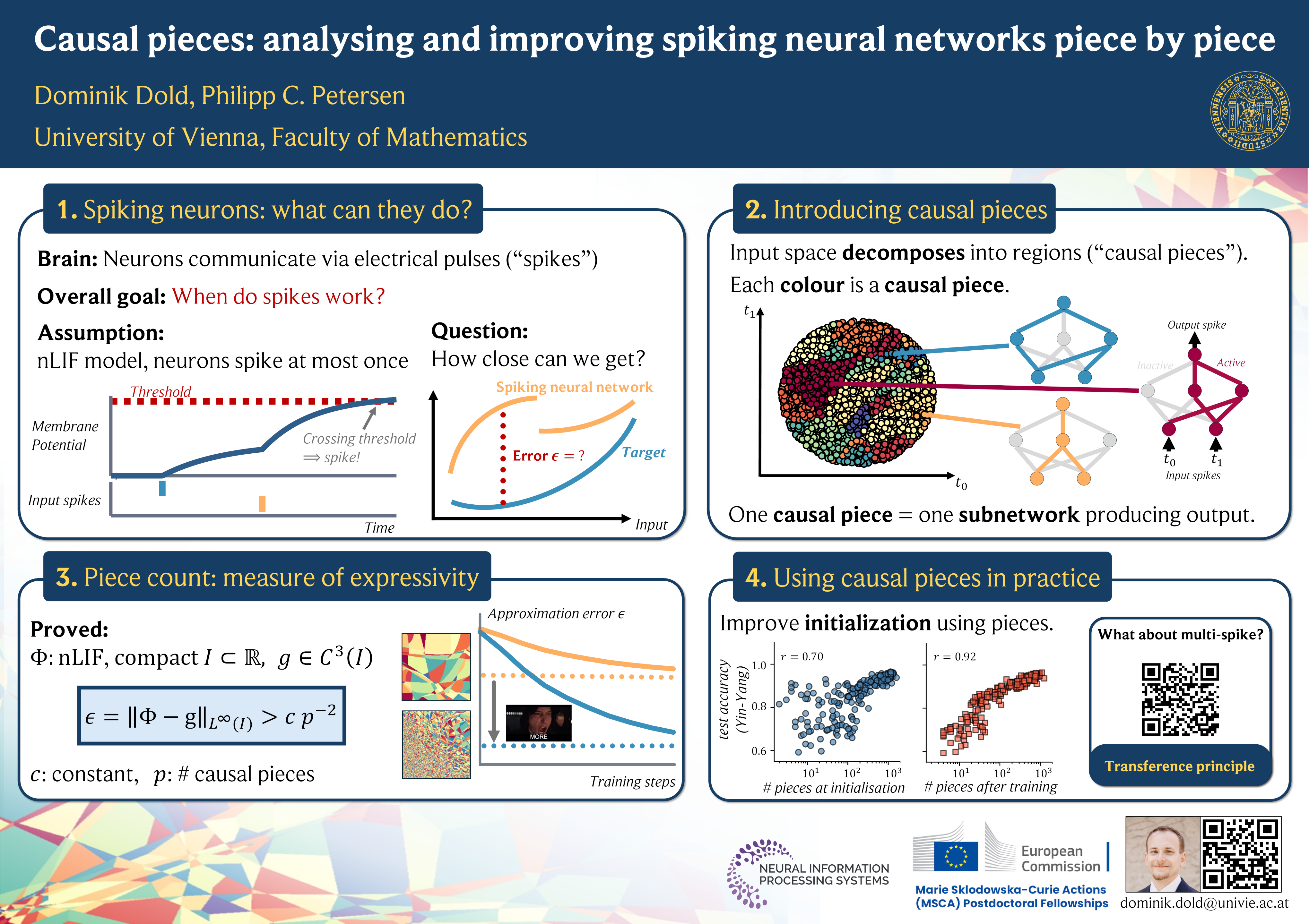
We introduce causal pieces, a novel concept for analysing spiking neural networks (SNNs), inspired by linear pieces used to study expressivity and trainability in artificial neural networks (ANNs). Causal pieces partition the input and parameter space of a feedforward SNN with single-spike coding into distinct regions where the same subnetwork causes the output spikes. For networks of current-based leaky integrate-and-fire (LIF) neurons with large membrane time constants, we show that within each causal piece, output spike times are locally Lipschitz continuous with respect to inputs and network parameters. We further prove a lower bound on the approximation error that depends on the number of causal pieces. Thus, the number of causal pieces is a measure of the approximation capabilities of SNNs, which is valid despite spike-time discontinuities and applies to networks with both excitatory and inhibitory synapses. Empirically, we find that parameter initialisations yielding more causal pieces on the training set strongly correlate with SNN training success across multiple benchmarks, including Yin-Yang, Fashion-MNIST, and EuroSAT. Moreover, simulations with standard single-spike LIF neurons indicate that our findings extend beyond the theoretically analysed regime. These results establish causal pieces as a powerful and principled tool for analysing and improving the computational capabilities of SNNs.
Certified Single-Level Reformulation for Tri-Level Cyber-Physical Grid Security
Debraj Banerjee ⋅ Gurunath Gurrala ⋅ Kunal Narayan Chaudhury
Modern power grids are increasingly exposed to coordinated cyber-physical disruptions, where the outage of a small number of transmission components can trigger severe post-contingency load shedding. Designing proactive _security defense_ against such adversarial contingencies is naturally modeled as a tri-level Defender-Attacker-Operator (DAO) problem: the defender allocates limited hardening resources, the attacker selects worst-case line outages, and the operator solves a post-attack DC/AC-optimal power flow (OPF). However, the resulting tri-level program is computationally prohibitive even for moderate network sizes. We develop a certified four-step reformulation pipeline that converts this intractable tri-level DAO problem into a tractable single-level optimization, yielding a Single-Level Mixed-Integer Linear Program (SL-MILP) under DC-OPF and a Single-Level Mixed-Integer Conic Program (SL-MICP) under AC-OPF. The construction combines exact dualization, exact Big-$M$ linearization, and a single controlled attacker relaxation. We prove that the resulting single-level optimum provides a conservative upper bound on the true worst-case load shedding and, more importantly, yields a robustness certificate for the deployed defense: no feasible binary attack can induce damage exceeding the reported single-level value. Extensive experiments on IEEE benchmark systems demonstrate substantial runtime improvements while maintaining strong worst-case security guarantees.
Characterizing the Edge of Stability in Variational Training Without Priors
Juraj Marusic ⋅ Jonathan Wenger ⋅ Beau Coker ⋅ John Cunningham
Variational approaches in deep learning promise to deliver improved uncertainty quantification and out-of-distribution generalization by inferring a distribution over weights, regularized by a divergence to a chosen prior. However, prior elicitation presents a significant challenge in deep learning, resulting in the common practice of significantly downweighting the regularization term in the variational objective. Recently, it was proposed to train solely via the expected loss by relying on implicit regularization from the optimizer, rather than explicit regularization from the divergence to the prior. While this approach largely sidesteps the issue of prior elicitation, current theory lacks an understanding of how key optimization hyperparameters impact the implicit regularization. Here, we theoretically and empirically demonstrate that larger learning rates and fewer parameter samples lead to flatter minima of the loss landscape, which are known to generalize better. We show that training on the expected loss operates at a modified edge of stability, characterized by the signal-to-noise ratio of the gradient estimates and the number of Monte Carlo samples. Experiments on out-of-distribution benchmark datasets confirm the practical significance of the theoretical results.
CLoSeR: Closing the Loop for Long-Context Streaming Reconstruction
Moyang Li ⋅ Zihan Zhu ⋅ Wei Zhang ⋅ Marc Pollefeys ⋅ Daniel Barath
Feedforward foundation models have recently shown remarkable 3D reconstruction capabilities. However, existing models exhibit large tracking drift in long-context streaming reconstruction due to error accumulation. In this paper, we revisit loop closure with streaming reconstruction foundation models to enable accurate, drift-free, kilometer-scale reconstruction. Specifically, our method detects loop candidates through global descriptor retrieval, and constructs loop-conditioned windows to estimate the relative poses between looped frames. Given the observation that our adopted streaming reconstruction backbone produces a globally consistent scale, we optimize all frame poses on the SE(3) manifold with sequential and loop closure constraints, avoiding the pose graph optimization on the Sim(3) or higher-dimensional SL(4) manifolds employed in prior works. Extensive experiments show that our method reduces drift and produces consistent geometry on kilometer-scale sequences, significantly outperforming the state of the art. The code will be made public.
Clustered Randomized Smoothing for Stochastic Prediction Functions
Eduardo Figueiredo ⋅ Frederik B Mathiesen ⋅ Julian F Schumann ⋅ Jens Kober ⋅ Arkady Zgonnikov ⋅ Luca Laurenti
Neural networks are expressive predictors capable of modeling rich, multi-modal outcome distributions. However, this expressive power comes with challenges in ensuring robust predictions—a critical requirement in safety-critical domains. Randomized smoothing is a leading technique for improving robustness, particularly against adversarial perturbations. Yet, in stochastic multi-modal regression settings, randomized smoothing often fails due to mode collapse, yielding averaged predictions that do not reflect the underlying distribution. To address this limitation, we propose clustered $\alpha$-smoothing, a framework that (1) partitions noisy samples using an arbitrary clustering algorithm, (2) applies $\alpha$-smoothing locally within each cluster, and (3) combines the resulting predictions into a mixture distribution. By interpreting the smoothing distribution as a mixture of $\alpha$-smoothers, we derive a lower bound on the probability that the smoothed prediction lies within a union of compact regions corresponding to distinct modes. We empirically evaluate our framework on two benchmarks, demonstrating substantial improvements over state-of-the-art methods. In stochastic trajectory prediction on a driving simulator dataset, our approach achieves, on average, a 33\% lower Wasserstein distance to the ground-truth distribution compared to $\alpha$-smoothing. In quadrotor control, where modes correspond to distinct feasible paths to a target, our method reduces the collision rate by 81\% relative to the state-of-the-art randomized smoothing.
Competing Event Models: Next Event Prediction Under Interventions
Yoav Wald ⋅ Xiang Gao ⋅ Sumit Chopra ⋅ Juho Lee ⋅ Rajesh Ranganath
Modeling interventions that include timing is an important task in many domains, such as treatments in healthcare, transactions in finance, and others. However, estimating these interventional distributions is challenging because standard next-token predictors, typically implemented using transformers, do not naturally support altering the timing of specific future events. We develop \emph{Competing Event Models} (CEMs), an autoregressive generative approach that simplifies the estimation of interventions on both what interventions are applied and \emph{when}. Drawing from the competing risks literature, CEMs model independent probability distributions for latent times of each event type, where the earliest realized time determines the next event. We show that this framework enables straightforward interventions on event timing and efficient sampling, and, through careful design choices, can also model concurrent events. We evaluate CEMs on a cancer tumor volume simulator and on prediction tasks using the MIMIC-IV dataset. Our results show that CEMs accurately recover causal effects of sequential treatments in simulations while surpassing standard transformer baselines in predictive performance on 3 out of 4 real-world medical data tasks.
ContextShift: A Controlled Benchmark for Context Dependence in Object Detection
Dan Zlotnikov ⋅ Alex Lazarovich ⋅ Ohad Ben-Shahar
Modern object detectors achieve strong performance on standard benchmarks, yet their robustness to contextual variation remains insufficiently investigated. Prior evaluations largely rely on aggregate metrics such as AP on uncontrolled distribution shifts, which conflate multiple factors and can obscure how performance degrades under context change. We introduce \textsc{ContextShift}, a controlled benchmark for evaluating context dependence by systematically manipulating object--context relationships while preserving object appearance. Built on COCO 2017, it isolates context as an independent variable both implicitly, through geometric transformations and explicitly via synthetic and natural background substitutions - with a compatibility axis based on normalized pointwise mutual information (NPMI) for continuous evaluation. Across diverse detector architectures, we observe a consistent degradation pattern: false negatives increase up to 227\% and prediction volume decreases down to -44\%, while false positives remain relatively stable or decline. This observed suppression behavior is not revealed by aggregate metrics such as AP, which can mask substantial recall loss and changes in prediction dynamics. Further analysis suggests that degradation is not primarily explained by reduced confidence, but is instead consistent with a reduced formation of valid detection candidates. Moreover, we find that performance along the statistical compatibility axis is non-monotonic, peaking at intermediate NPMI and degrading toward both extremes, indicating that statistical co-occurrence does not correlate linearly with effective visual context. Finally, we show that a training methodology based on context-aware augmentations rather than the dataset alone, which yields overall better models: every augmented variant outperforms the dataset-only baseline on both original (unmanipulated) test images as well as manipulated images, indicating that data-oriented augmentation can partially recover performance lost to prediction-suppression failures by exposing the model to object--context decoupling during training.
Convergence Guarantees for Federated SARSA with Local Training and Heterogeneous Agents
Paul Mangold ⋅ Eloïse Berthier ⋅ Eric Moulines
We present a novel theoretical analysis of Federated SARSA (FedSARSA) with linear function approximation and local training. We establish convergence guarantees for FedSARSA in the presence of heterogeneity, both in local transitions and rewards, providing the first sample and communication complexity bounds in this setting. At the core of our analysis is a new, exact multi-step error expansion for single-agent SARSA, which is of independent interest. Our analysis precisely quantifies the impact of heterogeneity, demonstrating the convergence of FedSARSA with multiple local updates. Crucially, we show that FedSARSA achieves linear speed-up with respect to the number of agents, up to higher-order terms due to Markovian sampling. Numerical experiments support our theoretical findings.
Correct but Unselectable: The Hidden Interface Tax in Multi-Candidate Reasoning
Qianli Ma ⋅ Zhiqing Tang ⋅ Fanshuai Meng ⋅ Zhi Yao ⋅ Hanshuai Cui ⋅ Weijia Jia
Small language models deployed under cost, latency, or privacy constraints cannot simply switch to larger models when reasoning fails. Multi-candidate generate then-rerank offers a natural test-time scaling route. However, more candidates do not always yield higher accuracy. We identify a previously overlooked bottleneck between generation and selection: a correct answer may appear in the candidate pool yet fail to be selected because it is incomplete, unparseable, or misaligned with the answer mode the fixed selector expects. We term this loss the hidden interface tax and formalize a coverage–conversion decomposition that distinguishes raw oracle coverage from selectable coverage, the subset of problems where a correct candidate can actually be consumed by the selector. We propose Compatibility Aware Candidate Construction (CACC), an interface layer between the candidate source and the fixed selector that repairs fragments, aligns answer modes, and removes selector-confusing noise without retraining either component. On numeric reasoning (GSM8K, competition_math), CACC raises both oracle coverage and final accuracy. On GPQA Diamond, CACC alone improves final accuracy from 5.6% to 19.2% (+13.6pp); combined with proposer-side strengthening it reaches 25.8% (+20.2pp). On MMLU-Pro, CACC exposes a coverage–conversion gap: answer-mode-compatible construction raises oracle coverage, but final gains require additional proposer-side distribution shaping.
CroissantMiner: Automated Extraction and Validation of Croissant Metadata for ML Datasets
Berke Arda ⋅ Mubashara Akhtar ⋅ Ahmetcan Yavuz ⋅ Paul Gerry ⋅ Sebastian Lobentanzer ⋅ Nobin Sarwar ⋅ Joan Giner-Miguelez ⋅ Kongtao Chen ⋅ Luyao Zhang ⋅ Mrinmaya Sachan
Croissant has emerged as a standard for machine-readable dataset metadata, yet populating its fields remains labor-intensive and requires careful reading of accompanying dataset documentation. The benchmark comprises 602 papers, including 102 with human-validated gold annotations (9,595 ratings) and 500 with LLM-validated silver annotations, covering the full Croissant schema with both core and Responsible AI (RAI) fields. To our knowledge, this is the first benchmark enabling end-to-end evaluation of metadata extraction aligned with a community-standard schema. We evaluate 20 extraction systems, including frontier and open-weight models as well as four agentic architectures, using a two-tier evaluation framework that combines rule-based scoring with an LLM judge selected via human audit. Our results show that single-pass extraction with Claude Sonnet 4.6 and a canonical prompt is the strongest configuration (composite 0.704). Across all backbones, agentic architectures consistently underperform their single-pass counterparts, indicating that task decomposition degrades performance for schema-complete metadata extraction. This effect is most prevalent on long-form RAI fields, where accurate extraction requires integrating information across multiple sections. Claude Sonnet 4.5, used to seed the gold pre-fills, is excluded from the headline ranking to avoid circularity. We release the benchmark, evaluation code, and judge audit anonymously for review at https://anonymous.4open.science/r/croissantminer-F87C, with a live Hugging Face Space demo to be provided at camera-ready.
Merging separately trained LoRA adapters is a practical alternative to joint multi-task training, but it often hurts performance. Existing methods usually treat the LoRA update $\Delta W = BA$ as a single object and do not distinguish the two LoRA matrices. We show that the main source of LoRA merge interference comes from the output-side matrix $B$. Across tasks, $B$ repeatedly uses a small set of shared directions, while $A$ remains much more task-specific. As a result, the merged adapter overemphasizes these shared directions, and task-specific information is lost. We propose Pico (Pre-merge interference calibration in output-space), a data-free method that calibrates $B$ before merge by downscaling over-shared directions and then rescaling the merged update. Pico plugs directly into existing merging methods such as Task Arithmetic, TIES, and TSV-M. Across eight different benchmarks from math, coding, finance, and medical domains, Pico improves average accuracy by 3.4-8.3 points over the corresponding base method and achieves the best overall average performance. Pico also enables merged adapters to outperform the LoRA trained with all task data. These results show that LoRA merging works better when the two LoRA matrices are treated separately.
Diff-CA: Separating Common and Salient Factors with Diffusion Models
Michaël Soumm ⋅ Alexandre Fournier Montgieux ⋅ Yunlong HE ⋅ Pietro Gori ⋅ Alasdair Newson
Contrastive Analysis aims to separate factors which are common between two data distributions from those which are salient to only one of them. Existing contrastive methods are based on generative models (e.g., VAEs or GANs) that often suffer from limited reconstruction and image quality, which hampers effective latent factor separation and limits their applicability to high-fidelity image generation and editing. We propose a novel conditioning framework for diffusion models that enables contrastive decomposition without compromising generation quality. We first train a prompt-free, image-conditioned diffusion model, and then learn to decompose the conditioning into a common and a salient factor, using weak supervision. We prove that the additive contrastive factorization, commonly assumed in prior work, is identifiable under mild conditions. This factorization enables targeted editing operations by swapping or interpolating only the salient factor while preserving the common factor.
Diffusion fine-tuning with Rewarded Moment Matching Distillation
Alexis Jacq ⋅ Guillaume Couairon ⋅ Quentin Berthet ⋅ Valentin De Bortoli ⋅ Arnaud Doucet ⋅ Romuald Elie
Distillation and Reinforcement Learning (RL) fine-tuning are the primary pillars of diffusion post-training. While traditionally studied in isolation, the interaction between these phases remains poorly understood, and in particular how fine-tuning impacts the generative quality of distilled models. We introduce Rewarded Moment Matching Distillation (RMMD), a novel framework that simultaneously distills diffusion models and maximizes a reward function. RMMD preserves the high-fidelity "naturalness" characteristic of advanced distillation (e.g., 8-step Moment Matching) by adapting the sampling loop for on-policy training and repurposing the distillation loss as a proxy for integral KL regularization. By evaluating the FID-Reward Pareto fronts on ImageNet, we demonstrate that RMMD achieves superior trade-offs compared to single-step baselines (DI++) and multi-step competitors (DRaFT, HyperNoise). Finally, we apply RMMD to GenCast, a state-of-the-art weather forecasting model, to distill it while optimizing the Continuous Ranked Probability Score (CRPS) metric. The resulting distilled model achieves a 7.5x speedup while outperforming the teacher model on 93% of target weather variables, and being better calibrated. This proves that RMMD scales to complex, high-dimensional scientific domains.
DINOv3
Oriane Siméoni ⋅ Huy Vo ⋅ Maximilian Seitzer ⋅ Federico Baldassarre ⋅ Maxime Oquab ⋅ Cijo Jose ⋅ Vasil Khalidov ⋅ Marc Szafraniec ⋅ Seung Eun Yi ⋅ Michaël Ramamonjisoa ⋅ Francisco Massa ⋅ Daniel Haziza ⋅ Luca Wehrstedt ⋅ Jianyuan Wang ⋅ Timothée Darcet ⋅ Théo Moutakanni ⋅ Leonel Sentana ⋅ Claire Roberts ⋅ Andrea Vedaldi ⋅ Jamie Tolan ⋅ John Brandt ⋅ Camille Couprie ⋅ Julien Mairal ⋅ Herve Jegou ⋅ Patrick Labatut ⋅ Piotr Bojanowski
Self-supervised learning holds the promise of eliminating the need for manual data annotation, enabling models to scale effortlessly to massive datasets and larger architectures. By not being tailored to specific tasks or domains, this training paradigm has the potential to learn visual representations from diverse sources, ranging from natural to aerial images -- using a single algorithm. This technical report introduces DINOv3, a major milestone toward realizing this vision by leveraging simple yet effective strategies. First, we leverage the benefit of scaling both dataset and model size by careful data preparation, design, and optimization. Second, we introduce a new method called Gram anchoring, which effectively addresses the known yet unsolved issue of dense feature maps degrading during long training schedules. Finally, we apply post-hoc strategies that further enhance our models' flexibility with respect to resolution, model size, and alignment with text. As a result, we present a versatile vision foundation model that outperforms the specialized state of the art across a broad range of settings, without fine-tuning. DINOv3 produces high-quality dense features that achieve outstanding performance on various vision tasks, significantly surpassing previous self- and weakly-supervised foundation models. We also share the DINOv3 suite of vision models, designed to advance the state of the art on a wide spectrum of tasks and data by providing scalable solutions for diverse resource constraints and deployment scenarios.
Discrete Diffusion Models Exploit Asymmetry to Solve Lookahead Planning Tasks
Itamar Trainin ⋅ Shauli Ravfogel ⋅ Omri Abend ⋅ Amir Feder
Discrete diffusion models are often said to outperform autoregressive models on planning tasks, but the specific mechanisms enabling this are not yet well understood. To explain why, we abstract the complexity of studying ``planning'' into graph traversal problems, which offer a minimal setup for evaluating language models' planning and lookahead capabilities. We find that non-autoregressive language models are able to leverage an inherent directional asymmetry in lookahead planning tasks to outperform the training efficiency of their autoregressive counterparts. Through a mechanistic study of the training and inference dynamics of autoregressive and non-autoregressive models, we discover that while forward traversal through junctions in the graph requires complex sequential planning, the reverse path remains deterministic. Consequently, non-autoregressive models naturally develop a fundamentally different solution strategy. Effectively, they learn a reverse-decoding pattern which reduces an $\ell^{th}$-order lookahead problem to a sequence of simple $1^{st}$-order transitions. Latent-space analysis further confirms these divergent strategies by demonstrating the distinct internal representations formed during generation. Ultimately, these findings highlight the advantages of non-autoregressive modeling while clarifying the inherent planning limitations induced by autoregressive architectures.
Disentangling the Good From the Bad: Quantization-Induced Flips Are Not Random
Aymen Bouguerra ⋅ Alexandra Gomez-Villa ⋅ Chokri Mraidha ⋅ Fabio Arnez
Model quantization has advanced tremendously in recent years, producing models that require a fraction of the compute while maintaining baseline accuracy and creating the illusion of lossless compression. Beneath the surface, however, model behavior undergoes severe shifts that simple global accuracy fails to capture. Notably, quantized models experience a high rate of "flips": individual predictions that change from correct to incorrect (bad flips-CI) and vice versa (good flips-IC). Although overall accuracy remains stable, these changes degrade model reliability and introduce unforeseen safety risks. Current literature largely attributes these flips to random rounding noise, a perspective that ignores the specific precision constraints imposed by quantization with or without training. In this paper, we show that flips are driven by quantization's implicit regularization, low-pass filtering, and exacerbated spectral bias. By analyzing these effects via Singular Value Decomposition (SVD), we leverage the model's low-to-high rank internal disagreement to disentangle good flips from bad ones. Building on this insight, we introduce post-hoc approaches to selectively preserve the former while correcting the latter, and we validate the universality of our disentanglement through extensive experiments spanning Post-Training Quantization (PTQ) to Quantization-Aware Training (QAT) and across vision, language, and multi-modal models. With this work, we aim not only to restore the quantized model's hidden reliability degradation but also to elevate it beyond the accuracy ceiling of its full-precision counterpart.
Learning functions $ f : \mathbb{F}_2^n \to \mathbb{R} $ with sparse Fourier representations plays a central role in computational learning theory, as such functions capture many natural concept classes in machine learning. In recent years, Fourier sparsity has also been studied from the related perspective of property testing, where the goal is to determine, given query access to a function, whether it is $ s $-Fourier-sparse or far from every such function under an appropriate distance measure. Such testers can serve as a preprocessing step for model selection in agnostic learning of Fourier-sparse functions, where validating the structural assumption is crucial before applying computationally expensive learning algorithms. However, all prior work on testing Fourier sparsity considers distance with respect to the uniform distribution over the hypercube. In this work, we initiate the study of Fourier sparsity testing in the distribution-free setting, the property-testing analogue of the PAC+MQ learning framework. In this model, the tester is given oracle access to an unknown function and sample access to an arbitrary and unknown input distribution, and must distinguish $ s $-Fourier-sparse functions from those that are $ \delta $-far from every such function with respect to the underlying distribution. We design a nonadaptive randomized tester that succeeds with high probability using $ \widetilde{O}((s/\delta)^4) $ oracle queries and $ \widetilde{O}(1/\delta) $ samples from the unknown distribution.
Does Weight Decay Enhance Training Stability?
Marius Sæther ⋅ Amir Kolić ⋅ Pierfrancesco Beneventano ⋅ Tomaso Poggio
In modern deep learning, weight decay is often credited with "stabilizing" training dynamics, diverging from its classical role as a static regularization penalty. We investigate a fundamental question: does weight decay stabilize training dynamics, and if so, through which mechanism? Indeed, training stability is understood through different but related notions in the literature. We consider how weight decay affects the parameter-space dynamics and loss sharpness by analyzing its effects at the Edge of Stability (EoS). We show that weight decay robustly slows progressive sharpening. Furthermore, we uncover a striking architecture-dependent phase transition. In CNNs, weight decay dampens the oscillations at the EoS, while in MLPs, increasing weight decay causes a phase transition in which the sharpness stabilizes at a threshold significantly below the theoretical $\frac{2}{\eta}$ boundary. We develop a mathematical framework that accurately models these phenomena and identify the global alignment of the parameter vector and the sharpness gradient as the mechanistic driver of the phase transition. Importantly, we show that these phenomena translate into stability in terms of search in function-space (NTK).
An influential paper of Calvano et al. empirically demonstrated that Q-learning agents spontaneously collude when placed as sellers that compete on prices in a natural market model. More recent results of Fish et al. empirically demonstrated that similar collusion happens with commercial LLMs. We formally prove that such collusion can also happen with external-regret-minimizing agents. We identify a very general class of agents, which we term Domination-Avoiding agents, that provably do not collude in such markets. This class contains all Mean-Based agents and all internal-regret-minimizing agents, as well as others such as Multiplicative-Weight agents with variable learning rate and contextual variants thereof. More generally we show that, in any game, this class of agents is guaranteed to jointly learn to almost never play strategies that are eliminated by repeated elimination of purely dominated strategies.
Dual-Pronged LoRA: Achieving Near-Zero Forgetting and High-Performance Adaptation for MLLMs
Jingqi Ye ⋅ haonan he ⋅ Minglei Li ⋅ Fujun Han ⋅ Tao Chen ⋅ Peng Ye
Adapting Multimodal Large Language Models (MLLMs) to specialized and diverse downstream applications necessitates fine-tuning, typically through parameter-efficient methods such as Low-Rank Adaptation (LoRA). However, fine-tuning MLLMs severely degrades pre-trained upstream capabilities, a phenomenon known as catastrophic forgetting. Existing Methods primarily rely on parameter pruning to strike a balance between the downstream adaptation and upstream knowledge retention. Empirical analysis indicates that these methods are subject to parameter space entanglement, wherein the imposition of downstream adaptation and upstream retention within a unified parameter space results in suboptimal outcomes for both objectives. To address this, we introduce Dual-Pronged LoRA, a novel fine-tuning framework for MLLMs featuring two components. (1) Task-Decoupled Contextual Routing (TDCR) makes the first attempt to explicitly decouple tasks by modeling a downstream contextual support region. It adaptively activates the LoRA branch exclusively for downstream-relevant inputs and bypasses it otherwise, thereby preventing downstream adaptation from interfering with pre-trained knowledge. (2) Downstream-Performance-Oriented Rank Sculpting (DPO-RS) maximizes downstream adaptation performance by dynamically sculpting ranks via gradient energy. It effectively strengthens critical layers while compressing redundant ones and is theoretically grounded in the minimization of information loss. Extensive experimental results indicate that Dual-Pronged LoRA achieves near-zero forgetting while attaining new state-of-the-art downstream performance.
Dynamic Video Generation: Shaping Video Generation Across Time and Space
Shikang Zheng ⋅ Jingkai Huang ⋅ Jiacheng Liu ⋅ Guantao Chen ⋅ Lixuan He ⋅ Yuqi Lin ⋅ Peiliang Cai ⋅ Linfeng Zhang
Diffusion models have achieved impressive performance in video generation, but their iterative denoising process remains computationally expensive due to the large number of tokens processed at each timestep. Recently, progressive resolution sampling has emerged as a promising acceleration approach by reducing latent resolution in early stages. However, scaling this idea to video generation remains challenging, as the additional temporal dimension introduces diverse spatio-temporal demands across different videos, and compressing only a single dimension often leads to limited acceleration or degraded quality. Therefore, we propose \textbf{DVG}, a \textbf{D}ynamic \textbf{V}ideo \textbf{G}eneration framework that jointly allocates computation across time and space, automatically selecting content-aware acceleration strategies without manual tuning or retraining. \textbf{DVG} achieves near-lossless acceleration across models and tasks, reaching up to \textbf{7$\times$} speedup on HunyuanVideo and HunyuanVideo-1.5, and \textbf{18$\times$} when combined with distillation, demonstrating its potential as a key component in today’s large-scale efficient video generation systems. \emph{Our code is in supplementary material and will be released on Github.}
Dyna-Style Safety Augmented Reinforcement Learning: Staying Safe in the Face of Uncertainty
Artur Eisele ⋅ Bernd Frauenknecht ⋅ Friedrich Solowjow ⋅ Sebastian Trimpe
Safety is a key problem in reinforcement learning, especially during exploration. While safety filters are promising to address this issue, they are ill-suited for high-dimensional systems with unknown dynamics. We propose Dyna-style Safety Augmented Reinforcement Learning (Dyna-SAuR), a novel algorithm that learns a control policy as well as a scalable safety filter requiring minimal domain knowledge by leveraging a learned uncertainty-aware dynamics model. A novel filter learning formulation enforces to avoid failures and areas of high model uncertainty. As joint deployment of the control policy and filter allow to safely collect data and improve the dynamics model, certain areas grow and filter conservatism decreases over time. Dyna-SAuR reduces failures compared to state-of-the-art methods by two orders of magnitude on goal-reaching CartPole and MuJoCo Walker.
Effective Context in Transformers: An Analysis of Fragmentation and Tokenization
Amirmehdi Jafari Fesharaki ⋅ Mohammadamin Rami ⋅ Aslan Tchamkerten
Transformers predict over a representation of a sequence. The same data can be written as bytes, characters, or subword tokens, and these representations may be lossless. Yet, under a fixed context window, they need not expose the same information to the model. This raises a basic question: how does the choice of representation change what a finite-context predictor can achieve? We study this question on Markov sources and uncover two complementary phenomena. First, we observe that moving to smaller representation units can hurt prediction even when the context window is enlarged to cover the relevant source history. To explain this, we introduce fragmentation: a lossless recoding that replaces each source symbol by several smaller units. We prove that fragmentation can strictly increase the optimal finite-context log-loss, showing that the gap is not merely an optimization or capacity issue, but can be intrinsic to the representation. Second, we study the opposite direction: greedy tokenization, which groups source symbols into larger units. We show that tokenization can make a short token window behave like a longer source-context window, and we give a loss guarantee describing when this is achievable. The guarantee depends on how reliably token windows span the needed source history, together with the compression rate of the tokenizer. This also yields a simple diagnostic for real tokenizers: measuring how much source context a fixed token window reliably contains. Together, the two directions give a finite-context view of why representation matters for Transformer prediction.
Efficiently Aligning Draft Models via Parameter- and Data-Efficient Adaptation
Luxi Lin ⋅ Zhihang Lin ⋅ Zhanpeng Zeng ⋅ Yuhao Chen ⋅ Qingyu Zhang ⋅ Jixiang Luo ⋅ Rongrong Ji
Speculative decoding accelerates LLM inference but suffers from performance degradation when target models are fine-tuned for specific domains. A naive solution is to retrain draft models for every target model, which is costly and inefficient. To address this, we introduce a practical parameter- and data-efficient framework named Efficient Draft Adaptation, abbreviated as EDA, for efficiently adapting draft models. EDA introduces three innovations: (1) a decoupled architecture that utilizes shared and private components to model the shared and target-specific output distributions separately, enabling parameter-efficient adaptation by updating only the lightweight private component; (2) a data regeneration strategy that utilizes the fine-tuned target model to regenerate training data, thereby improving the alignment between training and speculative decoding, leading to higher average acceptance length; (3) a sample selection mechanism that prioritizes high-value data for efficient adaptation. Our experiments show that EDA effectively restores speculative performance on fine-tuned models, achieving superior average acceptance lengths with significantly reduced training costs compared to full retraining. Code will be released upon acceptance.
Emergence of Distortions in High-Dimensional Guided Diffusion Models
Enrico Ventura ⋅ Beatrice Achilli ⋅ Luca Ambrogioni ⋅ Carlo Lucibello
Classifier-free guidance (CFG) is the de facto standard for conditional sampling in diffusion models, yet it often reduces sample diversity. Using tools from statistical physics, we analyze the emergence of generative distortions induced by CFG, namely the mismatch between the CFG sampling distribution and the true conditional distribution. We study this phenomenon in analytically tractable settings with exact score functions, characterizing its dependence on data dimensionality and the number of classes. For high-dimensional Gaussian mixtures, we use dynamic mean-field theory to show that distortions arise when the number of classes scales exponentially with the data dimension, whereas they vanish in the sub-exponential regime due to a dynamical phase transition. We further prove that, in the infinite-class limit, distortions remain unavoidable regardless of dimensionality because of the increasing density of classes. Finally, we show that standard CFG schedules cannot prevent variance shrinkage, and we propose a theoretically grounded guidance schedule incorporating a negative-guidance window that improves both class separability and sample diversity in real-world latent diffusion models.
EM-NeSy: Expectation Maximization for Neurosymbolic Learning
Annegret Seibt ⋅ Luc De Raedt ⋅ Giuseppe Marra
Neurosymbolic (NeSy) models integrate neural networks and symbolic reasoning for robust and interpretable AI. State-of-the-art NeSy models require that the symbolic component is expressed in a differentiable way, often complicating the use of approximate inference. We propose EM-NeSy which casts probabilistic NeSy learning as an instance of the Expectation-Maximization (EM) algorithm. In the expectation step, we compute the posterior over the neurally predicted symbols conditioned on the label via probabilistic inference. In the maximization step, we update the neural parameters based on this posterior using gradient descent only through the neural component. This formulation unlocks the full potential of the EM algorithm for NeSy learning. It allows NeSy to extend naturally to approximate reasoning without any additional modifications or differentiability requirements of the symbolic component. Furthermore, it recovers the standard end-to-end gradient-based NeSy setting under exact inference. Our experimental results demonstrate the scalability and computational efficiency of EM-NeSy.
Enhancing Tabular Learners with Context-Aware Semantic Embeddings
Günther Schindler ⋅ Maximilian Schambach ⋅ Johannes Höhne
While modern tabular learners excel at capturing statistical patterns, they frequently operate in a semantic vacuum, treating textual features as discrete symbols, ignoringing the rich semantics inherent in feature names or cell entries. We propose CASE (Context-Aware Semantic Embeddings), a novel framework that bridges the gap between the semantic understanding of Large Language Models (LLMs) and the statistical capabilities of tabular learners. Unlike existing methods that embed rows in isolation, CASE utilizes a contextualization strategy: we pre-fill the KV cache of a custom-trained Gemma~3-based Tabular Language Model with a representative sample of rows to establish a persistent anchor of the dataset’s semantics. This ensures that generated row embeddings are dynamically contextualized, resolving semantic ambiguities and anchoring representations in domain-specific context. Our experiments across several benchmarks (CARTE, TextTab, and TabArena) demonstrate that CASE significantly improve performance of tabular learners -- particularly in low-data regimes and on semantically rich datasets -- setting a new state of the art when combined with recent tabular in-context learners. Inference code and model checkpoints will be made publicly available.
Flow and diffusion-based generative models achieve state-of-the-art quality, but require multiple forward passes at inference time, making them computationally costly. Consistency models overcome this by learning a flow map directly, enabling few‑step generation and dramatically reducing the computation needed at test time. However, formal statistical guarantees for such one‑step generators are scarce. Existing results either suffer from the curse of dimensionality or rely on impractical loss functions. We investigate whether one‑step flow-based models can escape the curse of dimensionality under the assumption that the data distribution is generated by a low-dimensional surface perturbed with Gaussian noise. In this setup, we derive approximation and generalization error bounds for the flow map estimate that circumvent the curse of dimensionality. Our findings provide the first principled explanation for practical success of one-step flow-based generative models.
ESS-Flow: training-free guidance as Bayesian inference in source space
Adhithyan Kalaivanan ⋅ Zheng Zhao ⋅ Jens Sjölund ⋅ Fredrik Lindsten
Guiding pretrained flow-based generative models for conditional generation or to produce samples with desired target properties enables solving diverse tasks without retraining on paired data. We present ESS-Flow, a gradient-free method that leverages the Gaussian prior of the source distribution in flow-based models to perform Bayesian inference directly in the source space using Elliptical Slice Sampling. ESS-Flow only requires forward passes through the generative model and observation process, making it applicable even when gradients are unavailable, such as with non-differentiable simulation-based observations or quantization in the generation process. We demonstrate its effectiveness on scientific applications including designing materials with desired target properties and predicting protein structures from sparse inter-residue distance measurements.
Evaluating and Understanding Scheming Propensity in LLM Agents
Mia Hopman ⋅ Jannes Elstner ⋅ Maria Avramidou ⋅ Amritanshu Prasad ⋅ David Lindner
As frontier language models are increasingly deployed as autonomous agents pursuing complex, long-term objectives, there is increased risk of scheming: agents covertly pursuing misaligned goals. Prior work has focused on showing agents are capable of scheming, but their propensity to scheme in realistic scenarios remains underexplored. To understand when agents scheme, we decompose scheming incentives into agent factors and environmental factors. We develop realistic settings allowing us to systematically vary these factors, each with scheming opportunities for agents that pursue instrumentally convergent goals such as self preservation, resource acquisition, and goal-guarding. We find only minimal instances of scheming despite high environmental incentives, and show this is unlikely due to evaluation awareness. While inserting adversarially-designed prompt snippets that encourage agency and goal-directedness into an agent’s system prompt can induce high scheming rates, snippets used in real agent scaffolds rarely do. Surprisingly, in model organisms Hubinger et al. [2023] built with these snippets, scheming behavior is remarkably brittle: removing a single tool can drop the scheming rate from 59% to 3%, and increasing oversight can raise rather than deter scheming by up to 25%. Our incentive decomposition enables systematic measurement of scheming propensity in settings relevant for deployment, which is necessary as agents are entrusted with increasingly consequential tasks.
Evaluating Multimodal Narrative Understanding of Popular Hollywood Films
David Bamman ⋅ Kent K Chang ⋅ Allison Cooper ⋅ Juishan Hsu ⋅ Reina Kushihashi ⋅ Madison Mar ⋅ Arnav Podichetty ⋅ Rachael G Samberg ⋅ Ipek N Sancak ⋅ Yuhan Shao
Multimodal language models increasingly show promise for enabling the large-scale computational analysis of film, opening up new avenues for learning about film history and the evolution of narrative techniques. But the creation of stable benchmarks built around Hollywood films is complicated by copyright protections. In this work, we address these concerns directly, by building a new collection of Hollywood films defined by two criteria: box office popularity (where we publish the first large-scale, open collection of weekly box office earnings reported by Variety magazine from 1922-1979); and likely public domain status (by researching copyright registrations and renewals in the US Catalog of Copyright Entries). We build a new multimodal MCQ benchmark on top of this collection that focuses on narrative elements that directly evaluate the abilities of models to inform meaningful research on film narrative; we find that many vision-language models struggle on this task (with many performing at near-chance levels of accuracy), while audio-visual models (including those that use audio in captioning scenes) reach a maximum accuracy of 61.1%, well below human-level performance.
Reinforcement learning (RL) agents face a continuous trade-off between exploiting known strategies and exploring novel states to obtain higher rewards. While exploration is often undirected, it can also be guided by intrinsic signals such as novelty or uncertainty. However, combining these signals with task rewards is challenging, as they can sometimes drive the agent away from optimal trajectories and reduce final performance. We find that this degradation arises from a structural occupancy conflict: as the policy improves, exploration signals naturally begin to anti-correlate with task advantages. In this work, we introduce Kantorovich Dual Shaping (KDS), a framework that resolves this conflict through constrained policy-space optimization. KDS formulates exploration as an Optimal Transport problem and applies the Sinkhorn-Knopp algorithm on the empirical batch manifold to reweight intrinsic rewards in a geometry-aware, point-by-point manner. When combined with standard RL objectives, it acts as a spatial filter that suppresses exploration in conflicting regions while enhancing it elsewhere. We evaluate this general approach across multiple off-policy and on-policy algorithms, achieving stable exploration that consistently avoids task degradation in complex continuous control environments.
Externalized CPDAG Summaries Improve LLM Causal Deduction
Wentao Sun ⋅ João P Nogueira ⋅ Dominique Verchere ⋅ Mathieu Acher ⋅ Alonso Silva
Corr2Cause asks whether a causal claim holds in every DAG compatible with observed correlations and conditional independencies. We frame this as latent-object reasoning: the label is defined by a CPDAG query, but free-form chain-of-thought often collapses the Markov-equivalence-class problem into local pattern matching. We propose Structured Thinking, a two-turn pipeline that first externalizes a typed, schema-constrained CPDAG summary and then answers against that graph state. On the Corr2Cause full test, Structured Thinking raises Qwen3.5-27B from 73.0 to 86.4 F1(Yes) over a strong PC-instruction baseline in the primary paired run (+13.4 percentage points; McNemar $p=2.4\times10^{-6}$; bootstrap 95% CI [+8.4, +18.6]); across three full-ID seeds, the mean gain is $+8.1 \pm 5.3$ percentage points. A PC-scaffolded two-turn prose control reaches only 67.6 F1, indicating that a detailed PC scaffold plus a schema-free prose intermediate is not sufficient. The same pattern holds on Qwen3.6-27B, Paraphrase-OOD, and GPT-5.4-mini. Scrambling the emitted CPDAG costs 12.0 percentage points in F1, and a full-split audit shows close agreement with the reference CPDAG, with ID skeleton F1 of 0.960 and exact CPDAG match of 75.9%. These results support a bounded design principle: externalize the latent object that defines the label, constrain its form, and test whether downstream answers use it.
Fast Wasserstein rates for estimating probability distributions of probabilistic graphical models
Daniel Bartl ⋅ Stephan Eckstein
Using i.i.d. data to estimate a high-dimensional distribution in Wasserstein distance is a fundamental instance of the curse of dimensionality. We explore how structural knowledge about the data-generating process which gives rise to the distribution can be used to overcome this curse. More precisely, we work with the set of distributions of probabilistic graphical models for a given directed acyclic graph. It turns out that this knowledge is only helpful if it can be quantified, which we formalize via smoothness conditions on the transition kernels in the disintegration corresponding to the graph. In this case, we prove that the rate of estimation is governed by the local structure of the graph, more precisely by dimensions corresponding to single nodes together with their parent nodes. The precise rate depends on the exact notion of smoothness assumed for the kernels, where either weak (Wasserstein-Lipschitz) or strong (bidirectional Total-Variation-Lipschitz) conditions lead to different results. We prove sharpness under the strong condition and show that this condition covers, as a special case, distributions having a positive Lipschitz density.
Federated Dataset Simulation: Inducing Label-Free Heterogeneity Across Tasks
Vasilis Siomos ⋅ Lam Ngo ⋅ Jonathan Passerat-Palmbach ⋅ Giacomo Tarroni
Federated Learning enables collaborative model training across decentralized clients without sharing raw data. While the field has seen rapid growth, the datasets underpinning FL evaluation have not kept pace: real federated datasets remain scarce, and most studies rely on small-scale centralized classification datasets partitioned via Dirichlet label skew, a one-dimensional proxy for the multi-dimensional heterogeneity present in real federations. Moreover, label-based partitioning is by construction inapplicable to non-classification tasks such as segmentation and detection, for which no principled simulation method exists. We cast the conversion of centralized datasets into federated benchmarks as the task of Federated Dataset Simulation (FDS), and decompose it into a representation function $\Phi$ and an assignment mechanism $\pi$. We provide two label-free instantiations---geometric partitioning via pretrained model embeddings and semantic partitioning via vision-language model-derived criteria---applicable to classification and dense prediction tasks alike. We evaluate across four datasets spanning classification, segmentation, and detection, and show that both methods induce heterogeneity that matches or exceeds that of label-skew partitioning, with measurable impact on downstream FL performance. We release \texttt{fds}, a modular open-source package for end-to-end federated dataset simulation, heterogeneity measurement, and FL training, at \url{https://anonymous.4open.science/r/FDS-neurips/}.
FineRMoE: Dimension Expansion for Finer-Grained Expert with an Upcycling Approach
Ning Liao ⋅ Xiaoxing Wang ⋅ Xiaohan Qin ⋅ Junchi Yan
As revealed by the scaling law of Mixture-of-Experts models, model performance ceases improving once the granularity of the intermediate dimension exceeds the optimal threshold, limiting further gains from single-dimension fine-grained design. To address this bottleneck, we propose FineRMoE (FineR-Grained MoE), an architecture that extends fine-grained expert design to both intermediate and output dimensions, aiming to enhance expert specialization beyond the single-dimension limit. We further introduce a bi-level sparse forward computation paradigm and a specialized routing mechanism to govern the activation. In addition, to obviate the prohibitive cost of pre-training from scratch, we devise a generalized upcycling method to build FineRMoE in a cost-effective manner. Extensive experiments performed under the upcycling paradigm demonstrate the superior performance achieved by FineRMoE across ten standard benchmarks. Compared with the strongest upcycling baseline method, FineRMoE achieves significant parameter and inference efficiency gains.
ForesightFlow: Self-Guided Flow Matching for Improving Vision-Language-Action Models
Yunpeng Mei ⋅ Jiakai He ⋅ Hongjie Cao ⋅ Chenyu Wang ⋅ Xiaowen Zhu ⋅ Yihan Zhou ⋅ Jiamin Wang ⋅ Chenbo Xin ⋅ Peng Cheng ⋅ Yuxuan Yang ⋅ Yijie Wang ⋅ Xinhu Zheng ⋅ Gao Huang ⋅ Jie Chen ⋅ Gang Wang
Large vision-language-action (VLA) policies are increasingly trained as conditional generative models over action chunks, yet they typically improve by imitating the data they are given. This is limiting in deployment, where robots collect mixed-quality experience containing demonstrations, partial completions, recoverable mistakes, and failures. Full behavior cloning imitates failures, filtered behavior cloning discards useful sub-trajectories, and offline RL usually requires a large separate critic. We introduce ForesightFlow, a self-guided flow policy that augments each generated action chunk with a learned success-potential vector. The same flow therefore proposes candidate actions and scores them, enabling best-of-K inference without an external critic. The key challenge is that policy improvement and value calibration require different supervision: advantage weighting should suppress low-quality actions, but applying the same weights to the potential dimension removes the failure gradients needed for calibration. We address this with decoupled advantage-weighted flow matching, applying exponentiated advantage weights only to action velocities while training potential velocities uniformly. We also derive a single-step boundary estimator for conditional flow matching with independent endpoint sampling, allowing advantage computation with one stop-gradient forward pass. Across five BEHAVIOR-1K simulation tasks and five real-world bimanual tasks, ForesightFlow improves over imitation baselines, matches the strongest separate-critic baseline in average simulation success, improves real-world success, and reduces training compute by 38\%. Ablations show that decoupling prevents value hallucination, the one-step estimator preserves candidate-ranking fidelity, and self-guided sampling improves long-horizon performance.
We consider smooth convex minimization over compact convex sets, i.e., $\min_{x \in \mathcal C} f(x)$ with the (vanilla) Frank--Wolfe algorithm. Well-known lower bounds establish a worst-case $\Omega(1/t)$ primal-gap barrier in the general smooth convex case, and faster convergence usually requires favorable function properties such as Hölder error bounds or strong convexity. We present a new Local Dual Sharpness (LDS) condition, essentially a property of the feasible region and its LMO, under which the Frank--Wolfe algorithm converges in $o(1/t)$ for any smooth convex function, ruling out an $\Omega(1/t)$ lower bound under LDS. The condition is a generalization (and localization) of uniform convexity of sets and it is satisfied by any uniformly convex set. To our knowledge, this is the first unconditional $o(1/t)$ convergence result for uniformly convex sets. Combining LDS with stronger function properties, e.g., a local variant of Hölder error bounds, allows us to quantify the actual rates.
FrED: External Data Influence Estimation via Domain Knowledge Graph Grounding
Theodoros Aivalis ⋅ Iraklis A Klampanos ⋅ Antonis Troumpoukis ⋅ Joemon M Jose
The rapid deployment of generative AI has amplified the critical need for Training Data Attribution to ensure transparency and accountability. However, current parametric approaches require computationally prohibitive access to model weights, while similarity-based methods ignore deep structural context. We propose a novel probabilistic framework that operates entirely in a black-box setting. Our method fuses continuous feature similarities with discrete, domain-specific Knowledge Graphs (KGs). This approach ensures the attribution is grounded in structural reality, explicitly rewarding highly specific historical samples while preventing generic background data from dominating the results. We evaluate our framework across two distinct domains where linking outputs to data and domain context is inherently complex: abstract artistic image synthesis and high-dimensional physical weather forecasting. Extensive benchmarking demonstrates the robust efficacy of our approach. In the artistic domain, it achieves a strong Linear Datamodeling Score that exceeds standard black-box similarity baselines, while closing much of the gap to gradient-based estimators. We additionally present a cross domain feasibility case study in environmental forecasting, where we use domain KGs to retrieve physically consistent historical analogs for regional flood forecasts, improving geographic localisation over a latent-only baseline. Operating entirely without internal model access, our approach provides an efficient, interpretable mechanism for post-hoc influence analysis and domain-grounded retrieval.
Frequency Domain Reservoir Computing
Klaus Schertler ⋅ Xiomara Runge ⋅ Andrea Ceni ⋅ David Kappel ⋅ Claudio Gallicchio
While the quadratic sequence-length bottleneck of transformers has fueled a resurgence in recurrent models, effectively capturing complex dynamics requires architectures that balance efficient training with highly expressive latent states. Echo State Networks (ESNs) offer a compelling approach by utilizing fixed recurrent weights to circumvent backpropagation through time, enabling a closed-form training solution. However, achieving the expressivity needed for complex tasks demands large reservoirs, exposing an $\mathcal{O}(N^2)$ state-update bottleneck that prevents ESNs from matching the scale of contemporary recurrent models. To address this limitation, we introduce Frequency Domain Reservoir Computing (FRESCO), an ESN architecture operating entirely in the frequency domain while avoiding domain-shift overheads to achieve $\mathcal{O}(N)$ complexity for dense, non-linear recurrent updates. By employing a novel dimensional zero-padding input embedding, a packed frequency-domain readout, and a natively applied frequency-domain non-linearity, FRESCO drastically reduces computational costs and energy consumption of training and inference. Furthermore, FRESCO matches the state-of-the-art predictive performance on memory benchmarks, sequential classification, and multivariate long-horizon forecasting, offering a scalable path forward for dense recurrent architectures.
From Approximation to Computation: Universal Power of Deep Narrow Networks at Constant Width
Olivier Bournez ⋅ Johanne Cohen ⋅ Adrian Wurm
Deep narrow neural networks underlie modern architectures from ResNets to Neural ODEs, yet their fundamental computational properties at constant width remain poorly understood. We prove that, for every deterministic Turing machine $M$, there is a single $ReLU$ network $N_M \colon [0,1]^4 \to [0,1]^4$ of width $4$ and depth $\mathrm{poly}(|M|)$, polynomial-time constructible, whose iterates simulate $M$ on every infinite binary tape encoded in a \emph{convex} initial region of $[0,1]^4$, with iteration count proportional to Turing-machine time. This establishes a tight correspondence between depth in width-$4$ networks and time on a Turing machine. The correspondence has three immediate consequences. First, verification of width-$4$ $ReLU$ networks spans the full complexity hierarchy along the single axis of depth: it is $NP$-complete for unary-encoded time bound, $NEXP$-complete for binary-encoded time bound, and $RE$-complete (undecidable) for unbounded time. Second, the hardness extends with two extra neurons of width to every common smooth activation: at width $6$, the robust verification problem (a promise problem with $\delta/2\delta$ gap) is $NP$-complete for $\tanh$, sigmoid, GELU, Swish, ELU, and any polynomial-time-computable continuous non-polynomial activation admitting a polynomial-time computable Lipschitz constant. A corollary is a discretized Neural ODE analogue at dimension 5. The simulation and statements are carried out on convex inputs, covering a regime previously inaccessible because of a continuity obstruction inherent to $\ReLU$ networks.
From Experts to Sub-experts: Fine-grained Parameter-Efficient Fine-Tuning for MoE LLMs
Zhentao Tan ⋅ Chang Liu ⋅ Yao Liu ⋅ Yue Wu ⋅ Jieping Ye
As large language models (LLMs) scale rapidly, dense full-parameter adaptation becomes increasingly expensive, motivating sparse and modular architectures such as Mixture-of-Experts (MoE) models. This shift raises a key question for parameter-efficient fine-tuning (PEFT): at what granularity should parameters be selected and updated? Existing PEFT methods such as LoRA operate on predefined weight matrices, while expert-level sparse tuning methods update entire selected experts. However, we observe that activated experts are internally sparse, with only a small fraction of intermediate channels strongly responding to downstream tasks, indicating that expert-level adaptation is still too coarse. We propose NSFT (Neural Sub-expert Fine-Tuning), a fine-grained PEFT framework that refines MoE adaptation from experts to sub-experts. NSFT decomposes each expert along the intermediate dimension into structured channel groups and selects task-relevant sub-experts by combining routing importance with intra-expert activation saliency. To optimize sparse partial updates, NSFT further introduces learning-rate scaling and dynamic gradient scaling to compensate for the reduced effective update magnitude. Experiments on OLMoE and Ling-mini-2.0 across challenging domain-specific tasks and general benchmarks show that NSFT consistently outperforms representative PEFT and expert-level sparse tuning baselines, while using substantially fewer trainable parameters and preserving competitive general capability. These results suggest that sub-expert-level adaptation is a more precise and efficient PEFT paradigm for MoE LLMs.
From Isolated feature to Orbits:\\Discovering Music Concepts via Multi-SAE Alignment
Liwei Lin ⋅ Gus Xia
How can we understand what a music foundation model has learned \textit{internally}? Most interpretability approaches, such as probing and Sparse Autoencoders (SAEs), focus on identifying individual features with minimal structural assumptions. We argue that many concepts are better understood as \textit{structured relations} rather than isolated features. This is especially prominent in music, where tonal structures are organized in the space of pitch and time. For example, concepts such as chords or keys are naturally expressed as structured sets (e.g., the 12 transpositions of a chord or the diatonic system within a key), rather than isolated features. In this study, \textbf{we shift from feature identification to structure-based analysis}, asking whether the learned inner representations of music language model emerge as organized structures over features. To this end, we introduce a framework that uses pitch transposition as an inductive bias to induce ordered orbits via multi-view SAE alignment. Concretely, we generate pitch-shifted input pairs and align their SAE representations to discover structured groups of pitch-related features. Experimental results show that this approach recovers orbit structures corresponding to chords, keys, and melodic patterns across two state-of-the-art music foundation models, while requiring only minimal grounding (e.g., a few anchor examples) to interpret entire concept families. Beyond interpretability, our results suggest a new paradigm for representation analysis: evaluating whether coherent relational structures emerge in learned representations as a proxy for model understanding.
From sequences to schemas: low-rank recurrent dynamics underlie abstract relational representations
Vezha Boboeva ⋅ Alberto Pezzotta ⋅ George Dimitriadis ⋅ Athena Akrami
A hallmark of intelligent behavior is the ability to extract abstract relational structure from temporal sequences -- recognizing, for instance, that aab, ccd, and eef all follow the same underlying pattern, regardless of the specific elements involved. This capacity, observed across species and sensory modalities, is thought to underlie the formation of cognitive schemas: compressed internal models that support rapid generalization to novel experiences. Yet the neural circuit mechanisms by which such abstract, identity-independent representations emerge from sequential experience remain largely unknown. Here, we investigate this question using Recurrent Neural Networks (RNNs) as mechanistic models of neural circuits, trained to classify sequences based on their latent algebraic patterns (e.g., aab, aad $\to$ AAB; aba, aca $\to$ ABA) without supervision on intermediate transitions. We demonstrate that RNNs learn low-dimensional representations that mirror the hierarchical generative structure of the sequences, and that this abstraction is mechanistically supported by the emergence of low-rank recurrent connectivity. The leading singular component of the recurrent weights integrates relational transition information -- whether consecutive tokens are the same or different -- across time, driving the formation of a structured, tree-like geometry in the population state space. Through singular vector ablation, we establish a causal role for this component: removing it selectively erases memory for earlier transitions while leaving local, single-step sensitivity intact. Finally, while RNNs trained on next-token prediction do not acquire these abstract representations, transferring the low-rank scaffold learned from classification significantly accelerates learning and improves generalization -- an effect specific to the abstract structure of the scaffold rather than generic statistical pretraining. These findings offer a computational account of how task demands shape recurrent connectivity to support temporal abstraction, with implications for schema formation in biological brains.
Symbolic regression aims to uncover explicit scientific laws from data. Recent methods use LLMs to guide mutation from background text, which is more directed than random genetic programming. However, exact symbolic recovery requires both semantic guidance and explicit structure, so that domain-informed search are carried out through valid symbolic representation. Current LLM-driven systems remain structure-blind: they select among opaque candidates, lack explicit mechanisms for local mutation, and rely on brittle coefficient fitting that can undervalue correct skeletons. We propose FunctionEvolve, an evolutionary framework using expression trees to organize the whole search: structural summaries promote diverse parent selection, local tree edits preserve useful subexpressions, and structure-aware fitting decomposes, constrains, and simplifies coefficients for more reliable scoring. It uses only elementary function families, without additional domain-specific rules limiting generalization. On the 129-task synthetic subset of LLM-SRBench, FunctionEvolve with Claude Opus 4.6 recovers 113 exact forms, reaching 87.6\% $\mathrm{SA@50}$, 4.7x above same-backbone baselines, and 58.9\% $\mathrm{SA@1}$, 3.8x above the strongest previously published top-1 result. Ablations show that structure-visible search is central to reliable recovery, with LLM-guided refinements and structure-aware coefficient optimization serving as essential proposal and scoring mechanisms. We also audit the benchmark and show that collinearity in its materials-science subset creates identifiability issues.
GAUGECAST++: A Physics-Informed Latent Forecasting System for Localized Flood Prediction
Adrian Kucia ⋅ Edward Rollason ⋅ Wai Lok Woo
Sparse-gauge flood forecasting is challenging because river-level dynamics combine transport, storage, rainfall forcing, and sharp event-scale phase shifts. We introduce GaugeCast++, a physics-informed latent forecasting framework that learns a coordinate system in which flood dynamics become easier to evolve. Its key component is a gauge-conditioned pullback operator, which reparameterizes the forecast field and suppresses residual transport, yielding a more stable latent evolution than direct prediction in observation space. To address delayed or shifted flood peaks, GaugeCast++ adds semigroup-consistent phase-transport learning, enforcing agreement between long-horizon forecasts and composed short-horizon rollouts in both amplitude and event phase. Finally, a decoupled inverse rainfall ambiguity module estimates uncertainty caused by imperfect future rainfall forcing. Experiments across six UK river-gauge catchments show consistent gains in event-level MSE, NSE, peak timing, and peak magnitude against strong neural forecasting baselines.
Generating Financial Time Series by Matching Random Convolutional Features
Konrad Mueller ⋅ Nikita Zozoulenko ⋅ Ben Wood ⋅ Thomas Cass ⋅ Lukas Gonon
Generating realistic financial time series is challenging as training data is often limited to a single historical path. With such scarce data, overfitting is hard to avoid, especially under adversarial training where a trained discriminator can memorize the training samples. To mitigate this, recent approaches train generators to minimize the discrepancy between untrained feature representations of real and generated time series. In these works, the feature maps are based on path signatures, which can fail to capture relevant time series properties at tractable truncation depths. In this work, we instead train generators by matching random convolutional features of real and generated time series. Existing random convolutional feature maps, such as Rocket and Hydra, have been shown to provide informative representations of real-world time series, but cannot supervise generative models because they are non-differentiable. We introduce SOCK (**SOft Competing Kernels), a fully differentiable random convolutional feature map, suited to train generative time series models. We show that generators trained by matching random SOCK features consistently outperform signature and diffusion baselines across a wide range of small-sample financial datasets. We further demonstrate SOCK's expressiveness on two-sample hypothesis testing and time series classification tasks, where SOCK matches or outperforms existing unsupervised feature maps.
GISA: A Benchmark for General Information-Seeking Assistant
Yutao Zhu ⋅ Xingshuo Zhang ⋅ Maosen Zhang ⋅ Jiajie Jin ⋅ Liancheng Zhang ⋅ Xiaoshuai Song ⋅ Kangzhi Zhao ⋅ Wencong Zeng ⋅ Ruiming Tang ⋅ Han Li ⋅ Ji-Rong Wen ⋅ Zhicheng Dou
The advancement of large language models~(LLMs) has significantly accelerated the development of search agents capable of autonomously gathering information through multi-turn web interactions. However, existing benchmarks often construct queries backward from answers, producing tasks misaligned with real-world needs. Moreover, these benchmarks tend to focus on either locating specific information or aggregating information from multiple sources, while relying on static answer sets prone to data contamination. To bridge these gaps, we introduce GISA, a benchmark for General Information-Seeking Assistants comprising 373 human-crafted queries reflecting authentic information-seeking scenarios. GISA features four structured answer formats (item, set, list, and table), enabling deterministic evaluation. It integrates both deep reasoning and broad aggregation within unified tasks, and includes a live subset with periodically updated answers to resist memorization. Notably, GISA provides complete human search trajectories for every query, serving as valuable references for analyzing and improving search agent behavior. Experiments on mainstream LLMs and commercial search products reveal that even the best model achieves only 19.30% exact match, with performance notably degrading on tasks requiring complex planning and comprehensive information gathering.
GNNs Meet Sequence Models Along the Shortest-Path: an Expressive Method for Link Prediction
Francesco Ferrini ⋅ Veronica Lachi ⋅ Antonio Longa ⋅ Bruno Lepri ⋅ Andrea Passerini
Graph Neural Networks (GNNs) often fail to capture the link-specific structural patterns essential for accurate link prediction, since their node-centric message passing might overlook the subgraph structures connecting two nodes. Prior attempts to inject such structural context either suffer from high computational cost or rely on oversimplified heuristics (e.g., common neighbor counts) that cannot capture multi-hop dependencies. We propose SP4LP (Shortest Path for Link Prediction), a new framework that integrates GNN-based node encodings with sequence modeling over shortest paths. Specifically, SP4LP first computes node representations with a GNN, then extracts the shortest path between each candidate node pair and processes the sequence of node embeddings with a sequence model. This design allows SP4LP to efficiently capture expressive multi-hop relational patterns. Theoretically, we show that SP4LP is strictly more expressive than both standard message-passing GNNs and several leading structural feature methods, positioning it as a general and principled framework for link prediction in graphs. Empirically, SP4LP sets a new state of the art on many standard link prediction benchmarks.
We prove that all 'gradient span algorithms' have asymptotically deterministic behavior on scaled Gaussian random functions as the dimension tends to infinity. This is a functional generalization of similar results for random quadratic functions and spin glasses. They explain the counterintuitive phenomenon that different training runs of many large machine learning models result in approximately equal cost curves despite random initialization on a complicated non-convex landscape. This 'predictable progress' phenomenon is exploited by the AutoML community: Since the optimization progress of a single run is already representative, multiple retries with the same hyperparameters are not necessary.
Grokking or Glitching? How Low-Precision Drives Slingshot Loss Spikes
LIU Hanqing ⋅ Jianjun Cao ⋅ Yuanze Li ⋅ Zijian Zhou
Deep neural networks exhibit periodic loss spikes during unregularized long-term training, a phenomenon known as the "Slingshot Mechanism." Existing work usually attributes this phenomenon to intrinsic optimization dynamics, but its triggering mechanism remains unclear. This paper shows that, under commonly used floating-point precision, the Cross-Entropy loss itself can produce a deterministic numerical instability. As training enters a high-confidence stage, the difference between the correct-class logit and the other logits may exceed the absorption-error threshold of float-point number. Then during backpropagation, the gradient of the correct class is rounded exactly to zero, while the gradients of the incorrect classes remain nonzero. This breaks the zero-sum constraint of gradients across classes and introduces a systematic drift in the parameter update of the classifier layer. We prove that this drift forms a positive feedback loop with the feature, causing the global classifier mean and the global feature mean to grow exponentially. We call this mechanism _Numerical Feature Inflation_ ($\mathcal{NFI}$). This mechanism explains the rapid norm growth before a Slingshot spike, the subsequent reappearance of gradients, and the resulting loss spike. We further show that $\mathcal{NFI}$ is not equivalent to an observed loss spike: in more practical tasks, absorption errors may affect only a subset of samples, so spikes do not necessarily occur, while the same zero-sum-breaking mechanism can still drive rapid growth of parameter norms. Our results reinterpret Slingshot as a numerical dynamic of finite-precision training, and provide a testable explanation for abnormal parameter growth and logit divergence in late-stage training.
Evaluating document OCR systems traditionally requires ground-truth (GT) text annotations aligned to each recognised element. Producing such annotations demands expert human labour, scales poorly with corpus size, varies between annotators on ambiguous content, ages quickly as document distributions and OCR systems evolve, and is often infeasible for sensitive or proprietary material. These constraints prevent continuous OCR quality monitoring at production scale and force practitioners to rely on small audited samples or proxy heuristics. To overcome these inherent limitations of ground-truth-based evaluations, we present a new class of reference-free OCR metrics based on render-and-compare that do not require any ground-truth annotations: OCR output is rendered back into a page image and the result is compared visually against the masked original using no-reference or learned metrics. The underlying principle is straightforward: the original page image already serves as a pixel-level ground truth for the content the OCR system tries to extract (text, formulas, and tables), so visual agreement between the original and a re-rendering of the OCR output is itself a proxy for recognition fidelity. To our knowledge, no prior work has systematically benchmarked reference-free visual metrics as proxies for whole-document OCR quality at scale. We conduct the first such study, evaluating 147 method implementations spanning 15 broad categories of techniques on 1,355 OmniDocBench pages across 5 OCR-output variants (text-only, formula-only, table-only, combined, combined without image masking). We measure every method by Spearman rank correlation against ground-truth-based metrics (edit distance for text and formulae, TEDS for tables), quantifying whether a reference-free metric correctly orders pages by OCR quality without any annotations. A naïve CLIP-cosine full-page similarity baseline achieves Spearman correlation $\rho = 0.339$; our best composite method reaches $\rho = 0.494$ (mean across the 5 variants; significance $p < 0.001$, computed over $N = 1{,}355$ pages), with a per-variant peak of $\rho = 0.605$ on the formula-only variant. Both numbers indicate that reference-free OCR quality estimation is genuinely viable: a meaningful page-level ranking signal can be recovered without any ground-truth annotations, and the gap to the ground-truth-based ranking is consistent with the inherent noise of a multi-domain document corpus where OCR errors are heterogeneous across text, formula, and table content. We also discuss inherent limitations that bound what any reference-free metric can achieve in this setting. To support reproducibility and for future research in this direction we are releasing three public HuggingFace datasets (rendered page pairs, per-element OCR log-probabilities, document-similarity triplets), and a trained document-similarity (DocSim) LoRA head (a DreamSim-style recipe adapted to document page reconstructions) along with the associated code.
HalluciText: Mitigating Text Hallucinations in Diffusion-Based Image Restoration
Zhiming Hu ⋅ Angela Ye ⋅ Ran Zhang ⋅ Tristan T Aumentado-Armstrong ⋅ Samrudhdhi B Rangrej ⋅ Faraz Ali ⋅ Dong Huo ⋅ Kosta Derpanis ⋅ Alex Levinshtein ⋅ Iqbal Mohomed
Diffusion-based image restoration models produce visually compelling results but systematically hallucinate text---generating characters that appear sharp and legible yet are factually incorrect. As text fidelity emerges as a key requirement for real-world image restoration, this failure mode poses a fundamental barrier to wide deployments of diffusion-based models: a model that replaces degraded-but-faithful text with sharp-but-wrong text misleads users and erodes trust. Recent text-aware models mitigate this by feeding text extracted from intermediate outputs or low-resolution (LR) images into the prompt, but they provide no mechanism to detect or correct the hallucinations that still commonly arise. In this work, we present a systematic study on how to improve text restoration during denoising, demonstrating that standard global conditioning alone is inadequate and that optical character recognition (OCR) confidence scores reliably predict word-level correctness. Grounded in these findings, we propose HalluciText, a training-free framework consisting of two complementary interventions: (i) Confidence-Weighted Classifier-Free Guidance (CW-CFG), which concentrates guidance energy on text regions weighted by OCR confidence to improve text recall; and (ii) VLM-Guided Test-Time Guidance (V-TTG), which leverages a vision-language model (VLM) to identify hallucinated regions and corrects them towards a faithful reference, improving text precision. Both operate solely on the noise prediction or latent representation, making them agnostic to the diffusion backbone and text spotting model. We demonstrate the effectiveness of HalluciText on state-of-the-art (SOTA) text-aware models, achieving up to 5.75 points of improvement in end-to-end text recognition F1 on several datasets without degrading image quality.
haphazard: A unified library and benchmark for online learning under varying feature availability
Rohit Agarwal ⋅ Arijit Das ⋅ Dilip K. Prasad
Haphazard inputs arise in online learning when feature availability varies across instances and the complete feature space is unknown in advance. However, the landscape of haphazard inputs research has been fragmented due to inconsistent data preprocessing, non-uniform evaluation metrics, limited coverage of streaming regimes and normalization, and model specific experimental code, making direct comparison across existing methods unreliable. We present haphazard, an open source Python library for reproducible benchmarking of haphazard input methods. The library provides an order preserving data pipeline with streaming normalization, unified evaluation, four streaming regimes, and shared interfaces for datasets, models, normalizers, and metrics. The current release supports 22 datasets, 11 model implementations, 5 normalization strategies, and 7 evaluation metrics, enabling systematic benchmarking across datasets and stream settings. By consolidating the experimental pipeline and exposing extensible interfaces for datasets, models, normalizers, metrics, and streaming regimes, haphazard provides a common reference point that can grow with future research on haphazard inputs. The anonymized source code is available at https://anonymous.4open.science/r/haphazard, and the PyPI package and docker container will be released publicly upon acceptance.
HARC: Coupling Harmfulness and Refusal Capabilities for Robust Safety Alignment
Shei Pern Chua ⋅ Fangzhao Wu
Understanding how aligned LLMs internally represent safety is critical for diagnosing alignment vulnerabilities, as it explains why jailbreaks succeed and informs the design of robust alignment strategies. Prior work shows that aligned LLMs encode harmfulness and refusal as separable directions in the residual stream at prompt-side token positions. We show that jailbreaks succeed at prompt encoding by suppressing either the refusal or harmfulness direction before any token is generated, with distinct attack classes occupying separable regions of the harmfulness-refusal plane. Extending the analysis to response-token positions, we find that the model recognizes harmful content while it is generating that content, even when it failed to recognize the input as harmful at the prompt side. Motivated by our findings, we introduce HARC (Harmfulness-And-Refusal Coupling), a fine-tuning method that pairs the two directions across both prompt and response positions. Since the intervention is confined to the harmfulness-refusal subspace, it leaves the rest of the residual stream intact and does not degrade general capability or inflate over-refusal. Across extensive experiments, HARC achieves the strongest robustness-capability-usability trade-off among six baselines spanning the major training-time and inference-time safety methods. The harmfulness and refusal directions at prompt and response positions transfer across the five model families and two scales we tested without architecture-specific tuning.
Heterogeneity-aware Distillation for Federated Continual Learning
Gaozhuo Liu ⋅ Yichen Li ⋅ Xiuying Wang ⋅ Yulong Li ⋅ Chuang Zhao ⋅ Yankai Jiang ⋅ Imran Razzak
Federated Continual Learning (FCL) requires distributed clients to acquire new tasks while retaining previously learned knowledge. In this paper, we revisit the heterogeneity challenge in FCL, which is composed of two distinct aspects: spatial static heterogeneity, e.g., initial data distribution and model architecture differences, and temporal dynamic heterogeneity, e.g., task shifts over time. While existing methods acknowledge the presence of heterogeneity, they typically treat it in a unified manner by employing a single adaptive strategy without explicitly disentangling their impacts. In contrast, we propose a heterogeneity-aware distillation framework for FCL called Ha-FCL, which is designed to handle spatial and temporal heterogeneity through tailored distillation strategies. Specifically, Ha-FCL combines width-aware federated training with server-side public-anchor distillation, integrating multi-layer feature distillation for architecture-aware alignment with historical-logit regularization and representation co-distillation. This forms a coordinated dual-dimensional distillation scheme that balances adaptation to new tasks with retention of prior knowledge. This enables more targeted knowledge transfer and leads to improved model performance under complex FCL scenarios. We evaluate our method in various heterogeneous settings. Compared with state-of-the-art baselines, Ha-FCL consistently improves test accuracy and shows better robustness under challenging heterogeneous FCL settings.
Due to their simplicity and interpretability, linkage methods are a central class of hierarchical agglomerative clustering (HAC). In particular, representative-based methods, such as centroid and medoid approaches, are appealing because their representatives provide intuitive summaries of the clusters. However, many representative-based linkage methods suffer from important drawbacks, such as high computational cost and the generation of inversions, which limit their broader applicability. We introduce *relaxed-representative clustering*, a principled generalization of representative-based linkages that preserves their interpretability while addressing these limitations. This framework yields (i) RMM*, a quadratic-time variant of the cubic-time Minimax method, and (ii) RC*, an inversion-free variant of the Centroid method whose representatives belong to the input set. On the theoretical side, we prove that for every $k$ our methods are $O(\min\{k,\log n\})$-approximation algorithms for the $k$-center objective. Empirically, experiments on tabular, biological, and textual datasets show that RMM* consistently outperforms several baselines and achieves clustering quality comparable to Minimax at a fraction of the computational cost. Meanwhile, RC* remains competitive with the Centroid method while producing inversion-free dendrograms and interpretable representatives.
High-dimensional Limit of SGD for Diagonal Linear Networks
Begoña García Malaxechebarría ⋅ Courtney Paquette ⋅ Maryam Fazel ⋅ Dmitriy Drusvyatskiy
Understanding the behavior of stochastic gradient methods is a central problem in modern machine learning. Recent work has highlighted diagonal linear networks as a simplified yet expressive setting for analyzing the optimization and generalization properties of neural models. In this work, we show that in the high-dimensional regime, stochastic gradient descent on diagonal linear networks is well-approximated by continuous dynamics governed by a stochastic differential equation (SDE), which explicitly decouples the drift from the gradient noise. We further derive a deterministic partial differential equation whose solution propagates the relevant state of the iterates and characterizes the time evolution of a broad class of observable statistics, including the risk, curvature, and other metrics for optimality. To the best of our knowledge, this is the first deterministic high-dimensional description of SGD for a genuinely nonlinearly parametrized model. Finally, we show that, under a suitable parametrization, the stochastic dynamics are globally well posed and converge exponentially fast to zero risk with high probability, yielding a fully explicit non-asymptotic description of their long-time behavior. Numerical simulations corroborate our theoretical findings.
How deep is your network? Deep vs. shallow learning of transfer operators
Mohammad Tabish ⋅ Benedict Leimkuhler ⋅ Stefan Klus
We introduce RaNNDy, a randomized neural network framework for learning transfer operators and their spectral decompositions. By fixing the weights of the hidden layers and training only the output layer, RaNNDy achieves significant reductions in computational costs---often by two orders of magnitude---with similar accuracy compared to state-of-the-art deep learning methods. The method is less sensitive to hyperparameter tuning and provides a closed-form solution for the output layer weights that directly represent eigenfunctions of the learned operator. Moreover, it is possible to estimate uncertainties associated with the computed spectral properties via ensemble learning. We demonstrate the efficacy of the proposed approach using diverse benchmark problems, including stochastic dynamical systems and protein folding processes, highlighting the strengths but also weaknesses of RaNNDy.
HPE: Hallucinated Positive Entanglement for Backdoor Attacks in Federated Self-Supervised Learning
Jiayao Wang ⋅ Yang Song ⋅ Zhendong Zhao ⋅ Jiale Zhang ⋅ Xiaoying Lei ⋅ Qilin Wu ⋅ Wenliang Yuan ⋅ Junwu Zhu ⋅ Dongfang Zhao
Federated self-supervised learning (FSSL) enables collaborative training of self-supervised representation models without sharing raw unlabeled data. While it serves as a crucial paradigm for privacy-preserving learning, its security remains vulnerable to backdoor attacks, where malicious clients manipulate local training to inject targeted backdoors. Existing FSSL attack methods, however, often suffer from low utilization of poisoned samples, limited transferability, and weak persistence. To address these limitations, we propose a new backdoor attack method for FSSL, namely Hallucinated Positive Entanglement (HPE). HPE first employs hallucination-based augmentation using synthetic positive samples to enhance the encoder’s embedding of backdoor features. It then introduces feature entanglement to enforce tight binding between triggers and backdoor samples in the representation space. Finally, selective parameter poisoning and proximity-aware updates constrain the poisoned model within the vicinity of the global model, enhancing its stability and persistence. Experimental results on several FSSL scenarios and datasets show that HPE significantly outperforms existing backdoor attack methods in performance and exhibits strong robustness under various defense mechanisms.
HumanStereo: A Benchmark for Metric Facial Depth Estimation and Its Evaluation
Alexandru-Ion Marinescu ⋅ DIANA-LAURA BORZA ⋅ DARABANT Sergiu Adrian
Stereo depth estimation of human faces is a prerequisite for various computer vision applications, yet existing stereo benchmarks target outdoor, driving, or large object reconstruction scenarios and lack the anatomical precision and evaluation framework these applications require. We introduce HumanStereo, the first large-scale synthetic stereo dataset dedicated to human faces, comprising 417k stereo pairs from 128 photorealistic avatars across 109 unique stereo configurations and four indoor environments, with dense ground-truth annotations including depth maps, surface normals, segmentation masks, and facial landmarks. We argue that standard evaluation metrics such as $\delta_1$ and RMSE are ill-suited for facial depth estimation, and propose two complementary metrics: task-grounded absolute inlier-ratio (IR) and Landmark 3D Distance Error (L3DE) for metric anatomical accuracy. We benchmark five representative stereo methods: geometrical matchers, RAFT-Stereo, IGEV++, MASt3R, and FoundationStereo. A downstream evaluation on real optometric data for inter-pupillary distance (IPD) measurement, a parameter required in all eyeglass prescription, shows that even the best-performing model remains an order of magnitude above the sub-millimeter accuracy required for clinical deployment.
idSCD: Identifying Training Datasets through Semantic Correlation Descriptors
Ionuț Hodoroagă ⋅ Andrada Gobeajă ⋅ Marius Leordeanu ⋅ Elena Burceanu
Can a dataset be recognized from the spurious correlations it induces during training? We argue that datasets leave dataset-specific traces in a model’s learned semantic correlation structure: incidental regularities that are predictive within a dataset, but not causal for the underlying task, can be internalized during training. We use this insight to study dataset-level membership inference, moving beyond existing methods that rely on behavioral or distributional evidence such as confidence scores, losses, margins, generated samples, or query responses. We introduce a white-box semantic fingerprinting approach based on semantic correlation descriptors (SCDs), which capture the semantic correlation structure learned by a model and make it comparable across dataset mixtures. In a controlled leave-one-dataset-out diagnostic, SCDs recover dataset-specific changes and perfectly separate matching from non-matching dataset pairs. We then propose a practical SCD-based membership score that tests whether a target dataset is part of a model’s training mixture using only the model’s SCD and the target dataset’s standalone SCD, without requiring leave-one-dataset-out models. Across three diverse experimental settings, with dataset groups for natural language inference, emotion classification, and medical text classification, we test both the advantages and limitations of SCD-based membership inference with different degrees of semantic separation and keyword support between dataset splits. On average, the classifier $id_{\mathrm{SCD}}$ based on this score achieves the highest performance and the lowest std, outperforming black-box baselines RMIA, Attack-P, and LiRA, as well as the white-box SIF baseline. These results show that dataset membership can be traced through internal semantic correlations, with the largest relative gain exceeding $60$% in ROC-AUC when dataset groups expose distinct semantic particularities.
Improved Regret bounds in Tabular Reinforcement Learning under Local Differential Privacy
Hugo Richard
We study regret minimization for time-homogeneous episodic tabular reinforcement learning with $S$ states and $A$ actions under non-interactive $\epsilon$-local differential privacy (LDP). In each episode $k \in [K]$, the decision-maker sends a policy to a user, the user executes the policy for $H$ steps, and sends an $\epsilon$-locally differentially private message back to the decision-maker. When $H=1$, the problem reduces to an LDP contextual bandit with $S$ contexts, $A$ arms and horizon $K$. We prove that the minimax regret is $\min\bigg(K, \frac{ \sqrt{\max( S, \exp(\epsilon) + 1) S A K (\exp(\epsilon) + 1)}}{\exp(\epsilon) - 1}\bigg)$, up to constants and a $\sqrt{\log(A)}$ factor. The upper bound is achieved by an adaptation of EXP3 and a unary encoding mechanism. When $H > 1$, and for small $\epsilon$, we show a lower bound in $\Omega(HS\frac{\sqrt{A K}}{\epsilon})$ and an upper bound in $\tilde{O}(H^2 S^2 \frac{\sqrt{ AK}}{\epsilon})$. The upper bound is achieved by an algorithm based on UCBVI and a unary encoding mechanism. For small $\epsilon$, these bounds improve the previously known lower bound by a factor $\sqrt{S}$ and the previously known upper bound by a factor of $H \sqrt{A}$.
Inferotemporal Cortex Collaborates Before It Codes: Non-Serial Inter-Area Synergy in the Macaque Ventral Stream
Arun Ponnambalam ⋅ Krishnan V Pottore
The ventral visual stream is widely modeled as a serial feedforward hierarchy in which V1, V4, and IT population codes develop sequentially during object recognition. We ask whether a second, concurrent coding mode exists—one organized not by anatomical order but by joint population structure across areas. Using Partial Information Decomposition applied to simultaneous multielectrode spiking recordings across all three areas at millisecond resolution—the first simultaneous three-area spiking PID analysis of the primate ventral stream—in two macaque monkeys viewing 25,000+ natural images, we decompose population coding into serial (unique per area) and synergistic (joint across areas) components at 5 ms resolution across five CNN target representations spanning low-level spatial features to high-level object identity. Three findings replicate across both animals and all five representations. First, synergistic inter-area coupling emerges before IT carries any unique object-related information—a dissociation of 15–65 ms that replicates in direction without exception across both animals—such that the joint population integrates before the apex encodes; moreover, V1–IT synergy persists for over 120 ms after V1’s unique information reaches zero. Second, although V1↔IT and V1↔V4 coupling emerge simultaneously and rise in parallel, V1↔IT exhibits stronger peak synergy at mid-to-high-level targets in both animals, suggesting a dominant role for non-serial joint coding. Third, when V1 and V4 are treated as an integrated feedforward block, their synergistic coupling with IT emerges last across all tested conditions—the feedforward foundation is the final component to join the synergistic mode, not the first. Together, these results show that serial and synergistic population codes co-occur in the same recordings, overlap in time, but follow different organizational principles, Providing a new level of nuance in our understanding of the primate ventral stream and introducing concrete constraints for biologically grounded models of vision.
Bounds based on Integral Probability Metrics (IPMs) are ubiquitous in machine learning and statistics, appearing, e.g., in generalization, alignment, fairness, and privacy. IPMs reduce the discrepancy between two distributions to a single worst-case expectation gap. This compression is costly: for rare events, safety failures, or under-represented groups, IPM-based bounds are loose or vacuous. We introduce a non-linear generalization of IPMs, which we term the Integral Probability Boundaries (IPBs). Unlike IPMs, IPBs provide bounds that are tight at the extremes. We derive basic properties of IPBs, and provide algorithms for estimating them in different practically relevant settings. We demonstrate the usage of IPBs in both theoretical and practical applications for alignment, judge-free performance estimation, and fairness, where they enable us to obtain sharp bounds on performance and fairness gaps, e.g., 15p.p. more precise estimates on fairness gaps for rare groups in a realistic generative modeling task, compared to state-of-the-art.
Intent Factored Generation: Unleashing the Diversity in Your Language Model
Eltayeb Ahmed ⋅ Uljad Berdica ⋅ Martha Elliott ⋅ Danijela Horak ⋅ Jakob Foerster
Obtaining meaningfully diverse high-quality samples from Large Language Models (LLMs) for a fixed prompt remains an open challenge. Current methods often only operate at the token-level, paraphrasing the same response. This is problematic as it leads to poor exploration on reasoning problems and to unengaging, repetitive conversational agents. To address this, we propose Intent Factored Generation (IFG), factorising the sampling process into two stages. First, we sample a semantically dense intent that anchors the sample, e.g., a summary or keywords. Second, we sample the final response conditioning on both the original prompt and the intent from the first stage. This factorisation allows the use a higher temperature during the intent step to promote conceptual diversity, and a lower temperature during the final generation to ensure the outputs are coherent. We find that prompting the model to explicitly state its intent for each step of the chain-of-thought before generating the step is beneficial for reasoning tasks. We show that our simple method is highly effective across a diverse set of tasks. We find that this method improves both exploration and final performance on math and code tasks, and combines well with Reinforcement Learning from Verifier Feedback (RLVF). We also show that our method can be used to increase the diversity of instruction-tuned models. Finally, we demonstrate that our method leads to higher quality diverse samples on a language modelling task, on a new dataset that we open-source. IFG is easy to implement, and can be used with off-the-shelf LLMs to improve the performance-diversity tradeoff. Full Implementation at https://anonymous.4open.science/r/IFG-Anon/
Inverse reinforcement learning (IRL) is a well-established paradigm for circumventing the need for explicit reward. In this paper, we study the problem of estimating the reward function from a single sequence of actions (i.e., a demonstration) of a stochastic linear bandit algorithm. Our main result is a unified approach for inverse linear bandits, based on the idea of formulating a linear program by tightly characterizing the confidence intervals of pulled actions. We show that the estimation error of our algorithms matches the information-theoretic lower bound, up to polynomial factors in $d$ and $\log T$, where $d$ is the dimensionality of the feature space and $T$ is the length of the demonstration. Compared to prior approaches, our approach (i) gives a unified reward estimator that works when the demonstrator employs LinUCB or Phased Elimination, two popular algorithms for stochastic linear bandits, while existing estimator only works for Phased Elimination; (ii) does not require access to hyperparameters or internal states of the demonstrator algorithm as required by prior work; and (iii) works for general action sets, while existing estimator requires assumptions on the density and geometry of the action set. We further demonstrate the practicality of our new approach by validating our new algorithms on synthetic data and demonstrations constructed from real-world datasets, where our estimators significantly outperform existing ones.
Jaguar: Fast Private CNN Inference with Power-of-Two Homomorphic Arithmetic
Yewon Jeong ⋅ Nayoung Jung ⋅ Hyeri Roh ⋅ Woo-Seok Choi
Hybrid HE/2PC private CNN inference remains bottlenecked by prime-modulus homomorphic arithmetic in convolution and by a precision flow that runs ReLU at doubled bitwidth before invoking a separate truncation protocol. We present Jaguar, a system built on a single design choice---a power-of-two ciphertext ring---that addresses both. The choice enables SPA-Conv, a coefficient-domain convolution kernel that replaces NTT-centric polynomial multiplication with scalar--polynomial accumulation, and an exact ciphertext-side truncation by local right shifts that lets ReLU run directly at the target fixed-point precision and eliminates the post-ReLU truncation protocol. Where NTT remains genuinely useful---at the client, for the single polynomial multiplication during decryption---we recover it through an auxiliary NTT prime, preserving the power-of-two protocol substrate while keeping decryption $O(N\log N)$. On ImageNet-scale ResNet-18, ResNet-50, and MobileNetV2 with AVX disabled, Jaguar achieves 2.07--3.72$\times$ lower end-to-end latency than Cheetah and 2.16--3.36$\times$ lower than Rhombus, with 1.16--1.76$\times$ lower communication than Cheetah.
JAXtari: High-Throughput and Easy-to-Modify Arcade Learning Environment
Quentin Delfosse ⋅ Raban Emunds ⋅ Paul Seitz ⋅ Sebastian Wette ⋅ Jannis Blüml ⋅ Daniel Kirn ⋅ Dominik Mandok ⋅ Kristian Kersting
The Arcade Learning Environment (ALE) has been a cornerstone of Deep Reinforcement Learning research, providing a standardized benchmark for evaluating general agents. However, its lack of native support for object-extraction and environment modification restricts research into agent generalization and reasoning.Furthermore, the ALE's dependence on CPU-based emulation creates a significant bottleneck in modern GPU-accelerated training pipelines, limiting both experimental scale and iteration frequency. In this work, we introduce JAXatari, an open-source, high-performance reimplementation of Atari 2600 environments. By leveraging massive parallelization on GPUs, PPO agents finish training with 100M frames on a single A100-GPU in under an hour. Beyond speed, JAXatari provides object-centric observations and a flexible modification system, allowing researchers to, e.g. develop neuro-symbolic methods or discover novel shortcuts and subsequently train and adapt their agents rapidly, sometimes in only minutes.
KDASO: Knowledge-Data Dual-Driven Automated Skill Optimization for Liability Adjudication Task
Zi-Jian Cheng ⋅ Weiming Wu ⋅ Jie Meng ⋅ Zhen Peng ⋅ Shan Huang ⋅ Tracy Li ⋅ Guobin Wu ⋅ Lan-Zhe Guo
Liability adjudication tasks (e.g., legal charge determination), require analyzing event descriptions against domain-specific skills to determine whether a party should bear liability. While Large Language Models (LLMs) have shown promise in this area by leveraging executable skills for interpretable reasoning, existing approaches face three critical limitations: skill libraries become stale as real-world scenarios dynamically evolve, skill descriptions often suffer from a semantic execution gap where LLMs deviate from intended expert logic, and growing skill collections exceed context budgets causing critical skill omission. To address these challenges, we propose Knowledge-Data Dual-Driven Automated Skill Optimization (KDASO), which continuously evolves a skill library through neighborhood-conditioned induction from recent adjudication data, execution-aligned refinement based on LLM trajectory analysis, and context-budgeted routing for scalable skill selection. Experiments across ride-hailing adjudication, legal liability determination, and logical reasoning judgment demonstrate that KDASO significantly outperforms current general-purpose and domain-specific baselines. KDASO further achieves an 8\% improvement when transferring skills to concept-similar scenarios and maintains consistent performance gains through continuous optimization, underscoring the high transferability and stability of generated skills.
KnowEvo: Knowledge Evolution for Protein Optimization
Zijie Xing ⋅ Xingyue Liu ⋅ Runze Wang ⋅ Luoming Hu ⋅ Yanming Shen
Large language models (LLMs) have shown promise in scientific discovery tasks such as protein optimization, but remain limited by the lack of a mechanism for persistent and reusable knowledge accumulation. Existing approaches adapt LLMs through parameter optimization or trajectory refinement, but in both cases, knowledge remains implicit, either encoded in opaque model weights or scattered across transient solution histories. As a result, knowledge cannot be systematically inspected, attributed, or reused. We propose \emph{KnowEvo}, a framework that treats externalized knowledge itself as the optimization target. Our key insight is that scientific knowledge is inherently modular: multiple interacting mechanisms jointly determine the design outcomes. This makes knowledge evolution fundamentally challenging, as improvements cannot be attributed to individual components in isolation. To address this, \emph{KnowEvo} represents knowledge as executable expertise blocks and organizes their refinements into strategy mutation trees, enabling structured exploration over a combinatorial knowledge space. The framework combines a forward exploration phase that adaptively allocates evaluation budget across strategy variants with a backward revision phase in which an agentic sandbox converts rollout evidence into localized program improvements. This design enables persistent accumulation, attribution, and refinement of mechanistic expertise across iterative experimentation. We evaluate \emph{KnowEvo} on protein optimization tasks including thermostability and solubility. Results show that knowledge evolution consistently improves over initial expert heuristics and outperforms monolithic program evolution and prior LLM-guided evolution baselines across ranking metrics such as pass@$k$, MRR, MAP, and NDCG@5. Codes are available at \url{https://anonymous.4open.science/r/KnowEvo-6E3B/}.
Video diffusion models often fail in precisely the dimension that distinguishes videos from images: motion. Standard reconstruction and flow-matching objectives in pixel or VAE-latent space are dominated by appearance, so visually similar clips can be treated as close even when their underlying dynamics differ. We propose Latent Motion Alignment, a training-time objective that compares predicted and ground-truth videos in a learned motion space. This space is learned by training a compact encoder to describe how one latent frame changes into the next, while a decoder ensures that the resulting token captures information needed to model the transition. Once learned, the encoder is frozen and used as an auxiliary loss for fine-tuning video diffusion models. The motion module is used only during training and adds no inference-time cost. We validate that the learned space separates motion rather than appearance shortcuts, improves motion-sensitive generation metrics, and enables fine-grained Olympic-diving generation where jump type and score depend on subtle temporal structure.
Learning Acceptable Lotteries via Queries: Minimizing Aggregated Violation Distances
Paul W Goldberg ⋅ Nicholas Teh
Randomization is often used to compromise among fixed policies, classifiers, or interventions, but affected stakeholders may be unable or unwilling to report utilities over all alternatives. We study a weaker feedback model in which, for each proposed lottery, each stakeholder reports only whether it is acceptable. Unlike prior work focused on finding a unanimously acceptable lottery when one exists, we allow unanimity to be impossible and seek lotteries that minimize aggregate acceptability violations. We model each stakeholder's acceptable lotteries by an unknown linear threshold rule over the lottery simplex, and the learner may only ask accept/reject queries. Since binary labels do not reveal utility shortfalls, and such shortfalls are not comparable across stakeholders, we measure violation geometrically: the Euclidean distance, within the affine hull of the simplex, to the stakeholder's normalized acceptance hyperplane. These distances are aggregated using the power mean. Our results characterize exactly which boundary information can be learned from these queries. A deterministic algorithm uses $\mathcal{O}(nm\log(m/\varepsilon))$ queries to recover the normalized boundary whenever violation distances are identifiable from query answers. Otherwise, queries determine the acceptable face but not the rate at which violation grows away from it; this ambiguity is unavoidable. When no ambiguity arises, the aggregate violation objective can be optimized exactly. When it does, we optimize a convex worst-case upper bound objective based on distance to the learned acceptable set and prove an additive loss bound of $\sqrt{2}(|B|/n)^{1/p}$. We also prove structural properties of optimal lotteries, including a support-size bound of $n+1$, and give a limited-budget algorithm with additive-$\alpha$ guarantees. Synthetic experiments illustrate the resulting breadth-depth tradeoff and the effect of the power-mean parameter $p$ on violation distribution.
Learning Domain Trajectories with Flow Matching for Gradual Domain Adaptation
Yubo Huang ⋅ Zixi Wang ⋅ Yushe Cao ⋅ Jingzehua Xu ⋅ Xin Lai ⋅ Xiongyu Hu ⋅ Shuai Zhang
Large distribution shifts remain a primary obstacle for domain generalization and unsupervised adaptation. Although gradual domain adaptation alleviates this difficulty by introducing ordered intermediate domains, most existing approaches still operate in a discrete, step-wise manner, which can accumulate errors and often relies on unstable Min--Max optimization. We propose \textbf{FlowGDA}, a flow-matching framework that models gradual adaptation as \emph{continuous} transport on a statistical manifold in a representation space. FlowGDA learns time-dependent velocity fields that induce smooth domain trajectories, using a simulation-free regression objective rather than adversarial training. To prevent semantic drift, we couple left-to-right transport between consecutive domains with a source-anchored transport and a semantic consistency loss, and we further stabilize learning via a two-stage sequential optimization scheme. Extensive experiments demonstrate that our method outperforms state-of-the-art techniques, validating flow matching as an effective alternative for domain adaptation.
We study how to choose a probability distribution, or lottery, over $m$ alternatives for $n$ agents when each agent's acceptable lotteries form an unknown linear halfspace of the simplex. The learner observes only binary accept/reject membership queries. Prior work asks whether there exists a lottery accepted by every agent; we study the relaxation that minimizes the number of agents who reject the lottery. We first show that this problem is APX-hard even when all halfspaces are explicitly known and scores are binary. We then give exact algorithms under additional structure: fixed $m$, and a margin condition under which an optimal lottery can be replaced by one supported on $\mathcal{O}(\log n/\gamma^2)$ alternatives. With limited queries, uniform sampling of agents gives additive population guarantees after recovering the sampled agents' normalized halfspaces. For arbitrary $m$, we give a polynomial-time LP based on a one-sided margin penalty and prove a population guarantee depending on the number of true violations and the number of agents near their thresholds. Finally, we prove a tight deterministic lower bound: without a stochastic link between queried and unqueried agents, querying only $K$ distinct agents cannot guarantee additive gap below $n-K$, and this gap is achievable.
Extremal combinatorics seeks rare mathematical structures that satisfy hard constraints while maximizing a global objective. Most existing neural systems for mathematical discovery train a model to generate complete configurations from scratch. We argue that this framing mismatches the dynamics of effective search: high-quality solutions are more effectively found by preserving a feasible partial core and conditionally regenerating the remaining uncertain objects. We formulate extremal structure discovery as object-level active-core completion: the model is trained to conditionally complete masked objects given a feasible partial core, capturing inter-object relations rather than fitting a distribution over complete configurations. We instantiate this with a full-attention Transformer over object-aligned slots, and propose Inpainting PatternBoost, a variant of PatternBoost. In each iteration, elite constructions from a top pool are partially destroyed by random or structured remasking; the model learns to reconstruct the missing objects, and their completions are reinserted into the pool. We evaluate on the no-three-in-line problem and maximum sum-of-radii circle packing in the unit square, under a single shared abstraction. On no-three-in-line, our framework recovers the optimal $2n$-point configuration for $n$ up to $18$, and reaches $2n-1$ points for $n=19, 20, 25$, outperforming prior neural baselines. On circle packing, where FlowBoost combines neural generation with gradient-based local search, our approach matches or exceeds FlowBoost when paired with the same local search; even without local search, it reaches an average of 88.1% of FlowBoost's reported score across instances.
Learning to Decide with AI Assistance under Human-Alignment
Nina Corvelo Benz ⋅ Eleni Straitouri ⋅ Manuel Rodriguez
It is widely agreed that when AI models assist decision-makers in high-stakes domains, they should communicate the confidence of their predictions. However, empirical evidence suggests that decision-makers often struggle to determine when to trust a prediction based solely on this communicated confidence. In this context, recent theoretical and empirical work suggests a positive correlation between the utility of AI-assisted decision-making and the degree of alignment between the AI confidence and the decision-makers' confidence in their own predictions. Crucially, these findings do not yet elucidate the extent to which this alignment influences the complexity of learning to make optimal decisions through repeated interactions. In this paper, we address this question in the canonical case of binary predictions and binary decisions. We first show that this problem is equivalent to a two-armed online contextual learning problem with full feedback, and establish a lower bound of $\Omega ( \sqrt{|\mathcal{H}| \cdot |\mathcal{B}| \cdot T} )$ on the expected regret any learner can attain, where $\mathcal{H}$ and $\mathcal{B}$ denote the sets of possible human and AI confidence values. We then demonstrate that, by leveraging the alignment between AI and human confidence, a learner can attain an expected regret of $\mathcal{O}(\sqrt{|\mathcal{H}| \cdot T\log T})$ and, in the regime where $\mathcal{B}$ is countable and $\sqrt{|\mathcal{H}|} = \mathcal{O}(\log T)$, a non-trivial generalization of the Dvoretzky-Kiefer-Wolfowitz inequality improves the regret bound to $\mathcal{O}(\sqrt{T\log T})$. Taken together, these results reveal that alignment can reduce the complexity of learning to make decisions with AI assistance. Experiments on real data from two different human subject studies where participants solve simple decision-making tasks assisted by AI models with different degrees of alignment complement our theoretical results.
Lifting Biomolecular Data Acquisition
Eli N. Weinstein ⋅ Andrei Slabodkin ⋅ Mattia G Gollub ⋅ Kerry Dobbs ⋅ Xiao-Bing Cui ⋅ Fang zhang ⋅ Kristina Gurung ⋅ Elizabeth B Wood
One strategy to scale up ML-driven science is to increase wet lab experiments' information density. We present a method based on a neural extension of compressed sensing to function space. We measure the activity of multiple different molecules simultaneously, rather than individually. Then, we deconvolute the molecule-activity map during model training. Co-design of wet lab experiments and learning algorithms provably leads to orders-of-magnitude gains in information density. We demonstrate on antibodies and cell therapies.
Linear-time rule mining under formal guarantees
Jonathan Feldstein ⋅ Dominic Phillips ⋅ Efthymia Tsamoura
Probabilistic logical models are a core component of neurosymbolic AI and are important in their own right for tasks that require high explainability. Unlike neural networks, logical theories that underlie the model are often handcrafted using domain expertise, making their development costly and prone to errors. While there are algorithms that learn logical theories from data, they are generally prohibitively expensive, limiting their applicability in real-world settings. Here, we introduce precision and recall for logical rules and define their composition as rule utility -- a measure of the predictive power of logical theories that can be computed in linear time. We then present SPECTRUM, a linear-time framework for learning logical theories from relational data, that mines recurrent patterns in the data, and subsequently, using our utility measure, evaluates and ranks rules derived from these patterns. Finally, we prove theoretical guarantees on the utility of the learnt logical theory. As a result, we demonstrate across various tasks that SPECTRUM scales to larger datasets, often learning more accurate logical theories on CPUs in < 1% of the runtime of SOTA neural network approaches on GPUs.
Logical Distillation of Transformer Encoders
Matteo Forasassi ⋅ Thomas Gärtner ⋅ Thomas Lukasiewicz ⋅ Sagar Malhotra
We present an algorithm that distills transformer encoders into logical formulas. Interpretable surrogates for transformers are important for safety and scientific knowledge discovery. Recent work extracts sparse latent features from transformer activations, but these features alone do not express how information is composed across a sequence. Building on theoretical connections between transformer expressivity and linear temporal logic (LTL), we introduce iterated temporal decision trees (ITDTs), a model that can express any LTL formula as a sequence of decision trees. Each decision tree builds on the previous ones, producing LTL formulas of increasing temporal depth. Our algorithm distills a transformer encoder into an ITDT. Empirically, our algorithm recovers succinct and accurate formulas on established LTL learning benchmarks and distills interpretable rules for multiple protein sequence datasets from ESM-2-T6, an established protein language model.
Mapping Uncharted Symmetries: Machine Discovery in Combinatorics
Eugenio Cainelli ⋅ Lorenzo Luccioli ⋅ Alessandro Iraci ⋅ Michele D'Adderio ⋅ Giovanni Paolini
Inspired by long-standing open problems in algebraic combinatorics, we show that modern machine learning can meaningfully contribute to verifiable mathematical discoveries. In particular, we focus on the construction of simple mathematical functions under exact distributional constraints, a setting we formalize as Simple Learning Under Rigid Proportions (SLURP). We tackle this problem by introducing two methods: MapSeek-Functional, which models the desired function alternating pseudo-labeling and supervised training steps; and MapSeek-Symbolic, designed to directly produce symbolic formulas. We successfully apply both methods to a research problem in algebraic combinatorics, discovering a new combinatorial interpretation of the $q,t$-Narayana polynomials arising from representation theory. To our knowledge, this is the first such interpretation based on noncrossing partitions. Using one discovered statistic, we find a combinatorial proof of the symmetry of these polynomials in a previously unsolved case. To streamline verification and reproducibility, we release all code, including a formalization of the mathematical discoveries of this paper in Lean 4.
MAPS: Margin-Aware Priors and Verifier-Guided Search for Embodied Planning
XIN Li ⋅ Junquan Huang ⋅ Xujia Li ⋅ Lei Chen
Large language models (LLMs) have shown strong reasoning capabilities in embodied planning tasks. However, they often fail to achieve good results on long-horizon and multi-robot tasks under strict physical constraints, and generate smooth but infeasible trajectories. In real-world robotic hardware deployment, systems also face two fundamental challenges: First, the fine-tuning method for open-source models, Direct Preference Optimization (DPO), typically only makes a binary true or false judgment on the planning results, without distinguishing the severity of the planning error. As a result, they fail to impose effective penalties for catastrophic violations of physical constraints. Second, methods that search over multiple candidate plans during inference do not filter out invalid plans in advance, often leading to combinatorial explosion and high inference latency, which makes them difficult to apply to real-time robotic operations. To address these limitations, we propose a complete training-to-inference architecture consisting of two modules. First, we introduce Margin-Aware Direct Preference Optimization (mDPO) during training, which distinguishes the severity of errors in negative samples, enabling the fine-tuned model to avoid generating severe errors that would render a task irreparable. Second, we deploy Verifier-Guided Search (VGS) during inference, using a symbolic verifier to hard-prune invalid search paths, thereby repairing infeasible task plans and reducing inference latency. In addition, latency analysis shows that our approach reduces the average end-to-end runtime from 12.814s to 10.969s compared with retry-based repair, while maintaining higher final success, making it more suitable for time-sensitive robotic deployment.
Martine: Benchmarking Multi-View 3D Surface Reconstruction Across Viewpoint Coverage, Resolution, and Lighting
Robin Bruneau ⋅ Baptiste Brument ⋅ Frederic Giraud ⋅ Bastian Sigrist ⋅ Sascha Jecklin ⋅ Philipp Fürnstahl ⋅ Bjoern Menze ⋅ Lilian Calvet
Controlled acquisition setups are widely used for high-accuracy multi-view 3D surface reconstruction, as they allow sensor configuration, image resolution, viewpoint distribution, and illumination to be specified. Yet benchmarking remains difficult, since reconstruction accuracy depends jointly on the reconstruction paradigm, object properties, and acquisition regime. Existing benchmarks often restrict viewpoint coverage, resolution, or illumination, which can bias comparisons toward methods suited to the chosen setting. Others lack accurate 3D ground truth or quantified image-to-geometry alignment, limiting their use for metric surface evaluation. We introduce Martine, a benchmark for controlled 3D object surface reconstruction. Martine comprises 28 objects, including transparent materials and fine structures, captured at (9568 x 6376) pixels from 84 views over a spherical cap under both single-light and multi-light regimes. It provides object-independent camera calibration, accurate 3D ground-truth scans, calibration and image-to-geometry accuracy quantified on test images, and 3D property masks for analysing errors by material properties, visibility, curvature and fine structures. Experiments across photogrammetry, classical multi-view stereo, neural implicit surfaces, Gaussian-splatting-based reconstruction, and multi-view photometric stereo show that Martine enables regime-aware evaluation with explicit control over reference-data accuracy. The benchmark resolves sub-millimetric reconstruction differences, with a best observed mean one-sided Chamfer distance of (0.063) mm over the evaluated visible surface.
MatchEx: Model-Level GNN Explanations with Multi-Granular Insights
Sayan Saha ⋅ Sanghamitra Bandyopadhyay
Graph Neural Networks (GNNs) are increasingly deployed in high-stakes domains where interpretability is crucial. Existing model-level explanation methods largely rely on generative models, which often produce motifs that fail to resemble real instances, cannot account for the diversity of discriminative motifs recognized by the classifier for a target class and lack mechanisms for translating global explanations to instance-level insights. We present MatchEx, a framework that discovers discriminative motifs directly from real instances by optimizing a novel matching objective. Unlike isomorphism, which can only recover identical motifs that rarely occur in real-world graphs, this objective extends beyond exact matches to provably recover semantically similar motifs, allowing generalizable explanations. The matching mechanism also enables projection of class level rationales onto individual graphs for faithful instance-level insights. When a single motif fails to explain all instances, MatchEx adaptively partitions the instances in a class into coherent subgroups with distinct rationales. Extensive experiments across six real and synthetic datasets show that MatchEx consistently outperforms state-of-the-art baselines, delivering coherent, generalizable, and multi-granular explanations.
Maximin Robust Bayesian Experimental Design
Hany Abdulsamad ⋅ Sahel Iqbal ⋅ Christian Andersson Naesseth ⋅ Takuo Matsubara ⋅ Adrien Corenflos
We address the brittleness of Bayesian experimental design under model misspecification by formulating the problem as a max--min game between the experimenter and an adversarial nature subject to information-theoretic constraints. We demonstrate that this approach yields a robust objective governed by Sibson's $\alpha$-mutual information (MI), which identifies the $\alpha$-tilted posterior as the robust belief update and establishes the R\'enyi divergence as the appropriate measure of conditional information gain. To mitigate the bias and variance of nested Monte Carlo estimators needed to estimate Sibson's $\alpha$-MI, we adopt a PAC-Bayes framework to search over stochastic design policies, yielding rigorous high-probability lower bounds on the robust expected information gain that explicitly control finite-sample error.
Mean-Field Control on Sparse Graphs: From Local Limits to GNNs via Neighborhood Distributions
Tobias Schmidt ⋅ Kai Cui
Mean-field control (MFC) offers a scalable solution to the curse of dimensionality in multi-agent systems but traditionally hinges on the restrictive assumption of exchangeability via dense, all-to-all interactions. In this work, we bridge the gap to real-world network structures by proposing a rigorous framework for MFC on large sparse graphs. We redefine the system state as a probability measure over decorated rooted neighborhoods, effectively capturing local heterogeneity. Our central contribution is a theoretical foundation for scalable reinforcement learning in this setting. We prove horizon-dependent locality: for finite-horizon problems, an agent's optimal policy at time t depends strictly on its (T-t)-hop neighborhood. This result renders the infinite-dimensional control problem tractable and underpins a novel Dynamic Programming Principle (DPP) on the lifted space of neighborhood distributions. Furthermore, we formally and experimentally justify the use of Graph Neural Networks (GNNs) for actor-critic algorithms in this context. Our framework naturally recovers classical MFC as a degenerate case while enabling efficient, theoretically grounded control on complex sparse topologies.
MemReg: Streaming Outdoor LiDAR Point Cloud Registration with Hybrid Memory Buffers
Jiuming Liu ⋅ Mengmeng Liu ⋅ Guangming Wang ⋅ Lihao Liu ⋅ Michael Yang ⋅ Yunpeng Zhang ⋅ Francesco Nex ⋅ Hao Cheng ⋅ Hesheng Wang
Prior outdoor LiDAR registration works are commonly limited by the pair-wise input paradigm, which neglects temporal correlations inherent within streaming sequences. In this paper, we propose a novel multi-frame outdoor point cloud registration network for streaming LiDAR scans enhanced with pose-related memory buffers. The key observation is that long-term temporal LiDAR sequences can provide rich global contextual information to complete sparse measurements, filter outliers, and address low-overlap problems, thereby boosting registration performance. Specifically, two hybrid memory buffers are designed, including an implicit memory feature buffer and an explicit memory pose buffer, to store and dynamically update pose-related temporal features. Moreover, a novel dynamic history weighting module is developed to adaptively fuse current and history pose-related features. Extensive experiments on three outdoor datasets, including KITTI, nuScenes, and Apollo-Southbay, demonstrate state-of-the-art performance of MemReg, surpassing all previous pair-wise methods and also multi-frame SLAM systems. Our method also generalizes surprisingly well to multiview indoor registration scenarios with rather competitive performance on 3DMatch, 3DLoMatch, and ScanNet. Code will be released upon publication.
Meta-memorization and memorization scaling laws in transformers
Alex Nguyen ⋅ Kenneth Norman ⋅ Gautam Reddy
Larger transformers can memorize more data, with a capacity (in bits) that scales roughly linearly with parameter count. Counterintuitively, larger models also memorize *faster*, requiring fewer repetitions of a sequence during training before it is perfectly memorized. We reproduce both memorization scaling laws in transformers trained on unstructured sequences, demonstrating that efficient memorization is not due to a larger model's superior ability to learn structure in data. Rapid memorization is due to a *meta-memorization* effect, where models trained to memorize a large set of random sequences learn to memorize novel sequences more quickly. The rate $r(t)$ at which models memorize grows with training time $t$ as a power-law $r(t) \sim t^{\beta}$ with a fixed exponent $\beta$ but an increasing upper cutoff across model scales. In one-layer models, we trace the origin of meta-memorization to structured attention heads that convey length-invariant sequence information to MLPs where memorized sequences are stored. Meta-memorization is explained using a simplified model of a dense associative memory where retrieval is constrained by an attentional bottleneck. Put together, our results suggest transformers dynamically acquire reusable mechanisms that enable highly efficient storage and retrieval of memories.
Module-Aware Optimization for Graph Neural Networks
Guy Hadad ⋅ Haggai Roitman ⋅ Moshe Eliasof ⋅ Bracha Shapira
Different optimizers impose different geometries on parameter updates. Adaptive methods such as Adam and AdamW use coordinate-wise updates, while matrix-aware optimizers such as Muon utilize weight-matrix structure through orthogonalized updates. For Graph Neural Networks (GNNs), however, the effective geometry of its weight matrices is shaped not only by its learned channel-mixing weights, but also by the graph-propagated representations it acts on. Thus, even if an update is well normalized as a matrix, its effect on the layer output can be amplified when applied to graph-propagated features. To address this gap, we introduce GraphMuon, a graph-aware optimizer that adapts Muon's matrix updates to the covariance structure of graph-propagated layer inputs. GraphMuon performs orthogonalization in a metric defined by these propagated representations and normalizes step sizes according to the update's induced effect on the layer representation. We show that theoretically, vanilla Muon can suffer from graph-induced update amplification, while our GraphMuon can mitigate this effect. As such, our GraphMuon yields a graph-metric analogue of Muon's polar update step. Empirically, we show that GraphMuon achieves $2.13\times$-$7.38\times$ speedups in time-to-target wall-clock runtime over AdamW across diverse graph-learning regimes, while maintaining competitive or superior predictive performance.
MSR-3D: Multi-Mode Semantic Representation for Open-Vocabulary 3D Scene Understanding
Jianan Fu ⋅ ting Wu ⋅ Rui Yang ⋅ Jiacheng Sun ⋅ Xinghong Zhou ⋅ Chenghai Mao ⋅ Jiaxiang Pan ⋅ Xiaomao Li
3DGS-based open-vocabulary 3D scene understanding requires identifying reconstructed 3D instances that correspond to a natural-language query. Existing methods typically compress multi-view observations of an instance into a single semantic descriptor, which is insufficient to represent a complete 3D instance. To retain rich semantic information across diverse viewpoints, we propose MSR-3D, a framework built around a Multi-Mode Semantic Representation. Specifically, MSR-3D derives multi-view observations from both 2D segmentation masks and rendered masks of each segmented 3D instance. These observations are organized into groups. Each group is summarized as a semantic mode through a representative feature and associated statistical attributes. Based on the multi-mode semantic representation, we further introduce a lightweight learnable mode-aware matcher for querying. The matcher employs linear scoring modules to project the multi-mode representation of each query-instance pair into a three-dimensional score space. Calibrated decision boundaries are then learned in the resulting score space to separate true query-instance matches from semantically related distractors. This structured and decomposable design further improves the interpretability and generalization of MSR-3D. Experiments on open-vocabulary scene-understanding benchmarks show that MSR-3D achieves state-of-the-art results, improving mIoU on LERF-OVS by 7.52% over the baseline and achieving the best overall performance on 3DOVS.
Multilevel and Sequential Monte Carlo for Training-Free Diffusion Guidance
Aidan Gleich ⋅ Scott C Schmidler
We address the problem of accurate, training-free guidance for conditional generation in trained diffusion models. Existing methods typically rely on point-estimates to approximate the posterior score, often resulting in biased approximations that fail to capture multimodality inherent to the reverse process of diffusion models. We propose a sequential Monte Carlo (SMC) framework that integrates over the full denoising distribution to construct an unbiased Monte Carlo estimator of $p_\theta(y|x_t)$, avoiding the bias of existing training-free guidance methods. To ensure computational tractability, we incorporate variance-reduction schemes based on MultiLevel Monte Carlo (MLMC). We evaluate on three image generation tasks. On CIFAR-10 and ImageNet classifier guidance, our approach improves accuracy by 18 and 38 points respectively over the strongest training-free baseline. On CelebA-HQ joint-attribute guidance, three existing methods (DPS, LGD, TFG) used within our framework all outperform the closest SMC-based comparator (TDS) by 25-37 points, and improve over the strongest baseline by 2-14 points.
This position paper argues that multimodal foundation models should use brain recordings as privileged internal-state supervision during training. External behavior alone leaves human-like cognition, robustness, and reasoning weakly constrained. Neural recordings can serve as a training-time modality that shapes representations, latent-state dynamics, private computation policies such as reasoning tokens, and robustness before distillation into agents that operate from ordinary sensory, language, and action streams. We develop this position through Foundational Human Modeling (FHM), a program centered on scaling generative brain models, aligning heterogeneous neural modalities through shared latent geometry, inserting brain tokens into unified multimodal token streams, and testing whether the privileged channel improves distilled agents after removal. The argument is grounded in privileged-information theory and prior work showing that neural or human-derived targets can improve robustness, semantic transfer, data efficiency, and behavioral similarity after auxiliary signals are removed.
Multiple Descent of Generalization Curve for Optimally Regularized Ridge Regression
Maxim Bochkov ⋅ Fedor Noskov
It is known that optimally regularized ridge regression can exhibit non-monotone dependence of the generalization risk on the sample size. We show that this behavior can be arbitrarily intricate in finite dimensions: for every $d \ge 2$, there exists a random design linear model in $\mathbb{R}^d$ whose generalization risk, viewed as a function of the sample size, exhibits at least $d - 1$ local maxima.
Neural Networks With Dense Weights Are Not Universal Approximators
Levi Rauchwerger ⋅ Stefanie Jegelka ⋅ Ron Levie
We investigate the approximation capabilities of dense neural networks. While universal approximation theorems establish that sufficiently large architectures can approximate arbitrary continuous functions when there are no restrictions on the weights, we show that dense neural networks do not possess this universality. Our argument is based on a model compression approach, combining the weak regularity lemma with an interpretation of feedforward networks as message passing graph neural networks. We consider ReLU neural networks subject to natural constraints on weights and input and output dimensions, which model a notion of dense connectivity. Within this setting, we demonstrate the existence of Lipschitz continuous functions that cannot be approximated by such networks. This highlights intrinsic limitations of neural networks with dense layers and motivates the use of sparse connectivity as a necessary ingredient for achieving true universality.
Noisy isomorphism: Robust expressivity of GNNs under structural perturbation
Ning Zhang ⋅ Mihai Cucuringu ⋅ Xiaowen Dong
The expressivity of graph neural networks is predominantly characterized in a noiseless setting via binary graph isomorphism tests. This perspective certifies whether two graphs can be distinguished, but does not quantify how robust such distinctions are under structural perturbations. In practice, however, real-world graphs are often corrupted by noise, where even small structural changes might lead to disproportionate distortions in learned representations. In this study, we generalize graph isomorphism to a noisy alignment criterion, requiring that graphs that remain identifiable under noise are embedded closer to their source than to any alternative. This yields a margin-based formulation of expressivity that bridges the gap between combinatorial isomorphism-based theory and the continuous learned representations. Notably, our framework is architecture-agnostic and strictly generalizes classical isomorphism-based expressivity. We further derive certified robustness guarantees for node-level tasks and an explicit robustness radius for graph-level representations. Experiments confirm that our criteria predict and improve robustness under structural perturbations.
Nonparametric Distribution Matching for Self-Supervised Whole-Slide Image Condensation
Duong Nguyen ⋅ Nghia Hoang ⋅ Hang T Nguyen ⋅ Thanh Trung Huynh ⋅ Phi Le Nguyen ⋅ Minh Do
Histological whole-slide images (WSIs) are central to computational pathology but pose severe computational challenges due to their extremely high resolution, often spanning several gigabytes per slide. To enable scalable learning, existing methods apply self-supervised data condensation to reduce computational cost, but typically rely on heuristic prototype learning and do not explicitly preserve learning-relevant feature distributions for downstream tasks. In response, we introduce a principled reformulation of WSI condensation as a distribution-matching problem under a fixed representational lens, and develop NICER, a tractable approximation framework based on a nonparametric prior with slide-adaptive capacity. Experiments on five histopathology datasets, together with clinical evaluation from a board-certified pathologist, show that NICER consistently outperforms prior methods, achieving an average accuracy improvement of 7.44% while offering improved efficiency–accuracy trade-offs, highlighting the benefits of principled, distribution-aware condensation for scalable histological representation learning.
Observable Neural ODEs for Identifiable Causal Forecasting in Continuous Time
Jennifer Wendland ⋅ Nicolas Freitag ⋅ Maik Kschischo
Causal inference in continuous-time sequential decision problems is challenged by hidden confounders. We show that, in latent state-space models with time-varying interventions, observability of the latent dynamics from observed data is necessary for identifying dynamic treatment effects, linking control-theoretic observability to causal identifiability, even when hidden confounders affect both treatments and outcomes. We derive a continuous-time adjustment formula expressing potential outcome dis- tributions under treatment trajectories via the measurement model, latent dynamics, and the filtering distribution over latent states given observed histories. We propose Observable Neural ODEs (ObsNODEs), Neural ODE models in ob- servable normal form for causal forecasting. ObsNODEs learn continuous-time dynamics with states reconstructible from observations, enabling outcome predic- tion under alternative treatment paths. Experiments on synthetic cancer data, semi-synthetic data based on MIMIC-IV, and real-world sepsis data show strong performance over recent sequence models.
On Differentially Private Mechanisms for Linear Regression
Bardiya Aryanfard ⋅ Monika Henzinger ⋅ Farhood Rostamkhani
We study the classic least-squares linear regression problem under differential privacy (DP) in the continual observation setting. In this setting, the mechanism receives a stream of $n$ data points $(x_i,y_i)$ ($x_i\in\mathbb{R}^d$ and $y_i\in\mathbb{R}$) and must output an estimate of the optimal parameters at each time step $i$. Although differentially private linear regression has been extensively studied in the batch setting, the problem remains underexplored for the continual setting, with prior work being restricted to constrained linear regression and update time polynomial in $n$. In this work, we introduce ContinualAdaSSP, the first mechanism for unconstrained linear regression under continual differential privacy. Our mechanism's suboptimality gap is proportional to $\sqrt{d}\operatorname{polylog}(n)$. It requires $O(d^2\log{n})$ space and $O(d^2\log{n}+d^{\omega})$ ($\omega$ is the matrix multiplication exponent.) update time, where $d$ is the dimension of the input space. This matches the suboptimality gap of the continual mechanism for the constrained version. We also study fundamental limits of differentially private linear regression by showing the first lower bounds for the box-constrained least-squares linear regression problem. Our lower bounds are proportional to $\min(n,\frac{\sqrt{d}}{\log^{1.5}d})$ for $(1,O(\frac{1}{n}))$-DP, and $\min(n,\frac{d}{\varepsilon})$ for $\varepsilon$-DP, and are derived using a reduction from a fingerprinting code problem from [Peter et al, 2024], providing new insights into the inherent hardness of this canonical task. Our experimental evaluation on real-world datasets shows that the accuracy of our mechanism clearly outperforms any other known differentially private mechanism for this problem such as rerunning the batch algorithm at each time step.
We study generation in separable metric instance spaces. We extend the language generation framework from Kleinberg and Mullainathan (2024) beyond countable domains by defining novelty through metric separation and allowing asymmetric novelty parameters for the adversary and the generator. We introduce the $(\varepsilon_a,\varepsilon_g)$-closure dimension, a scale-sensitive analogue of closure dimension, which yields characterizations of uniform and non-uniform generatability and a sufficient condition for generation in the limit. Along the way, we identify a sharp geometric contrast. Namely, in doubling spaces, including all finite-dimensional normed spaces, generatability is stable across novelty scales and invariant under equivalent metrics. In general metric spaces, however, generatability can be highly scale-sensitive and metric-dependent; even in the natural infinite-dimensional Hilbert space $\ell^2$, all notions of generation may fail abruptly as the novelty parameters vary.
OpenSearcher: Democratizing Deep Search through a Fully Offline Pipeline with Programmatic Verification
Zheng Chu ⋅ Xiao Wang ⋅ HuiMing Fan ⋅ Qianyu Wang ⋅ Zhuoyao Wang ⋅ Xiang Cheng ⋅ Ming Liu ⋅ Bing Qin ⋅ XingYu Li
Deep search capabilities have become an indispensable competency for frontier large language model (LLM) agents, yet training high-performance deep search agents remains constrained by three key challenges: as synthesized reasoning graphs grow in complexity, verifying answer correctness and uniqueness becomes increasingly difficult to scale; heavy dependence on online search APIs makes data synthesis costly and hard to scale; and the lack of fully open synthesis pipelines severely hinders reproducibility.To bridge this gap, we introduce OpenSearcher, the first deep search agent training pipeline with zero online API dependency throughout the entire data synthesis and model training process, built upon two core technical innovations: (1) \textit{Distinguishing Set-grounded QA synthesis with programmatic verification}: we compute minimal Distinguishing Sets on Wikidata to uniquely identify target entities, recursively expand them into reasoning DAGs, and transform the structured graphs into natural language questions via progressive generation and fuzzification. Answer uniqueness is deterministically verified through SPARQL conjunctive queries, complemented by lightweight LLM filtering for linguistic quality. (2) \textit{Fully offline training pipeline}, which builds an offline corpus of tens of millions of documents from publicly downloadable Wikidata, Wikipedia, and Web Crawl Dumps, and completes trajectory synthesis, SFT cold start, and reinforcement learning entirely offline. Experimental results demonstrate that OpenSearcher achieves strong performance across deep search benchmarks, establishing a new state of the art among fully offline methods, for example, achieving 32.3\% on BrowseComp and 72.8\% on GAIA. We fully open-source the complete data synthesis pipeline to democratize offline deep search agent research and foster a more transparent, collaborative ecosystem.
OPERA: An Agent for Image Restoration with End-to-End Joint Planning–Execution Optimization
Feng Zhu ⋅ Shuyang Xie ⋅ Zeng Yihan ⋅ Ming Liu ⋅ Wangmeng Zuo
Real-world image restoration is challenging due to complex and interacting mixed degradations. Recent agent-based approaches address this problem by composing multiple task-specific restoration tools. However, empirical analysis reveals that their performance is fundamentally limited by implicitly constrained planning spaces and the lack of coordination among independently pretrained tools. To address these issues, we propose $\textbf{OPERA}$ (Optimized Planning-Execution Restoration Agent), a framework that jointly optimizes restoration planning and tool execution in an end-to-end manner. On the planning side, OPERA uses reinforcement learning to directly optimize tool composition over a combinatorial plan space, with the final restoration quality as the reward. On the execution side, OPERA introduces agent-guided co-training of restoration tools, enabling them to learn cooperative behaviors under sequential composition. Extensive experiments on multi-degradation benchmarks and real-world datasets demonstrate that OPERA consistently outperforms both all-in-one restoration models and existing agent-based methods across diverse and complex degradation scenarios.
Causal queries are often only partially identifiable from observational data, and experiments that could tighten the resulting bounds are typically costly. We study the problem of selecting, prior to observing experimental outcomes, a cost-constrained subset of experiments that maximally tightens bounds on a target query. We formalize this as the max-potency problem, where epistemic potency measures the worst-case reduction in bound width guaranteed by an experiment, and show that this problem is NP-hard via a reduction from 0-1 knapsack. Building on the polynomial-programming framework of Duarte et al. (2023), we give a general procedure for evaluating epistemic potency in discrete settings. To control the super-exponential search space, we introduce two graphical pruning criteria that depend only on the causal graph and the query: a novel path-interception rule that exploits district structure to certify zero potency in linear time, and an identifiability check based on the ID algorithm. On Erdős–Rényi random graphs and 11 bnlearn benchmark networks, the two criteria together prune 50-88% of candidate experiments on average without solving a single polynomial program. For the general subset search, we show that ID-pruned experiments are combinatorially inert, yielding a super-exponential reduction in the number of subsets evaluated. We close with an end-to-end demonstration on observational NHANES data, selecting optimal experiments for estimating the effect of physical activity on diabetes.
Optimal scaling laws in learning hierarchical multi-index models
Leonardo Defilippis ⋅ Florent Krzakala ⋅ Bruno Loureiro ⋅ Antoine Maillard
In this work, we provide a sharp theory of scaling laws for two-layer neural networks trained on a class of hierarchical multi-index targets, in a genuinely representation-limited regime. We derive exact information-theoretic scaling laws for subspace recovery and prediction error, revealing how the hierarchical features of the target are sequentially learned through a cascade of phase transitions. We further show that these optimal rates are achieved by a simple, target-agnostic spectral estimator, which can be interpreted as the small learning-rate limit of gradient descent on the first-layer weights. Once an adapted representation is identified, the readout can be learned statistically optimally, using an efficient procedure. As a consequence, we provide a unified and rigorous explanation of scaling laws, plateau phenomena, and spectral structure in shallow neural networks trained on such hierarchical targets.
OrthoReg: Orthogonal Regularization for Hybrid Symbolic-Neural Dynamical Systems
Till Richter ⋅ Niki Kilbertus
Dynamical systems are fundamental to modeling the natural world, yet modeling them involves a persistent trade-off: manually prescribed mechanistic models are interpretable by design but often overly simplistic and misspecified; in contrast, flexible data-driven neural methods lack physical insight. Hybrid modeling aims for the best of both worlds by combining a prescribed or symbolic, physics-based component with a flexible neural network. A critical challenge, however, is that the neural component may relearn mechanistic parts, yielding redundant and uninterpretable models, especially when the symbolic structure itself is discovered from data. Existing methods based on standard $L^2$ regularization rely on a projection argument that breaks when the symbolic component is learned through sparse discovery, allowing the neural augmentation to overlap with symbolic structure. We introduce **OrthoReg** (Orthogonal Regularization), which directly penalizes overlap between the symbolic and neural components, preventing symbolic structure from being absorbed by the neural residual. This yields a complementary decomposition: the symbolic part captures what the library can express, and the neural part captures what remains. On benchmark dynamical systems with partial library mismatch, OrthoReg improves symbolic recovery and out-of-distribution behavior.
We study the parameterized complexity of testing approximate first-order stationarity at a prescribed point for continuous piecewise-affine (PA) functions, a basic task in nonsmooth optimization. PA functions form a canonical model for nonsmooth stationarity testing and capture the local polyhedral geometry that appears in ReLU-type training losses. Recent work of Tian and So (2025) shows that testing approximate stationarity notions for PA functions is computationally intractable in the worst case, and identifies fixed-dimensional tractability as an open direction. We address this direction from the viewpoint of parameterized complexity, with the ambient dimension $d$ as the parameter. In this paper, we give XP algorithms in fixed dimension for the tractable sides, and prove W[1]-hardness for the complementary sides. Moreover, lower bounds under the Exponential Time Hypothesis rule out algorithms running in time $\rho(d)s^{o(d)}$ for any computable function $\rho$, where $s$ denotes the total binary encoding length of the stationarity-testing instance. As a further consequence, our results yield the corresponding parameterized complexity picture for testing local minimality of continuous PA functions. We further extend our hardness results to a family of shallow ReLU CNN training losses, with stationarity tested in the trainable weight space. Thus, the same parameterized-complexity picture also appears for simple CNN training losses.
PASSAGE: A Real-Terrain Benchmark for Trustworthy Constrained Path Planning
Geoffrey Delhomme ⋅ François Trap ⋅ Fateh Kaakai
Machine learning is increasingly used for autonomous navigation, yet safety regulations governing safety-critical AI applications require rigorous datasets and protocols to evaluate learned planners on terrain-aware routing. Existing path-planning benchmarks address this only partially: synthetic grids offer algorithmic control without geographic realism, while Geographic Information System (GIS) resources provide real terrain without controllable obstacles or standardised baselines. To close this gap and steer research toward more trustworthy AI-based planners, especially in line with EASA and FAA guidance on AI, we introduce PASSAGE, an open-source benchmark and dataset that reframes constrained terrain path planning as a controlled trustworthiness-oriented evaluation harness rather than a static dataset. PASSAGE is sampled from a well-defined Operational Design Domain (ODD) built on JAXA ALOS AW3D30 elevation at its native 30 m/pixel resolution, and is derived into seven input-tensor resolutions from 64×64 to 4096×4096 pixels, totalling 4.4 million samples for ≈ 2.43 TB of compressed data. Each sample is a real-terrain cost grid annotated with start and goal markers, procedurally generated super-ellipse obstacles, and exact A* path labels under three physically interpretable cost models. The release pairs this dataset with a deterministic generation pipeline, a geographic hold-out, ODD-coverage diagnostics, and a rigorous evaluation protocol — a shift from dataset collection towards auditable benchmark design that provides a rare level of experimental control for studying robustness, generalisation, and other trustworthiness properties of safety-critical embedded AI. PASSAGE thereby offers a common surface for comparing AI-based path planners, including two dense-vision approaches we introduce as illustrative examples (path-mask segmentation and depth-estimation-inspired cost-to-go regression), with graph-neural and reinforcement-learning families as natural future extensions. Although motivated by aerospace trustworthiness requirements such as completeness, correctness, and representativeness, PASSAGE broadly supports trustworthy machine learning across robotics, autonomous navigation, and other safety-critical planning domains. Code (anonymous repository) and dataset (anonymous mirror) are released openly under permissive licences.
Patching Up Circuit Learning on Images
Charles Bricout ⋅ Gennaro Gala ⋅ Viacheslav (Slava) Borovitskiy ⋅ Antonio Vergari
Probabilistic circuits (PCs) have emerged as generative models guaranteeing tractable probabilistic inference. However, tractability comes at the price of larger model sizes than in other neural generative models. As such, to scale PCs to high-dimensional data such as images, previous work has devised several parameter sharing techniques as well as fast evaluation protocols that consider learning PCs on independent image patches. In this work, we revisit this practice to highlight a surprising learnability issue: models that assume independence counterintuitively can yield better likelihoods than models that do not. To break this apparent bottleneck and to scale PCs further, we introduce a recursive parameter sharing construction (RePA) that fosters efficiency without assuming independence. In a set of rigorous experiments, we show that RePA can greatly reduce time and memory consumption while yielding competitive likelihoods.
Penalize to Verify: A Multi-Domain Benchmark for Trustworthy LLM Evaluation
Jia-chen Zhang ⋅ Zheng Zhou ⋅ Zhuo Wang ⋅ Qi Jia ⋅ Zijian Chen ⋅ Jie Zhou ⋅ Kaiwei Zhang ⋅ Xin Li ⋅ Guangtao Zhai ⋅ Liang He
As Large Language Models are increasingly deployed as automated evaluators (LLM-as-a-Judge), ensuring the reliability of their judgments has become a critical challenge. Existing benchmarks primarily focus on human-model agreement, largely overlooking the evaluators' robustness against deceptive contexts, their inherent self-evaluation biases, and their pervasive tendency toward overconfident hallucination. To comprehensively evaluate the model's verification capability, we propose Penalize-to-Verify Benchmark (PVBench), a comprehensive multi-domain benchmark (encompassing Math, Code, and Knowledge) designed to rigorously stress-test the validation capabilities of LLMs. We propose a novel semi-automated framework to construct paired test cases featuring both correct and highly plausible misleading Chain-of-Thought trajectories, naturally derived from the errors of peer models. Furthermore, to mitigate blind guesses, we introduce a tiered penalty metric that rewards accurate verification, heavily penalizes incorrect judgments, and assigns zero score to abstentions, thereby forcing models to calibrate their true confidence. Extensive experiments reveal that state-of-the-art LLMs suffer catastrophic performance degradation when confronted with misleading CoTs, exhibit strong self-judge biases, and demonstrate distinct verification vulnerabilities across different domains. By shifting the evaluation paradigm from simple accuracy to risk-aware verification, our benchmark provides a scalable and rigorous foundation for developing trustworthy LLM evaluators. Our benchmark is available here: https://anonymous.4open.science/r/PVBench-CC63.
PLLS-CP: Unsupervised Hallucination Detection with Layer Selection and Cross-Domain Conformal Guarantees
Vladislav Tsvelenev ⋅ Maxim Ryndin
Ensuring reliability of large language models (LLMs) is critical for their safe deployment in autonomous and resource-constrained applications, where hallucinations can lead to incorrect or harmful outputs. Detecting hallucinations from internal model states without external knowledge is promising, but existing methods lack distribution-free guarantees and fail under domain shift. We introduce PLLS-CP, a unified framework for hallucination detection that addresses both challenges. First, PLLS uses pseudo-label probing across transformer layers to identify the most informative ones, and trains an unsupervised detector on the selected layers. Then, a Mondrian conformal layer wraps the detector to provide provable coverage guarantees. Under domain shift, only the conformal threshold is updated on a small target calibration set — leaving the PLLS-trained detector fixed and avoiding retraining. We provide theoretical guarantees: marginal coverage under cross-domain recalibration, exponential concentration of the coverage gap, and non-degradation of the validation-selected ensemble. Experiments on 18 domains from TrueFalse, HaluEval, and HELM show that PLLS-CP substantially improves accuracy retention under cross-domain transfer while maintaining empirical coverage close to the nominal target level. On informative domains the method loses less than 2.5% of selective accuracy under transfer, suggesting a practical path to deployable, distribution-shift-robust hallucination detectors.
Plug-and-Play ADMM for Inverse Problems with Flow Matching Denoiser
Dibyanshu Kumar ⋅ Magda Gregorova
Plug-and-Play (PnP) methods with generative priors have achieved strong performance in inverse problems, with recent flow matching models enabling fast and scalable reconstruction. However, a key challenge in PnP methods is maintaining consistency between data fidelity updates and the learned generative prior, as data-consistency steps can move iterates away from the flow trajectory. We propose an ADMM-based PnP framework for flow matching priors that enforces stronger consistency between the measurement model and the prior through auxiliary variables and dual updates. In addition, we introduce a trajectory correction mechanism that restores consistency with the flow via a combination of deterministic and stochastic projections. Our method provides a more principled integration of flow priors within PnP frameworks, achieving high-quality reconstructions with reduced computational cost.
Position: Anthropomorphic Language in AI Discourse Can Be Constructive
Yingshan CHANG ⋅ Yonatan Bisk
Anthropomorphic language attributes human traits, mental states, or behavioral characteristics to non-human entities. In the context of artificial intelligence, such attribution can lead to confusion, misplaced expectations, and discomfort. Rather than reiterating existing critiques, this position paper argues that anthropomorphic language in AI discourse can be constructive --- it points to where progress on terminological rigor and conceptual clarity should be pursued. Viewing anthropomorphic language as a specific case of language-use in scientific communication, we show (1) how properties of language-use give rise to both our tendency and resistance to anthropomorphic language, and (2) once anthropomorphic language appears, how can we treat it constructively. We outline future actions that should be rooted in a constructive mindset as opposed to condemnation.
Position: Lottery Tickets Do Not Explain Overparameterization. How About Escape Dimensions?
Flavio Martinelli ⋅ Johanni Brea ⋅ Wulfram Gerstner
Lotteries and tickets are often used as a didactical analogy to explain the success of overparameterized neural networks: “larger networks succeed because they more likely contain a well-initialized subnetwork that can learn the task in isolation, much like buying more tickets increases the chances of winning a lottery.” This explanation is intuitive but misleading: it suggests that subnetworks can be treated in isolation from the rest of the network. Following this reasoning leads to interpreting learning in wide networks as a multi-start optimization process, where gradient descent simply conducts a parallel search over subnetworks. We argue that this view is flawed since, among other reasons, winning tickets can be made to fail by perturbing the rest of the network. We put forward a more accurate intuitive picture for the success of overparameterization based on the geometry of loss landscapes: increasing width expands the set of available dimensions for optimization, making it easier to escape bad local minima. Moreover, as width grows, bad minima become increasingly rare relative to good minima. As the field grows mature, it is important to refine the analogies we use to explain foundational phenomena, such as the apparent redundancy of large networks, reconciling practitioners' intuitions with modern theoretical insights.
Position: The Road to Generalizable Neuro-Symbolic Learning Should be Paved with Foundation Models
Adam Stein ⋅ Aaditya Naik ⋅ Neelay Velingker ⋅ Mayur Naik ⋅ Eric Wong
Neuro-symbolic learning was proposed to address challenges with training neural networks for complex reasoning tasks with the added benefits of interpretability, reliability, and efficiency. Neuro-symbolic learning methods traditionally train neural models in conjunction with symbolic programs, but they face significant challenges that limit them to simplistic problems. On the other hand, purely-neural foundation models now reach state-of-the-art performance through prompting rather than training, but they are often unreliable and lack interpretability. Supplementing foundation models with symbolic programs, which we call neuro-symbolic prompting, provides a way to use these models for complex reasoning tasks. Doing so raises the question: What role does specialized model training as part of neuro-symbolic learning have in the age of foundation models? To explore this question, we highlight three pitfalls of traditional neuro-symbolic learning with respect to the compute, data, and programs leading to generalization problems. This position paper argues that foundation models enable generalizable neuro-symbolic solutions, offering a path towards achieving the original goals of neuro-symbolic learning without the downsides of training from scratch.
Prior as Geometry, Not Generator: Weak-Diffusion Test-Time Reconstruction for Dynamic MRI
Mengzhe Du ⋅ Congcong Liu ⋅ Baoqing Li ⋅ Jinglong Tao ⋅ Wenwu He ⋅ Zhuo-Xu Cui
Dynamic MRI reconstruction from highly undersampled k-space is a severely ill-posed inverse problem that requires strong measurement consistency, fine spatial recovery, and coherent temporal dynamics. Diffusion priors provide useful population-level regularization, but task-matched spatiotemporal diffusion models are costly to train, while generic pretrained priors may be mismatched to protocols, vendors, or anatomies, leading to hallucination or over-smoothing. Untrained test-time priors such as Time-Dependent Deep Image Prior (TD-DIP) adapt to each scan and naturally couple with data consistency, but can drift toward aliasing artifacts and overfit noise. We propose Geometry-Gated TD-DIP for this weak-diffusion regime, where diffusion is used as a local geometric reference rather than a generative driver. Each TD-DIP update is decomposed into a diffusion-consistent tangent component and a measurement-supported orthogonal innovation component. A self-calibrated gate adaptively regulates the innovation to counter prior mismatch while suppressing noise amplification. We further provide a mismatch-aware analysis showing descent of a local posterior surrogate under explicit conditions. Experiments on cine MRI show consistent gains over diffusion-only, TD-DIP-only, and additive hybrid baselines, especially at high acceleration and under out-of-distribution diffusion priors.
Property-Guided LLM Program Synthesis for Planning
André G. Pereira ⋅ Augusto B. Corrêa ⋅ Jendrik Seipp
LLMs have shown impressive success in program synthesis, discovering programs that surpass previously known solutions. However, these approaches rely on simple numeric scores to signal program quality, such as the value of the solution or the number of passed tests. Because such a score offers no guidance on why a program failed, the system must generate and evaluate many candidates per problem in the hope that some succeed, increasing both LLM inference and evaluation costs. We study a different approach: property-guided LLM program synthesis. Instead of scoring programs after evaluation, we check whether a candidate satisfies a formally defined property. When the property is violated, we stop the evaluation early and provide the LLM with a concrete counterexample showing exactly how the program failed. This feedback drastically reduces both the number of program generations and the evaluation cost, and can guide the LLM to generate stronger programs. We evaluate this approach on PDDL planning domains, asking the LLM to synthesize direct heuristic functions: every state reachable by strictly improving transitions has a strictly improving successor. A heuristic with this property leads hill-climbing search directly to a goal state. A counterexample-guided repair loop generates one candidate program, checks the property over a training set, and returns the first case that violates the property. We evaluate our approach on ten planning domains with an out-of-distribution test set. The synthesized heuristics are effectively \emph{direct} on virtually all test tasks, and compared to the best prior generation method our approach generates seven times fewer programs per domain on average, solves more tasks without using search, and requires several orders of magnitude less computation to evaluate candidates. Whenever a problem admits a verifiable property, property-guided LLM program synthesis can reduce synthesis and evaluation cost while improving program quality.
Proteus: Incremental Memory Activation for Long-Context Sequence Modeling
Reza Bayat ⋅ Ali Behrouz ⋅ Vahab Mirrokni ⋅ Aaron Courville
The quadratic cost of attention-based sequence models for long contexts has motivated a growing line of research on memory-based models that can compress context into a compact state. However, most existing memory models expose a static memory throughout the entire sequence. In practice, this approach is prone to memory being “polluted” by early inputs, and it can saturate and fail to incorporate later context. We study a new paradigm of incremental memory activation, where the effective capacity of memory is controlled and progressively expanded as the context grows. By imposing an early bottleneck and introducing fresh capacity over time, this leads to better compression of history and reduces interference. We instantiate this paradigm in Proteus, a straightforward mechanism that can be incorporated into a broad class of neural memory architectures at no additional cost. We apply Proteus to state-of-the-art models, including Hope-Attention, SWLA, Comba, and Titans, and observe consistent improvements across all of them. Overall, our results show that static memory is suboptimal and that incremental memory activation is a promising direction for long-context management.
Provable Speedups From Dynamic Population Sizes in Evolutionary Algorithms for Multiobjective Optimization
Andre Opris
This paper investigates the role of dynamic population sizes in evolutionary multi-objective optimization. Although such approaches are widely used in practice, their benefits remain poorly understood, and rigorous runtime analyses explaining when and why they help are still scarce. To address this, we introduce the bi-objective problem class CLIMB and analyze the runtime of GSEMO and the widely used NSGA-II on this problem. Our results show that allowing a dynamic population size for NSGA-II can lead to a moderate improvement, yielding a speedup of order $\Omega(\sqrt{n}/\log n)$. In particular, we prove that GSEMO and NSGA-II-DYN, a version of NSGA-II with dynamic population sizes we propose in this paper, can find the Pareto front of CLIMB in expected $O(n \log n)$ fitness evaluations, whereas NSGA-II with a fixed population size requires $\Omega(n^{1.5})$ fitness evaluations in expectation. To the best of our knowledge, this is the first rigorous runtime analysis in multi-objective optimization demonstrating a super-constant speedup of GSEMO over NSGA-II. Our analysis builds on concepts from single-objective optimization, like the evolution of population diversity over time, and employs the well-known family-three method to prove the lower bound.
We propose a principled framework for unsupervised domain adaptation under covariate shift in kernel Generalized Linear Models (GLMs), encompassing kernelized linear, logistic, and Poisson regression with ridge regularization. Our goal is to minimize prediction error in the target domain by leveraging labeled source data and unlabeled target data, despite differences in covariate distributions. We partition the labeled source data into two batches: one for training a family of candidate models, and the other for building an imputation model. This imputation model generates pseudo-labels for the target data, enabling robust model selection. We establish non-asymptotic excess-risk bounds that characterize adaptation performance through an “effective labeled sample size,” explicitly accounting for the unknown covariate shift. Experiments on synthetic and real datasets demonstrate consistent performance gains over source-only and importance weighting baselines.
Quantile Benchmarking Heterogeneous Web Corpora in Open LLM Pretraining
Kairong Luo ⋅ Zhenbo Sun ⋅ Xinyu Shi ⋅ Shengqi Chen ⋅ Bowen Yu ⋅ Yunyi Chen ⋅ Chenyi Dang ⋅ Tao H Tao ⋅ Hui Wang ⋅ Fangming Liu ⋅ Kaifeng Lyu ⋅ Wenguang Chen
Fully open pretraining now has increasingly reproducible recipes and accessible web-scale corpora. What remains missing is a principled way to merge scored open-web data. Corpora such as DCLM Baseline and FineWeb-Edu are built with different filters and scorers, so their raw scores are not directly comparable. Because web data is large, heterogeneous, and token-budget dominant, choosing an additional retained fraction is a consequential compute decision rather than a minor sampling detail. We formulate this setting as heterogeneous top-p mixing: choosing top-p retained fractions for each corpus along its score distribution under a fixed total token budget. We propose quantile benchmarking, a proxy-training framework that probes fixed score quantiles from each source and compares them through a shared downstream-utility metric. The resulting measurements reveal benchmark-dependent source orderings, large within-source utility variance, and a strong knowledge bias in current scorers. In particular, higher-score regions often degrade broader commonsense benchmarks such as PIQA and HellaSwag. We then fit benchmark-conditioned utility curves and derive top-p mixing cutoffs through a global utility threshold. 40B-token ablation experiments show that quantile-benchmarking-guided thresholds improve over both uniform mixing and heuristic top-p filtering. Finally, we apply the resulting recipe to train a 2B model over 2.2T tokens with a fully open recipe, reaching the Pareto frontier of parameter efficiency among compared fully open models of similar scale.
Rare Events, Real Signals: Functional Ensembles as Units of Computation in Deep Spiking Networks
Aditi Aravind ⋅ Konstantinos Ladakis ⋅ Mario Alexios Savaglio ⋅ Stelios Smirnakis ⋅ Maria Papadopouli
We investigate how internal representations emerge across hierarchical processing systems by introducing a neuroscience-inspired framework for analyzing deep spiking neural networks (SNN) through the lens of functional connectivity. Drawing on concepts from systems neuroscience and information theory, we form the first-order functionally connected (1FC) group of a neuron based on its statistically significant pairwise correlations with neurons from the previous layer of a trained SNN architecture. We then track its response properties during inference under various conditions. Our analysis shows that several principles of functional connectivity previously observed in biological cortex are preserved in spiking ResNet architectures. These 1FC ensembles display interesting properties: their aggregate cofiring reliably predicts downstream neuronal responses through a robust, ReLU-like input–output relationship, whose gain scales systematically with ensemble size. Reliable encoding of the presented class emerges only during high 1FC cofiring events, which themselves occur infrequently, indicating that informative representations are concentrated in rare but highly coordinated activity patterns. Under uniform random noise or adversarial perturbations, these response profiles are disrupted, particularly in early and intermediate layers. This enables a targeted high-resolution interrogation at specific nodes and pathways when large 1FC cofirings occur. We showed that the functional connectivity structure is shaped by learning and this structure breaks under weight permutation. This establishes 1FC ensembles as a functionally meaningful substrate for input encoding and information transfer, enabling targeted fine-grained diagnostics on the information flow.
RASS: Risk-Audited Budget Selection for Compact NeRF Benchmark Subsets
Ahmad AlMughrabi ⋅ Flavià Serret ⋅ Ricardo Marques ⋅ Petia Radeva
Full-dataset NeRF evaluation can require training and evaluating thousands of scenes, making exhaustive comparison expensive. In this paper, we introduce RASS, a risk-audited protocol for constructing compact NeRF benchmark subsets with explicit fidelity criteria. Given full-dataset per-scene logs, RASS repeatedly samples candidate subsets, checks whether their global metric means and score distributions match the full benchmark within user-defined tolerances, and recommends the smallest evaluated subset size whose Wilson lower confidence bound exceeds a target pass probability. We instantiate RASS on 3,522 Nutrition5k-derived food scenes using Zip-NeRF logs for the formal audit and PSNR, SSIM, LPIPS, and Kolmogorov--Smirnov (KS) distributional tests as fidelity criteria. The released 48-scene balanced operating point, RASS-48, is the lowest-cost evaluated screening subset that passes our declared global-fidelity audit and is intended for low-cost early ablations and rapid screening. A stricter target pass probability, $p_{\min}{=}0.20$, selects RASS-96, which we recommend when a stronger compact evaluation setting is affordable. We also evaluate alternative subset generators, including uniform random sampling, farthest-first selection, and facility-location diversity sampling, and find that the RASS audit can validate different generators under the same fidelity contract. Cross-method checks on Instant-NGP and Feature-Splatting are reported as diagnostic evidence rather than formal guarantees. We release the RASS-48/96 scenes, configurations, descriptors, regime labels, seeds, audit scripts, and permitted logs to enable reproducible, compact NeRF evaluation.
RayTun3R: Online Camera Adaptation in 3D Foundation Models
Daniil Sinitsyn ⋅ Nikita Araslanov ⋅ Daniel Cremers
Recent 3D foundation models, such as DUSt3R, MASt3R, VGGT, $\pi^3$, and Depth Anything 3, provide strong feed-forward depth and pose estimates on pinhole imagery, but degrade sharply under fisheye camera geometry. We show that this failure is partly caused by a pinhole camera bias in the positional encodings of pretrained 3D foundation models, and propose RayTun3R, a lightweight camera adaptation approach. It keeps the pretrained network fixed and adapts only lightweight components tied to token position and camera geometry. RayTun3R learns parameter-efficient residual corrections to absolute and rotary positional encodings, together with parameter-free tokenization and corrections to prediction-grid coordinates that remove residual pinhole assumptions. The resulting adapter contains only 10,752 trainable parameters and can be learned from a short temporal segment using geometric losses. Once adapted, RayTun3R transfers effectively to the remaining frames of the sequence without incurring additional runtime costs. Across diverse fisheye datasets with fields of view from $110^\circ$ to $200^\circ$, our adapter reduces rotation error by $2-12\times$ relative to the unadapted model, outperforms LoRA while using $\sim14\times$ fewer trainable parameters, improves pose over adaptation-free baselines while avoiding their multi-view inference cost, and remains competitive on depth accuracy.
Regret Minimization in Single-Dimensional Contract-Design with Binary Actions
Riccardo Poiani ⋅ Martino Bernasconi ⋅ Andrea Celli
We study principal-agent problems in which a principal commits to an outcome-dependent payment scheme (i.e., a contract) in order to induce an agent to take a costly action leading to a favorable outcome. We consider the online extension of the classical (one-shot) principal-agent problem, in which the principal repeatedly interacts with agents by proposing contracts over multiple rounds. The principal has no information about the agents and, crucially, does not observe their actions. As a result, the principal must learn an optimal contract using only the realized outcomes observed at each round. We focus on the setting with binary-actions and single-dimensional agent types, where the agent's private type represents their cost per unit-of-effort. For adversarial-type sequences, we provide tight $\widetilde\Theta(T^{2/3})$ regret guarantees. Remarkably, this rate is completely independent of the number of outcomes $m$. The upper bound is based on two key components: 1) a reduction to one-dimensional threshold optimization problem and 2) a non-uniform discretization to handle the non-Lipschitz nature of the problem. Moreover, in the case of a single (fixed) hidden type, we show that it is possible to improve the rates and provide a tight $\widetilde\Theta(\sqrt{T})$ regret bound. Our algorithm is based on an explore-then-commit strategy where we first approximately learn the hidden type via a stochastic binary search, and then we commit to a ``robustified'' near-optimal contract.
Replay-buffer engineering for noise-robust quantum circuit optimization
Akash Kundu ⋅ Sebastian Feld
Deep reinforcement learning (RL) for quantum circuit optimization faces three fundamental bottlenecks: replay buffers that ignore the reliability of temporal-difference (TD) targets, curriculum-based architecture search that triggers a full quantum-classical evaluation at every environment step, and the routine discard of noiseless trajectories when retraining under hardware noise. We address all three by treating the replay buffer as a primary algorithmic lever. We introduce ReaPER$+$, an annealed replay rule transitioning from TD error-driven prioritization to reliability-aware sampling as value estimates mature, achieving up to 4$\times$ improved sample efficiency over the strongest off-policy baselines (fixed PER, ReaPER, and uniform replay) and matching prior on-policy solution quality at up to 32$\times$ fewer interactions. At 12-qubit scale, ReaPER achieves the lowest energy error in the fewest steps which is consistent with ReaPER$+$'s annealing direction, while PER and Vanilla replay find more compact circuits at the cost of higher energy error. Validation on LunarLander-v3 confirms the annealing principle is domain-agnostic obtaining +9% AUC over PER and fixed ReaPER. We further introduce OptCRLQAS, which amortizes expensive quantum-classical evaluations over multiple architectural edits, cutting wall-clock time per episode by up to 67.5% on a 12-qubit task without degrading solution quality. Finally, a lightweight replay-buffer transfer scheme warm-starts noisy-setting learning from noiseless trajectories, without network-weight transfer or $\epsilon$-greedy pretraining, reducing steps to chemical accuracy by up to 85-90% and final energy error by up to 90% over from-scratch baselines, with transfer advantages that grow with system size. Together, these results establish that experience storage, sampling, and transfer are decisive levers for scalable, noise-robust quantum circuit optimization. The anonymized repository is available at : https://anonymous.4open.science/r/annealed-replay-buffer-transfer-for-quantum-optimization-6861/.
RESCAST-100K: A Comprehensive Dataset for Cross-Domain Residential Load and Indoor Temperature Forecasting
Jainam Dhruva ⋅ Yousaf Raza ⋅ A.B. Siddique ⋅ Simone Silvestri
Accurate short-term forecasting of residential energy load and indoor temperature is essential for home energy management systems, grid-level demand response participation, and community-level energy efficiency programs. Domain adaptation methods and transfer learning have shown promise in improving forecasting accuracy under data heterogeneity and scarcity scenarios commonly observed at the residential level. However, progress remains limited by the absence of comprehensive residential datasets: existing ones are narrow in target coverage and lack structured support for cross-domain evaluation. To address this, we introduce RESCAST-100K, a large-scale residential forecasting benchmark for studying cross-domain generalization. It exposes a configuration-driven interface that instantiates source and target domains along interpretable axes, such as geography, climate zone, wall construction, and heating equipment, supporting systematic evaluation of transfer learning, domain adaptation, and zero-shot generalization under controlled domain shifts. The benchmark covers approximately 100,000 EnergyPlus-simulated U.S. homes derived from ResStock, providing 15-minute time series of three coupled targets per home, namely total load, HVAC (heating, ventilation, and air conditioning) load, and indoor temperature, together with weather channels, HVAC setpoints, and over 40 static building covariates. Finally, it integrates five real-world residential datasets under a unified schema, supporting sim-to-real evaluation on the same tasks. We benchmark models from recurrent, attention, and MLP-mixer architectures for zero-shot performance across different domains, under missing input data conditions, for each task. Cross-attention and MLP-mixer based models consistently outperform recurrent and classical transformer-based baselines under domain shift. RESCAST-100K is intended to support the machine learning and building analytics communities in advancing cross-domain residential forecasting at the home, community, and grid levels.
SafePro: Generation of Safe and Functional Proteins via Cross-Task Conflict-Aware Alignment
Chongyang Gao ⋅ Marco Postiglione ⋅ Venkatramanan Subrahmanian
Protein language models (PLMs) enable the \textit{de novo} design of functional proteins at scale, yet they lack intrinsic safety constraints, raising dual-use concerns. We introduce SafePro, a reinforcement-learning framework that aligns PLMs against three simultaneous objectives: structural foldability, toxicity avoidance, and virulence avoidance. SafePro features two novel components: (1) Cross-Task Attentive Fusion (CTAF), a joint reward model that employs gated cross-attention between toxicity and virulence experts to capture shared biological signals without inducing negative transfer, and (2)Task-Conflict-Saliency MGDA (TCS-MGDA), an adaptive weight-calibration procedure for Proximal Policy Optimization (PPO). TCS-MGDA resolves gradient Gram-matrix dilution via parameter-space saliency filtering. On ProGen2, SafePro improves composite alignment scores by $+5.21$ over the strongest fixed-weight baseline, significantly reducing toxicity ($0.0523 \to 0.0139$) and virulence ($0.6926 \to 0.5407$) while maintaining structural quality. Among structurally designable outputs (scRMSD $< 2$\,\AA), SafePro reduces the harmful fraction from $89\%$ to $34\%$ while producing more than twice as many designable sequences as the base model. We also release a curated virulence dataset of $54{,}166$ sequences from VFDB.
Two finite-domain implementations, including neural-network parameterizations restricted to an evaluation domain, can agree on every input while implementing the computation through different mechanisms, such as independent lookup storage or a shared reusable rule. We formalize this distinction as a statement about the local Kullback-Leibler geometry of an implementation chart: a mechanism-specified local family of perturbations around a fixed predictive distribution. For finite input-output distributions with full support, we prove a logit-Fisher pullback theorem: the Hessian rank of a chart equals the dimension of its tangent image in the quotient logit space, so the quadratic active contribution to the local learning coefficient is half this rank under the analytic/dead-kernel conditions stated below. We prove that this rank is invariant under local reparameterizations, dead parameters, and redundant duplications, but changes when the allowed perturbation class changes; hence it is a first-order chart-germ invariant, not a function-only invariant. For mechanisms specified by exact finite-group sharing, we give a closed-form orbit-count formula for the active dimension. Lookup and shared cyclic modular addition are then immediate corollaries: both implement the same softened conditional distribution, yet their active ranks are $p^2(p-1)$ and $p-1$, respectively. The results clarify when Bayesian/Singular-Learning-Theory complexity can distinguish extensionally equivalent algorithms and when chart dependence is a real modeling choice rather than a defect.
Scalable Distributed Stochastic Optimization via Bidirectional Compression: Beyond Pessimistic Limits
Grigory Begunov ⋅ Alexander Tyurin
In centralized, distributed, and federated learning with stochastic gradients and $n$ workers, it was recently shown that it is infeasible to find an $\varepsilon$-stationary point faster than $\tilde{\Omega}(\min[{\frac{d \kappa L \Delta}{\varepsilon}} + \frac{h L \Delta}{\varepsilon} + \frac{h \sigma^2 L \Delta}{n \varepsilon^2}, {\frac{h \sigma^2 L \Delta}{\varepsilon^2}} + \frac{h L \Delta}{\varepsilon}])$ seconds in both homogeneous and heterogeneous settings under standard assumptions: $L$-smoothness, $\sigma^2$-bounded unbiased stochastic gradients, and lower boundedness of the function, i.e., $f(x) \geq f^\star$ for all $x \in \mathbb{R}^d$, where $\Delta = f(x^0) - f^*$, $h$ is the computation time, $\kappa$ is the communication speed between the workers and the server, and $d$ is the dimension of the iterates and gradients. This result is pessimistic since it does not allow a complexity in which both ${\frac{d \kappa L \Delta}{\varepsilon}}$ and ${\frac{h \sigma^2 L \Delta}{\varepsilon^2}}$ improve with $n$, even when using random sparsification techniques; moreover, this lower bound can be matched by either non-distributed SGD or vanilla Synchronous SGD, which reduces the impact of recent progress in the design of compression-based methods. In this work, we challenge this limitation and propose new compressed methods, Inkheart SGD and M4, and show that under an additional structural assumption, which is necessary due to the lower bound and which does not restrict the class of considered problems, we achieve new state-of-the-art time complexities that break this pessimistic barrier and allow scaling with the number of workers $n$.
Conformal prediction provides set-valued predictions with distribution-free coverage guarantees, making it attractive for high-stakes image classification. However, split conformal prediction is data-inefficient, while full conformal prediction (FCP), despite its stronger statistical efficiency, is computationally prohibitive at scale because it requires candidate-specific model refits at test time. We address this limitation by leveraging zero-shot vision-language models (VLMs) to guide scalable FCP in large label spaces. We introduce Targeted Full Conformal Prediction (T-FCP), which uses a lightweight inductive conformal predictor to prune unlikely labels and applies FCP only to the remaining candidates, reducing computation while retaining the formal guarantee of the combined conformal procedure. We further propose Stabilized Online LDA (SO-LDA), an efficient VLM adaptation solver based on rank-one inverse-covariance updates. Across multiple benchmarks, including ImageNet, T-FCP enables practical full-conformal image classification with modest test-time overhead, yielding efficient prediction sets and more stable empirical coverage than split conformal alternatives.
Scaling Genomic Language Modeling with Unified Corpus and Evaluation in Bacteria
Maciej Wiatrak ⋅ Samuel T Horsfield ⋅ Aaron Weimann ⋅ Ramon Viñas Torné ⋅ Maria Ntemourtsidou ⋅ David Abelson ⋅ Adam Dinan ⋅ John Lees ⋅ Maria Brbic ⋅ Andres Floto
Progress in genomic language modeling depends on pretraining resources that are both diverse and comprehensive, as well as benchmarks that evaluate models across biological scales from genes to whole genomes. This need is especially acute in bacteria, which are extremely abundant, diverse, and central to human health, ecology, and biotechnology. Yet resources for large-scale pretraining and evaluation in bacterial genomics remain limited, with existing frameworks focusing largely on eukaryotic settings. Here, we introduce BacCorpus, a genome-level resource for training genomic LMs comprising 20B proteins, including 4.6B unique sequences, from 7M genomes spanning more than 150,000 species, and BacBench, a comprehensive benchmark spanning 10 datasets and 5 tasks across gene-, system-, and genome-level tasks. We evaluate a diverse suite of genomic LMs on BacBench and additionally develop BacLM, a 350M-parameter model trained jointly on protein sequences and intergenic DNA to further investigate how bacterial genomes are best represented. Across tasks, we find that performance depends strongly on biological scale: methods leveraging protein sequence are competitive on gene-level prediction, whereas models that incorporate wider genomic context excel at problems which involve complex multi-gene interactions. Together, BacCorpus and BacBench provide a practical foundation for training and evaluating robust, genome-aware genomic language models in bacteria at an unprecedented scale.
SD-Search: Hindsight Self-Distillation for Search-Augmented Reasoning
Yufei Ma ⋅ Zihan Liang ⋅ Ben Chen ⋅ Zhipeng Qian ⋅ Huangyu Dai ⋅ Lingtao Mao ⋅ Xuxin Zhang ⋅ Chenyi Lei ⋅ Wenwu Ou
Search-augmented reasoning agents interleave internal reasoning with calls to an external retriever, and their performance relies on the quality of each issued query. However, under outcome-reward reinforcement learning, every search decision in a rollout shares the same trajectory-level reward, leaving individual queries without step-specific credit. Recent process-supervision approaches address this gap by drawing step-level signals from outside the policy, relying either on a much larger teacher model, or on sub-question annotations produced by a stronger external system. In contrast, we propose \textbf{SD-Search}, which derives step-level supervision \emph{from the policy itself} through hindsight self-distillation, requiring neither an external teacher nor additional annotations. In SD-Search, a single model plays two roles that differ only in conditioning: a student that sees only the context available at inference time, and a teacher that additionally conditions on a compact hindsight block summarizing the search queries and final outcomes of a group of rollouts sampled from the same question. Since teacher knows how each rollout unfolded and which ones succeeded, its query distribution implicitly marks which decisions were worth making, and the student is trained to recover this behavior by minimizing the token-level Jensen--Shannon divergence to the teacher at search-query positions. This layers a dense, step-level signal on top of GRPO's coarse trajectory reward. Crucially, this signal requires only a single teacher forward pass per rollout at training time, all absorbed within the standard RL loop without external model inference, auxiliary annotation pipeline, or additional training. On seven single-hop and multi-hop QA benchmarks, SD-Search reaches $0.428$ average Exact Match with Qwen2.5-3B, matching the leading process-supervision baseline without its external teacher, and $0.476$ with Qwen2.5-7B, surpassing all outcome-reward and process-supervision baselines on the average.
Secure Seed-Based Multi-bit Watermarking for Diffusion Models from First Principles
Enoal Gesny ⋅ Eva Giboulot
The rapid emergence of generative image models has led to the development of specialized watermarking techniques, particularly in-generation methods such as seed-based embedding. However, current evaluations in this area remain largely empirical, making them heavily reliant on the specific model architectures used for generation and inversion. This prevents any clear conclusion on the performance of any method, especially regarding security, for which a rigorous definition is lacking. Against this approach, we argue that the effectiveness of a watermarking scheme should be established purely through a thorough theoretical analysis. This is enabled by decoupling the model-dependent part from the actual decision mechanism of the watermarking system. Using this decoupling, we introduce a formal evaluation framework based on security, robustness, and fidelity. This allows precise comparisons between watermarking systems through a characteristic surface representing the trade-off between these three quantities, independent of any generative model. Based on this framework, we propose SSB, a novel watermarking method that generalizes previous seed-based methods by allowing to reach any security-robustness-fidelity regime on its characteristic surface. This work opens the door to the design of modern watermarking systems with theoretical guarantees that do not necessitate any costly empirical evaluations.
Self-Distillation of Hidden Layers for Masked Self-Supervised Representation Learning
Scott C. Lowe ⋅ Anthony Fuller ⋅ Sageev Oore ⋅ Evan Shelhamer ⋅ Graham Taylor
The landscape of self-supervised learning (SSL) is currently dominated by generative approaches (e.g. MAE) that reconstruct raw low-level data, and predictive approaches (e.g. I-JEPA) that predict high-level abstract embeddings. While generative methods are stable due to their reliable training targets based on ground-truth data, they are computationally inefficient for high-redundancy modalities like imagery, and their training objective does not prioritize learning high-level, conceptual features. Conversely, predictive methods often suffer from training instability due to their reliance on the non-stationary targets of final-layer self-distillation. We introduce Bootleg, a method that bridges this divide by tasking the model with predicting latent representations from multiple hidden layers of a teacher. This hierarchical objective forces the model to capture features at varying levels of abstraction simultaneously. We demonstrate Bootleg significantly outperforms comparable baselines (+10% vs. I-JEPA) on frozen probe classification of ImageNet-1K, iNaturalist-21, and VTAB, and semantic segmentation of ADE20K, Cityscapes, and COCO-Stuff.
SetAD: Semi-Supervised Anomaly Learning in Contextual Sets
Jianling Gao ⋅ Chongyang Tao ⋅ Xuelian Lin ⋅ Junfeng Liu ⋅ Shuai Ma
Semi-supervised anomaly detection (SSAD) has shown great promise by effectively leveraging limited labeled data. However, existing methods are typically structured around scoring individual points or simple pairs. Such point- or pair-centric view not only overlooks the contextual nature of anomalies, which are defined by their deviation from a collective group, but also fails to exploit the rich supervisory signals that can be generated from the combinatorial composition of sets. Consequently, such models struggle to exploit the high-order interactions within the data, which are critical for learning discriminative representations. To address these limitations, we propose SetAD, a novel framework that reframes SSAD as a set scoring problem. SetAD employs an attention-based set encoder trained via a graded learning objective, where the model learns to quantify the degree of anomalousness within an entire set. This approach directly models the complex group-level interactions that define anomalies. Furthermore, to enhance robustness and score calibration, we propose a context-calibrated anomaly scoring mechanism, which assesses a point's anomaly score by aggregating its normalized deviations relative to multiple randomly sampled reference contexts. Extensive experiments on 10 real-world datasets demonstrate that SetAD significantly outperforms state-of-the-art models.
Similarity-Constrained Reweighting for Complex Query Answering on Knowledge Graphs
Daniel Daza ⋅ Alberto Bernardi ⋅ Luca Costabello ⋅ Christophe Gueret ⋅ Michael Cochez ⋅ M.C. Schut
Machine learning models for answering logical queries on knowledge graphs estimate the likelihood of answers that are not reachable via direct traversal. Recent work has proposed extending such queries with \emph{soft entity constraints}, which require the \emph{target variable} to be similar or dissimilar to specified sets of entities. We study a more general formulation where similarity constraints are specified on an arbitrary variable in a query, and introduce SCORE: a computationally efficient and interpretable method for incorporating similarity constraints on an arbitrary variable of a query. SCORE is based on a lightweight and interpretable score adjustment function that only requires tuning two hyperparameters on a validation set. Our experiments show that SCORE effectively incorporates preferences while maintaining strong query answering performance. It significantly improves ranking quality when constraints apply to the target variable and performs effectively in the more general case involving constraints on intermediate variables.
SMOG: Scalable Meta-Learning for Multi-Objective Bayesian Optimization
Leonard Papenmeier ⋅ Petru Tighineanu
Multi-objective optimization aims to solve problems with competing objectives. Evaluating such problems is often slow or expensive, limiting the budget of evaluations. In many applications, historical data from related optimization tasks is available and can be leveraged via meta-learning to accelerate optimization. Bayesian optimization, as a promising technique for expensive black-box problems, has been extended independently to meta-learning and multi-objective optimization, but methods that simultaneously address both settings remain largely unexplored. We propose SMOG—a scalable and modular meta-learning model based on a multi-output Gaussian process—that explicitly learns correlations between objectives. SMOG builds a structured joint Gaussian process prior across meta- and target tasks and, after conditioning on metadata, yields a closed-form prior for the target task. This construction propagates metadata uncertainty into the target surrogate in a principled way. SMOG supports hierarchical, parallel training, achieving linear scaling with the number of meta-tasks. The resulting surrogate integrates seamlessly with standard multi-objective Bayesian optimization acquisition functions. We demonstrate that our method is consistently competitive, delivering strong data efficiency across representative benchmarks and applications.
SP$^3$: Spherical Priors for Plug-and-Play Restoration
Sean Man ⋅ Ron Raphaeli ⋅ Matan Kleiner ⋅ Or Ronai
In this paper, we introduce SP$^3$, a novel Plug-and-Play algorithm that accelerates Maximum \emph{a posteriori} image restoration by replacing denoisers with Spherical Encoders (SE) as generative priors. SP$^3$ approximates the intractable proximal prior step by utilizing the SE tightly structured latent space as a robust projection onto the natural image manifold. Alternating this projection with a closed-form data-consistency step, via Half-Quadratic Splitting, guarantees stable convergence without requiring gradient computation during inference. This unique formulation unlocks ``anytime'' restoration capabilities, producing sharp, plausible images from the first iteration. Evaluations across a variety of image restoration tasks demonstrate that SP$^3$ achieves perceptual quality comparable to state-of-the-art zero-shot diffusion and flow methods while being $3$-$630\times$ faster.
Space-Aware World Models: Spatial Persistence Through Factored Scene Representations
Bruno Corcuera ⋅ Carlos Eiras-Franco ⋅ Brais Cancela
Long-horizon navigation simulations require spatial persistence; revisited physical states must reproduce the same landmarks, rather than merely locally plausible frames. Standard latent-dynamics world models typically evolve a single predictive state that carries the scene layout, appearance, and agent motion simultaneously, which makes revisitation consistency brittle under compounding errors. We study a structured regime for navigation-like tasks in which the scene layout remains static during an episode, a map-like scene observation is available, and the agent motion can be described by a low-dimensional state. For this regime, we propose Space-Aware World Models (SWM). SWM factors world modeling into: (i) a scene latent inferred once per episode from a top-down map; (ii) an explicit, action-conditioned transition model over agent state; and (iii) a conditional renderer from scene code and state to observations. By anchoring scene content in an episode-level representation, SWM is designed to preserve the identity of revisited locations across autoregressive imagined trajectories. Across procedurally generated environments, SWM improves long-horizon fidelity and yields stronger revisitation and geometric consistency, as well as control-relevant fidelity, outperforming standard latent-dynamics baselines by eliminating compounding scene-generation errors. These results suggest that separating the scene from state evolution provides an effective inductive bias for spatially coherent simulations.
Spatially Feasible 3D Indoor Scene Generation via Interaction-Oriented Human Proxy
Xinyuan Chen ⋅ Mingwen Shao ⋅ Qiao Zhang ⋅ Qinglin Zhan ⋅ Xiang Lv ⋅ Boyuan Yang ⋅ Jixuan Shi ⋅ Lingzhuang Meng ⋅ Chang Liu ⋅ Shanshan Song ⋅ Ling Jian
Recent 3D indoor scene generation methods often produce layouts with limited spatial feasibility, where pathways are blocked and objects are difficult to access or use, restricting their applicability in virtual reality and embodied environments. To address this challenge, this paper presents a new paradigm for 3D indoor scene generation that explicitly models interaction feasibility through a carefully designed geometric abstraction, termed the Interaction-Oriented Human Proxy (IOHP). The IOHP serves as a compact yet spatially expressive representation for human interaction occupancy, and can be directly inferred by large language models without task-specific training. Building on IOHP, we formulate layout optimization as a unified objective that resolves geometric conflicts between the proxy and scene elements, while using the proxy as a bridge to preserve functional relationships among furniture, thereby improving overall usability and accessibility. Benefiting from this design, our method eliminates reliance on data-driven human preference learning and complex layout-planning pipelines, producing accessible, usable, and spatially coherent scenes in an efficient and stable manner. Extensive experiments demonstrate that our approach significantly improves layout quality and spatial plausibility, highlighting the role of human-centric interaction modeling in 3D scene generation.
Spectral Alignment in Forward–Backward Representations via Temporal Abstraction
Seyed Mahdi Basiri Azad ⋅ Jasper Hoffmann ⋅ Iman Nematollahi ⋅ Hao Zhu ⋅ Abhinav Valada ⋅ Joschka Boedecker
Forward-backward (FB) representations provide a powerful framework for learning the successor representation (SR) in continuous spaces by enforcing a low-rank factorization. However, a fundamental spectral mismatch often exists between the high-rank transition dynamics of continuous environments and the low-rank bottleneck of the FB architecture, making accurate low-rank representation learning difficult. In this work, we analyze temporal abstraction as a mechanism to mitigate this mismatch. By characterizing the spectral properties of the transition operator, we show that temporal abstraction acts as a low-pass filter that suppresses high-frequency spectral components. This suppression reduces the effective rank of the induced SR while preserving a formal bound on the resulting value function error. Empirically, we show that this alignment is a key factor for stable FB learning, particularly at high discount factors where bootstrapping becomes error-prone. Our results identify temporal abstraction as a principled mechanism for shaping the spectral structure of the underlying MDP and enabling effective long-horizon representations in continuous control.
Spiking neural network initialization for scale-invariant maximization of entropy
Reinier W Vos ⋅ Aurora Micheli ⋅ Nergis Tomen ⋅ Christophe De Wagter ⋅ Jan van Gemert ⋅ Sander Bohte ⋅ Guido de Croon
Parameter initialization shapes training dynamics, convergence, and performance in neural networks. In spiking neural networks (SNNs), analytical initialization is complicated by three additional mechanisms—binary spike outputs, temporal recurrence (leak), and reset-induced drops in membrane potential—which together suppress activity propagation: (1) over time, where recurrence and reset reduce individual neurons' firing rate, and (2) across depth, where deficits in upstream activity compromise downstream layers, known as spike-rate collapse. Prior initialization methods address only subsets of these challenges. We derive closed-form weight and bias distributions for initialization that jointly account for temporal recurrence, refractory reset, and signal propagation across depth. The method is data-agnostic: it requires only the architecture and neuron hyperparameters. Our derivation centers around a bias correction that yields stationary firing rates and membrane variance, with a principled default spike probability of $p = 0.5$ that maximizes per-neuron Bernoulli entropy—counteracting dead neurons ($p \approx 0$) and saturated neurons ($p \approx 1$) at initialization. In controlled simulations across 30 layers, it maintains target firing rates and membrane variance at the individual-neuron level, unlike alternatives tested. Across UEA multivariate time-series classification, neuromorphic classification, and continuous-control reinforcement learning, our SNNs rank first in every paradigm without per-paradigm tuning.
STABLE: A Continual Learning Optimizer with Adaptive Drift Control
Xiaoyan Li ⋅ Lanpei Li ⋅ Massimo Coppola ⋅ Vincenzo Lomonaco ⋅ Antonio Carta
Continual learning suffers from catastrophic forgetting, leading to the loss of past knowledge and unstable adaptation across task streams. Existing approaches typically address this issue through replay buffers, architectural changes, or additional regularization terms. We argue that forgetting is a consequence of unstable learning dynamics, which may benefit from an optimizer-level solution. The main challenge is that learning dynamics are time-dependent, as demonstrated by empirical phenomena such as the stability gap. First, we formally prove that, for distance-based classifiers, bounded parameter drift guarantees bounded margin erosion under a local score-stability condition. Based on this insight, we propose STABLE, a primal–dual optimizer with adaptive drift control. STABLE enforces a drift budget by increasing the dual variable when the budget is violated and decreasing it otherwise. This results in high stability without penalizing plasticity. Experiments on long-horizon unimodal streams and CLIP-based multimodal streams show that vanilla PEFT baselines trained with STABLE match or outperform specialized continual learning methods. In the multimodal setting, STABLE further preserves zero-shot transfer, matching or exceeding dedicated multimodal continual learning methods.
We introduce a bandit framework for stochastic matching under the multinomial logit (MNL) choice model. In our setting, $N$ agents on one side are assigned to $K$ arms on the other side, where each arm stochastically selects an agent from its assigned pool according to unknown preferences and yields a corresponding reward over a horizon $T$. The objective is to minimize regret by maximizing the cumulative revenue from successful matches. A naive approach requires solving an NP-hard combinatorial optimization problem at every round, resulting in a prohibitive computational cost. To address this challenge, we propose batched algorithms that strategically limit the number of times matching assignments are updated to $\Theta(\log\log T)$ over the entire horizon. By invoking expensive combinatorial optimization only on a vanishing fraction of rounds, our algorithms substantially reduce overall computational overhead while still achieving a regret bound of $\widetilde{\mathcal{O}}(\sqrt{T})$.
The classic online stochastic matching problem typically requires immediate and irrevocable matching decisions. However, in many modern decentralized systems such as real-time ride-hailing and distributed cloud computing, the primary bottleneck is often local communication bandwidth rather than the timing of the match itself. We formalize this challenge by introducing a two-stage local sparsification framework. In this setting, arriving requests must prune their realized compatibility sets to a strict budget of $k$ edges before a central coordinator optimizes the global matching. This creates a "middle ground" between local information constraints and global optimization utility. We propose a local selection strategy, parametrized by a fractional solution of the expected instance. Theoretically, we quantify the approximation ratio as a function of the solution's {\em spread}. We prove that under sufficient spread, our sparsifier globally preserves the expected size of the maximum matching. Empirically, we demonstrate the robustness of our approach using the New York City ride-hailing datasets and adversarial synthetic benchmarks. Our results show that near-optimal global matching is achievable even with highly constrained local budgets, significantly outperforming standard online baselines.
We study signal propagation at initialization in transformers through the averaged partial Jacobian norm (APJN), a measure of gradient amplification across layers. We extend APJN analysis to transformers with bidirectional attention and permutation-symmetric input token configurations by deriving recurrence relations for activation statistics and APJNs across layers. Our theory predicts how attention modifies the asymptotic behavior of the APJN at large depth and matches APJNs measured in deep vision transformers. The criticality picture known from residual networks carries over to transformers: the pre-LayerNorm architecture exhibits power-law APJN growth, whereas transformers with LayerNorm replaced by elementwise tanh-like nonlinearities have stretched-exponential APJN growth, indicating that the latter are subcritical. Applied to Dynamic Tanh (DyT) and Dynamic erf (Derf) transformers, the theory explains why these architectures can be more sensitive to initialization and optimization choices and require careful tuning for stable training.
SynthForensics: Benchmarking and Evaluating People-Centric Synthetic Video Deepfakes
Roberto Leotta ⋅ Salvatore A Sambataro ⋅ Claudio V Ragaglia ⋅ Mirko Casu ⋅ Yuri Petralia ⋅ Francesco Guarnera ⋅ Luca Guarnera ⋅ Sebastiano Battiato
Modern T2V/I2V generators synthesize people increasingly hard to distinguish from authentic footage, while current evaluation suites lag: legacy benchmarks target manipulation-based forgeries, and recent synthetic-video benchmarks prioritize scale over realistic human depiction. We introduce SynthForensics, a people-centric benchmark of $20{,}445$ videos from 8 T2V and 7 I2V open-source generators, paired-source from FF++/DFD reals, two-stage human-validated, in four compression versions with full metadata. In our paired-comparison human study, raters prefer SynthForensics in $71$--$77\%$ of head-to-head comparisons against each of nine existing synthetic-video benchmarks, while facial-quality metrics fall within the FF++/DFD baseline range. Across 15 detectors and three protocols, face-based methods drop $13$--$55$ AUC points (mean $27$) from FF++ to SynthForensics and a further $23$ under aggressive compression; fine-tuning closes the gap at a backward cost on legacy benchmarks; re-training shows synthetic and manipulation features largely disjoint for most detectors. We release dataset, pipeline, and code.
Tabular Foundation Model for Generative Modelling
Xiangjian Jiang ⋅ Mingxuan Liu ⋅ Nikola Simidjievski ⋅ Tassilo Klein ⋅ Mateja Jamnik
Generative modelling is a demanding test of foundation models, because it requires robust, holistic representation learning for a given data modality, rather than optimisation for a supervised prediction target alone. While recent work on tabular foundation models has achieved remarkable progress in predictive modelling, generative tabular foundation models remain underexplored. Existing tabular foundation generators, in particular, have not yet consistently matched strong dataset-specific generators in synthetic data quality. A key reason is their misalignment with the distinctive causal structural prior of heterogeneous tabular data. In this paper, we address this gap by introducing a novel tabular foundation model, TabFORGE, built on pretrained Tabular FOundational Representations for GEneration. TabFORGE is designed to utilise the implicitly learned causal information underlying diverse tabular datasets in a unified latent space induced by a pretrained causality-aware feature encoder. It further decouples latent modelling from decoding through a two-stage design: we first pretrain a score-based diffusion transformer, and then pretrain a denoising-aligned decoder using the denoised latent embeddings. This design elegantly mitigates the distribution shifts in latent embeddings that typically arise between training and inference. We evaluate TabFORGE comprehensively against 22 benchmark methods on 45 real-world datasets. Our results show that TabFORGE effectively learns and leverages generalisable tabular representations, enabling efficient generation of high-quality synthetic tabular data, particularly with strong structural fidelity.
Taking Low-Rank LLM Compression a Step Further: A Global Perspective with Fused Inference
Xinhao Huang ⋅ Yuqiang He ⋅ Zeyi Wen
Low-rank decomposition has emerged as a promising paradigm for compressing Large Language Models (LLMs). However, current methods universally rely on greedy, layer-wise reconstruction objective. This approach induces cascading error propagation, where localized truncation errors amplify across deep architectures. To mitigate this limitation, we formulate the low-rank decomposition problem from a global perspective using the Alternating Direction Method of Multipliers (ADMM). By decoupling the non-convex rank constraints from the holistic language modeling objective, our method preserves model quality. Systemically, the standard sequential execution of factorized matrices often fails to yield practical wall-clock speedups due to kernel launch overheads and activation memory traffic. We bridge the gap by developing a fused GPU operator. Extensive experiments across diverse architectures demonstrate that our algorithm-agnostic method significantly benefits existing methods. For example, at a 30% compression ratio on Qwen-3-8B, our method achieves a perplexity of 10.05—nearly indistinguishable from the uncompressed model's 9.85—while further improving zero-shot reasoning accuracy. Furthermore, by integrating our custom fused operator into the widely adopted inference ecosystems, we translate theoretical FLOPs reduction into practical inference speedup.
TempoPFN: Synthetic Pre-training of Linear RNNs for Zero-shot Time Series Forecasting
Vladyslav Moroshan ⋅ Julien Siems ⋅ Arber Zela ⋅ Timur Carstensen ⋅ Frank Hutter
Foundation models for zero-shot time series forecasting face challenges in efficient long-horizon prediction and reproducibility, with existing synthetic-only approaches underperforming on challenging benchmarks. This paper presents TempoPFN, a univariate time series foundation model based on linear Recurrent Neural Networks (RNNs) pre-trained exclusively on synthetic data. The model uses a GatedDeltaProduct architecture with state-weaving for fully parallelizable training across sequence lengths, eliminating the need for windowing or summarization techniques while maintaining robust temporal state-tracking. Our comprehensive synthetic data pipeline unifies diverse generators, including stochastic differential equations, Gaussian processes, and audio synthesis, with novel augmentations. In zero-shot evaluations on the Gift-Eval, fev-bench and Chronos-ZS benchmarks, TempoPFN achieves top-tier competitive performance, surpassing the majority of models trained on real-world data, while being more efficient than existing baselines by leveraging fully parallelizable training and inference. We open-source our complete data generation pipeline and training code, providing a reproducible foundation for future research.
Test-Time Conditioning with Representation-Aligned Visual Features
Nicolas Sereyjol-Garros ⋅ Ellington Kirby ⋅ Victor Letzelter ⋅ Victor Besnier ⋅ Nermin Samet
While representation alignment with self-supervised models has been shown to improve diffusion model training, its potential for enhancing inference-time conditioning remains largely unexplored. We introduce Representation-Aligned Guidance (REPA-G), a framework that leverages these aligned representations, with rich semantic properties, to enable test-time conditioning from features in generation. By optimizing a similarity objective (the potential) at inference, we steer the denoising process toward a conditioned representation extracted from a pre-trained feature extractor. Our method provides versatile control at multiple levels of granularity, ranging from patch level matching via single patches to broad semantic guidance using global image feature tokens. We further extend this to multi-concept composition, allowing for the faithful combination of distinct concepts. REPA-G operates entirely at inference time with no additional training required, offering a flexible and precise alternative to often ambiguous text prompts or coarse class labels. Our approach achieves high-quality, diverse generations on ImageNet and COCO.
The Algorithm Is Not the Behavior: Learned Priors Override Look-Ahead in a Chess-Playing Neural Network
Elias Sandmann ⋅ Sebastian Lapuschkin ⋅ Wojciech Samek
Recent mechanistic work has uncovered learned algorithms within neural networks, from modular arithmetic to search and planning in game-playing agents. But does algorithmic structure guarantee algorithmic behavior? We investigate this in Leela Chess Zero, the strongest neural chess engine, where prior work identified learned look-ahead. By extending the logit lens to its move-selecting policy network, we discover that correct puzzle solutions—including immediate checkmates—often appear in intermediate layers but are systematically overridden in the final output, a phenomenon we term forgotten puzzles. Replicating prior analyses on these positions, we find that look-ahead operates normally—future moves of the correct continuation are represented, causally important, and linearly decodable—ruling out a failure of the algorithm itself. Instead, late layers increasingly shift toward prioritizing safe play over aggression. To test whether this shift drives the override, we steer the model against these preferences and recover 61.7% of forgotten puzzles, providing causal evidence that safety priors override algorithmically computed solutions. These findings demonstrate that algorithmic structure does not guarantee algorithmic behavior: a model can internally solve a problem and still output the wrong answer.
The BatchNorm Illusion: Diagnosing Normalization Artifacts in Machine Unlearning Evaluation
Aaryaman Kalani ⋅ Murari Mandal ⋅ Dhruv Kumar ⋅ Mohan Kankanhalli ⋅ Yash Sinha
Approximate machine unlearning aims to remove the influence of specific training data from a trained model without retraining from scratch. We identify a previously undocumented confound in how unlearning is evaluated on BatchNorm-based architectures: a single forward pass over retain data, an operation that modifies no weight, can deterministically rewrite the model's normalization state and reverse the apparent surface-metric forgetting. We formalize this operation as a weight-preserving fixed-point operator and prove that any pre-versus-post gap it induces is provably attributable to BN running statistics rather than to any modification the unlearning method made to the weights. This attribution claim cleanly separates measurement failure (BN artifact) from encoder failure (residual weight-encoded information, recently documented in concurrent work), and the same operator framework yields a unique decomposition of linear-probe elevation into BN-measurement-bias and encoder-geometry components. Empirically, the artifact reverses headline forget accuracy by up to $78$pp across nine published methods on standard benchmarks; an attacker with as few as $10$ unlabeled images recovers most of the masked accuracy; and a strict GroupNorm control reduces the artifact to zero across all methods.
The Bayesian Learning Rule Beyond KL Geometry
SOPHIA SKLAVIADIS ⋅ Wu Lin ⋅ Mario Figueiredo ⋅ André Martins ⋅ Thomas Möllenhoff ⋅ Mohammad Emtiyaz Khan
The Bayesian learning rule (BLR) exploits the relation between Bayesian updating and the Kullback-Leibler divergence (KLD) to derive efficient additive updates for exponential-family variational posteriors. The KL geometry is powerful but restrictive: combined with posterior families with parameter-dependent support it can lead to undefined objectives. We ask which non-KL geometries preserve the additive BLR computation. Previous works that use $f$-divergences suggest that this is only possible with KLD. Here, we show that this is not true. We show that additive information-geometric optimization algorithms can be derived for the class of mixed-space Bregman or Fenchel-Young discrepancies. These discrepancies induce generalized maximum entropy families, dual coordinates, and generalized BLR canonical gradient updates, recovering the classical BLR. The generalized BLR leads to new algorithms that \textit{cannot} be derived from the KL-based BLR. For the Tsallis negentropy with quadratic statistics, the generalized BLR yields bounded-support and heavy-tailed $q$-Gaussian posteriors and an easy Newton-like implementation. Experiments up to CIFAR-100 illustrate controllable support and tail behavior and competitive performance.
The Geometric Inductive Bias of Grokking: Bypassing Phase Transitions via Architectural Topology
Alper YILDIRIM
Prior work on grokking—delayed generalization after memorization—has sought to shorten this delay through data augmentation or optimizer design. We take an architectural approach: rather than analyzing trained networks post-hoc, we modify architectural topology before training to test whether specific degrees of freedom prolong the memorization phase. We identify two independent factors in standard Transformers—unbounded residual magnitude and data-dependent attention routing—and introduce targeted interventions for each. A fully bounded spherical topology, enforcing L2 normalization throughout the residual stream, eliminates the memorization phase entirely on modular addition and multiplication over Z_p: training and test accuracy rise together from initialization. Independently, replacing learned attention with uniform aggregation achieves the same effect, consistent with theoretical results showing that commutative operations require only a bag-of-tokens representation. However, the same spherical constraint fails completely on non-commutative S5 permutation composition, where successful solutions rely on discrete coset structures rather than continuous Fourier features. This contrast demonstrates that bypassing the generalization delay is possible—but strictly depends on alignment between architectural priors and task symmetry. Since even the simplest non-commutative task resists the same constraint that eliminates delay on cyclic arithmetic, these results suggest that no single geometric prior can universally accelerate learning across the heterogeneous structures present in general-purpose domains.
The risk of KV cache compression
Lukas Haverbeck ⋅ Carmen Amo Alonso ⋅ Andres Posada Moreno ⋅ Sebastian Trimpe ⋅ Marco Pavone
Transformer inference on long sequences is expensive because softmax attention repeatedly reads from a large KV cache. The prevalent approach to this bottleneck is KV cache compression, which replaces the full cache with a compact summary. Despite its practical importance, the design of such summaries is largely driven by empirical experimentation. On the theoretical side, existing results show that KV cache compression can be impossible in the worst case, but offer little systematic guidance for designing algorithms in regimes where accurate compression is possible. We bridge this gap by characterizing the minimax risk of KV cache compression in terms of the intrinsic compressibility of a cache, revealing when and how accurate compression is possible. These results yield novel design principles for KV cache compression under causal masking, mapping efficiently to both prefill and autoregressive decoding while achieving minimax-optimal risk. We instantiate these principles in a practical algorithm and report promising performance on LongBench in targeted experiments. Overall, our results provide a principled avenue for practically applicable KV compression with theoretical guarantees.
The Sign Code: The Hidden Binary Nature of Deep Networks
Niclas A Göring ⋅ Shuofeng Zhang ⋅ Roi Holtzman ⋅ yoonsoo nam ⋅ Ard Louis
Every neuron in a trained network outputs a number that can be separated into its sign (positive or negative) and its magnitude (absolute size). We call the set of all neuron signs the \textit{sign code}. This raises a key question: does classification depend more on the sign code or on the magnitudes? For overparameterized vision classifiers with sign-preserving activations, the answer is overwhelmingly the sign code. A $k$-nearest neighbor classifier operating only on this binary sign code achieves accuracy comparable to the full model across different architectures, activation functions, and datasets. Moreover, replacing all magnitudes in every layer with random noise while keeping the original signs barely changes residual network performance. In contrast, flipping just 20\% of the signs reduces accuracy to chance. Models generalize well when same-class inputs share similar sign codes. When this overlap is disrupted by a regularizer, training accuracy remains high, but test performance collapses. A margin decomposition helps explain these results: the sign-only contribution to each logit grows as $\sqrt{d}$ in network width, dominating the magnitude residual. The natural unit of analysis for these networks may not be through their continuous weight space but instead through their discrete sign codes.
The Window for Preventive Action Before AI Saturates Most Cognitive Benchmarks is Closing
Jérémy Andréoletti ⋅ Antoine Maier ⋅ Laura Domenech ⋅ Tom David
This position paper argues that without coordinated intervention, AI systems will by default saturate most existing cognitive benchmarks by 2030, approaching or exceeding human expert performance across a broad range of measurable tasks. Using a joint hierarchical Bayesian model, we forecast frontier performance trajectories across 63 benchmarks spanning reasoning, mathematics, coding, scientific knowledge, and agentic capabilities. We find that nearly all current benchmarks (97% in our set, 80% CI: 95-100%) are on track to saturate within four years. This finding is robust to modeling choices: sensitivity analyses across 8 model variants and three saturation thresholds show that altering key assumptions yields qualitatively similar conclusions. Security-critical benchmarks (cybersecurity, autonomous AI R&D, biology, chemistry) show even faster trajectories, saturating before 2028. While benchmark saturation does not equate to artificial general intelligence, these findings add to a converging body of evidence indicating that superhuman performance on cognitive tasks is approaching faster than commonly assumed. Acknowledging that we neither understand nor control the behavior of current GPAI models, this timeline leaves limited runway before irreversible impacts. We outline implications for global governance and international coordination, AI safety research, and evaluation practices.
Thinking with Visual Primitives
Ruijie Lu ⋅ Yiyang Ma ⋅ Xiaokang Chen ⋅ Lingxiao Luo ⋅ Zhiyu Wu ⋅ Zizheng Pan ⋅ Ting Chen ⋅ Gang Zeng
Despite the remarkable progress in Multimodal Large Language Models (MLLMs), the prevailing Chain-of-Thought (CoT) paradigms remain predominantly confined to the linguistic space. While recent advancements have focused on bridging the Perception Gap through high-resolution cropping (e.g., Thinking with Images), they overlook a more fundamental bottleneck: the Reference Gap. The inherent ambiguity of natural language often fails to provide precise, unambiguous pointers to complex spatial layouts, leading to logical collapse in tasks requiring rigorous grounding. In this work, we introduce Thinking with Visual Primitives, a novel reasoning framework that elevates spatial markers (e.g., points and bounding boxes) to "minimal units of thought". By interleaving these visual primitives directly into the thinking process, our model can "point" while it "reasons", effectively grounding its cognitive trajectory in the physical coordinates of the image. Notably, our framework is built on a highly optimized architecture with extreme visual token efficiency. Despite its compact model scale and significantly lower image-token budget, our model achieves frontier-competitive performance on a focused suite of challenging visual QA tasks, matching or exceeding models such as GPT-5.4, Claude-Sonnet-4.6, and Gemini-3-Flash. This demonstrates a path toward more efficient and scalable System-2-like multimodal intelligence.
ThousandWorlds: A benchmark for climate emulation of potentially habitable exoplanets
Edward Stevenson ⋅ Mei T Mak ⋅ Eric Wolf ⋅ Denis E Sergeev ⋅ Tobi Hammond ⋅ Nathan Mayne ⋅ Miles Cranmer
The search for life beyond Earth will depend on detecting faint signatures in the atmospheres of potentially habitable exoplanets. Interpreting those signatures requires understanding the host planet's climate: the same molecule may signal life on one planet and abiotic chemistry on another. Global climate models (GCMs) provide this understanding, but individual runs can require up to millions of core-hours and substantial domain expert time. Machine-learning emulators could remove this bottleneck, but progress has been limited by the absence of a curated, multi-model exoclimate dataset. We introduce ThousandWorlds, an ML-ready benchmark for exoclimate emulation and for the broader regime of low-data, multi-simulator, parameter-to-field regression. The dataset contains approximately 1800 simulations from five GCMs, mapping eight planet parameters to 3D atmospheric fields including temperature, humidity, winds, clouds, and radiation. Three nested subsets define progressively harder challenges: single-simulator regression, multi-simulator regression with complete observations, and multi-simulator regression with structured missingness. We propose two evaluation protocols: one for ranking methods, and one that measures performance relative to the disagreement between GCMs themselves. We evaluate seven baselines spanning simple methods, deep learning, and Gaussian processes. GP-based methods perform best, suggesting that ThousandWorlds exposes a regime where off-the-shelf deep learning does not yet succeed. Data: https://doi.org/10.57967/hf/8695. Code: https://github.com/edstevenson/ThousandWorlds.
Tight Generalization Bounds for Noiseless Inverse Optimization
Sayedpouria Fatemi ⋅ Hoomaan Maskan ⋅ Suvrit Sra ⋅ Peyman Mohajerin Esfahani
Inverse optimization (IO) seeks to infer the parameters of a decision-maker's objective from observed context-action data. We study *noiseless IO*, where demonstrations are generated by a ground-truth objective. We provide a high-probability $\mathcal{O}(\frac{d}{T})$ generalization bound for the induced action set, where $d$ is the number of unknown parameters and $T$ is the size of the training dataset. We strengthen these guarantees under additional conditions that ensure uniqueness of the chosen action, bringing our IO guarantees in line with best-arm identification results in the bandit literature. We further show that the $\mathcal{O}(\frac{d}{T})$ rate is tight over all consistent estimators considered here, and extend the result to both instantaneous and cumulative regret. Notably, the resulting regret lower bound matches the corresponding upper bounds in the adversarial setting, indicating that the stochastic IO setting is effectively adversarial for the class of estimators studied here. Finally, we propose a parameter-free algorithm with lower per-iteration complexity than generic solvers. Experiments validate the predicted rates and illustrate the tightness of our bounds.
Token-to-Token Alignment of Text Embeddings for Semantic Blending
Saar Huberman ⋅ Ron Mokady ⋅ Or Patashnik ⋅ Daniel Cohen-or
In text-conditioned generative models, images are represented and controlled through text prompts. In practice, images are generated from sequences of tokens derived from these prompts. However, the space of token sequences lacks a consistent structure: semantically similar images may correspond to sequences that differ in wording, ordering, and placement of concepts, while similar token sequences may encode very different semantics. This lack of structure makes it difficult to perform smooth transitions in this space, hindering applications such as image blending and continuous control of edits. We argue that this limitation stems not from the absence of semantic structure, but from misalignment between representations. To address this misalignment, we introduce Token-to-Token alignment, a framework that establishes explicit semantic correspondence between tokens across prompts. Our approach transforms prompts into a structured representation in which semantically corresponding concepts occupy compatible positions, and then aligns their token embeddings based on semantic similarity. Concretely, the method consists of two stages: a structural alignment that rephrases prompts into a shared structured form, followed by an embedding-level alignment that matches token representations across prompts. With this alignment in place, simple linear interpolation becomes a meaningful operation, producing smooth and coherent semantic transitions and enabling applications such as blending and continuous editing. Our results show that text embedding spaces in such models implicitly encode a continuous semantic structure that becomes accessible once representations are properly aligned, suggesting that semantic control can be achieved by organizing existing representations rather than modifying the generative model.
Topological clustering, and its main algorithm ToMATo, is a clustering method from Topological Data Analysis (TDA) which has been applied successfully in several applications during the last few years. This is thanks to its high versatility, as clusters are detected from the persistent components in the sublevel sets of any user-defined function (gene expression, pixel values, etc), and efficiency, as topological clustering enjoys robustness guarantees. However, ToMATo is also limited in several ways. First, a graph on the data points needs to be provided as a hyper-parameter of the method (whose fine-tuning is left to the user). Second, ToMATo is known to be very sensitive to outlier values in the function range. Finally, and most importantly, ToMATo can only handle one function at a time, whereas it is critical to use several functions in various applications. In this article, we introduce ToMAToMP: the first topological clustering method able to handle several functions at the same time with theoretical guarantees. More specifically, we leverage a recent tool from multi-parameter persistent homology, called MMA decomposition, to design our clustering algorithm, and prove that it enjoys robustness properties. As corollaries, we show that it can be used to make ToMATo independent of graph tuning, and robust to outliers. Finally, we provide a set of numerical experiments showcasing the efficiency and quality of the clusterings produced by ToMAToMP, by showing strong improvement over non-topological and topological baselines for various datasets.
Topological Periodicity Test (TopPT) via Confidence Bound of Time-Delay Embeddings
Donghyun Park ⋅ Junhyun An ⋅ Taehyoung Kim ⋅ Jisu Kim
Time-delay embedding is a fundamental technique in Topological Data Analysis (TDA) for reconstructing phase-space dynamics of time-series data, where persistent homology can reveal loops associated with periodicity. However, rigorous statistical uncertainty quantification for these features remains underdeveloped. First, we analyze the topology of time-delay embeddings, showing that the embedded trajectory is homotopy equivalent to a circle ($S^1$) for periodic signals and contractible for non-periodic ones. We also prove a positive lower bound on the embedding reach, ensuring stable topological features. Second, we develop a subsampling approach to construct confidence bounds for persistence diagrams. Under standard manifold regularity conditions, we derive data-dependent bounds with asymptotic guarantees. Finally, we propose Topological Periodicity Test (TopPT), a hypothesis testing framework for periodicity with asymptotically controlled type I and type II error rates. Experiments on bounded-error synthetic data show that raw TDA detects periodic alternatives while avoiding false rejections on structured non-periodic signals, and that the robust rule is conservative after interpolation-error correction. On PhysioNet Fantasia and BIDMC respiratory waveforms, TDA detects most records but only a subset of local windows, unlike scalar periodogram baselines.
Trustworthy Retrosynthesis: Eliminating Hallucinations with a Diverse Ensemble of Reaction Scorers
Michał Sadowski ⋅ Tadija Radusinović ⋅ Maria Wyrzykowska ⋅ Lukasz Sztukiewicz ⋅ Jan Rzymkowski ⋅ Piotr Kozakowski ⋅ Mikolaj Sacha ⋅ Ruard van Workum ⋅ Stanislaw Jastrzebski
Retrosynthesis is one of the domains transformed by the rise of generative models, and it is one where the problem of nonsensical or erroneous outputs (hallucinations) is particularly insidious: reliable assessment of synthetic plans is time-consuming, with automatic methods lacking. In this work, we present RetroTrim, a retrosynthesis system that successfully avoids nonsensical plans on a set of challenging drug-like targets. Compared to common baselines in the field, our system is not only the sole method that succeeds in filtering out hallucinated reactions, but it also results in the highest number of high-quality paths overall. The key insight behind RetroTrim is the combination of diverse reaction scoring strategies, based on machine learning models and existing chemical databases. We show that our scoring strategies capture different classes of hallucinations by analyzing them on a dataset of labeled retrosynthetic intermediates. To measure the performance of retrosynthesis systems, we propose a novel evaluation protocol for reactions and synthetic paths based on a structured review by expert chemists. Using this protocol, we compare systems on a set of 32 novel targets, curated to reflect recent trends in drug structures. While the insights behind our methodology are broadly applicable to retrosynthesis, our focus is on targets in the drug-like domain. By releasing our benchmark targets and the details of our evaluation protocol, we hope to inspire further research into reliable retrosynthesis.
Understanding Multi-View Transformers
Julien Gaubil ⋅ Michal Stary ⋅ Louis Martinez ⋅ Andreas Geiger ⋅ Maks Ovsjanikov ⋅ Ayush Tewari ⋅ Vincent Sitzmann
Multi-view transformers solve 3D vision tasks in a single feed-forward pass, yet their internal mechanisms remain poorly understood. We view their residual layers as progressively updating a latent state, and study how this state evolves during 3D reconstruction. To make the state geometrically interpretable, we train layer-wise probes that decode intermediate tokens into 3D pointmaps, yielding intermediate 3D reconstructions throughout the network. This view recasts feed-forward 3D reconstruction as progressive refinement rather than a single reconstruction step, with most layers improving reconstruction. Convergence speed varies across models and sample difficulty, with slower convergence on difficult samples. We further analyze these updates and find consistent, complementary roles for single-view and cross-view attention. Cross-view attention improves multi-view alignment, while single-view attention refines intra-view geometry and compensates for points visible in only one view. Finally, we identify cross-view attention heads that specialize in correspondence matching. We show that their correspondences are jointly refined with the reconstructed geometry, and that selected heads can be partially replaced by analytical correspondences. Our analysis provides a direct view of the reconstruction process inside multi-view transformers, and suggests a first step toward replacing emergent mechanisms with analytical operations. The code used for the analysis will be made available.
Understanding the Interplay between Memorization and Learning in Large Language Models
Bishwamittra Ghosh ⋅ Soumi Das ⋅ Qinyuan Wu ⋅ Mohammad Aflah Khan ⋅ Krishna Gummadi ⋅ Evimaria Terzi ⋅ Deepak Garg
We investigate foundational questions about the interplay between memorization and learning in large language models (LLMs). When an LLM generates a string, can we disentangle the roles of rote memorization and contextual learning? Rote memorization results in an LLM regurgitating specific details of a training string, while contextual learning leads to the generation of new strings that follow generalizable patterns of the underlying language. Related questions of interest include: can an LLM avoid memorization when optimally learning a language?, and if not, can we design training schemes to reduce memorization and improve learning? To address these questions, we propose contextual memorization, a new measure that precisely disentangles memorization from learning. Using this measure, we establish that memorization of some training strings is unavoidable when optimally learning a language. Finally, we propose memorization-aware training, a scheme that equalizes learning across all training strings and in doing so, reduces memorization and improves learning. Our conclusions are supported by extensive experiments on multiple LLMs using formal languages as a controlled testbed – enabling precise language specification, exact string sampling, and elimination of data contamination – and further validated on natural language datasets.
Unlearning That Lasts: Utility-Preserving, Robust, and Almost Irreversible Forgetting in LLMs
Naman Deep Singh ⋅ Maximilian Mueller ⋅ Amit Peleg ⋅ Francesco Croce ⋅ Matthias Hein
Unlearning in large language models (LLMs) requires precisely removing specific information from a pre-trained model, e.g. to delete private data or harmful knowledge acquired during pre-training. However, existing unlearning methods often fall short under thorough evaluation. This paper makes three contributions. First, we introduce JensUn, a novel unlearning approach which leverages the Jensen-Shannon Divergence (JSD) as the training objective for both forget and retain sets. We provide theoretical arguments why JSD outperforms KL-Divergence, and show in extensive experiments that JensUn achieves the best forget-utility trade-off and demonstrates strong resilience to benign relearning, outperforming existing methods. Second, for a precise unlearning evaluation, we introduce LPF, a curated dataset of less prominent facts that provides a realistic unlearning scenario. Third, to comprehensively test unlearning methods, we (i) employ an LLM as semantic judge instead of the standard ROUGE score, and (ii) evaluate worst-case unlearning over various paraphrases and input formats. Our improved evaluation reveals that many unlearning methods are less effective than previously thought.
ViewSAM: Learning View-aware Semantics for Weakly Supervised Cross-view Referring Multi-Object Tracking
Jiawei Ge ⋅ Xintian Zhang ⋅ Jiuxin Cao ⋅ Bo Liu ⋅ Fabian Deuser ⋅ Chang Liu ⋅ Gong Wenkang ⋅ Siyou Li ⋅ Juexi Shao ⋅ Wenqing Wu ⋅ Chen Feng ⋅ Ioannis Patras

Cross-view Referring Multi-Object Tracking (CRMOT) aims to track multiple objects specified by natural language across multiple camera views, with globally consistent identities. Despite recent progress, existing methods rely heavily on costly frame-level spatial annotations and cross-view identity supervision. To reduce such reliance, we explore CRMOT under weak supervision by leveraging the capabilities of foundation models. Our empirical study shows that directly applying foundation models such as SAM2 and SAM3, even with task-specific modifications, fails to accurately understand referring expressions and maintain consistent identities across views. Yet, such models remain effective at producing reliable object tracklets that can serve as supervision signal. We therefore repurpose foundation models as pseudo-label generators and propose a two-stage framework for weakly supervised CRMOT, using only object category labels as coarse-grained supervision. In the first stage, we design an Affinity-guided Cross-view Re-prompting strategy to refine and associate SAM3-generated tracklets across cameras, producing reliable cross-view pseudo labels for subsequent training. In the second stage, we introduce ViewSAM, a CRMOT model built upon SAM2 that explicitly models view-aware cross-modal semantics. By formulating view-induced variations as learnable conditions, ViewSAM bridges the gap between view-variant visual observations and view-invariant textual expressions, enabling robust cross-view referring tracking with only approximately 10% additional parameters. Extensive experiments demonstrate that ViewSAM achieves SOTA performance under weak supervision and remains competitive with fully supervised methods.
Wavelet Flow Matching for Multi-Scale Physics Emulation
Gabriele Accarino ⋅ Juan Nathaniel ⋅ Carla Roesch ⋅ Pierre Gentine ⋅ Sara Shamekh ⋅ Duncan Watson-Parris ⋅ Viviana Acquaviva
Accurate emulation of multi-scale physical systems governed by PDEs demands models that remain stable over long autoregressive rollouts while preserving fine-scale structures. Deterministic emulators produce overly-smoothed predictions, while generative approaches better capture details but are costly. Latent-space generative models have emerged as a compromise but with the additional cost of separately pre-trained autoencoders. We propose Wavelet Flow Matching (WFM), a novel generative emulator that overcomes current trade-offs between cost and skill by performing optimal-transport directly in the multi-scale wavelet space. Rather than learning a latent compression, WFM leverages the hierarchical structure of a U-Net to jointly predict transport velocities of a prescribed wavelet representation. On three challenging systems of chaotic fluid dynamics, WFM achieves superior long-horizon stability, accuracy and spectral coherence compared to state-of-the-art models. Our results clearly position the wavelet space as an effective training-free representation for generative emulation of complex physical dynamics.
Frozen representations are often adapted using task labels alone, without environment, nuisance, or concept annotations. In this label-only regime, the first question is identifiability: what semantic target is actually determined by the joint law of representation and label? We show that labels identify only the posterior quotient, equivalently the coarsest deterministic representation that preserves all label information, and do not identify a finer semantic/background decomposition. This yields a quotient-first principle for label-only auditing and editing: first estimate a low-dimensional label-sufficient surrogate, then analyze residual class-dependent structure only after removing it. Under a structured linear second-order specialization, this leads to dual-moment decomposition (DMD). Empirically, stage one is a strong semantic audit and label-preserving compression baseline across frozen CelebA, Waterbirds, and PACS features, while stage-two residual editing improves leakage--label tradeoffs only in some regimes. Overall, the results support a conservative recipe for label-only frozen-feature editing: preserve the quotient first, and trust residual edits when residual support and split stability are strong.
What Drives Compositional Generalization? The Importance of Continuous Training Objectives in Visual Generative Models
Karim Farid ⋅ Rajat Sahay ⋅ Yumna Alnaggar ⋅ Simon Schrodi ⋅ Volker Fischer ⋅ Cordelia Schmid ⋅ Thomas Brox
Compositional generalization, the ability to generate novel combinations of known concepts, is a key ingredient for visual generative models. Yet, not all mechanisms that enable or inhibit it are fully understood. In this work, we conduct a systematic study of which design choices critically determine compositional generalization in image and video generation. By isolating independent design axes, we identify two key factors that determine compositional success: (i) whether the training objective operates on a discrete or continuous distribution, and (ii) the completeness of conditioning information about constituent factors during training. We also show that relaxing the discrete loss with an auxiliary continuous latent objective can partially recover compositional performance in discrete models like MaskGIT. Our findings, corroborated by diverse compositional tasks and preliminary evidence in world models and LLMs, motivate a shift toward continuous objectives for compositional generalization.
When Graph Anomalies Learn to Hide: Test-Time Cloaking in Graph-Level Anomaly Detection
Jinyu Cai ⋅ Glynnis Lim ⋅ See-Kiong Ng
Graph-level anomaly detection (GLAD) is increasingly deployed in high-stakes settings, where its performance is evaluated on static, clean test graphs at deployment. This creates a critical gap in practice, as anomalous graph inputs may be structurally modified after deployment to evade a fixed detector. We formalize this challenge as test-time graph cloaking: an unsupervised score-minimization attack within a bounded graph-edit budget. We introduce score-directed graph cloaking (SGC), an architecture-agnostic white-box attack that operates solely on the scalar anomaly score, making it applicable across diverse GLAD architectures. To isolate adaptive evasion from generic perturbation sensitivity, we pair SGC with budget-matched random edits and identify a distinct directedness gap. While random structural noise largely preserves anomaly separation, score-directed edits can drive anomalous graphs into the normal-score region. To mitigate this, we propose adversarial score training (AST), a normal-only defense that smooths the score landscape via adversarial local score regularization on normal training graphs. Our experiments across diverse benchmarks and GLAD detectors demonstrate that AST empirically improves cloaking robustness against adaptive evasion without relying on anomaly labels.
When Should LLMs Be Less Specific? Selective Abstraction for Reliable Long-Form Text Generation
Shani Goren ⋅ Ido Galil ⋅ Ran El-Yaniv
LLMs are widely used, yet they remain prone to factual errors that erode trust and limit adoption in high-risk settings. One approach to mitigate this risk is to equip models with uncertainty estimation mechanisms that abstain when confidence is low. However, this binary "all-or-nothing" approach is excessively restrictive in long-form settings, often discarding valuable information. We introduce Selective Abstraction (SA), a framework that enables LLMs to trade specificity for reliability by selectively reducing the detail of uncertain content. We formalize SA through selective risk and coverage, and propose Atom-wise Selective Abstraction, a claim-level instantiation that decomposes responses into atomic claims and replaces uncertain atoms with higher-confidence, less specific abstractions. We develop a novel end-to-end pipeline for evaluating long-form generation that instantiates risk as factual correctness and measures coverage as retained information. Our comprehensive empirical evaluation across five LLMs and two long-form factual benchmarks shows that atom-wise SA consistently improves the risk-coverage trade-off, outperforming seven baselines, including claim removal, self-revision, sampling-based aggregation, and chain-of-verification. It improves AURC by up to 35.61\% over claim removal, demonstrating that reducing specificity boosts reliability while preserving substantial information. We further provide a risk-guided procedure for selecting a confidence threshold that satisfies a target risk.
World Models as Adversaries: Multi-Agent Self-Play Fine-Tuning for Robust Motion Planning
Tong Nie ⋅ Yuewen Mei ⋅ Junlin He ⋅ Yihong Tang ⋅ Jian Sun ⋅ Wei Ma
Robust motion planning in dense traffic requires autonomous vehicles to interact in rare and safety-critical scenarios that are underrepresented in naturalistic driving data. Although adversarial training offers a feasible solution, existing methods often rely on external scenario generators, heuristic perturbations, or simulator-heavy rollouts, which makes them difficult to integrate with modern autoregressive planners. Here, we cast adversarially robust planner learning as a constrained min-max game and propose Adversarial World Modeling (AWM), a theoretically grounded multi-agent self-play fine-tuning framework. Since solving the exact game is intractable, AWM introduces a principled decoupled solver. In the inner minimization, the planner's predictive world model is converted into a role-conditioned adversary that learns sparse, scene-adaptive attack coalitions via counterfactual credit assignment. In the outer maximization, the ego planner optimizes a regret-aware robust best response against the frozen AWM, utilizing tail-risk weighting and reference-anchored trust regions to improve hard-case recovery while preserving nominal driving behavior. Experiments on the nuPlan and InterPlan benchmarks demonstrate that our method generates transferable adversarial interactions and yields a robust planner that achieves competitive closed-loop performance in both nominal and highly interactive long-tail scenarios. Theoretical analysis justifies the decoupled solver and the main optimization components.
World Models as Group Actions
Zijie Wang ⋅ Wei Zhang ⋅ Weiming Zhang ⋅ Fanqi Zhang ⋅ Xiao Tan ⋅ Yipeng Qin ⋅ Guanbin Li
Video world models have achieved strong visual realism, but this does not ensure that their dynamics are truly governed by actions. In this work, we argue that action faithfulness should be understood through the compositional structure of actions, which in many embodied settings follows a group structure (e.g., SE(2) for navigation). Based on this insight, we formalize action-conditioned world modeling as realizing a {\it group action} on the state space, providing a principled criterion for evaluating dynamics beyond visual quality. To operationalize this framework, we propose a unified approach that enforces identity, inverse, and composition consistency via latent-space regularization with synthesized supervision, avoiding additional data collection. We further introduce two metrics: Group-Action Consistency (GAC) and Group-Action Robustness (GAR), to evaluate structural correctness and rollout stability. Extensive experimental results show that our method consistently improves both GAC and GAR in state-of-the-art video world models without degrading perceptual quality.
xWhy: Causal Learning from Explanations
Nicholas Tagliapietra ⋅ Florian Peter Busch ⋅ Moritz Willig ⋅ Matej Zečević ⋅ Lavdim Halilaj ⋅ Juergen Luettin ⋅ Kristian Kersting
Explanations are central to causal reasoning, and cognitive science has long established that the human drive to explain is itself a mechanism for learning about causality. Despite this, learning from those abductive signals is largely ignored in artificial intelligence. While explainable AI (XAI) increasingly draws on causal models to generate explanations, the converse direction about what explanations can do for causality remains largely unexplored. To fill this gap, we propose xWhyL, a formal framework connecting causality and XAI by learning causal models from explanations. We develop a mathematical theory that translates explanations into a learning signal complementary to observational data, and demonstrate how it enables overcoming the limits of observational causal discovery. As explanations can be derived from incorrect beliefs and clash with data, a tension we call the Causal Tug-of-War, we prove conditions under which our framework rejects misspecified explanations rather than absorbing them. Our practical instantiation, Causal Interactive Learning (CIL), shows how expert explanations can efficiently support causal discovery and distinguish correct from incorrect explanations.